service MAZDA MODEL B3000 TRUCK 2006 User Guide
[x] Cancel search | Manufacturer: MAZDA, Model Year: 2006, Model line: MODEL B3000 TRUCK, Model: MAZDA MODEL B3000 TRUCK 2006Pages: 266, PDF Size: 2.11 MB
Page 85 of 266
JOBNAME: No Job Name PAGE: 85 SESS: 1 OUTPUT: Thu Sep 15 08:22:27 2005
/ford_pdm/ford/own2002/mbs/og
WARNING: You must turn the passenger airbag Off if you have
a rear facing child seat in the front seat of the pickup (the
center lapbelt on front split seats or the center facing rear
seats do not accommodate child seats). Statistics show that
children under 12 are more likely to suffer minor injuries in the
front passenger seats than adults. If you must have a child in
the front passenger seat, place the largest child in the front
seat, make sure that the child is belted, the vehicle seat is all
the way back, and the passenger airbag is turned OFF. The front
seat center lap belt and the center facing rear seats do not
accommodate child seats; therefore, you may not be able to put
a larger child in the front passenger seat if a child seat is
involved.
WARNING: If the OFF light fails to illuminate when the
passenger airbag switch is in the OFF position and the ignition
switch is in the ON position, have the passenger airbag switch
serviced at your authorized Mazda dealership.
WARNING: In order to avoid inadvertent activation of the
switch, always remove the ignition key from the passenger air
bag ON/OFF switch.
Turning the passenger airbag back on
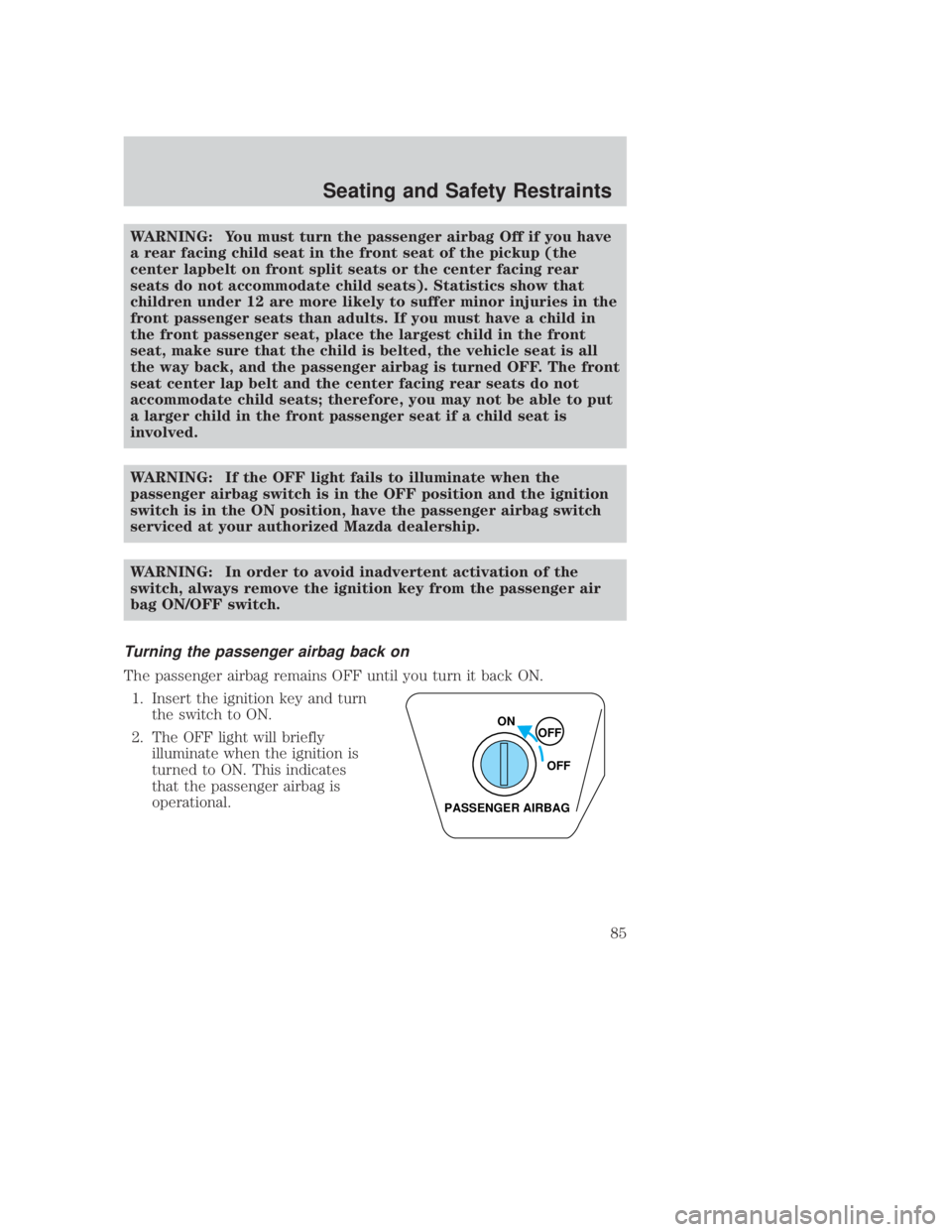
The passenger airbag remains OFF until you turn it back ON.1. Insert the ignition key and turn the switch to ON.
2. The OFF light will briefly illuminate when the ignition is
turned to ON. This indicates
that the passenger airbag is
operational.
ON OFF
OFF
PASSENGER AIRBAG
art=ranss500_a
REVIEW COPY ÐÐ2006 B-Series (mbs), Owners Guide (post-2002-fmt) (own2002),Market:USA(fus)
PAGE: 85OP: root EDIT SESSION: 1DATE: SEPT 15 2005 at 8:21JOB:@ibm2/ford_pdm/CLS_ford/GRP_own2002/JOB_mbs/DIV_og
Seating and Safety Restraints
85
Page 86 of 266
JOBNAME: No Job Name PAGE: 86 SESS: 1 OUTPUT: Thu Sep 15 08:22:27 2005
/ford_pdm/ford/own2002/mbs/og
WARNING: If the light is illuminated when the passenger
airbag ON/OFF switch is in the ON position and the ignition
switch is ON, have the passenger airbag ON/OFF switch serviced
at your authorized Mazda dealership immediately.
The passenger side airbag should always be ON (the airbag OFF light
should notbe illuminated) except for certain vulnerable persons. See
guidance on following pages.
WARNING: The safety belts for the driver and right front
passenger seating positions have been specifically designed to
function together with the airbags in certain types of crashes.
When you turn OFF your airbag, you not only lose the
protection of the airbag, you also may reduce the effectiveness
of your safety belt system, which was designed to work with the
airbag. Most vehicles with full back seats do not have cut-off
switches, but NHTSA and Transport Canada will allow a cut-off
switch to be installed on request for a certain category of
persons who must ride up front and there is a concern about
riding there. Please see the guidance below.
WARNING: Always use safety belts and child restraints
properly. If a child in a rear facing infant seat must be
transported in front, the passenger airbag mustbe turned OFF.
This is because the back of the infant seat is too close to the
inflating airbag and the risk of a fatal injury to the infant when
the airbag inflates is substantial.
The vast majority of drivers and passengers over the age of 12 years are
much safer with an airbag than without. To do their job and reduce the
risk of life threatening injuries, airbags must open with great force, and
this force can pose a potentially deadly risk in some situations,
particularly when a front seat occupant is not properly buckled up. The
most effective way to reduce the risk of unnecessary airbag injuries
without reducing the overall safety of the vehicle is to make sure all
occupants are properly restrained in the vehicle, especially in the front
seat. This provides the protection of safety belts and permits the airbags
to provide the additional protection they were designed to provide. If
you choose to deactivate your airbag, you are losing the very significant
risk reducing benefits of the airbag and you are also reducing the
REVIEW COPY ÐÐ 2006 B-Series (mbs), Owners Guide (post-2002-fmt) (own2002),Market:USA(fus)
PAGE: 86OP: root EDIT SESSION: 1DATE: SEPT 15 2005 at 8:21JOB:@ibm2/ford_pdm/CLS_ford/GRP_own2002/JOB_mbs/DIV_og
Seating and Safety Restraints
86
Page 108 of 266
JOBNAME: No Job Name PAGE: 108 SESS: 1 OUTPUT: Thu Sep 15 08:22:27 2005
/ford_pdm/ford/own2002/mbs/og
and one-half (1 1/2) times as well on the government course as a tire
graded 100. The relative performance of tires depends upon the actual
conditions of their use, however, and may depart significantly from the
norm due to variations in driving habits, service practices, and
differences in road characteristics and climate.
Traction AA A B C
The traction grades, from highest to lowest are AA, A, B, and C. The
grades represent the tire's ability to stop on wet pavement as measured
under controlled conditions on specified government test surfaces of
asphalt and concrete. A tire marked C may have poor traction
performance.
NOTE:The traction grade assigned to this tire is based on
straight-ahead braking traction tests, and does not include acceleration,
cornering, hydroplaning or peak traction characteristics.
Temperature A B C
The temperature grades are A (the highest), B, and C, representing the
tire's resistance to the generation of heat and its ability to dissipate heat
when tested under controlled conditions on a specified indoor laboratory
test wheel. Sustained high temperature can cause the material of the tire
to degenerate and reduce tire life, and excessive temperature can lead to
sudden tire failure. The grade C corresponds to a level of performance
which all passenger car tires must meet under the Federal Motor Vehicle
Safety Standard No. 109. Grades B and A represent higher levels of
performance on the laboratory test wheel than the minimum required by
law.
WARNING: The temperature grade for this tire is established
for a tire that is properly inflated and not overloaded.
Excessive speed, underinflation, or excessive loading, either
separately or in combination, can cause heat buildup and
possible tire failure.
TIRES
Tires are designed to give many thousands of miles of service, but they
must be maintained in order to get the maximum benefit from them.
Glossary of tire terminology
² Tire label: A label showing the OE (Original Equipment) tire sizes,
recommended inflation pressure and the maximum weight the vehicle
can carry.
CIMS #599890
com_traction_a-b-c.j14 itdseq=137
CIMS #600046
com_temp_a-b-c.j14 itdseq=138
CIMS #1272072
com_tire-intro itdseq=139
CIMS #1272100
com_glossary-of-tire-terms itdseq=140
REVIEW COPY ÐÐ
2006 B-Series (mbs), Owners Guide (post-2002-fmt) (own2002),Market:USA(fus)
PAGE: 108OP:root EDIT SESSION: 1DATE: SEPT 15 2005 at 8:21JOB:@ibm2/ford_pdm/CLS_ford/GRP_own2002/JOB_mbs/DIV_og
Tires, Wheels and Loading
108
Page 110 of 266
JOBNAME: No Job Name PAGE: 110 SESS: 1 OUTPUT: Thu Sep 15 08:22:27 2005
/ford_pdm/ford/own2002/mbs/og
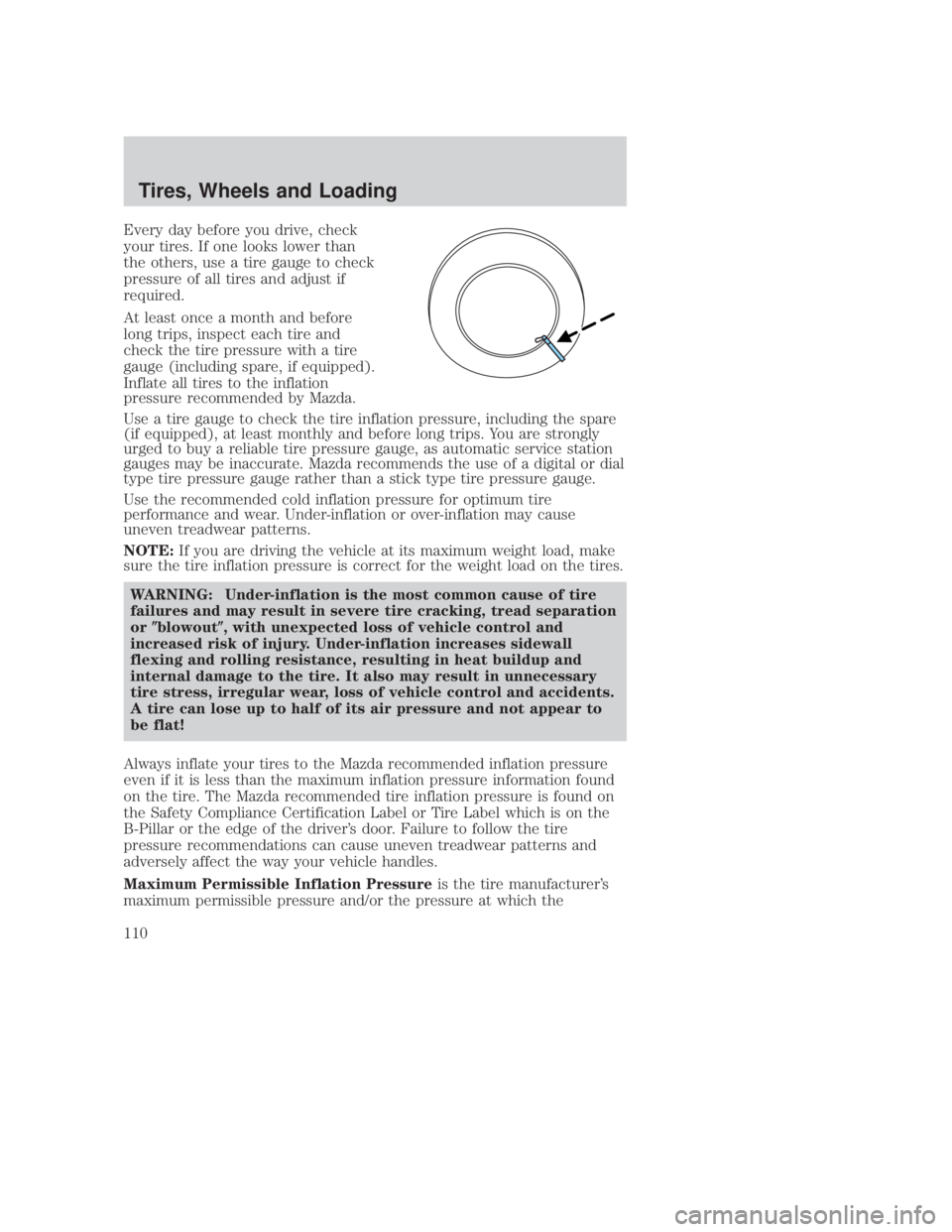
Every day before you drive, check
your tires. If one looks lower than
the others, use a tire gauge to check
pressure of all tires and adjust if
required.
At least once a month and before
long trips, inspect each tire and
check the tire pressure with a tire
gauge (including spare, if equipped).
Inflate all tires to the inflation
pressure recommended by Mazda.
Use a tire gauge to check the tire inflation pressure, including the spare
(if equipped), at least monthly and before long trips. You are strongly
urged to buy a reliable tire pressure gauge, as automatic service station
gauges may be inaccurate. Mazda recommends the use of a digital or dial
type tire pressure gauge rather than a stick type tire pressure gauge.
Use the recommended cold inflation pressure for optimum tire
performance and wear. Under-inflation or over-inflation may cause
uneven treadwear patterns.
NOTE:If you are driving the vehicle at its maximum weight load, make
sure the tire inflation pressure is correct for the weight load on the tires.
WARNING: Under-inflation is the most common cause of tire
failures and may result in severe tire cracking, tread separation
or (blowout(, with unexpected loss of vehicle control and
increased risk of injury. Under-inflation increases sidewall
flexing and rolling resistance, resulting in heat buildup and
internal damage to the tire. It also may result in unnecessary
tire stress, irregular wear, loss of vehicle control and accidents.
A tire can lose up to half of its air pressure and not appear to
be flat!
Always inflate your tires to the Mazda recommended inflation pressure
even if it is less than the maximum inflation pressure information found
on the tire. The Mazda recommended tire inflation pressure is found on
the Safety Compliance Certification Label or Tire Label which is on the
B-Pillar or the edge of the driver's door. Failure to follow the tire
pressure recommendations can cause uneven treadwear patterns and
adversely affect the way your vehicle handles.
Maximum Permissible Inflation Pressure is the tire manufacturer's
maximum permissible pressure and/or the pressure at which the
CIMS #1302691
com_tire-inflate-mazda itdseq=142
art=ecomc021_b
REVIEW COPY ÐÐ
2006 B-Series (mbs), Owners Guide (post-2002-fmt) (own2002),Market:USA(fus)
PAGE: 11 0OP:root EDIT SESSION: 1DATE: SEPT 15 2005 at 8:22JOB:@ibm2/ford_pdm/CLS_ford/GRP_own2002/JOB_mbs/DIV_og
Tires, Wheels and Loading
110
Page 113 of 266
JOBNAME: No Job Name PAGE: 113 SESS: 1 OUTPUT: Thu Sep 15 08:22:27 2005
/ford_pdm/ford/own2002/mbs/og
have the tire inspected by a tire professional. Tires can be damaged
during off-road use, so inspection after off-road use is also
recommended.WARNING: Age
Tires degrade over time, even when they are not being used. It
is recommended that tires generally be replaced after 6 years of
normal service. Heat caused by hot climates or frequent high
loading conditions can accelerate the aging process.
You should replace the spare tire when you replace the other
road tires due to the aging of the spare tire.
U.S. DOT Tire Identification Number (TIN)
Both U.S. and Canada Federal regulations require tire manufacturers to
place standardized information on the sidewall of all tires. This
information identifies and describes the fundamental characteristics of
the tire and also provides a U.S. DOT Tire Identification Number for
safety standard certification and in case of a recall.
This begins with the letters ªDOTº and indicates that the tire meets all
federal standards. The next two numbers or letters are the plant code
designating where it was manufactured, the next two are the tire size
code and the last four numbers represent the week and year the tire was
built. For example, the numbers 317 mean the 31st week of 1997. After
2000 the numbers go to four digits. For example, 2501 means the 25th
week of 2001. The numbers in between are identification codes used for
traceability. This information is used to contact customers if a tire defect
requires a recall.
Tire Replacement Requirements
Your vehicle is equipped with tires designed to provide a safe ride and
handling capability.
CIMS #1512512 com_tire-age itdseq=147
CIMS #1519956 com_usdot itdseq=148
CIMS #1348871
com_tire-replace-req itdseq=149
REVIEW COPY ÐÐ
2006 B-Series (mbs), Owners Guide (post-2002-fmt) (own2002),Market:USA(fus)
PAGE: 11 3OP:root EDIT SESSION: 1DATE: SEPT 15 2005 at 8:22JOB:@ibm2/ford_pdm/CLS_ford/GRP_own2002/JOB_mbs/DIV_og
Tires, Wheels and Loading
113
Page 118 of 266
JOBNAME: No Job Name PAGE: 118 SESS: 1 OUTPUT: Thu Sep 15 08:22:27 2005
/ford_pdm/ford/own2002/mbs/og
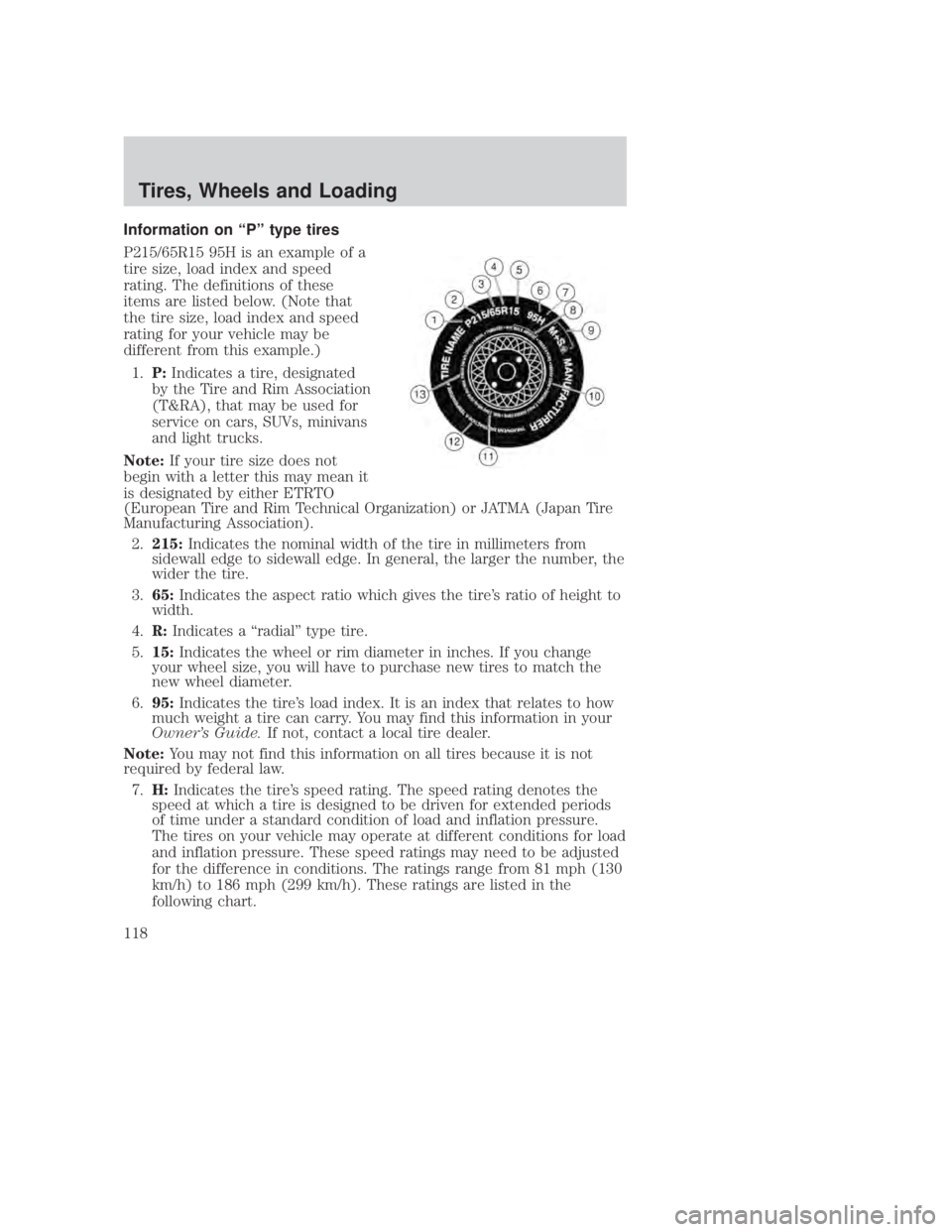
Information on ªPº type tires
P215/65R15 95H is an example of a
tire size, load index and speed
rating. The definitions of these
items are listed below. (Note that
the tire size, load index and speed
rating for your vehicle may be
different from this example.)1. P:Indicates a tire, designated
by the Tire and Rim Association
(T&RA), that may be used for
service on cars, SUVs, minivans
and light trucks.
Note: If your tire size does not
begin with a letter this may mean it
is designated by either ETRTO
(European Tire and Rim Technical Organization) or JATMA (Japan Tire
Manufacturing Association).
2. 215: Indicates the nominal width of the tire in millimeters from
sidewall edge to sidewall edge. In general, the larger the number, the
wider the tire.
3. 65: Indicates the aspect ratio which gives the tire's ratio of height to
width.
4. R: Indicates a ªradialº type tire.
5. 15: Indicates the wheel or rim diameter in inches. If you change
your wheel size, you will have to purchase new tires to match the
new wheel diameter.
6. 95: Indicates the tire's load index. It is an index that relates to how
much weight a tire can carry. You may find this information in your
Owner's Guide. If not, contact a local tire dealer.
Note: You may not find this information on all tires because it is not
required by federal law.
7. H: Indicates the tire's speed rating. The speed rating denotes the
speed at which a tire is designed to be driven for extended periods
of time under a standard condition of load and inflation pressure.
The tires on your vehicle may operate at different conditions for load
and inflation pressure. These speed ratings may need to be adjusted
for the difference in conditions. The ratings range from 81 mph (130
km/h) to 186 mph (299 km/h). These ratings are listed in the
following chart.CIMS #1272097
com_pass-tire-information itdseq=154
art=f23mc119_a
REVIEW COPY ÐÐ
2006 B-Series (mbs), Owners Guide (post-2002-fmt) (own2002),Market:USA(fus)
PAGE: 11 8OP:root EDIT SESSION: 1DATE: SEPT 15 2005 at 8:22JOB:@ibm2/ford_pdm/CLS_ford/GRP_own2002/JOB_mbs/DIV_og
Tires, Wheels and Loading
118
Page 121 of 266
JOBNAME: No Job Name PAGE: 121 SESS: 1 OUTPUT: Thu Sep 15 08:22:27 2005
/ford_pdm/ford/own2002/mbs/og
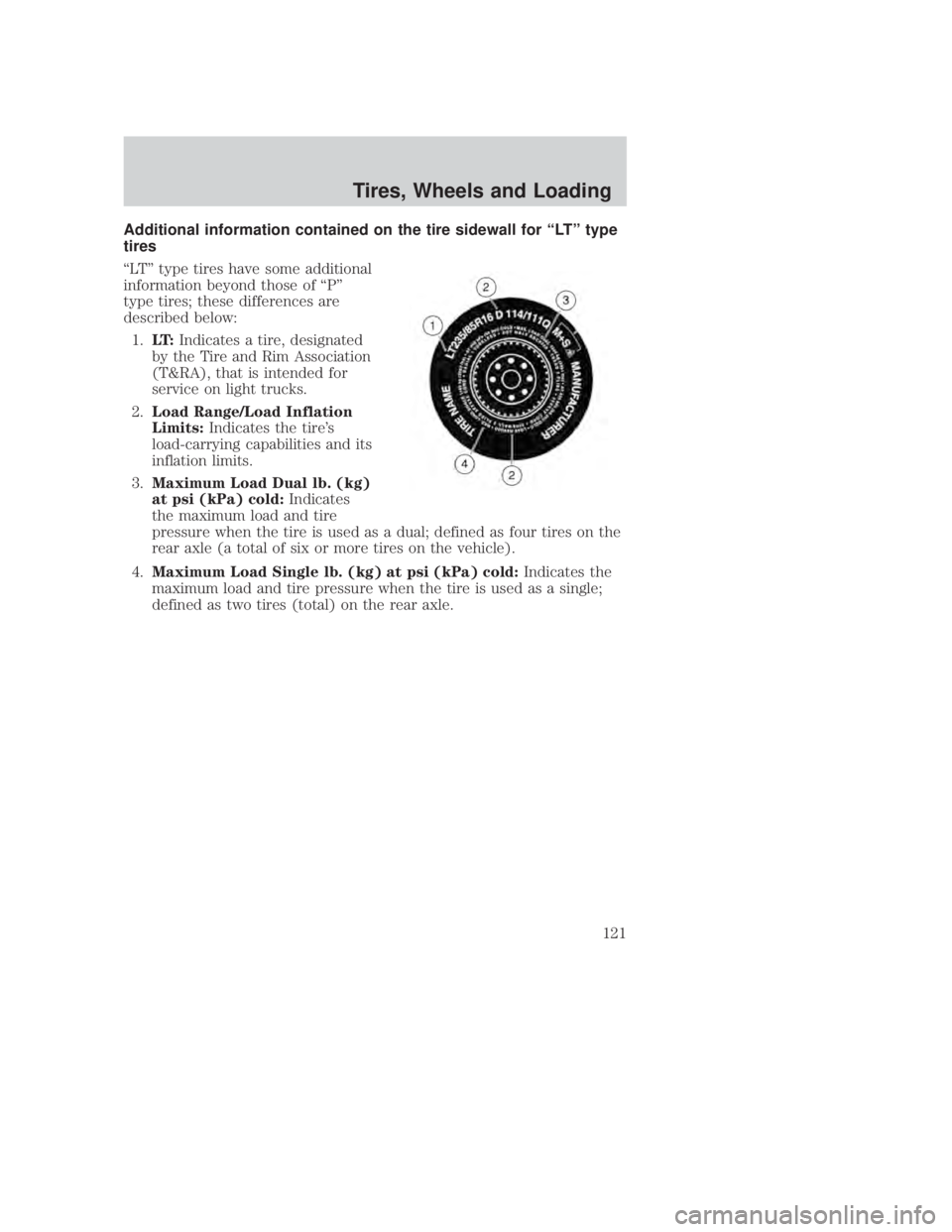
Additional information contained on the tire sidewall for ªLTº type
tires
ªLTº type tires have some additional
information beyond those of ªPº
type tires; these differences are
described below:1. LT: Indicates a tire, designated
by the Tire and Rim Association
(T&RA), that is intended for
service on light trucks.
2. Load Range/Load Inflation
Limits: Indicates the tire's
load-carrying capabilities and its
inflation limits.
3. Maximum Load Dual lb. (kg)
at psi (kPa) cold: Indicates
the maximum load and tire
pressure when the tire is used as a dual; defined as four tires on the
rear axle (a total of six or more tires on the vehicle).
4. Maximum Load Single lb. (kg) at psi (kPa) cold: Indicates the
maximum load and tire pressure when the tire is used as a single;
defined as two tires (total) on the rear axle.CIMS #1272098
com_lt-tire-information itdseq=155
art=f23mc120_b
REVIEW COPY ÐÐ
2006 B-Series (mbs), Owners Guide (post-2002-fmt) (own2002),Market:USA(fus)
PAGE: 121OP:root EDIT SESSION: 1DATE: SEPT 15 2005 at 8:22JOB:@ibm2/ford_pdm/CLS_ford/GRP_own2002/JOB_mbs/DIV_og
Tires, Wheels and Loading
121
Page 122 of 266
JOBNAME: No Job Name PAGE: 122 SESS: 1 OUTPUT: Thu Sep 15 08:22:27 2005
/ford_pdm/ford/own2002/mbs/og
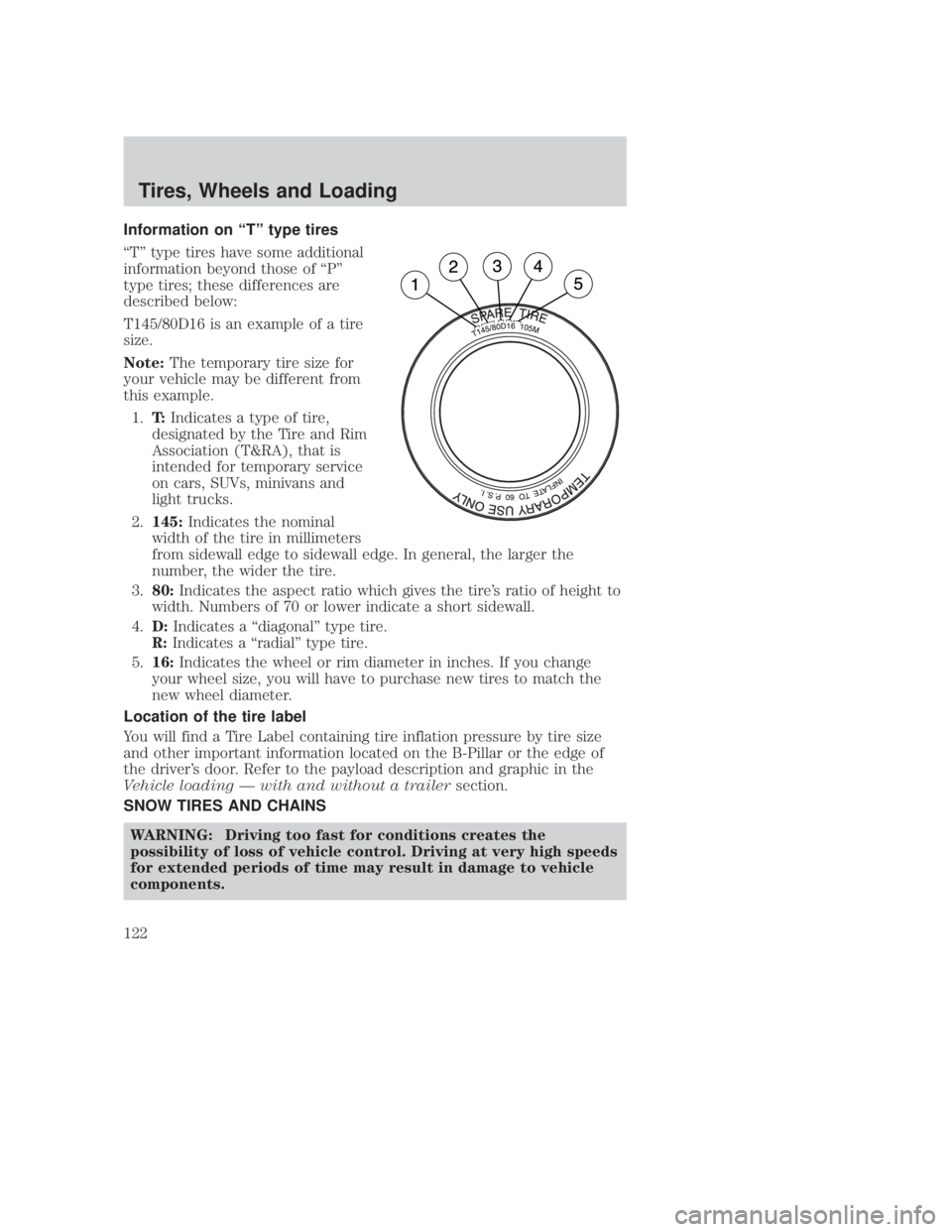
Information on ªTº type tires
ªTº type tires have some additional
information beyond those of ªPº
type tires; these differences are
described below:
T145/80D16 is an example of a tire
size.
Note:The temporary tire size for
your vehicle may be different from
this example.
1. T:Indicates a type of tire,
designated by the Tire and Rim
Association (T&RA), that is
intended for temporary service
on cars, SUVs, minivans and
light trucks.
2. 145: Indicates the nominal
width of the tire in millimeters
from sidewall edge to sidewall edge. In general, the larger the
number, the wider the tire.
3. 80: Indicates the aspect ratio which gives the tire's ratio of height to
width. Numbers of 70 or lower indicate a short sidewall.
4. D: Indicates a ªdiagonalº type tire.
R: Indicates a ªradialº type tire.
5. 16: Indicates the wheel or rim diameter in inches. If you change
your wheel size, you will have to purchase new tires to match the
new wheel diameter.
Location of the tire label
You will find a Tire Label containing tire inflation pressure by tire size
and other important information located on the B-Pillar or the edge of
the driver's door. Refer to the payload description and graphic in the
Vehicle loading Ð with and without a trailer section.
SNOW TIRES AND CHAINS
WARNING: Driving too fast for conditions creates the
possibility of loss of vehicle control. Driving at very high speeds
for extended periods of time may result in damage to vehicle
components.CIMS #1280261
com_t-tire-information itdseq=156
CIMS #1450451
com_placard-loc-ref itdseq=157
CIMS #684807
com_snow_tires_chains.mbs itdseq=158
art=f23mc123_b
REVIEW COPY ÐÐ
2006 B-Series (mbs), Owners Guide (post-2002-fmt) (own2002),Market:USA(fus)
PAGE: 122OP:root EDIT SESSION: 1DATE: SEPT 15 2005 at 8:22JOB:@ibm2/ford_pdm/CLS_ford/GRP_own2002/JOB_mbs/DIV_og
Tires, Wheels and Loading
122
Page 138 of 266
JOBNAME: No Job Name PAGE: 138 SESS: 1 OUTPUT: Thu Sep 15 08:22:27 2005
/ford_pdm/ford/own2002/mbs/og
Servicing after towing
If you tow a trailer for long distances, your vehicle will require more
frequent service intervals. Refer to yourservice maintenance section
for more information.
Trailer towing tips
² Practice turning, stopping and backing up before starting on a trip to
get the feel of the vehicle trailer combination. When turning, make
wider turns so the trailer wheels will clear curbs and other obstacles.
² Allow more distance for stopping with a trailer attached.
² The trailer tongue weight should be 10±15% of the loaded trailer
weight.
² If you will be towing a trailer frequently in hot weather, hilly
conditions, at GCW, or any combination of these factors, consider
refilling your rear axle with synthetic gear lube if not already so
equipped. Refer to the Maintenance and specifications chapter for
the lubricant specification. Remember that regardless of the rear axle
lube used, do not tow a trailer for the first 500 miles (800 km) of a
new vehicle, and that the first 500 miles (800 km) of towing be done
at no faster than 70 mph (112 km/h) with no full throttle starts.
² After you have traveled 50 miles (80 km), thoroughly check your
hitch, electrical connections and trailer wheel lug nuts.
² To aid in engine/transmission cooling and A/C efficiency during hot
weather while stopped in traffic, place the gearshift lever in P (Park)
(automatic transmission) or N (Neutral) (manual transmissions).
² Vehicles with trailers should not be parked on a grade. If you must
park on a grade, place wheel chocks under the trailer's wheels.
Launching or retrieving a boat
Disconnect the wiring to the trailer before backing the trailer
into the water. Reconnect the wiring to the trailer after the
trailer is removed from the water.
When backing down a ramp during boat launching or retrieval:
² do not allow the static water level to rise above the bottom edge of
the rear bumper.
² do not allow waves to break higher than 6 inches (15 cm) above the
bottom edge of the rear bumper.
Exceeding these limits may allow water to enter vehicle components:
CIMS #83488
com_towing-tips.02 itdseq=171
CIMS #81391
com_launch-retrieving_boat.1 itdseq=172
REVIEW COPY ÐÐ
2006 B-Series (mbs), Owners Guide (post-2002-fmt) (own2002),Market:USA(fus)
PAGE: 138OP:root EDIT SESSION: 1DATE: SEPT 15 2005 at 8:22JOB:@ibm2/ford_pdm/CLS_ford/GRP_own2002/JOB_mbs/DIV_og
Tires, Wheels and Loading
138
Page 146 of 266
JOBNAME: No Job Name PAGE: 146 SESS: 1 OUTPUT: Thu Sep 15 08:22:27 2005
/ford_pdm/ford/own2002/mbs/og
has continuous vibration or shudder in the steering wheel while braking,
the vehicle should be inspected by an authorized dealer.
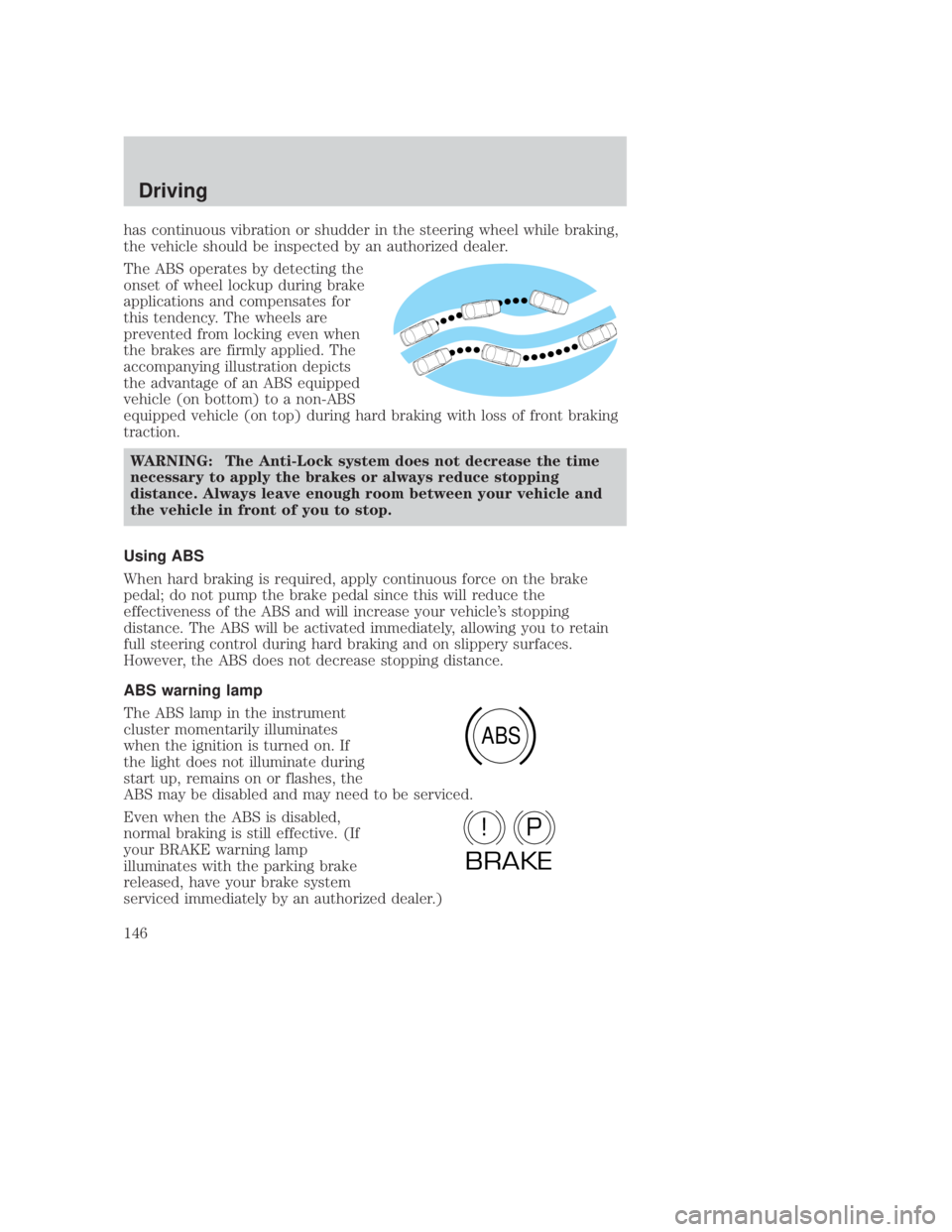
The ABS operates by detecting the
onset of wheel lockup during brake
applications and compensates for
this tendency. The wheels are
prevented from locking even when
the brakes are firmly applied. The
accompanying illustration depicts
the advantage of an ABS equipped
vehicle (on bottom) to a non-ABS
equipped vehicle (on top) during hard braking with loss of front braking
traction.WARNING: The Anti-Lock system does not decrease the time
necessary to apply the brakes or always reduce stopping
distance. Always leave enough room between your vehicle and
the vehicle in front of you to stop.
Using ABS
When hard braking is required, apply continuous force on the brake
pedal; do not pump the brake pedal since this will reduce the
effectiveness of the ABS and will increase your vehicle's stopping
distance. The ABS will be activated immediately, allowing you to retain
full steering control during hard braking and on slippery surfaces.
However, the ABS does not decrease stopping distance.
ABS warning lamp
The ABS lamp in the instrument
cluster momentarily illuminates
when the ignition is turned on. If
the light does not illuminate during
start up, remains on or flashes, the
ABS may be disabled and may need to be serviced.
Even when the ABS is disabled,
normal braking is still effective. (If
your BRAKE warning lamp
illuminates with the parking brake
released, have your brake system
serviced immediately by an authorized dealer.)
ABS
P!
BRAKE
CIMS #954499
com_abs_use.fly itdseq=186
CIMS #954498
com_abs_warn.fly itdseq=187
art=comss004_a
art=dnogf001_a
art=dnogf004_a
REVIEW COPY ÐÐ
2006 B-Series (mbs), Owners Guide (post-2002-fmt) (own2002),Market:USA(fus)
PAGE: 146OP:root EDIT SESSION: 1DATE: SEPT 15 2005 at 8:22JOB:@ibm2/ford_pdm/CLS_ford/GRP_own2002/JOB_mbs/DIV_og
Driving
146