warning MAZDA MODEL B3000 TRUCK 2006 Repair Manual
[x] Cancel search | Manufacturer: MAZDA, Model Year: 2006, Model line: MODEL B3000 TRUCK, Model: MAZDA MODEL B3000 TRUCK 2006Pages: 266, PDF Size: 2.11 MB
Page 106 of 266
JOBNAME: No Job Name PAGE: 106 SESS: 1 OUTPUT: Thu Sep 15 08:22:27 2005
/ford_pdm/ford/own2002/mbs/og
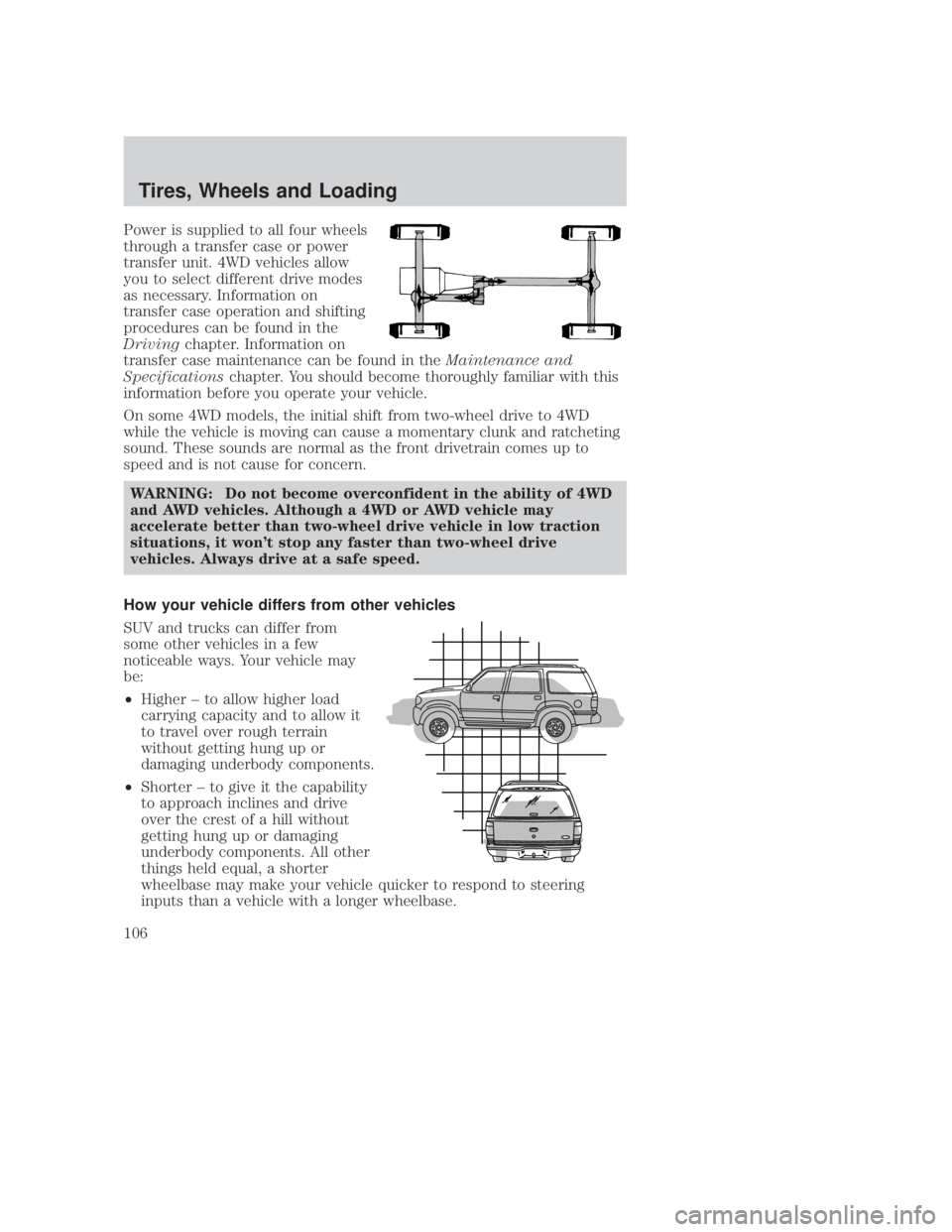
Power is supplied to all four wheels
through a transfer case or power
transfer unit. 4WD vehicles allow
you to select different drive modes
as necessary. Information on
transfer case operation and shifting
procedures can be found in the
Drivingchapter. Information on
transfer case maintenance can be found in the Maintenance and
Specifications chapter. You should become thoroughly familiar with this
information before you operate your vehicle.
On some 4WD models, the initial shift from two-wheel drive to 4WD
while the vehicle is moving can cause a momentary clunk and ratcheting
sound. These sounds are normal as the front drivetrain comes up to
speed and is not cause for concern.
WARNING: Do not become overconfident in the ability of 4WD
and AWD vehicles. Although a 4WD or AWD vehicle may
accelerate better than two-wheel drive vehicle in low traction
situations, it won't stop any faster than two-wheel drive
vehicles. Always drive at a safe speed.
How your vehicle differs from other vehicles
SUV and trucks can differ from
some other vehicles in a few
noticeable ways. Your vehicle may
be:
² Higher ± to allow higher load
carrying capacity and to allow it
to travel over rough terrain
without getting hung up or
damaging underbody components.
² Shorter ± to give it the capability
to approach inclines and drive
over the crest of a hill without
getting hung up or damaging
underbody components. All other
things held equal, a shorter
wheelbase may make your vehicle quicker to respond to steering
inputs than a vehicle with a longer wheelbase.
CIMS #1434026
com_veh-dr-differs
itdseq=134
art=supfw001_a
art=supfw010_a
REVIEW COPY ÐÐ
2006 B-Series (mbs), Owners Guide (post-2002-fmt) (own2002),Market:USA(fus)
PAGE: 106OP:root EDIT SESSION: 1DATE: SEPT 15 2005 at 8:21JOB:@ibm2/ford_pdm/CLS_ford/GRP_own2002/JOB_mbs/DIV_og
Tires, Wheels and Loading
106
Page 108 of 266
JOBNAME: No Job Name PAGE: 108 SESS: 1 OUTPUT: Thu Sep 15 08:22:27 2005
/ford_pdm/ford/own2002/mbs/og
and one-half (1 1/2) times as well on the government course as a tire
graded 100. The relative performance of tires depends upon the actual
conditions of their use, however, and may depart significantly from the
norm due to variations in driving habits, service practices, and
differences in road characteristics and climate.
Traction AA A B C
The traction grades, from highest to lowest are AA, A, B, and C. The
grades represent the tire's ability to stop on wet pavement as measured
under controlled conditions on specified government test surfaces of
asphalt and concrete. A tire marked C may have poor traction
performance.
NOTE:The traction grade assigned to this tire is based on
straight-ahead braking traction tests, and does not include acceleration,
cornering, hydroplaning or peak traction characteristics.
Temperature A B C
The temperature grades are A (the highest), B, and C, representing the
tire's resistance to the generation of heat and its ability to dissipate heat
when tested under controlled conditions on a specified indoor laboratory
test wheel. Sustained high temperature can cause the material of the tire
to degenerate and reduce tire life, and excessive temperature can lead to
sudden tire failure. The grade C corresponds to a level of performance
which all passenger car tires must meet under the Federal Motor Vehicle
Safety Standard No. 109. Grades B and A represent higher levels of
performance on the laboratory test wheel than the minimum required by
law.
WARNING: The temperature grade for this tire is established
for a tire that is properly inflated and not overloaded.
Excessive speed, underinflation, or excessive loading, either
separately or in combination, can cause heat buildup and
possible tire failure.
TIRES
Tires are designed to give many thousands of miles of service, but they
must be maintained in order to get the maximum benefit from them.
Glossary of tire terminology
² Tire label: A label showing the OE (Original Equipment) tire sizes,
recommended inflation pressure and the maximum weight the vehicle
can carry.
CIMS #599890
com_traction_a-b-c.j14 itdseq=137
CIMS #600046
com_temp_a-b-c.j14 itdseq=138
CIMS #1272072
com_tire-intro itdseq=139
CIMS #1272100
com_glossary-of-tire-terms itdseq=140
REVIEW COPY ÐÐ
2006 B-Series (mbs), Owners Guide (post-2002-fmt) (own2002),Market:USA(fus)
PAGE: 108OP:root EDIT SESSION: 1DATE: SEPT 15 2005 at 8:21JOB:@ibm2/ford_pdm/CLS_ford/GRP_own2002/JOB_mbs/DIV_og
Tires, Wheels and Loading
108
Page 110 of 266
JOBNAME: No Job Name PAGE: 110 SESS: 1 OUTPUT: Thu Sep 15 08:22:27 2005
/ford_pdm/ford/own2002/mbs/og
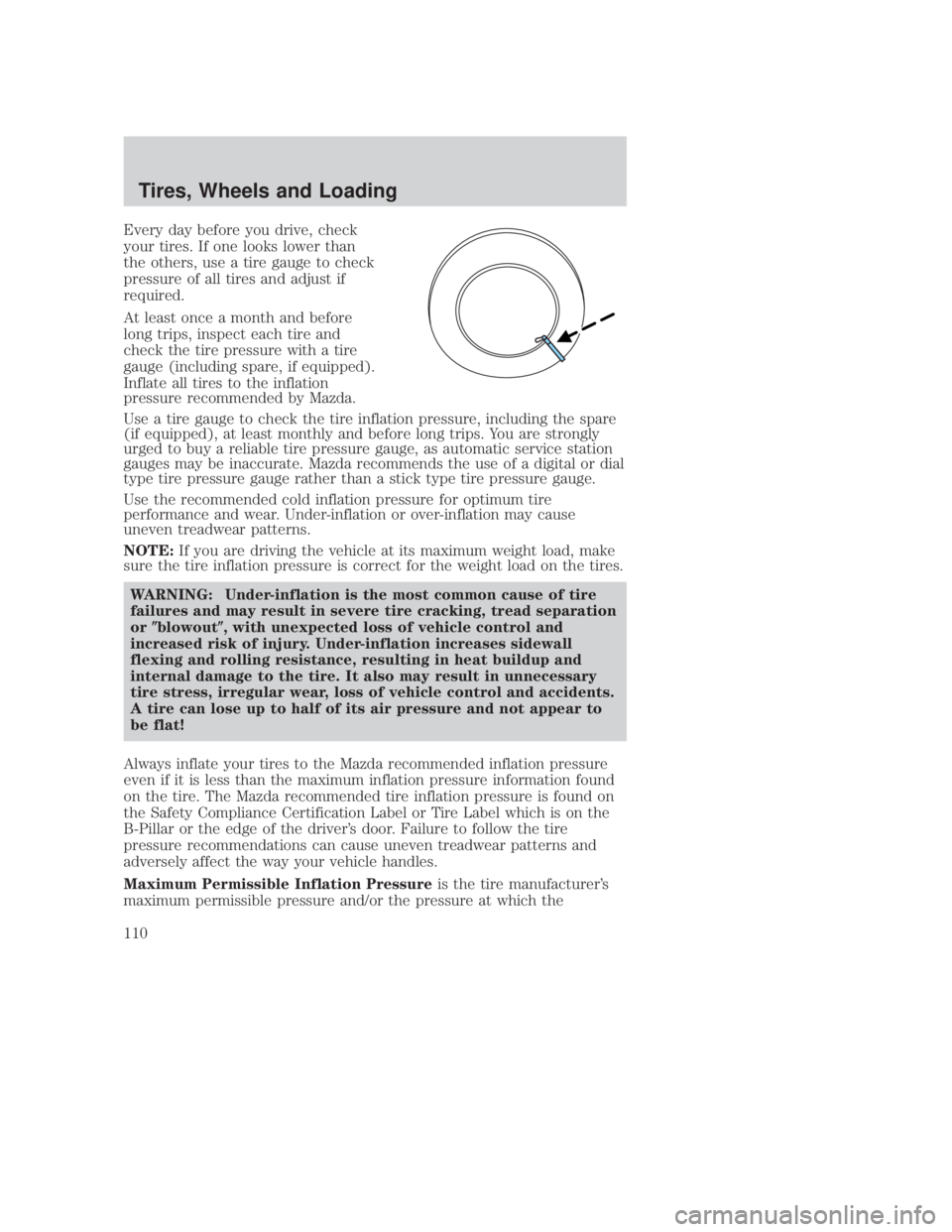
Every day before you drive, check
your tires. If one looks lower than
the others, use a tire gauge to check
pressure of all tires and adjust if
required.
At least once a month and before
long trips, inspect each tire and
check the tire pressure with a tire
gauge (including spare, if equipped).
Inflate all tires to the inflation
pressure recommended by Mazda.
Use a tire gauge to check the tire inflation pressure, including the spare
(if equipped), at least monthly and before long trips. You are strongly
urged to buy a reliable tire pressure gauge, as automatic service station
gauges may be inaccurate. Mazda recommends the use of a digital or dial
type tire pressure gauge rather than a stick type tire pressure gauge.
Use the recommended cold inflation pressure for optimum tire
performance and wear. Under-inflation or over-inflation may cause
uneven treadwear patterns.
NOTE:If you are driving the vehicle at its maximum weight load, make
sure the tire inflation pressure is correct for the weight load on the tires.
WARNING: Under-inflation is the most common cause of tire
failures and may result in severe tire cracking, tread separation
or (blowout(, with unexpected loss of vehicle control and
increased risk of injury. Under-inflation increases sidewall
flexing and rolling resistance, resulting in heat buildup and
internal damage to the tire. It also may result in unnecessary
tire stress, irregular wear, loss of vehicle control and accidents.
A tire can lose up to half of its air pressure and not appear to
be flat!
Always inflate your tires to the Mazda recommended inflation pressure
even if it is less than the maximum inflation pressure information found
on the tire. The Mazda recommended tire inflation pressure is found on
the Safety Compliance Certification Label or Tire Label which is on the
B-Pillar or the edge of the driver's door. Failure to follow the tire
pressure recommendations can cause uneven treadwear patterns and
adversely affect the way your vehicle handles.
Maximum Permissible Inflation Pressure is the tire manufacturer's
maximum permissible pressure and/or the pressure at which the
CIMS #1302691
com_tire-inflate-mazda itdseq=142
art=ecomc021_b
REVIEW COPY ÐÐ
2006 B-Series (mbs), Owners Guide (post-2002-fmt) (own2002),Market:USA(fus)
PAGE: 11 0OP:root EDIT SESSION: 1DATE: SEPT 15 2005 at 8:22JOB:@ibm2/ford_pdm/CLS_ford/GRP_own2002/JOB_mbs/DIV_og
Tires, Wheels and Loading
110
Page 113 of 266
JOBNAME: No Job Name PAGE: 113 SESS: 1 OUTPUT: Thu Sep 15 08:22:27 2005
/ford_pdm/ford/own2002/mbs/og
have the tire inspected by a tire professional. Tires can be damaged
during off-road use, so inspection after off-road use is also
recommended.WARNING: Age
Tires degrade over time, even when they are not being used. It
is recommended that tires generally be replaced after 6 years of
normal service. Heat caused by hot climates or frequent high
loading conditions can accelerate the aging process.
You should replace the spare tire when you replace the other
road tires due to the aging of the spare tire.
U.S. DOT Tire Identification Number (TIN)
Both U.S. and Canada Federal regulations require tire manufacturers to
place standardized information on the sidewall of all tires. This
information identifies and describes the fundamental characteristics of
the tire and also provides a U.S. DOT Tire Identification Number for
safety standard certification and in case of a recall.
This begins with the letters ªDOTº and indicates that the tire meets all
federal standards. The next two numbers or letters are the plant code
designating where it was manufactured, the next two are the tire size
code and the last four numbers represent the week and year the tire was
built. For example, the numbers 317 mean the 31st week of 1997. After
2000 the numbers go to four digits. For example, 2501 means the 25th
week of 2001. The numbers in between are identification codes used for
traceability. This information is used to contact customers if a tire defect
requires a recall.
Tire Replacement Requirements
Your vehicle is equipped with tires designed to provide a safe ride and
handling capability.
CIMS #1512512 com_tire-age itdseq=147
CIMS #1519956 com_usdot itdseq=148
CIMS #1348871
com_tire-replace-req itdseq=149
REVIEW COPY ÐÐ
2006 B-Series (mbs), Owners Guide (post-2002-fmt) (own2002),Market:USA(fus)
PAGE: 11 3OP:root EDIT SESSION: 1DATE: SEPT 15 2005 at 8:22JOB:@ibm2/ford_pdm/CLS_ford/GRP_own2002/JOB_mbs/DIV_og
Tires, Wheels and Loading
113
Page 114 of 266
JOBNAME: No Job Name PAGE: 114 SESS: 1 OUTPUT: Thu Sep 15 08:22:27 2005
/ford_pdm/ford/own2002/mbs/og
WARNING: Only use replacement tires and wheels that are the
same size and type (such as P-metric versus LT-metric or
all-season versus all-terrain) as those originally provided by
Mazda. Use of any tire or wheel not recommended by Mazda can
affect the safety and performance of your vehicle, which could
result in an increased risk of loss of vehicle control, vehicle
rollover, personal injury and death. Additionally the use of
non-recommended tires and wheels could cause steering,
suspension, axle or transfer case/power transfer unit failure. If
you have questions regarding tire replacement, see an
authorized dealer.
Important: Remember to replace the wheel valve stems when the road
tires are replaced on your vehicle.
It is recommended that the two front tires or two rear tires generally be
replaced as a pair.
Safety practices
Driving habits have a great deal to do with your tire mileage and safety.
² Observe posted speed limits
² Avoid fast starts, stops and turns
² Avoid potholes and objects on the road
² Do not run over curbs or hit the tire against a curb when parking
WARNING: If your vehicle is stuck in snow, mud, sand, etc., do
not rapidly spin the tires; spinning the tires can tear the tire
and cause an explosion. A tire can explode in as little as three
to five seconds.
WARNING: Never spin the tires in excess of the 35 mph (55
km/h) point indicated on the speedometer.
Highway hazards
No matter how carefully you drive there's always the possibility that you
may eventually have a flat tire on the highway. Drive slowly to the
closest safe area out of traffic. This may further damage the flat tire, but
your safety is more important.
If you feel a sudden vibration or ride disturbance while driving, or you
suspect your tire or vehicle has been damaged, immediately reduce your
CIMS #1272513
com_tire-safety-practices itdseq=150
REVIEW COPY ÐÐ
2006 B-Series (mbs), Owners Guide (post-2002-fmt) (own2002),Market:USA(fus)
PAGE: 11 4OP:root EDIT SESSION: 1DATE: SEPT 15 2005 at 8:22JOB:@ibm2/ford_pdm/CLS_ford/GRP_own2002/JOB_mbs/DIV_og
Tires, Wheels and Loading
114
Page 120 of 266
JOBNAME: No Job Name PAGE: 120 SESS: 1 OUTPUT: Thu Sep 15 08:22:27 2005
/ford_pdm/ford/own2002/mbs/og
Compliance Certification Label, which is located on the B-Pillar or
the edge of the driver's door, for the correct tire pressure for your
vehicle.
12. Treadwear, Traction and Temperature Grades
² Treadwear: The treadwear grade is a comparative rating based on the
wear rate of the tire when tested under controlled conditions on a
specified government test course. For example, a tire graded 150
would wear one and one-half (1
1¤2) times as well on the government
course as a tire graded 100.
² Traction: The traction grades, from highest to lowest are AA, A, B,
and C. The grades represent the tire's ability to stop on wet pavement
as measured under controlled conditions on specified government test
surfaces of asphalt and concrete. A tire marked C may have poor
traction performance.
² Temperature: The temperature grades are A (the highest), B and C,
representing the tire's resistance to the generation of heat and its
ability to dissipate heat when tested under controlled conditions on a
specified indoor laboratory test wheel.
13. Maximum Permissible Inflation Pressure: Indicates the tire
manufacturers' maximum permissible pressure and/or the pressure at
which the maximum load can be carried by the tire. This pressure is
normally higher than the manufacturer's recommended cold inflation
pressure which can be found on the Safety Compliance Certification
Label or Tire Label which is located on the B-Pillar or the edge of
the driver's door. The cold inflation pressure should never be set
lower than the recommended pressure on the vehicle label.
The tire suppliers may have additional markings, notes or warnings such
as standard load, radial tubeless, etc.
REVIEW COPY ÐÐ 2006 B-Series (mbs), Owners Guide (post-2002-fmt) (own2002),Market:USA(fus)
PAGE: 120OP:root EDIT SESSION: 1DATE: SEPT 15 2005 at 8:22JOB:@ibm2/ford_pdm/CLS_ford/GRP_own2002/JOB_mbs/DIV_og
Tires, Wheels and Loading
120
Page 122 of 266
JOBNAME: No Job Name PAGE: 122 SESS: 1 OUTPUT: Thu Sep 15 08:22:27 2005
/ford_pdm/ford/own2002/mbs/og
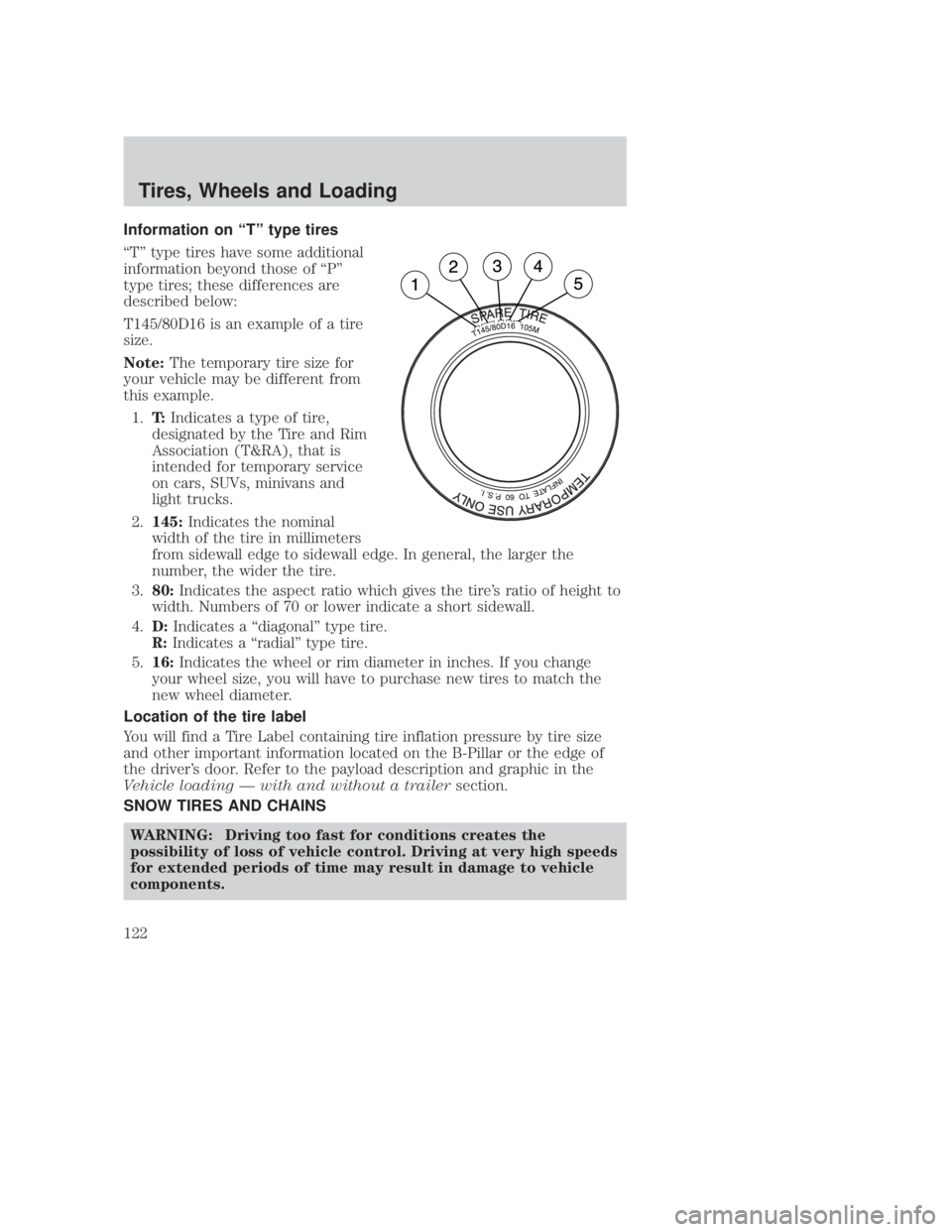
Information on ªTº type tires
ªTº type tires have some additional
information beyond those of ªPº
type tires; these differences are
described below:
T145/80D16 is an example of a tire
size.
Note:The temporary tire size for
your vehicle may be different from
this example.
1. T:Indicates a type of tire,
designated by the Tire and Rim
Association (T&RA), that is
intended for temporary service
on cars, SUVs, minivans and
light trucks.
2. 145: Indicates the nominal
width of the tire in millimeters
from sidewall edge to sidewall edge. In general, the larger the
number, the wider the tire.
3. 80: Indicates the aspect ratio which gives the tire's ratio of height to
width. Numbers of 70 or lower indicate a short sidewall.
4. D: Indicates a ªdiagonalº type tire.
R: Indicates a ªradialº type tire.
5. 16: Indicates the wheel or rim diameter in inches. If you change
your wheel size, you will have to purchase new tires to match the
new wheel diameter.
Location of the tire label
You will find a Tire Label containing tire inflation pressure by tire size
and other important information located on the B-Pillar or the edge of
the driver's door. Refer to the payload description and graphic in the
Vehicle loading Ð with and without a trailer section.
SNOW TIRES AND CHAINS
WARNING: Driving too fast for conditions creates the
possibility of loss of vehicle control. Driving at very high speeds
for extended periods of time may result in damage to vehicle
components.CIMS #1280261
com_t-tire-information itdseq=156
CIMS #1450451
com_placard-loc-ref itdseq=157
CIMS #684807
com_snow_tires_chains.mbs itdseq=158
art=f23mc123_b
REVIEW COPY ÐÐ
2006 B-Series (mbs), Owners Guide (post-2002-fmt) (own2002),Market:USA(fus)
PAGE: 122OP:root EDIT SESSION: 1DATE: SEPT 15 2005 at 8:22JOB:@ibm2/ford_pdm/CLS_ford/GRP_own2002/JOB_mbs/DIV_og
Tires, Wheels and Loading
122
Page 124 of 266
JOBNAME: No Job Name PAGE: 124 SESS: 1 OUTPUT: Thu Sep 15 08:22:27 2005
/ford_pdm/ford/own2002/mbs/og
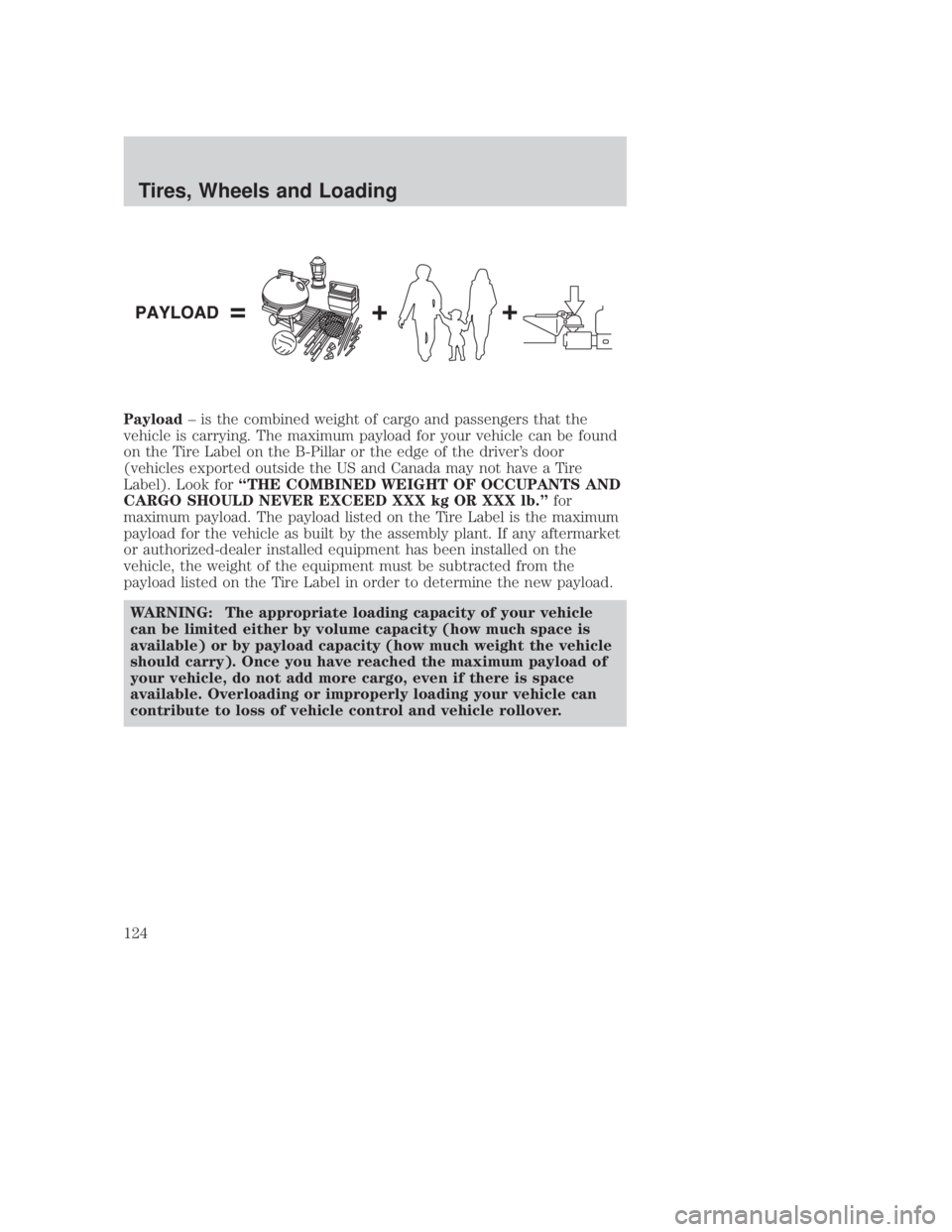
Payload± is the combined weight of cargo and passengers that the
vehicle is carrying. The maximum payload for your vehicle can be found
on the Tire Label on the B-Pillar or the edge of the driver's door
(vehicles exported outside the US and Canada may not have a Tire
Label). Look for ªTHE COMBINED WEIGHT OF OCCUPANTS AND
CARGO SHOULD NEVER EXCEED XXX kg OR XXX lb.º for
maximum payload. The payload listed on the Tire Label is the maximum
payload for the vehicle as built by the assembly plant. If any aftermarket
or authorized-dealer installed equipment has been installed on the
vehicle, the weight of the equipment must be subtracted from the
payload listed on the Tire Label in order to determine the new payload.
WARNING: The appropriate loading capacity of your vehicle
can be limited either by volume capacity (how much space is
available) or by payload capacity (how much weight the vehicle
should carry). Once you have reached the maximum payload of
your vehicle, do not add more cargo, even if there is space
available. Overloading or improperly loading your vehicle can
contribute to loss of vehicle control and vehicle rollover.
art=f23gf110_b
REVIEW COPY ÐÐ2006 B-Series (mbs), Owners Guide (post-2002-fmt) (own2002),Market:USA(fus)
PAGE: 124OP:root EDIT SESSION: 1DATE: SEPT 15 2005 at 8:22JOB:@ibm2/ford_pdm/CLS_ford/GRP_own2002/JOB_mbs/DIV_og
Tires, Wheels and Loading
124
Page 126 of 266
JOBNAME: No Job Name PAGE: 126 SESS: 1 OUTPUT: Thu Sep 15 08:22:27 2005
/ford_pdm/ford/own2002/mbs/og
GAWR (Gross Axle Weight Rating)± is the maximum allowable
weight that can be carried by a single axle (front or rear). These
numbers are shown on the Safety Compliance Certification Label
located on the B-Pillar or the edge of the driver's door. The total
load on each axle must never exceed its GAWR.
WARNING: Exceeding the Safety Compliance Certification
Label axle weight rating limits could result in substandard
vehicle handling or performance, engine, transmission and/or
structural damage, serious damage to the vehicle, loss of
control and personal injury.
Note: For trailer towing information refer to Trailer towingfound in
this chapter or the RV and Trailer Towing Guide provided by your
authorized dealer.
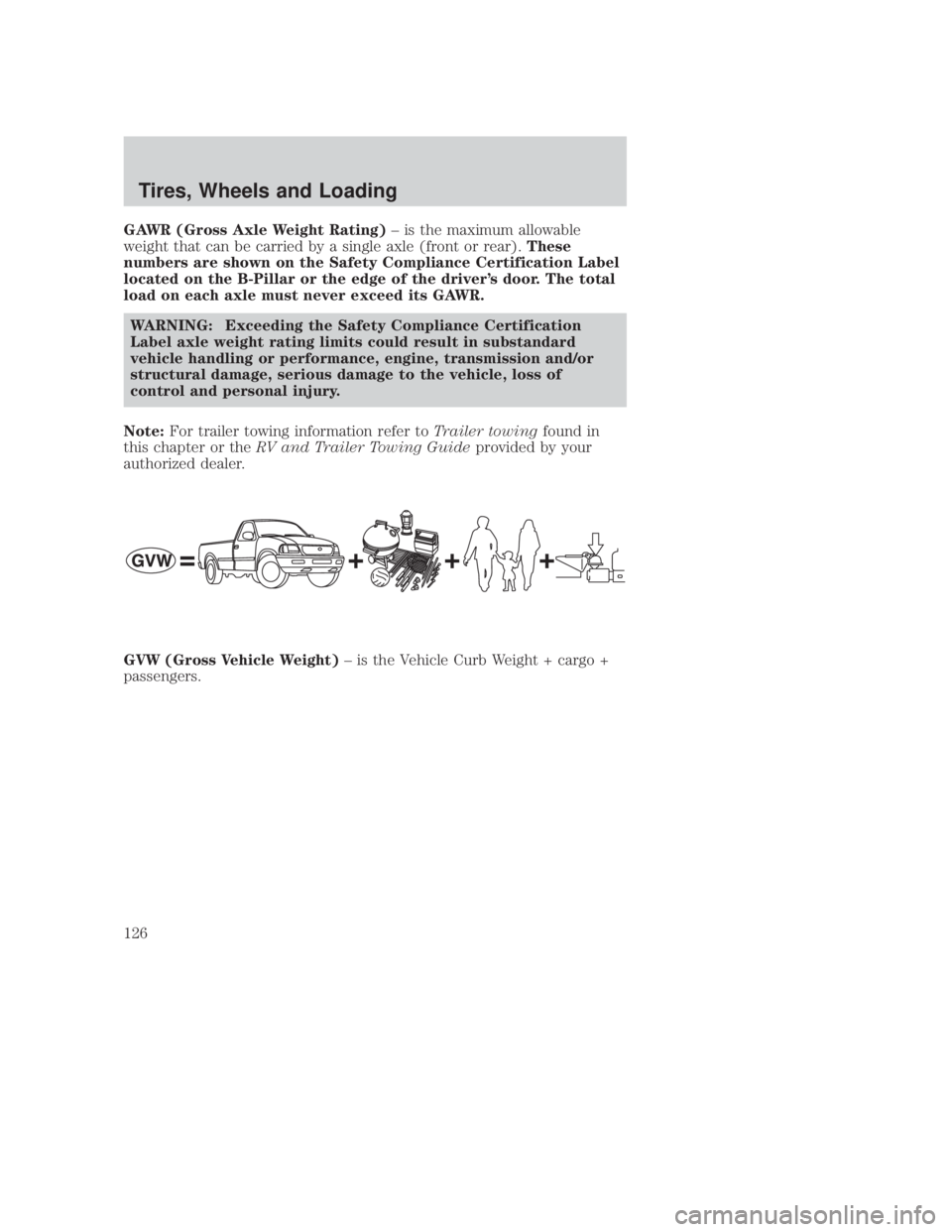
GVW (Gross Vehicle Weight) ± is the Vehicle Curb Weight + cargo +
passengers.
art=f23gf113_b
REVIEW COPY ÐÐ
2006 B-Series (mbs), Owners Guide (post-2002-fmt) (own2002),Market:USA(fus)
PAGE: 126OP:root EDIT SESSION: 1DATE: SEPT 15 2005 at 8:22JOB:@ibm2/ford_pdm/CLS_ford/GRP_own2002/JOB_mbs/DIV_og
Tires, Wheels and Loading
126
Page 127 of 266
JOBNAME: No Job Name PAGE: 127 SESS: 1 OUTPUT: Thu Sep 15 08:22:27 2005
/ford_pdm/ford/own2002/mbs/og
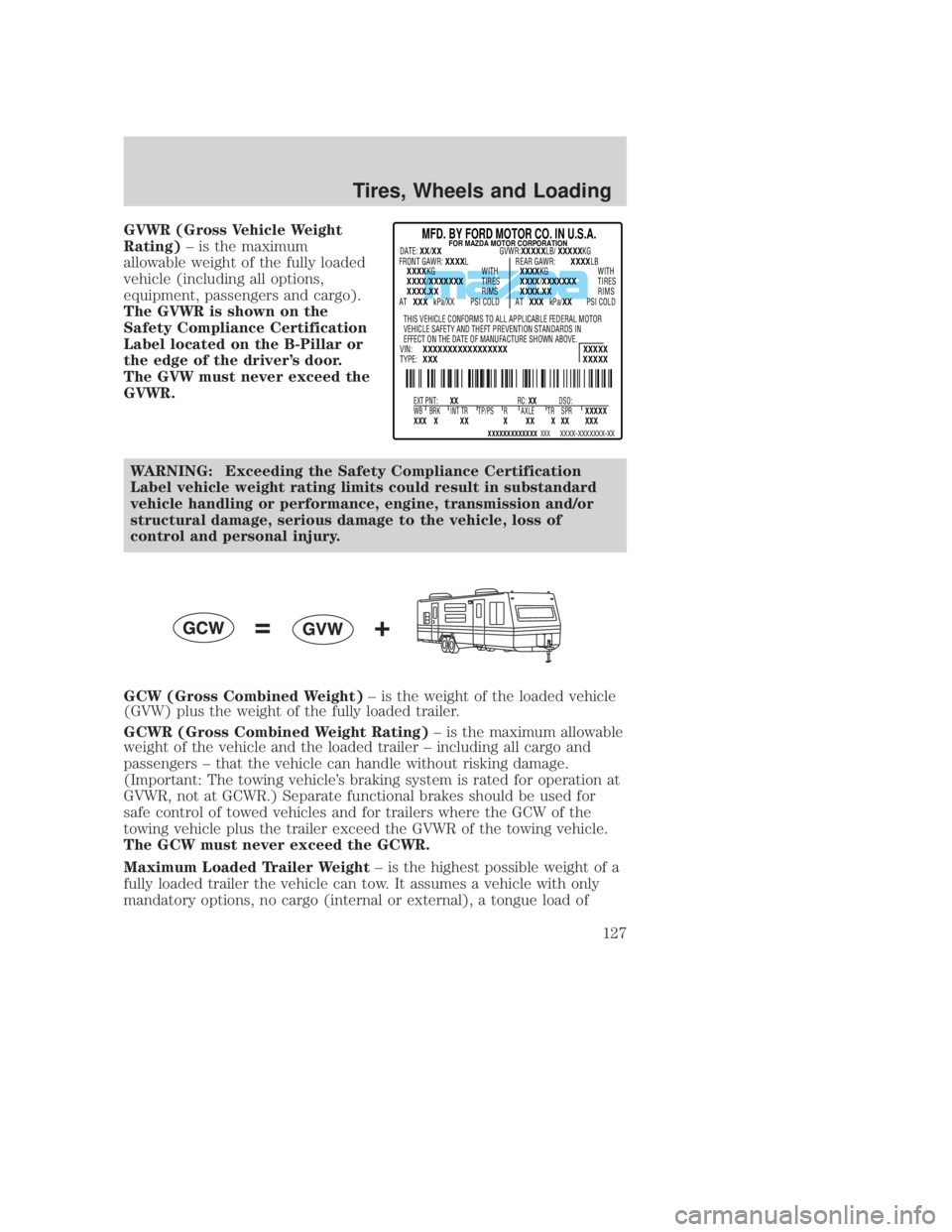
GVWR (Gross Vehicle Weight
Rating)± is the maximum
allowable weight of the fully loaded
vehicle (including all options,
equipment, passengers and cargo).
The GVWR is shown on the
Safety Compliance Certification
Label located on the B-Pillar or
the edge of the driver's door.
The GVW must never exceed the
GVWR.
WARNING: Exceeding the Safety Compliance Certification
Label vehicle weight rating limits could result in substandard
vehicle handling or performance, engine, transmission and/or
structural damage, serious damage to the vehicle, loss of
control and personal injury.
GCW (Gross Combined Weight) ± is the weight of the loaded vehicle
(GVW) plus the weight of the fully loaded trailer.
GCWR (Gross Combined Weight Rating) ± is the maximum allowable
weight of the vehicle and the loaded trailer ± including all cargo and
passengers ± that the vehicle can handle without risking damage.
(Important: The towing vehicle's braking system is rated for operation at
GVWR, not at GCWR.) Separate functional brakes should be used for
safe control of towed vehicles and for trailers where the GCW of the
towing vehicle plus the trailer exceed the GVWR of the towing vehicle.
The GCW must never exceed the GCWR.
Maximum Loaded Trailer Weight ± is the highest possible weight of a
fully loaded trailer the vehicle can tow. It assumes a vehicle with only
mandatory options, no cargo (internal or external), a tongue load ofMFD. BY FORD MOTOR CO. IN U.S.A.
EXT PNT: XX RC: XXDSO:
WB BRK INT TR TP/PS R AXLE TR SPR XXXXX
XXX X XX X XX X XX \
XXX
XXXXXXXXXXXXX XXX XXXX-XXXXXXX-XX
THIS VEHICLE CONFORMS TO ALL APPLICABLE FEDERAL MOTOR
VEHICLE SAFETY AND THEFT PREVENTION STANDARDS IN
EFFECT ON THE DATE OF MANUFACTURE SHOWN ABOVE.
VIN: XXXXXXXXXXXXXXXXX XXXXX
TYPE: XXX XXXXX
DATE: XX/XX GVWR:
XXXXXLB/ XXXXX KG
FRONT GAWR: XXXXL REAR GAWR: XXXXLB
AT XXX kPa/XX PSI COLD AT XXX kPa/XX PSI COLD
XXXXKG
WITH
XXXX/XXXXXXX TIRES
XXXX.XX RIMSXXXXKG
WITH
XXXX/XXXXXXX TIRES
XXXX.XX RIMS
FOR MAZDA MOTOR CORPORATIONart=mazmc001_a
art=f23gf115_c
REVIEW COPY ÐÐ
2006 B-Series (mbs), Owners Guide (post-2002-fmt) (own2002),Market:USA(fus)
PAGE: 127OP:root EDIT SESSION: 1DATE: SEPT 15 2005 at 8:22JOB:@ibm2/ford_pdm/CLS_ford/GRP_own2002/JOB_mbs/DIV_og
Tires, Wheels and Loading
127