engine MAZDA MODEL B3000 TRUCK 2007 Service Manual
[x] Cancel search | Manufacturer: MAZDA, Model Year: 2007, Model line: MODEL B3000 TRUCK, Model: MAZDA MODEL B3000 TRUCK 2007Pages: 280, PDF Size: 1.95 MB
Page 169 of 280
Driving on snow and ice
A 4WD vehicle has advantages over 2WD vehicles in snow and ice but
can skid like any other vehicle.
Avoid sudden applications of power and quick changes of direction on
snow and ice. Apply the accelerator slowly and steadily when starting
from a full stop.
When braking, apply the brakes as you normally would. In order to allow
the anti-lock brake system (ABS) to operate properly, keep steady
pressure on the brake pedal.
Make sure you allow sufficient distance between you and other vehicles
for stopping. Drive slower than usual and consider using one of the lower
gears.
DRIVING THROUGH WATER
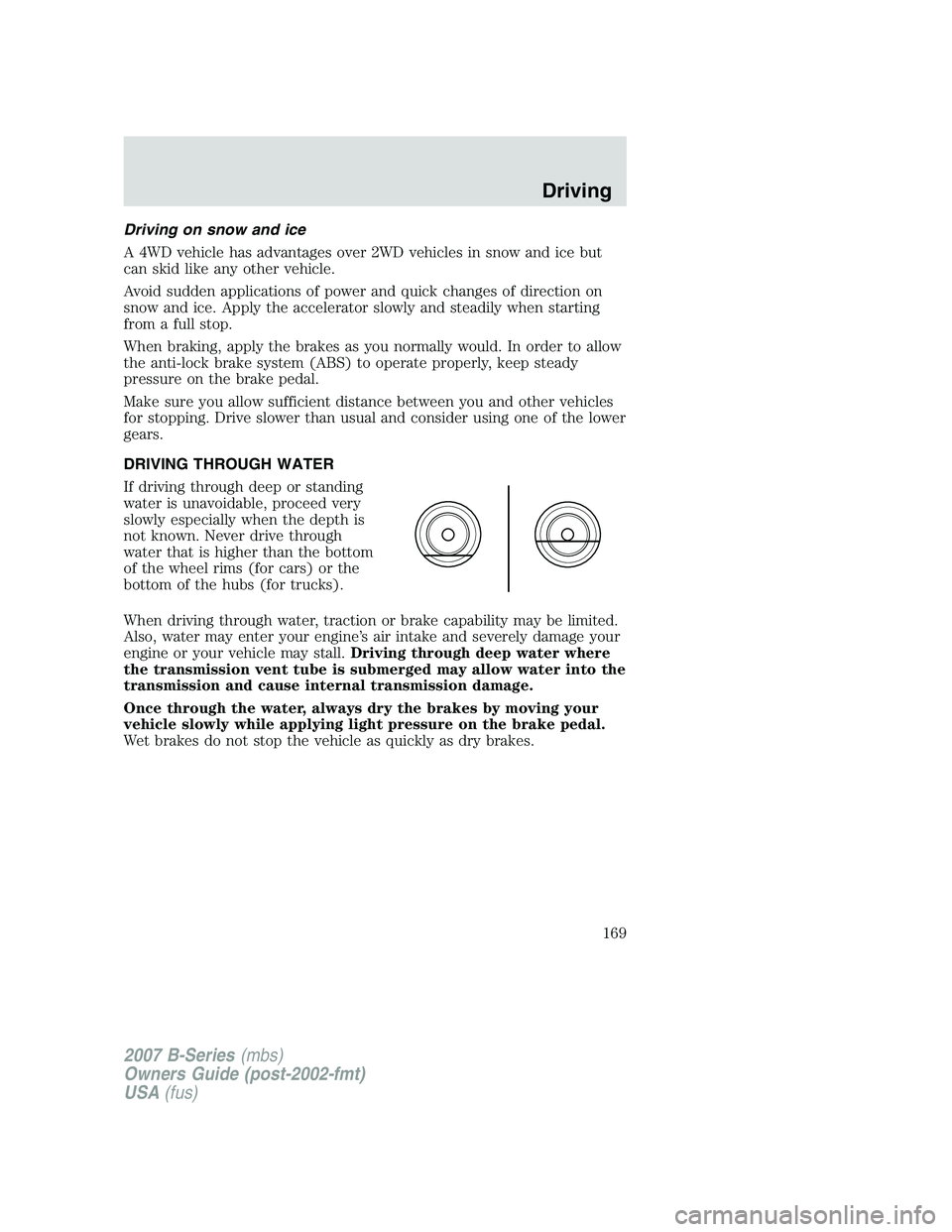
If driving through deep or standing
water is unavoidable, proceed very
slowly especially when the depth is
not known. Never drive through
water that is higher than the bottom
of the wheel rims (for cars) or the
bottom of the hubs (for trucks).
When driving through water, traction or brake capability may be limited.
Also, water may enter your engine’s air intake and severely damage your
engine or your vehicle may stall.Driving through deep water where
the transmission vent tube is submerged may allow water into the
transmission and cause internal transmission damage.
Once through the water, always dry the brakes by moving your
vehicle slowly while applying light pressure on the brake pedal.
Wet brakes do not stop the vehicle as quickly as dry brakes.
2007 B-Series (mbs)
Owners Guide (post-2002-fmt)
USA (fus)
Driving
169
Page 170 of 280
HAZARD FLASHER
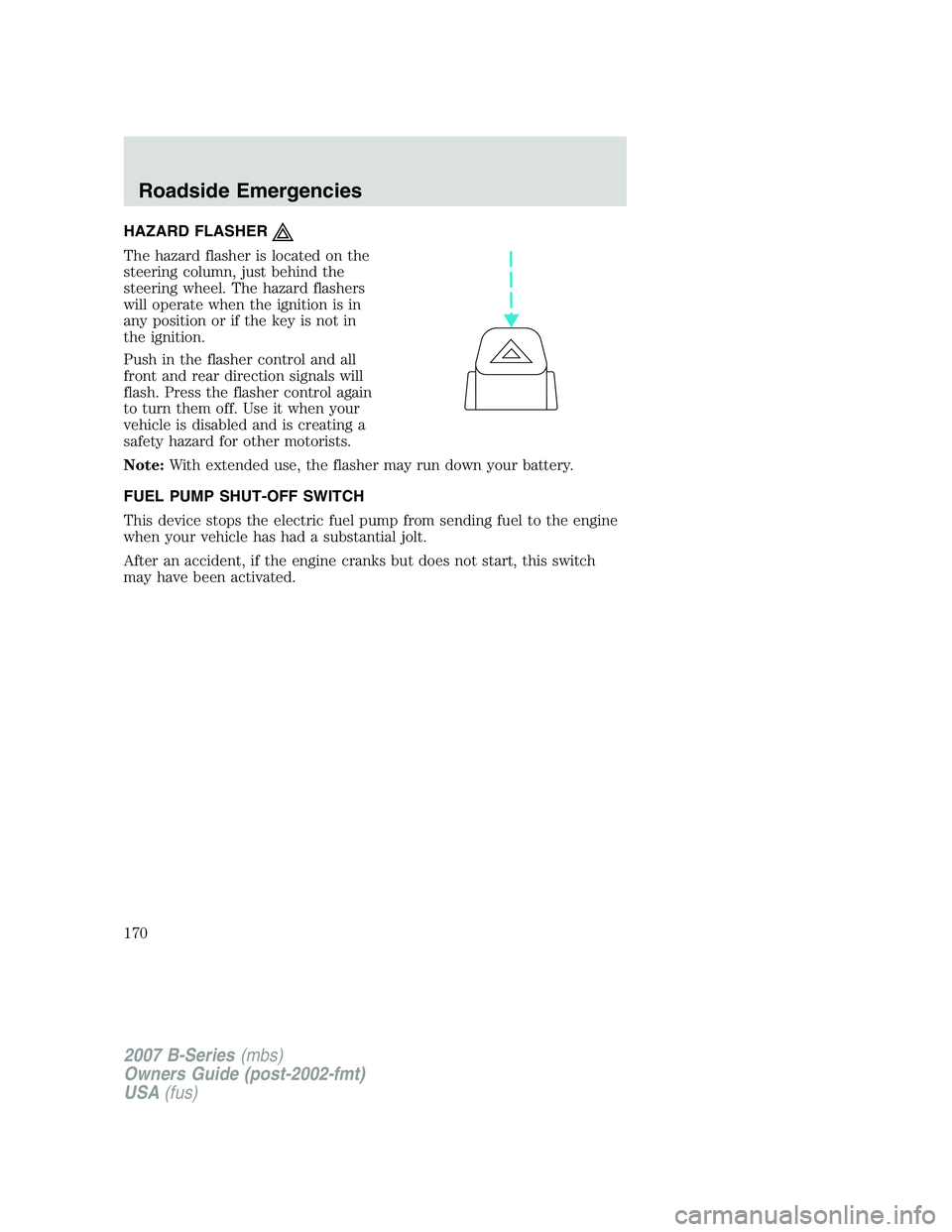
The hazard flasher is located on the
steering column, just behind the
steering wheel. The hazard flashers
will operate when the ignition is in
any position or if the key is not in
the ignition.
Push in the flasher control and all
front and rear direction signals will
flash. Press the flasher control again
to turn them off. Use it when your
vehicle is disabled and is creating a
safety hazard for other motorists.
Note:With extended use, the flasher may run down your battery.
FUEL PUMP SHUT-OFF SWITCH
This device stops the electric fuel pump from sending fuel to the engine
when your vehicle has had a substantial jolt.
After an accident, if the engine cranks but does not start, this switch
may have been activated.
2007 B-Series (mbs)
Owners Guide (post-2002-fmt)
USA (fus)
Roadside Emergencies
170
Page 175 of 280
Fuse/RelayLocation Fuse Amp
Rating Passenger Compartment Fuse
Panel Description
30 5A Power mirrors
31 20A Front park lamps, Rear park
lamps, License plate lamps,
Dimmer switch, Trailer tow park
lamps
32 5A Brake switch (logic)
33 5A Instrument cluster battery feed
(B+)
34 20A Power point
35 15A Power locks
Power distribution box
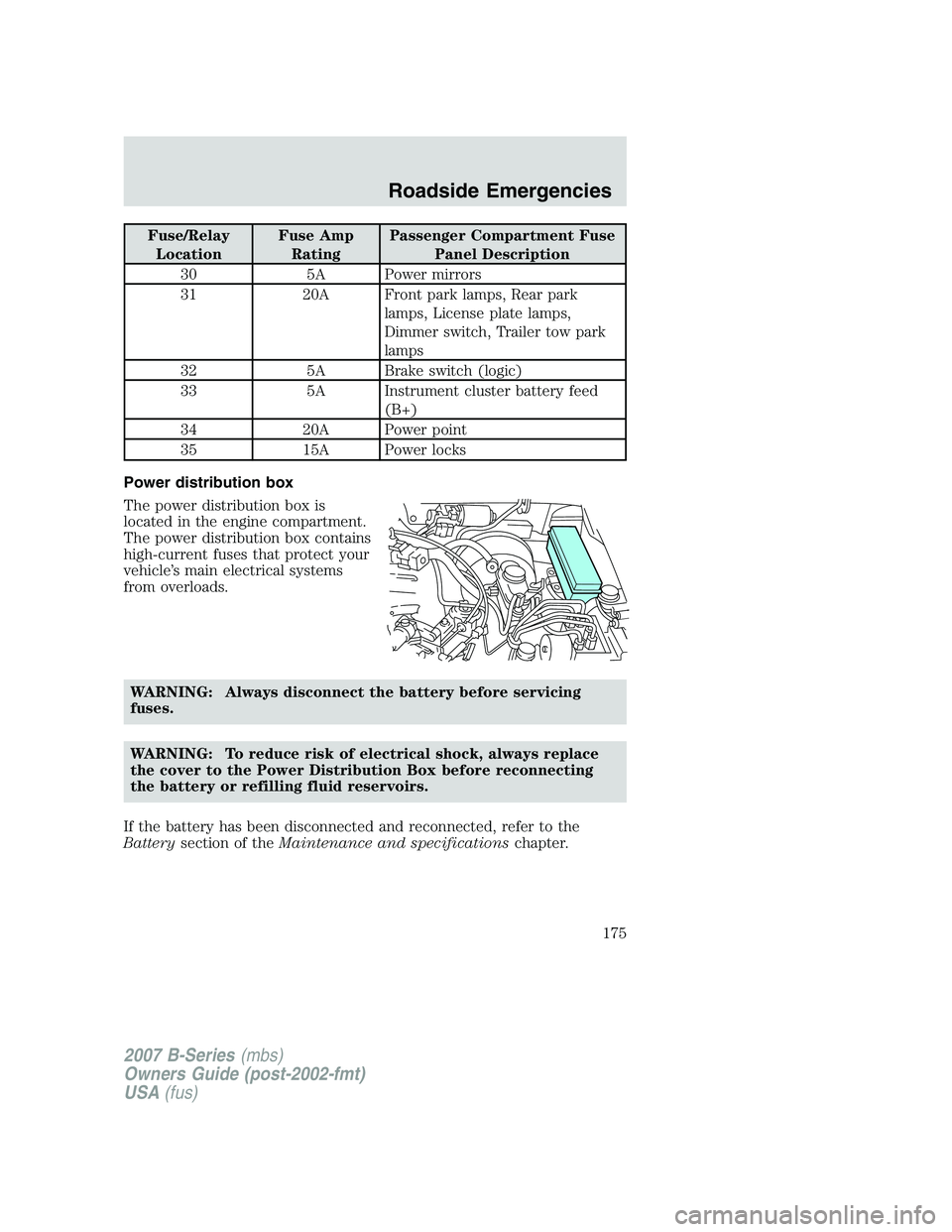
The power distribution box is
located in the engine compartment.
The power distribution box contains
high-current fuses that protect your
vehicle’s main electrical systems
from overloads.
WARNING: Always disconnect the battery before servicing
fuses.
WARNING: To reduce risk of electrical shock, always replace
the cover to the Power Distribution Box before reconnecting
the battery or refilling fluid reservoirs.
If the battery has been disconnected and reconnected, refer to the
Battery section of the Maintenance and specifications chapter.
2007 B-Series(mbs)
Owners Guide (post-2002-fmt)
USA (fus)
Roadside Emergencies
175
Page 176 of 280
2.3L engine (if equipped)
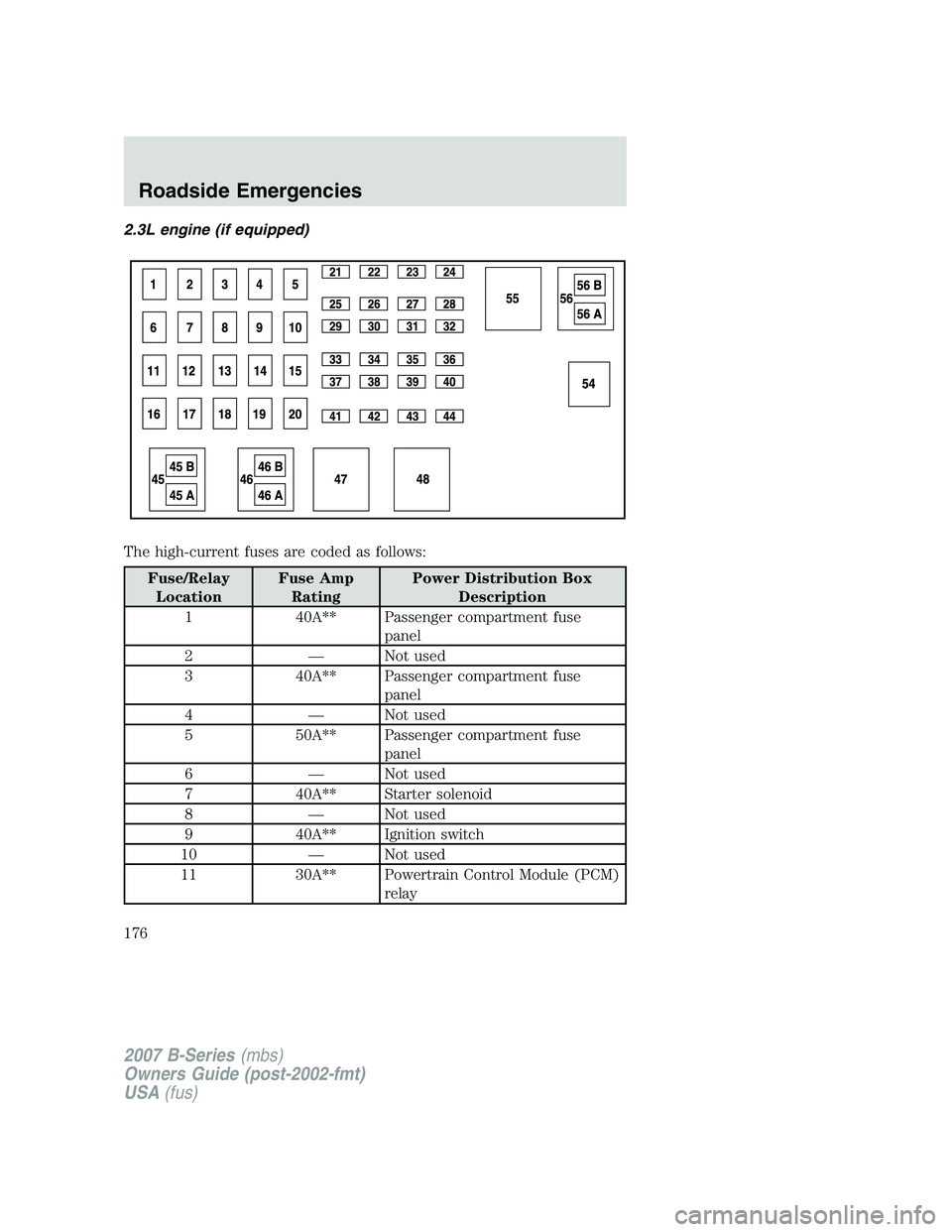
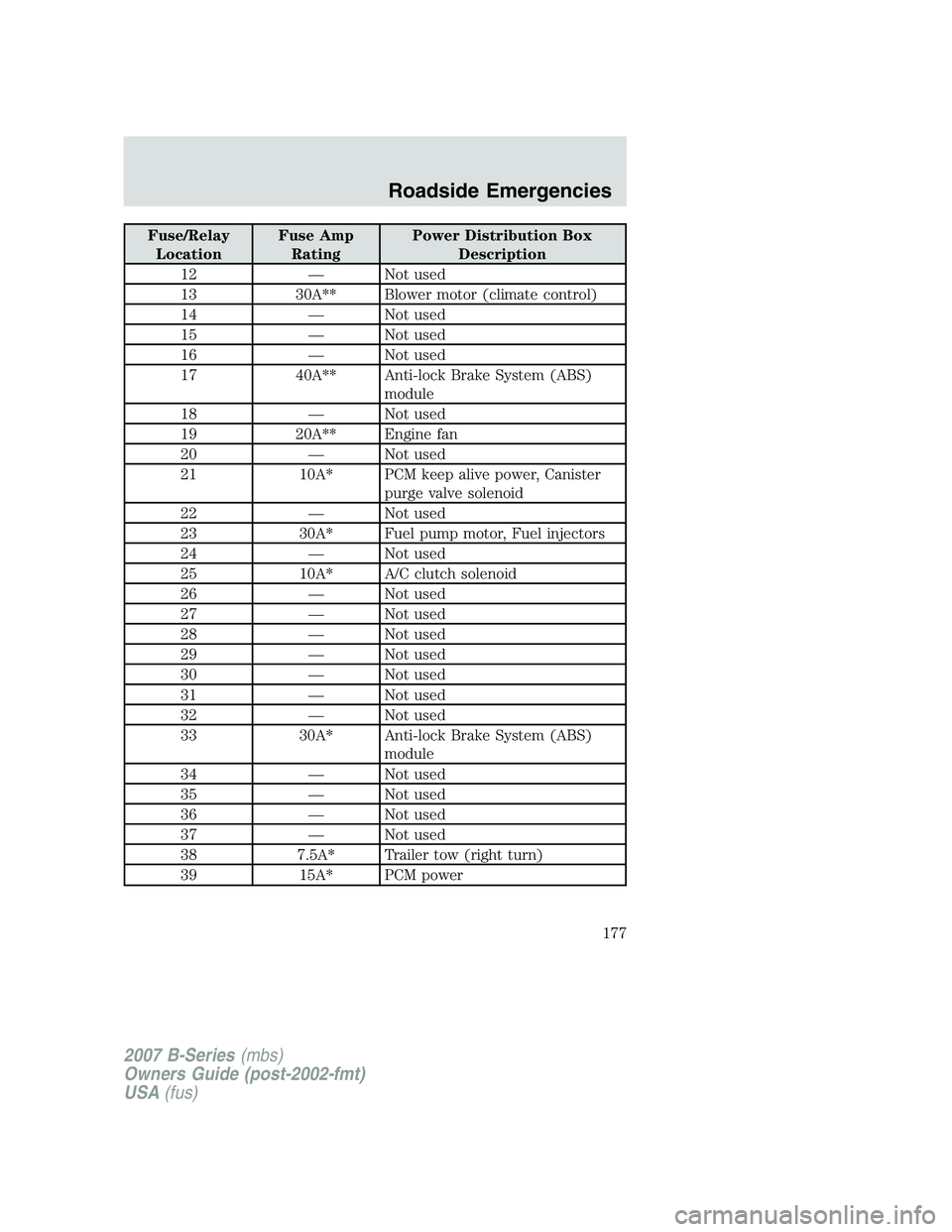
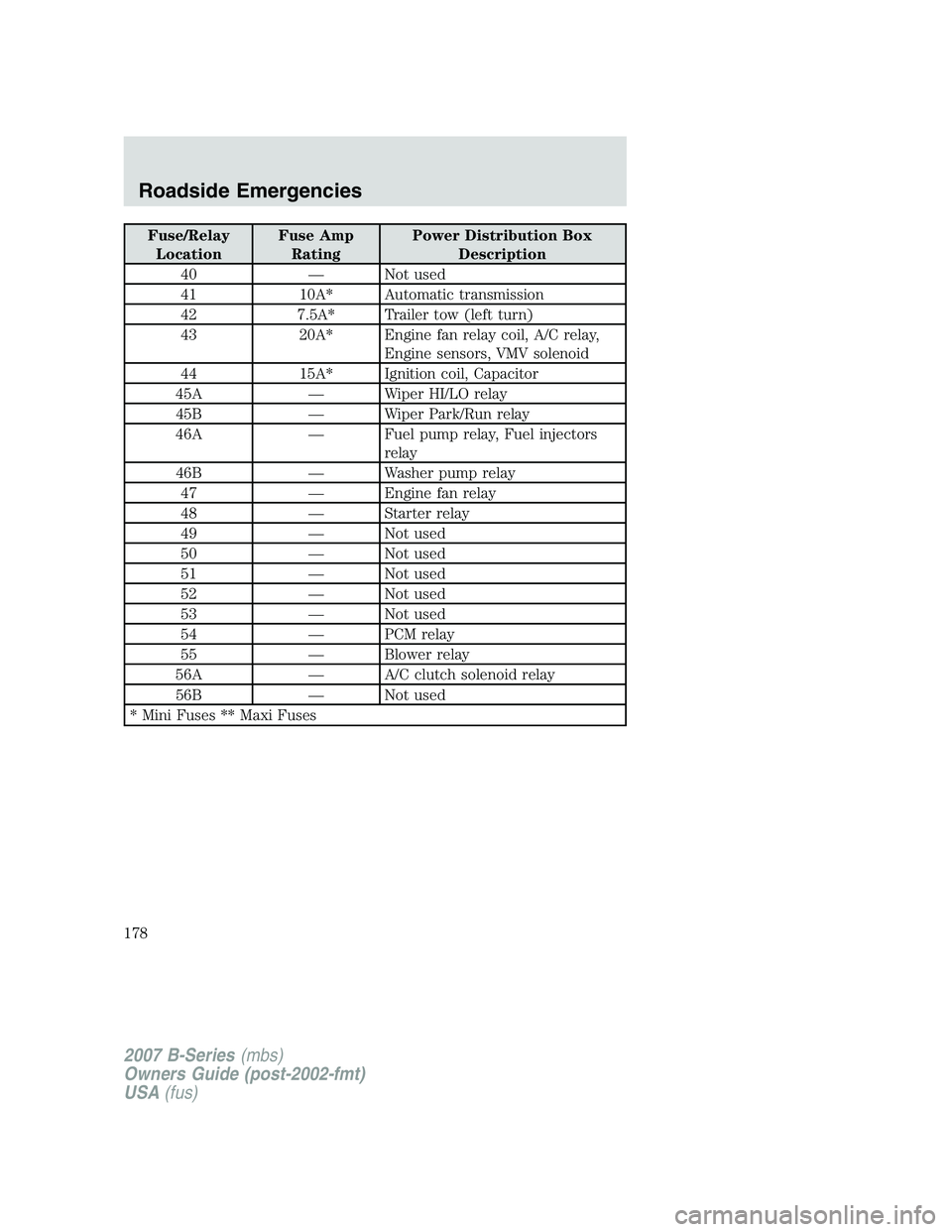
The high-current fuses are coded as follows:
Fuse/RelayLocation Fuse Amp
Rating Power Distribution Box
Description
1 40A** Passenger compartment fuse
panel
2 — Not used
3 40A** Passenger compartment fuse
panel
4 — Not used
5 50A** Passenger compartment fuse
panel
6 — Not used
7 40A** Starter solenoid
8 — Not used
9 40A** Ignition switch
10 — Not used
11 30A** Powertrain Control Module (PCM)
relay
2007 B-Series (mbs)
Owners Guide (post-2002-fmt)
USA (fus)
Roadside Emergencies
176
Page 177 of 280
Fuse/RelayLocation Fuse Amp
Rating Power Distribution Box
Description
12 — Not used
13 30A** Blower motor (climate control)
14 — Not used
15 — Not used
16 — Not used
17 40A** Anti-lock Brake System (ABS)
module
18 — Not used
19 20A** Engine fan
20 — Not used
21 10A* PCM keep alive power, Canister
purge valve solenoid
22 — Not used
23 30A* Fuel pump motor, Fuel injectors
24 — Not used
25 10A* A/C clutch solenoid
26 — Not used
27 — Not used
28 — Not used
29 — Not used
30 — Not used
31 — Not used
32 — Not used
33 30A* Anti-lock Brake System (ABS)
module
34 — Not used
35 — Not used
36 — Not used
37 — Not used
38 7.5A* Trailer tow (right turn)
39 15A* PCM power
2007 B-Series(mbs)
Owners Guide (post-2002-fmt)
USA (fus)
Roadside Emergencies
177
Page 178 of 280
Fuse/RelayLocation Fuse Amp
Rating Power Distribution Box
Description
40 — Not used
41 10A* Automatic transmission
42 7.5A* Trailer tow (left turn)
43 20A* Engine fan relay coil, A/C relay,
Engine sensors, VMV solenoid
44 15A* Ignition coil, Capacitor
45A — Wiper HI/LO relay
45B — Wiper Park/Run relay
46A — Fuel pump relay, Fuel injectors
relay
46B — Washer pump relay
47 — Engine fan relay
48 — Starter relay
49 — Not used
50 — Not used
51 — Not used
52 — Not used
53 — Not used
54 — PCM relay
55 — Blower relay
56A — A/C clutch solenoid relay
56B — Not used
* Mini Fuses ** Maxi Fuses
2007 B-Series (mbs)
Owners Guide (post-2002-fmt)
USA (fus)
Roadside Emergencies
178
Page 179 of 280
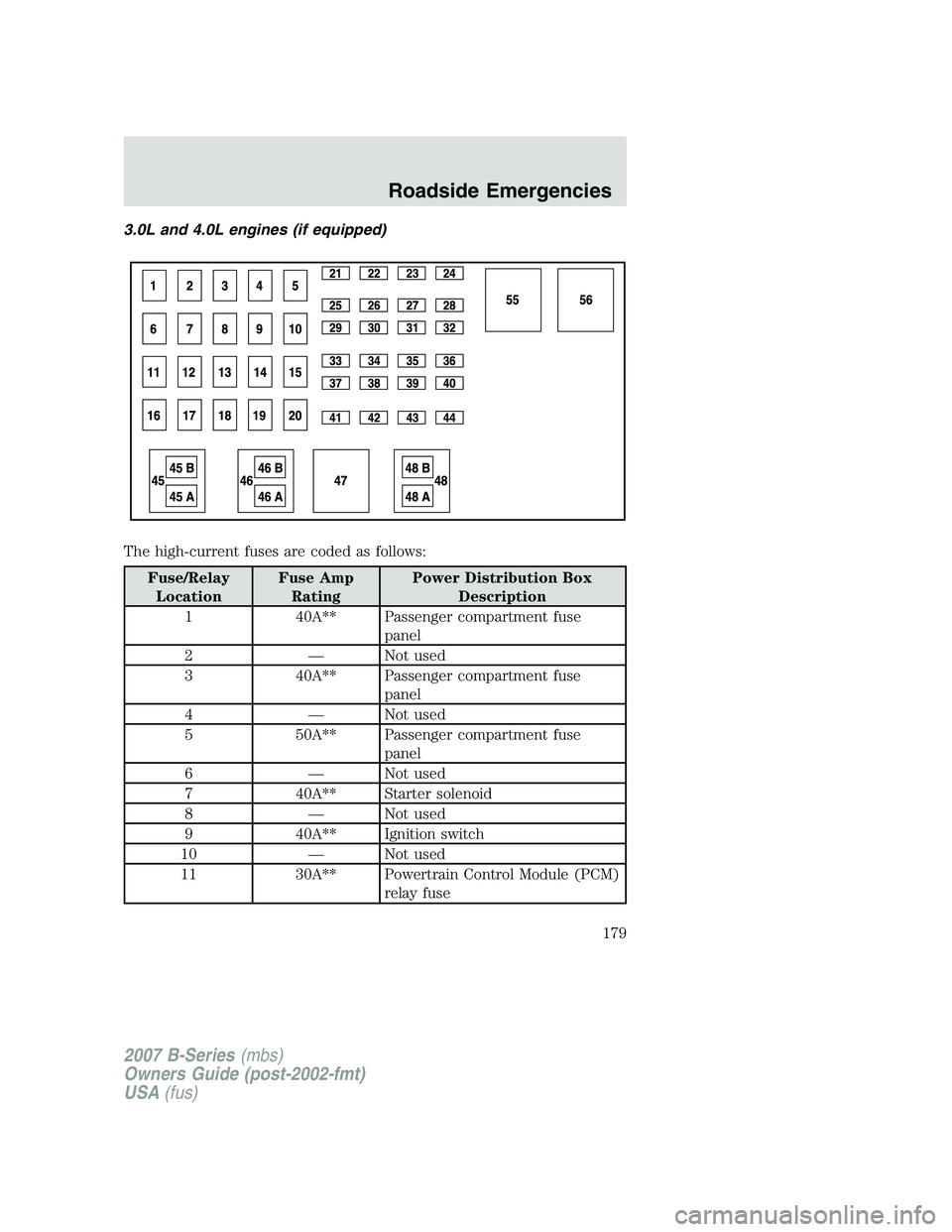
3.0L and 4.0L engines (if equipped)
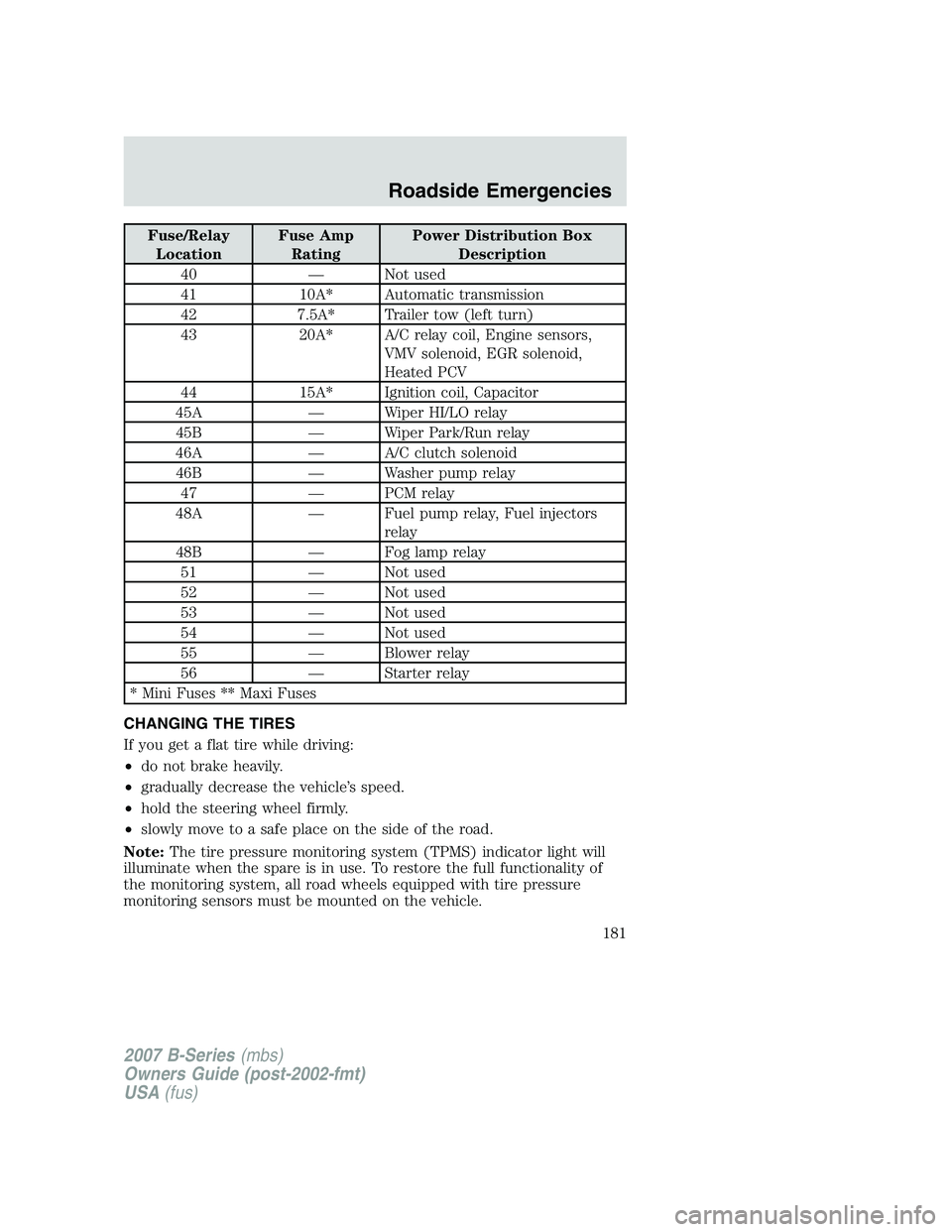
The high-current fuses are coded as follows:
Fuse/RelayLocation Fuse Amp
Rating Power Distribution Box
Description
1 40A** Passenger compartment fuse
panel
2 — Not used
3 40A** Passenger compartment fuse
panel
4 — Not used
5 50A** Passenger compartment fuse
panel
6 — Not used
7 40A** Starter solenoid
8 — Not used
9 40A** Ignition switch
10 — Not used
11 30A** Powertrain Control Module (PCM)
relay fuse
2007 B-Series (mbs)
Owners Guide (post-2002-fmt)
USA (fus)
Roadside Emergencies
179
Page 181 of 280
Fuse/RelayLocation Fuse Amp
Rating Power Distribution Box
Description
40 — Not used
41 10A* Automatic transmission
42 7.5A* Trailer tow (left turn)
43 20A* A/C relay coil, Engine sensors,
VMV solenoid, EGR solenoid,
Heated PCV
44 15A* Ignition coil, Capacitor
45A — Wiper HI/LO relay
45B — Wiper Park/Run relay
46A — A/C clutch solenoid
46B — Washer pump relay
47 — PCM relay
48A — Fuel pump relay, Fuel injectors
relay
48B — Fog lamp relay
51 — Not used
52 — Not used
53 — Not used
54 — Not used
55 — Blower relay
56 — Starter relay
* Mini Fuses ** Maxi Fuses
CHANGING THE TIRES
If you get a flat tire while driving:
• do not brake heavily.
• gradually decrease the vehicle’s speed.
• hold the steering wheel firmly.
• slowly move to a safe place on the side of the road.
Note: The tire pressure monitoring system (TPMS) indicator light will
illuminate when the spare is in use. To restore the full functionality of
the monitoring system, all road wheels equipped with tire pressure
monitoring sensors must be mounted on the vehicle.
2007 B-Series (mbs)
Owners Guide (post-2002-fmt)
USA (fus)
Roadside Emergencies
181
Page 187 of 280
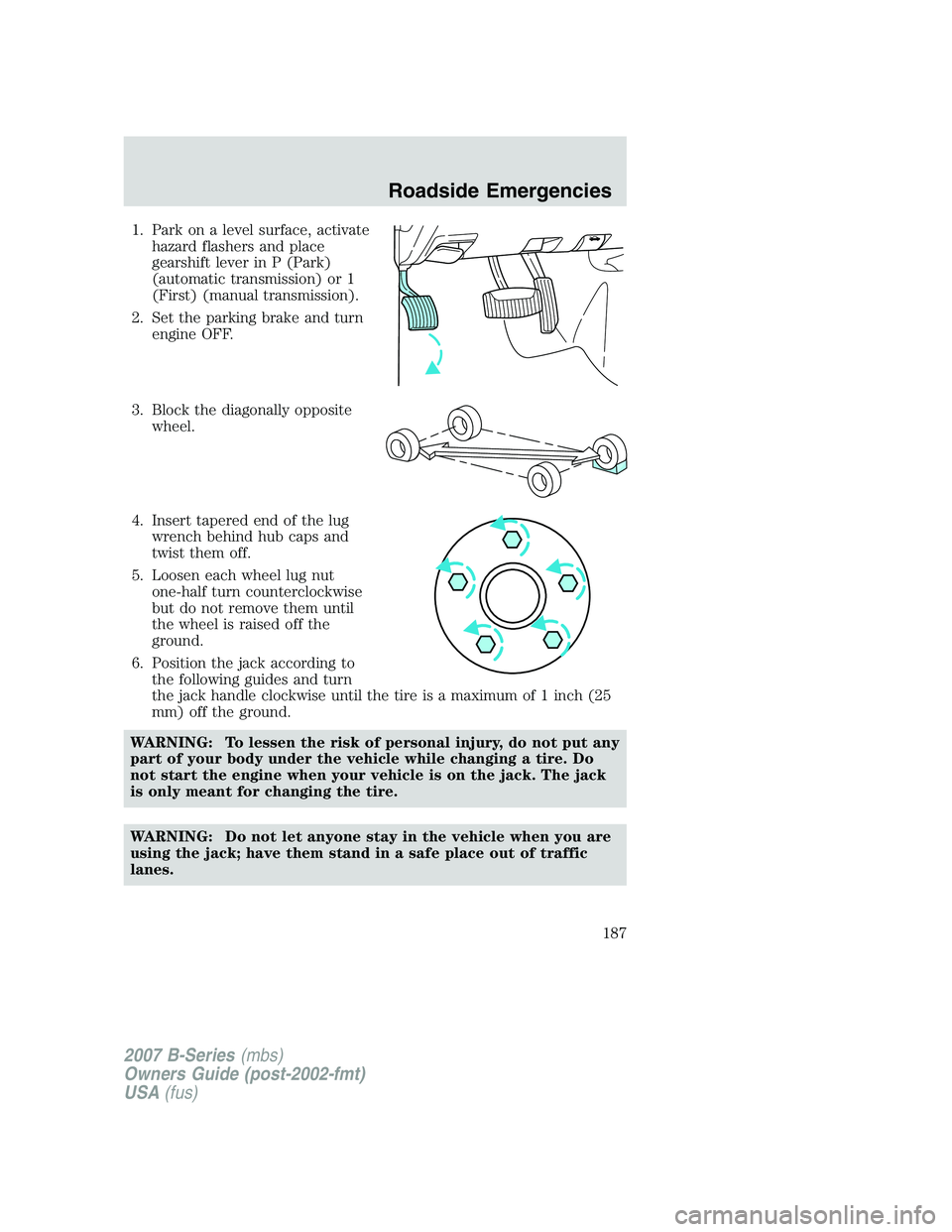
1. Park on a level surface, activatehazard flashers and place
gearshift lever in P (Park)
(automatic transmission) or 1
(First) (manual transmission).
2. Set the parking brake and turn engine OFF.
3. Block the diagonally opposite wheel.
4. Insert tapered end of the lug wrench behind hub caps and
twist them off.
5. Loosen each wheel lug nut one-half turn counterclockwise
but do not remove them until
the wheel is raised off the
ground.
6. Position the jack according to the following guides and turn
the jack handle clockwise until the tire is a maximum of 1 inch (25
mm) off the ground.
WARNING: To lessen the risk of personal injury, do not put any
part of your body under the vehicle while changing a tire. Do
not start the engine when your vehicle is on the jack. The jack
is only meant for changing the tire.
WARNING: Do not let anyone stay in the vehicle when you are
using the jack; have them stand in a safe place out of traffic
lanes.
2007 B-Series (mbs)
Owners Guide (post-2002-fmt)
USA (fus)
Roadside Emergencies
187
Page 190 of 280
WHEEL LUG NUT TORQUE SPECIFICATIONS
Retighten the lug nuts to the specified torque at 50–100 miles (80–160
km) after any wheel disturbance (rotation, flat tire, wheel removal, etc.).
Lug nut socketsize/Bolt size Wheel lug nut torque*
lb.ft. N•m
Lug nut socket size:
34” (19 mm) hex
Bolt size:12x 20 100
135
* Torque specifications are for nut and bolt threads free of dirt and
rust. Use only Mazda recommended replacement fasteners. WARNING: When a wheel is installed, always remove any
corrosion, dirt or foreign materials present on the mounting
surfaces of the wheel or the surface of the wheel hub, brake
drum or brake disc that contacts the wheel. Ensure that any
fasteners that attach the rotor to the hub are secured so they
do not interfere with the mounting surfaces of the wheel.
Installing wheels without correct metal-to-metal contact at the
wheel mounting surfaces can cause the wheel nuts to loosen
and the wheel to come off while the vehicle is in motion,
resulting in loss of control.
Note: If there is corrosion on the area where the wheel contacts the
hub, apply a thin film of grease or anti-seize compound on that area.
OVERHEATING
If the temperature gauge indicates overheating and you experience
power loss, you hear a loud knocking or pinging noise, the engine is
probably too hot.
If this happens:
1. Drive safely to the side of the road and park off the right-of-way.
2. Shift the automatic transmission into P (Park) or the manual transmission into the neutral position, and apply the parking brake.
3. Turn off the air conditioner.
WARNING: Steam from an overheated engine is dangerous. The
escaping steam could seriously burn you. Open the hood ONLY
after steam is no longer escaping from the engine.
2007 B-Series (mbs)
Owners Guide (post-2002-fmt)
USA (fus)
Roadside Emergencies
190