engine MAZDA MODEL B3000 TRUCK 2007 Owner's Manual
[x] Cancel search | Manufacturer: MAZDA, Model Year: 2007, Model line: MODEL B3000 TRUCK, Model: MAZDA MODEL B3000 TRUCK 2007Pages: 280, PDF Size: 1.95 MB
Page 139 of 280
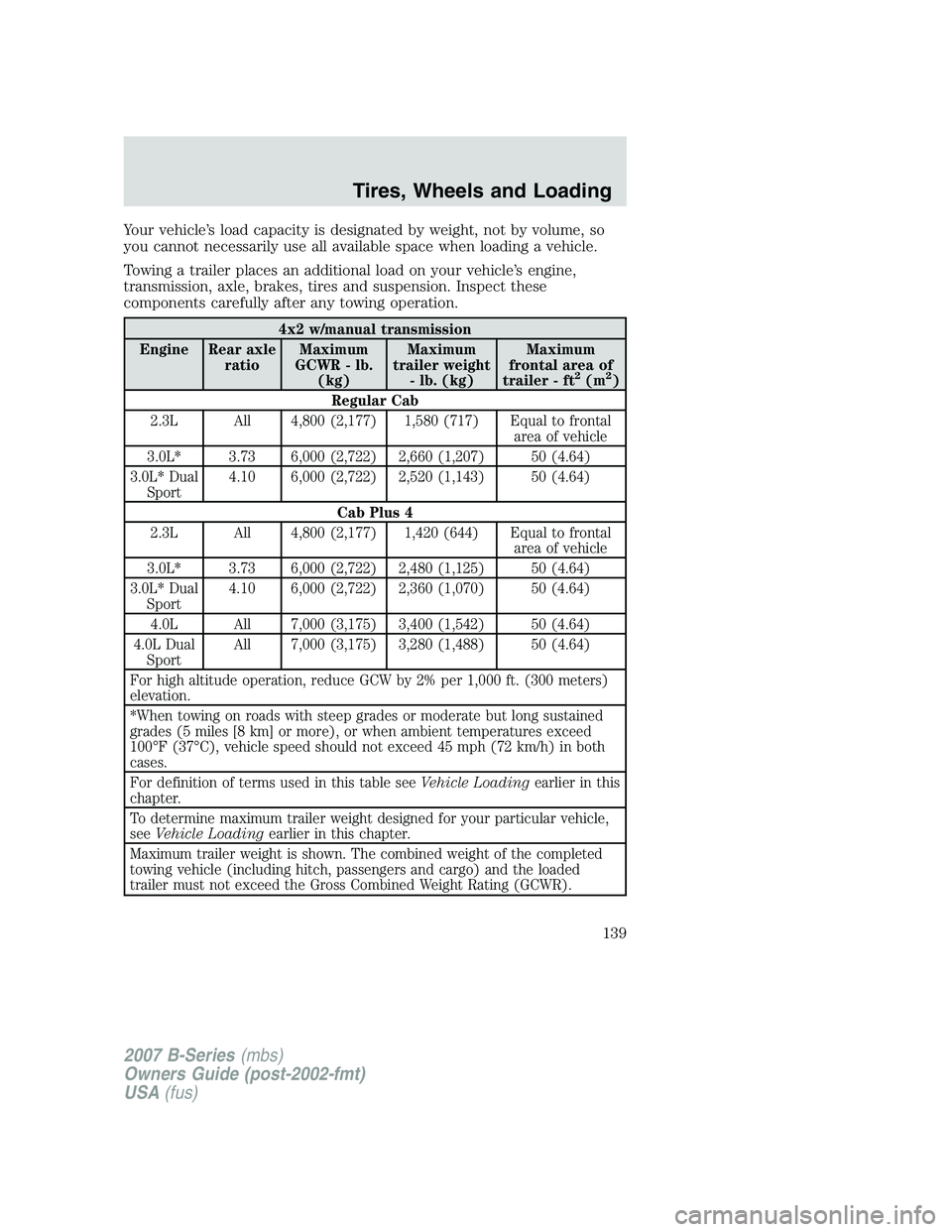
Your vehicle’s load capacity is designated by weight, not by volume, so
you cannot necessarily use all available space when loading a vehicle.
Towing a trailer places an additional load on your vehicle’s engine,
transmission, axle, brakes, tires and suspension. Inspect these
components carefully after any towing operation.
4x2 w/manual transmission
Engine Rear axle ratioMaximum
GCWR - lb. (kg) Maximum
trailer weight - lb. (kg) Maximum
frontal area of
trailer - ft
2(m2)
Regular Cab
2.3L All 4,800 (2,177) 1,580 (717) Equal to frontal area of vehicle
3.0L* 3.73 6,000 (2,722) 2,660 (1,207) 50 (4.64)
3.0L* Dual Sport 4.10 6,000 (2,722) 2,520 (1,143) 50 (4.64)
Cab Plus 4
2.3L All 4,800 (2,177) 1,420 (644) Equal to frontal area of vehicle
3.0L* 3.73 6,000 (2,722) 2,480 (1,125) 50 (4.64)
3.0L* Dual Sport 4.10 6,000 (2,722) 2,360 (1,070) 50 (4.64)
4.0L All 7,000 (3,175) 3,400 (1,542) 50 (4.64)
4.0L Dual Sport All 7,000 (3,175) 3,280 (1,488) 50 (4.64)
For high altitude operation, reduce GCW by 2% per 1,000 ft. (300 meters)
elevation.
*When towing on roads with steep grades or moderate but long sustained
grades (5 miles [8 km] or more), or when ambient temperatures exceed
100°F (37°C), vehicle speed should not exceed 45 mph (72 km/h) in both
cases.
For definition of terms used in this table see Vehicle Loadingearlier in this
chapter.
To determine maximum trailer weight designed for your particular vehicle,
see Vehicle Loading earlier in this chapter.
Maximum trailer weight is shown. The combined weight of the completed
towing vehicle (including hitch, passengers and cargo) and the loaded
trailer must not exceed the Gross Combined Weight Rating (GCWR).
2007 B-Series (mbs)
Owners Guide (post-2002-fmt)
USA (fus)
Tires, Wheels and Loading
139
Page 140 of 280
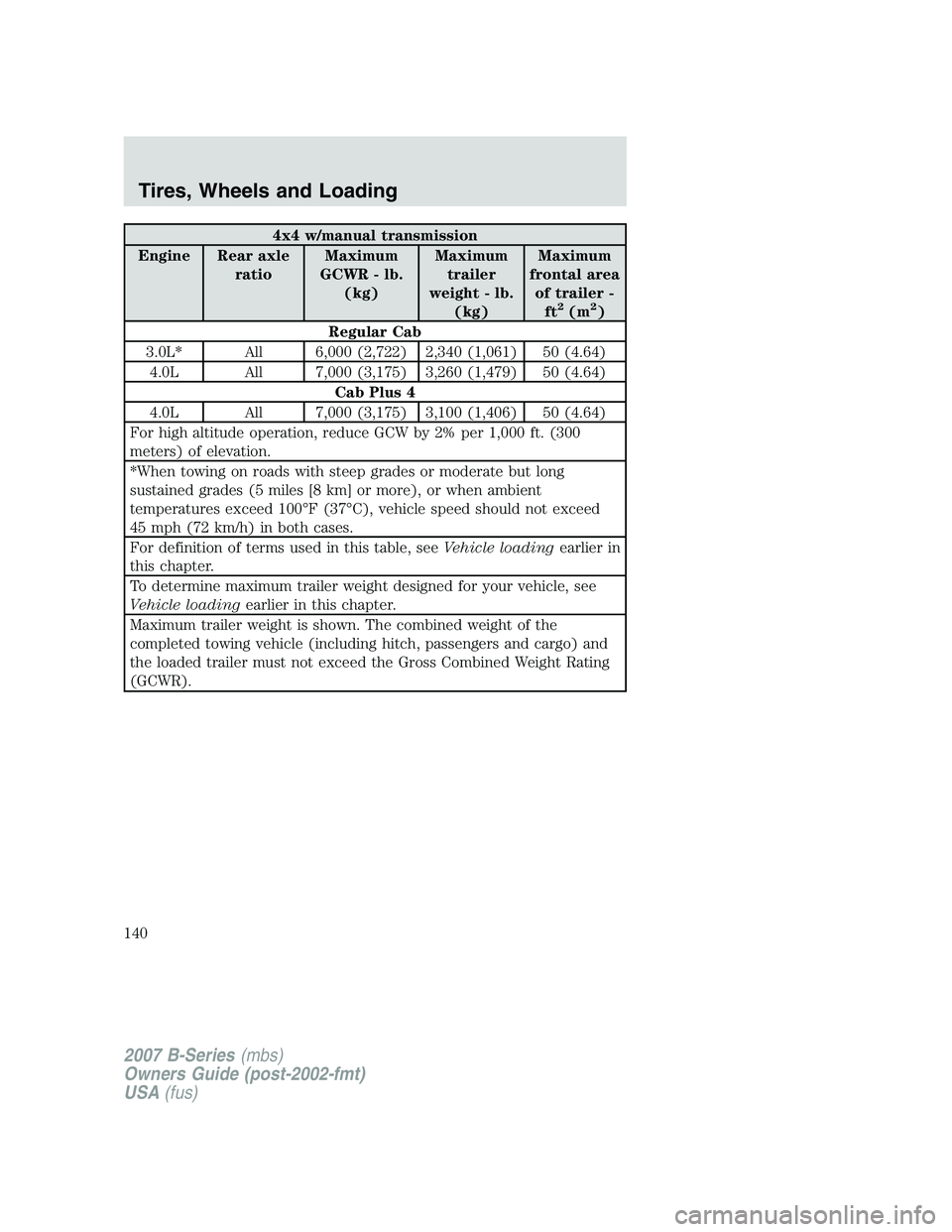
4x4 w/manual transmission
Engine Rear axle ratioMaximum
GCWR - lb. (kg) Maximum
trailer
weight - lb. (kg) Maximum
frontal area of trailer - ft
2(m2)
Regular Cab
3.0L* All 6,000 (2,722) 2,340 (1,061) 50 (4.64) 4.0L All 7,000 (3,175) 3,260 (1,479) 50 (4.64) Cab Plus 4
4.0L All 7,000 (3,175) 3,100 (1,406) 50 (4.64)
For high altitude operation, reduce GCW by 2% per 1,000 ft. (300
meters) of elevation.
*When towing on roads with steep grades or moderate but long
sustained grades (5 miles [8 km] or more), or when ambient
temperatures exceed 100°F (37°C), vehicle speed should not exceed
45 mph (72 km/h) in both cases.
For definition of terms used in this table, see Vehicle loadingearlier in
this chapter.
To determine maximum trailer weight designed for your vehicle, see
Vehicle loading earlier in this chapter.
Maximum trailer weight is shown. The combined weight of the
completed towing vehicle (including hitch, passengers and cargo) and
the loaded trailer must not exceed the Gross Combined Weight Rating
(GCWR).
2007 B-Series (mbs)
Owners Guide (post-2002-fmt)
USA (fus)
Tires, Wheels and Loading
140
Page 141 of 280
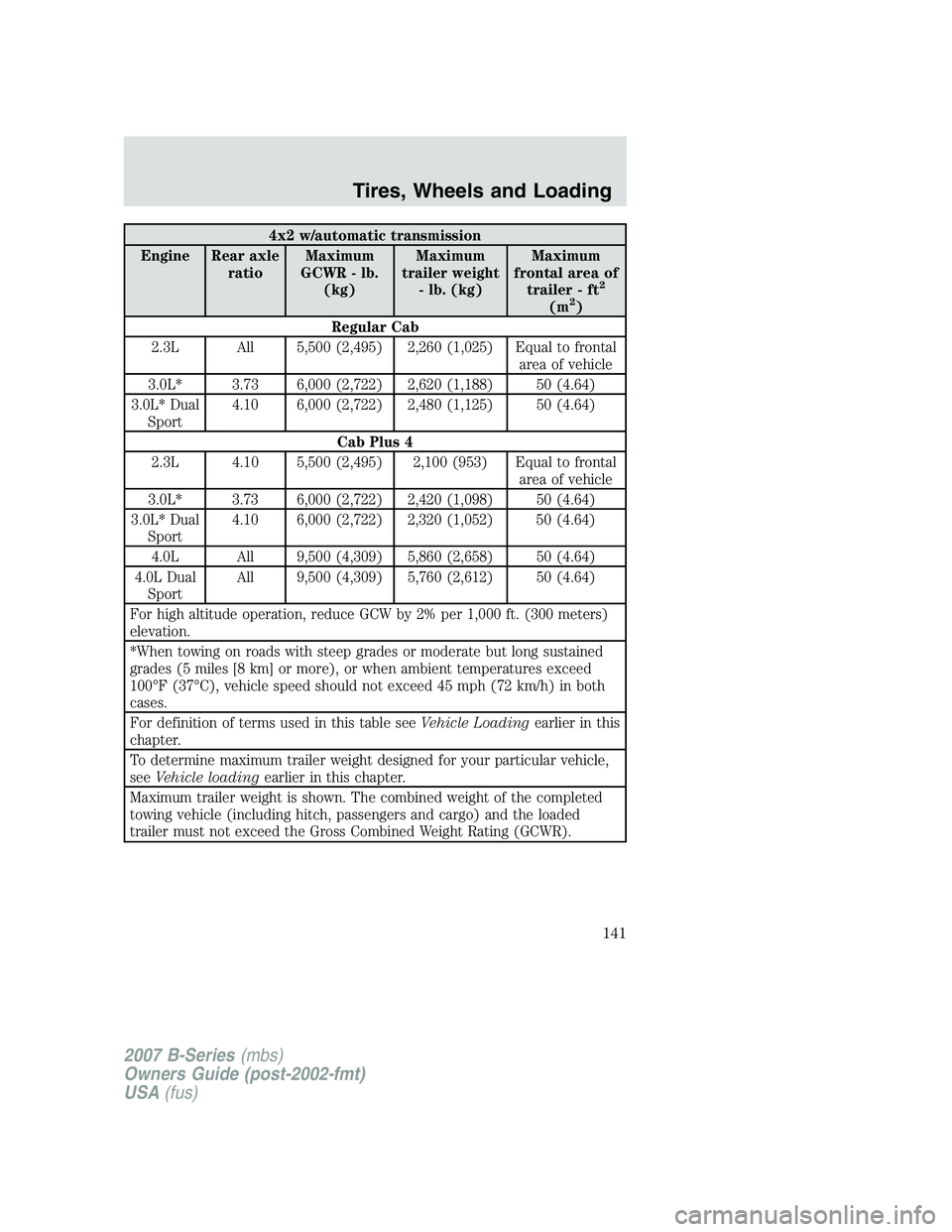
4x2 w/automatic transmission
Engine Rear axle ratioMaximum
GCWR - lb. (kg) Maximum
trailer weight - lb. (kg) Maximum
frontal area of trailer - ft
2
(m2)
Regular Cab
2.3L All 5,500 (2,495) 2,260 (1,025) Equal to frontal area of vehicle
3.0L* 3.73 6,000 (2,722) 2,620 (1,188) 50 (4.64)
3.0L* Dual Sport 4.10 6,000 (2,722) 2,480 (1,125) 50 (4.64)
Cab Plus 4
2.3L 4.10 5,500 (2,495) 2,100 (953) Equal to frontal area of vehicle
3.0L* 3.73 6,000 (2,722) 2,420 (1,098) 50 (4.64)
3.0L* Dual Sport 4.10 6,000 (2,722) 2,320 (1,052) 50 (4.64)
4.0L All 9,500 (4,309) 5,860 (2,658) 50 (4.64)
4.0L Dual Sport All 9,500 (4,309) 5,760 (2,612) 50 (4.64)
For high altitude operation, reduce GCW by 2% per 1,000 ft. (300 meters)
elevation.
*When towing on roads with steep grades or moderate but long sustained
grades (5 miles [8 km] or more), or when ambient temperatures exceed
100°F (37°C), vehicle speed should not exceed 45 mph (72 km/h) in both
cases.
For definition of terms used in this table see Vehicle Loadingearlier in this
chapter.
To determine maximum trailer weight designed for your particular vehicle,
see Vehicle loading earlier in this chapter.
Maximum trailer weight is shown. The combined weight of the completed
towing vehicle (including hitch, passengers and cargo) and the loaded
trailer must not exceed the Gross Combined Weight Rating (GCWR).
2007 B-Series (mbs)
Owners Guide (post-2002-fmt)
USA (fus)
Tires, Wheels and Loading
141
Page 142 of 280
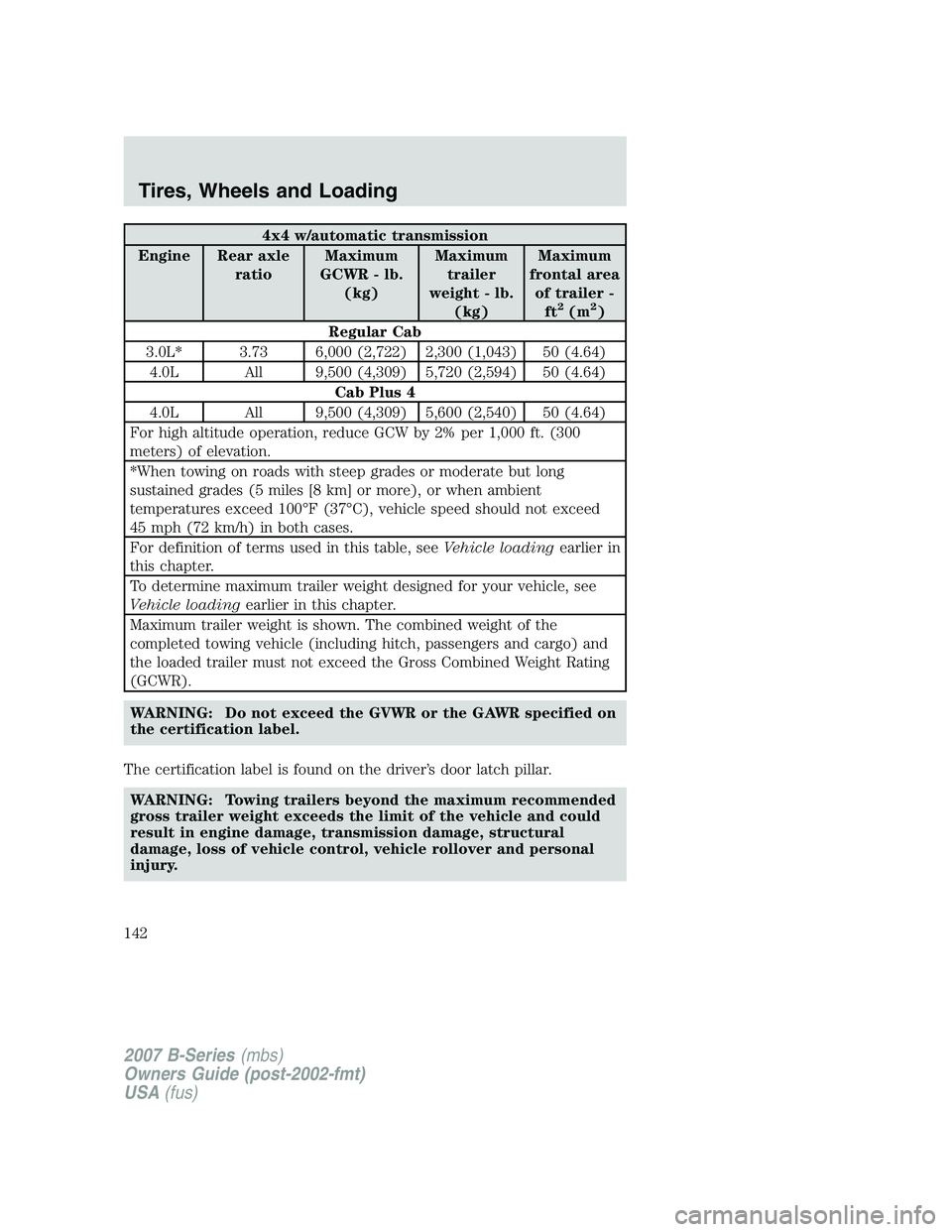
4x4 w/automatic transmission
Engine Rear axle ratioMaximum
GCWR - lb. (kg) Maximum
trailer
weight - lb. (kg) Maximum
frontal area of trailer - ft
2(m2)
Regular Cab
3.0L* 3.73 6,000 (2,722) 2,300 (1,043) 50 (4.64) 4.0L All 9,500 (4,309) 5,720 (2,594) 50 (4.64) Cab Plus 4
4.0L All 9,500 (4,309) 5,600 (2,540) 50 (4.64)
For high altitude operation, reduce GCW by 2% per 1,000 ft. (300
meters) of elevation.
*When towing on roads with steep grades or moderate but long
sustained grades (5 miles [8 km] or more), or when ambient
temperatures exceed 100°F (37°C), vehicle speed should not exceed
45 mph (72 km/h) in both cases.
For definition of terms used in this table, see Vehicle loadingearlier in
this chapter.
To determine maximum trailer weight designed for your vehicle, see
Vehicle loading earlier in this chapter.
Maximum trailer weight is shown. The combined weight of the
completed towing vehicle (including hitch, passengers and cargo) and
the loaded trailer must not exceed the Gross Combined Weight Rating
(GCWR).
WARNING: Do not exceed the GVWR or the GAWR specified on
the certification label.
The certification label is found on the driver’s door latch pillar. WARNING: Towing trailers beyond the maximum recommended
gross trailer weight exceeds the limit of the vehicle and could
result in engine damage, transmission damage, structural
damage, loss of vehicle control, vehicle rollover and personal
injury.
2007 B-Series (mbs)
Owners Guide (post-2002-fmt)
USA (fus)
Tires, Wheels and Loading
142
Page 145 of 280
Refer to the following chart for information regarding the
factory-equipped trailer tow connector:
Trailer tow connector
ColorFunction Comment
1. Dark Green Trailer right-hand turn signal Circuit activated when brake
pedal is depressed or when
ignition is on and right-hand
turn signal is applied.
2. Yellow Trailer left-hand turn signal Circuit activated when brake
pedal is depressed or when
ignition is on and left-hand
turn signal is applied.
3. Tan/White Tail lamp Relay controlled circuit
activated when the park
lamps/headlamps are on.
4. White Ground Matching vehicle circuit
returns to battery’s negative
ground.
Driving while you tow
When towing a trailer:
•
Keep your speed no faster than 70 mph (112 km/h) during the first 500
miles (800 km) of towing a trailer, and don’t make full throttle starts.
• Turn off the speed control. The speed control may shut off
automatically when you are towing on long, steep grades.
• Consult your local motor vehicle speed regulations for towing a trailer.
• To eliminate excessive shifting, use a lower gear. This will also assist
in transmission cooling. (For additional information, refer to the
Driving with a 5–speed automatic transmission section in the
Driving chapter.)
•
Under extreme conditions with large frontal trailers, high outside
temperatures and highway speeds, the coolant gauge may indicate
higher than normal coolant temperatures. If this occurs, reduce speed
until the coolant temperature returns to the normal range. Refer to
Engine coolant temperature gauge in theInstrument Cluster chapter.
•Anticipate stops and brake gradually.
• Do not exceed the GCWR rating or transmission damage may occur.
2007 B-Series (mbs)
Owners Guide (post-2002-fmt)
USA (fus)
Tires, Wheels and Loading
145
Page 146 of 280
Servicing after towing
If you tow a trailer for long distances, your vehicle will require more
frequent service intervals. Refer to yourscheduled maintenance
information for more information.
Trailer towing tips
• Practice turning, stopping and backing up before starting on a trip to
get the feel of the vehicle trailer combination. When turning, make
wider turns so the trailer wheels will clear curbs and other obstacles.
• Allow more distance for stopping with a trailer attached.
• The trailer tongue weight should be 10–15% of the loaded trailer
weight.
• If you will be towing a trailer frequently in hot weather, hilly
conditions, at GCWR, or any combination of these factors, consider
refilling your rear axle with synthetic gear lube if not already so
equipped. Refer to the Maintenance and specifications chapter for
the lubricant specification. Remember that regardless of the rear axle
lube used, do not tow a trailer for the first 500 miles (800 km) of a
new vehicle, and that the first 500 miles (800 km) of towing be done
at no faster than 70 mph (112 km/h) with no full throttle starts.
• After you have traveled 50 miles (80 km), thoroughly check your
hitch, electrical connections and trailer wheel lug nuts.
• To aid in engine/transmission cooling and A/C efficiency during hot
weather while stopped in traffic, place the gearshift lever in P (Park)
(automatic transmission) or N (Neutral) (manual transmissions).
• Vehicles with trailers should not be parked on a grade. If you must
park on a grade, place wheel chocks under the trailer’s wheels.
Launching or retrieving a boat
Disconnect the wiring to the trailer before backing the trailer
into the water. Reconnect the wiring to the trailer after the
trailer is removed from the water.
When backing down a ramp during boat launching or retrieval:
• do not allow the static water level to rise above the bottom edge of
the rear bumper.
• do not allow waves to break higher than 6 inches (15 cm) above the
bottom edge of the rear bumper.
2007 B-Series (mbs)
Owners Guide (post-2002-fmt)
USA (fus)
Tires, Wheels and Loading
146
Page 149 of 280
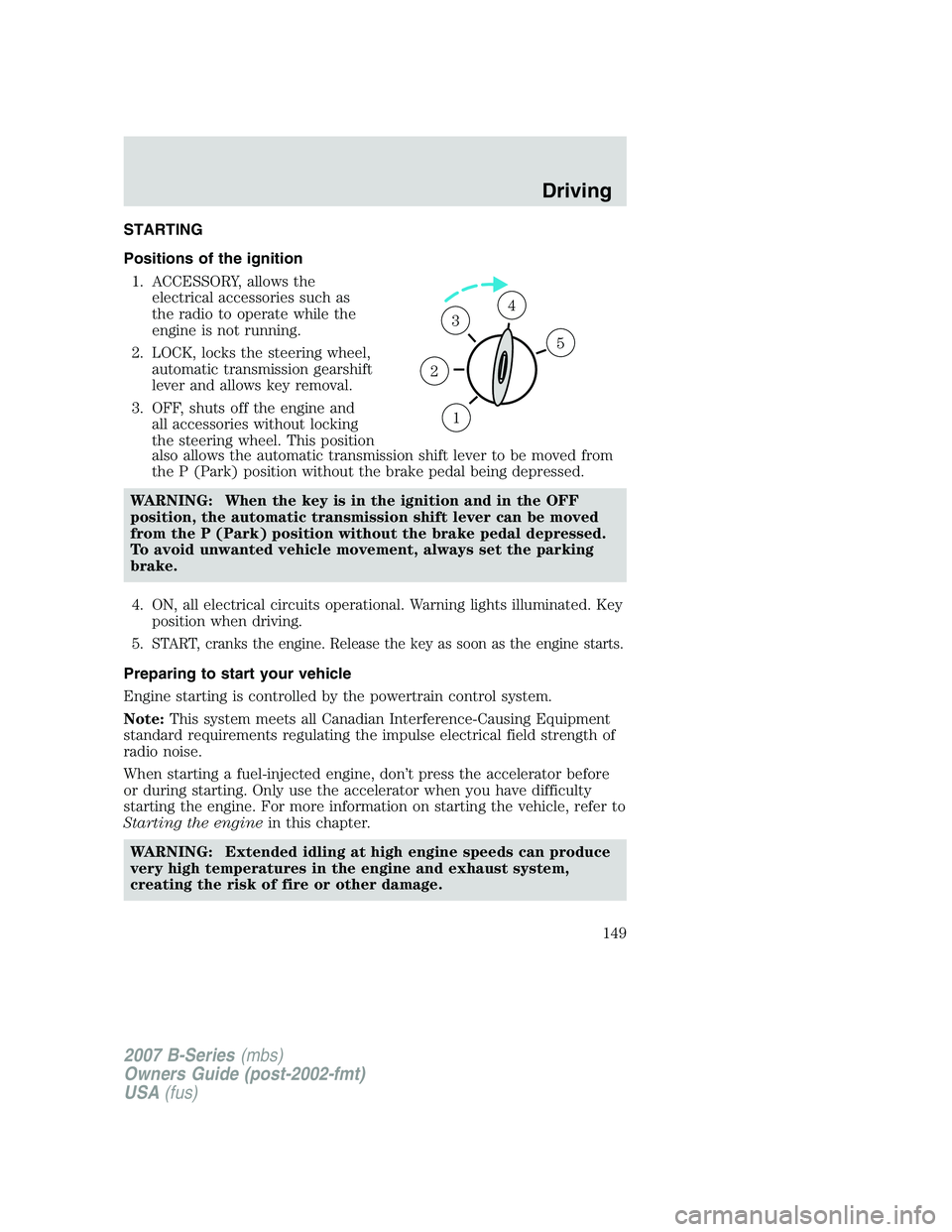
STARTING
Positions of the ignition1. ACCESSORY, allows the electrical accessories such as
the radio to operate while the
engine is not running.
2. LOCK, locks the steering wheel, automatic transmission gearshift
lever and allows key removal.
3. OFF, shuts off the engine and all accessories without locking
the steering wheel. This position
also allows the automatic transmission shift lever to be moved from
the P (Park) position without the brake pedal being depressed.
WARNING: When the key is in the ignition and in the OFF
position, the automatic transmission shift lever can be moved
from the P (Park) position without the brake pedal depressed.
To avoid unwanted vehicle movement, always set the parking
brake.
4. ON, all electrical circuits operational. Warning lights illuminated. Key position when driving.
5.
START, cranks the engine. Release the key as soon as the engine starts.
Preparing to start your vehicle
Engine starting is controlled by the powertrain control system.
Note: This system meets all Canadian Interference-Causing Equipment
standard requirements regulating the impulse electrical field strength of
radio noise.
When starting a fuel-injected engine, don’t press the accelerator before
or during starting. Only use the accelerator when you have difficulty
starting the engine. For more information on starting the vehicle, refer to
Starting the engine in this chapter.
WARNING: Extended idling at high engine speeds can produce
very high temperatures in the engine and exhaust system,
creating the risk of fire or other damage.
1
2
34
5
2007 B-Series (mbs)
Owners Guide (post-2002-fmt)
USA (fus)
Driving
149
Page 150 of 280
WARNING: Do not park, idle, or drive your vehicle in dry grass
or other dry ground cover. The emission system heats up the
engine compartment and exhaust system, which can start a fire.
WARNING: Do not start your vehicle in a closed garage or in
other enclosed areas. Exhaust fumes can be toxic. Always open
the garage door before you start the engine. SeeGuarding
against exhaust fumes in this chapter for more instructions.
WARNING: If you smell exhaust fumes inside your vehicle,
have your dealer inspect your vehicle immediately. Do not drive
if you smell exhaust fumes.
Important safety precautions
When the engine starts, the idle RPM runs faster to warm the engine. If
the engine idle speed does not slow down automatically, have the vehicle
checked.
Before starting the vehicle: 1. Make sure all occupants buckle their safety belts. For more information on safety belts and their proper usage, refer to the
Seating and Safety Restraints chapter.
2. Make sure the headlamps and electrical accessories are off.
If starting a vehicle with an automatic transmission:
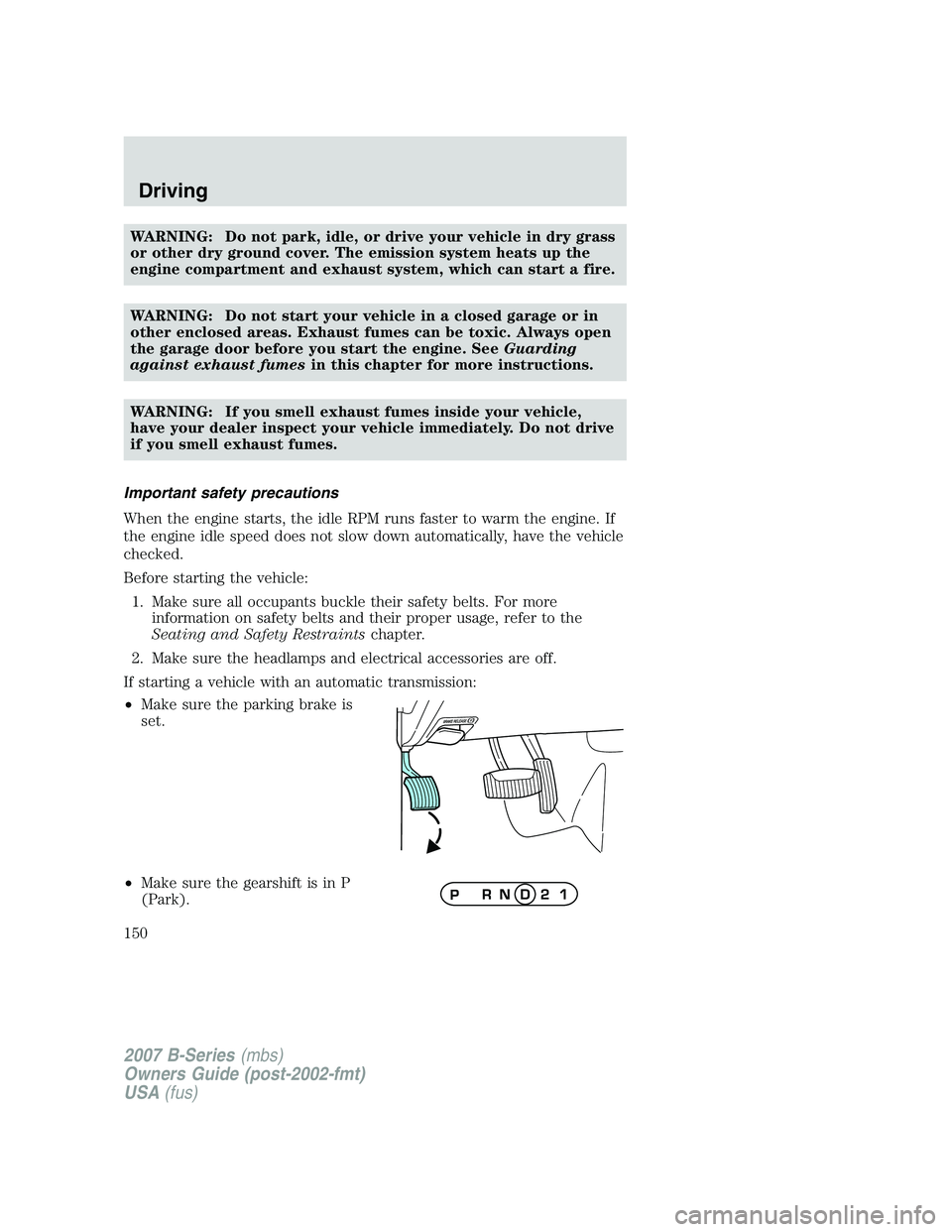
• Make sure the parking brake is
set.
• Make sure the gearshift is in P
(Park).
2007 B-Series (mbs)
Owners Guide (post-2002-fmt)
USA (fus)
Driving
150
Page 151 of 280
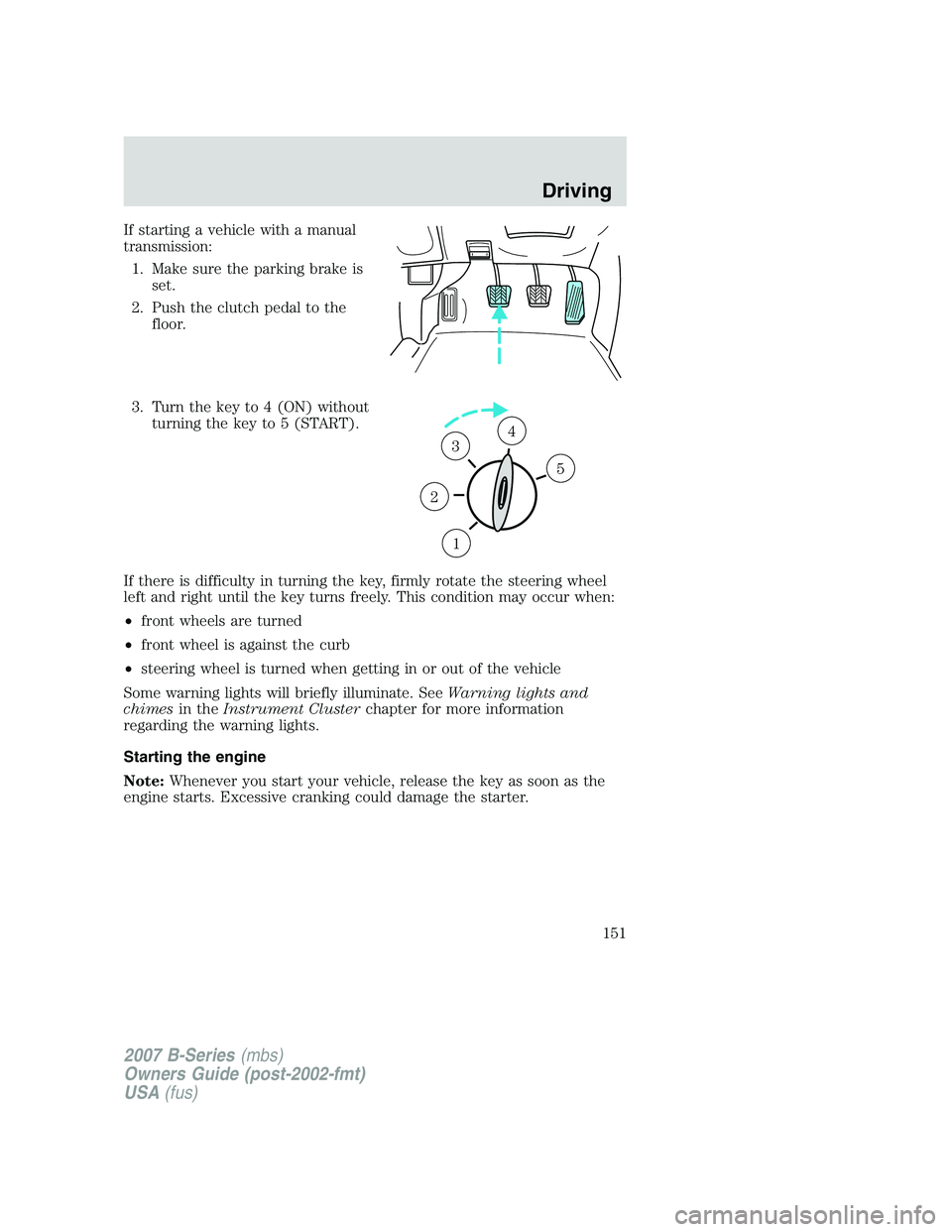
If starting a vehicle with a manual
transmission:1. Make sure the parking brake is set.
2. Push the clutch pedal to the floor.
3. Turn the key to 4 (ON) without turning the key to 5 (START).
If there is difficulty in turning the key, firmly rotate the steering wheel
left and right until the key turns freely. This condition may occur when:
• front wheels are turned
• front wheel is against the curb
• steering wheel is turned when getting in or out of the vehicle
Some warning lights will briefly illuminate. See Warning lights and
chimes in theInstrument Cluster chapter for more information
regarding the warning lights.
Starting the engine
Note: Whenever you start your vehicle, release the key as soon as the
engine starts. Excessive cranking could damage the starter.
1
2
34
5
2007 B-Series (mbs)
Owners Guide (post-2002-fmt)
USA (fus)
Driving
151
Page 152 of 280
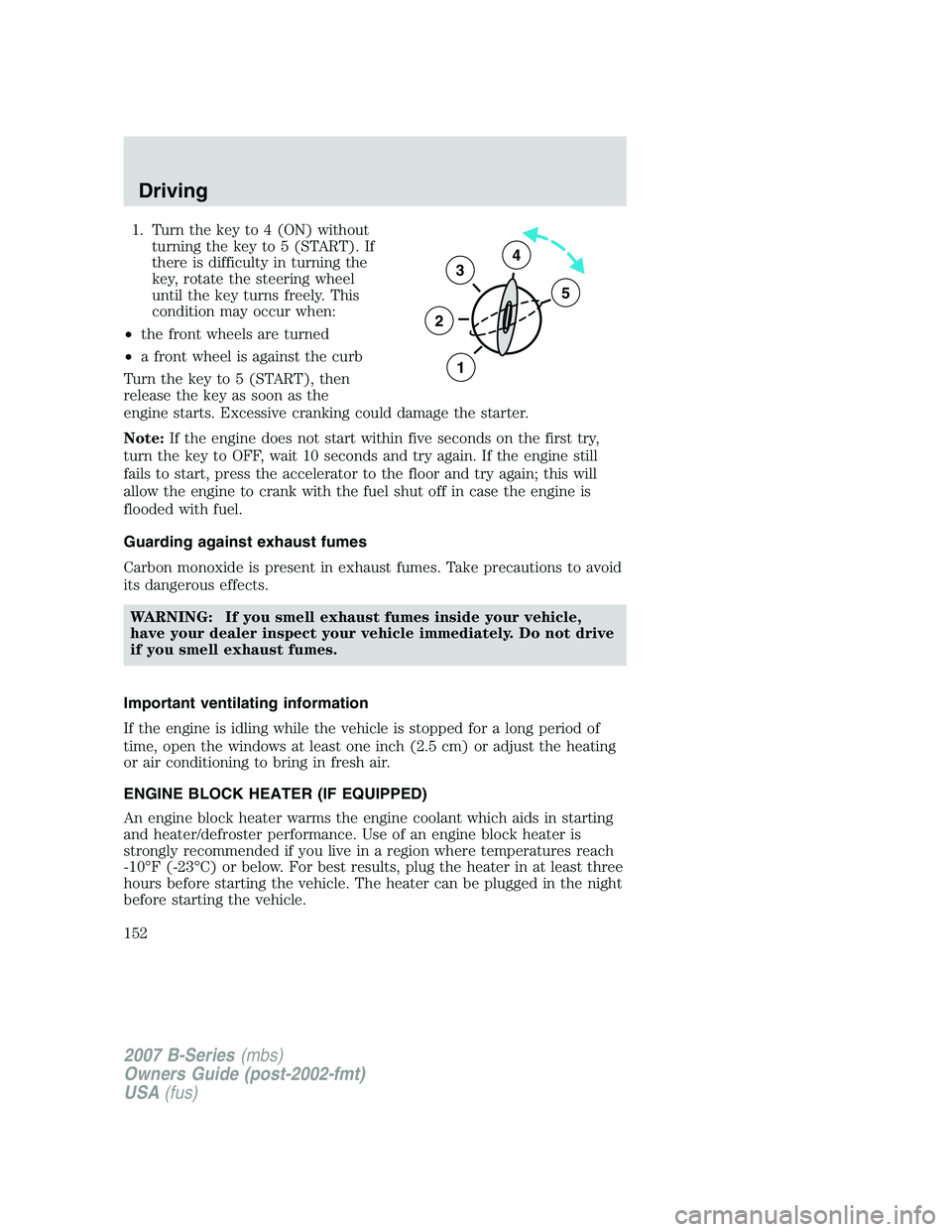
1. Turn the key to 4 (ON) withoutturning the key to 5 (START). If
there is difficulty in turning the
key, rotate the steering wheel
until the key turns freely. This
condition may occur when:
• the front wheels are turned
• a front wheel is against the curb
Turn the key to 5 (START), then
release the key as soon as the
engine starts. Excessive cranking could damage the starter.
Note: If the engine does not start within five seconds on the first try,
turn the key to OFF, wait 10 seconds and try again. If the engine still
fails to start, press the accelerator to the floor and try again; this will
allow the engine to crank with the fuel shut off in case the engine is
flooded with fuel.
Guarding against exhaust fumes
Carbon monoxide is present in exhaust fumes. Take precautions to avoid
its dangerous effects.
WARNING: If you smell exhaust fumes inside your vehicle,
have your dealer inspect your vehicle immediately. Do not drive
if you smell exhaust fumes.
Important ventilating information
If the engine is idling while the vehicle is stopped for a long period of
time, open the windows at least one inch (2.5 cm) or adjust the heating
or air conditioning to bring in fresh air.
ENGINE BLOCK HEATER (IF EQUIPPED)
An engine block heater warms the engine coolant which aids in starting
and heater/defroster performance. Use of an engine block heater is
strongly recommended if you live in a region where temperatures reach
-10°F (-23°C) or below. For best results, plug the heater in at least three
hours before starting the vehicle. The heater can be plugged in the night
before starting the vehicle.
3
2
1
5
4
2007 B-Series (mbs)
Owners Guide (post-2002-fmt)
USA (fus)
Driving
152