suspension MAZDA MODEL B3000 TRUCK 2007 Owners Manual
[x] Cancel search | Manufacturer: MAZDA, Model Year: 2007, Model line: MODEL B3000 TRUCK, Model: MAZDA MODEL B3000 TRUCK 2007Pages: 280, PDF Size: 1.95 MB
Page 118 of 280
WARNING: Age
Tires degrade over time, even when they are not being used. It
is recommended that tires generally be replaced after 6 years of
normal service. Heat caused by hot climates or frequent high
loading conditions can accelerate the aging process.
You should replace the spare tire when you replace the other
road tires due to the aging of the spare tire.
U.S. DOT Tire Identification Number (TIN)
Both U.S. and Canada Federal regulations require tire manufacturers to
place standardized information on the sidewall of all tires. This
information identifies and describes the fundamental characteristics of
the tire and also provides a U.S. DOT Tire Identification Number for
safety standard certification and in case of a recall.
This begins with the letters “DOT” and indicates that the tire meets all
federal standards. The next two numbers or letters are the plant code
designating where it was manufactured, the next two are the tire size
code and the last four numbers represent the week and year the tire was
built. For example, the numbers 317 mean the 31st week of 1997. After
2000 the numbers go to four digits. For example, 2501 means the 25th
week of 2001. The numbers in between are identification codes used for
traceability. This information is used to contact customers if a tire defect
requires a recall.
Tire Replacement Requirements
Your vehicle is equipped with tires designed to provide a safe ride and
handling capability. WARNING: Only use replacement tires and wheels that are the
same size and type (such as P-metric versus LT-metric or
all-season versus all-terrain) as those originally provided by
Mazda. Use of any tire or wheel not recommended by Mazda can
affect the safety and performance of your vehicle, which could
result in an increased risk of loss of vehicle control, vehicle
rollover, personal injury and death. Additionally the use of
non-recommended tires and wheels could cause steering,
suspension, axle or transfer case/power transfer unit failure. If
you have questions regarding tire replacement, see an
authorized dealer.
2007 B-Series (mbs)
Owners Guide (post-2002-fmt)
USA (fus)
Tires, Wheels and Loading
118
Page 120 of 280
•Avoid potholes and objects on the road
• Do not run over curbs or hit the tire against a curb when parking
WARNING: If your vehicle is stuck in snow, mud, sand, etc., do
not rapidly spin the tires; spinning the tires can tear the tire
and cause an explosion. A tire can explode in as little as three
to five seconds.
WARNING: Do not spin the wheels at over 35 mph (56 km/h).
The tires may fail and injure a passenger or bystander.
Highway hazards
No matter how carefully you drive there’s always the possibility that you
may eventually have a flat tire on the highway. Drive slowly to the
closest safe area out of traffic. This may further damage the flat tire, but
your safety is more important.
If you feel a sudden vibration or ride disturbance while driving, or you
suspect your tire or vehicle has been damaged, immediately reduce your
speed. Drive with caution until you can safely pull off the road. Stop and
inspect the tires for damage. If a tire is under-inflated or damaged,
deflate it, remove wheel and replace it with your spare tire and wheel. If
you cannot detect a cause, have the vehicle towed to the nearest repair
facility or tire dealer to have the vehicle inspected.
Tire and wheel alignment
A bad jolt from hitting a curb or pothole can cause the front end of your
vehicle to become misaligned or cause damage to your tires. If your
vehicle seems to pull to one side, vibrate or shake when you’re driving,
the wheels may be out of alignment. Have a qualified technician at a
Mazda dealer check the wheel alignment periodically.
Wheel misalignment in the front or the rear can cause uneven and rapid
treadwear of your tires and should be corrected by a qualified technician
at a Mazda dealer. Front wheel drive (FWD) vehicles and those with an
independent rear suspension require alignment of all four wheels.
The tire should also be balanced periodically. An unbalanced tire and
wheel assembly may result in irregular tire wear.
NOTE: When it is time to replace front tires with new ones, this is an
ideal time to perform an alignment. New tires should be balanced at the
time they are installed.
2007 B-Series (mbs)
Owners Guide (post-2002-fmt)
USA (fus)
Tires, Wheels and Loading
120
Page 132 of 280
SNOW TIRES AND CHAINSWARNING: Driving too fast for conditions creates the
possibility of loss of vehicle control. Driving at very high speeds
for extended periods of time may result in damage to vehicle
components.
NOTE: Snow tires must be the same size and grade as the tires you
currently have on your vehicle.
The tires on your vehicle have all weather treads to provide traction in
rain and snow. However, in some climates, you may need to use snow
tires and chains. If you need to use snow tires and chains, it is
recommended that steel wheels are used of the same size and
specifications as those originally installed.
Follow these guidelines when using snow tires and chains:
• Do not use tire chains on aluminum wheels. Chains may chip the
wheels.
• Use only SAE Class S chains.
• Install chains securely, verifying that the chains do not touch any
wiring, brake lines or fuel lines.
Drive cautiously. Ensure you obtain the proper cables or chains
for you vehicle. Test fit the cables or chains before using them in
snow and/or ice. If you hear the cables or chains rub or bang
against the vehicle, stop and retighten them. If this does not
work, remove the cables or chains to prevent vehicle damage.
Have the cables or chains fitted by a professional before
proceeding.
• If possible, avoid fully loading your vehicle.
• Remove the tire chains when they are no longer needed. Do not use
tire chains on dry roads.
• The suspension insulation and bumpers will help prevent vehicle
damage. Do not remove these components from your vehicle when
using snow tires and chains.
VEHICLE LOADING – WITH AND WITHOUT A TRAILER
This section will guide you in the proper loading of your vehicle and/or
trailer, to keep your loaded vehicle weight within its design rating
capability, with or without a trailer. Properly loading your vehicle will
provide maximum return of vehicle design performance. Before loading
2007 B-Series (mbs)
Owners Guide (post-2002-fmt)
USA (fus)
Tires, Wheels and Loading
132
Page 139 of 280
Your vehicle’s load capacity is designated by weight, not by volume, so
you cannot necessarily use all available space when loading a vehicle.
Towing a trailer places an additional load on your vehicle’s engine,
transmission, axle, brakes, tires and suspension. Inspect these
components carefully after any towing operation.
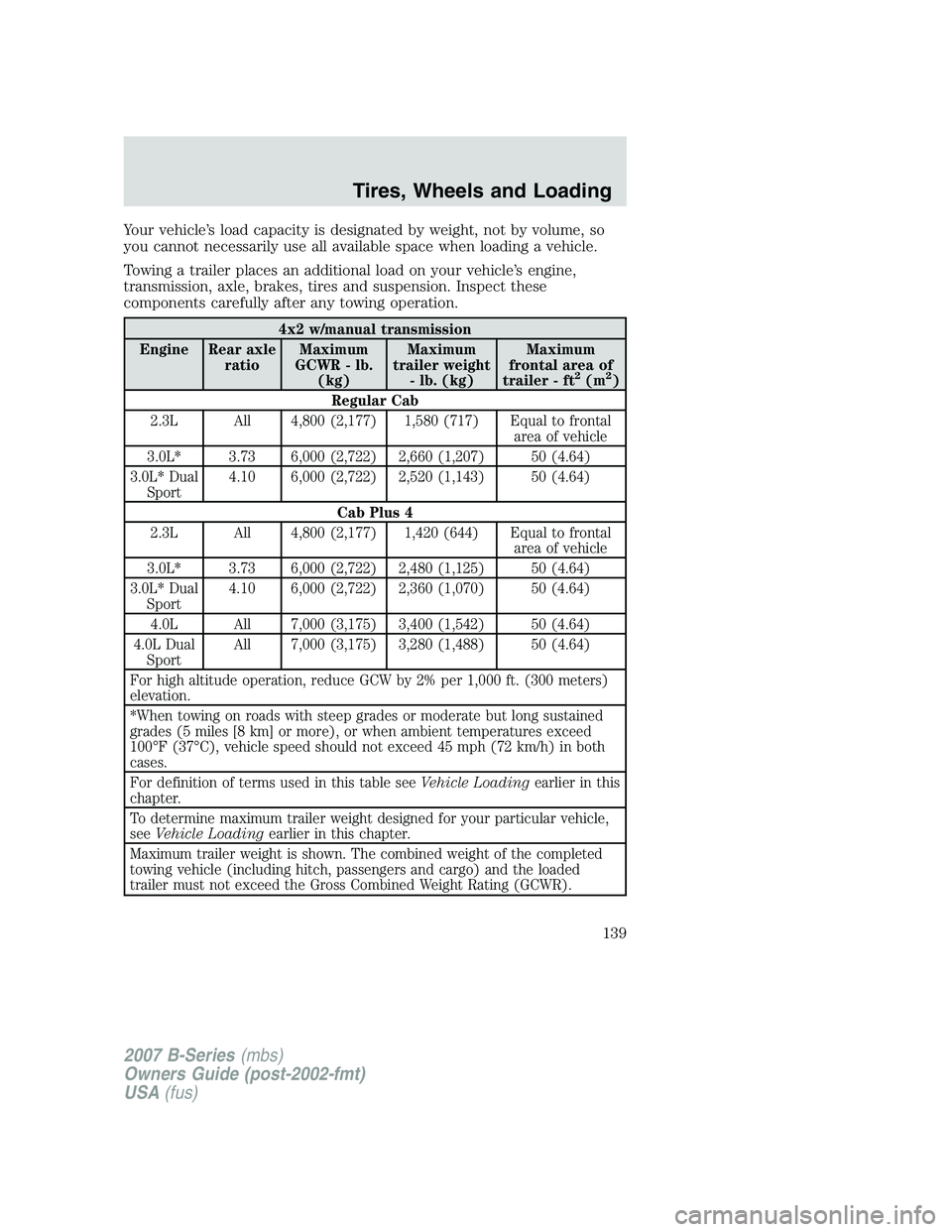
4x2 w/manual transmission
Engine Rear axle ratioMaximum
GCWR - lb. (kg) Maximum
trailer weight - lb. (kg) Maximum
frontal area of
trailer - ft
2(m2)
Regular Cab
2.3L All 4,800 (2,177) 1,580 (717) Equal to frontal area of vehicle
3.0L* 3.73 6,000 (2,722) 2,660 (1,207) 50 (4.64)
3.0L* Dual Sport 4.10 6,000 (2,722) 2,520 (1,143) 50 (4.64)
Cab Plus 4
2.3L All 4,800 (2,177) 1,420 (644) Equal to frontal area of vehicle
3.0L* 3.73 6,000 (2,722) 2,480 (1,125) 50 (4.64)
3.0L* Dual Sport 4.10 6,000 (2,722) 2,360 (1,070) 50 (4.64)
4.0L All 7,000 (3,175) 3,400 (1,542) 50 (4.64)
4.0L Dual Sport All 7,000 (3,175) 3,280 (1,488) 50 (4.64)
For high altitude operation, reduce GCW by 2% per 1,000 ft. (300 meters)
elevation.
*When towing on roads with steep grades or moderate but long sustained
grades (5 miles [8 km] or more), or when ambient temperatures exceed
100°F (37°C), vehicle speed should not exceed 45 mph (72 km/h) in both
cases.
For definition of terms used in this table see Vehicle Loadingearlier in this
chapter.
To determine maximum trailer weight designed for your particular vehicle,
see Vehicle Loading earlier in this chapter.
Maximum trailer weight is shown. The combined weight of the completed
towing vehicle (including hitch, passengers and cargo) and the loaded
trailer must not exceed the Gross Combined Weight Rating (GCWR).
2007 B-Series (mbs)
Owners Guide (post-2002-fmt)
USA (fus)
Tires, Wheels and Loading
139
Page 156 of 280
•Heavy or uneven steering efforts may be caused by low power steering
pump fluid level. Check for low power steering pump fluid level before
seeking service by your authorized dealer.
• Do not fill the power steering pump reservoir above the MAX mark on
the reservoir, as this may result in leaks from the reservoir.
If the power steering system breaks down (or if the engine is turned
off), you can steer the vehicle manually, but it takes more effort.
If the steering wanders or pulls, check for:
• Underinflated tire(s) on any wheel(s)
• Uneven vehicle loading
• High crown in center of road
• High crosswinds
• Wheels out of alignment
• Loose or worn suspension components
TRACTION-LOK AXLE (IF EQUIPPED)
This axle provides added traction on slippery surfaces, particularly when
one wheel is on a poor traction surface. Under normal conditions, the
Traction-Lok axle functions like a standard rear axle. The axle may
exhibit a slight noise or vibration in tight turns with low vehicle speed.
This is normal behavior and indicates the axle is working.
PREPARING TO DRIVE WARNING: Utility vehicles have a significantly higher rollover
rate than other types of vehicles.
WARNING: In a rollover crash, an unbelted person is
significantly more likely to die than a person wearing a seat
belt.
Your vehicle has larger tires and increased ground clearance, giving the
vehicle a higher center of gravity than a passenger car.
2007 B-Series (mbs)
Owners Guide (post-2002-fmt)
USA (fus)
Driving
156
Page 217 of 280
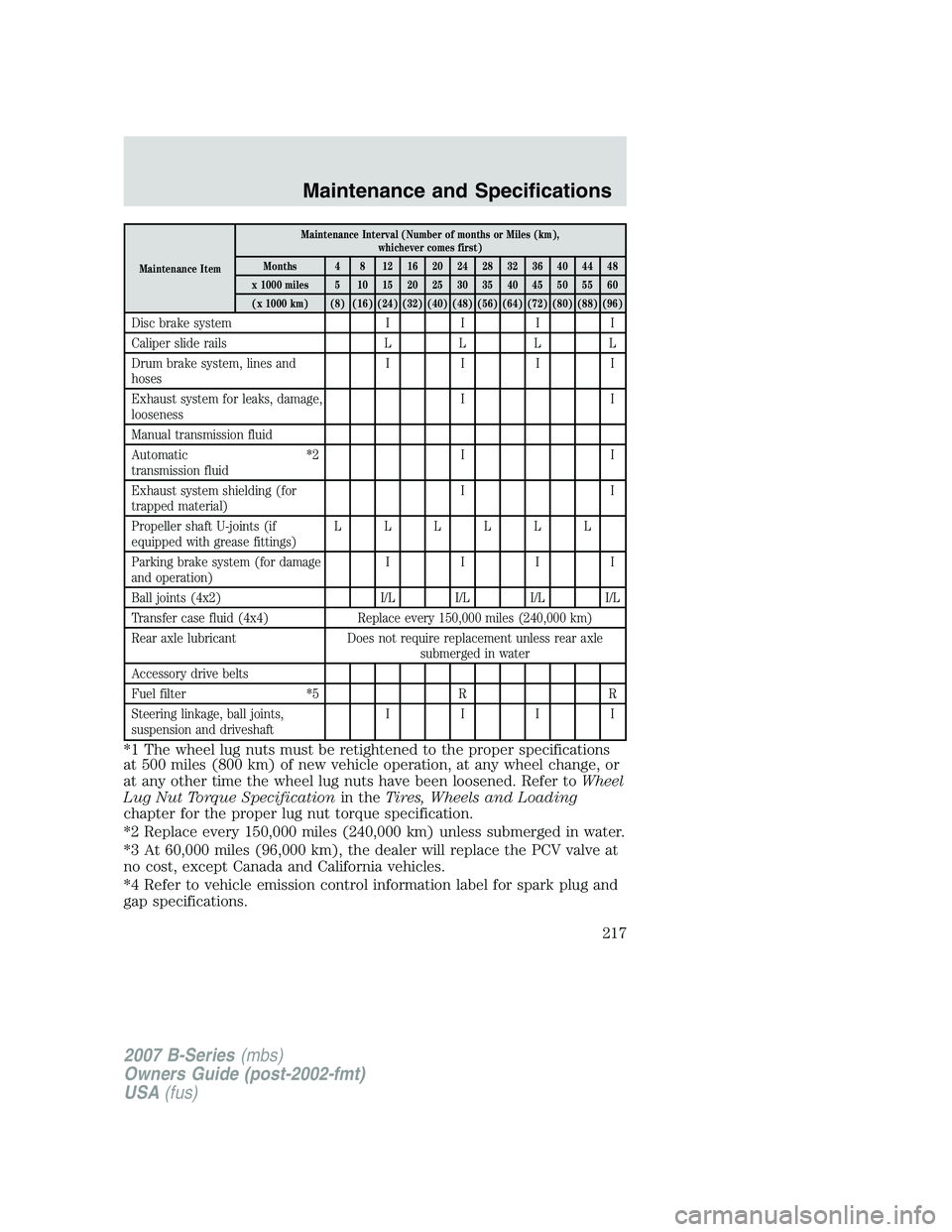
Maintenance ItemMaintenance Interval (Number of months or Miles (km),
whichever comes first)
Months 4 8 12 16 20 24 28 32 36 40 44 48
x 1000 miles 5 10 15 20 25 30 35 40 45 50 55 60 (x 1000 km) (8) (16) (24) (32) (40) (48) (56) (64) (72) (80) (88) (96)
Disc brake system IIII
Caliper slide rails LLLL
Drum brake system, lines and
hoses IIII
Exhaust system for leaks, damage,
looseness II
Manual transmission fluid
Automatic
transmission fluid *2
II
Exhaust system shielding (for
trapped material) II
Propeller shaft U-joints (if
equipped with grease fittings) LLLLLL
Parking brake system (for damage
and operation) IIII
Ball joints (4x2) I/L I/L I/L I/L
Transfer case fluid (4x4) Replace every 150,000 miles (240,000 km)
Rear axle lubricant Does not require replacement unless rear axle
submerged in water
Accessory drive belts
Fuel filter *5RR
Steering linkage, ball joints,
suspension and driveshaft IIII
*1 The wheel lug nuts must be retightened to the proper specifications
at 500 miles (800 km) of new vehicle operation, at any wheel change, or
at any other time the wheel lug nuts have been loosened. Refer to
Wheel
Lug Nut Torque Specification in theTires, Wheels and Loading
chapter for the proper lug nut torque specification.
*2 Replace every 150,000 miles (240,000 km) unless submerged in water.
*3 At 60,000 miles (96,000 km), the dealer will replace the PCV valve at
no cost, except Canada and California vehicles.
*4 Refer to vehicle emission control information label for spark plug and
gap specifications.
2007 B-Series (mbs)
Owners Guide (post-2002-fmt)
USA (fus)
Maintenance and Specifications
217
Page 219 of 280
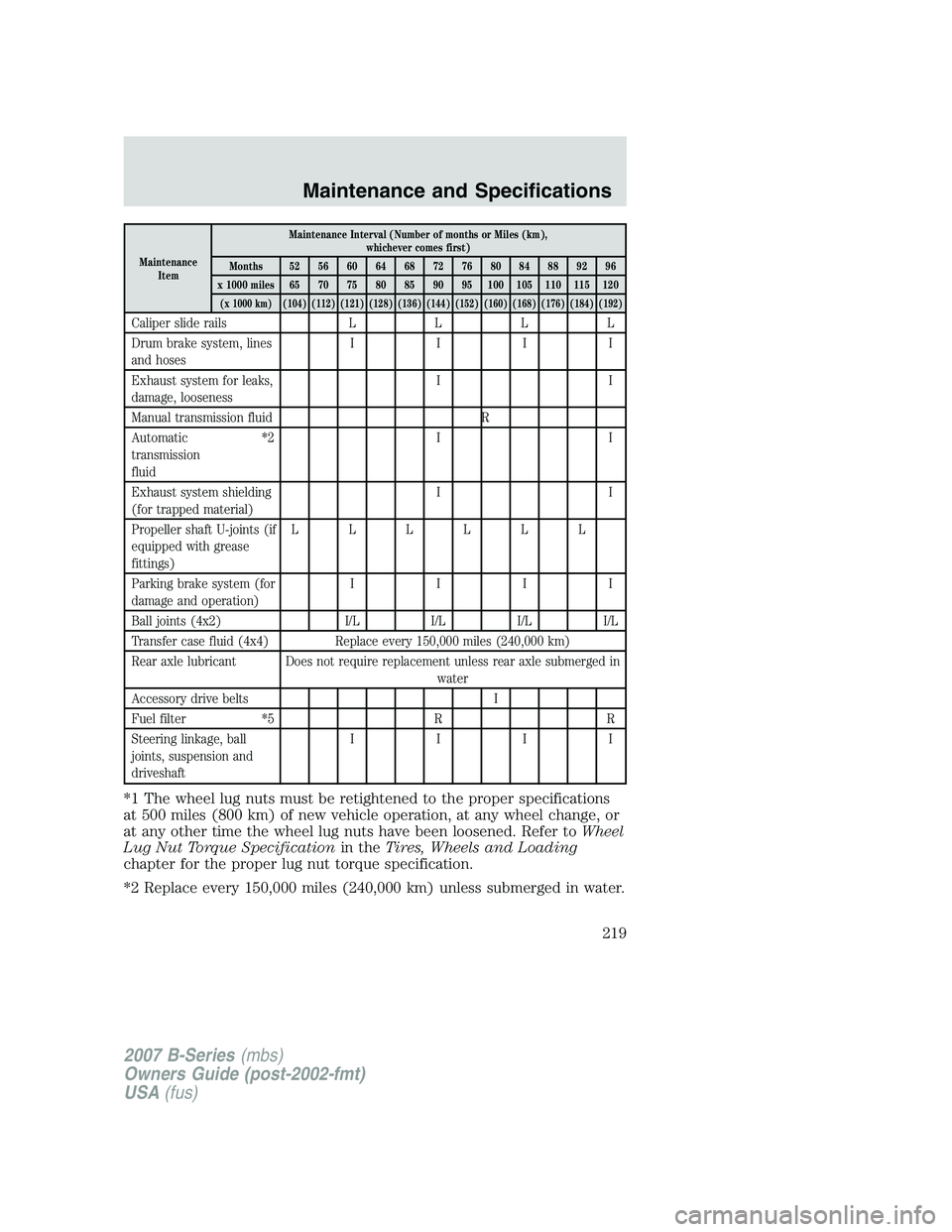
MaintenanceItem Maintenance Interval (Number of months or Miles (km),
whichever comes first)
Months 52 56 60 64 68 72 76 80 84 88 92 96
x 1000 miles 65 70 75 80 85 90 95 100 105 110 115 120
(x 1000 km) (104) (112) (121) (128) (136) (144) (152) (160) (168) (176) (184) (192)
Caliper slide rails LLLL
Drum brake system, lines
and hoses IIII
Exhaust system for leaks,
damage, looseness II
Manual transmission fluid R
Automatic
transmission
fluid *2
II
Exhaust system shielding
(for trapped material) II
Propeller shaft U-joints (if
equipped with grease
fittings) LLLLLL
Parking brake system (for
damage and operation) IIII
Ball joints (4x2) I/LI/LI/LI/L
Transfer case fluid (4x4) Replace every 150,000 miles (240,000 km)
Rear axle lubricant Does not require replacement unless rear axle submerged in water
Accessory drive belts I
Fuel filter *5 RR
Steering linkage, ball
joints, suspension and
driveshaft IIII
*1 The wheel lug nuts must be retightened to the proper specifications
at 500 miles (800 km) of new vehicle operation, at any wheel change, or
at any other time the wheel lug nuts have been loosened. Refer to
Wheel
Lug Nut Torque Specification in theTires, Wheels and Loading
chapter for the proper lug nut torque specification.
*2 Replace every 150,000 miles (240,000 km) unless submerged in water.
2007 B-Series (mbs)
Owners Guide (post-2002-fmt)
USA (fus)
Maintenance and Specifications
219