window MAZDA MODEL B4000 2003 Owners Manual
[x] Cancel search | Manufacturer: MAZDA, Model Year: 2003, Model line: MODEL B4000, Model: MAZDA MODEL B4000 2003Pages: 250, PDF Size: 2.85 MB
Page 1 of 250
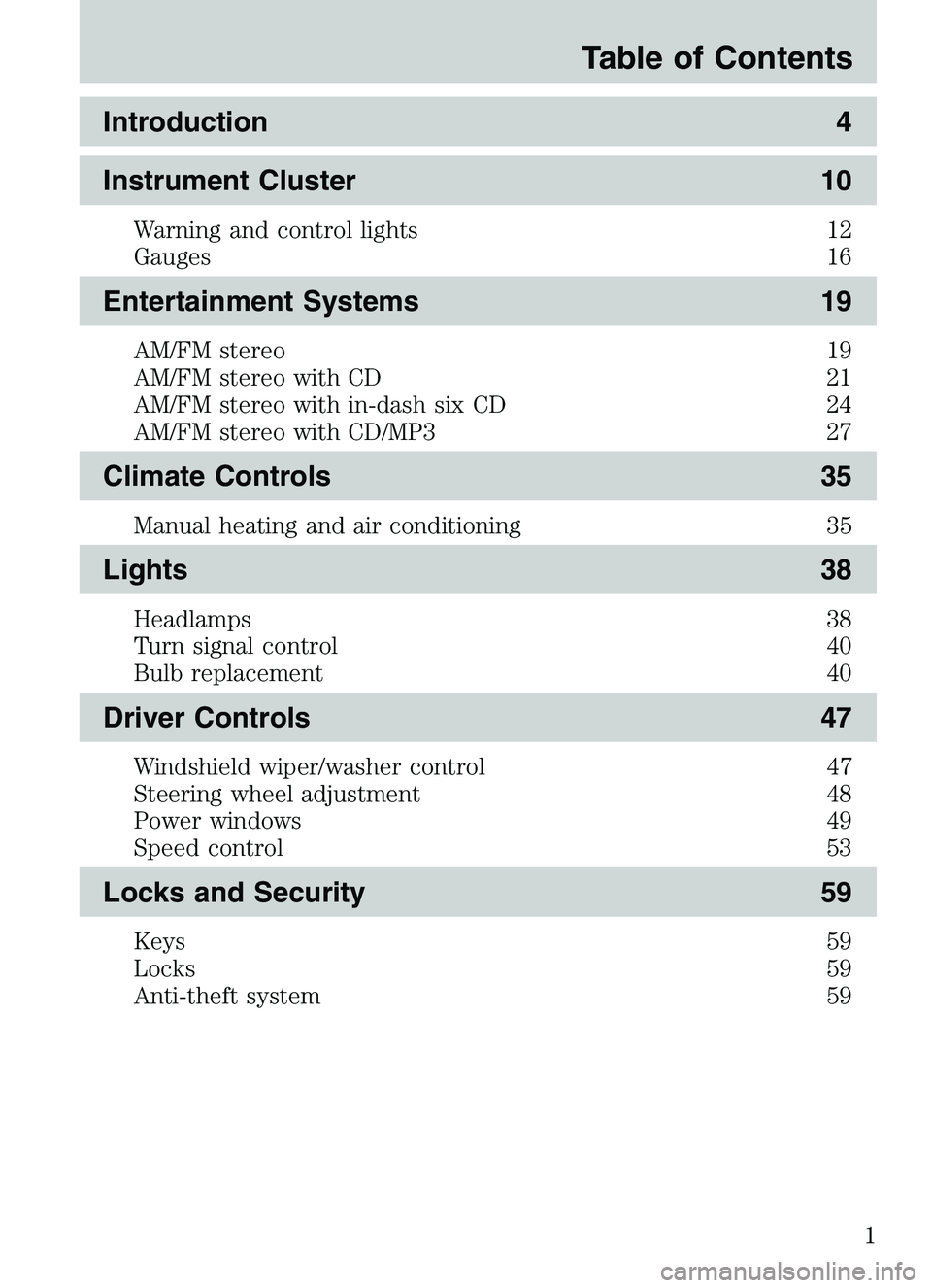
Introduction4
Instrument Cluster 10
Warning and control lights 12
Gauges 16
Entertainment Systems19
AM/FM stereo 19
AM/FM stereo with CD 21
AM/FM stereo with in-dash six CD 24
AM/FM stereo with CD/MP3 27
Climate Controls35
Manual heating and air conditioning 35
Lights38
Headlamps 38
Turn signal control 40
Bulb replacement 40
Driver Controls47
Windshield wiper/washer control 47
Steering wheel adjustment 48
Power windows 49
Speed control 53
Locks and Security59
Keys 59
Locks 59
Anti-theft system 59
Table of Contents
1
Page 8 of 250
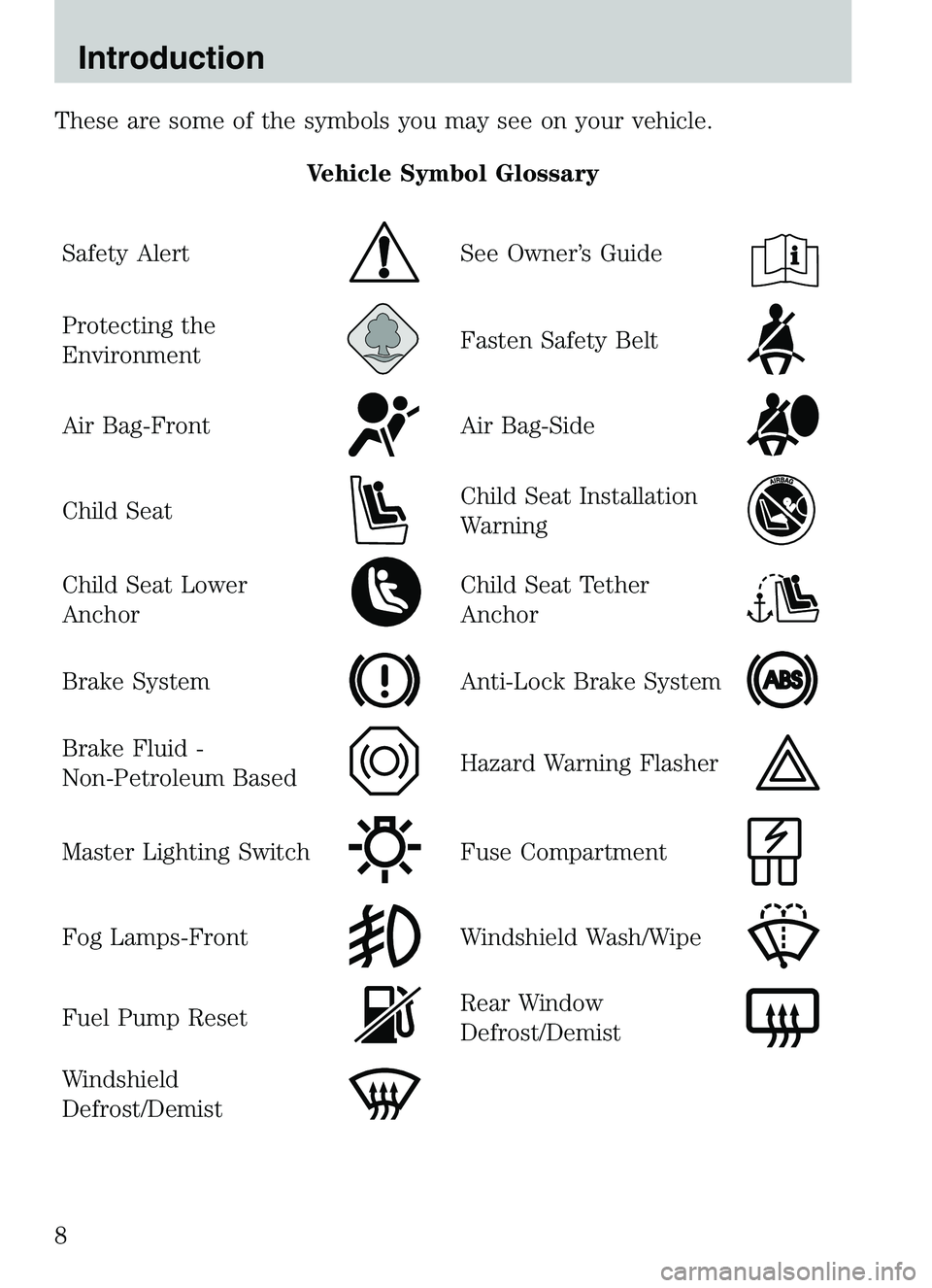
These are some of the symbols you may see on your vehicle.Vehicle Symbol Glossary
Safety Alert
See Owner’s Guide
Protecting the
EnvironmentFasten Safety Belt
Air Bag-FrontAir Bag-Side
Child SeatChild Seat Installation
Warning
Child Seat Lower
AnchorChild Seat Tether
Anchor
Brake SystemAnti-Lock Brake System
Brake Fluid -
Non-Petroleum BasedHazard Warning Flasher
Master Lighting SwitchFuse Compartment
Fog Lamps-FrontWindshield Wash/Wipe
Fuel Pump ResetRear Window
Defrost/Demist
Windshield
Defrost/Demist
Introduction
8
Page 9 of 250
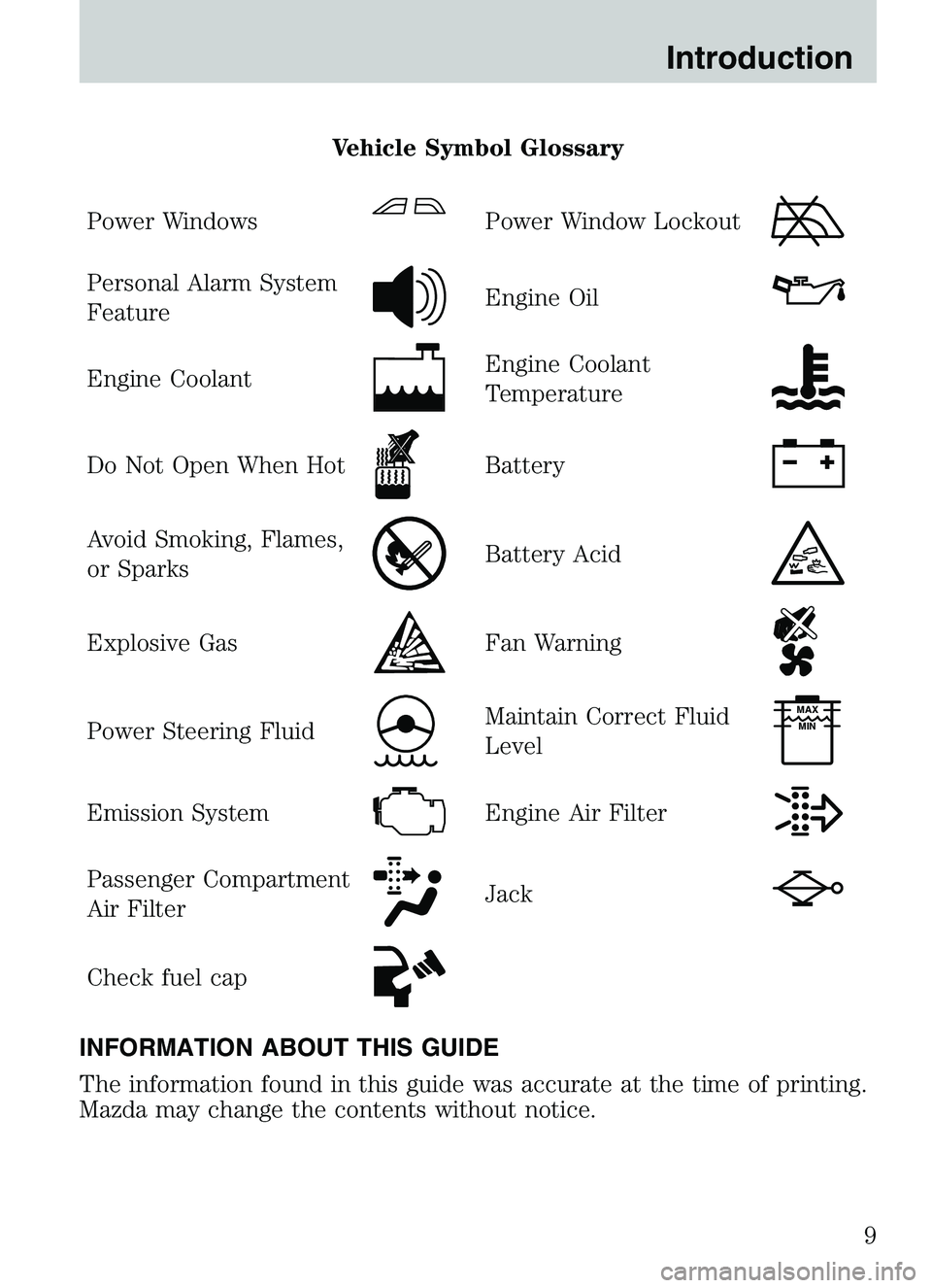
Vehicle Symbol Glossary
Power Windows
Power Window Lockout
Personal Alarm System
FeatureEngine Oil
Engine CoolantEngine Coolant
Temperature
Do Not Open When HotBattery
Avoid Smoking, Flames,
or SparksBattery Acid
Explosive GasFan Warning
Power Steering FluidMaintain Correct Fluid
LevelMAX MIN
Emission SystemEngine Air Filter
Passenger Compartment
Air FilterJack
Check fuel cap
INFORMATION ABOUT THIS GUIDE
The information found in this guide was accurate at the time of printing.
Mazda may change the contents without notice.
Introduction
9
Page 35 of 250
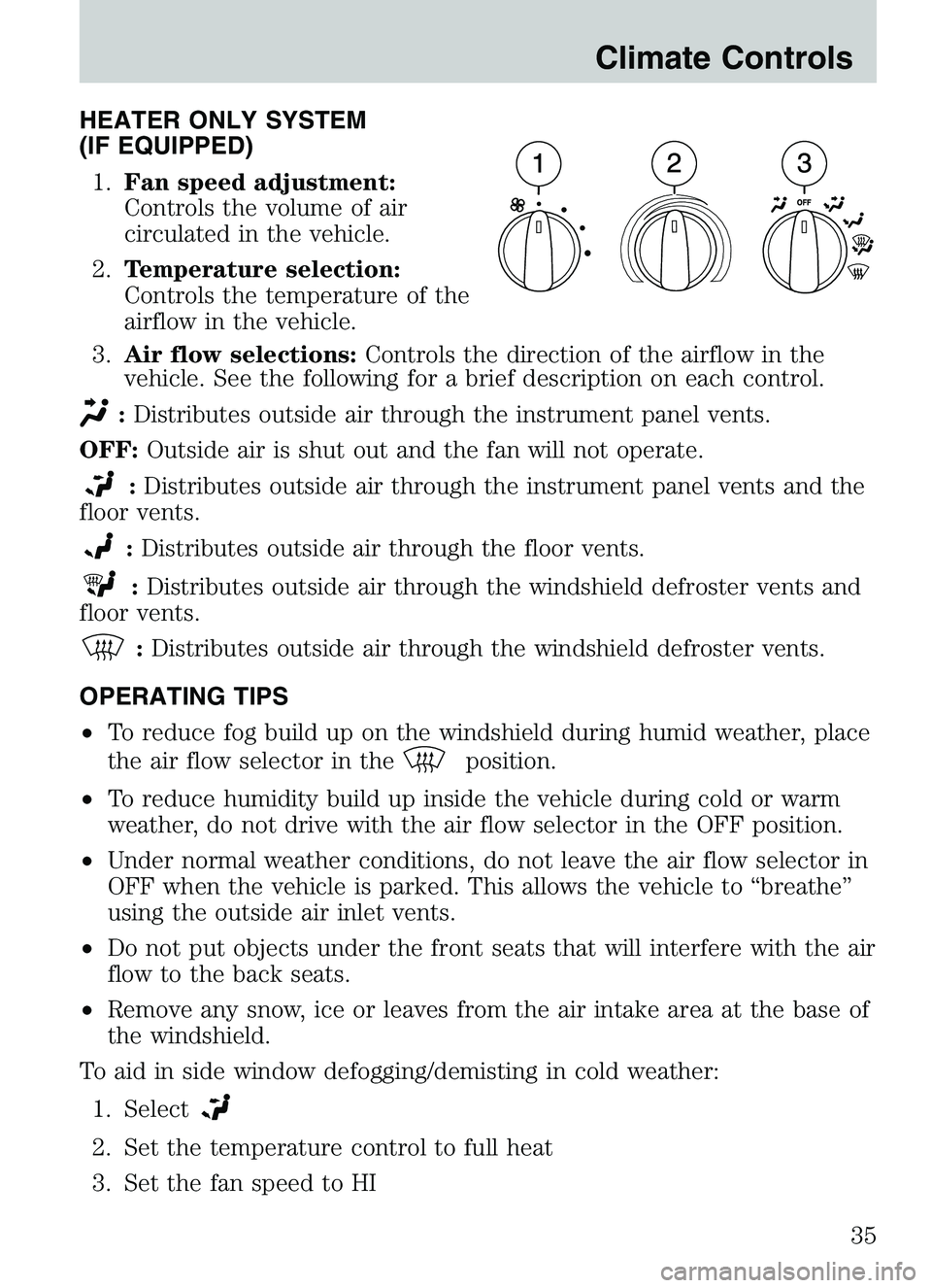
HEATER ONLY SYSTEM
(IF EQUIPPED)1. Fan speed adjustment:
Controls the volume of air
circulated in the vehicle.
2. Temperature selection:
Controls the temperature of the
airflow in the vehicle.
3. Air flow selections: Controls the direction of the airflow in the
vehicle. See the following for a brief description on each control.
: Distributes outside air through the instrument panel vents.
OFF: Outside air is shut out and the fan will not operate.
:Distributes outside air through the instrument panel vents and the
floor vents.
: Distributes outside air through the floor vents.
:Distributes outside air through the windshield defroster vents and
floor vents.
: Distributes outside air through the windshield defroster vents.
OPERATING TIPS
• To reduce fog build up on the windshield during humid weather, place
the air flow selector in the
position.
• To reduce humidity build up inside the vehicle during cold or warm
weather, do not drive with the air flow selector in the OFF position.
• Under normal weather conditions, do not leave the air flow selector in
OFF when the vehicle is parked. This allows the vehicle to “breathe”
using the outside air inlet vents.
• Do not put objects under the front seats that will interfere with the air
flow to the back seats.
• Remove any snow, ice or leaves from the air intake area at the base of
the windshield.
To aid in side window defogging/demisting in cold weather:
1. Select
2. Set the temperature control to full heat
3. Set the fan speed to HI
Climate Controls
35
Page 36 of 250
4. Direct the outer instrument panel vents towards the side windows
To increase airflow to the outer instrument panel vents, close the vents
located in the middle of the instrument panel.
WARNING: Do not place objects on top of the instrument panel
as these objects may become projectiles in a collision or sudden
stop.
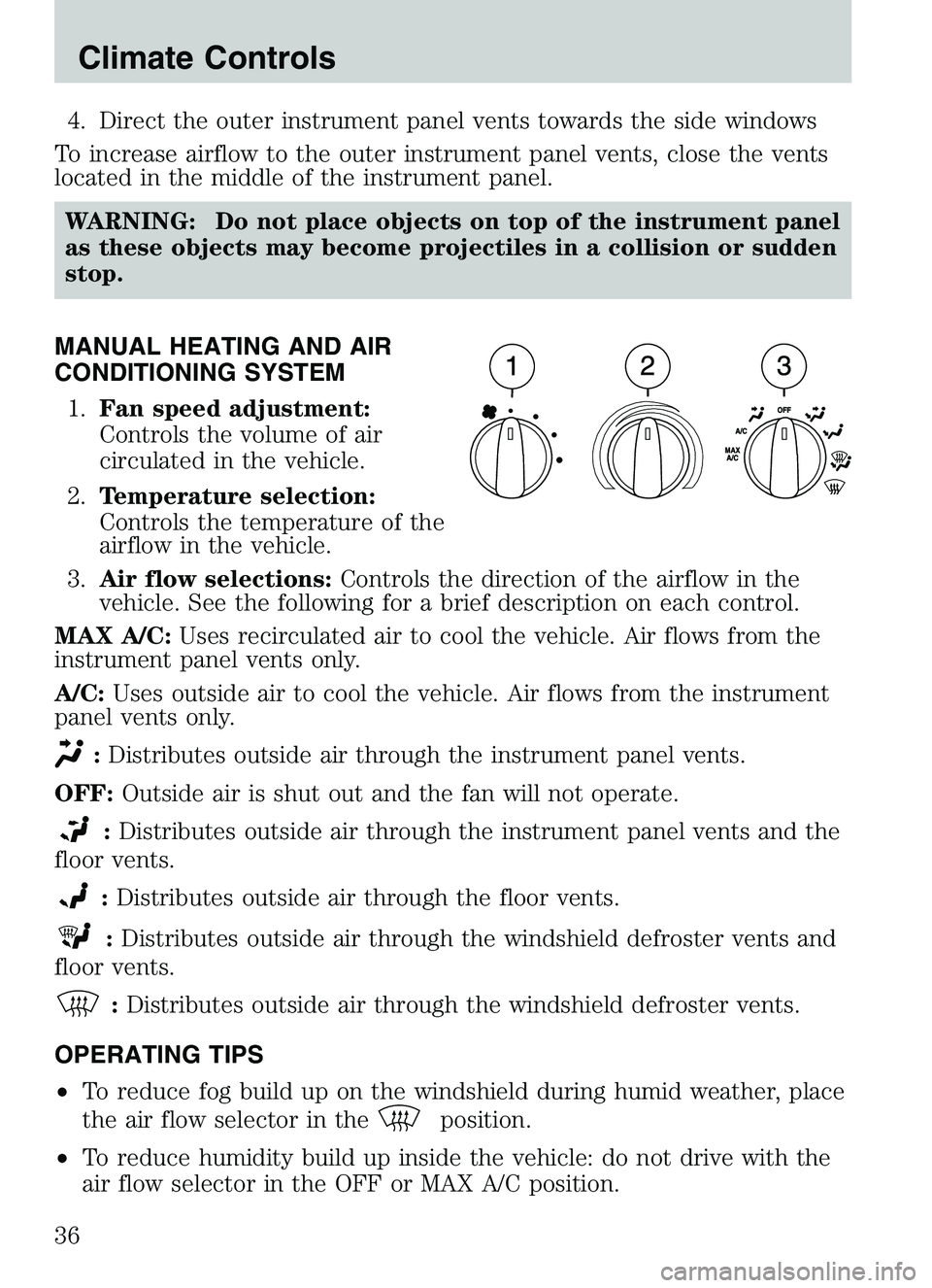
MANUAL HEATING AND AIR
CONDITIONING SYSTEM 1. Fan speed adjustment:
Controls the volume of air
circulated in the vehicle.
2. Temperature selection:
Controls the temperature of the
airflow in the vehicle.
3. Air flow selections: Controls the direction of the airflow in the
vehicle. See the following for a brief description on each control.
MAX A/C: Uses recirculated air to cool the vehicle. Air flows from the
instrument panel vents only.
A/C: Uses outside air to cool the vehicle. Air flows from the instrument
panel vents only.
: Distributes outside air through the instrument panel vents.
OFF: Outside air is shut out and the fan will not operate.
:Distributes outside air through the instrument panel vents and the
floor vents.
: Distributes outside air through the floor vents.
:Distributes outside air through the windshield defroster vents and
floor vents.
: Distributes outside air through the windshield defroster vents.
OPERATING TIPS
• To reduce fog build up on the windshield during humid weather, place
the air flow selector in the
position.
• To reduce humidity build up inside the vehicle: do not drive with the
air flow selector in the OFF or MAX A/C position.
Climate Controls
36
Page 37 of 250
•Under normal weather conditions, do not leave the air flow selector in
MAX A/C or OFF when the vehicle is parked. This allows the vehicle
to “breathe” using the outside air inlet vents.
• Do not put objects under the front seats that will interfere with the
airflow to the back seats.
• Remove any snow, ice or leaves from the air intake area at the base of
the windshield.
To aid in side window defogging/demisting in cold weather:
1. Select
2. Select A/C
3. Modulate the temperature control to maintain comfort.
4. Set the fan speed to HI
5. Direct the outer instrument panel vents towards the side windows
To increase airflow to the outer instrument panel vents, close the vents
located in the middle of the instrument panel.
WARNING: Do not place objects on top of the instrument panel
as these objects may become projectiles in a collision or sudden
stop.
Climate Controls
37
Page 49 of 250
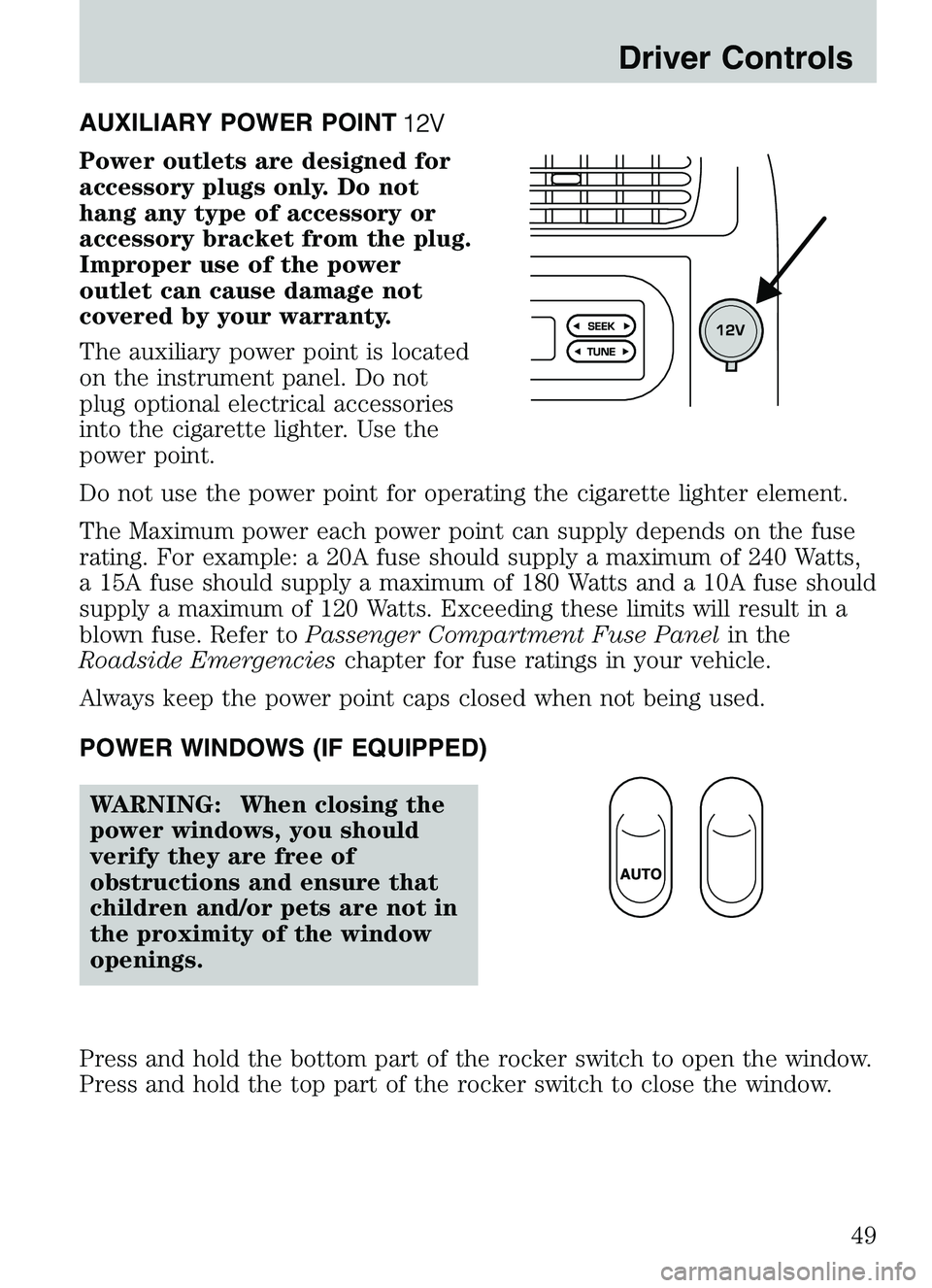
AUXILIARY POWER POINT
Power outlets are designed for
accessory plugs only. Do not
hang any type of accessory or
accessory bracket from the plug.
Improper use of the power
outlet can cause damage not
covered by your warranty.
The auxiliary power point is located
on the instrument panel. Do not
plug optional electrical accessories
into the cigarette lighter. Use the
power point.
Do not use the power point for operating the cigarette lighter element.
The Maximum power each power point can supply depends on the fuse
rating. For example: a 20A fuse should supply a maximum of 240 Watts,
a 15A fuse should supply a maximum of 180 Watts and a 10A fuse should
supply a maximum of 120 Watts. Exceeding these limits will result in a
blown fuse. Refer toPassenger Compartment Fuse Panel in the
Roadside Emergencies chapter for fuse ratings in your vehicle.
Always keep the power point caps closed when not being used.
POWER WINDOWS (IF EQUIPPED)
WARNING: When closing the
power windows, you should
verify they are free of
obstructions and ensure that
children and/or pets are not in
the proximity of the window
openings.
Press and hold the bottom part of the rocker switch to open the window.
Press and hold the top part of the rocker switch to close the window.
Driver Controls
49
Page 50 of 250

One touch down
Allows the driver’s window to open
fully without holding the control
down. Press completely down on
AUTO and release quickly. Press
again to stop.
AUTOMATIC DIMMING REAR VIEW MIRRORS (IF EQUIPPED)
The electronic day/night mirror will change from the normal state to the
non-glare state when bright lights (glare) reach the inside rear view
mirror. When the inside rear view mirror detects bright light from behind
the vehicle, the inside rear view mirror will automatically adjust (darken)
to minimize glare.
Do not block the sensor on the backside of the inside rear view mirror
since this may impair proper system performance.
Press the left button on the mirror
to turn the auto dimming ON or
OFF. The green indicator light left
of the display will illuminate when
this feature is ON.
COMPASS/TEMPERATURE EC MIRROR (IF EQUIPPED)
The compass reading may be affected when you drive near large
buildings, bridges, power lines and powerful broadcast antennas.
Magnetic or metallic objects placed in, on or near the vehicle may also
affect compass accuracy.
Usually, when something affects the compass readings, the compass will
correct itself after a few days of operating your vehicle in normal
conditions. If the compass still appears to be inaccurate, a manual
calibration may be necessary. Refer toCompass calibration
adjustment.
Most geographic areas (zones) have a magnetic north compass point that
varies slightly from the northerly direction on maps. This variation is four
Driver Controls
50
Page 115 of 250

WARNING: If you smell exhaust fumes inside your vehicle,
have your dealer inspect your vehicle immediately. Do not drive
if you smell exhaust fumes.
Important ventilating information
If the engine is idling while the vehicle is stopped for a long period of
time, open the windows at least 2.5 cm (one inch) or adjust the heating
or air conditioning to bring in fresh air.
BRAKES
Occasional brake noise is normal. If a metal-to-metal, continuous grinding
or continuous squeal sound is present, the brake linings may be worn-out
and should be inspected by a qualified service technician. If the vehicle
has continuous vibration or shudder in the steering wheel while braking,
the vehicle should be inspected by a qualified service technician.
Four-wheel anti-lock brake system (ABS)
This vehicle is equipped with an anti-lock braking system (ABS), a noise
from the hydraulic pump motor and pulsation in the pedal may be
observed during ABS braking events. Pedal pulsation coupled with noise
while braking under panic conditions or on loose gravel, bumps, wet or
snowy roads is normal and indicates proper functioning of the vehicle’s
anti-lock brake system.
NOTE: The ABS performs a self-check after you start the engine and
begin to drive away.
A brief mechanical noise may be heard during this test. This is normal. If
a malfunction is found, the ABS warning light will come on. If the vehicle
has continuous vibration or shudder in the steering wheel while braking,
the vehicle should be inspected by an authorized Mazda dealership.
The ABS operates by detecting the
onset of wheel lockup during brake
applications and compensates for
this tendency. The wheels are
prevented from locking even when
the brakes are firmly applied. The
accompanying illustration depicts
the advantage of an ABS equipped
vehicle (on bottom) to a non-ABS
equipped vehicle (on top) during hard braking with loss of front braking
traction.
Driving
115
Page 146 of 250

Fuse/RelayLocation Fuse Amp
Rating Power Distribution Box
Description
8 20A* Central security module, Power
door locks, Remote entry
9 — Not used
10 — Not used
11 50A** Starter relay, Ignition switch
12 20A* Power windows
13 — Not used
14 — Not used
15 — Not used
16 40A** Blower motor
17 20A** Auxiliary cooling fan
18 — Not used
19 — Not used
20 — Not used
21 10A* PCM memory
22 — Not used
23 20A* Fuel pump motor
24 30A* Headlamps
25 10A* A/C clutch relay
26 — Not used
27 — Not used
28 30A* ABS module
29 — Not used
30 15A* Trailer Tow
31 20A* Foglamp, Daytime Running Lamps
(DRL)
32 — Not used
33 15A* Park lamp, Central security
module
34 — Not used
35 — Not used
Roadside Emergencies
146