air condition MAZDA MODEL B4000 4WD 2003 User Guide
[x] Cancel search | Manufacturer: MAZDA, Model Year: 2003, Model line: MODEL B4000 4WD, Model: MAZDA MODEL B4000 4WD 2003Pages: 250, PDF Size: 2.85 MB
Page 91 of 250

effectiveness of the safety belts, because safety belts in modern vehicles
are designed to work as a safety system with the air bags.
Read all air bag Warning labels in the vehicle as well as the other
important air bag instructions and Warnings in this Owner’s Guide.
NHTSA gives permission to install airbag cut-off switches in the
following terms:1. Infant. An infant (less than 1 year old) must ride in the front seat
because:
• the vehicle has no rear seat;
• the vehicle has a rear seat too small to accommodate a rear-facing
infant seat; or
• the infant has a medical condition which, according to the infant’s
physician, makes it necessary for the infant to ride in the front so that
the driver can constantly monitor the child’s condition.
2. Child age 1 to 12. A child age 1 to 12 must ride in the front seat
because:
• the vehicle has no rear seat;
• although children ages 1 to 12 ride in the rear seat(s) whenever
possible, children ages 1 to 12 sometimes must ride in the front
because no space is available in the rear seat(s) of the vehicle; or
• the child has a medical condition which, according to the child’s
physician, makes it necessary for the child to ride in the front seat so
that the driver can constantly monitor the child’s condition.
3. Medical condition. A passenger has a medical condition which,
according to his or her physician:
• causes the passenger air bag to pose a special risk for the passenger;
and
• makes the potential harm from the passenger air bag in a crash
greater than the potential harm from turning OFF the air bag and
allowing the passenger, even if belted, to hit the dashboard or
windshield in a crash.
Seating and Safety Restraints
91
Page 92 of 250
WARNING: This vehicle has special energy management safety
belts for the driver and right front passenger. These particular
belts are specifically designed to work with air bags to help
reduce the risk of injury in a collision. The energy management
safety belt is designed to give or release additional belt
webbing in some accidents to reduce concentration of force on
an occupant’s chest and reduce the risk of certain bone
fractures and injuries to underlying organs. In a crash, if the air
bag is turned OFF, this energy management safety belt might
permit the person wearing the belt to move forward enough to
incur a serious or fatal injury. The more severe the crash, and
the heavier the occupant, the greater the risk is. Be sure the air
bag is turned ON for any person who does not qualify under the
NHTSA deactivation criteria.
Transport Canada gives permission to install aribag cut-off
switches in the following terms: 1. Infant: An infant (less than 1 year old) must ride in the front seat
because:
• my vehicle has no rear seat;
• the rear seat in my vehicle cannot accommodate a rear-facing infant
seat; or
• the infant has a medical condition which, according to the infant’s
physician, makes it necessary for the infant to ride in the front seat so
that the driver can monitor the infant’s condition.
2. Child age 12 or under: A child age 12 or under must ride in the
front seat because:
• my vehicle has no rear seat;
• although children age 12 and under ride in the rear seat whenever
possible, children age 12 and under have no option but to sometimes
ride in the front seat because rear seat space is insufficient; or
• the child has a medical condition that, according to the child’s
physician, makes it necessary for the child to ride in the front seat so
that the driver can monitor the child’s condition.
3. Medical condition: A passenger has a medical condition that,
according to his or her physician:
• poses a special risk for the passenger if the air bag deploys; and
• makes the potential harm from the passenger air bag deployment
greater than the potential harm from turning OFF the air bag and
experiencing a crash without the protection offered by the air bag
Seating and Safety Restraints
92
Page 115 of 250

WARNING: If you smell exhaust fumes inside your vehicle,
have your dealer inspect your vehicle immediately. Do not drive
if you smell exhaust fumes.
Important ventilating information
If the engine is idling while the vehicle is stopped for a long period of
time, open the windows at least 2.5 cm (one inch) or adjust the heating
or air conditioning to bring in fresh air.
BRAKES
Occasional brake noise is normal. If a metal-to-metal, continuous grinding
or continuous squeal sound is present, the brake linings may be worn-out
and should be inspected by a qualified service technician. If the vehicle
has continuous vibration or shudder in the steering wheel while braking,
the vehicle should be inspected by a qualified service technician.
Four-wheel anti-lock brake system (ABS)
This vehicle is equipped with an anti-lock braking system (ABS), a noise
from the hydraulic pump motor and pulsation in the pedal may be
observed during ABS braking events. Pedal pulsation coupled with noise
while braking under panic conditions or on loose gravel, bumps, wet or
snowy roads is normal and indicates proper functioning of the vehicle’s
anti-lock brake system.
NOTE: The ABS performs a self-check after you start the engine and
begin to drive away.
A brief mechanical noise may be heard during this test. This is normal. If
a malfunction is found, the ABS warning light will come on. If the vehicle
has continuous vibration or shudder in the steering wheel while braking,
the vehicle should be inspected by an authorized Mazda dealership.
The ABS operates by detecting the
onset of wheel lockup during brake
applications and compensates for
this tendency. The wheels are
prevented from locking even when
the brakes are firmly applied. The
accompanying illustration depicts
the advantage of an ABS equipped
vehicle (on bottom) to a non-ABS
equipped vehicle (on top) during hard braking with loss of front braking
traction.
Driving
115
Page 127 of 250
When driving through water, determine the depth; avoid water higher
than the bottom of the hubs (if possible) and proceed slowly. If the
ignition system gets wet, the vehicle may stall.
Once through water, always try the brakes. Wet brakes do not stop the
vehicle as effectively as dry brakes. Drying can be improved by moving
your vehicle slowly while applying light pressure on the brake pedal.
After driving through mud, clean off residue stuck to the driveshafts and
tires. Excess mud stuck on tires and rotating driveshafts causes an
imbalance that could damage drive components.
If the transmission, transfer case or front axle are submerged in water,
their fluids should be checked and changed, if necessary.
Driving through deep water where the transmission vent tube is
submerged may allow water into the transmission and cause
internal transmission damage.
Replace rear axle lubricant any time the axle has been submerged in
water. The rear axle does not normally require a lubricant change for the
life of the vehicle. Rear axle lubricant quantities are not to be checked or
changed unless a leak is suspected or repair is required.
Driving on hilly or sloping terrain
When driving on a hill, avoid driving crosswise or turning on steep
slopes. You could lose traction and slip sideways. Drive straight up,
straight down or avoid the hill completely. Know the conditions on the
other side of a hill before driving over the crest.
When climbing a steep hill, start in a lower gear rather than downshifting
to a lower gear from a higher gear once the ascent has started. This
reduces strain on the engine and the possibility of stalling.
When descending a steep hill, avoid sudden braking. Shift to a lower gear
when added engine braking is desired.
When speed control is on and you are driving uphill, your vehicle speed
may drop considerably, especially if you are carrying a heavy load.
If vehicle speed drops more than 16 km/h (10 mph), the speed control
will cancel automatically. Resume speed with accelerator pedal.
If speed control cancels after climbing the hill, reset speed by pressing
and holding the SET ACCEL button (to resume speeds over 50 km/h [30
mph]).
Automatic transmissions may shift frequently while driving up steep
grades. Eliminate frequent shifting by shifting out of
(Overdrive) into
a lower gear.
Driving
127
Page 150 of 250

Fuse/RelayLocation Fuse Amp
Rating Power Distribution Box
Description
42 10A* Right headlamp low beam
43 — Not used
44 — Not used
45A — Wiper HI/LO relay 45B — Wiper park/run relay
46A — Fuel pump relay 46B — Trailer tow relay
47A — A/C clutch solenoid relay 47B — Front washer pump relay
48A — Fog lamps 48B — Fog lamp relay 51 — Not used
52 — Not used
53 — Powertrain Control Module (PCM) Diode
54 — Powertrain Control Module (PCM)
55 — Blower relay
56 — Starter relay
* Mini Fuses ** Maxi Fuses
OVERHEATING
If the temperature gauge indicates overheating and you experience
power loss, you hear a loud knocking or pinging noise, the engine is
probably too hot.
If this happens: 1. Drive safely to the side of the road and park off the right-of-way.
2. Shift the automatic transmission into P (Park) or the manual transmission into the neutral position, and apply the parking brake.
3. Turn off the air conditioner.
WARNING: Steam from an overheated engine is dangerous. The
escaping steam could seriously burn you. Open the hood ONLY
after steam is no longer escaping from the engine.
Roadside Emergencies
150
Page 174 of 250

IN CALIFORNIA (U.S. ONLY)
California Civil Code Section 1793.2(d) requires that, if a manufacturer
or its representative is unable to repair a motor vehicle to conform to the
vehicle’s applicable express warranty after a reasonable number of
attempts, the manufacturer shall be required to either replace the
vehicle with one substantially identical or repurchase the vehicle and
reimburse the buyer in an amount equal to the actual price paid or
payable by the consumer (less a reasonable allowance for consumer
use). The consumer has the right to choose whether to receive a refund
or replacement vehicle.
California Civil Code Section 1793.22(b) presumes that the manufacturer
has had a reasonable number of attempts to conform the vehicle to its
applicable express warranties if, within the first 18 months of ownership
of a new vehicle or the first 29 000 km (18 000 miles), whichever occurs
first:1. Two or more repair attempts are made on the same nonconformity likely to cause death or serious bodily injury OR
2. Four or more repair attempts are made on the same nonconformity (a defect or condition that substantially impairs the use, value or
safety of the vehicle) OR
3. The vehicle is out of service for repair of nonconformities for a total of more than 30 calendar days (not necessarily all at one time)
In the case of 1 or 2 above, the consumer must also notify the
manufacturer of the need for the repair of the nonconformity at the
following address:
Mazda North American Operations
7755, Irvine Center Drive
Irvine, CA 92618–2922
REPORTING SAFETY DEFECTS (U.S. ONLY)
If you believe that your vehicle has a defect that could cause a crash, or
could cause injury or death, you should immediately inform the National
Highway Traffic Safety Administration (NHTSA) in addition to notifying
Mazda Corporation.
If NHTSA receives similar complaints, it may open an investigation, and
if it finds that a safety defect exists in a group of vehicles, it may order a
recall and remedy campaign. However, NHTSA cannot become involved
in individual problems between you, your dealer or Mazda Corporation.
Customer Assistance
174
Page 182 of 250
INTRODUCTION
Be extremely careful to prevent injury to yourself and others and
damage to your vehicle when using this manual for inspection and
maintenance.
If you’re unsure about any procedure it describes, we strongly urge you
to have a reliable and qualified service shop perform the work, preferably
an Authorized Mazda Dealer.
Factory-trained Mazda technicians and genuine Mazda parts are best for
your vehicle. Without this expertise and the parts that have been
designed and made especially for your Mazda, inadequate, incomplete,
and insufficient servicing may result in problems. This could lead to
vehicle damage or an accident and injuries.
For expert advice and quality service, consult an Authorized Mazda
Dealer.
The owner should retain evidence that proper maintenance has been
performed as prescribed.
Claims against the warranty resulting from lack of maintenance, as
opposed to defective materials or authorized Mazda workmanship, will
not be honored.
Any auto repair shop using parts equivalent to your Mazda’s original
equipment may perform maintenance.But we recommend that it
always be done by an Authorized Mazda Dealer using genuine
Mazda parts.
SCHEDULED MAINTENANCE
Schedule I — Normal Driving Conditions/Emission Control
Systems
Follow Schedule I if the vehicle is operated mainly where none of the
following conditions apply. If any do apply follow Schedule II.
• Repeated short-distance driving.
• Driving in dusty conditions.
• Towing a trailer.
• Operating in hot weather in stop-and-go “rush hour” traffic.
• Extended periods of idling or low-speed operation.
• High-speed operation with a fully loaded vehicle.
• Off-road operation.
NOTE: After the described period, continue to follow the described
maintenance at the recommended intervals.
Maintenance and Specifications
182
Page 183 of 250
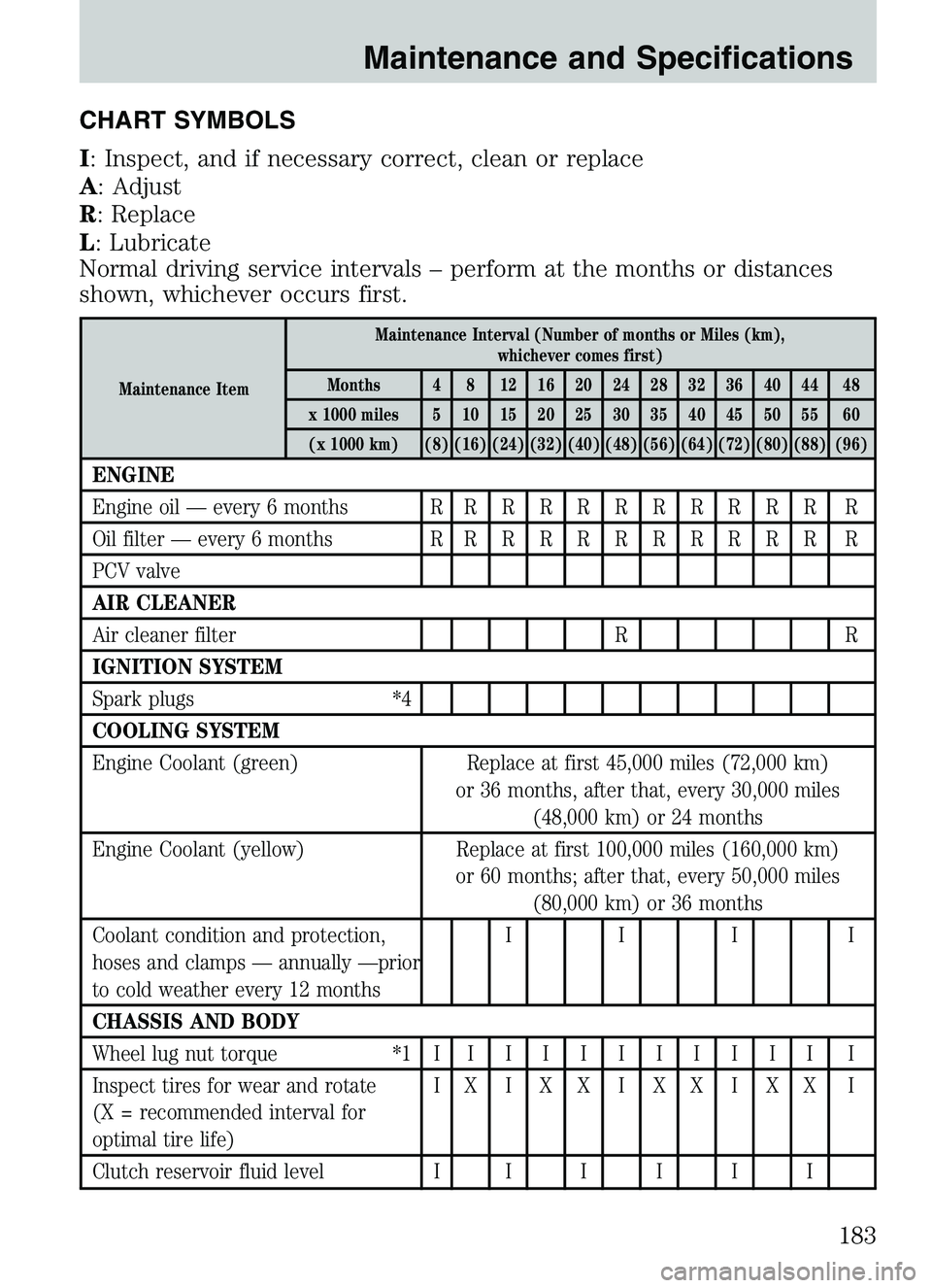
CHART SYMBOLS
I: Inspect, and if necessary correct, clean or replace
A: Adjust
R: Replace
L: Lubricate
Normal driving service intervals – perform at the months or distances
shown, whichever occurs first.
Maintenance ItemMaintenance Interval (Number of months or Miles (km),
whichever comes first)
Months 4 8 12 16 20 24 28 32 36 40 44 48
x 1000 miles 5 10 15 20 25 30 35 40 45 50 55 60 (x 1000 km) (8) (16) (24) (32) (40) (48) (56) (64) (72) (80) (88) (96)
ENGINE
Engine oil — every 6 months R RRRRRRRRRR R
Oil filter — every 6 months R RRRRRRRRRR R
PCV valve
AIR CLEANER
Air cleaner filter R R
IGNITION SYSTEM
Spark plugs *4
COOLING SYSTEM
Engine Coolant (green) Replace at first 45,000 miles (72,000 km) or 36 months, after that, every 30,000 miles(48,000 km) or 24 months
Engine Coolant (yellow) Replace at first 100,000 miles (160,000 km) or 60 months; after that, every 50,000 miles(80,000 km) or 36 months
Coolant condition and protection,
hoses and clamps — annually —prior
to cold weather every 12 months III I
CHASSIS AND BODY
Wheel lug nut torque *1 I IIIIIIIIII I
Inspect tires for wear and rotate
(X = recommended interval for
optimal tire life) IXIXXIXXIXX I
Clutch reservoir fluid level I IIIII
Maintenance and Specifications
183
Page 185 of 250
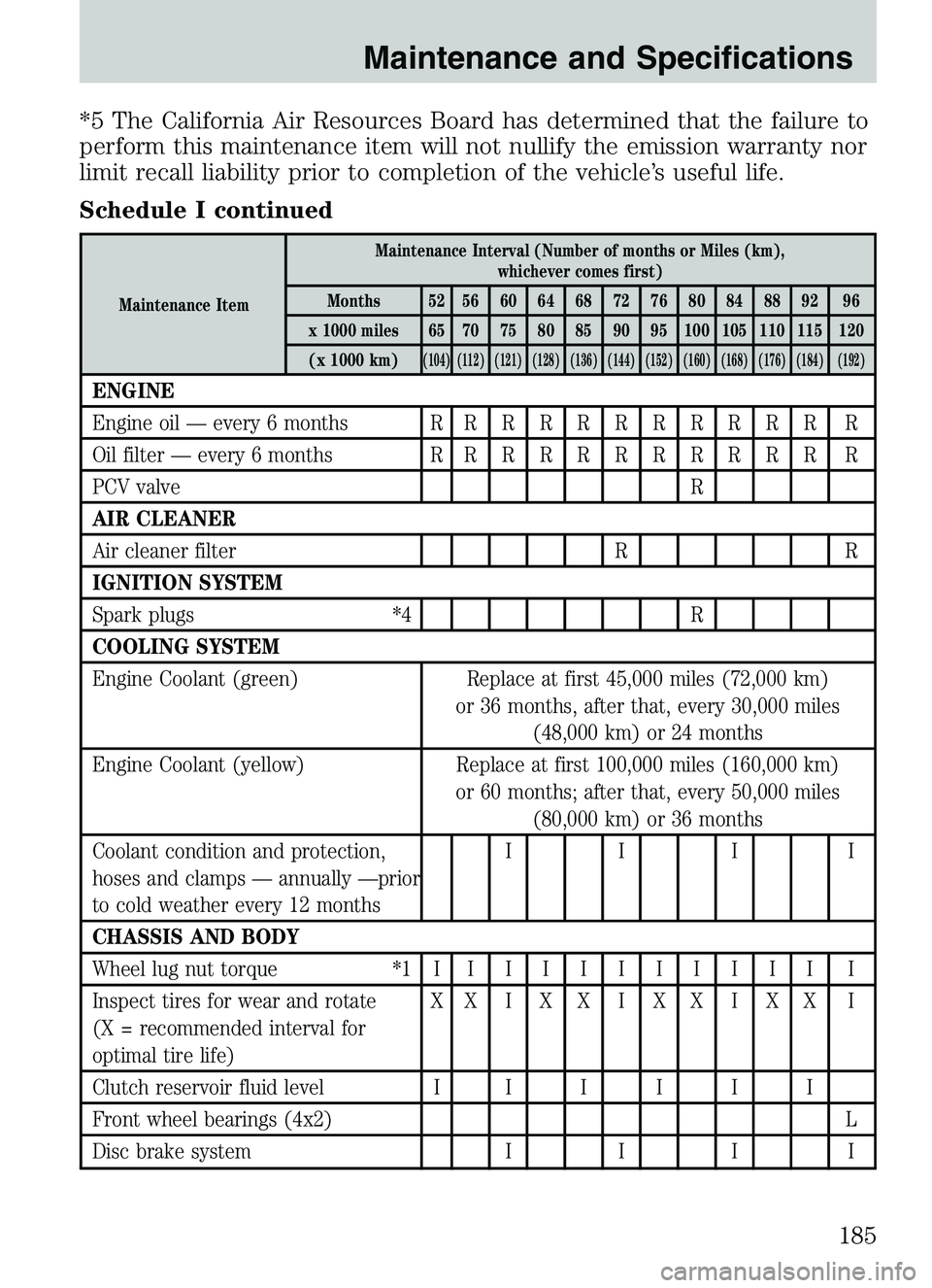
*5 The California Air Resources Board has determined that the failure to
perform this maintenance item will not nullify the emission warranty nor
limit recall liability prior to completion of the vehicle’s useful life.
Schedule I continued
Maintenance ItemMaintenance Interval (Number of months or Miles (km),
whichever comes first)
Months 52 56 60 64 68 72 76 80 84 88 92 96
x 1000 miles 65 70 75 80 85 90 95 100 105 110 115 120 (x 1000 km)
(104) (112) (121) (128) (136) (144) (152) (160) (168) (176) (184) (192)
ENGINE
Engine oil — every 6 months R RRRRRRRRRR R
Oil filter — every 6 months R RRRRRRRRRR R
PCV valve R
AIR CLEANER
Air cleaner filter R R
IGNITION SYSTEM
Spark plugs *4 R
COOLING SYSTEM
Engine Coolant (green) Replace at first 45,000 miles (72,000 km) or 36 months, after that, every 30,000 miles(48,000 km) or 24 months
Engine Coolant (yellow) Replace at first 100,000 miles (160,000 km) or 60 months; after that, every 50,000 miles(80,000 km) or 36 months
Coolant condition and protection,
hoses and clamps — annually —prior
to cold weather every 12 months III I
CHASSIS AND BODY
Wheel lug nut torque *1 I IIIIIIIIII I
Inspect tires for wear and rotate
(X = recommended interval for
optimal tire life) XXIXXIXXIXX I
Clutch reservoir fluid level I IIIII
Front wheel bearings (4x2) L
Disc brake system I I I I
Maintenance and Specifications
185
Page 188 of 250
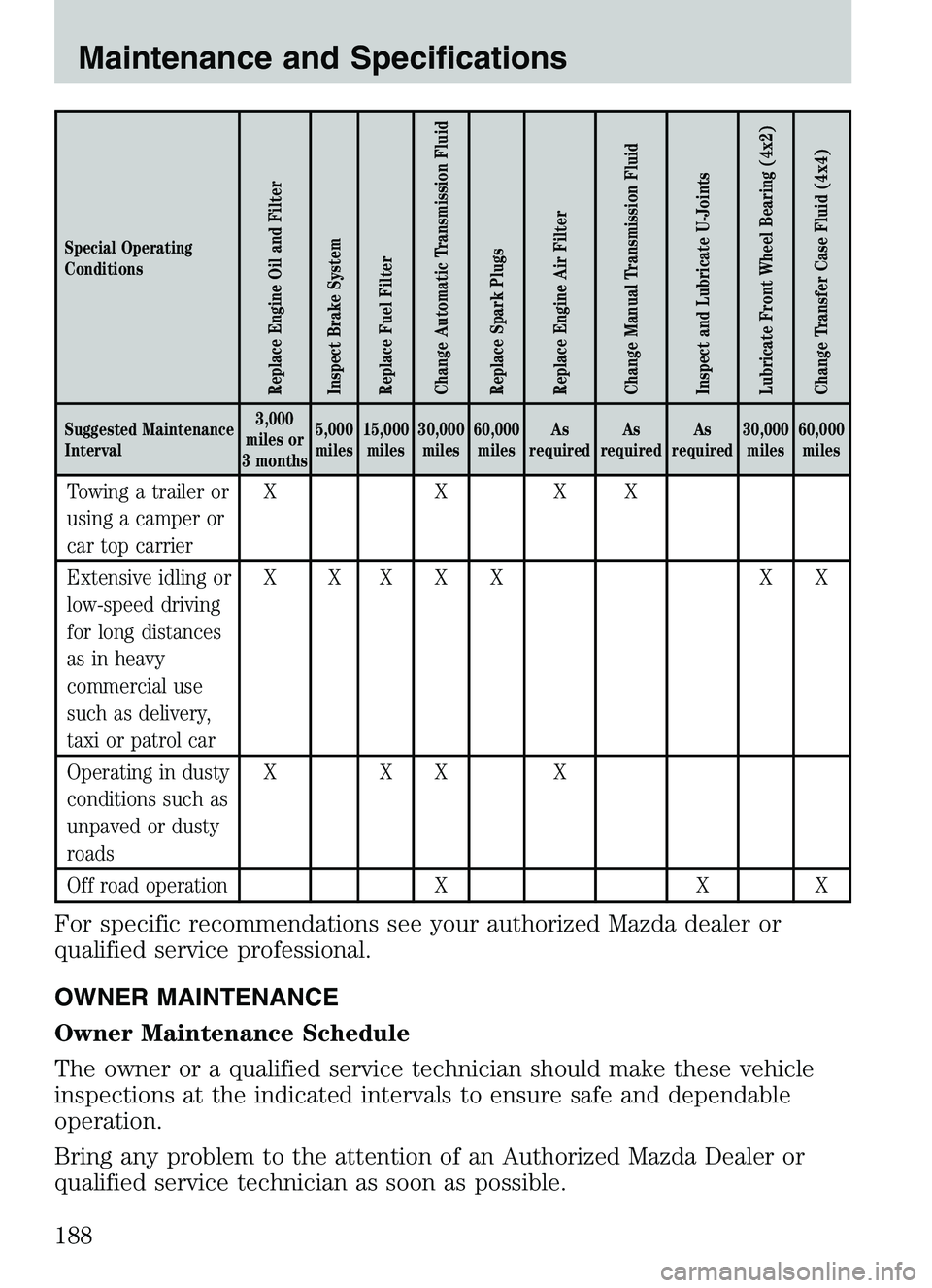
Special Operating
Conditions
Replace Engine Oil and Filter
Inspect Brake System
Replace Fuel Filter
Change Automatic Transmission Fluid
Replace Spark Plugs
Replace Engine Air Filter
Change Manual Transmission Fluid
Inspect and Lubricate U-Joints
Lubricate Front Wheel Bearing (4x2)
Change Transfer Case Fluid (4x4)
Suggested Maintenance
Interval3,000
miles or
3 months 5,000
miles 15,000
miles 30,000
miles 60,000
miles As
required As
required As
required 30,000
miles 60,000
miles
Towing a trailer or
using a camper or
car top carrier XXXX
Extensive idling or
low-speed driving
for long distances
as in heavy
commercial use
such as delivery,
taxi or patrol car X XXXX XX
Operating in dusty
conditions such as
unpaved or dusty
roads XXX X
Off road operation X X X
For specific recommendations see your authorized Mazda dealer or
qualified service professional.
OWNER MAINTENANCE
Owner Maintenance Schedule
The owner or a qualified service technician should make these vehicle
inspections at the indicated intervals to ensure safe and dependable
operation.
Bring any problem to the attention of an Authorized Mazda Dealer or
qualified service technician as soon as possible.
Maintenance and Specifications
188