lock MAZDA MODEL B4000 4WD 2003 Workshop Manual
[x] Cancel search | Manufacturer: MAZDA, Model Year: 2003, Model line: MODEL B4000 4WD, Model: MAZDA MODEL B4000 4WD 2003Pages: 250, PDF Size: 2.85 MB
Page 148 of 250

3.0L and 4.0L engines (if equipped)
The high-current fuses are coded as follows:
Fuse/RelayLocation Fuse Amp
Rating Power Distribution Box
Description
1 50A** I/P fuse panel
2 — Not used
3 — Not used
4 — Not used
5 — Not used
6 50A** Anti-lock Brake System (ABS)
Pump Motor
7 30A* Powertrain Control Module (PCM)
8 20A* Power door locks, Remote entry
9 — Not used
10 — Not used
11 50A** Starter relay, Ignition switch
12 20A* Power windows
13 20A* 4x4 motor
Roadside Emergencies
148
Page 149 of 250

Fuse/RelayLocation Fuse Amp
Rating Power Distribution Box
Description
14 — Not used
15 — Not used
16 40A** Blower motor
17 — Not used
18 — Not used
19 — Not used
20 — Not used
21 10A* Powertrain Control Module (PCM) memory
22 — Not used
23 20A* Fuel pump motor
24 30A* Headlamps
25 10A* A/C clutch solenoid
26 — Not used
27 — Not used
28 30A* Anti-lock Brake System (ABS) module
29 — Not used
30 15A* Trailer tow
31 20A* Foglamps, Daytime Running Lamps (DRL)
32 — Not used
33 15A* Park lamp
34 — Not used
35 — Not used
36 — Not used
37 — Not used
38 10A* Left headlamp low beam
39 — Not used
40 — Not used
41 20A* Heated oxygen sensors
Roadside Emergencies
149
Page 153 of 250

Location of the spare tire and tools
The spare tire and tools for your vehicle are stowed in the following
locations:
ToolLocation
Spare tire Under the vehicle, just forward of
the rear bumper
Jack, jack handle, wheel nut wrench Regular Cab: behind seats and
underneath the jack and tools
cover
Cab Plus: stowed in the passenger
side rear cab compartment or
behind the jump seat in a separate
tool bag
Cab Plus 4–Door: stowed behind
the front seats, between jump
seats and underneath jack and
tools cover.
Key, spare tire lock (if equipped) In the glove box
Removing the spare tire 1. Assemble the jack handle to the lug wrench as shown in the illustrations.
When connecting the jack handle, assemble the following:
• one handle extension and one
typical extension. To assemble,
slide parts together. To
disconnect, depress button and
pull apart.
• one wheel nut wrench. Depress
button and slide together.
2003 Mazda B Series (mbs)
New Owners Guide own2002 (own2002)
USA English (fus)
Roadside Emergencies
153
Page 154 of 250

2. If equipped, unlock and removethe spare tire carrier lock from
the rear access hole located just
above the rear bumper and
below the tailgate.
3. Insert the straight end of the jack handle into the rear access
hole located just above the rear
bumper and below the tailgate.
Forward motion will stop and
resistance to turning will be felt
when properly engaged. 4. Turn the handle counterclockwise until tire is
lowered to the ground and the cable is slightly slack.
5. Remove the retainer from the spare tire.
Stowing the spare tire 1. Lay the tire on the ground with the valve stem facing up.
2. Install the retainer through the wheel center and slide the
wheel under the vehicle.
3. Turn the spare handle clockwise until the tire is raised to its
original position underneath the
vehicle. The spare handle
ratchets when the tire is raised
to the stowed position. It will
not allow you to overtighten.
Roadside Emergencies
154
Page 155 of 250
4. If your vehicle is equipped with P265/75 R15 AT tires, do not stow aflat or inflated full size spare tire in the spare tire carrier. The flat
full size tire should be stowed and tied down in the pickup box bed
until it can be repaired.
5. If removed, install the spare tire carrier lock on the access hole above the bumper.
Tire change procedure WARNING: When one of the front wheels is off the ground, the
transmission alone will not prevent the vehicle from moving or
slipping off the jack, even if the vehicle is in P (Park)
(automatic transmission) or R (Reverse) (manual
transmission).
WARNING: To prevent the vehicle from moving when you
change a tire, be sure the parking brake is set, then block (in
both directions) the wheel that is diagonally opposite (other
side and end of the vehicle) to the tire being changed.
WARNING: If the vehicle slips off the jack, you or someone
else could be seriously injured.
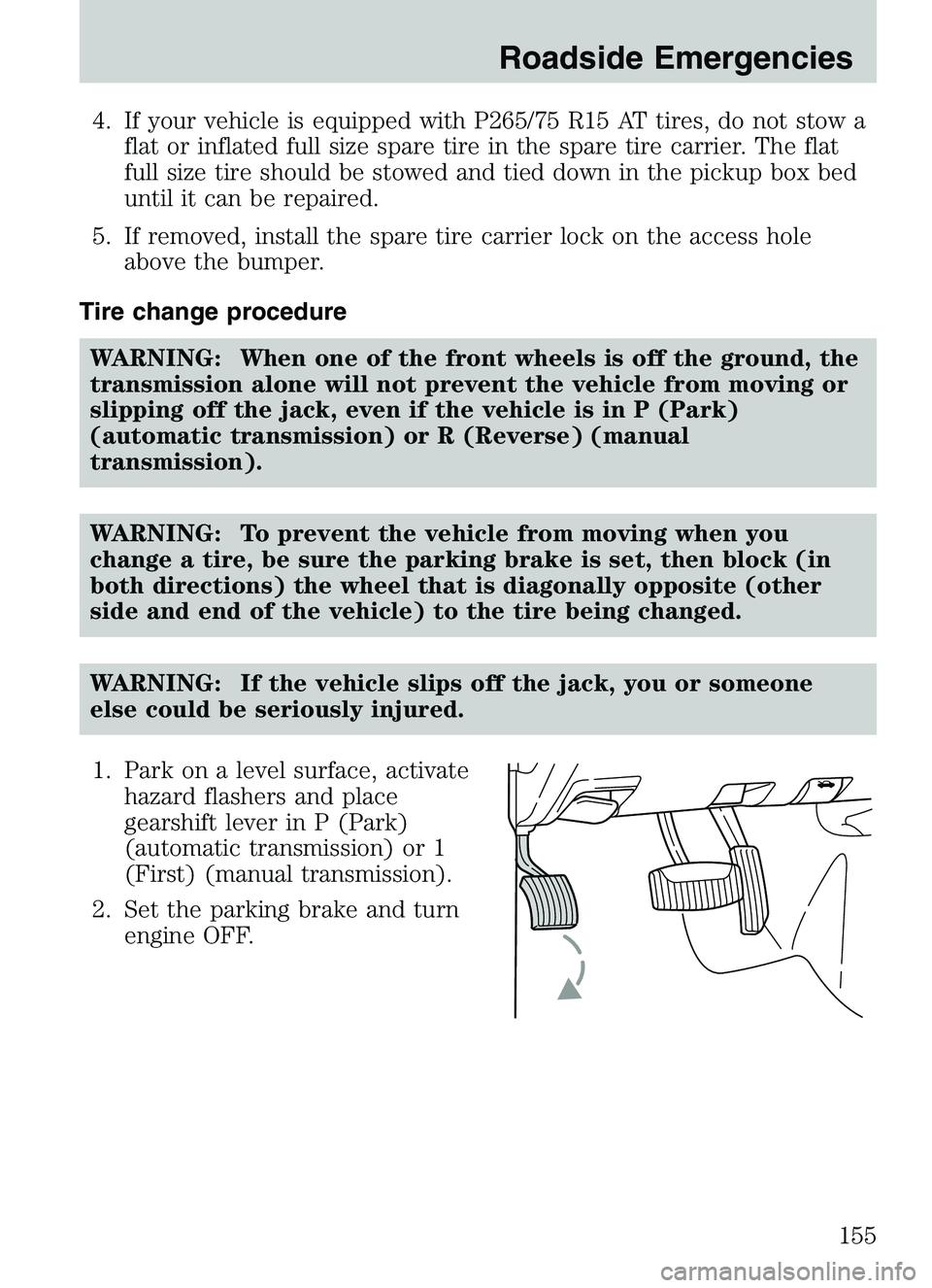
1. Park on a level surface, activate hazard flashers and place
gearshift lever in P (Park)
(automatic transmission) or 1
(First) (manual transmission).
2. Set the parking brake and turn engine OFF.
Roadside Emergencies
155
Page 156 of 250

3. Block the diagonally oppositewheel.
4. Insert tapered end of the lug wrench behind hub caps and
twist them off.
5. Loosen each wheel lug nut one-half turn counterclockwise
but do not remove them until
the wheel is raised off the
ground.
6. Position the jack according to the following guides and turn
the jack handle clockwise until the tire is a maximum of 25 mm
(1 inch) off the ground.
WARNING: To lessen the risk
of personal injury, do not put
any part of your body under
the vehicle while changing a
tire. Do not start the engine
when your vehicle is on the
jack. The jack is only meant
for changing the tire.
2003 Mazda B Series (mbs)
New Owners Guide own2002 (own2002)
USA English (fus)
Roadside Emergencies
156
Page 157 of 250

•Front
• Rear
Never use the differential as a jacking point. It is too easy for the
vehicle to tilt or fall and you can be injured. 7. Remove the wheel lug nuts with the lug wrench.
8. Replace the flat tire with the spare tire, making sure the valve stem is facing outward. Reinstall the lug nuts until the wheel is snug
against the hub. Do not fully tighten the lug nuts until the wheel has
been lowered.
9. Lower the wheel by turning the jack handle counterclockwise.
2003 Mazda B Series (mbs)
New Owners Guide own2002 (own2002)
USA English (fus)
Roadside Emergencies
157
Page 158 of 250

10. Remove the jack and fullytighten the lug nuts, in the
order shown, to 135 Nm (100
lb-ft). Note that these tightening
specifications are for nut and
bolt threads that are free of dirt
and rust. Use only Mazda
recommended (1/2–20)
replacement fasteners.
11. Stow the flat tire. Refer to Stowing the spare tire.
12. Stow the jack and lug wrench. Make sure the jack is fastened so it does not rattle when you drive.
13. Unblock the wheels.
Stowing the flat/spare tire 1. Lay the tire on the ground with the valve stem facing up.
2. Slide the wheel partially under the vehicle and install the wire and retainer through the center of the wheel.
3. Turn the jack handle clockwise until the tire is raised to its original position underneath the vehicle. The effort to turn the jack handle
increases significantly as the tire contacts the frame. The spare tire
carrier will ratchet when the tire is in the fully stowed position. The
spare tire carrier has a built-in ratchet feature that will not allow you
to overtighten. If the spare tire carrier ratchets with very little effort,
take the vehicle to your dealer for assistance at your earliest
convenience.
4. Check that the tire lies flat against the frame assembly. Push against the tire to make sure it is tightly sealed under the vehicle. Loosen
and retighten, if necessary. Failure to properly stow the spare tire
may result in failure of the winch cable and loss of the spare tire.
5. Repeat this tightness check procedure when servicing the spare tire pressure (every six months, per service maintenance section), or at
any time that the spare tire is disturbed through service of other
components.
6. Install the spare tire lock (if equipped) into the access hole above the rear bumper with the spare tire lock key (if equipped) and jack
handle.1
4
3
2
5
2003 Mazda B Series (mbs)
New Owners Guide own2002 (own2002)
USA English (fus)
Roadside Emergencies
158
Page 189 of 250
While operating your vehicle
•Note any changes in the sound of the exhaust or any smell or exhaust
fumes in the vehicle.
• Check for vibrations in the steering wheel. Notice any increased
steering effort or looseness in the steering wheel, or change in the
straight ahead position.
• Notice if your vehicle constantly turns slightly or “pulls” to one side
when traveling on a smooth, level road.
• When stopping, listen and check for strange sounds, pulling to one
side, increased brake pedal travel or “hard to push” brake pedal.
• If any slipping or changes in the operation of your transmission occur,
check the transmission fluid level.
• Check automatic transmission Park function.
• Check parking brake.
At least monthly
• Check function of all interior and exterior lights.
• Check tires for wear and proper air pressure.
• Check engine oil level.
• Check coolant level in the coolant reservoir.
• Check washer fluid level.
At least twice a year (for example, every spring and fall)
• Check power steering fluid level.
• Check clutch fluid level (if equipped).
• Check and clean body and door drain holes.
• Check and lubricate all hinges, latches, and outside locks.
• Check and lubricate door rubber weather strips.
• Check parking brake for proper operation.
• Check lap/shoulder belts and seat latches for wear and function.
• Check air pressure in spare tire.
• Check windshield washer spray and wiper operation. Clean wiper
blades with clean cloth dampened with washer fluid.
• Check safety warning lamps (brake, ABS, air bag, safety belt) for
operation.
Maintenance and Specifications
189
Page 190 of 250

•Check cooling system fluid level and coolant strength.
• Check battery water level (non-maintenance free).
• Check battery connections and clean if necessary.
SERVICE RECOMMENDATIONS
To help you service your vehicle:
• We highlight do-it-yourself items in the engine compartment for easy
location.
• We provide a Scheduled Maintenance section which makes tracking
routine service easy.
If your vehicle requires professional service, your dealership can provide
necessary parts and service. Check your “Warranty Information” to find
out which parts and services are covered.
Use only recommended fuels, lubricants, fluids and service parts
conforming to specifications. Genuine Mazda parts are designed and built
to provide the best performance in your vehicle.
PRECAUTIONS WHEN SERVICING YOUR VEHICLE
• Do not work on a hot engine.
• Make sure that nothing gets caught in moving parts.
• Do not work on a vehicle with the engine running in an enclosed
space, unless you are sure you have enough ventilation.
• Keep all open flames and other lit material away from the battery and
all fuel related parts.
Working with the engine off
• Automatic transmission:
1. Set the parking brake and shift to P (Park).
2. Turn off the engine and remove the key.
3. Block the wheels.
• Manual transmission:
1. Set the parking brake, depress the clutch and place the gearshift in 1 (First).
2. Turn off the engine and remove the key.
3. Block the wheels.
Maintenance and Specifications
190