height MAZDA MODEL B4000 CAB PLUS 4 TRUCK 2009 Owners Manual
[x] Cancel search | Manufacturer: MAZDA, Model Year: 2009, Model line: MODEL B4000 CAB PLUS 4 TRUCK, Model: MAZDA MODEL B4000 CAB PLUS 4 TRUCK 2009Pages: 288, PDF Size: 3.05 MB
Page 84 of 288
crash sensor system as the front airbag supplemental restraint system
(SRS). When the seat belt pretensioner deploys, webbing from the lap
and shoulder belt is tightened. Refer to theSeat belt maintenance
section in this chapter.
WARNING: The driver and front passenger seat belt system
(including retractors, buckles and height adjusters) must be
replaced if the vehicle is involved in a collision that results in
deployment of front airbags and seat belt pretensioners.
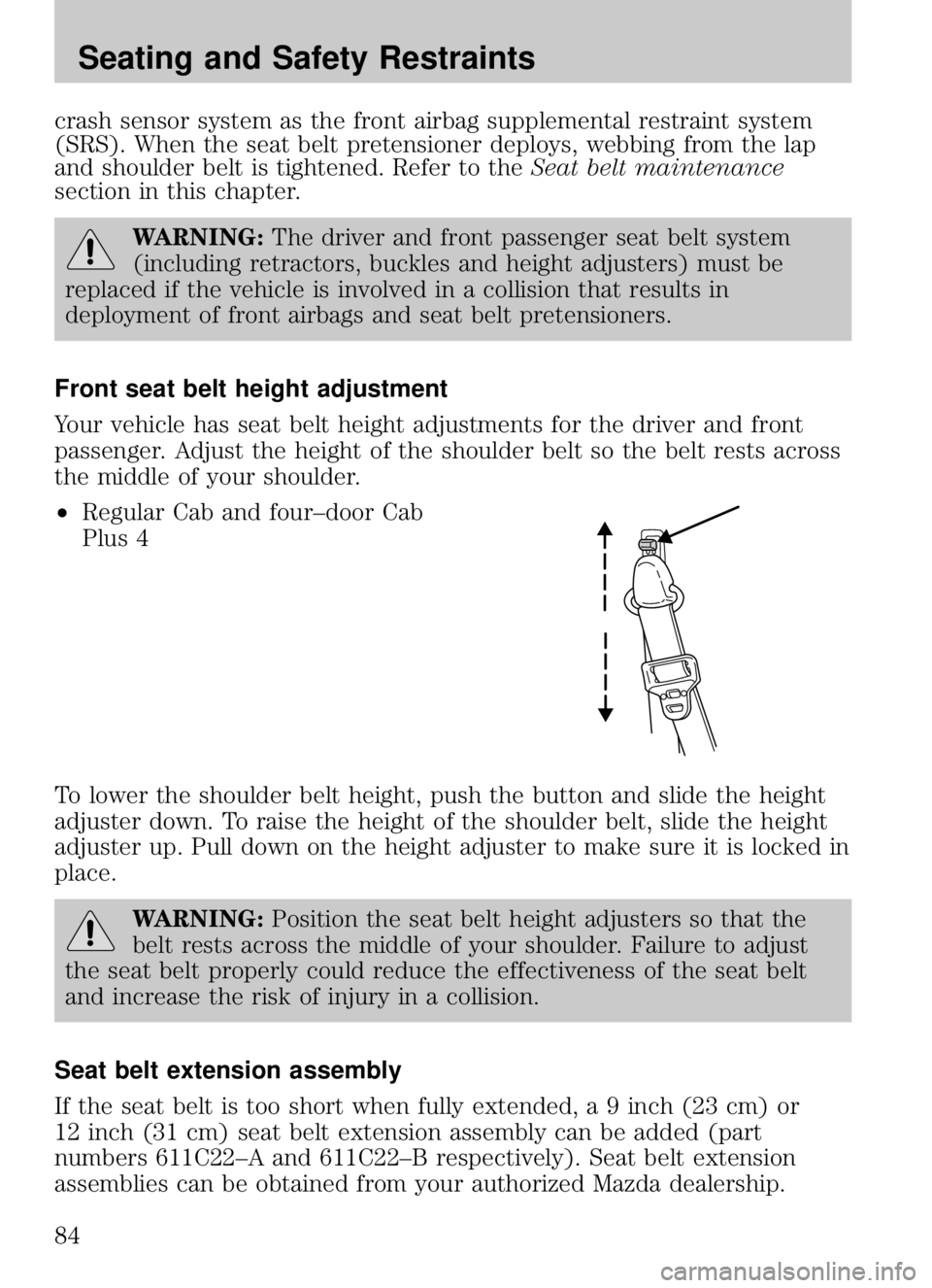
Front seat belt height adjustment
Your vehicle has seat belt height adjustments for the driver and front
passenger. Adjust the height of the shoulder belt so the belt rests across
the middle of your shoulder.
• Regular Cab and four–door Cab
Plus 4
To lower the shoulder belt height, push the button and slide the height
adjuster down. To raise the height of the shoulder belt, slide the height
adjuster up. Pull down on the height adjuster to make sure it is locked in
place.
WARNING: Position the seat belt height adjusters so that the
belt rests across the middle of your shoulder. Failure to adjust
the seat belt properly could reduce the effectiveness of the seat belt
and increase the risk of injury in a collision.
Seat belt extension assembly
If the seat belt is too short when fully extended, a 9 inch (23 cm) or
12 inch (31 cm) seat belt extension assembly can be added (part
numbers 611C22–A and 611C22–B respectively). Seat belt extension
assemblies can be obtained from your authorized Mazda dealership.
2009 B-Series (mbs)
Owners Guide, 1st Printing
USA (fus)
Seating and Safety Restraints
84
Page 99 of 288
WARNING:Any alteration/modification to the front passenger
seat may affect the performance of the front passenger sensing
system.
SAFETY RESTRAINTS FOR CHILDREN
See the following sections for directions on how to properly use safety
restraints for children. Also see Airbag supplemental restraint system
(SRS) in this chapter for special instructions about using airbags.
Important child restraint precautions
WARNING: Always make sure your child is secured properly in
a device that is appropriate for their height, age and weight.
Child safety restraints must be purchased separately from the vehicle.
Failure to follow these instructions and guidelines may result in an
increased risk of serious injury or death to your child.
WARNING: All children are shaped differently. The
Recommendations for Safety Restraints are based on probable
child height, age and weight thresholds from NHTSA and other safety
organizations or are the minimum requirements of law. Mazda
recommends checking with a NHTSA Certified Child Passenger Safety
Technician (CPST) and your pediatrician to make sure your child seat
is appropriate for your child, and is compatible with and properly
installed in the vehicle. To locate a child seat fitting station and CPST
contact the NHTSA toll free at 1-888-327-4236 or on the internet at
http://www.nhtsa.dot.gov. Failure to properly restrain children in safety
seats made especially for their height, age, and weight may result in an
increased risk of serious injury or death to your child.
2009 B-Series (mbs)
Owners Guide, 1st Printing
USA (fus)
Seating and Safety Restraints
99
Page 100 of 288
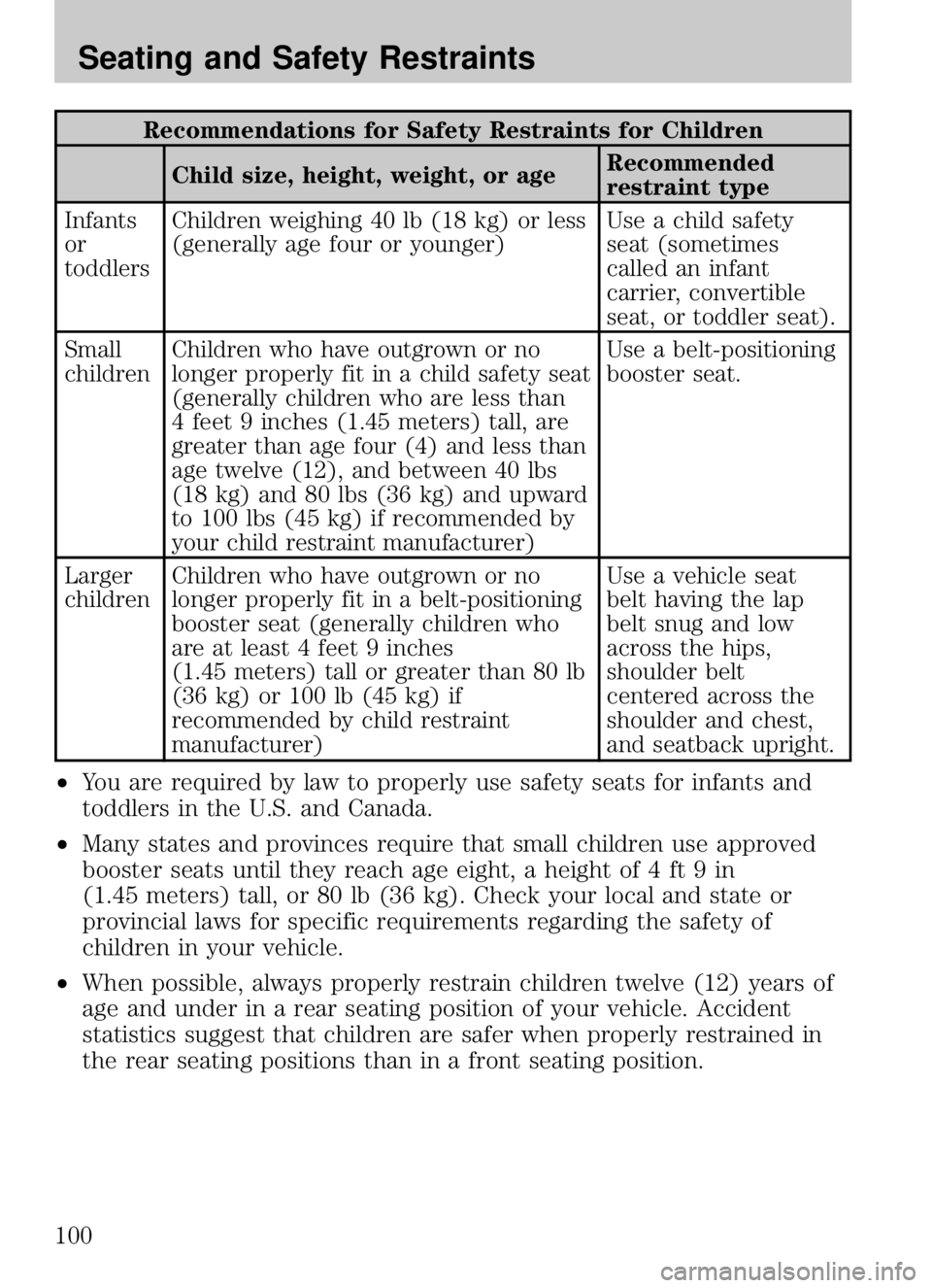
Recommendations for Safety Restraints for ChildrenChild size, height, weight, or age Recommended
restraint type
Infants
or
toddlers Children weighing 40 lb (18 kg) or less
(generally age four or younger)
Use a child safety
seat (sometimes
called an infant
carrier, convertible
seat, or toddler seat).
Small
children Children who have outgrown or no
longer properly fit in a child safety seat
(generally children who are less than
4 feet 9 inches (1.45 meters) tall, are
greater than age four (4) and less than
age twelve (12), and between 40 lbs
(18 kg) and 80 lbs (36 kg) and upward
to 100 lbs (45 kg) if recommended by
your child restraint manufacturer) Use a belt-positioning
booster seat.
Larger
children Children who have outgrown or no
longer properly fit in a belt-positioning
booster seat (generally children who
are at least 4 feet 9 inches
(1.45 meters) tall or greater than 80 lb
(36 kg) or 100 lb (45 kg) if
recommended by child restraint
manufacturer) Use a vehicle seat
belt having the lap
belt snug and low
across the hips,
shoulder belt
centered across the
shoulder and chest,
and seatback upright.
•
You are required by law to properly use safety seats for infants and
toddlers in the U.S. and Canada.
• Many states and provinces require that small children use approved
booster seats until they reach age eight, a height of 4 ft 9 in
(1.45 meters) tall, or 80 lb (36 kg). Check your local and state or
provincial laws for specific requirements regarding the safety of
children in your vehicle.
• When possible, always properly restrain children twelve (12) years of
age and under in a rear seating position of your vehicle. Accident
statistics suggest that children are safer when properly restrained in
the rear seating positions than in a front seating position.
2009 B-Series (mbs)
Owners Guide, 1st Printing
USA (fus)
Seating and Safety Restraints
100
Page 101 of 288
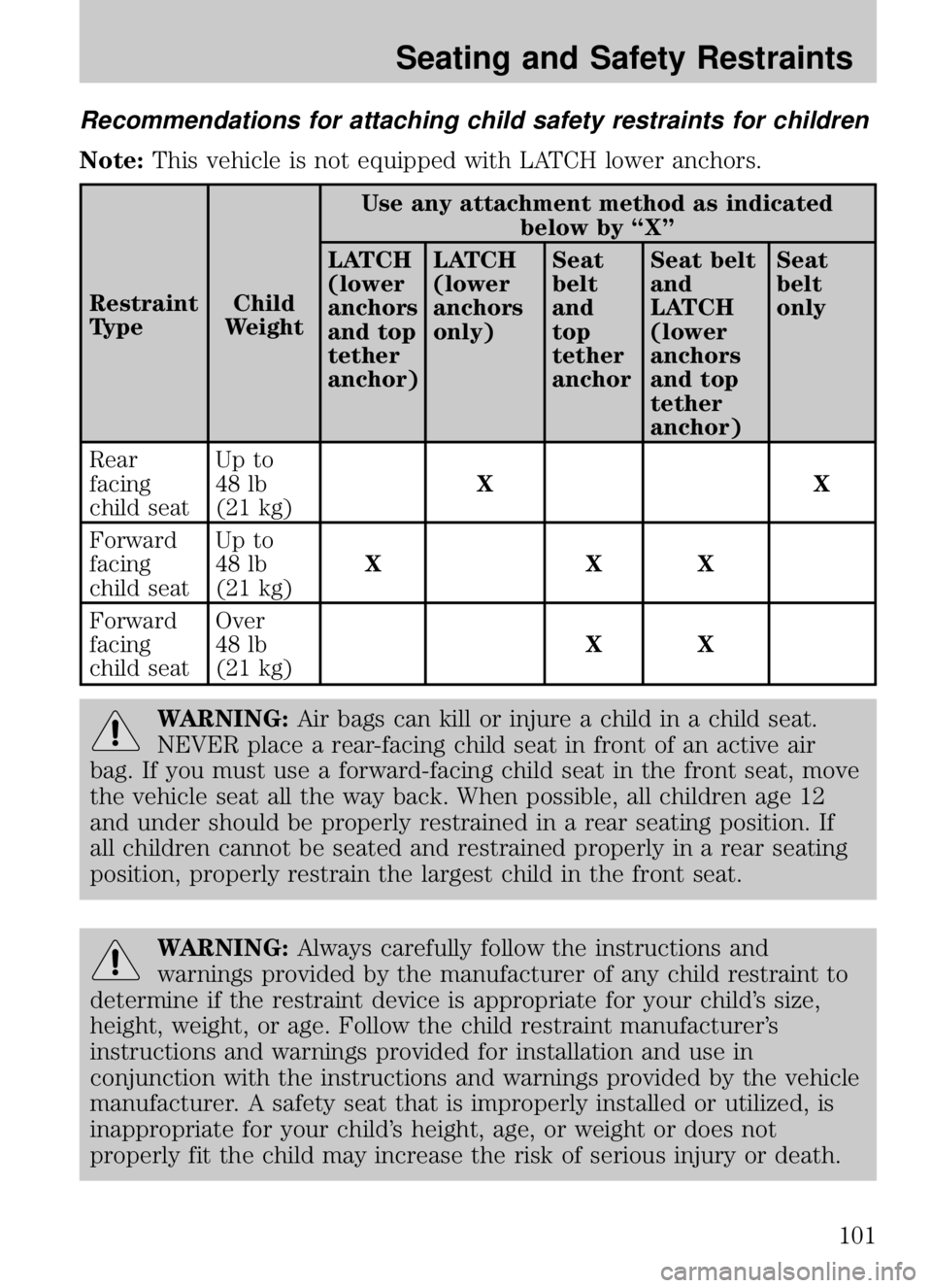
Recommendations for attaching child safety restraints for children
Note:This vehicle is not equipped with LATCH lower anchors.
Restraint
Type Child
Weight Use any attachment method as indicated
below by “X”
LATCH
(lower
anchors
and top
tether
anchor) LATCH
(lower
anchors
only)
Seat
belt
and
top
tether
anchorSeat belt
and
LATCH
(lower
anchors
and top
tether
anchor) Seat
belt
only
Rear
facing
child seat Up to
48 lb
(21 kg)
XX
Forward
facing
child seat Up to
48 lb
(21 kg)
X XX
Forward
facing
child seat Over
48 lb
(21 kg)
XX
WARNING:
Air bags can kill or injure a child in a child seat.
NEVER place a rear-facing child seat in front of an active air
bag. If you must use a forward-facing child seat in the front seat, move
the vehicle seat all the way back. When possible, all children age 12
and under should be properly restrained in a rear seating position. If
all children cannot be seated and restrained properly in a rear seating
position, properly restrain the largest child in the front seat.
WARNING: Always carefully follow the instructions and
warnings provided by the manufacturer of any child restraint to
determine if the restraint device is appropriate for your child’s size,
height, weight, or age. Follow the child restraint manufacturer’s
instructions and warnings provided for installation and use in
conjunction with the instructions and warnings provided by the vehicle
manufacturer. A safety seat that is improperly installed or utilized, is
inappropriate for your child’s height, age, or weight or does not
properly fit the child may increase the risk of serious injury or death.
2009 B-Series (mbs)
Owners Guide, 1st Printing
USA (fus)
Seating and Safety Restraints
101
Page 102 of 288
WARNING:Never let a passenger hold a child on his or her lap
while the vehicle is moving. The passenger cannot protect the
child from injury in a collision, which may result in serious injury or
death.
WARNING: Never use pillows, books, or towels to boost a child.
They can slide around and increase the likelihood of injury or
death in a collision.
WARNING: Always restrain an unoccupied child seat or booster
seat. These objects may become projectiles in a collision or
sudden stop, which may increase the risk of serious injury.
WARNING: Never place, or allow a child to place, the shoulder
belt under a child’s arm or behind the back because it reduces
the protection for the upper part of the body and may increase the risk
of injury or death in a collision.
WARNING: Do not leave children, unreliable adults, or pets
unattended in your vehicle.
Transporting children
Always make sure your child is secured properly in a device that is
appropriate for their age, height and weight. All children are shaped
differently. The child height, age and weight thresholds provided are
recommendations or the minimum requirements of law. The National
Highway Traffic Safety Administration (NHTSA) provides education and
training to ensure that all children ages 0 to 16 are properly restrained in
the correct restraint system. Mazda recommends checking with a NHTSA
Certified Child Passenger Safety Technician (CPST) and your
pediatrician to make sure your seat is appropriate for your child and
properly installed in the vehicle. To locate a child seat fitting station and
CPST contact the NHTSA toll free at 1-888-327-4236or on the internet
at http://www.nhtsa.dot.gov.
Follow all the safety restraint and airbag precautions that apply to adult
passengers in your vehicle.
If the child is the proper height, age, and weight (as specified by your
child safety seat or booster manufacturer), fits the restraint and can be
2009 B-Series (mbs)
Owners Guide, 1st Printing
USA (fus)
Seating and Safety Restraints
102
Page 115 of 288
Move a child to a different seating location if the shoulder belt does not
stay positioned on the shoulder during use.
Follow all instructions provided by the manufacturer of the booster seat.
WARNING:Never place, or allow a child to place, the shoulder
belt under a child’s arm or behind the back because it reduces
the protection for the upper part of the body and may increase the risk
of injury or death in a collision.
Child restraint and seat belt maintenance
Inspect the seat belt systems periodically to make sure they work
properly and are not damaged.
NOTE: If unsure about the proper procedures, bring your vehicle to an
authorized Mazda dealership for inspection. Inspect the seat belts to
make sure there are no nicks, tears or cuts, replacing if necessary. Check
the automatic locking retractor on the passenger outboard seating
position. All seat belt assemblies, including retractors, buckles, front seat
belt buckle assemblies, buckle support assemblies (slide bar-if equipped),
shoulder belt height adjusters (if equipped), shoulder belt guide on
seatback (if equipped), child safety seat tether bracket assemblies (if
equipped), and attaching hardware, should be inspected after a collision.
Mazda recommends that all seat belt assemblies used in vehicles involved
in a collision be replaced. However, if the collision was minor and an
authorized Mazda technician finds that the belts do not show damage
and continue to operate properly, they do not need to be replaced. Seat
belt assemblies not in use during a collision should also be inspected and
replaced if either damage or improper operation is noted.
The energy absorbing functions may have been activated in a collision so
the restraints should be examined; if the front airbags have deployed, the
pretensioners have also deployed and must be replaced — regardless of
whether there was an occupant in the passenger seat or not.
WARNING: Failure to inspect and if necessary replace the seat
belt assembly under the above conditions could result in severe
personal injuries in the event of a collision.
Refer to Interior in theCleaning chapter.
2009 B-Series (mbs)
Owners Guide, 1st Printing
USA (fus)
Seating and Safety Restraints
115
Page 130 of 288
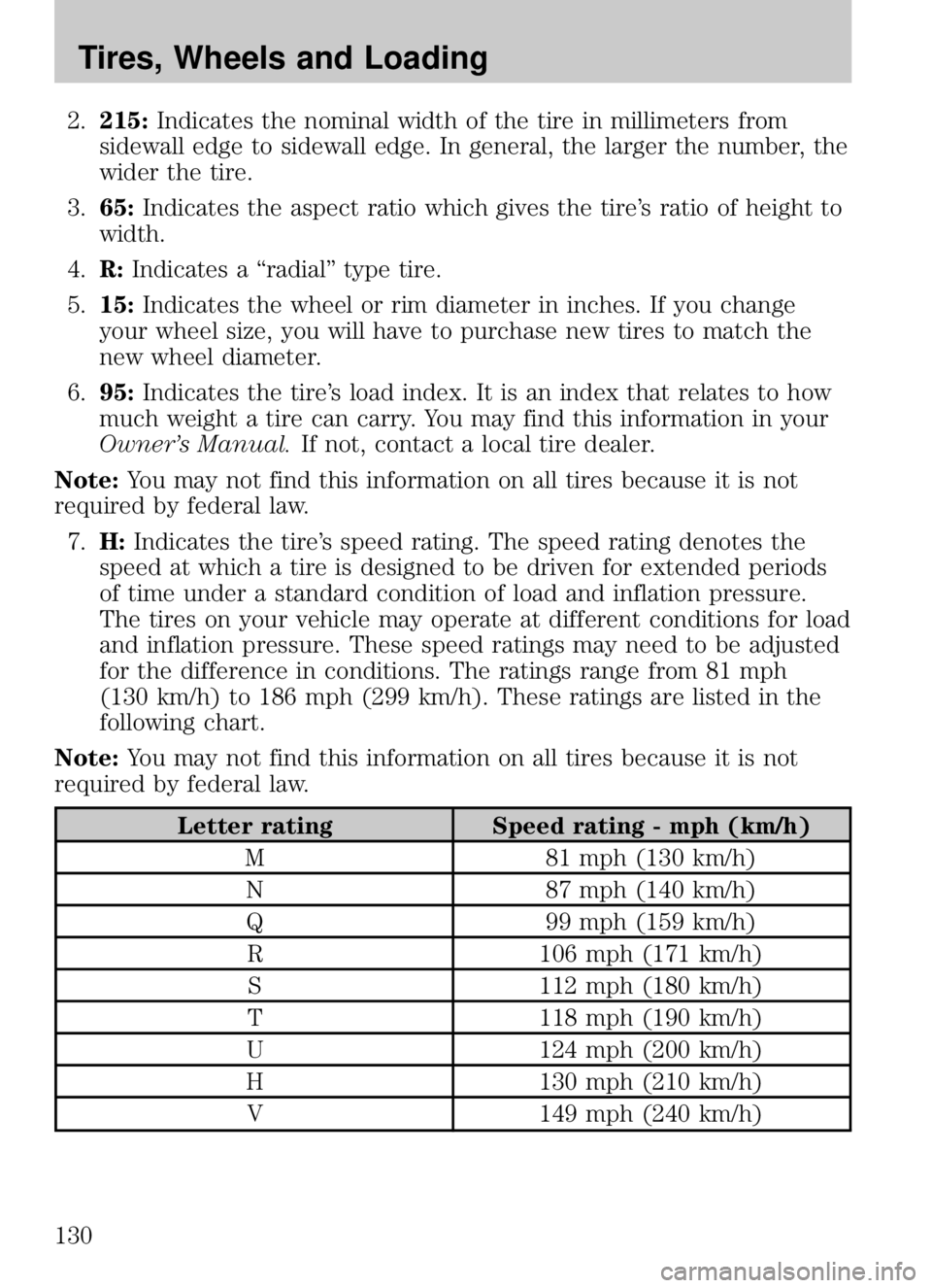
2.215: Indicates the nominal width of the tire in millimeters from
sidewall edge to sidewall edge. In general, the larger the number, the
wider the tire.
3. 65: Indicates the aspect ratio which gives the tire’s ratio of height to
width.
4. R: Indicates a “radial” type tire.
5. 15: Indicates the wheel or rim diameter in inches. If you change
your wheel size, you will have to purchase new tires to match the
new wheel diameter.
6. 95: Indicates the tire’s load index. It is an index that relates to how
much weight a tire can carry. You may find this information in your
Owner’s Manual. If not, contact a local tire dealer.
Note: You may not find this information on all tires because it is not
required by federal law.
7. H: Indicates the tire’s speed rating. The speed rating denotes the
speed at which a tire is designed to be driven for extended periods
of time under a standard condition of load and inflation pressure.
The tires on your vehicle may operate at different conditions for load
and inflation pressure. These speed ratings may need to be adjusted
for the difference in conditions. The ratings range from 81 mph
(130 km/h) to 186 mph (299 km/h). These ratings are listed in the
following chart.
Note: You may not find this information on all tires because it is not
required by federal law.
Letter rating Speed rating - mph (km/h)
M 81 mph (130 km/h)
N 87 mph (140 km/h)
Q 99 mph (159 km/h)
R 106 mph (171 km/h)
S 112 mph (180 km/h)
T 118 mph (190 km/h)
U 124 mph (200 km/h)
H 130 mph (210 km/h)
V 149 mph (240 km/h)
2009 B-Series(mbs)
Owners Guide, 1st Printing
USA (fus)
Tires, Wheels and Loading
130