instrument cluster MAZDA MODEL B4000 TRUCK 2005 Owner's Manual
[x] Cancel search | Manufacturer: MAZDA, Model Year: 2005, Model line: MODEL B4000 TRUCK, Model: MAZDA MODEL B4000 TRUCK 2005Pages: 256, PDF Size: 2 MB
Page 121 of 256

Shifting to/from 4X4 LOW1. Bring the vehicle to a complete stop
2. Depress the brake
3. On vehicles equipped with an automatic transmission, place the transmission in N (Neutral); on vehicles equipped with a manual
transmission, depress the clutch.
4. Move the 4WD control to the desired position.
• If shifting into 4X4 LOW, wait for the 4WD LOW light in the
instrument cluster to turn onindicating the shift is complete.
• If shifting out of 4X4 LOW, wait for the 4WD LOW light in the
instrument cluster to turn offindicating the shift is complete.
Driving off-road with 4WD
Your vehicle is specially equipped for driving on sand, snow, mud and
rough terrain and has operating characteristics that are somewhat
different from conventional vehicles, both on and off the road.
Maintain steering wheel control at all times, especially in rough terrain.
Since sudden changes in terrain can result in abrupt steering wheel
motion, make sure you grip the steering wheel from the outside. Do not
grip the spokes.
Drive cautiously to avoid vehicle damage from concealed objects such as
rocks and stumps.
You should either know the terrain or examine maps of the area before
driving. Map out your route before driving in the area. For more
information on driving off-road, read the “Four Wheeling” supplement in
your owner’s portfolio.
If your vehicle gets stuck
If the vehicle is stuck it may be rocked out by shifting from forward and
reverse gears, stopping between shifts, in a steady pattern. Press lightly
on the accelerator in each gear.
Do not rock the vehicle if the engine is not at normal operating
temperature or damage to the transmission may occur.
Do not rock the vehicle for more than a few minutes or damage
to the transmission and tires may occur or the engine may
overheat.
2004 Mazda B Series (mbs)
Owners Guide (post-2002-fmt)
USA English (fus)
Driving
121
Page 134 of 256
Trailer tow connector
Color Function Comment
3. Tan/White Tail lamp Relay controlled circuitactivated when the park
lamps/headlamps are on.
4. White Ground Matching vehicle circuit returns to battery’s negative
ground.
Driving while you tow
When towing a trailer:
• Turn off the speed control. The speed control may shut off
automatically when you are towing on long, steep grades.
• Consult your local motor vehicle speed regulations for towing a trailer.
• To eliminate excessive shifting, use a lower gear. This will also assist
in transmission cooling. (For additional information, refer to the
Driving with a 5–speed automatic transmission section in this
chapter.)
• Under extreme conditions with large frontal trailers, high outside
temperatures and highway speeds, the coolant gauge may indicate
higher than normal coolant temperatures. If this occurs, reduce speed
until the coolant temperature returns to the normal range. Refer to
Engine coolant temperature gauge in theInstrument cluster
chapter.
• Anticipate stops and brake gradually.
• Do not exceed the GCWR rating or transmission damage may occur.
Servicing after towing
If you tow a trailer for long distances, your vehicle will require more
frequent service intervals. Refer to your service maintenance section for
more information.
Trailer towing tips
• Practice turning, stopping and backing up before starting on a trip to
get the feel of the vehicle trailer combination. When turning, make
wider turns so the trailer wheels will clear curbs and other obstacles.
• Allow more distance for stopping with a trailer attached.
• The trailer tongue weight should be 10–15% of the loaded trailer
weight.
2004 Mazda B Series (mbs)
Owners Guide (post-2002-fmt)
USA English (fus)
Driving
134
Page 140 of 256
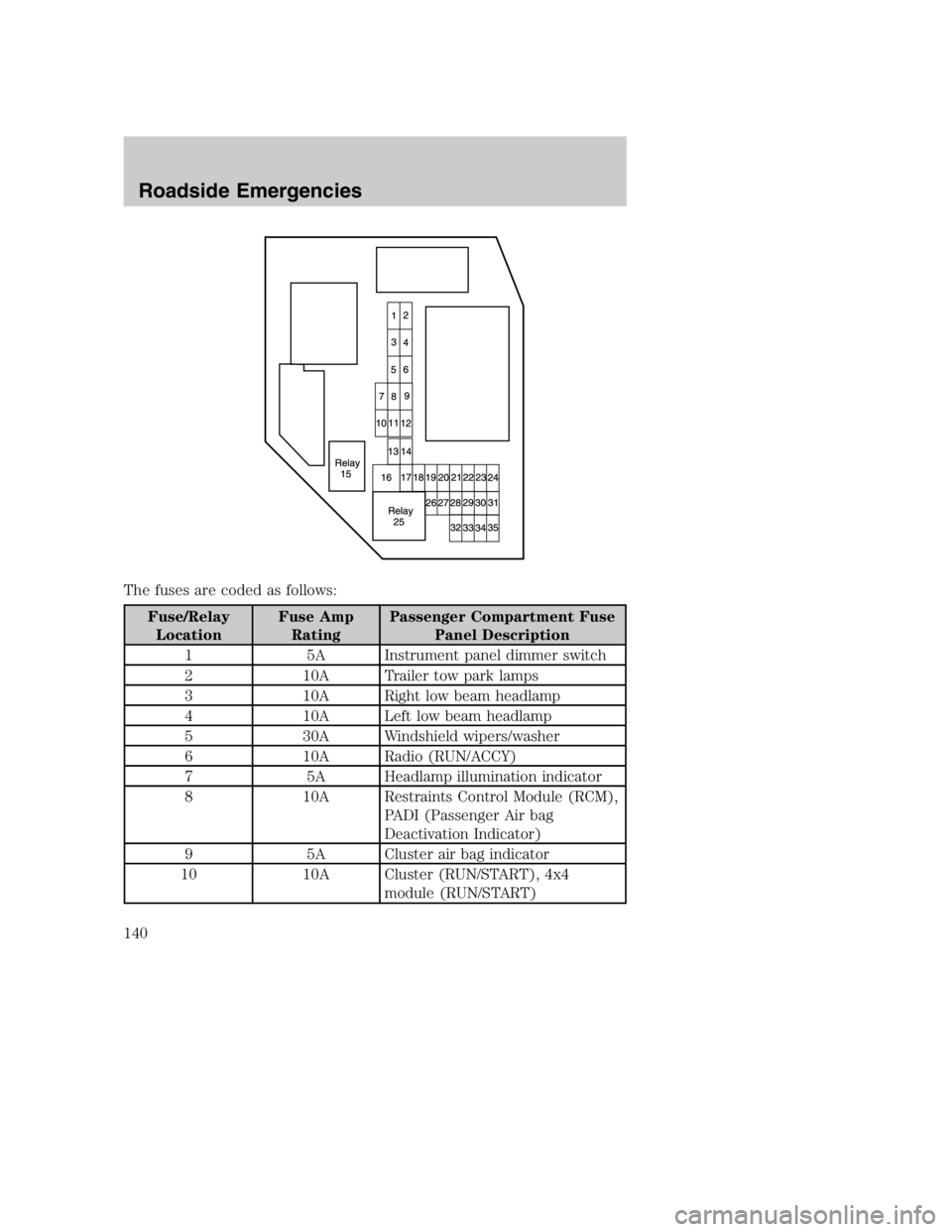
The fuses are coded as follows:
Fuse/RelayLocation Fuse Amp
Rating Passenger Compartment Fuse
Panel Description
1 5A Instrument panel dimmer switch
2 10A Trailer tow park lamps
3 10A Right low beam headlamp
4 10A Left low beam headlamp
5 30A Windshield wipers/washer
6 10A Radio (RUN/ACCY)
7 5A Headlamp illumination indicator
8 10A Restraints Control Module (RCM), PADI (Passenger Air bag
Deactivation Indicator)
9 5A Cluster air bag indicator
10 10A Cluster (RUN/START), 4x4 module (RUN/START)
2004 Mazda B Series(mbs)
Owners Guide (post-2002-fmt)
USA English (fus)
Roadside Emergencies
140
Page 142 of 256
Fuse/RelayLocation Fuse Amp
Rating Passenger Compartment Fuse
Panel Description
32 5A Brake switch (logic)
33 5A Instrument cluster
34 20A Power point
35 15A Power locks
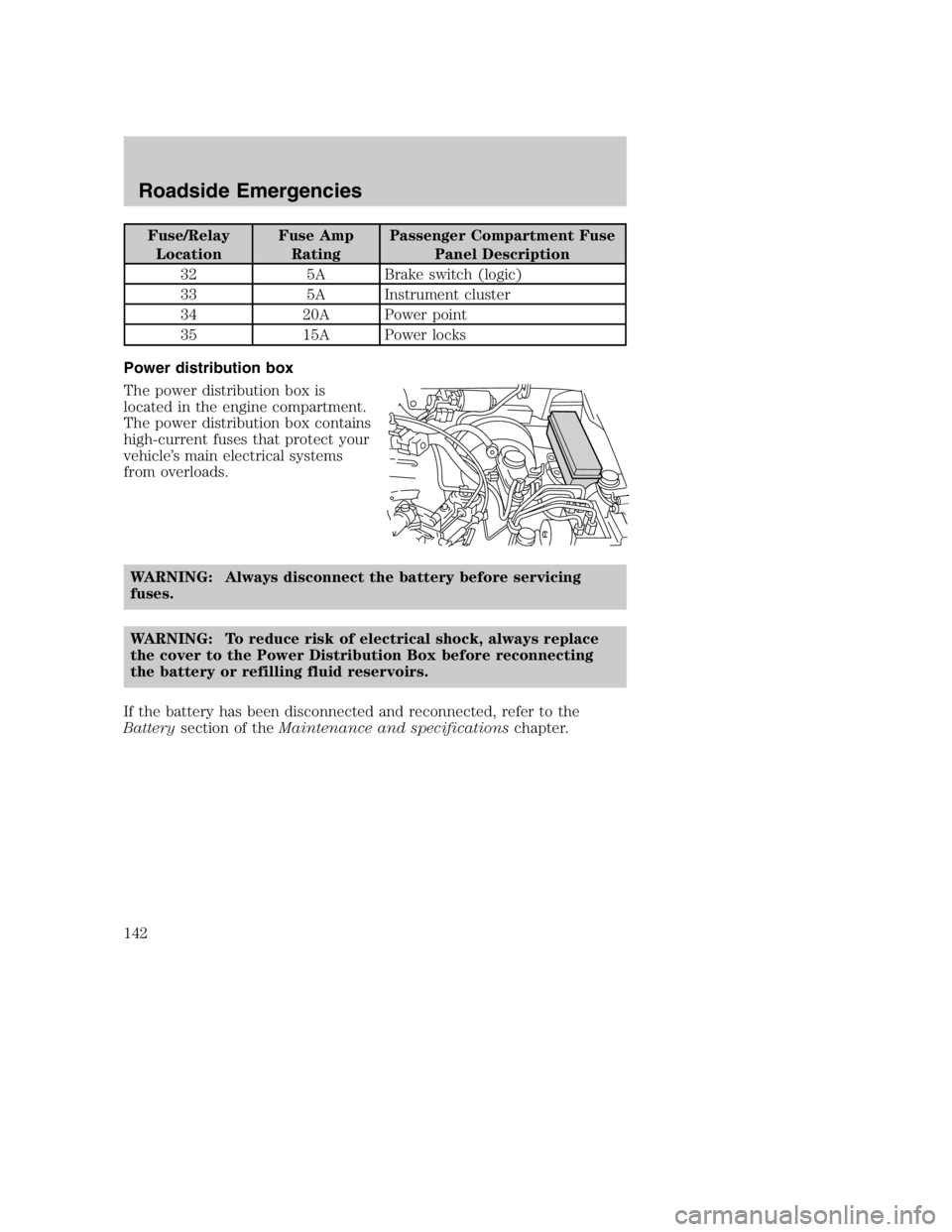
Power distribution box
The power distribution box is
located in the engine compartment.
The power distribution box contains
high-current fuses that protect your
vehicle’s main electrical systems
from overloads.
WARNING: Always disconnect the battery before servicing
fuses.
WARNING: To reduce risk of electrical shock, always replace
the cover to the Power Distribution Box before reconnecting
the battery or refilling fluid reservoirs.
If the battery has been disconnected and reconnected, refer to the
Battery section of the Maintenance and specifications chapter.
2004 Mazda B Series(mbs)
Owners Guide (post-2002-fmt)
USA English (fus)
Roadside Emergencies
142
Page 178 of 256
INSTRUMENT PANEL AND CLUSTER LENS
Clean the instrument panel with a damp cloth, then dry with a dry cloth.
•Avoid cleaners or polish that increase the gloss of the upper portion of
the instrument panel. The dull finish in this area helps protect the
driver from undesirable windshield reflection.
WARNING: Do not use chemical solvents or strong detergents
when cleaning the steering wheel or instrument panel to avoid
contamination of the air bag system.
• Be certain to wash or wipe your hands clean if you have been in
contact with certain products such as insect repellent and suntan
lotion in order to avoid possible damage to the interior painted
surfaces.
INTERIOR TRIM
• Clean the interior trim areas with a damp cloth, then dry by wiping
with a dry, soft, clean cloth.
• Do not use household or glass cleaners as these may damage the
finish.
INTERIOR
For fabric, carpets, cloth seats, and safety belts:
• Remove dust and loose dirt with a vacuum cleaner.
• Remove light stains and soil with Extra Strength Upholstery Cleaner,
available at your authorized Mazda dealer.
• If grease or tar is present on the material, spot-clean the area first
with Spot and Stain Remover, available at your authorized Mazda
dealer.
• Never saturate the seat covers with cleaning solution.
• Do not use household cleaning products or glass cleaners, which can
stain and discolor the fabric and affect the flame retardant abilities of
the seat materials.
2004 Mazda B Series (mbs)
Owners Guide (post-2002-fmt)
USA English (fus)
Cleaning
178
Page 214 of 256

If you are experiencing a rough or rolling idle after start-up with the
outside temperature above 27° C (80° F), the idle should improve within
10 to 30 seconds. If the problems persist below this temperature, see
your authorized Mazda dealership.
Cleaner air
Mazda endorses the use of reformulated “cleaner-burning” gasolines to
improve air quality.
Running out of fuel
Avoid running out of fuel because this situation may have an adverse
affect on powertrain components.
If you have run out of fuel:
•You may need to cycle the ignition from OFF to ON several times after
refueling, to allow the fuel system to pump the fuel from the tank to
the engine.
• Your “Check Engine” indicator may come on. For more information on
the “Check Engine” indicator, refer to the Instrument Cluster
chapter.
Fuel Filter
For fuel filter replacement, see your authorized Mazda dealership. Refer
to the service maintenance section for the appropriate intervals for
changing the fuel filter.
Replace the fuel filter with an authorized Mazda part. The
customer warranty may be void for any damage to the fuel system
if an authorized Mazda fuel filter is not used.
ESSENTIALS OF GOOD FUEL ECONOMY
Measuring techniques
Your best source of information about actual fuel economy is you, the
driver. You must gather information as accurately and consistently as
possible. Fuel expense, frequency of fillups or fuel gauge readings are
NOT accurate as a measure of fuel economy. We do not recommend
taking fuel economy measurements during the first 1,600 km (1,000
miles) of driving (engine break-in period). You will get a more accurate
measurement after 3,000 km–5,000 km (2,000 miles-3,000 miles).
Filling the tank
The advertised fuel capacity of the fuel tank on your vehicle is equal to
the rated refill capacity of the fuel tank as listed in the Refill capacities
section of this chapter.
2004 Mazda B Series (mbs)
Owners Guide (post-2002-fmt)
USA English (fus)
Maintenance and Specifications
214
Page 219 of 256

Readiness for Inspection/Maintenance (I/M) testing
In some localities, it may be a legal requirement to pass an I/M test of
the on-board diagnostics system. If your “Check Engine/Service Engine
Soon” light is on, refer to the description in theWarning lights and
chimes section of the Instrument cluster chapter. Your vehicle may not
pass the I/M test with the “Check Engine/Service Engine Soon” light on.
If the vehicle’s powertrain system or its battery has just been serviced,
the on-board diagnostics system is reset to a “not ready for I/M test”
condition. To ready the on-board diagnostics system for I/M testing, a
minimum of 30 minutes of city and highway driving is necessary as
described below:
• First, at least 10 minutes of driving on an expressway or highway.
• Next, at least 20 minutes driving in stop-and-go, city-type traffic with
at least four idle periods.
Allow the vehicle to sit for at least eight hours without starting the
engine. Then, start the engine and complete the above driving cycle. The
engine must warm up to its normal operating temperature. Once started,
do not turn off the engine until the above driving cycle is complete.
2004 Mazda B Series (mbs)
Owners Guide (post-2002-fmt)
USA English (fus)
Maintenance and Specifications
219
Page 251 of 256

F
Flexible Fuel Vehicle (FFV) ....208
Fluid capacities .........................240
Foglamps .....................................34
Four-Wheel Drive vehicles .......119driving off road .......................121
electronic shift ........................120
indicator light .........................120
preparing to drive your
vehicle .....................................113
Fuel ............................................208 calculating fuel economy .......214
cap ...........................................211
capacity ...................................240
choosing the right fuel ...........212
comparisons with EPA fuel
economy estimates .................217
detergent in fuel .....................214
filling your vehicle with
fuel ...........................208, 211, 214
filter, specifications ................214
fuel pump shut-off switch .....137
improving fuel economy ........214
octane rating ...................212, 245
quality ......................................213
running out of fuel .................214
safety information relating to
automotive fuels .....................208
Fuel - flex fuel vehicle
(FFV) .................................208, 212
Fuel pump shut-off switch .......137
Fuses ..................................138–139
G
Gas cap (see Fuel cap) ............211
Gas mileage
(see Fuel economy) .................214
Gauges .........................................16 GAWR
(Gross Axle Weight Rating)
calculating ...............................127
GVWR
(Gross Vehicle Weight Rating) calculating ...............................127
H
Hazard flashers .........................137
Headlamps ...................................34 aiming ........................................35
bulb specifications ....................36
daytime running lights .............34
flash to pass ..............................35
high beam .................................35
replacing bulbs .........................37
turning on and off ....................34
Heating heating and air
conditioning system ...........31–32
Hood ..........................................189
I
Ignition ...............................105, 245
Infant seats (see Safety seats) ..93
Inspection/maintenance (I/M)
testing ........................................219
Instrument panel cleaning ...................................178
cluster ........................................12
lighting up panel and
interior .......................................35
location of components ............12
J
Jack ............................................149 positioning ...............................149
2004 Mazda B Series (mbs)
Owners Guide (post-2002-fmt)
USA English (fus)
Index
251