brakes MAZDA MODEL CX-30 2019 (in English) Owner's Guide
[x] Cancel search | Manufacturer: MAZDA, Model Year: 2019, Model line: MODEL CX-30, Model: MAZDA MODEL CX-30 2019Pages: 683, PDF Size: 15.21 MB
Page 325 of 683
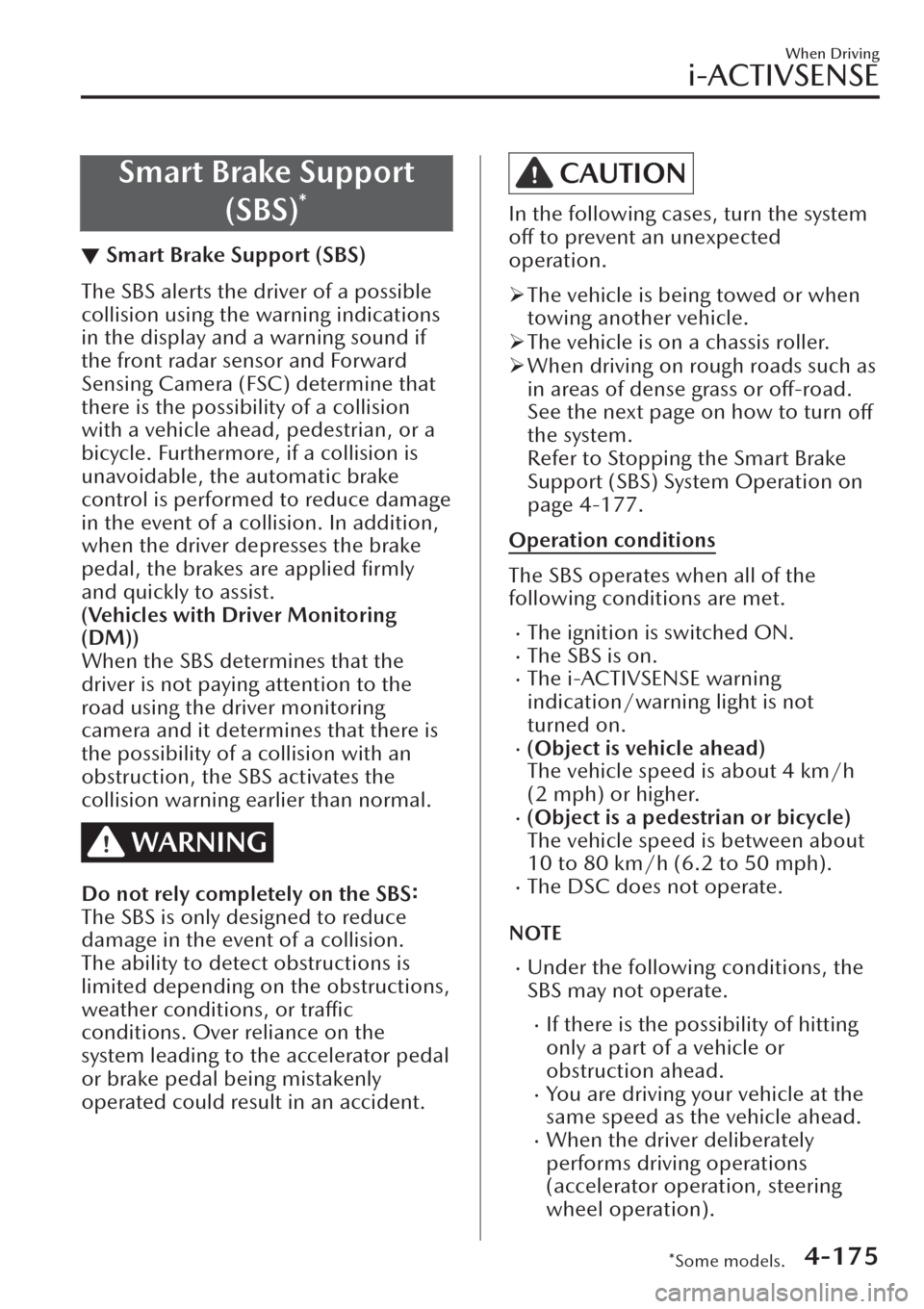
Smart Brake Support
(SBS)
*
▼Smart Brake Support (SBS)
The SBS alerts the driver of a possible
collision using the warning indications
in the display and a warning sound if
the front radar sensor and Forward
Sensing Camera (FSC) determine that
there is the possibility of a collision
with a vehicle ahead, pedestrian, or a
bicycle. Furthermore, if a collision is
unavoidable, the automatic brake
control is performed to reduce damage
in the event of a collision. In addition,
when the driver depresses the brake
pedal, the brakes are applied firmly
and quickly to assist.
(Vehicles with Driver Monitoring
(DM))
When the SBS determines that the
driver is not paying attention to the
road using the driver monitoring
camera and it determines that there is
the possibility of a collision with an
obstruction, the SBS activates the
collision warning earlier than normal.
WARNING
Do not rely completely on the
SBS:
The SBS is only designed to reduce
damage in the event of a collision.
The ability to detect obstructions is
limited depending on the obstructions,
weather conditions, or
traffic
conditions. Over reliance on the
system leading to the accelerator pedal
or brake pedal being mistakenly
operated could result in an accident.
CAUTION
In the following cases, turn the system
off to prevent an unexpected
operation.
¾The vehicle is being towed or when
towing another vehicle.
¾The vehicle is on a chassis roller.
¾When driving on rough roads such as
in areas of dense grass or off-road.
See the next page on how to turn
off
the system.
Refer to Stopping the Smart Brake
Support (SBS) System Operation on
page 4-177.
Operation conditions
The SBS operates when all of the
following conditions are met.
xThe ignition is switched ON.xThe SBS is on.xThe i-ACTIVSENSE warning
indication/warning light is not
turned on.
x(Object is vehicle ahead)
The vehicle speed is about 4 km/h
(2 mph) or higher.
x(Object is a pedestrian or bicycle)
The vehicle speed is between about
10 to 80 km/h (6.2 to 50 mph).
xThe DSC does not operate.
NOTE
xUnder the following conditions, the
SBS may not operate.
xIf there is the possibility of hitting
only a part of a vehicle or
obstruction ahead.
xYou are driving your vehicle at the
same speed as the vehicle ahead.
xWhen the driver deliberately
performs driving operations
(accelerator operation, steering
wheel operation).
When Driving
i-ACTIVSENSE
*Some models.4-175
Page 331 of 683
![MAZDA MODEL CX-30 2019 (in English) Owners Guide Smart Brake Support
[Rear Crossing] (SBS-RC)
*
▼Smart Brake Support [Rear
Crossing]
(SBS-RC)
The SBS-RC is a system designed to
assist the driver in avoiding collisions
and to reduce damage in the](/img/28/13699/w960_13699-330.png "MAZDA MODEL CX-30 2019 (in English) Owners Guide Smart Brake Support
[Rear Crossing] (SBS-RC)
*
▼Smart Brake Support [Rear
Crossing]
(SBS-RC)
The SBS-RC is a system designed to
assist the driver in avoiding collisions
and to reduce damage in the")
Smart Brake Support
[Rear Crossing] (SBS-RC)
*
▼Smart Brake Support [Rear
Crossing]
(SBS-RC)
The SBS-RC is a system designed to
assist the driver in avoiding collisions
and to reduce damage in the event of
a collision by applying the brakes if
there is the possibility of collision with
a vehicle approaching from the rear
while you are reversing out of parking
space.
The SBS-RC system detects vehicles
approaching from the rear left and
right sides of the vehicle, and the rear
of the vehicle while the vehicle is being
reversed out of a parking space, the
system reduces damage in the event of
a collision by operating the brake
control when the system determines
that a collision is unavoidable.
SBS-RC operation
1. The SBS-RC system operates when
the shift lever (manual
transmission) or the selector lever
(automatic transmission) is shifted
to the reverse (R) position.
2. If there is the possibility of a
collision with an approaching
vehicle, the SBS-RC system applies
brake and displays “BRAKE!” on the
active driving display and the
multi-information display.
WARNING
Always check the surrounding area
visually before actually putting the
vehicle in reverse:
The system is only designed to assist
you in backing out of the lot when
putting the vehicle in reverse. Due to
certain limitations with the operation
of this system, the SBS-RC system may
not operate brake or it might be
delayed even though a vehicle is
behind your vehicle. Always make it
your responsibility as a driver to check
the rear.
Do not rely completely on the SBS-RC
system:
¾The
SBS-RC system is only designed
to reduce damage in the event of a
collision. Over reliance on the system
leading to the accelerator pedal or
brake pedal being mistakenly
operated could result in an accident.
¾The SBS-RC system operates in
response to a vehicle. The system
does not operate in response to
obstructions such as a wall,
pedestrians, 2-wheeled vehicles, or
animals.
To assure the correct operation of the
SBS-RC, heed the following cautions.
¾Do not apply a sticker to a rear radar
and rear camera. Otherwise, the rear
radar and rear camera may not be
able to detect vehicles or
obstructions which could result in an
accident.
¾Do not disassemble a rear radar and
rear camera.
When Driving
i-ACTIVSENSE
*Some models.4-181
Page 456 of 683
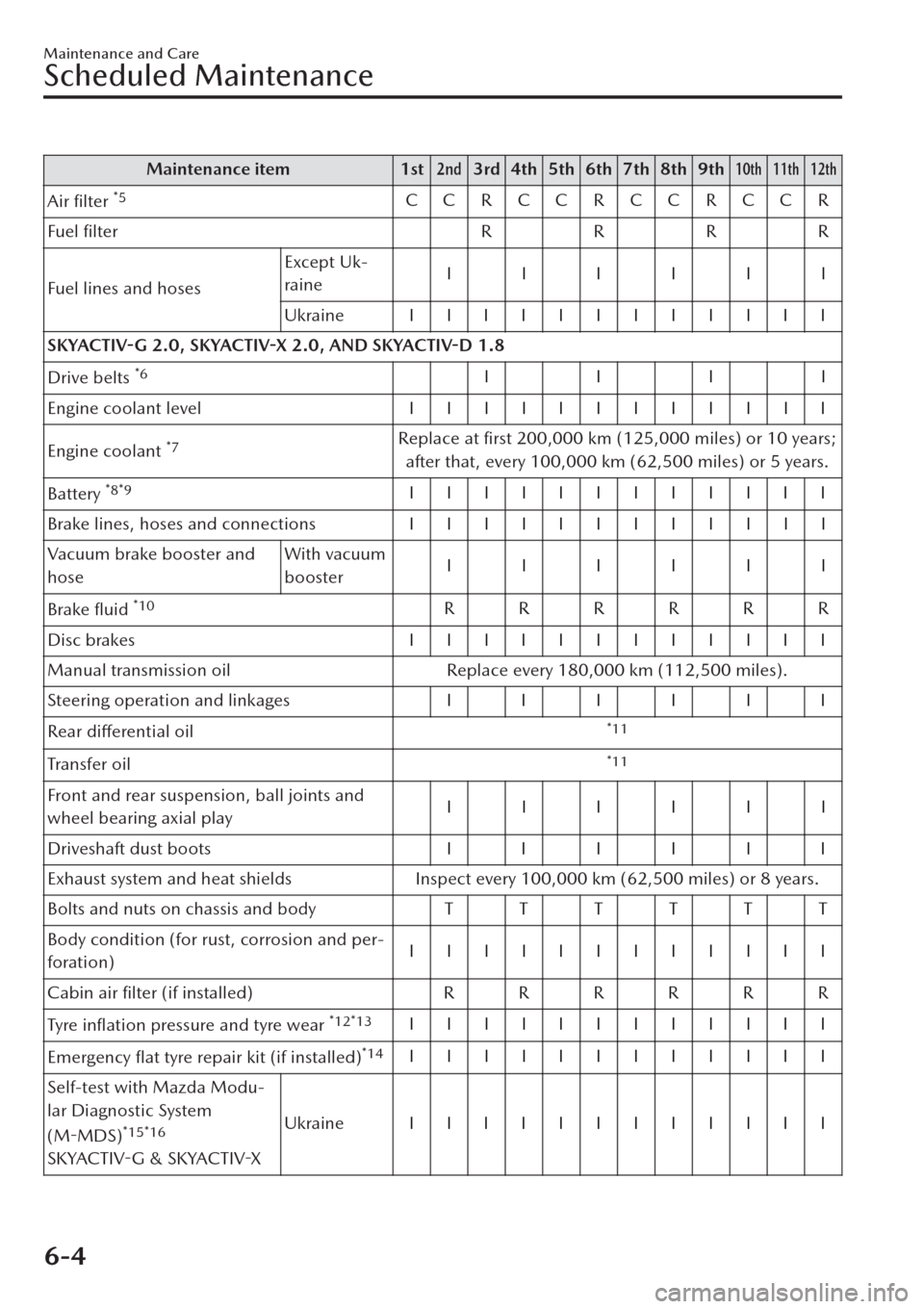
Maintenance item 1st2nd3rd 4th 5th 6th 7th 8th 9th10th 11th 12th
Air filter *5CCRCCRCCRCCR
Fuel filter RRRR
Fuel lines and hosesExcept Uk-
raineIIIIII
Ukraine IIIIIIIIIIII
SKYACTIV-G 2.0, SKYACTIV-X 2.0, AND SKYACTIV-D 1.8
Drive belts
*6IIII
Engine coolant level IIIIIIIIIIII
Engine coolant
*7Replace at first 200,000 km (125,000 miles) or 10 years;
after that, every 100,000 km (62,500 miles) or 5 years.
Battery
*8*9IIIIIIIIIIII
Brake lines, hoses and connections IIIIIIIIIIII
Vacuum brake booster and
hoseWith vacuum
boosterIIIIII
Brake
fluid
*10RRRRRR
Disc brakes IIIIIIIIIIII
Manual transmission oil Replace every 180,000 km (112,500 miles).
Steering operation and linkagesIIIIII
Rear differential oil
*11
Transfer oil*11
Front and rear suspension, ball joints and
wheel bearing axial playIIIIII
Driveshaft dust boots IIIIII
Exhaust system and heat shields Inspect every 100,000 km (62,500 miles) or 8 years.
Bolts and nuts on chassis and body TTTTTT
Body condition (for rust, corrosion and per-
foration)IIIIIIIIIIII
Cabin air filter (if installed) R R R R R R
Tyre inflation pressure and tyre wear
*12*13IIIIIIIIIIII
Emergency
flat tyre repair kit (if installed)
*14IIIIIIIIIIII
Self-test with Mazda Modu-
lar Diagnostic System
(M-MDS)
*15*16
SKYACTIV-G & SKYACTIV-XUkraine IIIIIIIIIIII
Maintenance and Care
Scheduled Maintenance
6-4
Page 458 of 683
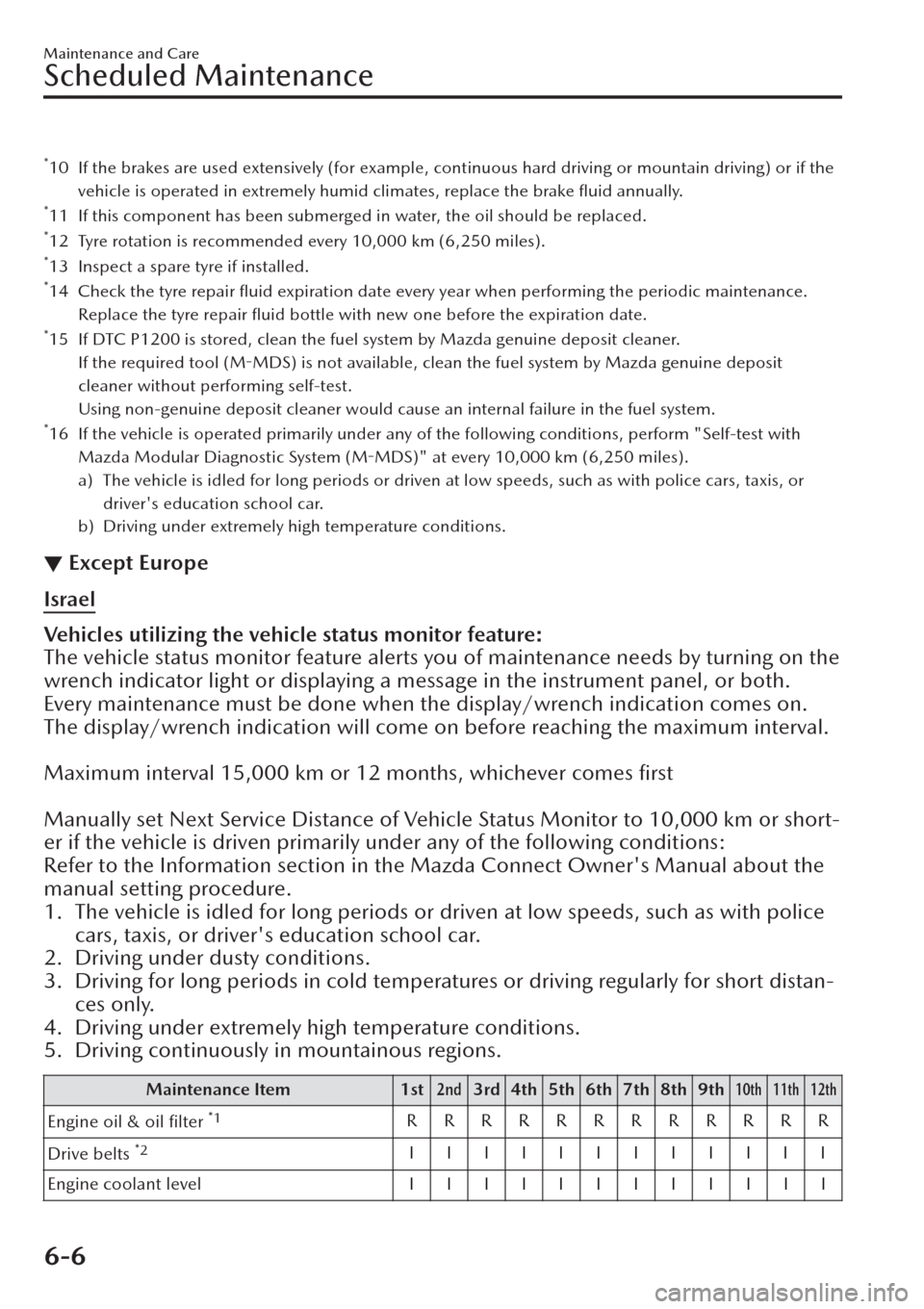
*10 If the brakes are used extensively (for example, continuous hard driving or mountain driving) or if the
vehicle is operated in extremely humid climates, replace the brake fluid annually.
*11 If this component has been submerged in water, the oil should be replaced.*12 Tyre rotation is recommended every 10,000 km (6,250 miles).*13 Inspect a spare tyre if installed.*14 Check the tyre repair fluid expiration date every year when performing the periodic maintenance.
Replace the tyre repair fluid bottle with new one before the expiration date.
*15 If DTC P1200 is stored, clean the fuel system by Mazda genuine deposit cleaner.
If the required tool (M-MDS) is not available, clean the fuel system by Mazda genuine deposit
cleaner without performing self-test.
Using non-genuine deposit cleaner would cause an internal failure in the fuel system.
*16 If the vehicle is operated primarily under any of the following conditions, perform "Self-test with
Mazda Modular Diagnostic System (M-MDS)" at every 10,000 km (6,250 miles).
a) The vehicle is idled for long periods or driven at low speeds, such as with police cars, taxis, or
driver's education school car.
b) Driving under extremely high temperature conditions.
▼Except Europe
Israel
Vehicles utilizing the vehicle status monitor feature:
The vehicle status monitor feature alerts you of maintenance needs by turning on the
wrench indicator light or displaying a message in the instrument panel, or both.
Every maintenance must be done when the display/wrench indication comes on.
The display/wrench indication will come on before reaching the maximum interval.
Maximum interval 15,000 km or 12 months, whichever comes first
Manually set Next Service Distance of Vehicle Status Monitor to 10,000 km or short-
er if the vehicle is driven primarily under any of the following conditions:
Refer to the Information section in the Mazda Connect Owner's Manual about the
manual setting procedure.
1. The vehicle is idled for long periods or driven at low speeds, such as with police
cars, taxis, or driver's education school car.
2. Driving under dusty conditions.
3. Driving for long periods in cold temperatures or driving regularly for short distan-
ces only.
4. Driving under extremely high temperature conditions.
5. Driving continuously in mountainous regions.
Maintenance Item 1st2nd3rd 4th 5th 6th 7th 8th 9th10th 11th 12th
Engine oil & oil
filter *1RRRRRRRRRRRR
Drive belts
*2IIIIIIIIIIII
Engine coolant level IIIIIIIIIIII
Maintenance and Care
Scheduled Maintenance
6-6
Page 459 of 683
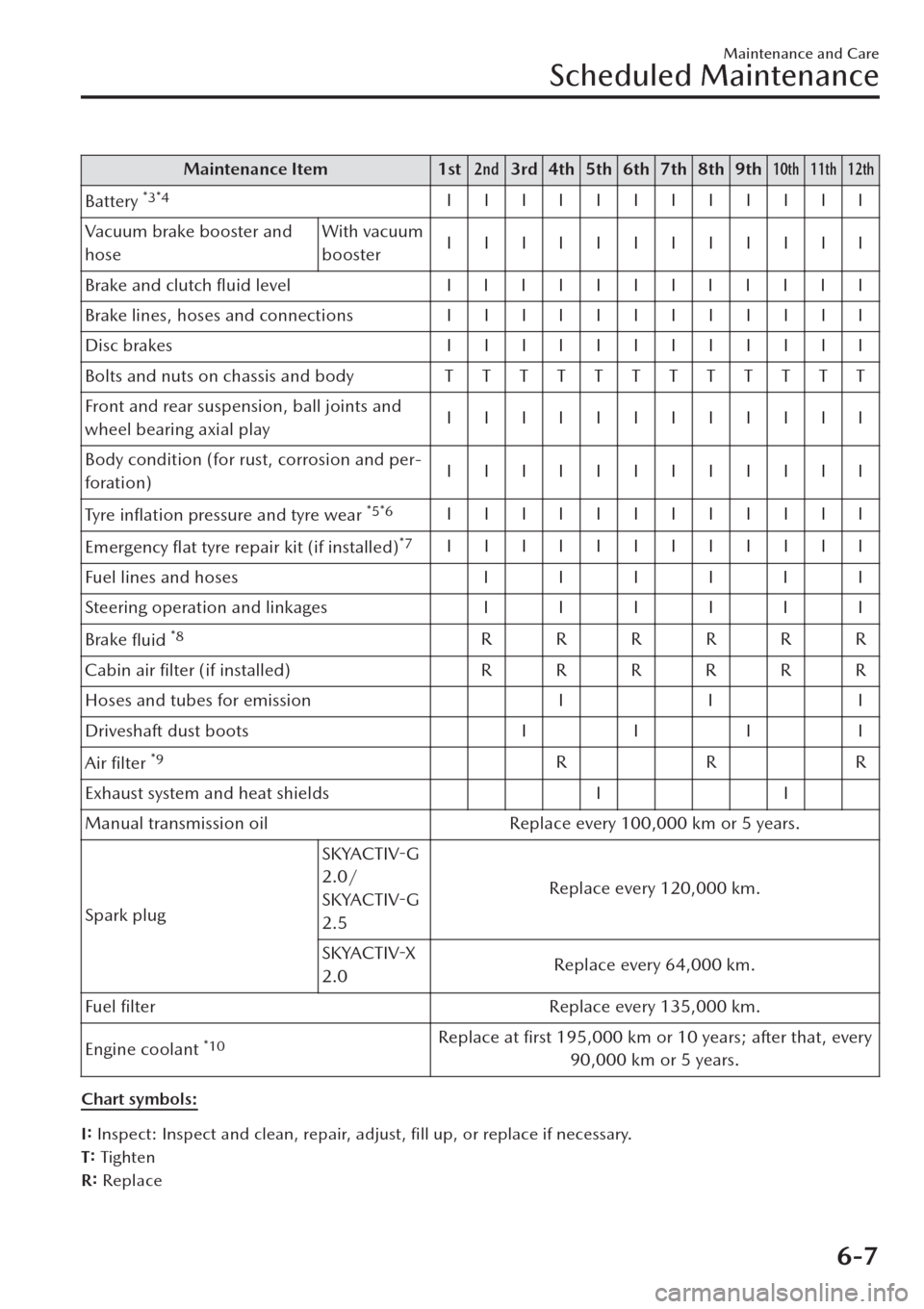
Maintenance Item 1st2nd3rd 4th 5th 6th 7th 8th 9th10th 11th 12th
Battery *3*4IIIIIIIIIIII
Vacuum brake booster and
hoseWith vacuum
boosterIIIIIIIIIIII
Brake and clutch fluid level IIIIIIIIIIII
Brake lines, hoses and connections I I I I I I I I I I I I
Disc brakes IIIIIIIIIIII
Bolts and nuts on chassis and body T T T T T T T T T T T T
Front and rear suspension, ball joints and
wheel bearing axial playIIIIIIIIIIII
Body condition (for rust, corrosion and per-
foration)IIIIIIIIIIII
Ty re
inflation pressure and tyre wear
*5*6IIIIIIIIIIII
Emergency
flat tyre repair kit (if installed)
*7IIIIIIIIIIII
Fuel lines and hoses IIIIII
Steering operation and linkages IIIIII
Brake
fluid
*8RRRRRR
Cabin air filter (if installed) RRRRRR
Hoses and tubes for emission I I I
Driveshaft dust boots I I I I
Air filter
*9RRR
Exhaust system and heat shields I I
Manual transmission oil Replace every 100,000 km or 5 years.
Spark plugSKYACTIV-G
2.0/
SKYACTIV-G
2.5Replace every 120,000 km.
SKYACTIV-X
2.0Replace every 64,000 km.
Fuel filter Replace every 135,000 km.
Engine coolant
*10Replace at first 195,000 km or 10 years; after that, every
90,000 km or 5 years.
Chart symbols:
I: Inspect: Inspect and clean, repair, adjust, fill up, or replace if necessary.
T: Tighten
R: Replace
Maintenance and Care
Scheduled Maintenance
6-7
Page 460 of 683
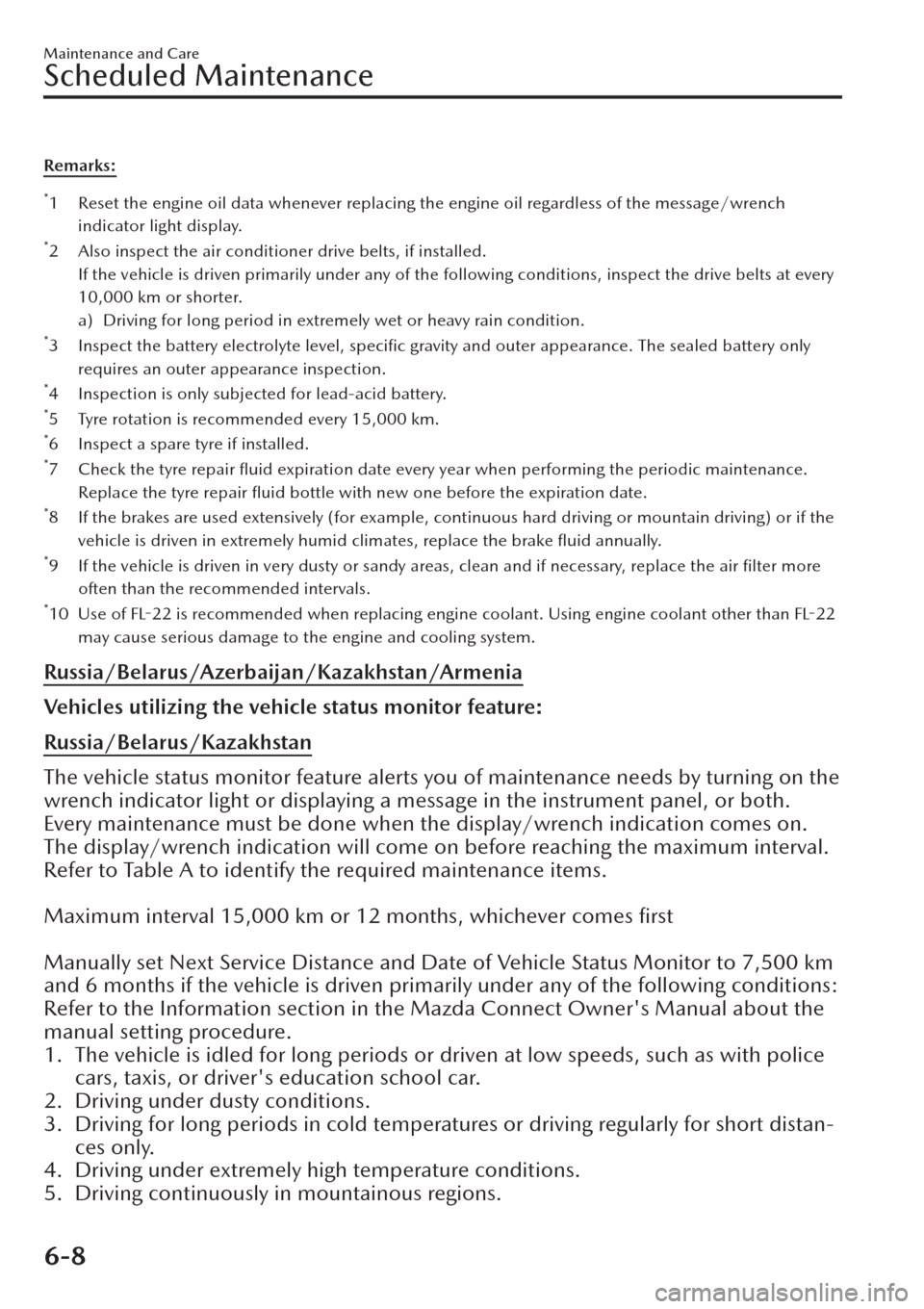
Remarks:
*1 Reset the engine oil data whenever replacing the engine oil regardless of the message/wrench
indicator light display.
*2 Also inspect the air conditioner drive belts, if installed.
If the vehicle is driven primarily under any of the following conditions, inspect the drive belts at every
10,000 km or shorter.
a) Driving for long period in extremely wet or heavy rain condition.
*3 Inspect the battery electrolyte level,
specific gravity and outer appearance. The sealed battery only
requires an outer appearance inspection.
*4 Inspection is only subjected for lead-acid battery.*5 Tyre rotation is recommended every 15,000 km.*6 Inspect a spare tyre if installed.*7 Check the tyre repair fluid expiration date every year when performing the periodic maintenance.
Replace the tyre repair
fluid bottle with new one before the expiration date.
*8 If the brakes are used extensively (for example, continuous hard driving or mountain driving) or if the
vehicle is driven in extremely humid climates, replace the brake fluid annually.
*9 If the vehicle is driven in very dusty or sandy areas, clean and if necessary, replace the air
filter more
often than the recommended intervals.
*10 Use of FL-22 is recommended when replacing engine coolant. Using engine coolant other than FL-22
may cause serious damage to the engine and cooling system.
Russia/Belarus/Azerbaijan/Kazakhstan/Armenia
Vehicles utilizing the vehicle status monitor feature:
Russia/Belarus/Kazakhstan
The vehicle status monitor feature alerts you of maintenance needs by turning on the
wrench indicator light or displaying a message in the instrument panel, or both.
Every maintenance must be done when the display/wrench indication comes on.
The display/wrench indication will come on before reaching the maximum interval.
Refer to Table A to identify the required maintenance items.
Maximum interval 15,000 km or 12 months, whichever comes first
Manually set Next Service Distance and Date of Vehicle Status Monitor to 7,500 km
and 6 months if the vehicle is driven primarily under any of the following conditions:
Refer to the Information section in the Mazda Connect Owner's Manual about the
manual setting procedure.
1. The vehicle is idled for long periods or driven at low speeds, such as with police
cars, taxis, or driver's education school car.
2. Driving under dusty conditions.
3. Driving for long periods in cold temperatures or driving regularly for short distan-
ces only.
4. Driving under extremely high temperature conditions.
5. Driving continuously in mountainous regions.
Maintenance and Care
Scheduled Maintenance
6-8
Page 461 of 683
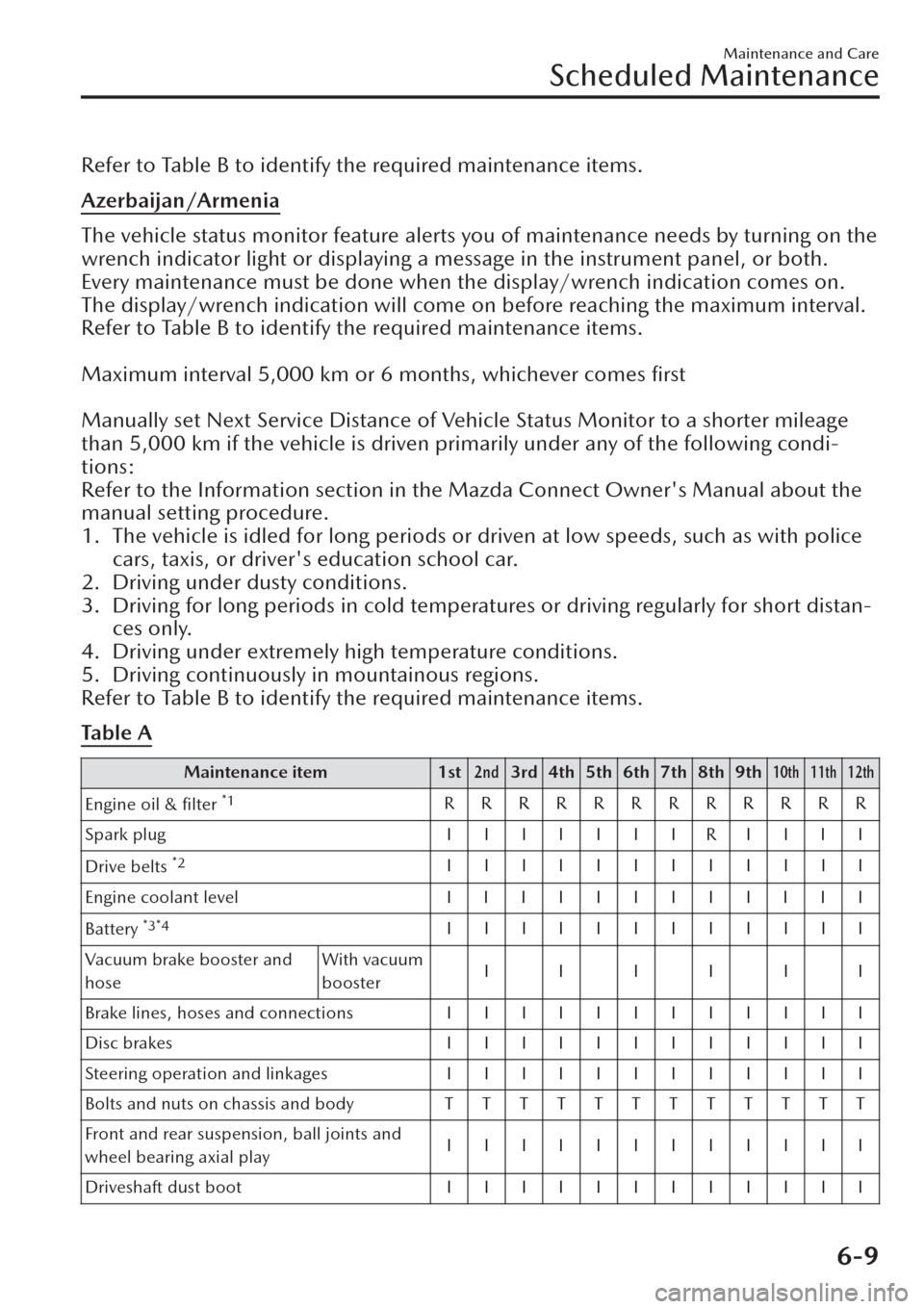
Refer to Table B to identify the required maintenance items.
Azerbaijan/Armenia
The vehicle status monitor feature alerts you of maintenance needs by turning on the
wrench indicator light or displaying a message in the instrument panel, or both.
Every maintenance must be done when the display/wrench indication comes on.
The display/wrench indication will come on before reaching the maximum interval.
Refer to Table B to identify the required maintenance items.
Maximum interval 5,000 km or 6 months, whichever comes
first
Manually set Next Service Distance of Vehicle Status Monitor to a shorter mileage
than 5,000 km if the vehicle is driven primarily under any of the following condi-
tions:
Refer to the Information section in the Mazda Connect Owner's Manual about the
manual setting procedure.
1. The vehicle is idled for long periods or driven at low speeds, such as with police
cars, taxis, or driver's education school car.
2. Driving under dusty conditions.
3. Driving for long periods in cold temperatures or driving regularly for short distan-
ces only.
4. Driving under extremely high temperature conditions.
5. Driving continuously in mountainous regions.
Refer to Table B to identify the required maintenance items.
Ta b l e A
Maintenance item 1st2nd3rd 4th 5th 6th 7th 8th 9th10th 11th 12th
Engine oil &
filter *1RRRRRRRRRRRR
Spark plug IIIIIIIRIIII
Drive belts
*2IIIIIIIIIIII
Engine coolant level IIIIIIIIIIII
Battery
*3*4IIIIIIIIIIII
Vacuum brake booster and
hoseWith vacuum
boosterIIIIII
Brake lines, hoses and connections I I I I I I I I I I I I
Disc brakes IIIIIIIIIIII
Steering operation and linkages I I I I I I I I I I I I
Bolts and nuts on chassis and body T T T T T T T T T T T T
Front and rear suspension, ball joints and
wheel bearing axial playIIIIIIIIIIII
Driveshaft dust boot IIIIIIIIIIII
Maintenance and Care
Scheduled Maintenance
6-9
Page 463 of 683
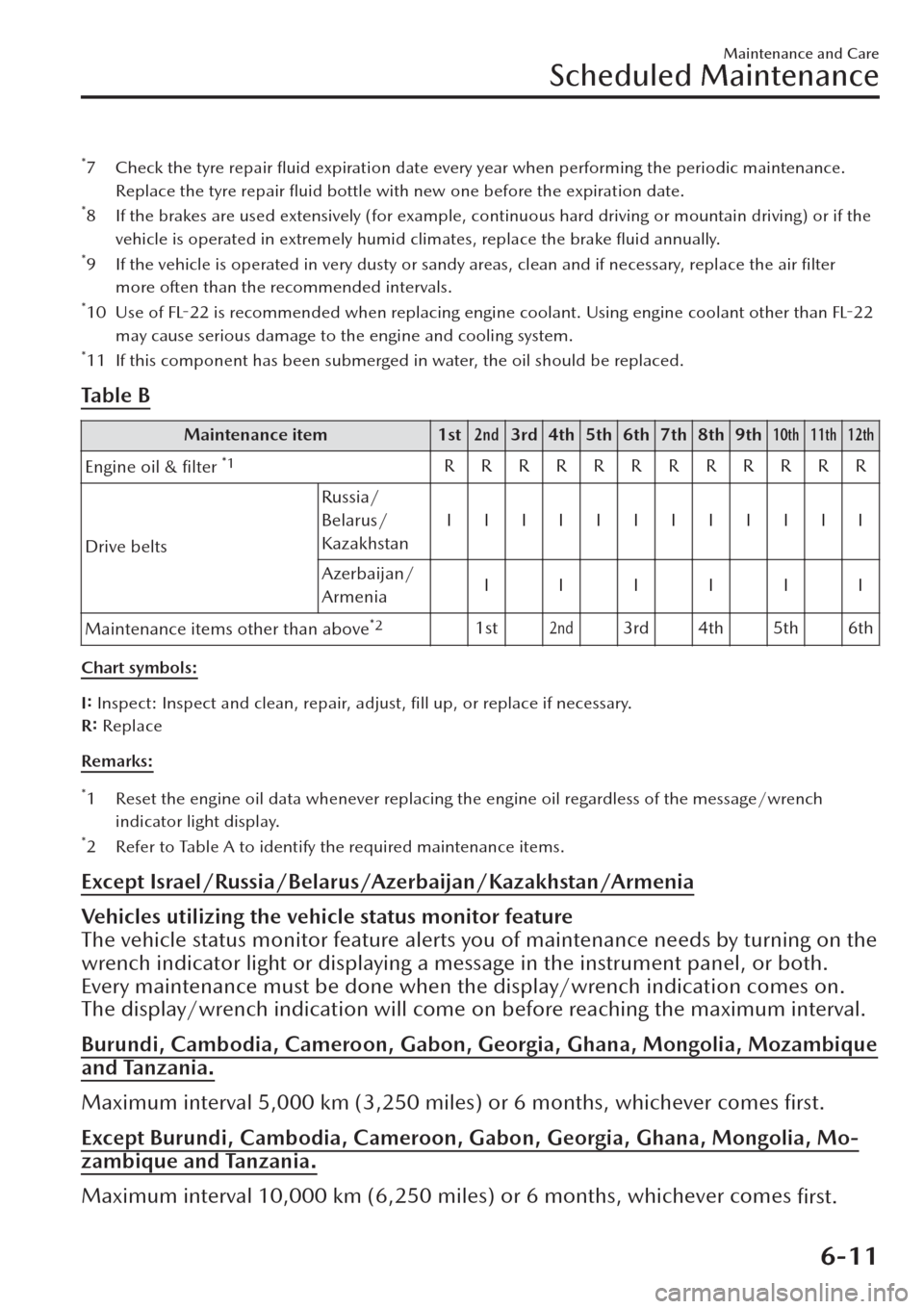
*7 Check the tyre repair fluid expiration date every year when performing the periodic maintenance.
Replace the tyre repair fluid bottle with new one before the expiration date.
*8 If the brakes are used extensively (for example, continuous hard driving or mountain driving) or if the
vehicle is operated in extremely humid climates, replace the brake fluid annually.
*9 If the vehicle is operated in very dusty or sandy areas, clean and if necessary, replace the air filter
more often than the recommended intervals.
*10 Use of
FL-22 is recommended when replacing engine coolant. Using engine coolant other than
FL-22
may cause serious damage to the engine and cooling system.
*11 If this component has been submerged in water, the oil should be replaced.
Ta b l e B
Maintenance item 1st2nd3rd 4th 5th 6th 7th 8th 9th10th 11th 12th
Engine oil &
filter *1RRRRRRRRRRRR
Drive beltsRussia/
Belarus/
KazakhstanIIIIIIIIIIII
Azerbaijan/
ArmeniaIIIIII
Maintenance items other than above
*21st2nd3rd 4th 5th 6th
Chart symbols:
I: Inspect: Inspect and clean, repair, adjust, fill up, or replace if necessary.
R: Replace
Remarks:
*1 Reset the engine oil data whenever replacing the engine oil regardless of the message/wrench
indicator light display.
*2 Refer to Table A to identify the required maintenance items.
Except Israel/Russia/Belarus/Azerbaijan/Kazakhstan/Armenia
Vehicles utilizing the vehicle status monitor feature
The vehicle status monitor feature alerts you of maintenance needs by turning on the
wrench indicator light or displaying a message in the instrument panel, or both.
Every maintenance must be done when the display/wrench indication comes on.
The display/wrench indication will come on before reaching the maximum interval.
Burundi, Cambodia, Cameroon, Gabon, Georgia, Ghana, Mongolia, Mozambique
and Tanzania.
Maximum interval 5,000 km (3,250 miles) or 6 months, whichever comes first.
Except Burundi, Cambodia, Cameroon, Gabon, Georgia, Ghana, Mongolia, Mo-
zambique and Tanzania.
Maximum interval 10,000 km (6,250 miles) or 6 months, whichever comes
first.
Maintenance and Care
Scheduled Maintenance
6-11
Page 464 of 683
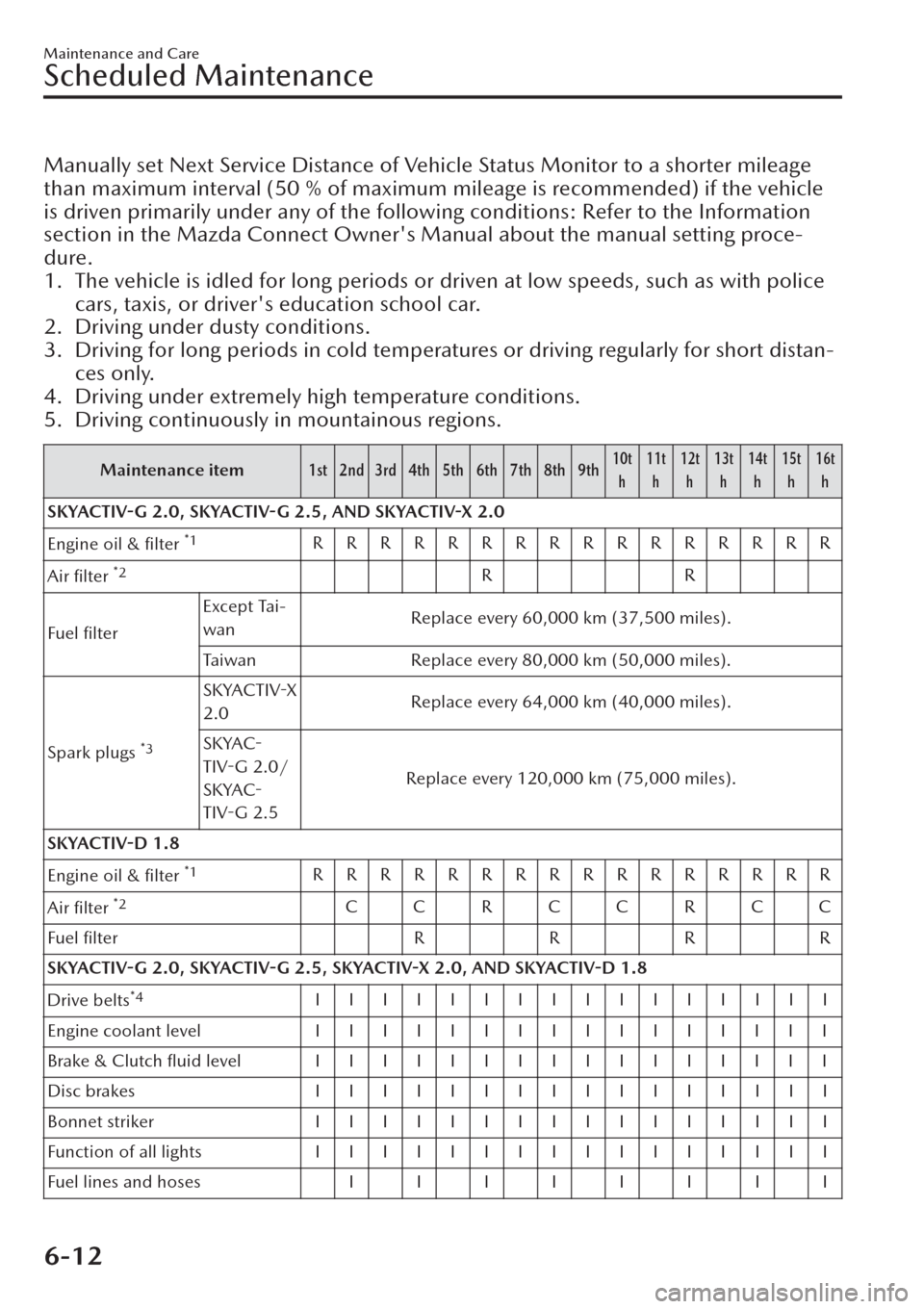
Manually set Next Service Distance of Vehicle Status Monitor to a shorter mileage
than maximum interval (50 % of maximum mileage is recommended) if the vehicle
is driven primarily under any of the following conditions: Refer to the Information
section in the Mazda Connect Owner's Manual about the manual setting proce-
dure.
1. The vehicle is idled for long periods or driven at low speeds, such as with police
cars, taxis, or driver's education school car.
2. Driving under dusty conditions.
3. Driving for long periods in cold temperatures or driving regularly for short distan-
ces only.
4. Driving under extremely high temperature conditions.
5. Driving continuously in mountainous regions.
Maintenance item1st 2nd 3rd 4th 5th 6th 7th 8th 9th10t
h11t
h12t
h13t
h14t
h15t
h16t
h
SKYACTIV-G 2.0, SKYACTIV-G 2.5, AND SKYACTIV-X 2.0
Engine oil & filter
*1RRRRRRRRRRRRRRRR
Air filter
*2RR
Fuel filterExcept Tai-
wanReplace every 60,000 km (37,500 miles).
Taiwan Replace every 80,000 km (50,000 miles).
Spark plugs
*3
SKYACTIV-X
2.0Replace every 64,000 km (40,000 miles).
SKYAC-
TIV-G 2.0/
SKYAC-
TIV-G 2.5Replace every 120,000 km (75,000 miles).
SKYACTIV-D 1.8
Engine oil & filter
*1RRRRRRRRRRRRRRRR
Air
filter
*2CC R CC R CC
Fuel filter RRRR
SKYACTIV-G 2.0, SKYACTIV-G 2.5, SKYACTIV-X 2.0, AND SKYACTIV-D 1.8
Drive belts
*4IIIIIIIIIIIIIIII
Engine coolant level IIIIIIIIIIIIIIII
Brake & Clutch fluid level IIIIIIIIIIIIIIII
Disc brakes IIIIIIIIIIIIIIII
Bonnet striker IIIIIIIIIIIIIIII
Function of all lights IIIIIIIIIIIIIIII
Fuel lines and hoses IIIIIIII
Maintenance and Care
Scheduled Maintenance
6-12
Page 466 of 683
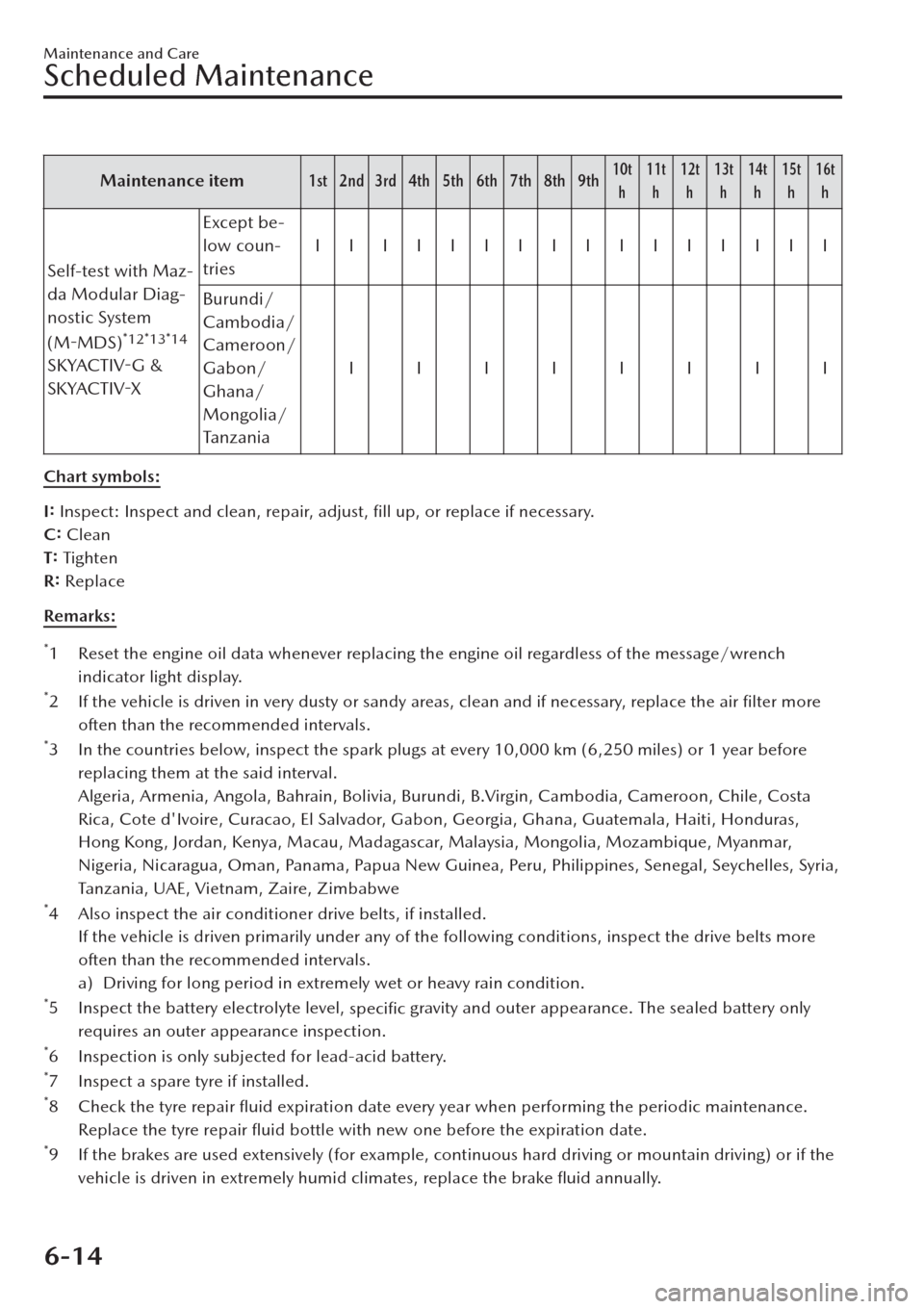
Maintenance item1st 2nd 3rd 4th 5th 6th 7th 8th 9th10t
h11t
h12t
h13t
h14t
h15t
h16t
h
Self-test with Maz-
da Modular Diag-
nostic System
(M-MDS)
*12*13*14
SKYACTIV-G &
SKYACTIV-XExcept be-
low coun-
triesIIIIIIIIIIIIIIII
Burundi/
Cambodia/
Cameroon/
Gabon/
Ghana/
Mongolia/
TanzaniaIIIIIIII
Chart symbols:
I: Inspect: Inspect and clean, repair, adjust, fill up, or replace if necessary.
C: Clean
T: Tighten
R: Replace
Remarks:
*1 Reset the engine oil data whenever replacing the engine oil regardless of the message/wrench
indicator light display.
*2 If the vehicle is driven in very dusty or sandy areas, clean and if necessary, replace the air filter more
often than the recommended intervals.
*3 In the countries below, inspect the spark plugs at every 10,000 km (6,250 miles) or 1 year before
replacing them at the said interval.
Algeria, Armenia, Angola, Bahrain, Bolivia, Burundi, B.Virgin, Cambodia, Cameroon, Chile, Costa
Rica, Cote d'Ivoire, Curacao, El Salvador, Gabon, Georgia, Ghana, Guatemala, Haiti, Honduras,
Hong Kong, Jordan, Kenya, Macau, Madagascar, Malaysia, Mongolia, Mozambique, Myanmar,
Nigeria, Nicaragua, Oman, Panama, Papua New Guinea, Peru, Philippines, Senegal, Seychelles, Syria,
Tanzania, UAE, Vietnam, Zaire, Zimbabwe
*4 Also inspect the air conditioner drive belts, if installed.
If the vehicle is driven primarily under any of the following conditions, inspect the drive belts more
often than the recommended intervals.
a) Driving for long period in extremely wet or heavy rain condition.
*5 Inspect the battery electrolyte level,
specific gravity and outer appearance. The sealed battery only
requires an outer appearance inspection.
*6 Inspection is only subjected for lead-acid battery.*7 Inspect a spare tyre if installed.*8 Check the tyre repair fluid expiration date every year when performing the periodic maintenance.
Replace the tyre repair fluid bottle with new one before the expiration date.
*9 If the brakes are used extensively (for example, continuous hard driving or mountain driving) or if the
vehicle is driven in extremely humid climates, replace the brake
fluid annually.
Maintenance and Care
Scheduled Maintenance
6-14