brakes MAZDA MODEL CX-30 2021 Owner's Manual
[x] Cancel search | Manufacturer: MAZDA, Model Year: 2021, Model line: MODEL CX-30, Model: MAZDA MODEL CX-30 2021Pages: 594, PDF Size: 83.37 MB
Page 274 of 594

Forward Sensing Camera (FSC) (page
4-198)
Front radar sensor (page 4-202)
WARNING
Do not rely completely on the MRCC
with Stop & Go function:
The MRCC with Stop & Go function
system has detection limitations
depending on the type of vehicle
ahead and its conditions, the weather
conditions, and the road conditions.
Additionally, the system may be unable
to decelerate sufficiently to avoid
hitting the vehicle ahead if the vehicle
ahead applies the brakes suddenly or
another vehicle cuts into the driving
lane in front of you, which could result
in an accident.
Always drive carefully and verify the
surrounding conditions and depress
the brake pedal or accelerator pedal
while keeping a safe distance from
vehicles ahead or on-coming vehicles.
Do not use the MRCC with Stop & Go
function system in the following
locations. Using the MRCC with Stop
& Go function system at the following
locations may result in an unexpected
accident:
General roads other than highways
(Driving under these conditions
using the MRCC with Stop & Go
function system is not possible.)
Roads with sharp curves and where
vehicle traffic is heavy with
insufficient space between vehicles,
or roads where frequent and
repetitive acceleration and
deceleration occur (Driving under
these conditions using the MRCC
with Stop & Go function is not
possible.)
When entering and exiting
interchanges, service areas, and
parking areas of highways (If you exit
a highway while headway control is
in use, the vehicle ahead will no
longer be tracked and your vehicle
may accelerate to the set speed.)
Slippery roads such as ice or
snow-bound roads (Tires could spin
causing you to lose vehicle control,
or the stop hold control may not
operate.)
Long, descending slopes (to
maintain distance between vehicles,
the system automatically and
continuously applies the brakes
which could result in the loss of
brake power.)
Slopes with a steep gradient (The
vehicle ahead may not be detected
correctly, your vehicle may slide
while stopped by the stop hold
control, and it may accelerate
suddenly after it starts moving.)
Two-wheeled vehicles such as
motorcycles or bicycles are ahead.
For safety purposes, switch the MRCC
with Stop & Go function system off
when it is not being used.
Leaving the MRCC with Stop & Go
function system turned on when it is
not in use is dangerous as it could
operate unexpectedly, resulting in an
accident.
When Driving
i-ACTIVSENSE
4-128
CX-30_8JP5-EA-20K_Edition1_new 2020-7-22 15:50:09
Page 275 of 594

Do not get out of the vehicle while
the stop hold control is operating:
Getting out of the vehicle while the
stop hold control is operating is
dangerous as the vehicle may move
unexpectedly and result in an accident.
Before getting out of the vehicle,
switch the MRCC with Stop & Go
function system off, shift the selector
lever to the P position, and apply the
parking brake.
CAUTION
If your vehicle is towed or you are
towing something , switch the MRCC
with Stop & Go function system off
to prevent an unexpected operation.
Turn the system
off when the vehicle
is running on a chassis roller.
NOTE
The MRCC with Stop & Go function
system does not detect the following
as physical objects.
Vehicles approaching in the
opposite direction
Pe d e s t r i a n sStationary objects (stopped
vehicles, obstructions)
If a vehicle ahead is traveling at an
extremely low speed, the system may
not detect it correctly.
If there is a structure on the road or
an object (such as a monorail) at a
low height off the ground in front of
the vehicle, the system may operate.
Therefore, do not use the MRCC
with Stop & Go function.
Do not use the MRCC with Stop &
Go function system under conditions
in which close proximity warnings
are frequently activated.
During headway control travel, the
system accelerates and decelerates
your vehicle in conjunction with the
speed of the vehicle ahead.
However, if it is necessary to
accelerate for a lane change or if the
vehicle ahead brakes suddenly
causing you to close in on the vehicle
rapidly, accelerate using the
accelerator pedal or decelerate using
the brake pedal depending on the
conditions.
While the MRCC with Stop & Go
function system is in use, it does not
cancel even if the selector lever is
operated and any intended engine
braking does not occur. If
deceleration is required, lower the
set speed or depress the brake
pedal.
While braking by the MRCC with
Stop & Go function control is
operating , you might hear an
operation sound, however, this does
not indicate a problem.
The brake lights turn on while
braking by the MRCC with Stop &
Go function control is operating,
however, they may not turn on while
the vehicle is on a down slope at the
set vehicle speed or traveling at a
constant speed and following a
vehicle ahead.
Stop the headway control function to
switch the system to the cruise
control function.
Refer to the Settings section in the
Mazda Connect Owner's Manual.
When Driving
i-ACTIVSENSE
4-129
CX-30_8JP5-EA-20K_Edition1_new 2020-7-22 15:50:09
Page 277 of 594

▼Close Proximity Warning
If your vehicle rapidly closes in on the
vehicle ahead because the vehicle
ahead applies the brakes suddenly
while you are traveling in headway
control, the warning sound activates
and the brake warning is indicated in
the display. Always verify the safety of
the surrounding area and depress the
brake pedal while keeping a safe
distance from the vehicle ahead.
Additionally, keep a safe distance from
the vehicles behind you.
1. “Depress Brake Pedal” message is
displayed
NOTE
In the following cases, the warnings
and brakes may not operate even if
your vehicle starts closing in on the
vehicle ahead.
You are driving your vehicle at the
same speed as the vehicle ahead.
Directly after the MRCC with Stop &
Go function system has been set.
Directly after the accelerator pedal is
released.
Another vehicle cuts into the driving
lane in front of you.
When Driving
i-ACTIVSENSE
4-131
CX-30_8JP5-EA-20K_Edition1_new 2020-7-22 15:50:09
Page 284 of 594

The TJA may not be able to detect a
vehicle ahead depending on the type
of vehicle ahead and its conditions,
the weather conditions, and the road
conditions. Additionally, the system
might be unable to decelerate
sufficiently if a vehicle ahead applies
the brakes suddenly, another vehicle
cuts into the driving lane, or the difference in vehicle speed between
your vehicle and the vehicle ahead is
larger, which could result in an
accident. Check the surrounding
conditions and always drive carefully
while keeping a safe distance from
vehicles ahead and on-coming
vehicles.
For the purposes of safety, switch the
TJA off when it is not being used.
Leaving the TJA turned on when it is
not in use is dangerous as it could
operate unexpectedly, resulting in an
accident.
Do not use the TJA under the
following conditions. Otherwise, it
may result in an accident.
General roads other than
expressways or highways (Driving
under these conditions using the TJA
is not possible.)
Roads with sharp curves and where
vehicle traffic is heavy with
insufficient space between vehicles,
or roads where frequent and
repetitive acceleration and
deceleration occur (Driving under
these conditions using the TJA is not
possible). When entering and exiting
interchanges, service areas, and
parking areas of expressways (If you
exit an expressway while headway
control is in use, the vehicle ahead
will no longer be tracked and your
vehicle may accelerate to the set
speed).
Slippery roads such as icy or
snow-covered roads (Tires could spin
causing you to lose vehicle control,
or the stop hold control may not
operate.)
Long, descending slopes (to
maintain distance between vehicles,
the system automatically and
continuously applies the brakes
which could result in the loss of
brake power.)
Two-wheeled vehicles such as
motorcycles or bicycles are ahead.
(Automatic transmission vehicle)
Slopes with a steep gradient (The
vehicle ahead may not be detected
correctly, your vehicle may slip while
stopped by the stop hold control, or
it may accelerate suddenly after it
starts moving.)
Driving under bad weather
conditions (rain, fog , and snow).
The vehicle is driven on slippery
roads such as icy or snow -covered
roads and unpaved roads (Tires
could spin causing you to lose
vehicle control, or the stop hold
control may not operate.)
Tires of a different specified size are
used, such as a temporary spare tire.
Tires with insufficient tread are used.
The tire pressures are not adjusted to
the
specified pressure.
The vehicle is being used to tow a
camper or boat trailer.
Tire chains are used.
When Driving
i-ACTIVSENSE
4-138
CX-30_8JP5-EA-20K_Edition1_new 2020-7-22 15:50:09
Page 285 of 594
The vehicle is driven on roads with
lane lines other than white (yellow)
lines, such as an expressway.
Do not get out of the vehicle while
the stop hold control is operating.
(Automatic transmission vehicle)
Getting out of the vehicle while the
stop hold control is operating is
dangerous as the vehicle may move
unexpectedly and result in an accident.
Before getting out of the vehicle,
switch the TJA off, apply the parking
brake, and then shift the selector lever
to the P position.
CAUTION
Turn the system off when the vehicle is
running on a chassis roller.
Heed the following cautions so that
the TJA can operate normally.
Turn the system off when the vehicle
is running on a chassis roller.
Do not modify the vehicle's
suspensions.
Always use wheels of the specified
size for the front and rear wheels.
Consult an Authorized Mazda Dealer
for tire replacement.
NOTE
The headway control does not detect
the following as physical objects.
Vehicles approaching in the
opposite direction
Pe d e s t r i a n sStationary objects (stopped
vehicles, obstructions)
If a vehicle ahead is traveling at an
extremely low speed, the system may
not detect it correctly.
If there is a structure on the road or
an object (such as a monorail) at a
low height off the ground in front of
the vehicle, the system may operate.
Therefore, do not use the TJA.
Do not use the TJA under conditions
in which close proximity warnings
are frequently activated.
If it is necessary to accelerate for a
lane change or the vehicle ahead
brakes suddenly causing you to close
in on the vehicle rapidly, accelerate
using the accelerator pedal or
decelerate using the brake pedal
depending on the conditions.
While the TJA is in use, any intended
engine braking does not occur even
if you shift the shift lever (manual
transmission) or the selector lever
(automatic transmission). If
deceleration is required, lower the
vehicle speed setting or depress the
brake pedal.
While braking by the TJA control is
operating , you might hear an
operation sound, however, this does
not indicate a problem.
The brake lights turn on while
braking by the TJA control is
operating , however, they may not
turn on while the vehicle is on a
down slope at the set vehicle speed
or traveling at a constant speed and
following a vehicle ahead.
Under the following conditions, the
TJA may not be able to detect white
(yellow) lines or vehicles ahead
correctly and the TJA may not
operate normally.
The forward sensing camera (FSC)
cannot recognize the area in front
of the vehicle due to soiling or fog.
When Driving
i-ACTIVSENSE
4-139
CX-30_8JP5-EA-20K_Edition1_new 2020-7-22 15:50:09
Page 288 of 594

Inactive
Active (vehicle ahead)
Active (lane line)
If there is a problem with the TJA, a
message is displayed on the
multi-information display. Check the
details of the problem on the center
display and then have your vehicle
inspected by an Authorized Mazda
Dealer.
Refer to If a Warning Light Turns On or
Flashes on page 7-22.
▼Close Proximity Warning
If your vehicle rapidly closes in on the
vehicle ahead while you are traveling
under headway control, the warning
sound is activated and the brake
warning is indicated on the display.
Keep a safe distance between your
vehicle and a vehicle ahead.
1. “Depress Brake Pedal” message is
displayed
NOTE
In the following cases, the warnings
and brakes may not operate even if
your vehicle starts closing in on the
vehicle ahead.
You are driving your vehicle at the
same speed as the vehicle ahead.
Directly after the TJA operates.Directly after the accelerator pedal is
released.
Another vehicle cuts into the driving
lane in front of you.
When Driving
i-ACTIVSENSE
4-142
CX-30_8JP5-EA-20K_Edition1_new 2020-7-22 15:50:09
Page 301 of 594

Smart Brake Support(SBS)
*
▼Smart Brake Support (SBS)
The SBS alerts the driver of a possible
collision using the warning indications
in the display and a warning sound if
the front radar sensor and Forward
Sensing Camera (FSC) determine that
there is the possibility of a collision
with a vehicle ahead, pedestrian, or a
bicycle. Furthermore, if a collision is
unavoidable, the automatic brake
control is performed to reduce damage
in the event of a collision. In addition,
when the driver de
presses the brake
pedal, the brakes are applied firmly
and quickly to assist.
(Vehicles with Driver Monitoring
(DM))
When the SBS determines that the
driver is not paying attention to the
road using the driver monitoring
camera and it determines that there is
the possibility of a collision with an
obstruction, the SBS activates the
collision warning earlier than normal.
WARNING
Do not rely completely on the SBS:
The SBS is only designed to reduce
damage in the event of a collision.
The ability to detect obstructions is
limited depending on the obstructions,
weather conditions, or traffic
conditions. Over reliance on the
system leading to the accelerator pedal
or brake pedal being mistakenly
operated could result in an accident.
CAUTION
In the following cases, turn the system
off to prevent an unexpected
operation.
The vehicle is being towed or when
towing another vehicle.
The vehicle is on a chassis roller.
When driving on rough roads such as
in areas of dense grass or off-road.
See the next page on how to turn
off
the system.
Refer to Stopping the Smart Brake
Support (SBS) System Operation on
page 4-157.
Operation conditions
The SBS operates when all of the
following conditions are met.
The ignition is switched ON.The SBS is on.The i-ACTIVSENSE warning
indication/warning light is not
turned on.
(Object is vehicle ahead)
The vehicle speed is about 4 km/h
(2 mph) or higher.
(Object is a pedestrian or bicycle)
The vehicle speed is between about
10 to 80 km/h (6.2 to 50 mph).
The DSC does not operate.
NOTE
Under the following conditions, the
SBS may not operate.
If there is the possibility of hitting
only a part of a vehicle or
obstruction ahead.
You are driving your vehicle at the
same speed as the vehicle ahead.
When the driver deliberately
performs driving operations
(accelerator operation, steering
wheel operation).
When Driving
i-ACTIVSENSE
*Some models.4-155
CX-30_8JP5-EA-20K_Edition1_new 2020-7-22 15:50:09
Page 307 of 594
![MAZDA MODEL CX-30 2021 Owners Manual Smart Brake Support
[Rear Crossing] (SBS-RC)
*
▼ Smart Brake Support [Rear
Crossing]
(SBS-RC)
The SBS-RC is a system designed to
assist the driver in avoiding collisions
and to reduce damage in the](/img/28/40980/w960_40980-306.png "MAZDA MODEL CX-30 2021 Owners Manual Smart Brake Support
[Rear Crossing] (SBS-RC)
*
▼ Smart Brake Support [Rear
Crossing]
(SBS-RC)
The SBS-RC is a system designed to
assist the driver in avoiding collisions
and to reduce damage in the")
Smart Brake Support
[Rear Crossing] (SBS-RC)
*
▼ Smart Brake Support [Rear
Crossing]
(SBS-RC)
The SBS-RC is a system designed to
assist the driver in avoiding collisions
and to reduce damage in the event of
a collision by applying the brakes if
there is the possibility of collision with
a vehicle approaching from the rear
while you are reversing out of parking
space.
The SBS-RC system detects vehicles
approaching from the rear left and
right sides of the vehicle, and the rear
of the vehicle while the vehicle is being
reversed out of a parking space, the
system reduces damage in the event of
a collision by operating the brake
control when the system determines
that a collision is unavoidable.
SBS-RC operation
1. The SBS-RC system operates when
the shift lever (manual
transmission) or the selector lever
(automatic transmi ssion) is shifted
to the reverse (R) position.
2. If there is the possibility of a collision with an approaching
vehicle, the SBS-RC system applies
brake and displays “BRAKE!” on the
active driving display and the
multi-information display.
WARNING
Always check the surrounding area
visually before actually putting the
vehicle in reverse:
The system is only designed to assist
you in backing out of the lot when
putting the vehicle in reverse. Due to
certain limitations with the operation
of this system, the SBS-RC system may
not operate brake or it might be
delayed even though a vehicle is
behind your vehicle. Always make it
your responsibility as a driver to check
the rear.
Do not rely completely on the SBS-RC
system:
The
SBS-RC system is only designed
to reduce damage in the event of a
collision. Over reliance on the system
leading to the accelerator pedal or
brake pedal being mistakenly
operated could result in an accident.
The SBS-RC system operates in
response to a vehicle. The system
does not operate in response to
obstructions such as a wall,
pedestrians, or animals.
To assure the correct operation of the
SBS-RC, heed the following cautions.
Do not apply a sticker to a rear radar
and rear camera. Otherwise, the rear
radar and rear camera may not be
able to detect vehicles or
obstructions which could result in an
accident.
Do not disassemble a rear radar and
rear camera.
When Driving
i-ACTIVSENSE
*Some models.4-161
CX-30_8JP5-EA-20K_Edition1_new 2020-7-22 15:50:09
Page 435 of 594
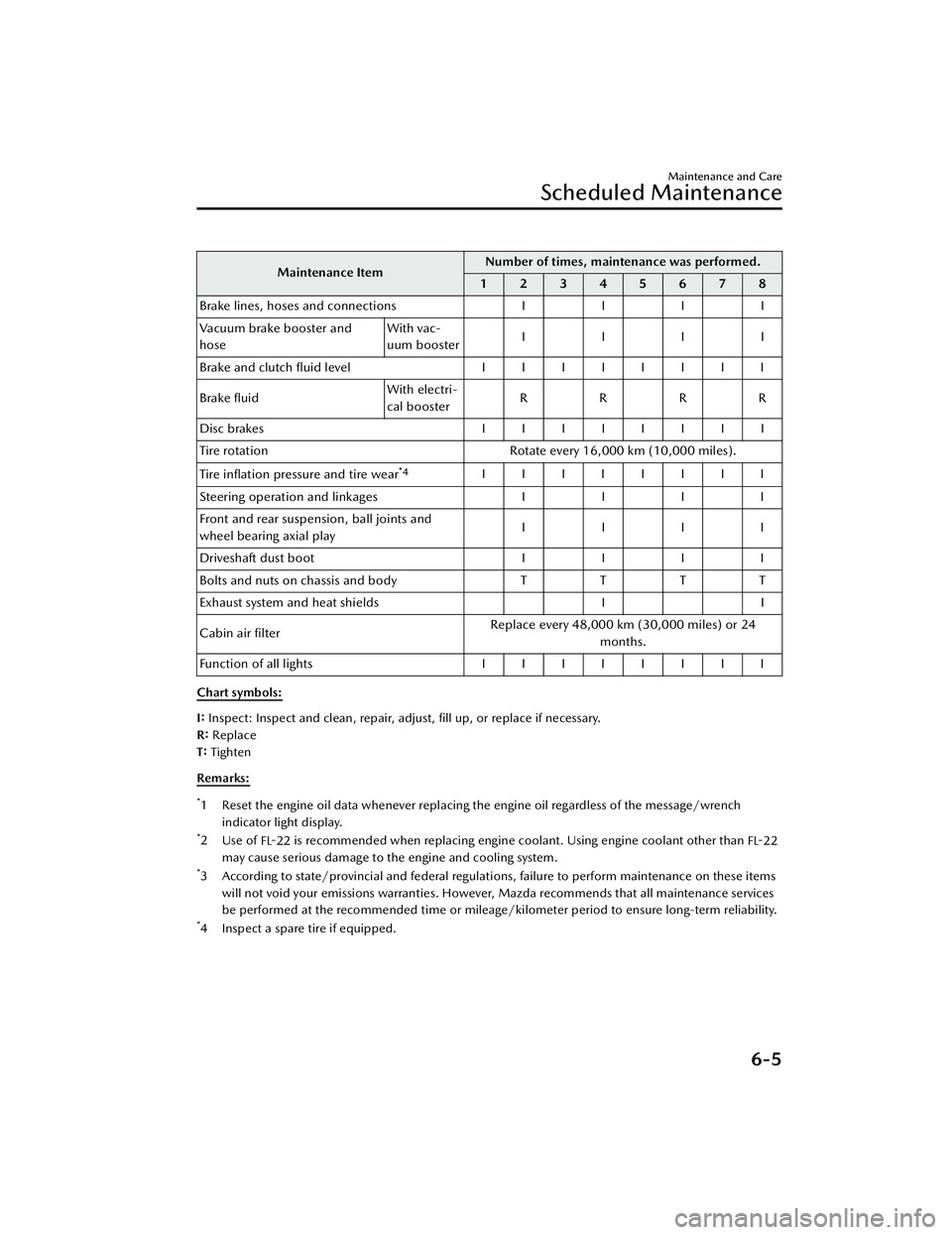
Maintenance ItemNumber of times, maintenance was performed.
12345678
B ra ke lin es, h ose s a nd c onnectio ns IIII
Vacuum brake booster and
hose With vac-
uum booster
IIII
Brake and clutch fluid level IIIIIIII
Brake fluid With electri-
cal booster
RRRR
Disc brakes IIIIIIII
Tire rotation Rotate every 16,000 km (10,000 miles).
Tire inflation pressure and tire wear
*4IIIIIIII
S te erin g o pera tio n a nd lin ka ge s IIII
Front and rear suspension, ball joints and
wheel bearing axial play IIII
D riv e sh aft d ust b oo t IIII
Bolts and nuts on chassis and body TTTT
Exhaust system and heat shields II
Cabin air filter Replace every 48,000 km (30,000 miles) or 24
months.
Function of all lights IIIIIIII
Chart symbols:
I: Inspect: Inspect and clean, repair, adjust, fill up, or replace if necessary.
R: Replace
T: Tighten
Remarks:
*1 Reset the engine oil data whenever replacing the engine oil regardless of the message/wrench indicator light display.
*2Use of FL-22 is recommended when replacing engine coolant. Using engine coolant other than
FL-22
may cause serious damage to the engine and cooling system.
*3 According to state/provincial and federal regulations, failure to perform maintenance on these items
will not void your emissions warranties. However, Mazda recommends that all maintenance services
be performed at the recommended time or mileage/kilometer period to ensure long-term reliability.
*4 Inspect a spare tire if equipped.
Maintenance and Care
Scheduled Maintenance
6-5
CX-30_8JP5-EA-20K_Edition1_new 2020-7-22 15:50:09
Page 437 of 594

Canada residents
Maintenance IntervalNumber of months or kilometers (miles), whichever comes first.
Months 6 1218243036424854606672
×1000 km 8 16 24 32 40 48 56 64 72 80 88 96 ×1000miles 5 1015202530354045505560
Engine oil & filter
*1*2Replace when the wrench indicator light is ON.
(Upper limit interval is 16,000 km (10,000 miles) or 12
months.)
Spark plugs SKYACTIV-G
2.5T
Replace every 64,000 km (40,000 miles).
Except SKY-
ACTIV-G
2.5T Replace every 120,000 km (75,000 miles).
Air filter Replace every 56,000 km (35,000 miles) or 36 months.
Drive belts
*3II
Engine coolant level IIIIIIIIIIII
Engine coolant
*4Replace at first 192,000 km (120,000 miles) or 120
months; after that, every 96,000 km (60,000 miles) or 60
months.
Fuel lines & hoses
*5III
Hoses and tubes for emission
*5I
Brake lines, hoses and connections III
Vacuum brake booster and
hose With vac-
uum booster
IIIIII
Brake fluid With electri-
cal booster
RRR
Disc brakes I C/L II/C
/L IC/LI I/C
/L
Tire rotation Rotate every 8,000 km (5,000 miles).
Tire inflation pressure and tire wear
*6IIIIIIIIIIII
Steering operation and linkages III
Front and rear suspension, ball joints and
wheel bearing axial play III
Body condition inspection for rust, corro-
sion and perforation IIIIII
Driveshaft dust boot III
Bolts and nuts on chassis and body TTT
Maintenance and Care
Scheduled Maintenance
6-7
CX-30_8JP5-EA-20K_Edition1_new 2020-7-22 15:50:09