low oil pressure MAZDA MODEL CX-30 2021 Owners Manual
[x] Cancel search | Manufacturer: MAZDA, Model Year: 2021, Model line: MODEL CX-30, Model: MAZDA MODEL CX-30 2021Pages: 594, PDF Size: 83.37 MB
Page 169 of 594

SignalWarning Refer to
Air Bag/Front Seat Belt Pretensioner System Warning Indication/
Warning Light*17-27
Tire Pressure Monitoring System (TPMS) Warning Indication/Warning
Light*1
Flashing
7-28
Tu r n s o n 7-32
(Red) KEY Warning Indication/Warning Light
*17-28
(Amber)
*High Beam Control System (HBC) Warning Indication/Warning
Light*17-29
i-ACTIVSENSE Warning Indication/Warning Light*17-29
Exterior Light Warning Indication/Warning Light*17-29
Low Fuel Warning Indication/Warning Light 7-30
Check Fuel Cap Warning Indication/Warning Light*17-30
Engine Oil Level Warning Indication/Warning Light*17-30
Seat Belt Warning Indication/Warning Light (Front seat)7-31
(Red)Seat Belt Warning Light (Rear seat)
7-31
*Low Washer Fluid Level Warning Indication/Warning Light7-31
Door-Ajar Warning Indication
7-32
Liftgate-Ajar Warning Indication 7-32
When Driving
Instrument Cluster and Display
*Some models.4-23
CX-30_8JP5-EA-20K_Edition1_new 2020-7-22 15:50:09
Page 229 of 594

i-ACTIV AWD Operation*
▼i-ACTIV AWD Operation
AWD provides excellent drivability on
snow-covered and ice-packed roads,
sand and mud, as well as on steep
slopes and other slippery surfaces.
A system malfunction or operation
conditions are indicated by a warning.
Refer to AWD Wa
rning Indication/
Warning Light on page 7-27.
WARNING
Never spin a wheel that is off the
ground:
Spinning a wheel that is off the ground
as a result of the vehicle being stuck or
in a ditch is dangerous. The drive
assembly could be seriously damaged
which could lead to an accident or
could even lead to overheating, oil
leakage, and a fire.
▼AWD Driving
WARNING
Avoid sharp turns, excessive speed
and abrupt maneuvers when driving
this vehicle:
Sharp turns, excessive speed and
abrupt maneuvering of this vehicle is
dangerous as it could result in the
increased risk of loss of vehicle control,
vehicle roll-over, personal injury or
death.
This vehicle has a higher center of
gravity. Vehicles with a higher center of
gravity such as utility and AWD vehicles
handle differently than vehicles with a
lower center of gravity.
Utility and AWD vehicles are not
designed for cornering at high speeds
any more than low profile sports cars
are designed to perform satisfactorily
under off-road conditions. In addition,
utility vehicles have a significantly
higher rollover rate than other types of
vehicles.
Drive carefully when the vehicle is
loaded by lowering vehicle speed and
applying the brakes earlier:
Abrupt maneuvering and sudden
braking when driving a loaded vehicle
is dangerous as the driving behavior of
a vehicle with a high center of gravity is
different when it is loaded compared
to when it is not, and could result in
the loss of vehicle control and an
accident.
▼Tires and Tire Chains
The condition of the tires plays a large
role in the performance of the vehicle.
Moreover, to prevent adverse
effects to
the drive assembly, please note the
following:
Tires
When replacing tires, always replace
all front and rear tires at the same
time.
All tires must be of the same size,
manufacture, brand and tread
pattern. Pay particular attention
when equipping snow or other types
of winter tires.
Do not mix tread-worn tires with
normal tires.
Inspect tire inflation pressures at the specified periods adjust to the
specified pressures.
When Driving
i-ACTIV AWD
*Some models.4-83
CX-30_8JP5-EA-20K_Edition1_new 2020-7-22 15:50:09
Page 349 of 594

NOTE
When the vehicle is driven on roads
in which there is an elevated road on
one side, the front radar sensor
function may be restricted
temporarily.
Under the following conditions, the
front radar sensor may not be able to
detect vehicles ahead or obstructions
correctly and each system may not
operate normally.
The rear surface of a vehicle ahead
does not reflect radio waves
effectively, such as an unloaded
trailer or an automobile with a
loading platform covered by a soft
top, vehicles with a hard plastic
tailgate, and round-shaped
vehicles.
Vehicles ahead with low vehicle
height and thus less area for
reflecting radio waves.
Visibility is reduced due to a
vehicle ahead casting off water,
snow, or sand from its tires and
onto your windshield.
The luggage compartment is
loaded with heavy objects or the
rear passenger seats are occupied.
Ice, snow, or soiling is on the front
surface of the front emblem.
During inclement weather such as
rain, snow, or sand storms.
When driving near facilities or
objects emitting strong radio
waves.
Under the following conditions, the
front radar sensor may not be able to
detect vehicles ahead or
obstructions.
The beginning and end of a curve.Roads with continuous curves.Narrow lane roads due to road
construction or lane closures.
The vehicle ahead enters the radar
sensor's blind spot.
The vehicle ahead is running
abnormally due to accident or
vehicle damage.
Roads with repeated up and down
slopes
Driving on poor roads or unpaved
roads.
The distance between your vehicle
and the vehicle ahead is extremely
short.
A vehicle suddenly comes close,
such as by cutting into your lane.
To prevent incorrect operation of the
system, use tires of the same
specified size, manufacturer, brand,
and tread pattern on all four wheels.
In addition, do not use tires with significantly different wear patterns
or tire pressures on the same vehicle
(Including the temporary spare tire).
If the battery power is weak, the
system may not operate correctly.
When driving on roads with little traffic and few vehicles ahead or
obstructions for the front radar
sensor to detect, “Safety and Driver
Support Systems Temporarily
Disabled. Front Radar Obscured.
Drive Safely” may be temporarily
displayed, however, this does not
indicate a problem.
The radar sensors are regulated by
the relevant radio wave laws of the
country in which the vehicle is
driven. If the vehicle is driven
abroad, authorization from the
country in which the vehicle is driven
may be required.
When Driving
i-ACTIVSENSE
4-203
CX-30_8JP5-EA-20K_Edition1_new 2020-7-22 15:50:09
Page 442 of 594

Owner MaintenancePrecautions
▼Owner Maintenance Precautions
The owner or a qualified service
technician should make these vehicle
inspections at the indicated intervals to
ensure safe and dependable
operation.
Bring any problem to the attention of
an Authorized Mazda Dealer or
qualified service technician as soon as
possible.
When Refueling
Brake and clutch fluid level (page
6-21)
Engine coolant level (page 6-19)Engine oil level (page 6-18)Washer fluid level (page 6-21)
At Least Monthly
Tire inflation pressures (page 6-31)
At Least Twice a Year (For Example,
Every Spring and Fall)
You can do the following scheduled
maintenance items if you have some
mechanical ability and a few basic
tools and if you closely follow the
directions in this manual.
Engine coolant (page 6-19)Engine oil (page 6-18)
Improper or incomplete service may
result in problems. This section gives
instructions only for items that are easy
to perform.
As explained in the Introduction (page
6-2), several procedures can be done
only by a qualified service technician
with special tools.
Improper owner maintenance during
the warranty period may affect
warranty coverage. Refer to
Introduction (page 6-2) for owner's
responsibility in protecting your
investment. For details, read the
separate Mazda Warranty statement
provided with the vehicle. If you are
unsure about any servicing or
maintenance procedure, have it done
by an Authorized Mazda Dealer.
There are strict environmental laws
regarding the disposal of waste oil and
fluids. Please dispose of your waste
properly and with due regard to the
environment.
We recommend that you entrust the oil
and fluid changes of your vehicle to an
Authorized Mazda Dealer.
WARNING
Do not perform maintenance work if
you lack sufficient knowledge and
experience or the proper tools and
equipment to do the work. Have
maintenance work done by a
qualified technician:
Performing maintenance work on a
vehicle is dangerous if not done
properly. You can be seriously injured
while performing some maintenance
procedures.
Maintenance and Care
Owner Maintenance
6-12
CX-30_8JP5-EA-20K_Edition1_new 2020-7-22 15:50:09
Page 449 of 594
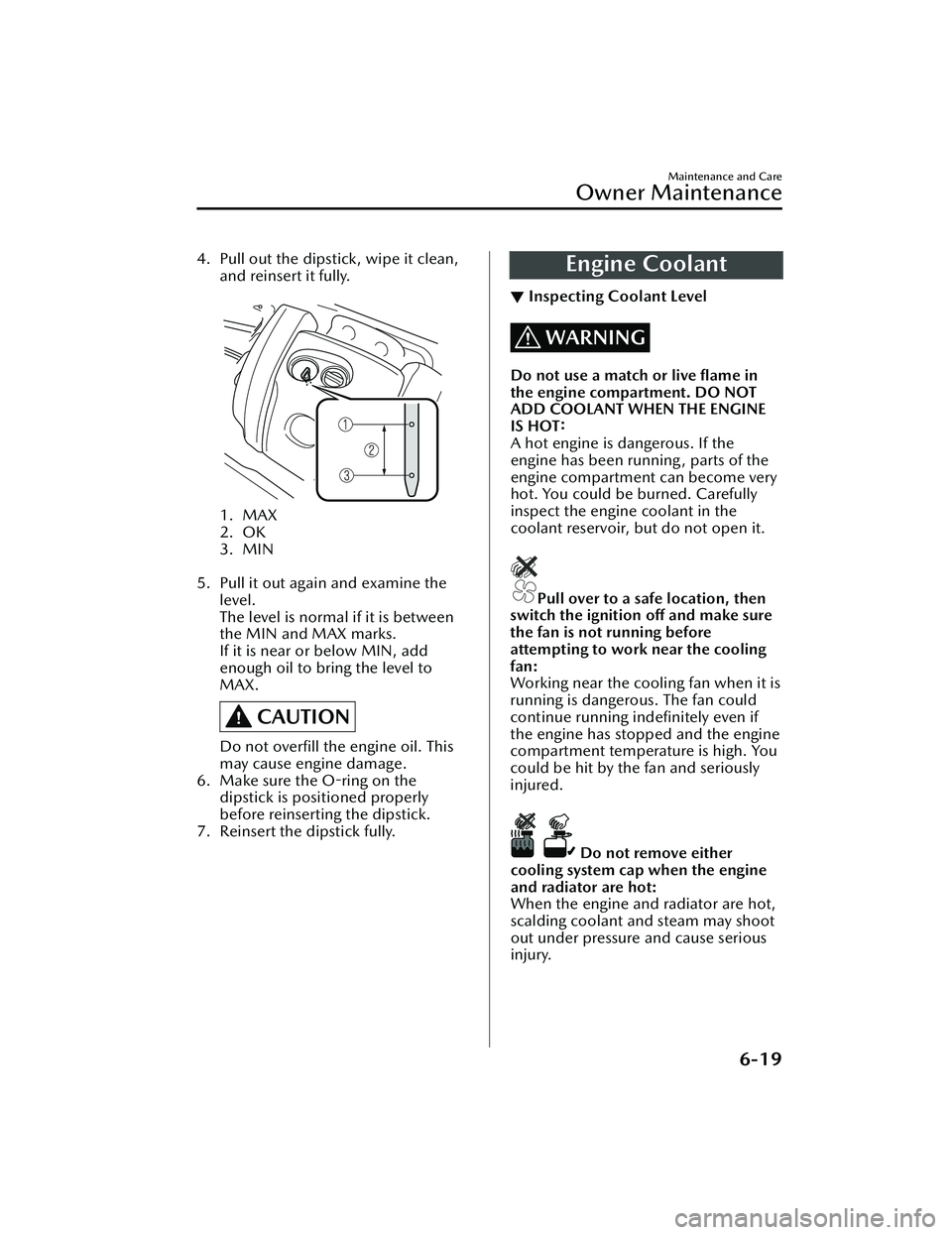
4. Pull out the dipstick, wipe it clean,and reinsert it fully.
1. MAX
2. OK
3. MIN
5. Pull it out again and examine the level.
The level is normal if it is between
the MIN and MAX marks.
If it is near or below MIN, add
enough oil to bring the level to
MAX.
CAUTION
Do not overfill the engine oil. This
may cause engine damage.
6. Make sure the O-ring on the dipstick is positioned properly
before reinserting the dipstick.
7. Reinsert the dipstick fully.
Engine Coolant
▼ Inspecting Coolant Level
WARNING
Do not use a match or live flame in
the engine compartment. DO NOT
ADD COOLANT WHEN THE ENGINE
IS HOT:
A hot engine is dangerous. If the
engine has been running , parts of the
engine compartment can become very
hot. You could be burned. Carefully
inspect the engine coolant in the
coolant reservoir, but do not open it.
Pull over to a safe location, then
switch the ignition off and make sure
the fan is not running before
attempting to work near the cooling
fan:
Working near the cooling fan when it is
running is dangerous. The fan could
continue running indefinitely even if
the engine has stopped and the engine
compartment temperature is high. You
could be hit by the fan and seriously
injured.
Do not remove either
cooling system cap when the engine
and radiator are hot:
When the engine and radiator are hot,
scalding coolant and steam may shoot
out under pressure and cause serious
injury.
Maintenance and Care
Owner Maintenance
6-19
CX-30_8JP5-EA-20K_Edition1_new 2020-7-22 15:50:09
Page 478 of 594

WARNING
Dry off brakes that have become wet
by driving slowly, releasing the
accelerator pedal and lightly applying
the brakes several times until the
brake performance returns to normal:
Driving with wet brakes is dangerous.
Increased stopping distance or the
vehicle pulling to one side when
braking could result in a serious
accident. Light braking will indicate
whether the brakes have been
affected.
▼Aluminum Wheel Maintenance*
A protective coating is provided over
the aluminum wheels. Special care is
needed to protect this coating.
CAUTION
Do not use any detergent other than
mild detergent. Before using any
detergent, verify the ingredients.
Otherwise, the product could discolor
or stain the aluminum wheels.
NOTE
Do not use a wire brush or any
abrasive cleaner, polishing
compound, or solvent on aluminum
wheels. They may damage the
coating.
Always use a sponge or soft cloth to
clean the wheels.
Rinse the wheels thoroughly with
lukewarm or cold water. Also, be
sure to clean the wheels after driving
on dusty or salted roads to help
prevent corrosion.
Avoid washing your vehicle in an
automatic car wash that uses
high-speed or hard brushes.
▼ Plastic Part Maintenance
When cleaning the plastic lenses of
the lights, do not use gasoline,
kerosene, rectified spirit, paint,
thinner, highly acidic detergents, or
strongly alkaline detergents.
Otherwise, these chemical agents
can discolor or damage the surfaces
resulting in a significant loss in
functionality. If plastic parts become
inadvertently exposed to any of these
chemical agents, flush with water
immediately.
If plastic parts such as the bumpers
become inadvertently exposed to
chemical agents or fluids such as
gasoline, oil, engine coolant, or
battery fluid, it could cause
discoloration, staining, or paint
peeling. Wipe off any such chemical
agents or fluids using a soft cloth
immediately.
High water temperature and high
water pressure car washers are
available depending on the type of
high pressure car washer device. If
the car washer nozzle is put too
close to the vehicle or aimed at one
area for an extended period of time,
it could deform plastic parts or
damage the paint.
Do not use wax containing
compounds (polish). Otherwise, it
could result in paint damage.
In addition, do not use an electrical
or air tool to apply wax. Otherwise,
the frictional heat generated could
result in deformation of plastic parts
or paint damage.
Maintenance and Care
Appearance Care
6-48*Some models.
CX-30_8JP5-EA-20K_Edition1_new
2020-7-22 15:50:09
Page 505 of 594

CAUTION
In addition, the
effectiveness of the
braking may diminish so you may
need to depress the brake pedal
more strongly than normal to stop
the vehicle.
▼ Electronic Brake Force Distribution
System Warning
If the electronic brake force
distribution control unit determines
that some components are operating
incorrectly, the control unit may
illuminate the brake system warning
light and the ABS warning light
simultaneously. The problem is likely to
be the electronic brake force
distribution system.
WARNING
Do not drive with both the brake
system warning light and ABS warning
light illuminated. Have the vehicle
towed to an Authorized Mazda
Dealer to have the brakes inspected as
soon as possible:
Driving when the brake system warning
light and ABS warning light are
illuminated simultaneously is
dangerous.
When both lights are illuminated, the
rear wheels could lock more quickly in
an emergency stop than under normal
circumstances.
▼
Charging System Warning
Indication/Warning Light
If the warning light illuminates while
driving, it indicates a malfunction of
the alternator or of the charging
system.
Drive to the side of the road and park
off the right-of-way. Consult an
Authorized Mazda Dealer.
CAUTION
Do not continue driving when the
charging system warning light is
illuminated because the engine could
stop unexpectedly.
▼Engine Oil Warning Indication/
Warning Light
This warning light indicates low engine
oil pressure.
CAUTION
Do not run the engine if the oil
pressure is low. Otherwise, it could
result in extensive engine damage.
If the light illuminates or the warning
indication is displayed while driving:
1. Drive to the side of the road and
park off the right-of-way on level
ground.
2. Turn off the engine and wait 5
minutes for the oil to drain back
into the oil pan.
If Trouble Arises
Warning/Indicator Lights and Warning Sounds
7-23
CX-30_8JP5-EA-20K_Edition1_new 2020-7-22 15:50:09
Page 509 of 594

▼AWD Warning Indication/
Warning Light*
“AWD Malfunction. Front Wheel
Drive Only. Have the Vehicle
Inspected” is displayed/When the
light is turned on
The indication is displayed/the light
turns on under the following
conditions. The system may have a
malfunction. Have the vehicle checked
at an Authorized Mazda Dealer.
When there is a malfunction in the
AWD system.
“Excessive AWD System Load. Drive
Slowly Until Warning Light Turns Off.
Vehicle Now in Front Wheel Drive” is
displayed/When the light is flashing
The indication is displayed/the light
flashes under the fo llowing conditions.
Park the vehicle in a safe place and
check that the warning indication light
turns off/ the warning light stops
flashing , and then drive the vehicle.
Contact an Authorized Mazda Dealer
if the indication is continuously
displayed.
When the differential oil temperature
is excessively high.
When there is a large difference
between the front and rear wheel
rotation, such as when trying to
remove the vehicle from mud.
“Mismatched Tire Diameters. Vehicle
Now in Front Wheel Drive” is
displayed/When the light is turned on
The indication is displayed/the light
turns on under the following
conditions. Inspect the tire sizes or tire
pressures on all 4 wheels. Contact an
Authorized Mazda Dealer if the
indication remains on or the warning
light remains illuminated.
When any of the tire diameter is different.
When any of the tire pressure is
incorrect.
▼ TCS/DSC Indication/Indicator
Light (Turns on)
If the light stays on, the TCS, DSC or
the brake assist system may have a
malfunction and they may not operate
correctly. Take your vehicle to an
Authorized Mazda Dealer.
▼Air Bag/Front Seat Belt
Pretensioner System Warning
Indication/Warning Light
A system malfunction is indicated if the
warning light constantly
flashes,
constantly illuminates or does not
illuminate at all when the ignition is
switched ON. If any of these occur,
consult an Authorized Mazda Dealer
as soon as possible. The system may
not operate in an accident.
If Trouble Arises
Warning/Indicator Lights and Warning Sounds
*Some models.7-27
CX-30_8JP5-EA-20K_Edition1_new 2020-7-22 15:50:09
Page 522 of 594

▼Power Liftgate Warning Beep*
If system operation precautions are
necessary, the driver is notified by the
warning sound.
Warning beep What to check
The beep sounds 3
times The conditions re-
quired for the power
liftgate to operate have
not been met, such as
an object being stuck
in the liftgate.
The beep sound con-
tinues The vehicle is being
driven with the liftgate
open. Stop the vehicle
and close the liftgate.
▼
Low Fuel Warning Beep
When the low fuel warning light
flashes, a warning beep is activated
once at the same time.
▼
Brake Override Warning Beep
A warning beep is activated when the
accelerator pedal and brake pedal are
depressed at the
same time while
driving. Only depress the brake pedal.
▼ Shift Position Warning Beep
A sound is activated when the push
button start is pressed while the
selector lever is in a position other
than P, and the ignition is switched to
ACC. Check the selector lever
position.
▼ Electric Parking Brake (EPB)
Warning Beep
The warning buzzer is activated under
the following conditions:
The vehicle is driven with the parking
brake applied.
The Electric Parking Brake (EPB)
switch is pulled while the vehicle is
driven.
You attempt to start driving the
vehicle while the conditions for
releasing the Electric Parking Brake
(EPB) automatically have not been
met.
▼AUTOHOLD Warning Beep
Warning light flashes/message is
displayed and beep sound is activated
simultaneously for about 5 seconds
when using AUTOHOLD function or
when AUTOHOLD switch is operated.
Because a problem with AUTOHOLD
function has occurred, AUTOHOLD
function does not operate even if
AUTOHOLD switch is operated.
If the warning light flashes/message is
displayed and the beep sound is
activated simultaneously, have your
vehicle inspected at an Authorized
Mazda Dealer.
▼
Vehicle Problem Warning Beep
If any of the following problems occur,
a warning beep is activated. Check the
information regarding the warning
indication in the instrument cluster or
on the center display.
Automatic transmission problemIncrease in automatic transmission
internal temperature
Brake
fluid amount decreaseEngine oil level sensor problemElectric Parking Brake (EPB) problemEngine hydraulic pressure decrease
If Trouble Arises
Warning/Indicator Lights and Warning Sounds
7-40*Some models.
CX-30_8JP5-EA-20K_Edition1_new
2020-7-22 15:50:09