warning MAZDA MODEL CX-5 2013 (in English) Repair Manual
[x] Cancel search | Manufacturer: MAZDA, Model Year: 2013, Model line: MODEL CX-5, Model: MAZDA MODEL CX-5 2013Pages: 488, PDF Size: 8.75 MB
Page 113 of 488
Black plate (113,1)
Rocking the Vehicle
WARNING
Do not spin the wheels at more than 56
km/h (35 mph), and do not allow
anyone to stand behind a wheel when
pushing the vehicle:
When the vehicle is stuck, spinning
the wheels at high speed is
dangerous. The spinning tire could
overheat and explode. This could
cause serious injuries.
CAUTION
Too much rocking may cause engine
overheating, transaxle failure, and
tire damage.
If you must rock the vehicle to free it from
snow, sand or mud, depress the
accelerator slightly and slowly move the
shift lever from 1 (D) to R.
Winter Driving
Carry emergency gear, including tire
chains, window scraper, flares, a small
shovel, jumper cables, and a small bag of
sand or salt.
Ask an Authorized Mazda Dealer to
perform the following precautions:
lHave the proper ratio of antifreeze in
the radiator.
Refer to Engine Coolant on page 6-23.
lInspect the battery and its cables. Cold
reduces battery capacity.
lUse an engine oil appropriate for the
lowest ambient temperatures that the
vehicle will be driven in (page 6-21).
lInspect the ignition system for damage
and loose connections.
lUse washer fluid made with
antifreeze―but do not use engine
coolant antifreeze for washer fluid
(page 6-26).
lDo not use the parking brake in
freezing weather as it may freeze.
Instead, shift to P with an automatic
transaxle and to 1 or R with a manual
transaxle. Block the rear wheels.
lSnow left on the windshield is
dangerous as it could obstruct vision.
Remove snow before driving.
lDo not apply excessive force to a
window scraper when removing ice or
frozen snow on the mirror glass and
windshield.
lNever use warm or hot water for
removing snow or ice from windows
and mirrors as it could result in the
glass cracking.
Before Driving
Driving Tips
3-41
CX-5_8CA5-EA-11L_Edition3 Page113
Friday, June 22 2012 3:45 PM
Form No.8CA5-EA-11L
Page 114 of 488
Black plate (114,1)
lBraking performance can be adversely
affected if snow or ice adheres to the
brake components. If this situation
occurs, drive the vehicle slowly,
releasing the accelerator pedal and
lightly applying the brakes several
times until the brake performance
returns to normal.
qSnow Tires
Use snow tires on all four wheels
Do not go faster than 120 km/h (75 mph)
while driving with snow tires. Inflate
snow tires 30 kPa (0.3 kgf/cm
2, 4.3 psi)
more than recommended on the tire
pressure label (driver's door frame), but
never more than the maximum cold-tire
pressure shown on the tires.
Your vehicle is originally equipped with
all season radials designed to be used all
year around. In some extreme climates
you may find it necessary to replace them
with snow tires during the winter months
to further improve traction on snow and
ice covered roads.
WARNING
Use only the same size and type tires
(snow, radial, or non-radial) on all four
wheels:
Using tires different in size or type is
dangerous. Your vehicle's handling
could be greatly affected and result
in an accident.
CAUTION
Check local regulations before using
studded tires.
qTire Chains
Check local regulations before using tire
chains.
CAUTION
ØChains may affect handling.
ØDo not go faster than 50 km/h (30
mph) or the chain manufacturer's
recommended limit, whichever is
lower.
ØDrive carefully and avoid bumps,
holes, and sharp turns.
ØAvoid locked-wheel braking.
ØDo not use chains on a temporary
spare tire; it may result in damage
to the vehicle and to the tire.
ØDo not use chains on roads that
are free of snow or ice. The tires
and chains could be damaged.
ØChains may scratch or chip
aluminum wheels.
NOTE
The tire pressure monitoring system may not
function correctly when using tire chains.
Install the chains on the front tires only.
Do not use chains on the rear tires.
Please consult an Authorized Mazda
Dealer.
Installing the chains
1. Secure the chains on the front tires as
tightly as possible.
Always follow the chain
manufacturer's instructions.
2. Retighten the chains after driving 1/2
―1 km (1/4―1/2 mile).
3-42
Before Driving
Driving Tips
CX-5_8CA5-EA-11L_Edition3 Page114
Friday, June 22 2012 3:45 PM
Form No.8CA5-EA-11L
Page 115 of 488

Black plate (115,1)
Driving In Flooded Area
WARNING
Dry off brakes that have become wet
by driving slowly, releasing the
accelerator pedal and lightly applying
the brakes several times until the brake
performance returns to normal:
Driving with wet brakes is
dangerous. Increased stopping
distance or the vehicle pulling to one
side when braking could result in a
serious accident. Light braking will
indicate whether the brakes have
been affected.
CAUTION
Do not drive the vehicle on flooded
roads as it could cause short
circuiting of electrical/electronic
parts, or engine damage or stalling
from water absorption. If the vehicle
has been immersed in water, consult
an Authorized Mazda Dealer.
Overloading
WARNING
Be careful not to overload your vehicle:
The gross axle weight rating (GAWR)
and the gross vehicle weight rating
(GVWR) of your vehicle are on the
Motor Vehicle Safety Standard Label
on the driver's door frame. Exceeding
these ratings can cause an accident
or vehicle damage. You can estimate
the weight of your load by weighing
the items (or people) before putting
them in the vehicle.
Before Driving
Driving Tips
3-43
CX-5_8CA5-EA-11L_Edition3 Page115
Friday, June 22 2012 3:45 PM
Form No.8CA5-EA-11L
Page 119 of 488
Black plate (119,1)
WARNING
Always keep tow loads within specified limits as indicated in the Trailer Towing-Load
Table:
Attempting to tow loads greater than those specified is dangerous as it may cause
serious handling and performance problems that could result in personal injury or
vehicle damage, or both.
Load your trailer with the weight about 60 % toward the front and 40 % toward the
rear:
Loading the trailer with more weight in the rear than in the front is dangerous.
Doing so could cause you to lose control. The trailer tongue load must be 10 %―15
% of the total trailer load (sum of the weights of the trailer and cargo).
Always have the total trailer weight and tongue load determined prior to departure:
Attempting to tow loads without determining the total trailer weight and tongue
load is dangerous. Trailer sway from crosswinds, rough roads or other causes could
result in loss of control and a serious accident.
CAUTION
The total trailer weight and tongue load can be determined by weighing the trailer
on platform scales at a highway weight station or a trucking company.
qTrailer Hitch
Use only a hitch ball recommended by the trailer manufacturer that conforms to the gross
trailer weight requirement.
When not towing a trailer, remove the trailer hitch (if detachable) to reduce the possibility
of damage as a result of the vehicle being rear-ended.
Before Driving
Towing
3-47
CX-5_8CA5-EA-11L_Edition3 Page119
Friday, June 22 2012 3:45 PM
Form No.8CA5-EA-11L
Page 120 of 488
Black plate (120,1)
WARNING
Always make sure the trailer hitch is securely attached before departure:
An unsecured trailer hitch is dangerous as it causes greater trailer sway from
crosswinds, rough roads or other causes, resulting in loss of control and a serious
accident.
Examine all trailer-hitch mounting bolts regularly and tighten any that are loose. If
the hitch is removed, seal any open mounting holes to prevent exhaust, dust, water,
dirt and other foreign elements from filtering in, possibly endangering personal
safety and damaging your vehicle.
Do not install a hitch that stiffens the bumper as it will reduce the bumper's
performance.
Make sure there are no exhaust gas leaks into the passenger compartment if any
mounting bolts are connected to the body:
Modifying your vehicle exhaust system is dangerous. Exhaust gas entering the
vehicle could cause loss of consciousness or even death.
When mounting the trailer hitch, make no modifications to the vehicle exhaust
system.
CAUTION
ØMake all hitch adjustments with actual loads. Do not load and unload vehicle
while adjusting hitch. This action will change the vehicle height.
ØDo not use an axle-mounted hitch. This may damage the axle and related parts.
qTires
When towing a trailer, make sure all tires are inflated to the recommended cold-tire
pressure, as indicated on the tire pressure chart on the driver's door frame. Trailer tire size,
load rating, and inflation pressures should conform to tire manufacturer specifications.
WARNING
Never use the temporary spare tire when towing:
Using the temporary spare tire on your vehicle when towing a trailer is dangerous as
it could result in tire failure, loss of control, and injury to vehicle occupants.
3-48
Before Driving
Towing
CX-5_8CA5-EA-11L_Edition3 Page120
Friday, June 22 2012 3:45 PM
Form No.8CA5-EA-11L
Page 121 of 488
Black plate (121,1)
qSafety Chains
Safety chains must be used as a precautionary measure should the trailer become
unintentionally unhitched. They should cross under the trailer tongue and attach to the
hitch. Leave enough slack to allow full turns. Consult literature published by your trailer or
hitch manufacturer for more details.
WARNING
Make sure the safety chain is securely attached to both the trailer and the vehicle
prior to departure:
Towing a trailer without using a safety chain securely attached to both the trailer
and the vehicle is dangerous. If damage occurs to the coupling unit or hitch ball, the
trailer could wander into another lane and cause a collision.
qTrailer Lights
Trailer lights must comply with all federal, state, and local regulations. Equip your trailer
as required before towing it day or night.
CAUTION
Do not connect a trailer lighting system directly to the lighting system of your
Mazda. This may damage your vehicle's electrical system and lighting systems. Have
a recreational vehicle dealer or trailer rental agency connect the system, and inspect
the brake lights and turn signals yourself before each trip.
qTrailer Brakes
If the total trailer weight exceeds 450 kg (1,000 lb), trailer brakes are required. If your
trailer has brakes, make sure they comply with all federal, state, and local regulations.
WARNING
Do not connect a hydraulic trailer-brake system to your vehicle's brake system:
Connecting a hydraulic trailer-brake system directly to the vehicle brake system is
dangerous and will result in inadequate braking and possible injury.
qTrailer Towing Tips
lVerify that your Mazda maintains a near-normal attitude when a loaded or unloaded
trailer is connected. Do not drive if it has an abnormal front-up or front-down position.
Inspect for incorrect tongue load, worn suspension parts, and trailer overloading.
lMake sure the trailer is properly loaded and the cargo is secure to prevent it from
shifting.
lMake sure the mirrors conform to all government regulations. If they do not, install
required rear view mirrors appropriate for towing purposes.
Before Driving
Towing
3-49
CX-5_8CA5-EA-11L_Edition3 Page121
Friday, June 22 2012 3:45 PM
Form No.8CA5-EA-11L
Page 123 of 488
Black plate (123,1)
Ascending a hill
Shift into a lower gear to reduce the possibility of overloading or overheating the engine, or
both.
Descending a hill
Shift into a lower gear and use engine compression as a braking effect.
WARNING
Always use lower gears to reduce speed:
Holding the brake pedal down too long or too frequently is dangerous as it could
cause the brakes to overheat and lose power, resulting in loss of control and a
serious accident. Use lower gears to help reduce speed. Pull off the road and allow
brakes to cool down whenever braking performance feels reduced.
Overheated engine
The extra weight of the trailer may strain the engine on hot days and on long or steep
upgrades.
If the temperature gauge indicates overheating, turn off the air conditioner, drive safely to
the side of the road, park off the right-of-way and wait for engine to cool. Refer to
Overheating (page 7-18).
Parking
Always make sure the tires of the trailer and the tow vehicle are blocked while parked.
Apply the parking brake firmly and put the transaxle in P.
Avoid parking on an incline, but if you must, follow these instructions:
1. Depress and hold down the brake pedal.
2. Have a helper put wheel blocks against the downhill side of all vehicle and trailer tires.
3. Then release the brake pedal slowly until the blocks bear the load.
lIf the grade is downhill, turn the steering wheel so that the front of the front tires face
the curb.
lIf it is uphill, face the rear of the front tires against the curb.
4. Firmly apply the parking brake.
5. Shift the transaxle into P, and stop the engine.
To restart after parking on an incline:
1. With the transaxle in P, start the engine. (Be sure to depress and hold the brake pedal.)
2. Shift into gear.
Before Driving
Towing
3-51
CX-5_8CA5-EA-11L_Edition3 Page123
Friday, June 22 2012 3:45 PM
Form No.8CA5-EA-11L
Page 125 of 488
Black plate (125,1)
4When Driving
Information concerning safe driving and stopping.
Start/Stop Engine .................................... 4-2
Ignition Switch .................................... 4-2
Starting the Engine
í........................... 4-3
Turning the Engine Off ....................... 4-8
Instrument Cluster and Display ............. 4-9
Meters and Gauges .............................. 4-9
Warning/Indicator Lights .................. 4-15
Transaxle ................................................ 4-31
Manual Transaxle Operation ............. 4-31
Automatic Transaxle Controls .......... 4-33
Switches and Controls ........................... 4-40
Lighting Control ............................... 4-40
Fog Lights
í...................................... 4-45
Turn and Lane-Change Signals ......... 4-46
Windshield Wipers and Washer ........ 4-47
Rear Window Wiper and Washer ...... 4-51
Rear Window Defroster ..................... 4-51
Horn .................................................. 4-52
Hazard Warning Flasher .................... 4-53
HomeLink Wireless Control
System
í............................................ 4-53
Brake ...................................................... 4-57
Brake System .................................... 4-57
ABS/TCS/DSC ....................................... 4-62
Antilock Brake System (ABS) .......... 4-62
Traction Control System (TCS) ........ 4-63
Dynamic Stability Control (DSC) ..... 4-64
AWD ....................................................... 4-65
All-Wheel Drive (AWD) Operation... 4-65Power Steering ....................................... 4-67
Power Steering .................................. 4-67
Cruise Control ....................................... 4-68
Cruise Control ................................... 4-68
Tire Pressure Monitoring System ........ 4-71
Tire Pressure Monitoring System ...... 4-71
Blind Spot Monitoring (BSM)
System .................................................... 4-75
Blind Spot Monitoring (BSM)
System
í............................................ 4-75
Rear View Monitor ................................ 4-79
Rear View Monitor
í........................ 4-79
4-1íSome models.
CX-5_8CA5-EA-11L_Edition3 Page125
Friday, June 22 2012 3:45 PM
Form No.8CA5-EA-11L
Page 126 of 488
Black plate (126,1)
Ignition Switch
qPush Button Start Positions
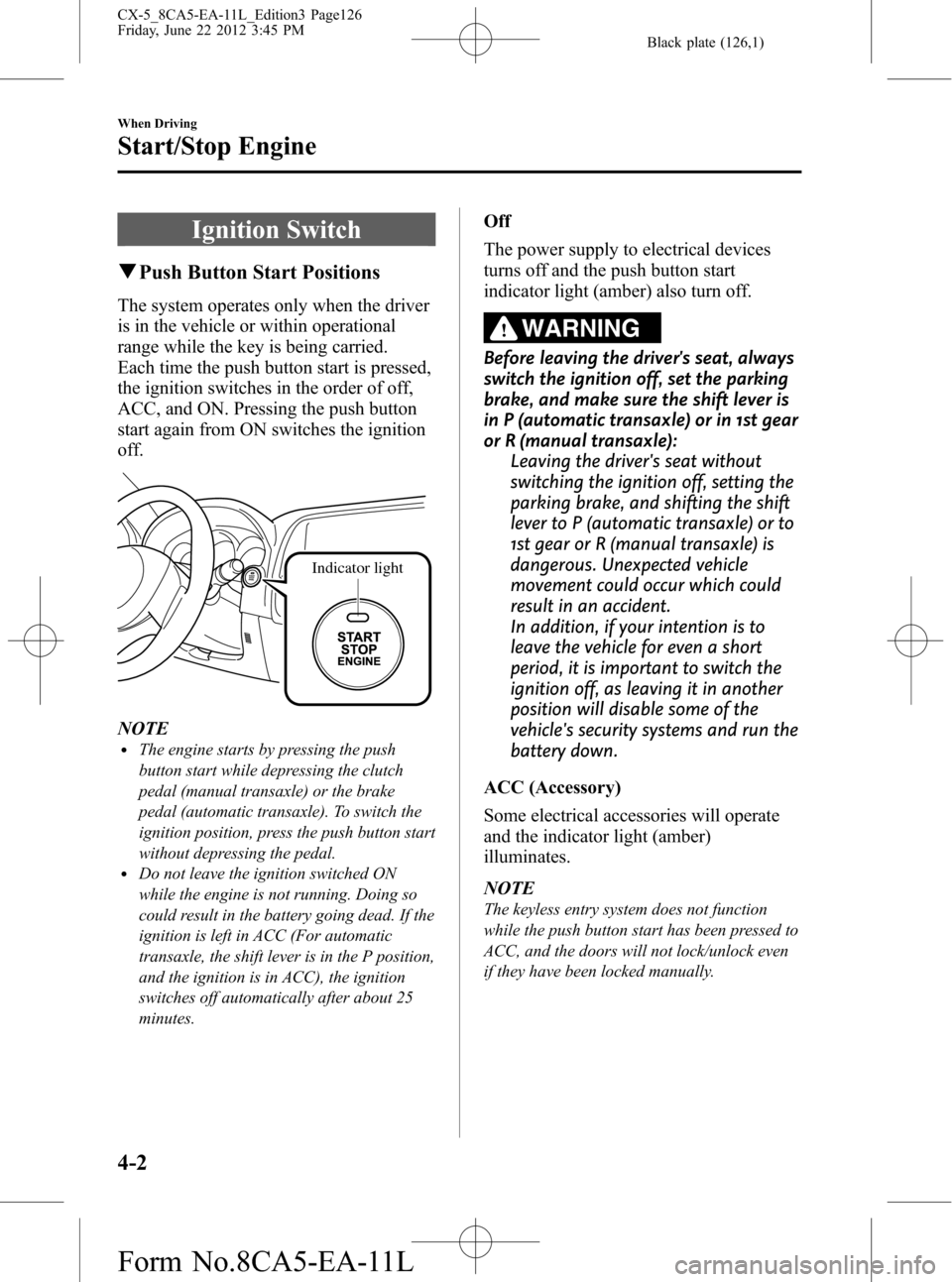
The system operates only when the driver
is in the vehicle or within operational
range while the key is being carried.
Each time the push button start is pressed,
the ignition switches in the order of off,
ACC, and ON. Pressing the push button
start again from ON switches the ignition
off.
Indicator light
NOTElThe engine starts by pressing the push
button start while depressing the clutch
pedal (manual transaxle) or the brake
pedal (automatic transaxle). To switch the
ignition position, press the push button start
without depressing the pedal.
lDo not leave the ignition switched ON
while the engine is not running. Doing so
could result in the battery going dead. If the
ignition is left in ACC (For automatic
transaxle, the shift lever is in the P position,
and the ignition is in ACC), the ignition
switches off automatically after about 25
minutes.
Off
The power supply to electrical devices
turns off and the push button start
indicator light (amber) also turn off.
WARNING
Before leaving the driver's seat, always
switch the ignition off, set the parking
brake, and make sure the shift lever is
in P (automatic transaxle) or in 1st gear
or R (manual transaxle):
Leaving the driver's seat without
switching the ignition off, setting the
parking brake, and shifting the shift
lever to P (automatic transaxle) or to
1st gear or R (manual transaxle) is
dangerous. Unexpected vehicle
movement could occur which could
result in an accident.
In addition, if your intention is to
leave the vehicle for even a short
period, it is important to switch the
ignition off, as leaving it in another
position will disable some of the
vehicle's security systems and run the
battery down.
ACC (Accessory)
Some electrical accessories will operate
and the indicator light (amber)
illuminates.
NOTE
The keyless entry system does not function
while the push button start has been pressed to
ACC, and the doors will not lock/unlock even
if they have been locked manually.
4-2
When Driving
Start/Stop Engine
CX-5_8CA5-EA-11L_Edition3 Page126
Friday, June 22 2012 3:45 PM
Form No.8CA5-EA-11L
Page 127 of 488

Black plate (127,1)
ON
This is the normal running position after
the engine is started. The indicator light
(amber) turns off. (The indicator light
(amber) illuminates when the ignition is
switched ON and the engine is not
running.)
Some indicator lights/warning lights
should be inspected before the engine is
started (page 4-15).
NOTE
When the push button start is pressed to ON,
the sound of the fuel pump motor operating
near the fuel tank can be heard. This does not
indicate an abnormality.
Starting the Engineí
WARNING
Radio waves from the key may affect
medical devices such as pacemakers:
Before using the key near people who
use medical devices, ask the medical
device manufacturer or your
physician if radio waves from the key
will affect the device.
When Driving
Start/Stop Engine
4-3íSome models. CX-5_8CA5-EA-11L_Edition3 Page127
Friday, June 22 2012 3:45 PM
Form No.8CA5-EA-11L