tires MAZDA MODEL CX-5 2016 Owners Manual (in English)
[x] Cancel search | Manufacturer: MAZDA, Model Year: 2016, Model line: MODEL CX-5, Model: MAZDA MODEL CX-5 2016Pages: 626, PDF Size: 13.81 MB
Page 12 of 626
Black plate (12,1)
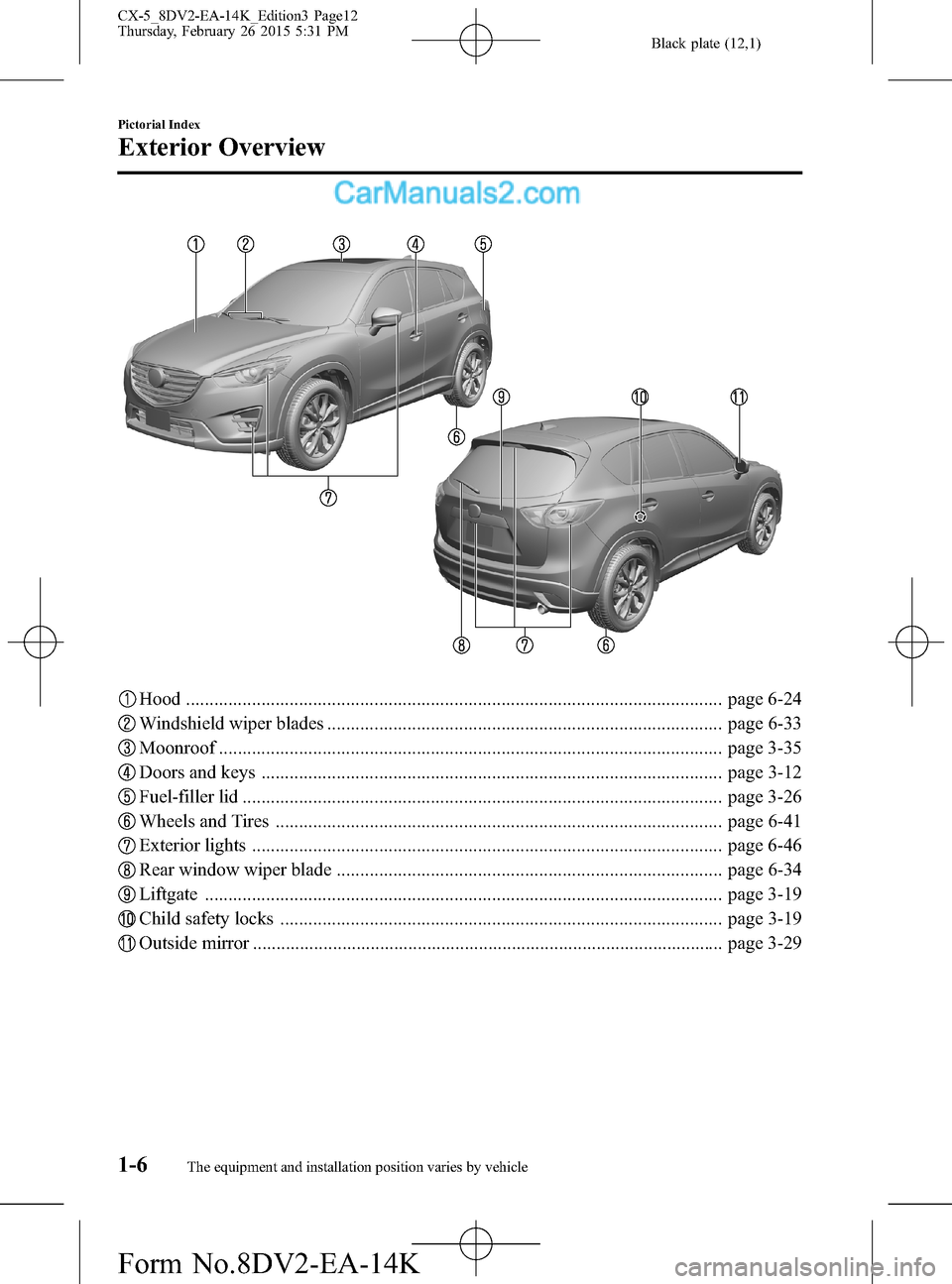
Hood .................................................................................................................. page 6-24
Windshield wiper blades .................................................................................... page 6-33
Moonroof ........................................................................................................... page 3-35
Doors and keys .................................................................................................. page 3-12
Fuel-filler lid ...................................................................................................... page 3-26
Wheels and Tires ............................................................................................... page 6-41
Exterior lights .................................................................................................... page 6-46
Rear window wiper blade .................................................................................. page 6-34
Liftgate .............................................................................................................. page 3-19
Child safety locks .............................................................................................. page 3-19
Outside mirror .................................................................................................... page 3-29
1-6
Pictorial Index
The equipment and installation position varies by vehicle
Exterior Overview
CX-5_8DV2-EA-14K_Edition3 Page12
Thursday, February 26 2015 5:31 PM
Form No.8DV2-EA-14K
Page 60 of 626

Black plate (60,1)
To prevent false detection by the air bag sensor system, heed the following:
ØDo not use tires or wheels other than those specified for your Mazda:
Use of any tire or wheel other than those specified for your Mazda (page 9-8) is
dangerous. Use of such wheels will prevent the vehicle's accident detections
system from accurately detecting a collision or roll-over accident resulting in
incorrect or unexpected air bag deployment and the possibility of serious injuries.
ØDo not overload your vehicle:
Overloading your vehicle is dangerous as it could prevent the air bag crash sensor
system from accurately detecting a collision or roll-over accident resulting in
incorrect or unexpected air bag deployment and the possibility of serious injuries.
The gross axle weight rating (GAWR) and the gross vehicle weight rating (GVWR)
for your vehicle are on the Motor Vehicle Safety Standard Label on the driver's
door frame. Do not exceed these ratings.
ØDo not drive the vehicle off-road:
Driving your Mazda off-road is dangerous because the vehicle has not been
designed to do so. Driving the vehicle off-road could prevent the air bag crash
sensor system from accurately detecting a collision or roll-over accident resulting
in incorrect or unexpected air bag deployment and the possibility of serious
injuries.
Do not modify a front door or leave any damage unrepaired. Always have an
Authorized Mazda Dealer inspect a damaged front door:
Modifying a front door or leaving any damage unrepaired is dangerous. Each front
door has a side crash sensor as a component of the supplemental restraint system. If
holes are drilled in a front door, a door speaker is left removed, or a damaged door is
left unrepaired, the sensor could be adversely affected causing it to not detect the
pressure of an impact correctly during a side collision. If a sensor does not detect a
side impact correctly, the side and curtain air bags and the front seat belt
pretensioner may not operate normally which could result in serious injury to
occupants.
Do not modify the supplemental restraint system:
Modifying the components or wiring of the supplemental restraint system is
dangerous. You could accidentally activate it or make it inoperable. Do not make
any modifications to the supplemental restraint system. This includes installing trim,
badges, or anything else over the air bag modules. It also includes installing extra
electrical equipment on or near system components or wiring. An Authorized Mazda
Dealer can provide the special care needed in the removal and installation of front
seats. It is important to protect the air bag wiring and connections to assure that the
bags do not accidentally deploy and that the seats retain an undamaged air bag
connection.
2-48
Essential Safety Equipment
SRS Air Bags
CX-5_8DV2-EA-14K_Edition3 Page60
Thursday, February 26 2015 5:31 PM
Form No.8DV2-EA-14K
Page 119 of 626

Black plate (119,1)
Break-In Period
No special break-in is necessary, but a few
precautions in the first 1,000 km (600
miles) may add to the performance,
economy, and life of your Mazda.
lDo not race the engine.lDo not maintain one constant speed,
either slow or fast, for a long period of
time.
lDo not drive constantly at full-throttle
or high engine rpm for extended
periods of time.
lAvoid unnecessary hard stops.lAvoid full-throttle starts.lDo not tow a trailer.
Saving Fuel and Protection
of the Environment
How you operate your Mazda determines
how far it will travel on a tank of fuel. Use
these suggestions to help save fuel and
reduce CO2.
lAvoid long warm-ups. Once the engine
runs smoothly, begin driving.
lAvoid fast starts.lDrive at lower speeds.lAnticipate when to apply the brakes
(avoid sudden braking).
lFollow the maintenance schedule (page
6-4) and have an Authorized Mazda
Dealer perform inspections and
servicing.
lUse the air conditioner only when
necessary.
lSlow down on rough roads.lKeep the tires properly inflated.lDo not carry unnecessary weight.lDo not rest your foot on the brake
pedal while driving.
lKeep the wheels in correct alignment.lKeep windows closed at high speeds.lSlow down when driving in crosswinds
and headwinds.
WARNING
Never stop the engine when going
down a hill:
Stopping the engine when going
down a hill is dangerous. This causes
the loss of power steering and power
brake control, and may cause
damage to the drivetrain. Any loss of
steering or braking control could
cause an accident.
Before Driving
Driving Tips
3-41
CX-5_8DV2-EA-14K_Edition3 Page119
Thursday, February 26 2015 5:32 PM
Form No.8DV2-EA-14K
Page 120 of 626

Black plate (120,1)
Hazardous Driving
WARNING
Be extremely careful if it is necessary to
downshift on slippery surfaces:
Downshifting into lower gear while
driving on slippery surfaces is
dangerous. The sudden change in tire
speed could cause the tires to skid.
This could lead to loss of vehicle
control and an accident.
Avoid sharp turns, excessive speed and
abrupt maneuvers when driving this
vehicle:
Sharp turns, excessive speed and
abrupt maneuvering of this vehicle
are dangerous as it could result in
the increased risk of loss of vehicle
control, vehicle roll-over, personal
injury or death.
This vehicle has a higher center of
gravity. Vehicles with a higher center
of gravity such as utility vehicles
handle differently than vehicles with
a lower center of gravity.
Utility vehicles are not designed for
cornering at high speeds any more
than low profile sports cars are
designed to perform satisfactorily
under off-road conditions.
In addition, utility vehicles have a
significantly higher rollover rate than
other types of vehicles.
In a rollover crash, an unbelted
person is significantly more likely to
die than a person wearing a seat
belt.
When driving on ice or in water, snow,
mud, sand, or similar hazards:
lBe cautious and allow extra distance
for braking.
lAvoid sudden braking and sudden
maneuvering.
lDo not pump the brakes. Continue to
press down on the brake pedal.
Refer to Antilock Brake System (ABS)
on page 4-80.
lIf you get stuck, select a lower gear and
accelerate slowly. Do not spin the front
wheels.
lFor more traction in starting on
slippery surfaces such as ice or packed
snow, use sand, rock salt, chains,
carpeting, or other nonslip material
under the front wheels.
NOTE
Use snow chains only on the front wheels.
3-42
Before Driving
Driving Tips
CX-5_8DV2-EA-14K_Edition3 Page120
Thursday, February 26 2015 5:32 PM
Form No.8DV2-EA-14K
Page 122 of 626

Black plate (122,1)
Winter Driving
Carry emergency gear, including tire
chains, window scraper, flares, a small
shovel, jumper cables, and a small bag of
sand or salt.
Ask an Authorized Mazda Dealer to
perform the following precautions:
lHave the proper ratio of antifreeze in
the radiator.
Refer to Engine Coolant on page 6-29.
lInspect the battery and its cables. Cold
reduces battery capacity.
lUse an engine oil appropriate for the
lowest ambient temperatures that the
vehicle will be driven in (page 6-27).
lInspect the ignition system for damage
and loose connections.
lUse washer fluid made with
antifreeze―but do not use engine
coolant antifreeze for washer fluid
(page 6-31).
lSnow left on the windshield is
dangerous as it could obstruct vision.
Remove snow before driving.
lDo not apply excessive force to a
window scraper when removing ice or
frozen snow on the mirror glass and
windshield.
lNever use warm or hot water for
removing snow or ice from windows
and mirrors as it could result in the
glass cracking.
lBraking performance can be adversely
affected if snow or ice adheres to the
brake components. If this situation
occurs, drive the vehicle slowly,
releasing the accelerator pedal and
lightly applying the brakes several
times until the brake performance
returns to normal.
qSnow Tires
Use snow tires on all four wheels
Do not go faster than 120 km/h (75 mph)
while driving with snow tires. Inflate
snow tires 30 kPa (0.3 kgf/cm
2, 4.3 psi)
more than recommended on the tire
pressure label (driver's door frame), but
never more than the maximum cold-tire
pressure shown on the tires.
Except Mexico
The vehicle is originally equipped with all
season radials designed to be used all year
around. In some extreme climates you
may find it necessary to replace them with
snow tires during the winter months to
further improve traction on snow and ice
covered roads.
Mexico
The vehicle is originally equipped with
summer tires designed for optimum
traction on wet and dry roads. If your
vehicle is to be used on snow and ice
covered roads, Mazda recommends that
you replace the tires originally equipped
on your vehicle with snow tires during the
winter months.
WARNING
Use only the same size and type tires
(snow, radial, or non-radial) on all four
wheels:
Using tires different in size or type is
dangerous. Your vehicle's handling
could be greatly affected and result
in an accident.
CAUTION
Check local regulations before using
studded tires.
3-44
Before Driving
Driving Tips
CX-5_8DV2-EA-14K_Edition3 Page122
Thursday, February 26 2015 5:32 PM
Form No.8DV2-EA-14K
Page 123 of 626

Black plate (123,1)
qTire Chains
Check local regulations before using tire
chains.
CAUTION
ØChains may affect handling.
ØDo not go faster than 50 km/h (30
mph) or the chain manufacturer's
recommended limit, whichever is
lower.
ØDrive carefully and avoid bumps,
holes, and sharp turns.
ØAvoid locked-wheel braking.
ØDo not use chains on a temporary
spare tire; it may result in damage
to the vehicle and to the tire.
ØDo not use chains on roads that
are free of snow or ice. The tires
and chains could be damaged.
ØChains may scratch or chip
aluminum wheels.
NOTE
The tire pressure monitoring system may not
function correctly when using tire chains.
Install the chains on the front tires only.
Do not use chains on the rear tires.
Please consult an Authorized Mazda
Dealer.
Installing the chains
1. Secure the chains on the front tires as
tightly as possible.
Always follow the chain
manufacturer's instructions.
2. Retighten the chains after driving 1/2
―1 km (1/4―1/2 mile).
Driving In Flooded Area
WARNING
Dry off brakes that have become wet
by driving slowly, releasing the
accelerator pedal and lightly applying
the brakes several times until the brake
performance returns to normal:
Driving with wet brakes is
dangerous. Increased stopping
distance or the vehicle pulling to one
side when braking could result in a
serious accident. Light braking will
indicate whether the brakes have
been affected.
CAUTION
Do not drive the vehicle on flooded
roads as it could cause short
circuiting of electrical/electronic
parts, or engine damage or stalling
from water absorption. If the vehicle
has been immersed in water, consult
an Authorized Mazda Dealer.
Before Driving
Driving Tips
3-45
CX-5_8DV2-EA-14K_Edition3 Page123
Thursday, February 26 2015 5:32 PM
Form No.8DV2-EA-14K
Page 125 of 626

Black plate (125,1)
Driving on Uneven Road
Your vehicle's suspension and underbody can be damaged if driven on rough/uneven roads
or over speed bumps at excessive speeds. Use care and reduce speed when traveling on
rough/uneven roads or over speed bumps.
Use care not to damage the vehicle's underbody, bumpers or muffler(s) when driving under
the following conditions:
lAscending or descending a slope with a sharp transition anglelAscending or descending a driveway or trailer ramp with a sharp transition angle
Your vehicle is equipped with low profile tires allowing class-leading performance and
handling. As a result, the sidewall of the tires are very thin and the tires and wheels can be
damaged if driven through potholes or on rough/uneven roads at excessive speeds. Use
care and reduce speed when traveling on rough/uneven roads or through potholes.
Before Driving
Driving Tips
3-47
CX-5_8DV2-EA-14K_Edition3 Page125
Thursday, February 26 2015 5:32 PM
Form No.8DV2-EA-14K
Page 129 of 626

Black plate (129,1)
WARNING
Always make sure the trailer hitch is securely attached before departure:
An unsecured trailer hitch is dangerous as it causes greater trailer sway from
crosswinds, rough roads or other causes, resulting in loss of control and a serious
accident.
Examine all trailer-hitch mounting bolts regularly and tighten any that are loose. If
the hitch is removed, seal any open mounting holes to prevent exhaust, dust, water,
dirt and other foreign elements from filtering in, possibly endangering personal
safety and damaging your vehicle.
Do not install a hitch that stiffens the bumper as it will reduce the bumper's
performance.
Make sure there are no exhaust gas leaks into the passenger compartment if any
mounting bolts are connected to the body:
Modifying your vehicle exhaust system is dangerous. Exhaust gas entering the
vehicle could cause loss of consciousness or even death.
When mounting the trailer hitch, make no modifications to the vehicle exhaust
system.
CAUTION
ØMake all hitch adjustments with actual loads. Do not load and unload vehicle
while adjusting hitch. This action will change the vehicle height.
ØDo not use an axle-mounted hitch. This may damage the axle and related parts.
qTires
When towing a trailer, make sure all tires are inflated to the recommended cold-tire
pressure, as indicated on the tire pressure chart on the driver's door frame. Trailer tire size,
load rating, and inflation pressures should conform to tire manufacturer specifications.
WARNING
Never use the temporary spare tire when towing:
Using the temporary spare tire on your vehicle when towing a trailer is dangerous as
it could result in tire failure, loss of control, and injury to vehicle occupants.
Before Driving
Towing
3-51
CX-5_8DV2-EA-14K_Edition3 Page129
Thursday, February 26 2015 5:32 PM
Form No.8DV2-EA-14K
Page 132 of 626

Black plate (132,1)
Ascending a hill
Shift into a lower gear to reduce the possibility of overloading or overheating the engine, or
both.
Descending a hill
Shift into a lower gear and use engine compression as a braking effect.
WARNING
Always use lower gears to reduce speed:
Holding the brake pedal down too long or too frequently is dangerous as it could
cause the brakes to overheat and lose power, resulting in loss of control and a
serious accident. Use lower gears to help reduce speed. Pull off the road and allow
brakes to cool down whenever braking performance feels reduced.
Overheated engine
The extra weight of the trailer may strain the engine on hot days and on long or steep
upgrades.
If the temperature gauge indicates overheating, turn off the air conditioner, drive safely to
the side of the road, park off the right-of-way and wait for engine to cool. Refer to
Overheating (page 7-18).
Parking
Always make sure the tires of the trailer and the tow vehicle are blocked while parked.
Apply the parking brake firmly and put the transaxle in P.
Avoid parking on an incline, but if you must, follow these instructions:
1. Depress and hold down the brake pedal.
2. Have a helper put wheel blocks against the downhill side of all vehicle and trailer tires.
3. Then release the brake pedal slowly until the blocks bear the load.
lIf the grade is downhill, turn the steering wheel so that the front of the front tires face
the curb.
lIf it is uphill, face the rear of the front tires against the curb.
4. Firmly apply the parking brake.
5. Shift the transaxle into P, and stop the engine.
To restart after parking on an incline:
1. With the transaxle in P, start the engine. (Be sure to depress and hold the brake pedal.)
2. Shift into gear.
3-54
Before Driving
Towing
CX-5_8DV2-EA-14K_Edition3 Page132
Thursday, February 26 2015 5:32 PM
Form No.8DV2-EA-14K
Page 166 of 626

Black plate (166,1)
qLane Departure Warning System
(LDWS) OFF Indication/
Indicator Light
í
Type A
Press the LDWS switch to cancel the
LDWS. The LDWS OFF indication is
displayed.
If the indication remains displayed even
though the LDWS switch has been
operated, it indicates a problem in the
system. Have your vehicle inspected at an
Authorized Mazda Dealer.
Type B
This indicator light illuminates for a few
seconds when the ignition is switched
ON.
A problem in the system may be indicated
under the following conditions. Have your
vehicle inspected at an Authorized Mazda
Dealer.
lThe light does not turn on when the
ignition is switched ON.
lIt remains illuminated even though the
LDWS switch has been switched off.
CAUTION
ØAlways use tires for all wheels that
are of the specified size, and the
same manufacture, brand, and
tread pattern. In addition, do not
use tires with significantly
different wear patterns on the
same vehicle. If such improper
tires are used, the LDWS may not
operate normally.
ØWhen an emergency spare tire is
used, the system may not operate
normally.
qAWD Warning Indication/
Warning Lightí
Type A
The warning indication will display under
the following conditions;
lThere is an abnormality with the AWD
system.
lThere is too much difference in tire
radius between the front and rear
wheels.
lThe differential oil temperature is
abnormally high.
lThere is a continuous large difference
between front and rear wheel rotation,
such as when trying to pull away from
an icy surface or when trying to
remove the vehicle from mud, sand or
similar conditions.
4-32
When Driving
íSome models.
Instrument Cluster and Display
CX-5_8DV2-EA-14K_Edition3 Page166
Thursday, February 26 2015 5:32 PM
Form No.8DV2-EA-14K