towed MAZDA MODEL CX-5 2016 Owners Manual (in English)
[x] Cancel search | Manufacturer: MAZDA, Model Year: 2016, Model line: MODEL CX-5, Model: MAZDA MODEL CX-5 2016Pages: 626, PDF Size: 13.81 MB
Page 163 of 626

Black plate (163,1)
WARNING
Do not drive with both the ABS warning
light and brake warning light
illuminated. Have the vehicle towed to
an Authorized Mazda Dealer to have
the brakes inspected as soon as
possible:
Driving when the brake system
warning light and ABS warning light
are illuminated simultaneously is
dangerous.
When both lights are illuminated, the
rear wheels could lock more quickly
in an emergency stop than under
normal circumstances.
qElectric Parking Brake Warning
Light
This warning light stays on for a few
seconds when the ignition is switched
ON.
The warning light illuminates when the
system has a malfunction. Have your
vehicle inspected at an Authorized Mazda
Dealer.
qBrake Pedal Operation Demand
Indicator Light (Type B)
This indicator light stays on for a few
seconds when the ignition is switched
ON.
The light turns on when the electric
parking brake is released using the electric
parking brake switch without depressing
the brake pedal.
qCharging System Warning
Indication/Warning Light
This warning light illuminates when the
ignition is switched ON and turns off
when the engine is started.
If the warning light/indication illuminates
while driving, it indicates a malfunction
of the alternator or of the charging system.
Drive to the side of the road and park off
the right-of-way. Consult an Authorized
Mazda Dealer.
When Driving
Instrument Cluster and Display
4-29
CX-5_8DV2-EA-14K_Edition3 Page163
Thursday, February 26 2015 5:32 PM
Form No.8DV2-EA-14K
Page 164 of 626

Black plate (164,1)
CAUTION
Do not continue driving when the
charging system warning light is
illuminated because the engine could
stop unexpectedly.
qEngine Oil Warning Indication/
Warning Light
The warning light stays on for a few
seconds when the ignition is switched
ON.
This warning light indicates low engine
oil pressure.
CAUTION
Do not run the engine if the oil
pressure is low. Otherwise, it could
result in extensive engine damage.
If the light illuminates while driving:
1. Drive to the side of the road and park
off the right-of-way on level ground.
2. Turn off the engine and wait 5 minutes
for the oil to drain back into the oil
pan.
3. Inspect the engine oil level (page 6-28).
If it's low, add the appropriate amount
of engine oil while being careful not to
overfill.
CAUTION
Do not run the engine if the oil level
is low. Otherwise, it could result in
extensive engine damage.
4. Start the engine and check the warning
light.
If the light remains illuminated even
though the oil level is normal or after
adding oil, stop the engine immediately
and have your vehicle towed to an
Authorized Mazda Dealer.
qCheck Engine Light
This indicator light illuminates when the
ignition is switched ON and turns off
when the engine is started.
If this light illuminates while driving, the
vehicle may have a problem. It is
important to note the driving conditions
when the light illuminated and consult an
Authorized Mazda Dealer.
The check engine light may illuminate in
the following cases:
lThe fuel tank level being very low or
approaching empty.
lThe engine's electrical system has a
problem.
lThe emission control system has a
problem.
l(U.S.A. and Canada)
The fuel-filler cap is missing or not
tightened securely.
4-30
When Driving
Instrument Cluster and Display
CX-5_8DV2-EA-14K_Edition3 Page164
Thursday, February 26 2015 5:32 PM
Form No.8DV2-EA-14K
Page 204 of 626

Black plate (204,1)
Horn
To sound the horn, press themark on
the steering wheel.
Hazard Warning Flasher
The hazard warning lights should always
be used when you stop on or near a
roadway in an emergency.
The hazard warning lights warn other
drivers that your vehicle is a traffic hazard
and that they must take extreme caution
when near it.
Depress the hazard warning flasher switch
and all the turn signals will flash. The
hazard warning indicator lights in the
instrument cluster flash simultaneously.
NOTE
lThe turn signals do not work when the
hazard warning lights are on.
lCheck local regulations about the use of
hazard warning lights while the vehicle is
being towed to verify that it is not in
violation of the law.
4-70
When Driving
Switches and Controls
CX-5_8DV2-EA-14K_Edition3 Page204
Thursday, February 26 2015 5:32 PM
Form No.8DV2-EA-14K
Page 222 of 626

Black plate (222,1)
qTires and Tire Chains
The condition of the tires plays a large
role in the performance of the vehicle.
Moreover, to prevent adverse effects to
the drive assembly, please note the
following:
Tires
lWhen replacing tires, always replace
all front and rear tires at the same time.
lAll tires must be of the same size,
manufacture, brand and tread pattern.
Pay particular attention when
equipping snow or other types of
winter tires.
lDo not mix tread-worn tires with
normal tires.
lInspect tire inflation pressures at the
specified periods adjust to the specified
pressures, and initialize the tire
pressure monitoring system.
NOTE
Check the tire inflation pressure label attached
to driver's door frame for the correct tire
inflation pressure.
lMake sure to equip the vehicle with
genuine wheels of the specified size,
on all wheels. With AWD, the system
is calibrated for all four wheels being
of the same dimensions.
Tire chains
lInstall tire chains to the front tires.lDo not use tire chains on the rear
wheels.
lDo not drive the vehicle faster than 30
km/h (19 mph) with the tire chains
installed.
lDo not drive the vehicle with tire
chains on road conditions other than
snow or ice.
qTowing
If the vehicle requires towing, have it
towed with all four wheels completely off
the ground(page 7-20).
4-88
When Driving
AW D
CX-5_8DV2-EA-14K_Edition3 Page222
Thursday, February 26 2015 5:32 PM
Form No.8DV2-EA-14K
Page 251 of 626

Black plate (251,1)
WARNING
Do not rely completely on the Mazda Radar Cruise Control (MRCC) system and
always drive carefully:
The Mazda Radar Cruise Control (MRCC) system is designed to reduce load on the
driver, and although it maintains a constant vehicle speed, or specifically, it
maintains a constant distance between your vehicle and the detected vehicle ahead
according to the vehicle speed, the system has detection limitations depending on the
type of vehicle ahead and its conditions, the weather conditions, and the road
conditions. Additionally, the system may be unable to decelerate sufficiently to avoid
hitting the vehicle ahead if the vehicle ahead applies the brakes suddenly or another
vehicle cuts into the driving lane, which could result in an accident. Always verify the
safety of the surrounding area and depress the brake pedal or accelerator pedal
while keeping a safer distance from vehicles ahead or on-coming vehicles.
Do not use the Mazda Radar Cruise Control (MRCC) system in the following locations.
Otherwise, it could lead to an accident:
ØRoads with sharp curves and where vehicle traffic is heavy and there is insufficient
space between vehicles. Roads where frequent and repetitive acceleration and
deceleration occur (Driving under these conditions using the Mazda Radar Cruise
Control (MRCC) system is not possible).
ØWhen entering and exiting interchanges, service areas, and parking areas of
highways (If you exit a highway while headway control is in use, the vehicle
ahead will no longer be tracked and your vehicle may accelerate to the set speed).
ØSlippery roads such as ice or snow-bound roads (The tires could spin causing you
to lose vehicle control).
ØLong descending slopes (to maintain distance between vehicles, the system
automatically and continuously applies the brakes which could result in the loss
of brake power).
For the purposes of safety, switch the Mazda Radar Cruise Control (MRCC) system off
when it is not being used.
CAUTION
If the vehicle is towed or you are towing something, switch the Mazda Radar Cruise
Control (MRCC) system off to prevent an incorrect operation.
When Driving
i-ACTIVSENSE
4-117
CX-5_8DV2-EA-14K_Edition3 Page251
Thursday, February 26 2015 5:33 PM
Form No.8DV2-EA-14K
Page 261 of 626

Black plate (261,1)
Do not rely completely on the Smart City Brake Support (SCBS) system:
ØThe Smart City Brake Support (SCBS) system is only designed to reduce damage in
the event of a collision. Over reliance on the system leading to the accelerator
pedal or brake pedal being mistakenly operated could result in an accident.
ØThe Smart City Brake Support (SCBS) is a system which operates in response to a
vehicle ahead. The system may not be able to detect or react to two-wheeled
vehicles or pedestrians.
ØThe laser sensor for the Smart City Brake Support (SCBS) system is installed near
the rearview mirror. To assure the correct operation of the Smart City Brake
Support (SCBS), heed the following cautions.
ØDo not apply stickers to the surface of the windshield near the laser sensor
(including transparent stickers). Otherwise, the laser sensor may not be able to
detect vehicles ahead which could result in an accident.
ØDo not apply coating agent to the windshield. Otherwise, the laser sensor may
not be able to detect vehicles in front which could result in an accident.
ØDo not disassemble the laser sensor.
ØIf cracks or damage caused by flying gravel or debris is visible near the laser
sensor, stop using the Smart City Brake Support (SCBS) system immediately
and have your vehicle inspected by an Authorized Mazda Dealer. If the vehicle
continues to be driven with cracks or scratch marks left on the windshield near
the laser sensor, the system may operate unnecessarily and cause an
unexpected accident.
Refer to Stopping the Smart City Brake Support (SCBS) System Operation on
page 4-130.
ØWhen replacing the windshield wipers or windshield, consult an Authorized
Mazda Dealer.
Do not modify the suspension:
If the vehicle height or inclination is changed, the system will not be able to correctly
detect vehicles ahead. This will result in the Smart City Brake Support (SCBS) system
not operating normally or mistakenly operating, which could cause a serious
accident.
Turn off the Smart City Brake Support (SCBS) when the vehicle is running on a chassis
roller or being towed:
Turn off the Smart City Brake Support (SCBS) system to prevent mistaken operation
when the vehicle is running on a chassis roller or being towed. See the next page on
how to turn off the Smart City Brake Support (SCBS).
Refer to Stopping the Smart City Brake Support (SCBS) System Operation on page
4-130.
When Driving
i-ACTIVSENSE
4-127
CX-5_8DV2-EA-14K_Edition3 Page261
Thursday, February 26 2015 5:33 PM
Form No.8DV2-EA-14K
Page 265 of 626

Black plate (265,1)
Smart Brake Support (SBS)í
Smart Brake Support (SBS) is a system which alerts the driver of a possible collision using
an indicator and warning sound in the instrument cluster while the vehicle is being driven
at about 15 km/h or faster (10 mph or faster) and the system's radar sensor determines that
your vehicle may hit a vehicle ahead. Furthermore, if the radar sensor determines that a
collision is unavoidable, the automatic brake control is performed to reduce damage in the
event of a collision.
In addition, when the driver depresses the brake pedal, the brakes operate more quickly to
assist the driver (vehicles with brake fluid pre-fill).
WARNING
Do not rely completely on the Smart Brake Support (SBS) system and always drive
carefully:
The Smart Brake Support (SBS) is designed to reduce damage in the event of a
collision, not avoid an accident. The ability to detect an obstruction is limited
depending on the obstruction, weather conditions, or traffic conditions. Therefore, if
the accelerator pedal or brake pedal is mistakenly operated it could result in an
accident. Always verify the safety of the surrounding area and depress the brake
pedal or accelerator pedal while keeping a safer distance from vehicles ahead or on-
coming vehicles.
CAUTION
If the vehicle is towed or you are towing something, switch the Smart Brake Support
(SBS) system off to prevent a mistaken operation.
When Driving
i-ACTIVSENSE
4-131íSome models. CX-5_8DV2-EA-14K_Edition3 Page265
Thursday, February 26 2015 5:33 PM
Form No.8DV2-EA-14K
Page 504 of 626

Black plate (504,1)
Parking in an Emergency
The hazard warning lights should always
be used when you stop on or near a
roadway in an emergency.
The hazard warning lights warn other
drivers that your vehicle is a traffic hazard
and that they must take extreme caution
when near it.
Depress the hazard warning flasher switch
and all the turn signals will flash. The
hazard warning indicator lights in the
instrument cluster flash simultaneously.
NOTE
lThe turn signals do not work when the
hazard warning lights are on.
lCheck local regulations about the use of
hazard warning lights while the vehicle is
being towed to verify that it is not in
violation of the law.
7-2
If Trouble Arises
Parking in an Emergency
CX-5_8DV2-EA-14K_Edition3 Page504
Thursday, February 26 2015 5:35 PM
Form No.8DV2-EA-14K
Page 519 of 626
Black plate (519,1)
Starting a Flooded Engine
If the engine fails to start, it may be
flooded (excessive fuel in the engine).
Follow this procedure:
1. If the engine does not start within five
seconds on the first try, wait ten
seconds and try again.
2. Make sure the parking brake is on.
3. Depress the accelerator all the way and
hold it there.
4. Depress the clutch pedal (Manual
transaxle) or the brake pedal
(Automatic transaxle), then press the
push button start. If the engine starts,
release the accelerator immediately
because the engine will suddenly rev
up.
5. If the engine fails to start, crank it
without depressing the accelerator.
If the engine still does not start using the
above procedure, have your vehicle
inspected by an Authorized Mazda
Dealer.
Push-Starting
Do not push-start your Mazda.
WARNING
Never tow a vehicle to start it:
Towing a vehicle to start it is
dangerous. The vehicle being towed
could surge forward when its engine
starts, causing the two vehicles to
collide. The occupants could be
injured.
CAUTION
Do not push-start a vehicle that has
a manual transaxle. It can damage
the emission control system.
NOTE
You cannot start a vehicle with an automatic
transaxle by pushing it.
If Trouble Arises
Emergency Starting
7-17
CX-5_8DV2-EA-14K_Edition3 Page519
Thursday, February 26 2015 5:35 PM
Form No.8DV2-EA-14K
Page 522 of 626
Black plate (522,1)
Towing Description
We recommend that towing be done only
by an Authorized Mazda Dealer or a
commercial tow-truck service.
Proper lifting and towing are necessary to
prevent damage to the vehicle.
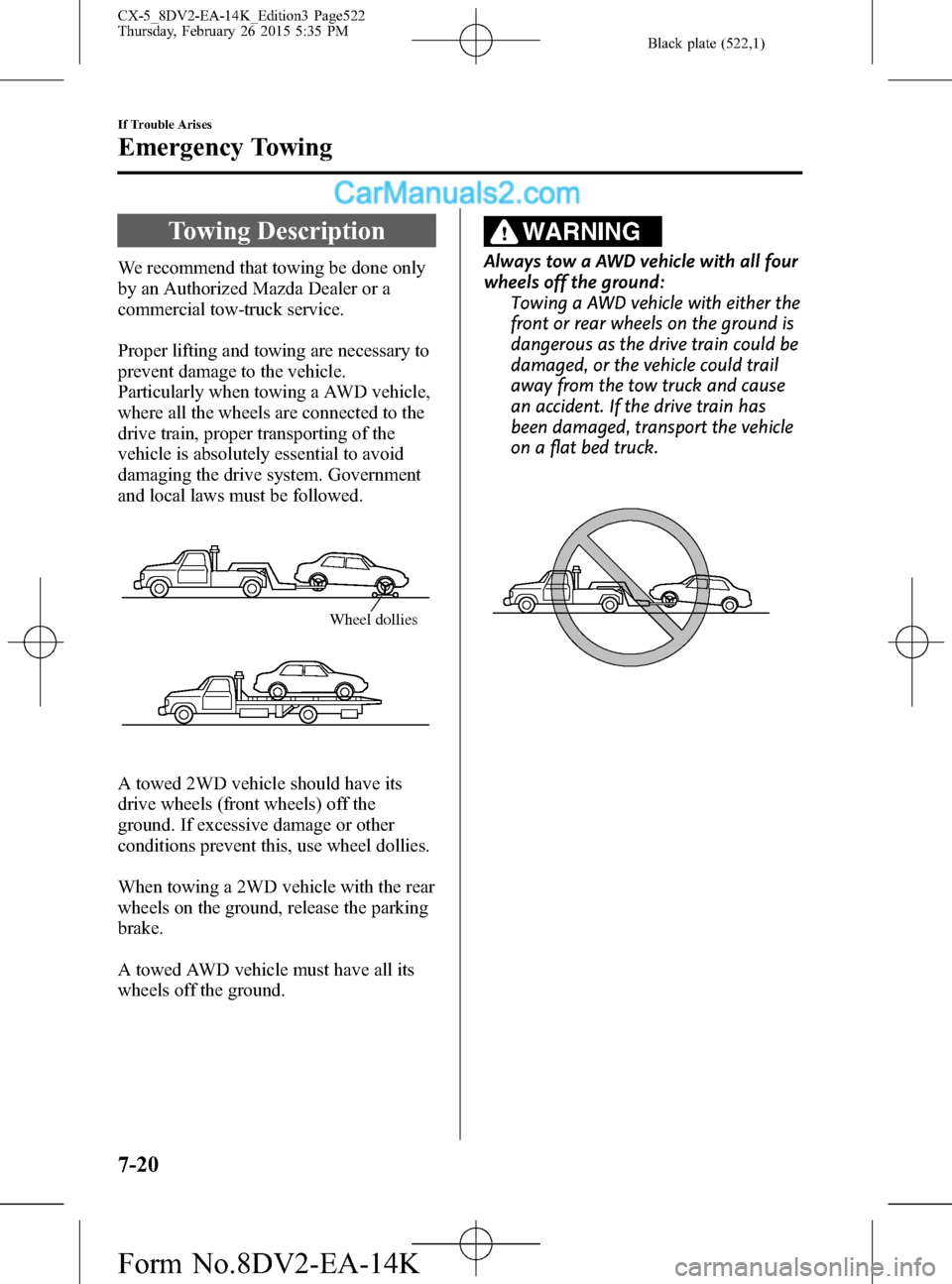
Particularly when towing a AWD vehicle,
where all the wheels are connected to the
drive train, proper transporting of the
vehicle is absolutely essential to avoid
damaging the drive system. Government
and local laws must be followed.
Wheel dollies
A towed 2WD vehicle should have its
drive wheels (front wheels) off the
ground. If excessive damage or other
conditions prevent this, use wheel dollies.
When towing a 2WD vehicle with the rear
wheels on the ground, release the parking
brake.
A towed AWD vehicle must have all its
wheels off the ground.
WARNING
Always tow a AWD vehicle with all four
wheels off the ground:
Towing a AWD vehicle with either the
front or rear wheels on the ground is
dangerous as the drive train could be
damaged, or the vehicle could trail
away from the tow truck and cause
an accident. If the drive train has
been damaged, transport the vehicle
on a flat bed truck.
7-20
If Trouble Arises
Emergency Towing
CX-5_8DV2-EA-14K_Edition3 Page522
Thursday, February 26 2015 5:35 PM
Form No.8DV2-EA-14K