inflation pressure MAZDA MODEL CX-5 2018 Owners Manual (in English)
[x] Cancel search | Manufacturer: MAZDA, Model Year: 2018, Model line: MODEL CX-5, Model: MAZDA MODEL CX-5 2018Pages: 628, PDF Size: 82.38 MB
Page 131 of 628
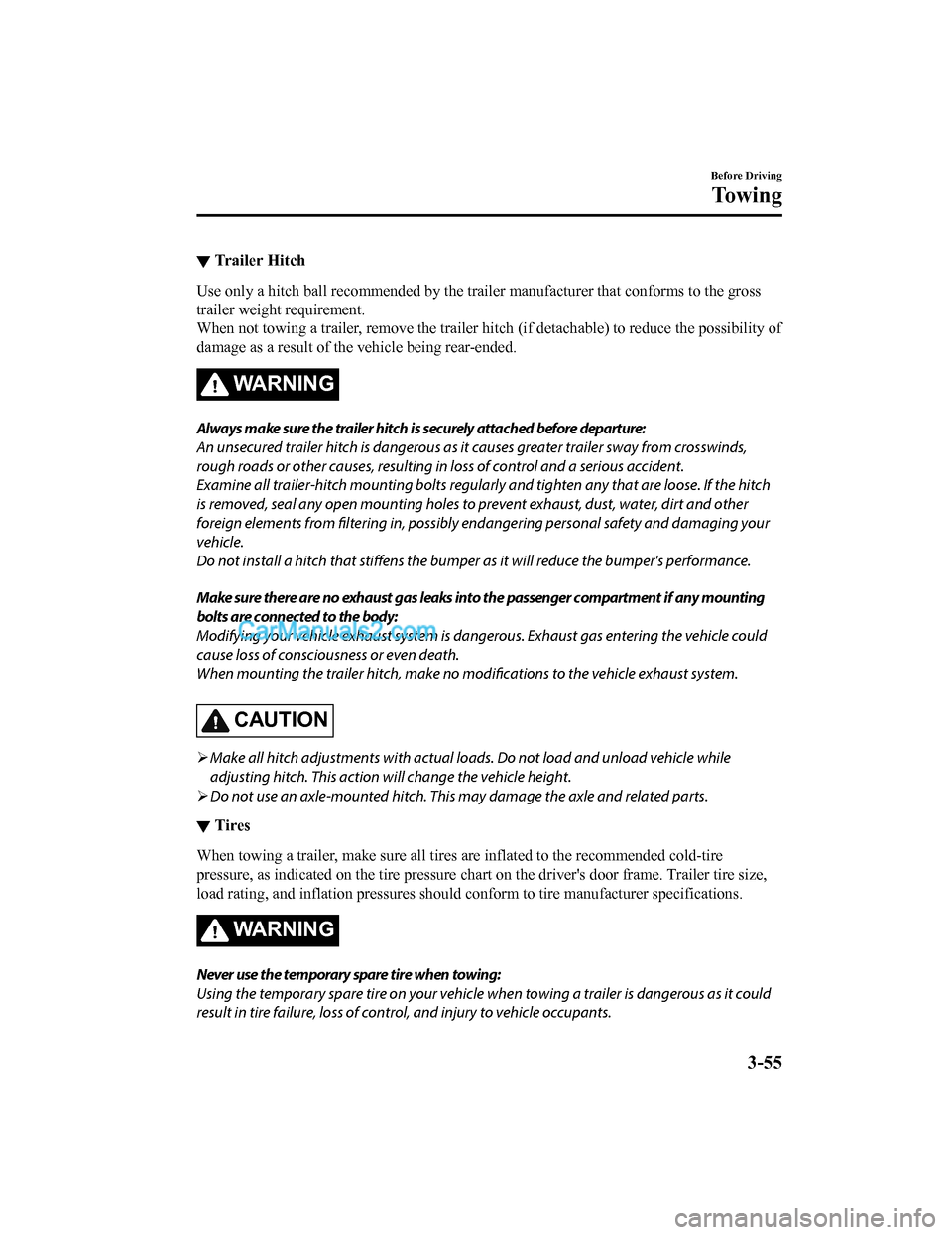
▼Trailer Hitch
Use only a hitch ball recommended by the trailer manufacturer that conforms to the gross
trailer weight requirement.
When not towing a trailer, remove
the trailer hitch (if detachable) to reduce the possibility of
damage as a result of the vehicle being rear-ended.
WA R N I N G
Always make sure the trailer hitch is securely attached before departure:
An unsecured trailer hitch is dangerous as it causes greater trailer sway from crosswinds,
rough roads or other causes, resulting in loss of control and a serious accident.
Examine all trailer-hitch mounting bolts regularly and tighten any that are loose. If the hitch
is removed, seal any open mounting holes to prevent exhaust, dust, water, dirt and other
foreign elements from filtering in, possibly en dangering personal safety and damaging your
vehicle.
Do not install a hitch that stiffens the bumper as it will reduce the bumper's performance.
Make sure there are no exhaust gas leaks into the passenger compartment if any mounting
bolts are connected to the body:
Modifying your vehicle exhaust system is dangerous. Exhaust gas entering the vehicle could
cause loss of consciousness or even death.
When mounting the trailer hitch, make no modifications to the vehicle exhaust system.
CAUTION
Make all hitch adjustments with actual load s. Do not load and unload vehicle while
adjusting hitch. This action w ill change the vehicle height.
Do not use an axle-mounted hitch. This may damage the axle and related parts.
▼Tires
When towing a trailer, make sure all tires are inflated to the
recommended cold-tire
pressure, as indicated on the tire pressure chart on the driver 's door frame. Trailer tire size,
load rating, and inflation pressu res should conform to tire manufacturer specifications.
WA R N I N G
Never use the temporary spare tire when towing:
Using the temporary spare tire on your vehicle wh en towing a trailer is dangerous as it could
result in tire failure, loss of control, and injury to vehicle occupants.
Before Driving
To w i n g
3-55
CX-5_8GN5-EA-17J_Edition1 2017-8-18 12:58:27
Page 219 of 628

i-ACTIV AWD Operation*
AWD provides excellent drivability on
snow-covered and ice-packed roads, sand
and mud, as well as on steep slopes and
other slippery surfaces.
A system malfunction or operation
conditions are indicated by a warning.
Refer to Warning Indication/Warning
Lights on page 4-30.
WA R N I N G
Never spin a wheel that is off the ground:
Spinning a wheel that is off the ground as a
result of the vehicle being stuck or in a
ditch is dangerous. The drive assembly
could be seriously damaged which could
lead to an accident or could even lead to
overheating, oil leakage, and a fire.
▼ AWD Driving
WA R N I N G
Avoid sharp turns, excessive speed and
abrupt maneuvers when driving this
vehicle:
Sharp turns, excessive speed and abrupt
maneuvering of this vehicle is dangerous
as it could result in the increased risk of loss
of vehicle control, vehicle roll-over,
personal injury or death.
This vehicle has a higher center of gravity.
Vehicles with a higher center of gravity
such as utility and AWD vehicles handle
differently than vehicles with a lower center
of gravity.
Utility and AWD vehicles are not designed
for cornering at high speeds any more than
low profile sports cars are designed to
perform satisfactorily under off-road
conditions. In addition, utility vehicles have
a significantly higher rollover rate than
other types of vehicles.
Drive carefully when the vehicle is loaded
by lowering vehicle speed and applying the
brakes earlier:
Abrupt maneuvering and sudden braking
when driving a loaded vehicle is dangerous
as the driving behavior of a vehicle with a
high center of gravity is different when it is
loaded compared to when it is not, and
could result in the loss of vehicle control
and an accident.
▼Tires and Tire Chains
The condition of the ti
res plays a large role
in the performance of the vehicle.
Moreover, to prevent adverse effects to the
drive assembly, please note the following:
Tires
•When replacing tires, always replace all
front and rear tires at the same time.
•All tires must be of the same size,
manufacture, brand and tread pattern.
Pay particular attention when equipping
snow or other types of winter tires.
•Do not mix tread-worn tires with normal
tires.
•Inspect tire inflation pressures at the
specified periods adjust to the specified
pressures.
When Driving
i-ACTIV AWD
*Some models.4-83
CX-5_8GN5-EA-17J_Edition1 2017-8-18 12:58:27
Page 220 of 628

NOTE
Check the tire inflation pressure label
attached to driver's door frame for the
correct tire inflation pressure.
•Make sure to equip the vehicle with
genuine wheels of the specified size, on
all wheels. With AWD, the system is
calibrated for all four wheels being of
the same dimensions.
Tire chains
•Install tire chains to the front tires.
•Do not use tire chains on the rear
wheels.
•Do not drive the vehicle faster than 30
km/h (19 mph) with the tire chains
installed.
•Do not drive the vehicle with tire chains
on road conditions other than snow or
ice.
▼ To w i n g
If the vehicle requ
ires towing, have it
towed with all four wh eels completely off
the ground.
Refer to Towing Description on page 7-
20.
When Driving
i-ACTIV AWD
4-84
CX-5_8GN5-EA-17J_Edition1 2017-8-18 12:58:27
Page 298 of 628
Tire Pressure Monitoring System
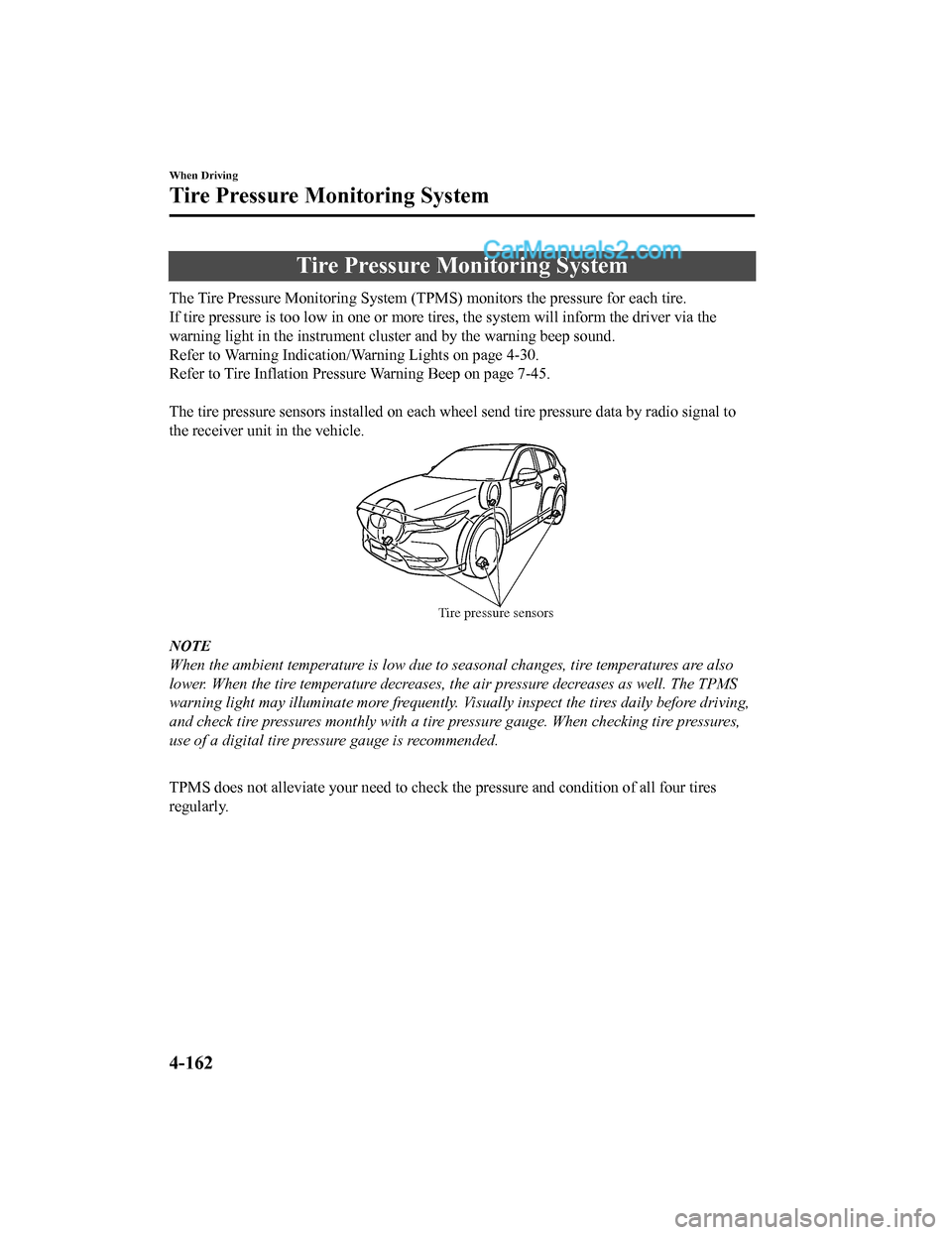
The Tire Pressure Monitoring System (TPMS) monitors the pressure for each tire.
If tire pressure is to o low in one or more tires, the system will inform the driver via the
warning light in the instrument cluster and by the warning beep sound.
Refer to Warning Indication/Warning Lights on page 4-30.
Refer to Tire Inflation Pressu re Warning Beep on page 7-45.
The tire pressure sensors installed on each wheel send tire pre ssure data by radio signal to
the receiver unit in the vehicle.
Tire pressure sensors
NOTE
When the ambient temperature is low due to seasonal changes, tire temperatures are also
lower. When the tire temperature decreases, the air pressure decreases as well. The TPMS
warning light may illumina te more frequently. Visually inspect the tires daily before driving,
and check tire pressures monthly with a tire pressure gauge. When checking tire pressures,
use of a digital tire pressure gauge is recommended.
TPMS does not alleviate your need to check the pressure and con dition of all four tires
regularly.
When Driving
Tire Pressure Monitoring System
4-162
CX-5_8GN5-EA-17J_Edition1 2017-8-18 12:58:27
Page 299 of 628
CAUTION
Each tire, including the spare (if provided), should be checked monthly when cold and
inflated to the inflation pressure recommended by the vehicle manufacturer on the vehicle
placard or tire inflation pressure label. (If your vehicle has tires of a
different size than the
size indicated on the vehicle placard or tire inflation pressure label, you should determine
the proper tire inflation pressure for those tires.)
As an added safety feature, your vehicle ha s been equipped with a tire pressure monitoring
system (TPMS) that illuminates a low tire pre ssure telltale when one or more of your tires is
significantly
under-inflated. Accordingly, when the low tire pressure telltale illuminates, you
should stop and check your tires as soon as possible, and inflate them to the proper
pressure. Driving on a significantly under-in flated tire causes the tire to overheat and can
lead to tire failure. Under-inflation also reduces fuel
efficiency and tire tread life, and may
affect the vehicle's handling and stopping ability.
Please note that the TPMS is not a substitute for proper tire maintenance, and it is the
driver's responsibility to maintain correct ti re pressure, even if under-inflation has not
reached the level to trigger illumination of the TPMS low tire pressure telltale.
Your vehicle has also been equipped with a TPMS malfunction indicator to indicate when
the system is not operating properly.
The TPMS malfunction indicator is combined with the low tire pressure telltale. When the
system detects a malfunction, the telltale wi ll flash for approximately one minute and then
remain continuously illuminated. This sequence will continue upon subsequent vehicle
start-ups as long as the malfunction exists. When the malfunction indicator is illuminated,
the system may not be able to detect or signal low tire pressure as intended. TPMS
malfunctions may occur for a variety of reasons, including the installation of replacement
or alternate tires or wheels on the vehicle th at prevent the TPMS from functioning properly.
Always check the TPMS malfunction telltale after replacing one or more tires or wheels on
your vehicle to ensure that the replacement or alternate tires and wheels allow the TPMS to
continue to function properly.
To avoid false readings, the system samples for a little while before indicating a problem. As
a result it will not instantaneously register a rapid tire
deflation or blow out.
When Driving
Tire Pressure Monitoring System
4-163
CX-5_8GN5-EA-17J_Edition1
2017-8-18 12:58:27
Page 456 of 628
Remarks:
*1 The engine oil and filter must be changed at least once a year or within 12,000 km (7,500 miles) since last
engine oil and filter change. Re set the engine oil data whenever replacing the engine oil regardless of the
message/wrench indicator light display.
*2 Use of FL-22 is recommended when replacing engine coolant. Using engine coolant other than FL-22 may
cause serious damage to the engine and cooling system.
*3 According to state/provincial and federal regulations, failure to perform maintenance on these items will not
void your emissions warranties. H owever, Mazda recommends that all maintenance services be performed at
the recommended time or mileage/kilometer period to ensure long -term reliability.
*4 If this component has been submerged in water, the oil should be replaced.*5 Check the tire repair fluid expiration date every year when performing the periodic maintenance. Replace the
tire repair fluid bottle with ne w one before the expiration dat e.
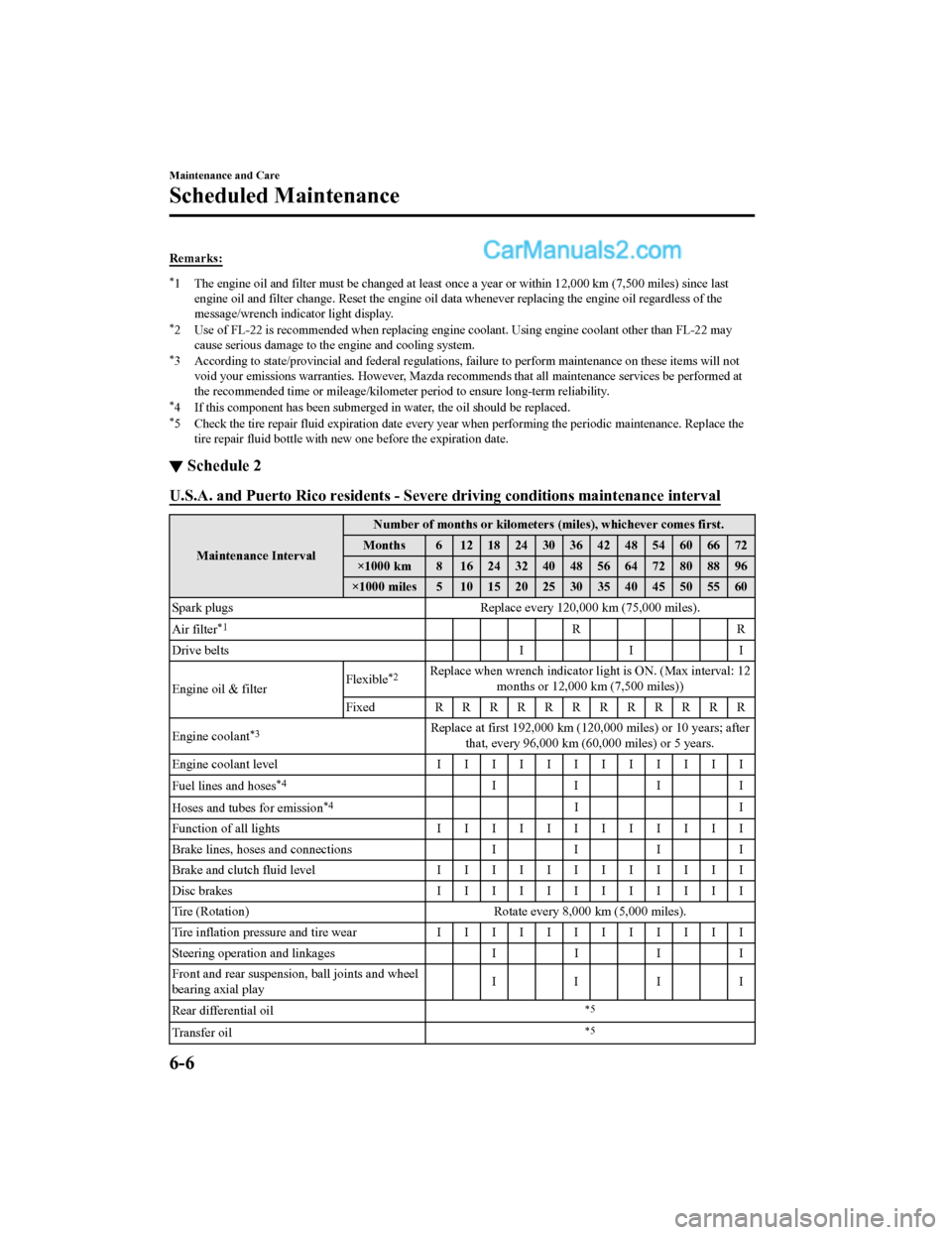
▼Schedule 2
U.S.A. and Puerto Rico residents - Severe driving conditions ma
intenance interval
Maintenance IntervalNumber of months or kilometers (miles), whichever comes first.
Months 6 1218243036424854606672
×1000 km 8 16 24 32 40 48 56 64 72 80 88 96
×1000 miles 5 10 15 20 25 30 35 40 45 50 55 60
Spark plugs Replace every 120,000 km (75,000 miles).
Air filter
*1RR
Drive belts I I I
Engine oil & filter Flexible
*2Replace when wrench indicator light is ON. (Max interval: 12
months or 12,000 km (7,500 miles))
Fixed RRRRRRRRRRRR
Engine coolant
*3Replace at first 192,000 km (120, 000 miles) or 10 years; after
that, every 96,000 km (60,000 miles) or 5 years.
Engine coolant level IIIIIIIIIIII
Fuel lines and hoses
*4IIII
Hoses and tubes for emission
*4II
Function of all lights IIIIIIIIIIII
Brake lines, hoses and connections II II
Brake and clutch fluid level I I I I I I I I I I I I
Disc brakes IIIIIIIIIIII
Tire (Rotation) Rotate every 8,000 km (5,000 miles).
Tire inflation pressure and tire wear IIIIIIIIIIII
Steering operation and linkages II II
Front and rear suspensi on, ball joints and wheel
bearing axial play IIII
Rear differential oil
*5
Transfer oil*5
Maintenance and Care
Scheduled Maintenance
6-6
CX-5_8GN5-EA-17J_Edition1 2017-8-18 12:58:27
Page 458 of 628
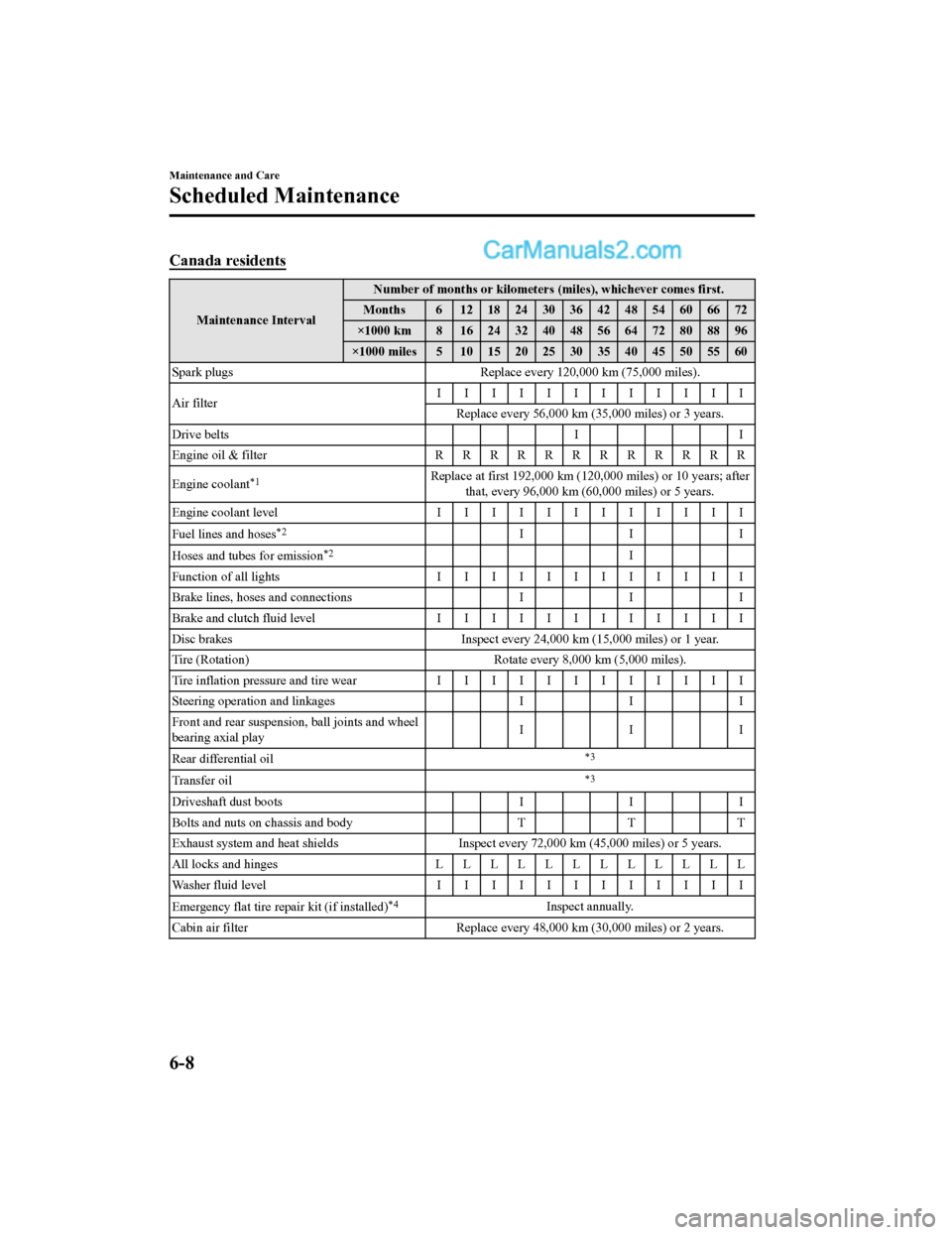
Canada residents
Maintenance IntervalNumber of months or kilometers (miles), whichever comes first.
Months 6 1218243036424854606672
×1000 km 8 16 24 32 40 48 56 64 72 80 88 96
×1000 miles 5 10 15 20 25 30 35 40 45 50 55 60
Spark plugs Replace every 120,000 km (75,000 miles).
Air filter IIIIIIIIIIII
Replace every 56,000 km (35 ,000 miles) or 3 years.
Drive belts II
Engine oil & filter RRRRRRRRRRRR
Engine coolant
*1Replace at first 192,000 km (120, 000 miles) or 10 years; after
that, every 96,000 km (60,000 miles) or 5 years.
Engine coolant level IIIIIIIIIIII
Fuel lines and hoses
*2III
Hoses and tubes for emission
*2I
Function of all lights IIIIIIIIIIII
Brake lines, hoses and connections II I
Brake and clutch fluid level I I I I I I I I I I I I
Disc brakes Inspect every 24,000 km (15,000 miles) or 1 year.
Tire (Rotation) Rotate every 8,000 km (5,000 miles).
Tire inflation pressure and tire wear IIIIIIIIIIII
Steering operation and linkages II I
Front and rear suspensi on, ball joints and wheel
bearing axial play III
Rear differential oil
*3
Transfer oil*3
Driveshaft dust boots II I
Bolts and nuts on chassis and body TTT
Exhaust system and heat shields Inspect every 72,000 km (45,000 miles) or 5 years.
All locks and hinges LLLLLLLLLLLL
Washer fluid level IIIIIIIIIIII
Emergency flat tire repair kit (if installed)
*4Inspect annually.
Cabin air filter Replace every 48,000 km (30,000 miles) or 2 yea rs.
Maintenance and Care
Scheduled Maintenance
6-8
CX-5_8GN5-EA-17J_Edition1 2017-8-18 12:58:27
Page 462 of 628

Owner Maintenance Precautions
The owner or a qualified service technician should make these vehicle inspections at the
indicated intervals to ensure safe and dependable operation.
Bring any problem to the attention of an Authorized Mazda Deale r or qualified service
technician as soon as possible.
When Refueling
•Brake fluid level (page 6-20)
•Engine coolant level (page 6-18)
•Engine oil level (page 6-17)
•Washer fluid level (page 6-20)
At Least Monthly
•Tire inflation pressures (page 6-31)
At Least Twice a Year (For Example, Every Spring and Fall)
You can do the following schedu led maintenance items if you hav e some mechanical ability
and a few basic tools and if you closely follow the directions in this manual.
•Engine coolant (page 6-18)
•Engine oil (page 6-17)
Improper or incomplete service may result in problems. This sec tion gives instructions only
for items that are easy to perform.
As explained in the Introduction (page 6-2), several procedures can be done only by a
qualified service technician with special tools.
Improper owner maintenance during the warranty period may affec t warranty coverage.
Refer to Introduction (page 6-2) for owner's responsibility in protecting your investment.
For details, read the separate Mazda Warranty statement provide d with the vehicle. If you
are unsure about any servicing or maintenance procedure, have i t done by an Authorized
Mazda Dealer.
There are strict environmental laws regarding the disposal of w aste oil and fluids. Please
dispose of your waste properly and with due regard to the envir onment.
We recommend that you entrust the oil and fluid changes of your vehicle to an Authorized
Mazda Dealer.
Maintenance and Care
Owner Maintenance
6-12
CX-5_8GN5-EA-17J_Edition1 2017-8-18 12:58:27
Page 481 of 628
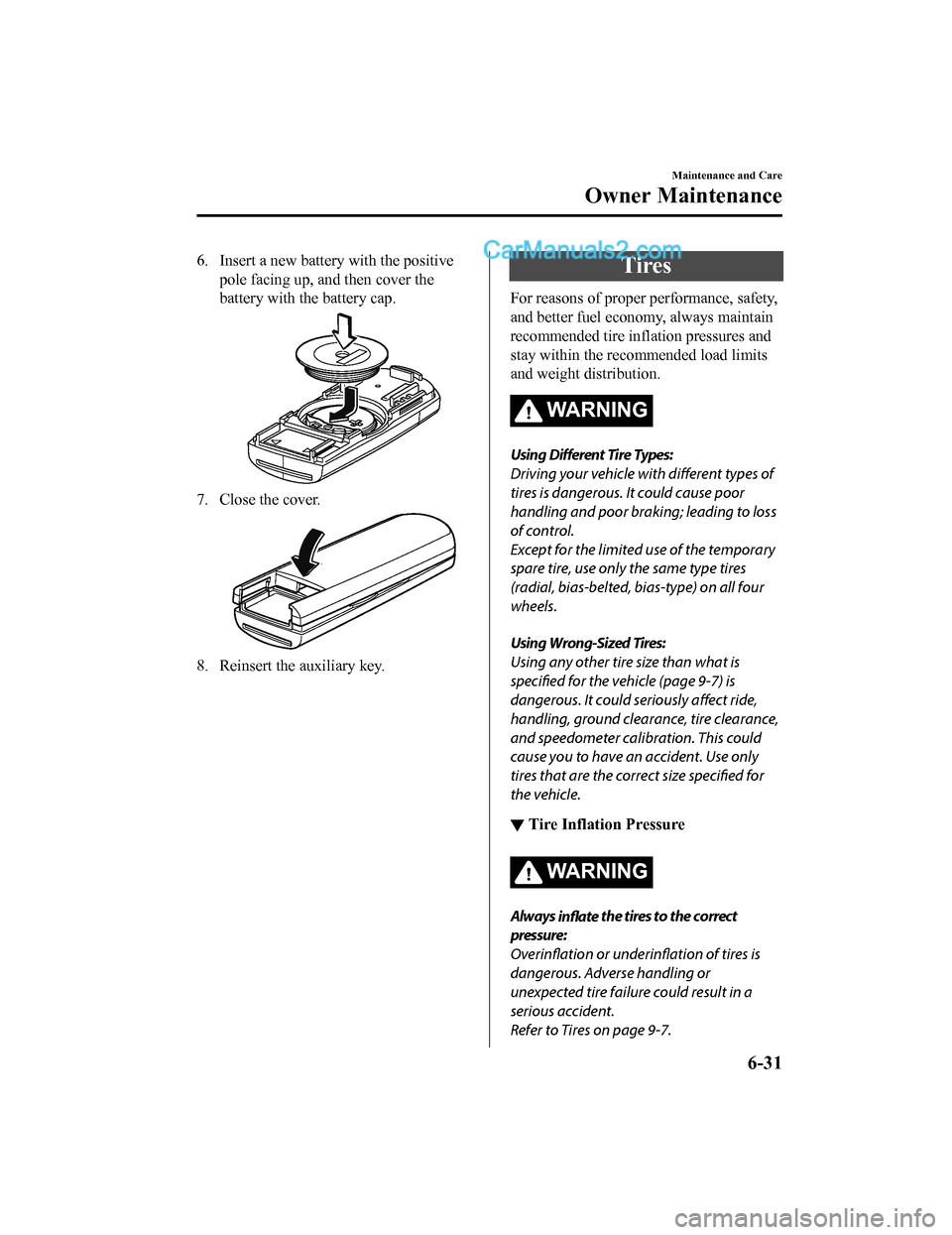
6. Insert a new battery with the positivepole facing up, and then cover the
battery with the battery cap.
7. Close the cover.
8. Reinsert the auxiliary key.
Tires
For reasons of proper performance, safety,
and better fuel economy, always maintain
recommended tire inflation pressures and
stay within the recommended load limits
and weight distribution.
WA R N I N G
Using Different Tire Types:
Driving your vehicle with different types of
tires is dangerous. It could cause poor
handling and poor braking; leading to loss
of control.
Except for the limited use of the temporary
spare tire, use only the same type tires
(radial, bias-belted, bias-type) on all four
wheels.
Using Wrong-Sized Tires:
Using any other tire size than what is
specified for the vehicle (page 9-7) is
dangerous. It could seriously affect ride,
handling, ground clearance, tire clearance,
and speedometer calibration. This could
cause you to have an accident. Use only
tires that are the correct size specified for
the vehicle.
▼ Tire Inflation Pressure
WA R N I N G
Always
inflate the tires to the correct
pressure:
Overinflation or underinflation of tires is
dangerous. Adverse handling or
unexpected tire failure could result in a
serious accident.
Refer to Tires on page 9-7.
Maintenance and Care
Owner Maintenance
6-31
CX-5_8GN5-EA-17J_Edition1 2017-8-18 12:58:27
Page 482 of 628
Use only a Mazda-genuine tire valve cap:
Use of a non-genuine part is dangerous as
the correct tire air pressure cannot be
maintained if the tire valve becomes
damaged. If the vehicle is driven under this
condition, the tire air pressure will decrease
which could result in a serious accident. Do
not use any part for the tire valve cap that
is not a Mazda-genuine part.
Inspect all tire pressures monthly
(including the spare) when the tires are
cold. Maintain recommended pressures for
the best ride, handling, and minimum tire
wear.
Refer to the specification charts (page 9-
7).
NOTE
•Always check tire pressure when tires
are cold.
•Warm tires normally exceed
recommended pressures. Do not release
air from warm tires to adjust the
pressure.
•Underinflation can cause reduced fuel
economy, uneven and accelerated tire
wear, and poor sealing of the tire bead,
which will deform the wheel and cause
separation of tire from rim.
•Overinflation can produce a harsh ride,
uneven and accelerated tire wear, and a
greater possibility of damage from road
hazards.
Keep your tire pressure at the correct
levels. If one frequently needs inflating,
have it inspected.
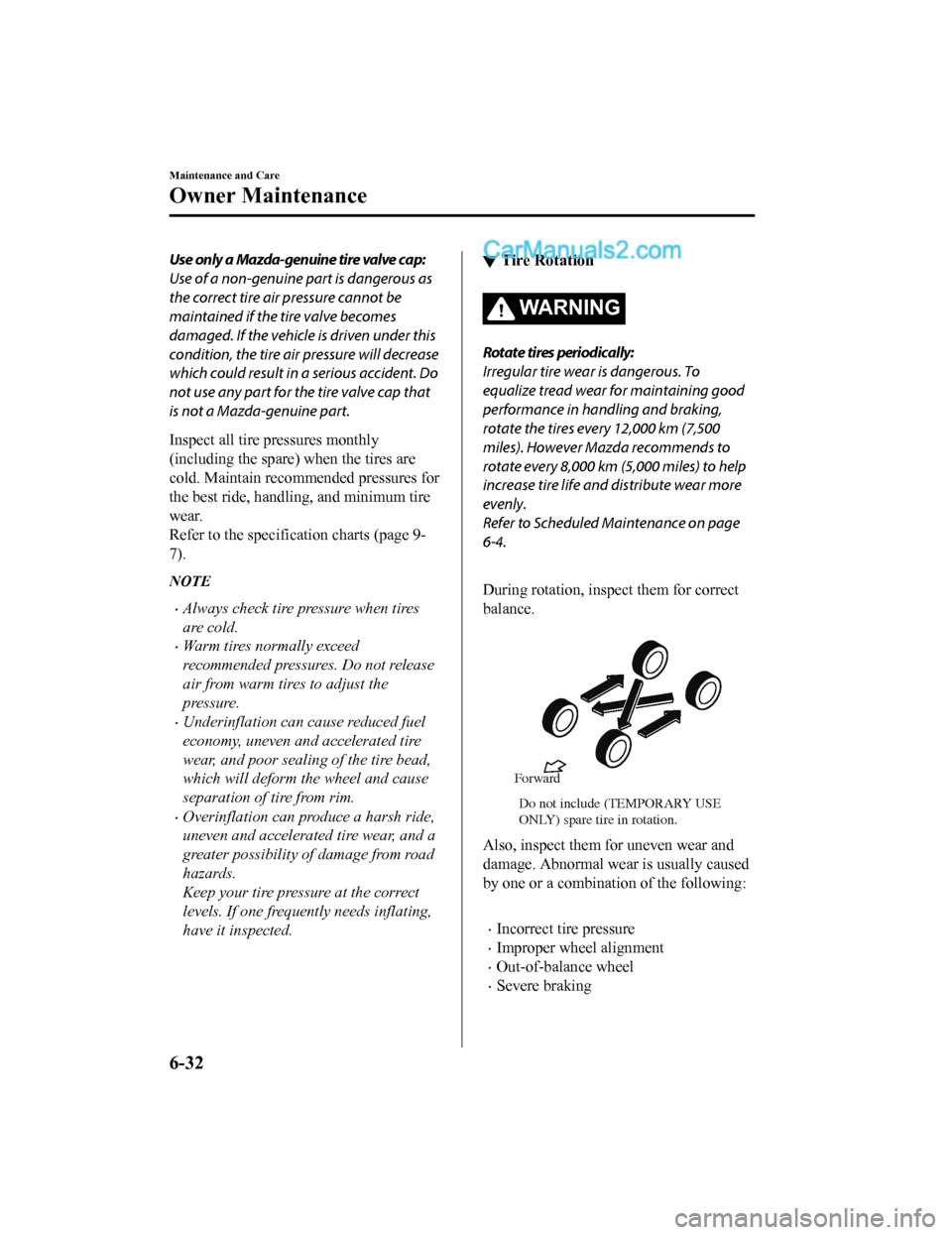
▼ Tire Rotation
WA R N I N G
Rotate tires periodically:
Irregular tire wear is dangerous. To
equalize tread wear for maintaining good
performance in handling and braking,
rotate the tires every 12,000 km (7,500
miles). However Mazda recommends to
rotate every 8,000 km (5,000 miles) to help
increase tire life and distribute wear more
evenly.
Refer to Scheduled Maintenance on page
6-4.
During rotation, inspect them for correct
balance.
Do not include (TEMPORARY USE
ONLY) spare tire in rotation.
Forward
Also, inspect them for uneven wear and
damage. Abnormal wear is usually caused
by one or a combination of the following:
•Incorrect tire pressure
•Improper wheel alignment
•Out-of-balance wheel
•Severe braking
Maintenance and Care
Owner Maintenance
6-32
CX-5_8GN5-EA-17J_Edition1 2017-8-18 12:58:27