weight MAZDA MODEL CX-5 2018 Owners Manual (in English)
[x] Cancel search | Manufacturer: MAZDA, Model Year: 2018, Model line: MODEL CX-5, Model: MAZDA MODEL CX-5 2018Pages: 628, PDF Size: 82.38 MB
Page 52 of 628
4. Place the child-restraint system on the
seat without putting your weight on the
seat and fasten the seat belt. See the
manufacturer's instructions on the
child-restraint system for belt routing
instructions.
5. To get the retractor into the automatic
locking mode, pull the shoulder belt
portion of the seat belt until the entire
length of the belt is out of the retractor.
6. Push the child-restraint system firmly
into the vehicle sea t. Be sure the belt
retracts as snugly as possible. A
clicking noise from the retractor will
be heard during retraction if the system
is in automatic lo cking mode. If the
belt does not lock the seat down tight,
repeat the previous step and also this
one.
NOTE
•Inspect this function before each use
of the child-restraint system. You
should not be able to pull the
shoulder belt out of the retractor
while the system is in the automatic
locking mode. When you remove the
child-restraint system, be sure the
belt fully retracts to return the
system to emergency locking mode
before occupants use the seat belts.
•Follow the child-restraint system
manufacturer's instructions
carefully.
Depending on the type of
child-restraint system, it may not
employ seat belts which are in
automatic locking mode.
7. Seat your child safely in the child-restraint system and secure the
child according to the instructions
from the child-restraint system
manufacturer.
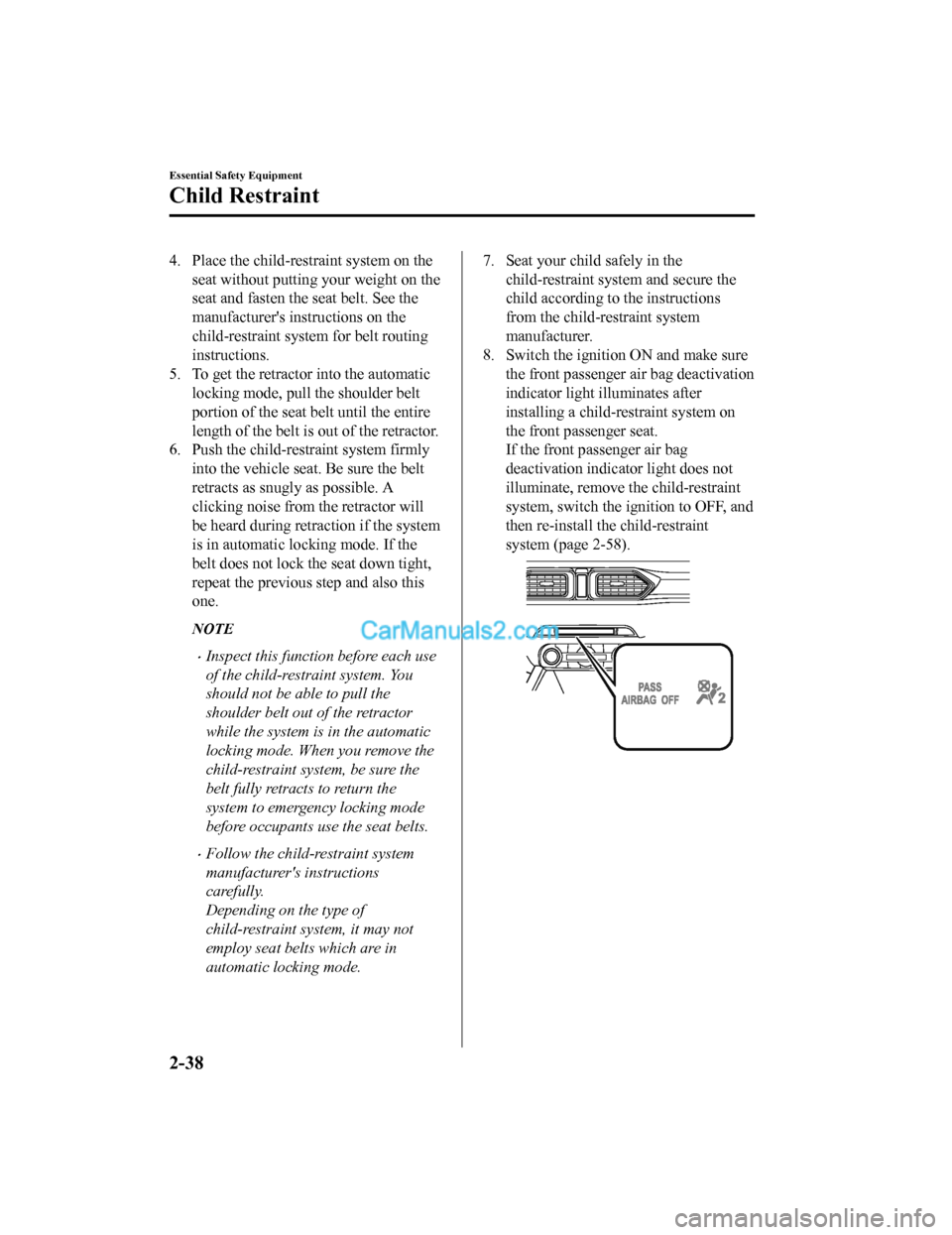
8. Switch the ignition ON and make sure the front passenger air bag deactivation
indicator light illuminates after
installing a child-restraint system on
the front passenger seat.
If the front passenger air bag
deactivation indicator light does not
illuminate, remove the child-restraint
system, switch the ignition to OFF, and
then re-install th e child-restraint
system (page 2-58).
Essential Safety Equipment
Child Restraint
2-38
CX-5_8GN5-EA-17J_Edition1 2017-8-18 12:58:27
Page 62 of 628
To prevent false detection by the air bag sensor system, heed the following:
Do not use tires or wheels other th an those specified for your Mazda:
Use of any tire or wheel other than thos e specified for your Mazda (page 9-7) is
dangerous. Use of such wheels will prevent th e vehicle's accident detections system from
accurately detecting a collision or roll-over accident resulting in incorrect or unexpected air
bag deployment and the possibility of serious injuries.
Do not overload your vehicle:
Overloading your vehicle is dangerous as it could prevent the air bag crash sensor system
from accurately detecting a collision or roll-over accident resulting in incorrect or
unexpected air bag deployment and the possibili ty of serious injuries. The gross axle weight
rating (GAWR) and the gross vehicle weight rati ng (GVWR) for your vehicle are on the Motor
Vehicle Safety Standard Label on the driver's door frame. Do not exceed these ratings.
Do not drive the vehicle off-road:
Driving your Mazda off-road is dangerous beca use the vehicle has not been designed to do
so. Driving the vehicle off-road could prev ent the air bag crash sensor system from
accurately detecting a collision or roll-over accident resulting in incorrect or unexpected air
bag deployment and the possibility of serious injuries.
Do not modify a front door or leave any da mage unrepaired. Always have an Authorized
Mazda Dealer inspect a damaged front door:
Modifying a front door or leaving any damage unrepaired is dangerous. Each front door has a
side crash sensor as a component of the suppleme ntal restraint system. If holes are drilled in a
front door, a door speaker is left removed, or a damaged door is left unrepaired, the sensor
could be adversely affected causing it to not de tect the pressure of an impact correctly during
a side collision. If a sensor does not detect a side impact correctly, the side and curtain air
bags and the front seat belt pretensioner may not operate normally which could result in
serious injury to occupants.
Do not modify the supplemental restraint system:
Modifying the components or wiring of the su pplemental restraint system is dangerous. You
could accidentally activate it or make it inoperable. Do not make any modifications to the
supplemental restraint system. This includes inst alling trim, badges, or anything else over the
air bag modules. It also includes installing extra electrical equipment on or near system
components or wiring. An Authorized Mazda Dealer can provide the special care needed in
the removal and installation of front seats. It is important to protect the air bag wiring and
connections to assure that the bags do not ac cidentally deploy, and that the front passenger
occupant classification system and the seats retain an undamaged air bag connection.
Essential Safety Equipment
SRS Air Bags
2-48
CX-5_8GN5-EA-17J_Edition1
2017-8-18 12:58:27
Page 96 of 628

Liftgate
WA R N I N G
Never allow a person to ride in the luggage
compartment:
Allowing a person to ride in the luggage
compartment is dangerous. The person in
the luggage compartment could be
seriously injured or killed during sudden
braking or a collision.
Do not drive with the liftgate open:
Exhaust gas in the cabin of a vehicle is
dangerous. An open liftgate in a moving
vehicle will cause exhaust gas to be drawn
into the cabin. This gas contains CO
(carbon monoxide), which is colorless,
odorless, and highly poisonous, and it can
cause loss of consciousness and death.
Moreover, an open liftgate could cause
occupants to fall out in an accident.
Do not stack or leave loaded luggage
unsecured in the luggage compartment:
Otherwise, the luggage may move or
collapse, resulting in injury or an accident.
In addition, do not load luggage higher
than the seatbacks. It may affect the side or
rear field of view.
CAUTION
Before opening the liftgate, remove any
snow and ice accumulation on it.
Otherwise, the liftgate could close under
the weight of the snow and ice resulting
in injury.
Be careful when opening/closing the
liftgate during strong winds. If a strong
gust blows against the liftgate, it could
close suddenly resulting in injury.
Fully open the liftgate and make sure
that it stays open. If the liftgate is only
opened partially, it could slam shut by
vibration or wind gusts resulting in
injury.
When loading or unloading luggage in
the luggage compartment, turn off the
engine. Otherwise, you could get burned
by the heat of the exhaust gas.
Be careful not to apply excessive force to
the damper stay on the liftgate such as
by putting your hand on the stay.
Otherwise, the damper stay may bend
and
affect the liftgate operation.
Damper stay
Do not modify or replace the liftgate
damper stay. Consult an Authorized
Mazda Dealer if a liftgate damper stay is
deformed or damaged for reasons such
as a collision or if there is some other
problem.
Before Driving
Doors and Locks
3-20
CX-5_8GN5-EA-17J_Edition1 2017-8-18 12:58:27
Page 99 of 628
Never allow children to operate the power
liftgate system:
Allowing children to operate the power
liftgate switch and the keyless entry system
is dangerous. Children are not aware of the
dangers of people getting fingers and
hands caught in a moving liftgate. If
someone's neck, head or hands get caught
in a closing door, it could result in death or
serious injury.
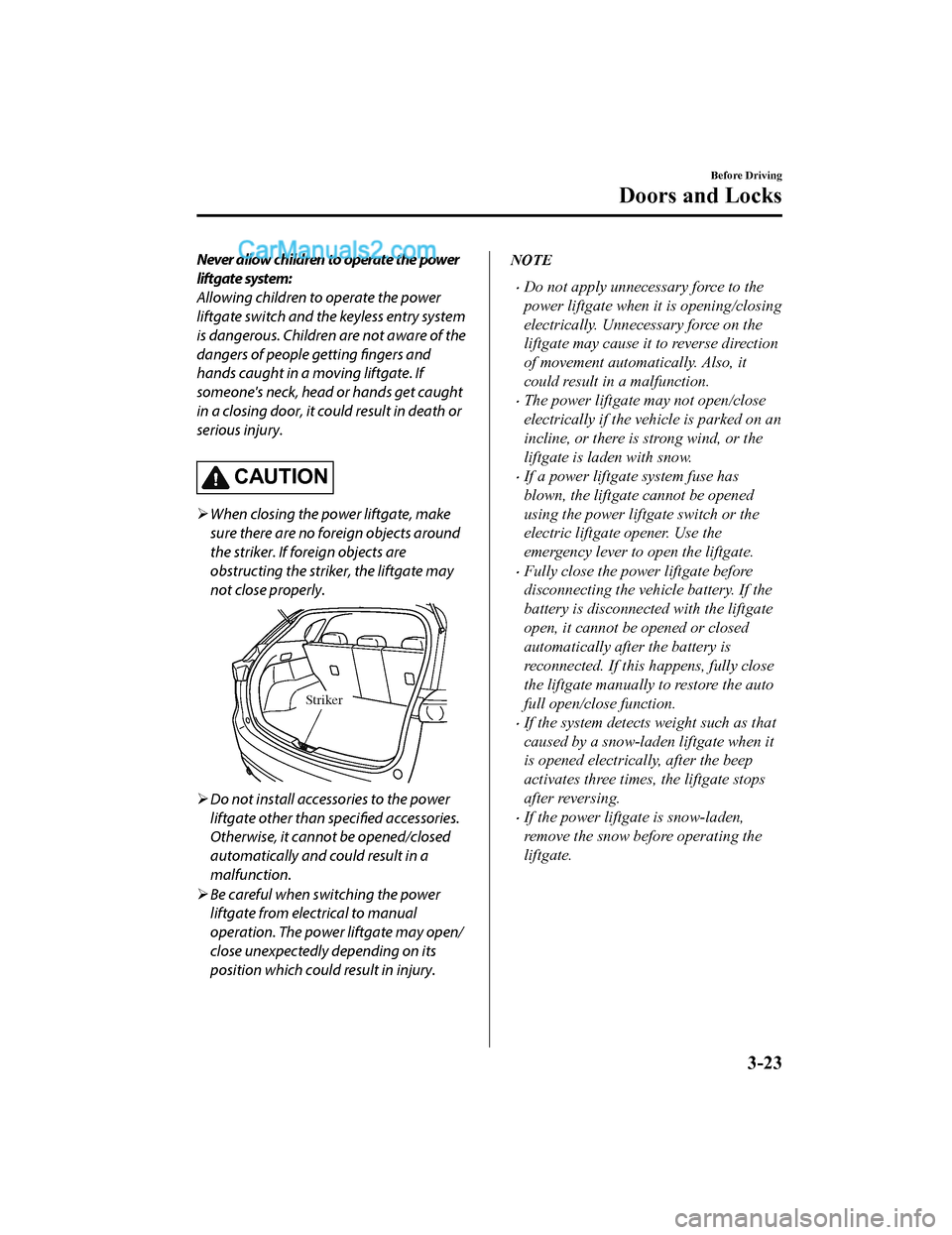
CAUTION
When closing the power liftgate, make
sure there are no foreign objects around
the striker. If foreign objects are
obstructing the striker, the liftgate may
not close properly.
Striker
Do not install accessories to the power
liftgate other than specified accessories.
Otherwise, it cannot be opened/closed
automatically and could result in a
malfunction.
Be careful when switching the power
liftgate from electrical to manual
operation. The power liftgate may open/
close unexpectedly depending on its
position which could result in injury.
NOTE
•Do not apply unnecessary force to the
power liftgate when it is opening/closing
electrically. Unnecessary force on the
liftgate may cause it to reverse direction
of movement automatically. Also, it
could result in a malfunction.
•The power liftgate may not open/close
electrically if the veh icle is parked on an
incline, or there is strong wind, or the
liftgate is laden with snow.
•If a power liftgate system fuse has
blown, the liftgate cannot be opened
using the power liftgate switch or the
electric liftgate opener. Use the
emergency lever to open the liftgate.
•Fully close the power liftgate before
disconnecting the vehicle battery. If the
battery is disconnected with the liftgate
open, it cannot be opened or closed
automatically after the battery is
reconnected. If this happens, fully close
the liftgate manually to restore the auto
full open/close function.
•If the system detects weight such as that
caused by a snow-laden liftgate when it
is opened electrically, after the beep
activates three times, the liftgate stops
after reversing.
•If the power liftgate is snow-laden,
remove the snow before operating the
liftgate.
Before Driving
Doors and Locks
3-23
CX-5_8GN5-EA-17J_Edition1 2017-8-18 12:58:27
Page 121 of 628
Break-In Period
No special break-in is necessary, but a few
precautions in the first 1,000 km (600
miles) may add to the performance,
economy, and life of the vehicle.
•Do not race the engine.
•Do not maintain one constant speed,
either slow or fast, for a long period of
time.
•Do not drive constantly at full-throttle or
high engine rpm for extended periods of
time.
•Avoid unnecessary hard stops.
•Avoid full-throttle starts.
•Do not tow a trailer.
Saving Fuel and Protection of the Environment
How you operate your Mazda determines
how far it will travel on a tank of fuel. Use
these suggestions to help save fuel and
reduce CO
2.
•Avoid long warm-ups. Once the engine
runs smoothly, begin driving.
•Avoid fast starts.
•Drive at lower speeds.
•Anticipate when to apply the brakes
(avoid sudden braking).
•Follow the maintenance schedule (page
6-4) and have an Authorized Mazda
Dealer perform inspections and
servicing.
•Use the air conditioner only when
necessary.
•Slow down on rough roads.
•Keep the tires properly inflated.
•Do not carry unnecessary weight.
•Do not rest your foot on the brake pedal
while driving.
•Keep the wheels in correct alignment.
•Keep windows closed at high speeds.
•Slow down when driving in crosswinds
and headwinds.
WA R N I N G
Never stop the engine when going down a
hill:
Stopping the engine when going down a
hill is dangerous. This causes the loss of
power steering and power brake control,
and may cause damage to the drivetrain.
Any loss of steering or braking control
could cause an accident.
Before Driving
Driving Tips
3-45
CX-5_8GN5-EA-17J_Edition1 2017-8-18 12:58:27
Page 126 of 628

Driving In Flooded Area
WA R N I N G
Dry off brakes that have become wet by
driving slowly, releasing the accelerator
pedal and lightly applying the brakes
several times until the brake performance
returns to normal:
Driving with wet brakes is dangerous.
Increased stopping distance or the vehicle
pulling to one side when braking could
result in a serious accident. Light braking
will indicate whether the brakes have been
affected.
CAUTION
Do not drive the vehicle on flooded roads
as it could cause short circuiting of
electrical/electronic parts, or engine
damage or stalling from water absorption.
If the vehicle has been immersed in water,
consult an Authorized Mazda Dealer.
Overloading
WA R N I N G
Be careful not to overload your vehicle:
The gross axle weight rating (GAWR) and
the gross vehicle weight rating (GVWR) of
the vehicle are on the Motor Vehicle Safety
Standard Label on the driver's door frame.
Exceeding these ratings can cause an
accident or vehicle damage. You can
estimate the weight of the load by
weighing the items (or people) before
putting them in the vehicle.
Before Driving
Driving Tips
3-50
CX-5_8GN5-EA-17J_Edition1 2017-8-18 12:58:27
Page 128 of 628

Trailer Towing
Your Mazda was designed and built primarily to carry passengers and cargo.
If you tow a trailer, follow these instructions because driver and passenger safety depends
on proper equipment and safe driving habits. Towing a trailer w ill affect handling, braking,
durability, performance , and fuel economy.
Never overload your vehicle or trailer. Consult an Authorized M azda Dealer if you need
further details.
CAUTION
Do not tow a trailer during the first 1,000 km (6 00 miles) of your new Mazda. If you do, you
may damage the engine, transaxle, differenti al, wheel bearings, and other power-train
components.
▼ Weight Limits
TTW and GCWR
The total trailer weight (TTW),
gross combination weight rating (GCWR), gross axle
weight rating (GAWR), trailer l oad, and trailer tongue load mus t be within the
prescribed limits.
•The total trailer weight (TTW) i s the sum of the weights of the trailer load (trailer
weight plus cargo), trailer hitc h, 2 passengers, and vehicle load (baggage, food, camp
gear, etc.). Never allow the total trailer weight (TTW) to exceed specifications in the
Trailer Towing-Load Table.
•The maximum GCWR is the combinat ion weight of the trailer and load plus the
towing vehicle (includ ing trailer hitch, vehicle passengers, and load). It must not
exceed the specifications in the load table.
GAWR and GVWR
Do not exceed front and rear GAWR (gross axle weight rating) an d GVWR (gross vehicle
weight rating). If you do, vehicle handling, braking, and perfo rmance will be affected. These
values are also on the Motor Vehi cle Safety Certification Label posted on the driver's door
frame.
Before Driving
To w i n g
3-52
CX-5_8GN5-EA-17J_Edition1 2017-8-18 12:58:27
Page 129 of 628

High-altitude operation
CAUTION
Be aware of the towing load weight differences when towing at high altitudes. For altitudes
exceeding 1,000 meter (3,280 ft 10 in), always reduce the towing load by 10 % for every 1,000
meter (3,280 ft 10 in) increase in altitude from the load indicated under the maximum GCWR
heading in the trailer towing-load table. If the determined maximum total towing load
weight is exceeded, the engine and ot her power-train parts may be damaged.
TRAILER TOWING-LOAD TABLE
Because vehicle weights vary, adjustments must be made to meet the requirements in this
table.
Item Model
2WD AWD
MAX. FRON-
TA L A R E A
2.97 m2 (32 ft2)
MAX. TTW
907.2 kg (2,000 lb)
MAX.
GCWR
2,725 kg (6,007.5 lb) 2,784 kg (6,137.6 lb)
MAX. GAWR
Front 1,069 kg (2,357 lb) 1,089 kg (2,401 lb)
Rear 992 kg (2,187 lb) 1,029 kg (2,269 lb)
MAX.
GVWR
2,061 kg (4,544 lb) 2,118 kg (4,669 lb)
TRAIL-
ER-TONGUE
LOAD Tongue load
Tongue load/Trailer load × 100 = 10 % to 15 %
Trailer load
DISTRIBU-
TION OF
TRAILER
LOADFront 60 %
Rear 40 %
Before Driving
To w i n g
3-53
CX-5_8GN5-EA-17J_Edition1 2017-8-18 12:58:27
Page 130 of 628

WA R N I N G
Always keep tow loads within specified limits as indicated in the Trailer Towing-Load Table:
Attempting to tow loads greater than those sp ecified is dangerous as it may cause serious
handling and performance problems that could res ult in personal injury or vehicle damage,
or both.
Load your trailer with the weight about 60 % toward the front and 40 % toward the rear:
Loading the trailer with more weight in the rear than in the front is dangerous. Doing so could
cause you to lose control. The tr ailer tongue load must be 10 %―15 % of the total trailer load
(sum of the weights of the trailer and cargo).
Always have the total trailer weight and tongue load determined prior to departure:
Attempting to tow loads without determining the total trailer weight and tongue load is
dangerous. Trailer sway from crosswinds, rough roads or other causes could result in loss of
control and a serious accident.
CAUTION
The total trailer weight and tongue load ca n be determined by weighing the trailer on
platform scales at a highway weight station or a trucking company.
Before Driving
To w i n g
3-54
CX-5_8GN5-EA-17J_Edition1 2017-8-18 12:58:27
Page 131 of 628
▼Trailer Hitch
Use only a hitch ball recommended by the trailer manufacturer that conforms to the gross
trailer weight requirement.
When not towing a trailer, remove
the trailer hitch (if detachable) to reduce the possibility of
damage as a result of the vehicle being rear-ended.
WA R N I N G
Always make sure the trailer hitch is securely attached before departure:
An unsecured trailer hitch is dangerous as it causes greater trailer sway from crosswinds,
rough roads or other causes, resulting in loss of control and a serious accident.
Examine all trailer-hitch mounting bolts regularly and tighten any that are loose. If the hitch
is removed, seal any open mounting holes to prevent exhaust, dust, water, dirt and other
foreign elements from filtering in, possibly en dangering personal safety and damaging your
vehicle.
Do not install a hitch that stiffens the bumper as it will reduce the bumper's performance.
Make sure there are no exhaust gas leaks into the passenger compartment if any mounting
bolts are connected to the body:
Modifying your vehicle exhaust system is dangerous. Exhaust gas entering the vehicle could
cause loss of consciousness or even death.
When mounting the trailer hitch, make no modifications to the vehicle exhaust system.
CAUTION
Make all hitch adjustments with actual load s. Do not load and unload vehicle while
adjusting hitch. This action w ill change the vehicle height.
Do not use an axle-mounted hitch. This may damage the axle and related parts.
▼Tires
When towing a trailer, make sure all tires are inflated to the
recommended cold-tire
pressure, as indicated on the tire pressure chart on the driver 's door frame. Trailer tire size,
load rating, and inflation pressu res should conform to tire manufacturer specifications.
WA R N I N G
Never use the temporary spare tire when towing:
Using the temporary spare tire on your vehicle wh en towing a trailer is dangerous as it could
result in tire failure, loss of control, and injury to vehicle occupants.
Before Driving
To w i n g
3-55
CX-5_8GN5-EA-17J_Edition1 2017-8-18 12:58:27