brake MAZDA MODEL CX-5 SKYACTIV-D 2019 Owners Manual
[x] Cancel search | Manufacturer: MAZDA, Model Year: 2019, Model line: MODEL CX-5 SKYACTIV-D, Model: MAZDA MODEL CX-5 SKYACTIV-D 2019Pages: 721, PDF Size: 97.68 MB
Page 566 of 721

3. Turn the screws counterclockwise andremove them.
4. Pull the unit rearward to remove it.
5. Turn the socket and bulb assemblycounterclockwise and remove it.
6. Disconnect the bulb from the socket.
Rear turn signal lights
Brake lights/Taillights/Rear
side-marker lights
7. Install the new bulb in the reverseorder of the removal procedure.
▼Replacing Interior Light Bulbs
The interior lights have either LEDs or
normal bulbs.
LED type
Overhead lights/
Front map lights
Rear map lights
Vanity mirror lights*
Luggage compartment light
Ambient lights*
The LED bulb cannot be replaced as a
single unit because it is an integrated unit.
The LED bulb has to be replaced with the
unit. We recommend an Authorized
Mazda Dealer when the replacement is
necessary.
Bulb type
Overhead light/Front map lights, Rear
map lights, Vanity mirror lights
*
1. Wrap a flathead screwdriver with a
soft cloth to prevent damage to the
lens, and then remove the lens by
carefully prying on the edge of the lens
with a flathead screwdriver.
Maintenance and Care
Owner Maintenance
6-54*Some models.
CX-5_8HH4-EA-19A_Edition1 2018-11-21 10:03:20
Page 572 of 721

▼Fuse Panel Description
Fuse block (Engine compartment)
DESCRIPTION FUSE
RATING PROTECTED COMPONENT
1 CABIN.+B 50 A For protection of various circuits
2 IG2 30 A For protection of various circuits
3 INJECTOR
ENG.SUB 30 A
Engine control system
*
4 SCR1
EVVT 20 A Engine control system
5 P.WINDOW1 30 A ―
6 R.HEATER 20 A ―
7 ADD FAN DE 40 A Cooling fan
*
8WIPER.DEI 20 AWindshield wiper de-icer*
9DEFOG 40 A Rear window defogger
10 DCDC DE 40 A ―
11 EPB R 20 A Electric parking brake (EPB) (RH)
12 EPB L 20 A Electric parking brake (EPB) (LH)
Maintenance and Care
Owner Maintenance
6-60*Some models.
CX-5_8HH4-EA-19A_Edition1 2018-11-21 10:03:20
Page 574 of 721
DESCRIPTIONFUSE
RATING PROTECTED COMPONENT
47 FUEL WARM 25 A Fuel warmer
*
48TAIL 15 A Taillights, License plate lights, Parking lights
49 SCR2
FUEL PUMP2 25 A
Engine control system
*
50 HAZARD 25 A Hazard warning flashers, Turn signal lights, Parking lights
51 H/L LOW R 15 A Headlight low beam (RH)
52 OUTLET 25 A Accessory sockets
53 STOP 10 A Brake lights
54 ROOM 15 A For protection of various circuit
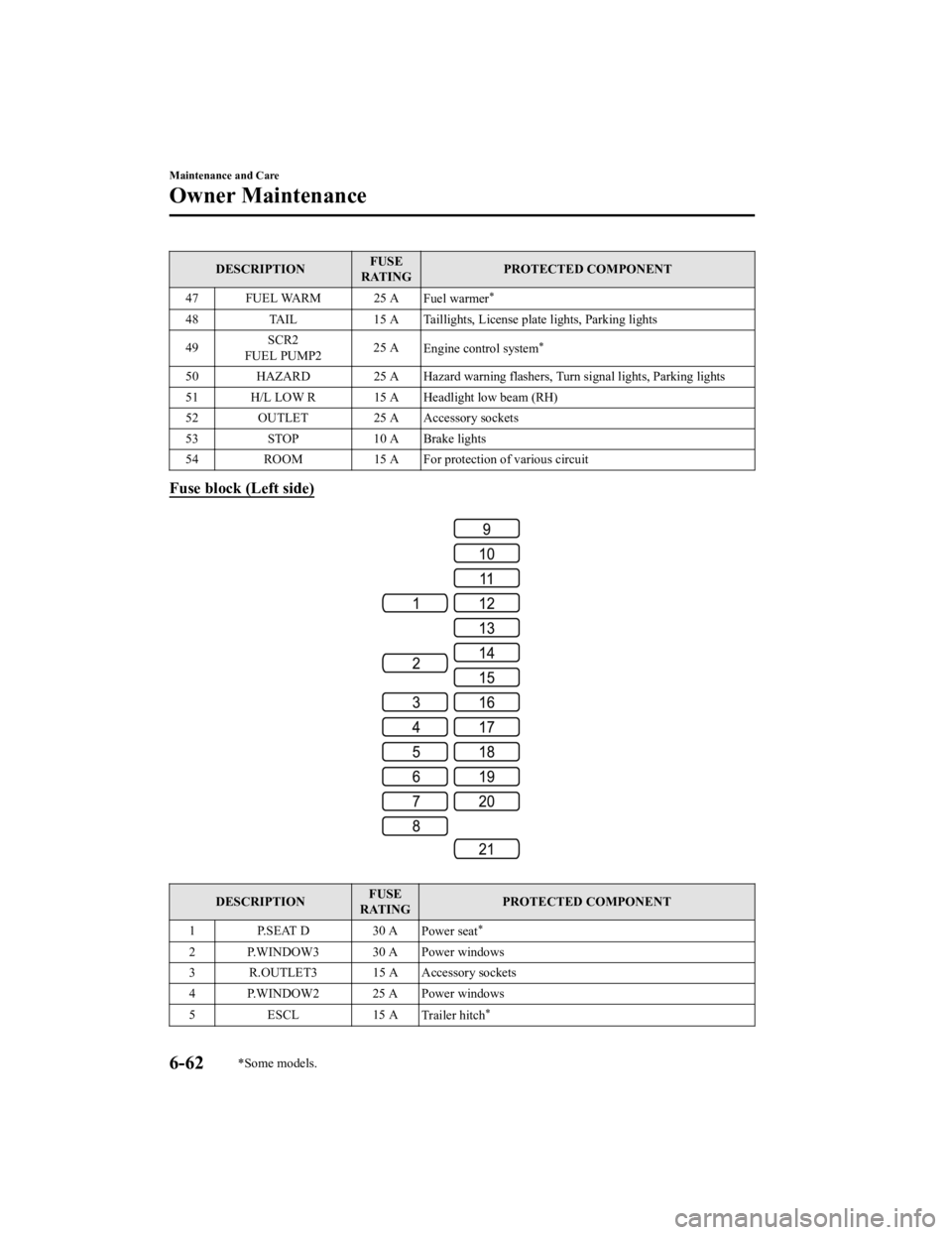
Fuse block (Left side)
DESCRIPTION FUSE
RATING PROTECTED COMPONENT
1 P.SEAT D 30 A Power seat
*
2 P.WINDOW3 30 A Power windows
3 R.OUTLET3 15 A Accessory sockets
4 P.WINDOW2 25 A Power windows
5ESC L 1 5 A
Trailer hitch
*
Maintenance and Care
Owner Maintenance
6-62*Some models.
CX-5_8HH4-EA-19A_Edition1 2018-11-21 10:03:20
Page 579 of 721

WA R N I N G
Dry off brakes that have become wet by
driving slowly, releasing the accelerator
pedal and lightly applying the brakes
several times until the brake performance
returns to normal:
Driving with wet brakes is dangerous.
Increased stopping distance or the vehicle
pulling to one side when braking could
result in a serious accident. Light braking
will indicate whether the brakes have been
affected.
When using an automatic car wash
Retract the door mirrors.
The automatic car wash brushes could
reduce the paint lustre or hasten paint
deterioration.
When using a high water pressure car
wash
High water temperature and high water
pressure car washers are available
depending on the type of car wash
machine. If the car washer nozzle is put
too close to the vehicle, the force of the
spray could damage or deform the
molding, affect the sealability of parts, and
allow water to penetrate the interior. Keep
a sufficient space (30 cm (12 in) or more)
between the nozzle and the vehicle. In
addition, do not spend too much time
spraying the same area of the vehicle, and
be very careful when spraying between
gaps in doors and around windows.
Waxing
Your vehicle needs to be waxed when
water no longer beads on the finish.
Always wash and dry the vehicle before
waxing it. In addition to the vehicle body,
wax the metal trim to maintain its luster.
1. Use wax which contains no abrasives. Waxes containing abrasive will remove
paint and could damage bright metal
parts.
2. Use a good grade of natural wax for metallic, mica, and solid colors.
3. When waxing, coat evenly with the sponge supplied or a soft cloth.
4. Wipe off the wax with a soft cloth.
NOTE
A spot remover to remove oil, tar, and
similar materials will usually also take off
the wax. Rewax these areas even if the rest
of the vehicle does not need it.
▼ Repairing Damage to the Finish
Deep scratches or chips on the finish
should be repaired promptly. Exposed
metal quickly rusts and can lead to major
repairs.
CAUTION
If your Mazda is da
maged and needs metal
parts repaired or replaced, make sure the
body shop applies anti-corrosion materials
to all parts, both repaired and new. This
will prevent them from rusting.
Maintenance and Care
Appearance Care
6-67
CX-5_8HH4-EA-19A_Edition1 2018-11-21 10:03:20
Page 580 of 721

▼Bright-Metal Maintenance
Use tar remover to remove road tar and
insects. Never do this with a knife or
similar tool.
To prevent corrosion on bright-metal
surfaces, apply wax or chrome
preservative and rub it to a high luster.
During cold weather or in coastal areas,
cover bright-metal parts with a coating
of wax or preservative heavier than
usual. It would also help to coat them
with noncorrosive petroleum jelly or
some other protective compound.
CAUTION
Do not use steel wool, abrasive cleaners, or
strong detergents containing highly
alkaline or caustic agents on
chrome-plated or anodized aluminum
parts. This may result in damage to the
protective coating and cause discoloration
or paint deterioration.
▼ Underbody Maintenance
Road chemicals and salt used for ice and
snow removal and solvents used for dust
control may collect on the underbody. If
not removed, they will speed up rusting
and deterioration of
such underbody parts
as fuel lines, frame, floor pan, and exhaust
system, even though these parts may be
coated with anti-corrosive material.
Thoroughly flush the underbody and
wheel housings with lukewarm or cold
water at the end of each winter. Try also to
do this every month.
Pay special attention to these areas
because they easily hide mud and dirt. It
will do more harm than good to wet
down the road grime without removing
it.
The lower edges of doors, rocker panels,
and frame members have drain holes that
should not be clogged. Water trapped there
will cause rusting.
WA R N I N G
Dry off brakes that have become wet by
driving slowly, releasing the accelerator
pedal and lightly applying the brakes
several times until the brake performance
returns to normal:
Driving with wet brakes is dangerous.
Increased stopping distance or the vehicle
pulling to one side when braking could
result in a serious accident. Light braking
will indicate whether the brakes have been
affected.
Maintenance and Care
Appearance Care
6-68
CX-5_8HH4-EA-19A_Edition1 2018-11-21 10:03:20
Page 585 of 721

WA R N I N G
Do not use rubber cleaners, such as tire
cleaner or tire shine, when cleaning rubber
floor mats:
Cleaning the rubber floor mats with rubber
cleaning products makes the floor mats
slippery.
This may cause an accident when
depressing the accelerator, brake, or clutch
(Manual transaxle) pedal or when getting
in or out of the vehicle.
After removing the floor mats for
cleaning, always reinstall them securely
(page 3-52).
Maintenance and Care
Appearance Care
6-73
CX-5_8HH4-EA-19A_Edition1 2018-11-21 10:03:20
Page 592 of 721

For vehicles not equipped with a
sub-woofer, turn the spare tire
hold-down bolt counterclockwise and
remove the spare tire.
Spare tire hold-down bolt
To secure the spare tire
Store the spare tire in the reverse order of
removal. After storing, verify that the
spare tire is stored securely.
Changing a Flat Tire
NOTE
If the following occurs while driving, it
could indicate a flat tire.
Steering becomes difficult.
The vehicle begins to vibrate
excessively.
The vehicle pulls in one direction.
If you have a flat tire, drive slowly to a
level spot that is well off the road and out
of the way of traffic to change the tire.
Stopping in traffic or on the shoulder of a
busy road is dangerous.
WA R N I N G
Be sure to follow the directions for
changing a tire:
Changing a tire is dangerous if not done
properly. The vehicle can slip off the jack
and seriously injure someone.
No person should plac e any portion of their
body under a vehicle that is supported by a
jack.
Never allow anyone inside a vehicle
supported by a jack:
Allowing someone to remain in a vehicle
supported by a jack is dangerous. The
occupant could cause the vehicle to fall
resulting in serious injury.
NOTE
Make sure the jack is well lubricated
before using it.
1. Park on a hard, level surface off the right-of-way and firmly set the parking
brake.
If Trouble Arises
Flat Tire
7-6
CX-5_8HH4-EA-19A_Edition1 2018-11-21 10:03:20
Page 593 of 721

2. Put a vehicle with an automatictransaxle in Park (P), a manual
transaxle in Reverse (R) or 1, and turn
off the engine.
3. Turn on the hazard warning flasher.
4. Have everyone get out of the vehicle
and away from the vehicle and traffic.
5. Remove the jack, tool, and spare tire (page 7-3).
6. Block the wheel diagonally opposite the flat tire. When blocking a wheel,
place a tire block both in front and
behind the tire.
NOTE
When blocking a tire, use rocks or
wood blocks of sufficient size if
possible to hold the tire in place.
▼Removing a Flat Tire
WA R N I N G
When jacking-up a vehicle, always shift the
shift lever to 1st or R (manual transaxle
vehicle) or shift the selector lever to P
(automatic transaxle vehicle), apply the
parking brake, and place wheel blocks in
the position diagonally opposed to the
jack:
Changing a
flat tire without using wheel
blocks is dangerous because the vehicle
may move and fall off the jack even with
the shift lever in 1st or R, or the select lever
is in P, which could result in an accident.
1. If your vehicle is equipped with steel wheels, pry off the center cap with the
beveled end of the jack lever.
CAUTION
Use the jack lever when removing the
center cap. Using your hands to remove
it may cause an injury. In addition,
using a tool other than the jack lever
may cause damage to the wheel or the
center cap.
If Trouble Arises
Flat Tire
7-7
CX-5_8HH4-EA-19A_Edition1 2018-11-21 10:03:20
Page 603 of 721

Starting a Flooded Engine(SKYACTIV-G 2.0,
SKYACTIV-G 2.5, and SKYACTIV-G 2.5T)
If the engine fails to start, it may be
flooded (excessive fuel in the engine).
Follow this procedure:
1. If the engine does not start within 5
seconds on the first try, wait 10
seconds and try again.
2. Make sure the parking brake is on.
3. Depress the accelerator all the way and hold it there.
4. Depress the clutch pedal (Manual transaxle) or the brake pedal
(Automatic transaxle), then press the
push button start. If the engine starts,
release the accelerator immediately
because the engine will suddenly rev
up.
5. If the engine fails to start, crank it
without depressing the accelerator.
If the engine still does not start using the
previous procedure, have your vehicle
inspected by an Authorized Mazda Dealer.
Push-Starting
Do not push-start your Mazda.
WA R N I N G
Never tow a vehicle to start it:
Towing a vehicle to start it is dangerous.
The vehicle being towed could surge
forward when its engine starts, causing the
2 vehicles to collide. The occupants could
be injured.
CAUTION
Do not push-start a vehicle that has a
manual transaxle. It can damage the
emission control system.
NOTE
You cannot start a vehicle with an
automatic transaxle by pushing it.
If Trouble Arises
Emergency Starting
7-17
CX-5_8HH4-EA-19A_Edition1 2018-11-21 10:03:20
Page 605 of 721

Overheating
If the temperature gauge indicates
overheating or the high engine coolant
temperature warning light turns on, the
vehicle loses power, or you hear a loud
knocking or pinging noise, the engine is
probably too hot.
WA R N I N G
Pull over to a safe location, then switch
the ignition off and make sure the fan is
not running before attempting to work
near the cooling fan:
Working near the cooling fan when it is
running is dangerous. The fan could
continue running indefinitely even if the
engine has stopped and the engine
compartment temperature is high. You
could be hit by the fan and seriously
injured.
Do not remove either cooling
system cap when the engine and radiator
are hot:
When the engine and radiator are hot,
scalding coolant and steam may shoot out
under pressure and cause serious injury.
Open the hood ONLY after steam is no
longer escaping from the engine:
Steam from an overheated engine is
dangerous. The escaping steam could
seriously burn you.
If the temperature gauge indicates
overheating or the high engine coolant
temperature warning light turns on:
1. Drive safely to the side of the road and park off the right-of-way.
2. Put a vehicle with an automatic transaxle in park (P), a manual
transaxle in neutral.
3. Apply the parking brake.
4. Turn off the air conditioner.
5. Check whether coolant or steam is escaping from the engine
compartment.
If steam is coming from the engine
compartment:
Do not go near the front of the vehicle.
Stop the engine.
Wait until the steam dissipates, then
open the hood and start the engine.
If neither coolant nor steam is
escaping:
Open the hood and idle the engine
until it cools.
CAUTION
If the cooling fan does not operate
while the engine is running, the engine
temperature will increase. Stop the
engine and call an Authorized Mazda
Dealer.
6. Make sure the cooling fan is operating, then turn off the engine after the
temperature has decreased.
If Trouble Arises
Overheating
7-19
CX-5_8HH4-EA-19A_Edition1 2018-11-21 10:03:20