tires MAZDA MODEL CX-7 2008 (in English) User Guide
[x] Cancel search | Manufacturer: MAZDA, Model Year: 2008, Model line: MODEL CX-7, Model: MAZDA MODEL CX-7 2008Pages: 502, PDF Size: 10.53 MB
Page 161 of 502
Black plate (161,1)
NOTE
Having to add brake fluid is sometimes an
indicator of leakage. Consult an Authorized
Mazda Dealer as soon as possible even if the
brake light is no longer illuminated.
WARNING
Do not drive with the brake system
warning light illuminated. Contact an
Authorized Mazda Dealer to have the
brakes inspected as soon as possible:Driving with the brake system
warning light illuminated is
dangerous. It indicates that your
brakes may not work at all or that
they could completely fail at any
time. If this light remains
illuminated, after checking that the
parking brake is fully released, have
the brakes inspected immediately.
qParking Brake Reminder
If the parking brake has not been
completely released and the vehicle is
driven at about 5 km/h (3 mph) or faster, a
continuous beep sound will be heard to
notify the driver that the parking brake
has not been released.
qAnti-Lock Brake System (ABS)
The ABS control unit continuously
monitors the speed of each wheel. If one
is about to lock up, the ABS responds by
automatically releasing and reapplying
that wheel's brake.
The driver will feel a slight vibration in
the brake pedal and may hear a chattering
noise from the brake system. This is
normal when the ABS operates. Don't
pump the brakes, continue to press down
on the brake pedal.
WARNING
Do not rely on ABS as a substitute for
safe driving:
The ABS cannot compensate for
unsafe and reckless driving, excessive
speed, tailgating (following another
vehicle too closely), driving on ice and
snow, and hydroplaning (reduced tire
friction and road contact because of
water on the road surface). You can
still have an accident.
NOTE
lBraking distances may be longer on loose
surfaces (snow or gravel, for example)
which usually have a hard foundation. A
vehicle with a normal braking system may
require less distance to stop under these
conditions because the tires will build up a
wedge of surface layer when the wheels
skid.
lThe sound of the ABS operating may be
heard when starting the engine or
immediately after starting the vehicle.
However, it does not indicate a malfunction.
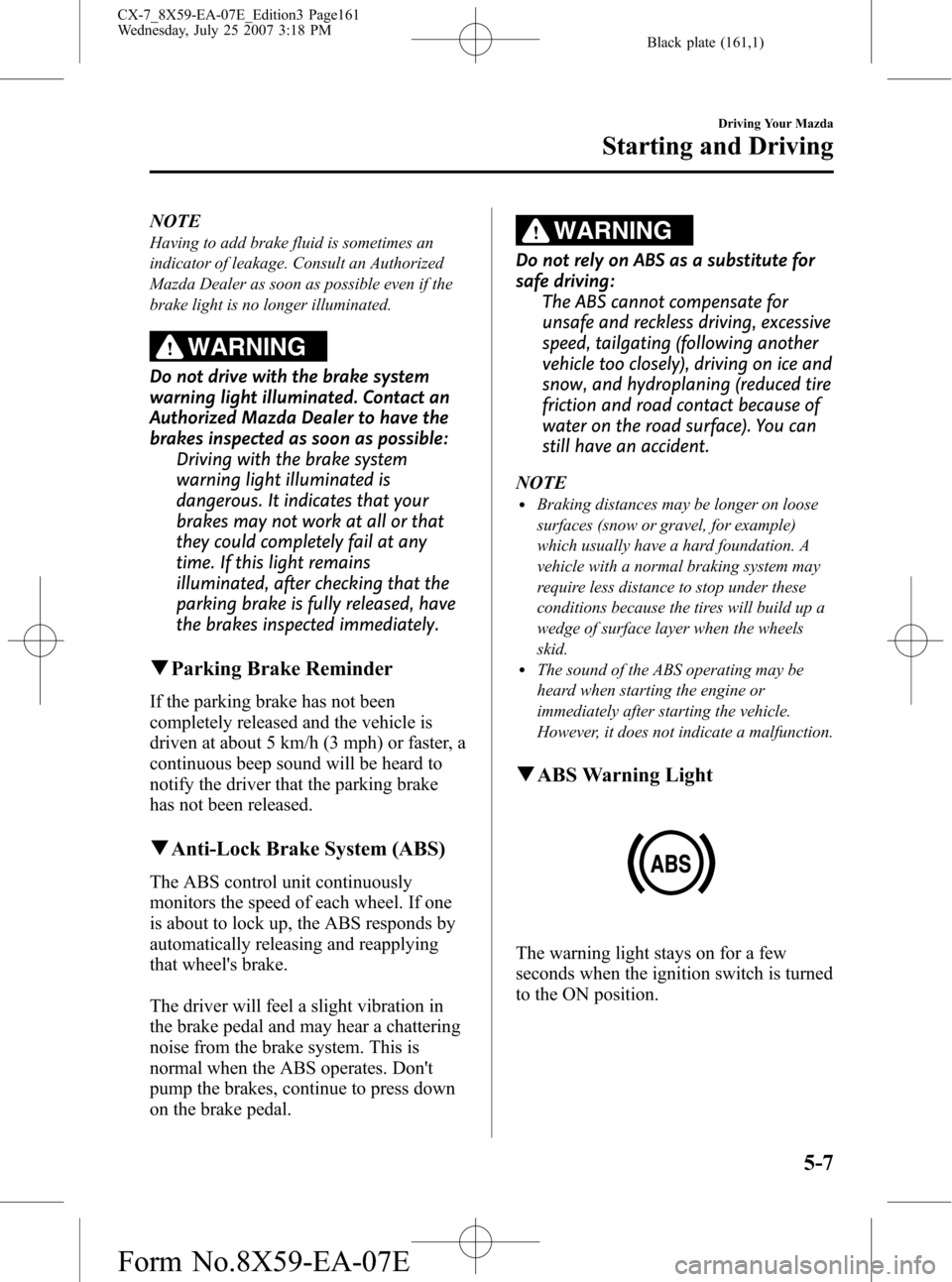
q ABS Warning Light
The warning light stays on for a few
seconds when the ignition switch is turned
to the ON position.
Driving Your Mazda
Starting and Driving
5-7
CX-7_8X59-EA-07E_Edition3 Page161
Wednesday, July 25 2007 3:18 PM
Form No.8X59-EA-07E
Page 168 of 502

Black plate (168,1)
Manually Shifting down
(M6→M5 →M4 →M3 →M2 →M1)
To shift down to a lower gear, tap the shift
lever forward (
) once.
WARNING
Do not use engine braking on slippery
road surfaces or at high speeds: Shifting down while driving on wet,
snowy, or frozen roads, or while
driving at high speeds causes sudden
engine braking, which is dangerous.
The sudden change in tire speed
could cause the tires to skid. This
could lead to loss of vehicle control
and an accident.
NOTE
lWhen driving at high speeds, the gear may
not shift down depending on vehicle speed.
lDuring deceleration, the gear may
automatically shift down depending on
vehicle speed.
lWhen depressing the accelerator fully, the
transaxle will shift to a lower gear,
depending on vehicle speed.
Second gear fixed mode
When the shift lever is tapped back (
)
while the vehicle is stopped, the transaxle
is set in the second gear fixed mode. The
gear is fixed in second while in this mode
for easier starting and driving on slippery
roads. If the shift lever is tapped back (
)
or forward (
) while in the second gear
fixed mode, the mode will be canceled.
Shifting specification
Shifting up
If the vehicle speed is lower than the
speed specified for each gear, the gear
cannot be shifted up to a higher gear.
Gear Vehicle speed
M1 →M2 You can shift up to M2 whether the
vehicle is stopped or moving.
M2 →M3 9 km/h (6 mph)
M3 →M4 26 km/h (16 mph)
M4 →M5 36 km/h (22 mph)
M5 →M6 53 km/h (33 mph)
Shifting down
If the vehicle speed is higher than the
speed specified for each gear, the gear
cannot be shifted down to a lower gear.
Gear Vehicle speed
M6 →M5 230 km/h (143 mph)
M5 →M4 182 km/h (113 mph)
M4 →M3 135 km/h (83 mph)
M3 →M2 86 km/h (53 mph)
M2 →M1 44 km/h (27 mph)
During deceleration, the gears shift down
automatically when speed is reduced to
the following:
Gear Vehicle speed
M6 →M5 52 km/h (32 mph)
M5 →M4 34 km/h (21 mph)
M4 →M3 25 km/h (15 mph)
M3 or M2 →M1 8 km/h (5 mph)
5-14
Driving Your Mazda
Starting and Driving
CX-7_8X59-EA-07E_Edition3 Page168
Wednesday, July 25 2007 3:18 PM
Form No.8X59-EA-07E
Page 172 of 502

Black plate (172,1)
WARNING
Never spin a wheel that is off the
ground:Spinning a wheel that is off the
ground as a result of the vehicle
being stuck or in a ditch is
dangerous. The drive assembly could
be seriously damaged which could
lead to an accident or could even
lead to overheating, oil leakage, and
a fire.
qTires and Tire Chains
The condition of the tires plays a large
role in the performance of the vehicle.
Moreover, to prevent adverse effects to
the drive assembly, please note the
following:
Tires
lWhen replacing tires, always replace
all front and rear tires at the same time.
lAll tires must be of the same size,
manufacture, brand and tread pattern.
Pay particular attention when
equipping snow or other types of
winter tires.
lDo not mix tread-worn tires with
normal tires.
lInspect tire inflation pressures at the
specified periods and adjust to the
specified pressures.
NOTE
Check the tire inflation pressure label attached
to driver's door frame for the correct tire
inflation pressure.
lMake sure to equip the vehicle with
genuine wheels of the specified size,
on all wheels. With AWD, the system
is calibrated for all four wheels being
of the same dimensions.
Tire chains
lInstall tire chains to the front tires.lDo not use tire chains on the rear
wheels.
lDo not drive the vehicle faster than 30
km/h (19 mph) with the tire chains
installed.
lDo not drive the vehicle with tire
chains on road conditions other than
snow or ice.
q Towing
If the vehicle requires towing, have it
towed with all four wheels completely off
the ground(page 7-18).
5-18
Driving Your Mazda
Starting and Driving
CX-7_8X59-EA-07E_Edition3 Page172
Wednesday, July 25 2007 3:18 PM
Form No.8X59-EA-07E
Page 176 of 502

Black plate (176,1)
lPress the CANCEL button.
The system is off when the ignition is off.
NOTE
Cruise control will cancel at about 15 km/h (9
mph) below the preset speed (such as may
happen when climbing a long, steep grade) or
below 30 km/h (19 mph).
Traction Control System
(TCS)
The Traction Control System (TCS)
enhances traction and safety by
controlling engine torque. When the TCS
detects driving wheel slippage, it lowers
engine torque to prevent loss of traction.
This means that on a slick surface, the
engine adjusts automatically to provide
optimum power to the drive wheels
without causing them to spin and lose
traction.
WARNING
Do not rely on the traction control
system as a substitute for safe driving:The traction control system (TCS)
cannot compensate for unsafe and
reckless driving, excessive speed,
tailgating (following another vehicle
too closely), and hydroplaning
(reduced tire friction and road
contact because of water on the road
surface). You can still have an
accident.
Use snow tires or tire chains on the
front wheels only and drive at reduced
speeds when roads are covered with ice
and/or snow: Driving without proper traction
devices on snow and/or ice-covered
roads is dangerous. The traction
control system (TCS) alone cannot
provide adequate traction and you
could still have an accident.
5-22
Driving Your Mazda
Starting and Driving
CX-7_8X59-EA-07E_Edition3 Page176
Wednesday, July 25 2007 3:18 PM
Form No.8X59-EA-07E
Page 180 of 502

Black plate (180,1)
CAUTION
ØThe DSC may not operate correctly
unless the following are observed:
ØUse tires of the correct size
specified for your Mazda on all
four wheels.
ØUse tires of the same
manufacturer, brand and tread
pattern on all four wheels.
ØDo not mix worn tires.
Ø The DSC may not operate correctly
when tire chains are used or a
temporary spare tire is installed
because the tire diameter changes.
qTCS/DSC Indicator Light
This indicator light stays on for a few
seconds when the ignition switch is turned
to the ON position. If the TCS or DSC is
operating, the indicator light flashes.
If the light stays on, the TCS or DSC may
have a malfunction and they may not
operate correctly. Take your vehicle to an
Authorized Mazda Dealer.
5-26
Driving Your Mazda
Starting and Driving
CX-7_8X59-EA-07E_Edition3 Page180
Wednesday, July 25 2007 3:18 PM
Form No.8X59-EA-07E
Page 181 of 502

Black plate (181,1)
Tire Pressure Monitoring Systemí
The tire pressure monitoring system (TPMS) monitors the pressure for each tire.
If tire pressure is too low in one or more tires, the system will inform the driver via the
warning light in the instrument panel and by the warning beep sound.
The tire pressure sensors installed on each wheel send tire pressure data by radio signal to
the receiver unit in the vehicle.
Tire pressure sensors
NOTE
When the ambient temperature is low due to seasonal changes, tire temperatures are also lower.
When the tire temperature decreases, the air pressure decreases as well. The TPMS warning light
may illuminate more frequently. Visually inspect the tires daily before driving, and check tire
pressures monthly with a tire pressure gauge. When checking tire pressures, use of a digital tire
pressure gauge is recommended.
TPMS does not alleviate your need to check the pressure and condition of all four tires
regularly.
Driving Your Mazda
Starting and Driving
5-27íSome models.
CX-7_8X59-EA-07E_Edition3 Page181
Wednesday, July 25 2007 3:18 PM
Form No.8X59-EA-07E
Page 182 of 502

Black plate (182,1)
CAUTION
ØEach tire, including the spare (if provided), should be checked monthly when cold
and inflated to the inflation pressure recommended by the vehicle manufacturer
on the vehicle placard or tire inflation pressure label. (If your vehicle has tires of a
different size than the size indicated on the vehicle placard or tire inflation
pressure label, you should determine the proper tire inflation pressure for those
tires.)
As an added safety feature, your vehicle has been equipped with a tire pressure
monitoring system (TPMS) that illuminates a low tire pressure telltale when one
or more of your tires is significantly under-inflated. Accordingly, when the low tire
pressure telltale illuminates, you should stop and check your tires as soon as
possible, and inflate them to the proper pressure. Driving on a significantly under-
inflated tire causes the tire to overheat and can lead to tire failure. Under-inflation
also reduces fuel efficiency and tire tread life, and may affect the vehicle's
handling and stopping ability.
Please note that the TPMS is not a substitute for proper tire maintenance, and it
is the driver's responsibility to maintain correct tire pressure, even if under-
inflation has not reached the level to trigger illumination of the TPMS low tire
pressure telltale.
Ø Your vehicle has also been equipped with a TPMS malfunction indicator to
indicate when the system is not operating properly.
The TPMS malfunction indicator is combined with the low tire pressure telltale.
When the system detects a malfunction, the telltale will flash for approximately
one minute and then remain continuously illuminated. This sequence will
continue upon subsequent vehicle start-ups as long as the malfunction exists.
When the malfunction indicator is illuminated, the system may not be able to
detect or signal low tire pressure as intended. TPMS malfunctions may occur for a
variety of reasons, including the installation of replacement or alternate tires or
wheels on the vehicle that prevent the TPMS from functioning properly. Always
check the TPMS malfunction telltale after replacing one or more tires or wheels on
your vehicle to ensure that the replacement or alternate tires and wheels allow
the TPMS to continue to function properly.
Ø To avoid false readings, the system samples for a little while before indicating a
problem. As a result it will not instantaneously register a rapid tire deflation or
blow out.
NOTE
This device complies with part 15 of the FCC Rules. Operation is subject to the following two
conditions: (1) This device may not cause harmful interference, and (2) this device must accept any
interference received, including interference that may cause undesired operation.
5-28
Driving Your Mazda
Starting and Driving
CX-7_8X59-EA-07E_Edition3 Page182
Wednesday, July 25 2007 3:18 PM
Form No.8X59-EA-07E
Page 183 of 502

Black plate (183,1)
qTire Pressure Monitoring System
Warning Light
This warning light illuminates for a few
seconds when the ignition switch is turned
to the ON position.
Thereafter, the warning light illuminates
and a beep is heard when tire pressure is
too low in one or more tires, and flashes
when there is a system malfunction.
WARNING
If the tire pressure monitoring system
warning light illuminates or flashes, or
the tire pressure warning beep sound is
heard, decrease vehicle speed
immediately and avoid sudden
maneuvering and braking:
If the tire pressure monitoring system
warning light illuminates or flashes,
or the tire pressure warning beep
sound is heard, it is dangerous to
drive the vehicle at high speeds, or
perform sudden maneuvering or
braking. Vehicle drivability could
worsen and result in an accident.
To determine if you have a slow leak
or a flat, pull over to a safe position
where you can check the visual
condition of the tire and determine if
you have enough air to proceed to a
place where air may be added and
the system monitored again, an
Authorized Mazda Dealer or a tire
repair station.
Do not ignore the TPMS Warning Light: Ignoring the TPMS warning light is
dangerous, even if you know why it is
illuminated. Have the problem taken
care of as soon as possible before it
develops into a more serious
situation that could lead to tire
failure and a dangerous accident.
Warning light illuminates/Warning
beep sounds
When the warning light illuminates, and
the warning beep sound is heard (about 3
seconds), tire pressure is too low in one or
more tires.
Driving Your Mazda
Starting and Driving
5-29
CX-7_8X59-EA-07E_Edition3 Page183
Wednesday, July 25 2007 3:18 PM
Form No.8X59-EA-07E
Page 184 of 502

Black plate (184,1)
Adjust the tire pressure to the correct tire
pressure. Refer to the specification charts
(page 10-6).
CAUTION
When replacing/repairing the tires or
wheels or both, have the work done
by an Authorized Mazda Dealer, or
the tire pressure sensors may be
damaged.NOTE
lPerform tire pressure adjustment when the
tires are cold. Tire pressure will vary
according to the tire temperature, therefore
let the vehicle stand for 1 hour or only drive
it 1.6 km (1 mile) or less before adjusting
the tire pressures. When pressure is
adjusted on hot tires to the cold inflation
pressure, the TPMS warning light/beep may
turn on after the tires cool and pressure
drops below specification.
Also, an illuminated TPMS warning light,
resulting from the tire air pressure dropping
due to cold ambient temperature, may go
out if the ambient temperature rises. In this
case, it will also be necessary to adjust the
tire air pressures. If the TPMS warning
light illuminates due to a drop in tire air
pressure, make sure to check and adjust the
tire air pressures.
lAfter adjusting the tire air pressures, it may
require some time for the TPMS warning
light to go out. If the TPMS warning light
remains illuminated, drive the vehicle at a
speed of at least 25 km/h (16 mph) for 10
minutes, and then verify that it goes out.
lTires can loose a little air quite naturally
over time and the TPMS cannot tell if the
tires are getting too soft over time or you
have a flat. However, when you find one
low tire in a set of four - that is an
indication of trouble; you should have
someone drive the vehicle slowly forward
so you can inspect any low tire for cuts and
any metal sticking through tread or
sidewall. Put a few drops of water in the
valve stem to see if it bubbles indicating a
bad valve. Leaks need to be addressed by
more than simply refilling the trouble tire as
leaks are dangerous - take it to an
Authorized Mazda Dealer which has all the
equipment to fix tires, TPMS systems and
order the best replacement tire for your
vehicle.
5-30
Driving Your Mazda
Starting and Driving
CX-7_8X59-EA-07E_Edition3 Page184
Wednesday, July 25 2007 3:18 PM
Form No.8X59-EA-07E
Page 185 of 502

Black plate (185,1)
If the warning light illuminates again even
after the tire pressures are adjusted, there
may be a tire puncture. Replace the
punctured tire with the temporary spare
tire (page 7-6).
NOTE
A tire pressure sensor is not installed to the
temporary spare tire. The warning light will
flash continuously while the temporary spare
tire is being used.
Warning light flashes
When the warning light flashes, there may
be a system malfunction. Consult an
Authorized Mazda Dealer.
qSystem Error Activation
When the TPMS warning light flashes,
there may be a system malfunction.
Consult an Authorized Mazda Dealer.
A system error activation may occur in
the following cases:
lWhen there is equipment or a device
near the vehicle using the same radio
frequency as that of the tire pressure
sensors.
lWhen using the following devices in
the vehicle that may cause radio
interference with the receiver unit.
lA digital device such as a personal
computer.
lA current converter device such as a
DC-AC converter.
lWhen excess snow or ice adheres to
the vehicle, especially around the
wheels.
lWhen the tire pressure sensor batteries
are exhausted.
lWhen using a wheel with no tire
pressure sensor installed.
lWhen using tires with steel wire
reinforcement in the side walls.
lWhen using tire chains.
qTires and Wheels
CAUTION
When inspecting or adjusting the tire
air pressures, do not apply excessive
force to the stem part of the wheel
unit. The stem part could be
damaged.
Changing tires and wheels
The following procedure allows the
TPMS to recognize a tire pressure sensor's
unique ID signal code whenever tires or
wheels are changed, such as changing to
and from winter tires.
NOTE
Each tire pressure sensor has a unique ID
signal code. The signal code must be
registered with the TPMS before it can work.
The easiest way to do it is to have an
Authorized Mazda Dealer change your tire and
complete ID signal code registration.
When having tires changed at an
Authorized Mazda Dealer
Tire pressure sensor ID signal code
registration is completed when an
Authorized Mazda Dealer changes your
vehicle's tires.
When changing tires yourself
If you or someone else changes tires, you
or someone else can also undertake the
steps for the TPMS to complete the ID
signal code registration.
1. After tires have been changed, turn the
ignition switch to the ON position, then
turn it back to the ACC or LOCK
position.
2. Wait for about 15 minutes.
Driving Your Mazda
Starting and Driving
5-31
CX-7_8X59-EA-07E_Edition3 Page185
Wednesday, July 25 2007 3:18 PM
Form No.8X59-EA-07E