wheel MAZDA MODEL CX-9 2015 (in English) Owner's Manual
[x] Cancel search | Manufacturer: MAZDA, Model Year: 2015, Model line: MODEL CX-9, Model: MAZDA MODEL CX-9 2015Pages: 604, PDF Size: 9.15 MB
Page 169 of 604
Black plate (169,1)
Driving on Uneven Road
Your vehicle's suspension and underbody can be damaged if driven on rough/uneven roads
or over speed bumps at excessive speeds. Use care and reduce speed when traveling on
rough/uneven roads or over speed bumps.
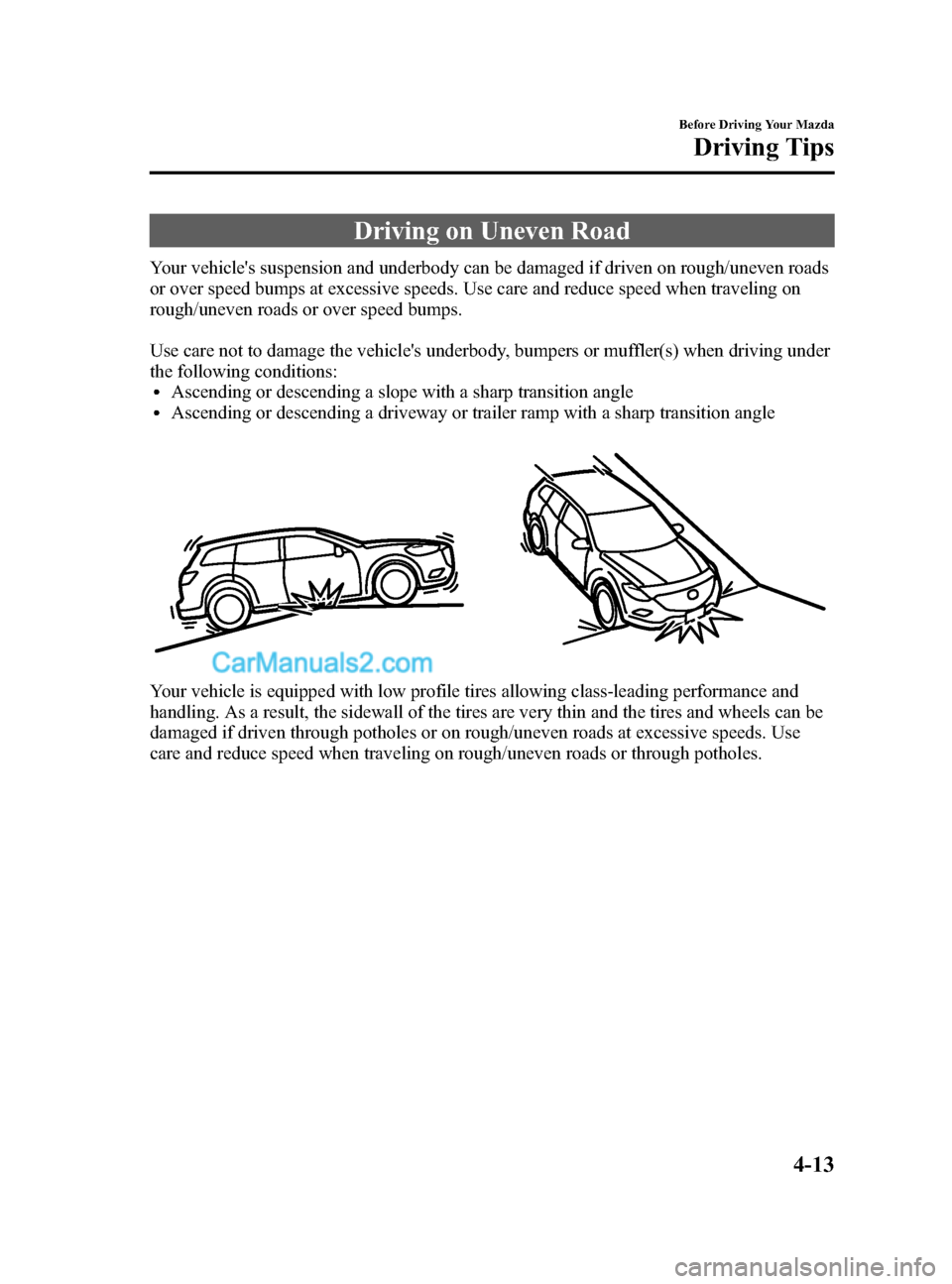
Use care not to damage the vehicle's underbody, bumpers or muffler(s) when driving under
the following conditions:
lAscending or descending a slope with a sharp transition anglelAscending or descending a driveway or trailer ramp with a sharp transition angle
Your vehicle is equipped with low profile tires allowing class-leading performance and
handling. As a result, the sidewall of the tires are very thin and the tires and wheels can be
damaged if driven through potholes or on rough/uneven roads at excessive speeds. Use
care and reduce speed when traveling on rough/uneven roads or through potholes.
Before Driving Your Mazda
Driving Tips
4-13
CX-9_8DU1-EA-14H_Edition1 Page169
Thursday, June 5 2014 4:17 PM
Form No.8DU1-EA-14H
Page 170 of 604
Black plate (170,1)
Trailer Towing (U.S.A. and Canada)
Your Mazda was designed and built primarily to carry passengers and cargo.
If you tow a trailer, follow these instructions because driver and passenger safety depends
on proper equipment and safe driving habits. Towing a trailer will affect handling, braking,
durability, performance, and economy.
Never overload vehicle or trailer. Consult an Authorized Mazda Dealer if you need further
details.
CAUTION
Do not tow a trailer during the first 1,000 km (600 miles) of your new Mazda. If you
do, you may damage the engine, transaxle, differential, wheel bearings, and other
power train components.
qWeight Limits
TTW and GCWR
The total trailer weight (TTW), gross combination weight rating (GCWR), gross axle
weight rating (GAWR), trailer load, and trailer tongue load must be within the
prescribed limits.
lThe total trailer weight (TTW) is the sum of the weights of the trailer load (trailer
weight plus cargo), trailer hitch, vehicle passengers, and vehicle load. Never allow
the total trailer weight (TTW) to exceed specifications in the Trailer Towing-Load
Table.
lThe maximum GCWR is the combination weight of the trailer and load plus the
towing vehicle (including trailer hitch, vehicle passengers, and load). It must not
exceed specifications in the load table.
GAWR and GVWR
Do not exceed front and rear GAWR (gross axle weight rating) and GVWR (gross vehicle
weight rating). If you do, vehicle handling, braking, and performance will be affected.
These values are also on the Motor Vehicle Safety Certification Label posted on the driver's
door frame.
High-altitude operation
In a high-altitude operating environment, a gasoline engine loses power at a rate of 3 % to
4 % per 304 m (1,000 ft) of elevation. In these conditions, a reduction in gross vehicle
weight and gross combination weight is recommended.
4-14
Before Driving Your Mazda
Towing
CX-9_8DU1-EA-14H_Edition1 Page170
Thursday, June 5 2014 4:17 PM
Form No.8DU1-EA-14H
Page 175 of 604
Black plate (175,1)
The three main causes of vehicle-trailer accidents are driver error, excessive speed, and
improper trailer loading.
Before driving
lHave your cooling and braking system checked by an Authorized Mazda Dealer.lBefore starting out, inspect the operation of all vehicle and trailer lights and all vehicle-
to-trailer connections. Stop and re-inspect all lights and connections after driving a short
distance.
Driving
lYour Mazda will handle differently with a trailer in tow, so practice turning, backing,
and stopping in a traffic-free area.
lTake time to get accustomed to the extra weight and length.lAllow more room between your vehicle and the one in front because braking distance
increases with a trailer. For each 16 km/h (10 mph) of speed, allow at least one vehicle
and trailer length between your Mazda and the vehicle ahead.
lAvoid jerky starts or sudden acceleration.lAvoid sudden braking. It may cause loss of control and result in jackknifing, especially
so on wet or slippery roads.
lShift the shift lever to the D position when towing a trailer in hilly terrain or when
heavily loaded.
The D position will allow operating the vehicle without frequent shifting.
Lane changes and turning
Avoid quick lane changes, sudden turns, and tight turns. Slow down before turning to
avoid the need of sudden braking.
A turning trailer will make a tighter arc than the tow vehicle. Compensate with turns that
are larger than normal.
Passing
Plan well ahead to pass other vehicles, and provide plenty of room before changing lanes.
Crosswinds from passing vehicles, especially larger ones, and the effects of rough roads
will affect handling.
If swaying occurs, firmly grip the steering wheel and reduce speed immediately, but
gradually.
Steer straight ahead. If no extreme correction of steering or braking is made, the
combination of less speed and firm steering will result in stability.
Backing up
Backing a vehicle with a trailer requires practice and patience. Back slowly, and have a
helper outside at the rear of the trailer to reduce the risk of an accident.
To turn the trailer, place your hand at the bottom of the steering wheel and turn it in the
direction you want the trailer to go. Make only slight movements to prevent sharp or
prolonged turning.
Before Driving Your Mazda
Towing
4-19
CX-9_8DU1-EA-14H_Edition1 Page175
Thursday, June 5 2014 4:17 PM
Form No.8DU1-EA-14H
Page 176 of 604
Black plate (176,1)
Ascending a hill
Shift into a lower gear to reduce the possibility of overloading or overheating the engine, or
both.
Descending a hill
Shift into a lower gear and use engine compression as a braking effect.
WARNING
Always use lower gears to reduce speed:Holding the brake pedal down too long or too frequently is dangerous as it could
cause the brakes to overheat and lose power, resulting in loss of control and a
serious accident. Use lower gears to help reduce speed. Pull off the road and allow
brakes to cool down whenever braking performance feels reduced.
Overheated engine
The extra weight of the trailer may strain the engine on hot days and on long or steep
upgrades.
If the temperature gauge indicates overheating, turn off the air conditioner, drive safely to
the side of the road, park off the right-of-way and wait for engine to cool. Refer to
Overheating (page 7-16).
Parking
Always make sure the tires of the trailer and the tow vehicle are blocked while parked.
Apply the parking brake firmly and put the transaxle in P.
Avoid parking on an incline, but if you must, follow these instructions:
1. Depress and hold down the brake pedal.
2. Have a helper put wheel blocks against the downhill side of all vehicle and trailer tires.
3. Then release the brake pedal slowly until the blocks bear the load.
lIf the grade is downhill, turn the steering wheel so that the front of the front tires face
the curb.
lIf it is uphill, face the rear of the front tires against the curb.
4. Firmly apply the parking brake.
5. Shift the transaxle into P, and stop the engine.
To restart after parking on an incline:
1. With the transaxle in P, start the engine. (Be sure to depress and hold the brake pedal.)
2. Shift into gear.
4-20
Before Driving Your Mazda
Towing
CX-9_8DU1-EA-14H_Edition1 Page176
Thursday, June 5 2014 4:17 PM
Form No.8DU1-EA-14H
Page 177 of 604
Black plate (177,1)
3. Release the parking brake (also the foot brake) and pull away from the wheel blocks.Stop; apply the parking brake and shift into P.
4. Have a helper retrieve the wheel blocks.
Fuel consumption
Trailer towing causes higher fuel consumption.
Maintenance
If you tow a trailer frequently, have your vehicle serviced as shown in Scheduled
Maintenance (page 8-4).
Before Driving Your Mazda
Towing
4-21
CX-9_8DU1-EA-14H_Edition1 Page177
Thursday, June 5 2014 4:17 PM
Form No.8DU1-EA-14H
Page 179 of 604
Black plate (179,1)
5Driving Your Mazda
Explanation of instruments and controls.
Starting and Driving ..................................................................... 5-2Ignition Switch .......................................................................... 5-2
Starting the Engine .................................................................... 5-4
Turning the Engine Off ............................................................. 5-5
Brake System ............................................................................ 5-5
Automatic Transaxle Controls ................................................. 5-11
Power Steering ........................................................................ 5-18
All-Wheel Drive (AWD) Operation
í..................................... 5-18
Cruise Control ......................................................................... 5-21
Traction Control System (TCS) .............................................. 5-24
Dynamic Stability Control (DSC)/Roll Stability Control
(RSC) ...................................................................................... 5-27
Tire Pressure Monitoring System
í......................................... 5-29
Blind Spot Monitoring (BSM) Systemí................................. 5-35
Parking Sensor System ........................................................... 5-46
Instrument Cluster and Indicators ............................................ 5-52 Meters and Gauges .................................................................. 5-52
Warning/Indicator Lights and Beep Sounds ............................ 5-56 Warning/Indicator Lights ........................................................ 5-56
Beep Sounds ........................................................................... 5-70
Switches and Controls ................................................................ 5-72 Lighting Control ..................................................................... 5-72
Turn and Lane-Change Signals ............................................... 5-78
Fog Lights
í............................................................................ 5-79
Windshield Wipers and Washer .............................................. 5-80
Rear Window Wiper and Washer ............................................ 5-84
Rear Window Defogger .......................................................... 5-85
Horn ........................................................................................ 5-86
Hazard Warning Flasher .......................................................... 5-87
HomeLink Wireless Control System
í.................................... 5-88
5-1íSome models.
CX-9_8DU1-EA-14H_Edition1 Page179
Thursday, June 5 2014 4:17 PM
Form No.8DU1-EA-14H
Page 186 of 604

Black plate (186,1)
qBrake System Warning Light
This warning has the following functions:
Parking brake warning/Warning light
inspection
The light illuminates when the parking
brake is applied with the ignition switched
to START or ON. It turns off when the
parking brake is fully released.
Low brake fluid level warning
If the brake warning light remains
illuminated even though the parking brake
is released, the brake fluid may be low or
there could be a problem with the brake
system. Park the vehicle in a safe place
immediately and contact an Authorized
Mazda Dealer.
WARNING
Do not drive with the brake system
warning light illuminated. Contact an
Authorized Mazda Dealer to have the
brakes inspected as soon as possible:
Driving with the brake system
warning light illuminated is
dangerous. It indicates that your
brakes may not work at all or that
they could completely fail at any
time. If this light remains
illuminated, after checking that the
parking brake is fully released, have
the brakes inspected immediately.
CAUTION
In addition, the effectiveness of the
braking may diminish so you may
need to depress the brake pedal more
strongly than normal to stop the
vehicle.
qParking Brake Reminder
If the parking brake has not been
completely released and the vehicle is
driven at about 5 km/h (3 mph) or faster, a
continuous beep sound will be heard to
notify the driver that the parking brake
has not been released.
qAnti-Lock Brake System (ABS)
The ABS control unit continuously
monitors the speed of each wheel. If one
wheel is about to lock up, the ABS
responds by automatically releasing and
reapplying that wheel's brake.
The driver will feel a slight vibration in
the brake pedal and may hear a chattering
noise from the brake system. This is
normal ABS system operation. Continue
to depress the brake pedal without
pumping the brakes.
WARNING
Do not rely on ABS or RSC as a
substitute for safe driving:
The ABS and RSC cannot compensate
for unsafe and reckless driving,
excessive speed, tailgating (following
another vehicle too closely), driving
on ice and snow, and hydroplaning
(reduced tire friction and road
contact because of water on the road
surface). You can still have an
accident.
5-8
Driving Your Mazda
Starting and Driving
CX-9_8DU1-EA-14H_Edition1 Page186
Thursday, June 5 2014 4:18 PM
Form No.8DU1-EA-14H
Page 187 of 604
Black plate (187,1)
NOTElBraking distances may be longer on loose
surfaces (snow or gravel, for example)
which usually have a hard foundation. A
vehicle with a normal braking system may
require less distance to stop under these
conditions because the tires will build up a
wedge of surface layer when the wheels
skid.
lThe sound of the ABS operating may be
heard when starting the engine or
immediately after starting the vehicle,
however, it does not indicate a malfunction.
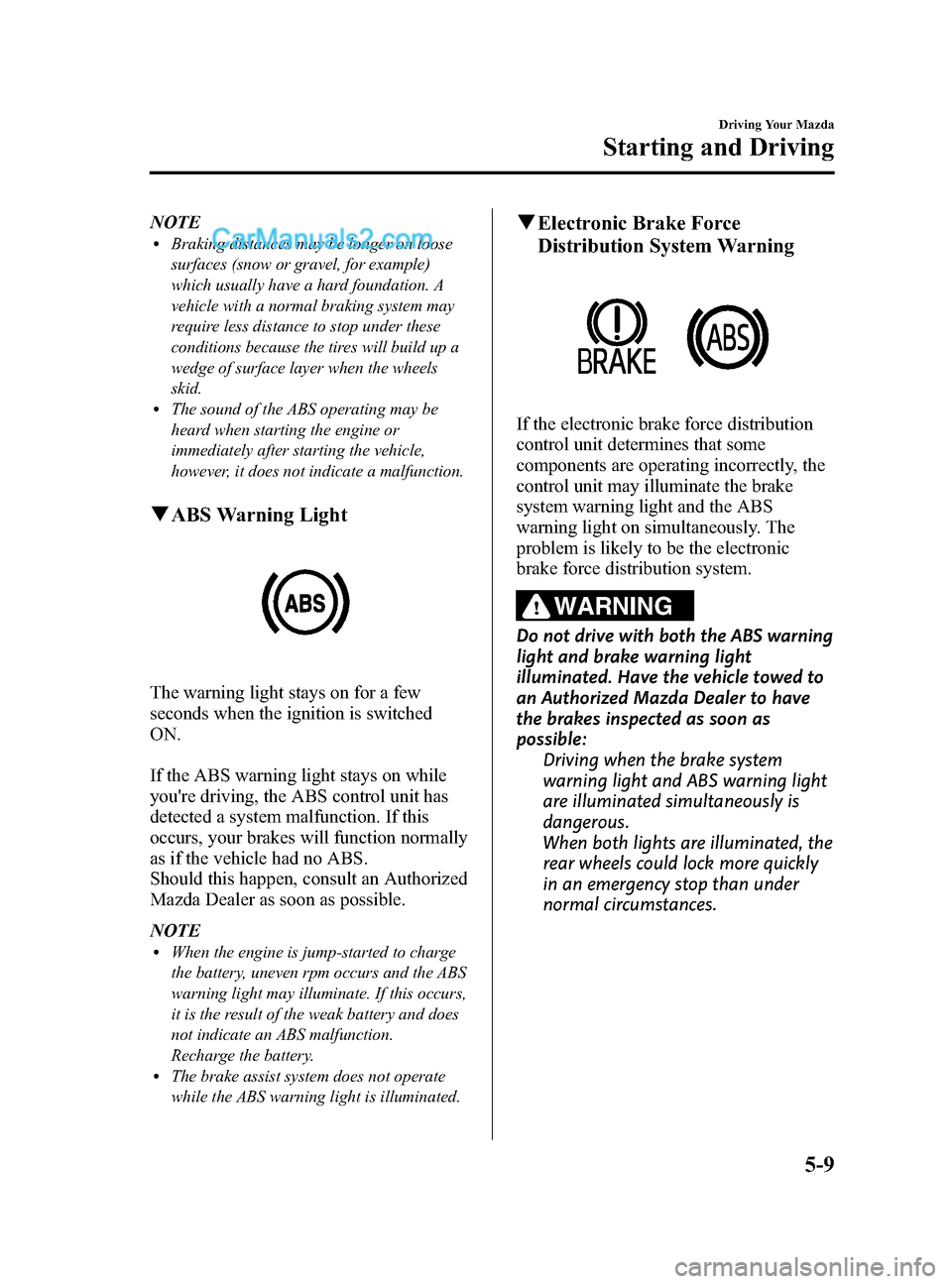
qABS Warning Light
The warning light stays on for a few
seconds when the ignition is switched
ON.
If the ABS warning light stays on while
you're driving, the ABS control unit has
detected a system malfunction. If this
occurs, your brakes will function normally
as if the vehicle had no ABS.
Should this happen, consult an Authorized
Mazda Dealer as soon as possible.
NOTE
lWhen the engine is jump-started to charge
the battery, uneven rpm occurs and the ABS
warning light may illuminate. If this occurs,
it is the result of the weak battery and does
not indicate an ABS malfunction.
Recharge the battery.
lThe brake assist system does not operate
while the ABS warning light is illuminated.
qElectronic Brake Force
Distribution System Warning
If the electronic brake force distribution
control unit determines that some
components are operating incorrectly, the
control unit may illuminate the brake
system warning light and the ABS
warning light on simultaneously. The
problem is likely to be the electronic
brake force distribution system.
WARNING
Do not drive with both the ABS warning
light and brake warning light
illuminated. Have the vehicle towed to
an Authorized Mazda Dealer to have
the brakes inspected as soon as
possible:
Driving when the brake system
warning light and ABS warning light
are illuminated simultaneously is
dangerous.
When both lights are illuminated, the
rear wheels could lock more quickly
in an emergency stop than under
normal circumstances.
Driving Your Mazda
Starting and Driving
5-9
CX-9_8DU1-EA-14H_Edition1 Page187
Thursday, June 5 2014 4:18 PM
Form No.8DU1-EA-14H
Page 190 of 604

Black plate (190,1)
qTransaxle Ranges
The shift lever must be in P or N to
operate the starter.
P (Park)
P locks the transaxle and prevents the
front wheels from rotating.
WARNING
Always set the shift lever to P and set
the parking brake:
Only setting the shift lever to the P
position without using the parking
brake to hold the vehicle is
dangerous. If P fails to hold, the
vehicle could move and cause an
accident.
CAUTION
ØShifting into P, N or R while the
vehicle is moving can damage
your transaxle.
Ø Shifting into a driving gear or
reverse when the engine is running
faster than idle can damage the
transaxle.
R (Reverse)
In position R, the vehicle moves only
backward. You must be at a complete stop
before shifting to or from R, except under
rare circumstances as explained in
Rocking the Vehicle (page 4-9).
N (Neutral)
In N, the wheels and transaxle are not
locked. The vehicle will roll freely even
on the slightest incline unless the parking
brake or brakes are on.
WARNING
If the engine is running faster than idle,
do not shift from N or P into a driving
gear:
It's dangerous to shift from N or P
into a driving gear when the engine
is running faster than idle. If this is
done, the vehicle could move
suddenly, causing an accident or
serious injury.
Do not shift into N when driving the
vehicle: Shifting into N while driving is
dangerous. Engine braking cannot be
applied when decelerating which
could lead to an accident or serious
injury.
CAUTION
Do not shift into N when driving the
vehicle. Doing so can cause transaxle
damage.
NOTE
Apply the parking brake or depress the brake
pedal before moving the shift lever from N to
prevent the vehicle from moving unexpectedly.
D (Drive)
D is the normal driving position. From a
stop, the transaxle will automatically shift
through a 6-gear sequence.
M (Manual)
M is the manual shift mode position.
Gears can be shifted up or down by
operating the shift lever.
Refer to Manual Shift Mode (page 5-13).
5-12
Driving Your Mazda
Starting and Driving
CX-9_8DU1-EA-14H_Edition1 Page190
Thursday, June 5 2014 4:18 PM
Form No.8DU1-EA-14H
Page 191 of 604

Black plate (191,1)
qActive Adaptive Shift (AAS)
Active Adaptive Shift (AAS)
automatically controls the transaxle shift
points to best suit the road conditions and
driver input. This improves driving feel.
If the driver accelerates rapidly, or
accelerates and decelerates rapidly by
operating the accelerator and brake pedal
for a certain period of time while the shift
lever is in the D position, AAS mode
could activate.
When cornering the vehicle, AAS mode
will hold the transaxle in the gear the
vehicle was in before entering the curve,
allowing the vehicle to be accelerated
from the same gear after exiting the curve.
AAS mode will maintain the transaxle in
the optimum gear and the driver may
sense that the transaxle is not shifting,
however this does not indicate an
abnormality.
qShift-Lock System
The shift-lock system prevents shifting
out of P unless the brake pedal is
depressed.
To shift from P:
1. Depress and hold the brake pedal.
2. Start the engine.
3. Move the shift lever.
NOTE
lWhen the ignition is switched off, the shift
lever cannot be shifted from P.
lTo be sure the vehicle is in park, the
ignition key cannot be removed unless the
shift lever is in P.
l(With Advanced Key)
The ignition cannot be switched from ACC
to OFF when the shift lever is not in P.
q Manual Shift Mode
This mode gives you the feel of driving a
manual transaxle vehicle by operating the
shift lever and allows you to control
engine rpm and torque to the drive wheels
much like a manual transaxle when more
control is desired.
To change to manual shift mode, shift the
lever from D to M.
NOTE
Changing to manual shift mode while driving
will not damage the transaxle.
To return to automatic shift mode, shift
the lever from M to D.
NOTE
lIf you change to manual shift mode when
the vehicle is stopped, the gear will shift to
M1.
lIf you change to manual shift mode without
depressing the accelerator pedal when
driving in D range, 5th gear, the gear will
shift to M4.
lIf you change to manual shift mode without
depressing the accelerator pedal when
driving in D range, 6th gear, the gear will
shift to M5.
Driving Your Mazda
Starting and Driving
5-13
CX-9_8DU1-EA-14H_Edition1 Page191
Thursday, June 5 2014 4:18 PM
Form No.8DU1-EA-14H