air condition MAZDA MODEL CX-9 2019 Owners Manual (in English)
[x] Cancel search | Manufacturer: MAZDA, Model Year: 2019, Model line: MODEL CX-9, Model: MAZDA MODEL CX-9 2019Pages: 692
Page 3 of 692

Thank you for choosing a Mazda. We at Mazda design and build vehicles with complete
customer satisfaction in mind.
To help ensure enjoyable and trouble-free operation of your Mazda, read this manual
carefully and follow its recommendations.
An Authorized Mazda Dealer knows your vehicle best. So when mai ntenance or service is
necessary, that's the place to go.
Our nationwide network of Mazda professionals is dedicated to p roviding you with the best
possible service.
We assure you that all of us at Mazda have an ongoing interest in your motoring pleasure
and in your full satisfaction with your Mazda product.
Mazda Motor Corporation
HIROSHIMA, JAPAN
Important Notes About This Manual
Keep this manual in the glove com partment as a handy reference for the safe and enjoyable use of your Mazda.
Should you resell the vehicle, leave this manual with it for th e next owner.
All specifications and descriptio ns are accurate at the time of printing. Because improvement is a constant goal
at Mazda, we reserve the right to make changes in specifications at any time without notice and without obliga‐
tion.
Air Conditioner and the Environment
Your Mazda's genuine air condit ioner is filled with a refrigerant that has been found not to damage the earth's
ozone layer. If the air conditione r does not operate properly, consult an Authorized Mazda Dealer.
Perchlorate
Certain components of this vehicle such as [air bag modules, se at belt pretensioners, lithium batteries,…] may
contain Perchlorate Material-- Special handling may apply for s ervice or vehicle end of life disposal. See
www.dtsc.ca.gov/hazardouswaste/perchlorate.
Please be aware that this manual applies to all models, equipme nt and options. As a result, you may find
some explanations for equipment not installed on your vehicle.
©2018 Mazda Motor CorporationJuly 2018 (Print1)
A Word to Mazda Owners
CX-9_8HB2-EA-18G_Edition1 2018-5-11 13:09:27
Page 5 of 692
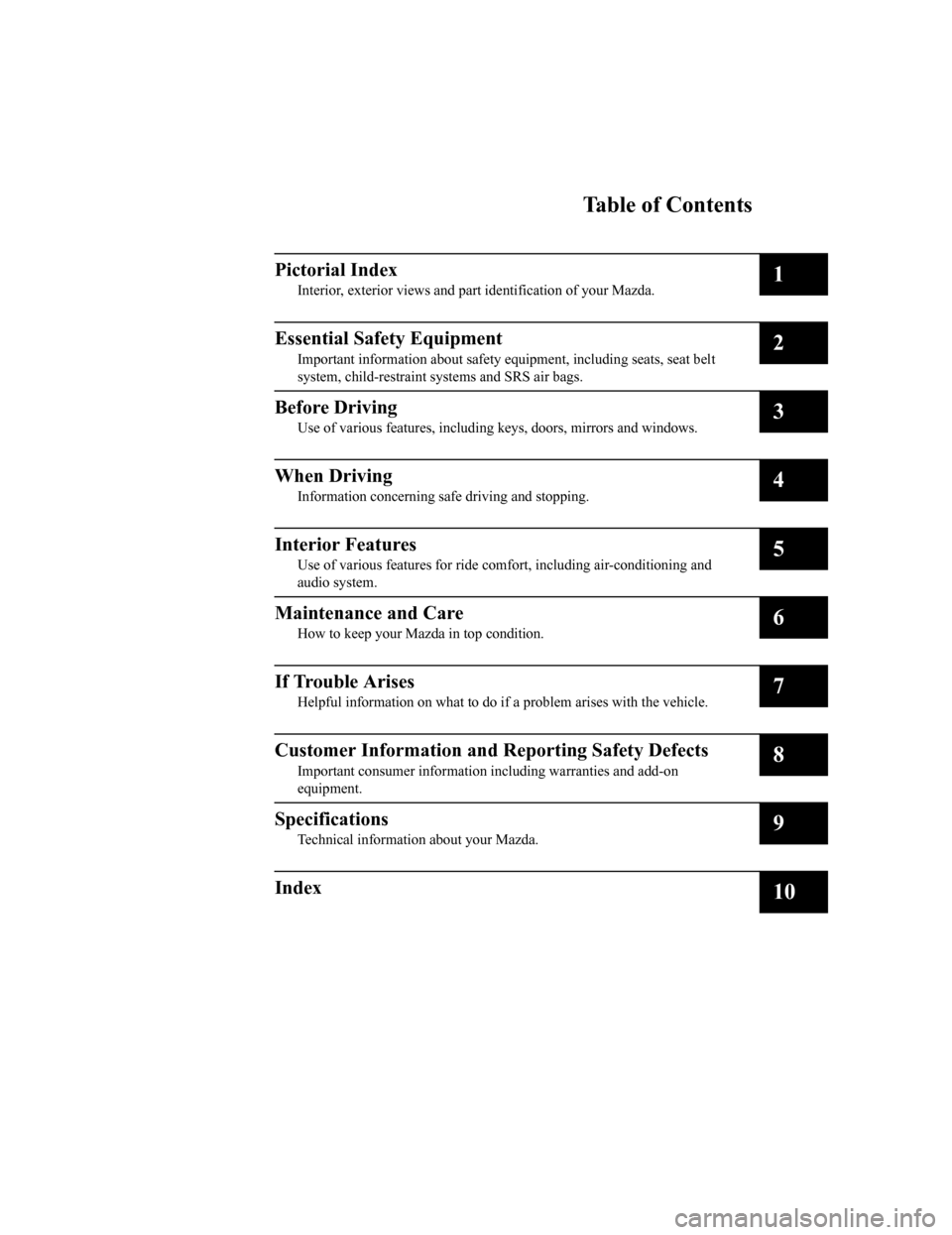
Table of Contents
Pictorial Index
Interior, exterior views and part identification of your Mazda.1
Essential Safety Equipment
Important information about safet y equipment, including seats, seat belt
system, child-restraint systems and SRS air bags.2
Before Driving
Use of various featur es, including keys, doors, mirrors and windows.3
When Driving
Information concerning s afe driving and stopping.4
Interior Features
Use of various features for ride comfort, including air-conditi oning and
audio system.5
Maintenance and Care
How to keep your Maz da in top condition.6
If Trouble Arises
Helpful information on what to do if a problem arises with the vehicle.7
Customer Information and Reporting Safety Defects
Important consumer information including warranties and add-on
equipment.8
Specifications
Technical informati on about your Mazda.9
Index10
CX-9_8HB2-EA-18G_Edition1 2018-5-11 13:09:27
Page 45 of 692

Front Seat Belt
Pretensioner and Load Limiting Systems
For optimum protecti on, the driver and
front passenger seat belts are equipped
with pretensioner and load limiting
systems. For both these systems to work
properly you must wear the seat belt
properly.
Pretensioners:
When a collision is detected, the
pretensioners deploy simultaneously with
the air bags.
For vehicles with the front passenger
occupant classification system, the
pretensioners deploy simultaneously with
the air bags when a roll-over is also
detected.
For deployment details, refer to the SRS
Air Bag Deployment Criteria (page
2-75).
The front seat belt retractors remove slack
quickly as the air bags are expanding. Any
time the air bags and seat belt
pretensioners have fired they must be
replaced.
A system malfunction or operation
conditions are indicated by a warning.
Refer to Taking Action on page 7-37.
Refer to Air Bag/Front Seat Belt
Pretensioner System Warning Beep on
page 7-46.
(With Front Passenger Occupant
Classification System)
In addition, the pretensioner system for the
front passenger, like the front and side
passenger air bag, is designed to only
deploy when the front passenger occupant
classification sensor detects a passenger
sitting on the front passenger's seat.
For details, refer t o the front passenger
occupant classification sensor (page
2-78).
Load limiter:
The load limiti ng system releases belt
webbing in a controlled manner to reduce
belt force on the occupant's chest. While
the most severe load on a seat belt occurs
in frontal collisions, the load limiter has an
automatic mechanical function and can
activate in any accident mode with
sufficient occupant movement.
Even if the pretensioners have not fired,
the load limiting func tion must be checked
by an Authorized Mazda Dealer.
WA R N I N G
Wear seat belts only as recommended in
this owner's manual:
Incorrect positioning of the driver and front
passenger seat belts is dangerous. Without
proper positioning, the pretensioner and
load limiting systems cannot provide
adequate protection in an accident and
this could result in serious injury. For more
details about wearing seat belts, refer to
"Fastening the seat belts" (page 2-31).
Essential Safety Equipment
Seat Belt Systems
2-33
CX-9_8HB2-EA-18G_Edition1 2018-5-11 13:09:27
Page 48 of 692

Do not leave a seat belt extender
connected to the buckle:
Leaving a seat belt extender connected to
the buckle without using the seat belt is
dangerous. When the seat belt extender is
connected to the driver's seat belt buckle
(or front passenger's seat belt buckle), the
SRS driver's (or front passenger's) air bag
system will determine that the driver (or
front passenger) is wearing the seat belt
even if the driver (or front passenger) is not
wearing it. This condition could cause the
driver's (or front passenger's) air bag to not
activate correctly and result in death or
serious injury in the event of collision.
Always wear the seat belt with the seat belt
extender.
Do not use the seat belt extender when
installing a child-restraint system on the
front or rear passenger seat:
Using a seat belt extender to fasten a
child-restraint system on any seat is
dangerous. Always follow the
child-restraint system manufacturer's
installation instructions and never use a
seat belt extender.
NOTE
When not in use, remove the seat belt
extender and store it in the vehicle. If the
seat belt extender is left connected, the
seat belt extender might get damaged as it
will not retract with the rest of the seat belt
and can easily fall out of the door when
not in use and be damaged. In addition,
the seat belt warning light will not
illuminate and function properly.
Essential Safety Equipment
Seat Belt Systems
2-36
CX-9_8HB2-EA-18G_Edition1 2018-5-11 13:09:27
Page 52 of 692

Seating a child in a child-restraint system on the front passenger seat is dangerous under
certain conditions (With Front Passenger Occupant Classification System):
Your vehicle is equipped with front passenger occupant classification sensor. Even with the
front passenger occupant classification sensor, if you must use the front passenger seat to
seat a child, using a child-restraint system on the front passenger seat under the following
conditions increases the danger of the front passenger air bag deploying and could result in
serious injury or death to the child.
The front passenger air bag deactivation indica tor light does not illuminate when seating a
child in the child-restraint system.
Luggage or other items are placed on the seat with the child in the child-restraint system.
A rear passenger or luggage pushing or pulling down on the front passenger seatback.
Luggage or other items are placed on the seatback or hung on the head restraint.
The seat is washed.
Liquids are spilled on the seat.
The front passenger seat is moved backward, pushing into luggage or other items placed
behind it.
The front passenger seatback contacts the rear seat.
Luggage or other items are placed between the front passenger seat and driver seat.
An electric device is put on the front passenger's seat.
An additional electrical device, such as a seat warmer is installed to the surface of the front
passenger seat.
The designated positions with seat belts on the rear seats are the safest places for children.
Always use seat belts and child restraints.
Do not allow a child or anyone to lean over or against the side window of a vehicle with side
and curtain air bags:
It is dangerous to allow anyone to lean over or against the side window, the area of the front
passenger seat, the front and rear window pilla rs and the roof edge along both sides from
which the side and curtain air bags deploy, even if a child-restraint system is used. The impact
of inflation from a side or curtain air bag could ca
use serious injury or death to an out of
position child. Furthermore, leaning over or against the front door could block the side and
curtain air bags and eliminate the advantages of supplemental protecti on. With the front air
bag and the additional side air bag that comes out of the front seat, the rear seat is always a
better location for children. Take special care no t to allow a child to lean over or against the
side window, even if the child is seated in a child-restraint system.
Essential Safety Equipment
Child Restraint
2-40
CX-9_8HB2-EA-18G_Edition1 2018-5-11 13:09:27
Page 80 of 692

NOTE
If it becomes necessary to have the components or wiring system for the supplementary
restraint system modified to accommodate a person with certain medical conditions in
accordance with a certified physician, contact an Authorized Mazda Dealer, refer to
“Customer Assistance (U.S.A.)” (page 8-2).
When an air bag deploys, a loud inflation noise can be heard and some smoke will be
released. Neither is likely to cause injury, however, the text ure of the air bags may cause
light skin injuries on body parts not covered with clothing through friction.
Should you sell your Mazda, we urge you to tell the new owner of its air bag systems and
that familiarization with all instructions about them, from the Owner's Manual, is
important.
This highly-visible label is displayed wh ich warns against the use of a rear-facing
child-restraint system on the front passenger seat.
(Except Mexico) (Mexico)
Essential Safety Equipment
SRS Air Bags
2-68
CX-9_8HB2-EA-18G_Edition1 2018-5-11 13:09:27
Page 86 of 692

▼Warning Light/Beep
A system malfunction or operation conditions are indicated by a
warning.
Refer to Contact Authorized Mazda Dealer and Have Vehicle Inspected on page 7-31.
Refer to Warning Sound is Activated on page 7-46.
Essential Safety Equipment
SRS Air Bags
2-74
CX-9_8HB2-EA-18G_Edition1 2018-5-11 13:09:27
Page 90 of 692
Front Passenger Occupant Classification System*
First, please read "Supplemental Restraint System (SRS) Precaut ions" (page 2-62) carefully.
▼Front Passenger Occupant Classification Sensor
Your vehicle is equipped with a front passenger occupant classi
fication sensor as a part of
the supplemental restraint system. This sensor is equipped in the front passenger's seat
cushion. This sensor measures the electrostatic capacity of the front passenger's seat. The
SAS unit is designed to prevent the front passenger front and side air bags and seat belt
pretensioner system from deploying if the front passenger air b ag deactivation indicator
light turns on.
To reduce the chance of injuries caused by deployment of the fr ont passenger air bag, the
system deactivates the front passenger front and side air bags and also the seat belt
pretensioner system when the front passenger air bag deactivati on indicator light turns on.
Refer to the following table fo r the front passenger air bag de activation indicator light
illumination conditions.
This system shuts off the front passenger front and side air bags and seat belt pretensioner
system, so make sure the front passenger air bag deactivation i ndicator light turns on
according to the following table.
The air bag/front seat belt pretensioner system warning light f lashes and the front passenger
air bag deactivation indicator li ght illuminates if the sensors have a possible malfunction. If
this happens, the front passenger front and side air bags and s eat belt pretensioner system
will not deploy.
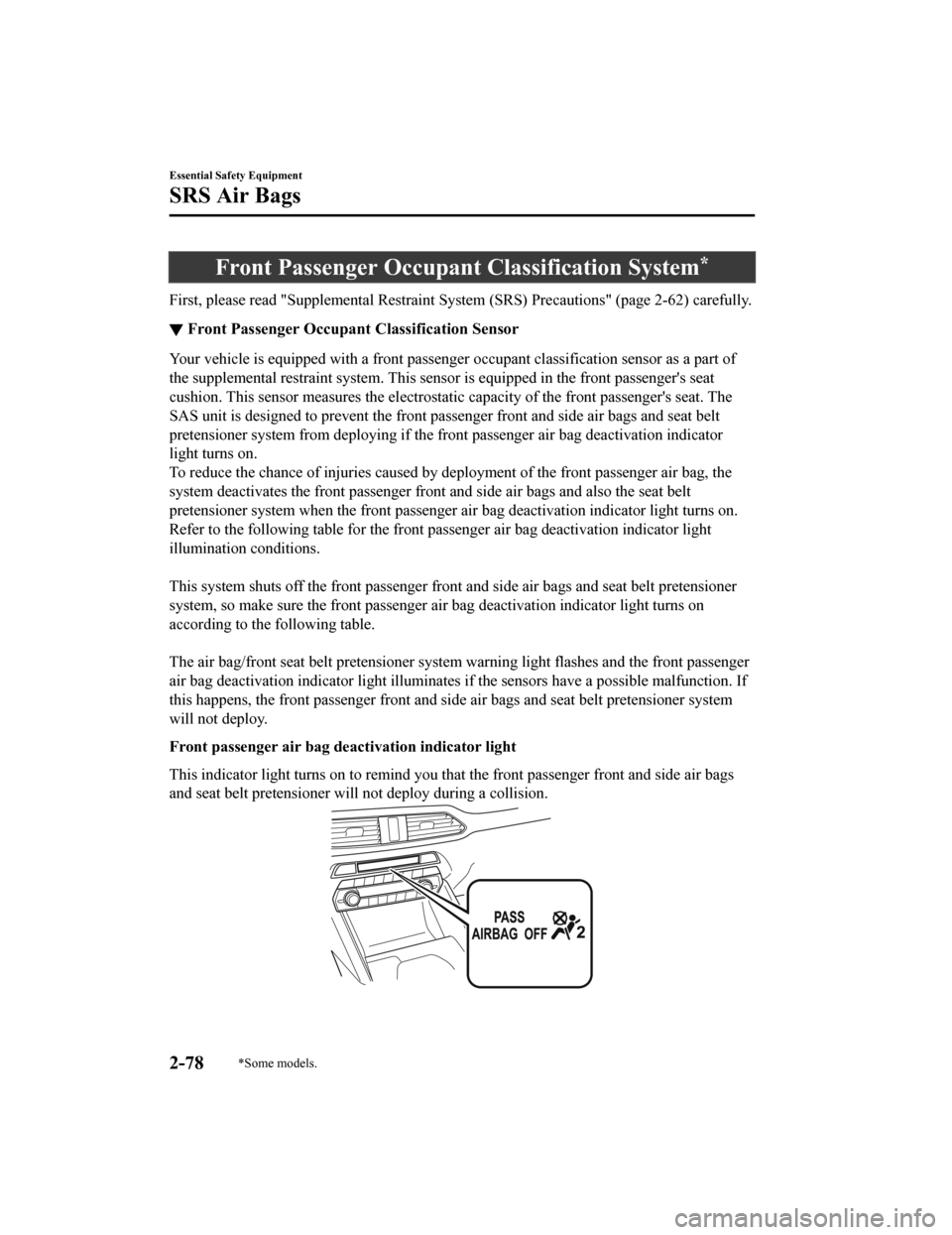
Front passenger air bag de activation indicator light
This indicator light turns on to remind you that the front pass enger front and side air bags
and seat belt pretensioner wil l not deploy during a collision.
Essential Safety Equipment
SRS Air Bags
2-78*Some models.
CX-9_8HB2-EA-18G_Edition1 2018-5-11 13:09:27
Page 91 of 692
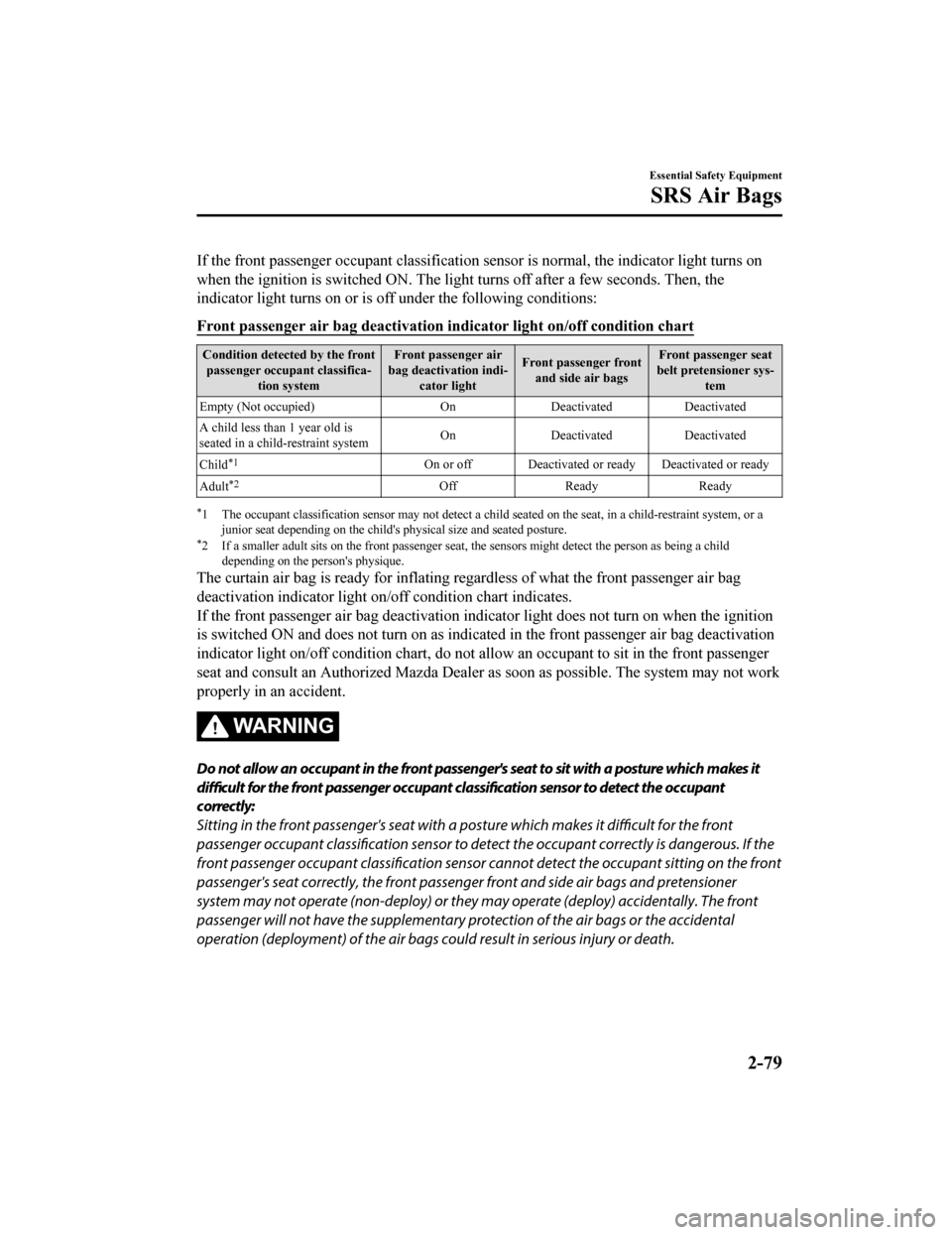
If the front passenger occupant classification sensor is normal, the indicator light turns on
when the ignition is switched ON. The light turns off after a f ew seconds. Then, the
indicator light turns on or is off under the following conditio ns:
Front passenger air bag deactivation indicator light on/off con dition chart
Condition detected by the front
passenger occupant classifica‐ tion system Front passenger air
bag deactivation indi‐ cator light Front passenger front
and side air bags Front passenger seat
belt pretensioner sys‐ tem
Empty (Not occupied) OnDeactivated Deactivated
A child less than 1 year old is
seated in a child-restraint system On
Deactivated Deactivated
Child
*1On or off Deactivated or ready Deactivated or ready
Adult
*2Off Ready Ready
*1 The occupant classification sensor may not detect a child seat ed on the seat, in a child-restraint system, or a
junior seat depending on the ch ild's physical size and seated posture.
*2 If a smaller adult sits on the front passenger seat, the sensors might detect the person as being a child
depending on the person's physique.
The curtain air bag is ready for inflating regardless of what the front passenger air bag
deactivation indicator light on/ off condition chart indicates.
If the front passenger air bag d eactivation indicator light does not turn on when the ignition
is switched ON and does not turn on as indicated in the front p assenger air bag deactivation
indicator light on/off condition chart, do not allow an occupan t to sit in the front passenger
seat and consult an Authorized Mazda Dealer as soon as possible . The system may not work
properly in an accident.
WA R N I N G
Do not allow an occupant in the front passenger's seat to sit with a posture which makes it
difficult for the front passenger occupant classification sensor to detect the occupant
correctly:
Sitting in the front passenger's seat with a posture which makes it difficult for the front
passenger occupant classification sensor to dete ct the occupant correctly is dangerous. If the
front passenger occupant classification sensor ca nnot detect the occupant sitting on the front
passenger's seat correctly, the front passeng er front and side air bags and pretensioner
system may not operate (non-deploy) or they may operate (deploy) accidentally. The front
passenger will not have the supplementary prot ection of the air bags or the accidental
operation (deployment) of the air bags could result in serious injury or death.
Essential Safety Equipment
SRS Air Bags
2-79
CX-9_8HB2-EA-18G_Edition1 2018-5-11 13:09:27
Page 92 of 692

Under the following conditions, the front passenger occupant classification sensor cannot
detect a passenger sitting on the front passe nger's seat correctly and the deployment/
non-deployment of the air bags cannot be contro lled as indicated in the front passenger air
bag deactivation indicator light on /off condition chart. For example:
A front passenger is seated as shown in the following figure:
A rear passenger pushes up on the front passenger seat with their feet.
Luggage or other items placed under the front passenger seat or between the front
passenger seat and driver seat that push up the front passenger seat bottom.
An object, such as a seat cushion, is put on the front passenger's seat or between the
passenger's back and the seatback.
A seat cover is put on the front passenger's seat.
Luggage or other items are placed on the seat with the child in the child-restraint system.
A rear passenger or luggag e push or pull down on the front passenger seatback.
Luggage or other items are placed on the seatback or hung on the head restraint.
The seat is washed.
Liquids are spilled on the seat.
The front passenger seat is moved backward, pushing into luggage or other items placed
behind it.
The front passenger seatback contacts the rear seat.
Essential Safety Equipment
SRS Air Bags
2-80
CX-9_8HB2-EA-18G_Edition1 2018-5-11 13:09:27