tire pressure MAZDA MODEL CX-9 2021 Owners Manual
[x] Cancel search | Manufacturer: MAZDA, Model Year: 2021, Model line: MODEL CX-9, Model: MAZDA MODEL CX-9 2021Pages: 723, PDF Size: 10.61 MB
Page 155 of 723
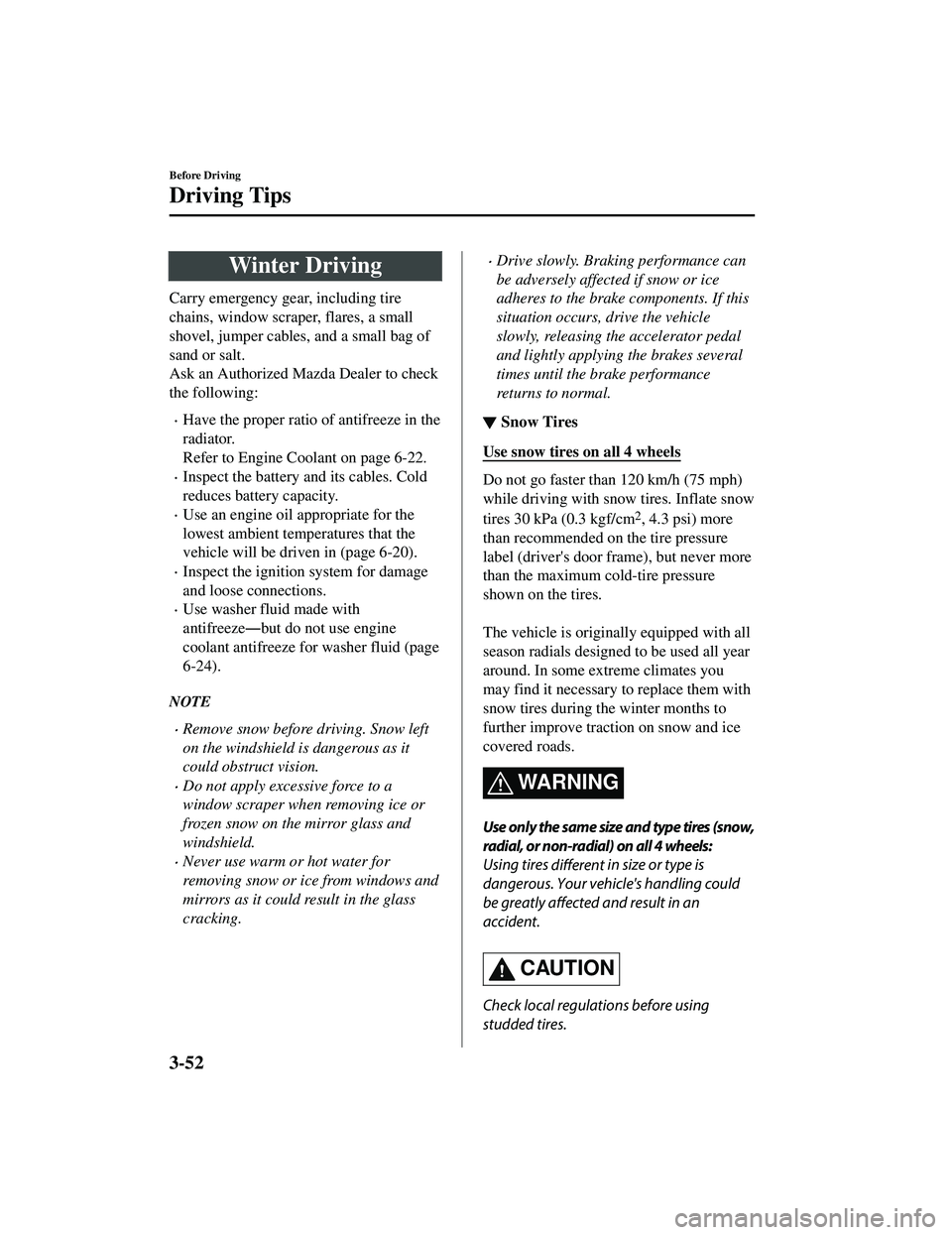
Winter Driving
Carry emergency gear, including tire
chains, window scraper, flares, a small
shovel, jumper cables, and a small bag of
sand or salt.
Ask an Authorized Mazda Dealer to check
the following:
Have the proper ratio of antifreeze in the
radiator.
Refer to Engine Coolant on page 6-22.
Inspect the battery and its cables. Cold
reduces battery capacity.
Use an engine oil appropriate for the
lowest ambient temperatures that the
vehicle will be driven in (page 6-20).
Inspect the ignition system for damage
and loose connections.
Use washer fluid made with
antifreeze―but do not use engine
coolant antifreeze for washer fluid (page
6-24).
NOTE
Remove snow before driving. Snow left
on the windshield is dangerous as it
could obstruct vision.
Do not apply excessive force to a
window scraper when removing ice or
frozen snow on the mirror glass and
windshield.
Never use warm or hot water for
removing snow or ice from windows and
mirrors as it could result in the glass
cracking.
Drive slowly. Braking performance can
be adversely affected if snow or ice
adheres to the brake components. If this
situation occurs, drive the vehicle
slowly, releasing the accelerator pedal
and lightly applying the brakes several
times until the brake performance
returns to normal.
▼ Snow Tires
Use snow tires on all 4 wheels
Do not go faster than 120 km/h (75 mph)
while driving with snow
tires. Inflate snow
tires 30 kPa (0.3 kgf/cm
2, 4.3 psi) more
than recommended on the tire pressure
label (driver's door frame), but never more
than the maximum cold-tire pressure
shown on the tires.
The vehicle is originally equipped with all
season radials designed to be used all year
around. In some extreme climates you
may find it necessary to replace them with
snow tires during the winter months to
further improve traction on snow and ice
covered roads.
WA R N I N G
Use only the same size and type tires (snow,
radial, or non-radial) on all 4 wheels:
Using tires different in size or type is
dangerous. Your vehi cle's handling could
be greatly affected and result in an
accident.
CAUTION
Check local regulations before using
studded tires.
Before Driving
Driving Tips
3-52
CX-9_8JK1-EA-20G_Edition6_old 2021-12-8 9:30:44
Page 156 of 723

NOTE
The tire pressure monitoring system may
not function correctly when using tires
with steel wire reinforcement in the
sidewalls (page 4-253).
▼ Tire Chains
Check local regulations before using tire
chains.
CAUTION
Chains may affect handling.
Do not go faster than 50 km/h (30 mph)
or the chain manufacturer's
recommended limit, whichever is lower.
Drive carefully and avoid bumps, holes,
and sharp turns.
Avoid locked-wheel braking.
Do not use chains on a temporary spare
tire; it may result in damage to the
vehicle and to the tire.
Do not use chains on roads that are free
of snow or ice. The tires and chains could
be damaged.
Chains may scratch or chip aluminum
wheels.
NOTE
The tire pressure monitoring system may
not function correctly when using tire
chains.
Use of tire chains on a vehicle equipped
with P255/50R20 specification tires
could cause interference with the vehicle
body and scratching. If tire chains are to
be used, replace both front and rear tires
with P255/60R18 tires. Please consult
an Authorized Mazda Dealer.
Install the chains on the front tires only.
Do not use chains on the rear tires.
Please consult an Authorized Mazda
Dealer.
Installing the chains
1. Secure the chains on the front tires as tightly as possible.
Always follow the chain
manufacturer's instructions.
2. Retighten the chains after driving 1/2―1 km (1/4 ―1/2 mile).
Before Driving
Driving Tips
3-53
CX-9_8JK1-EA-20G_Edition6_old 2021-12-8 9:30:44
Page 163 of 723
Make sure there are no exhaust gas leaks into the passenger compartment if any mounting
bolts are connected to the body:
Modifying your vehicle exhaust system is dangerous. Exhaust gas entering the vehicle could
cause loss of consciousness or even death.
When mounting the trailer hitch, make no modifications to the vehicle exhaust system.
CAUTION
Make all hitch adjustments with actual loads. Do not load and unload vehicle while
adjusting hitch. This action wi ll change the vehicle height.
Do not use an axle-mounted hitch. This may damage the axle and related parts.
▼ Tires
When towing a trailer, make sure all tires
are inflated to the recommended cold-tire
pressure, as indicated on the tire pressure chart on the driver's door frame. Trailer tire size,
load rating, and inflation pr essures should conform to ti re manufacturer specifications.
WA R N I N G
Never use the temporary spare tire when towing:
Using the temporary spare tire on your vehicle wh en towing a trailer is dangerous as it could
result in tire failure, loss of control, and injury to vehicle occupants.
▼ Safety Chains
Safety chains must be used as a precautionary measure should the trailer become
unintentionally unhitched. They should cross un
der the trailer tongue and attach to the hitch.
Leave enough slack to allow full turns. Consult literature published by your trailer or hitch
manufacturer for more details.
WA R N I N G
Make sure the safety chain is securely attached to both the trailer and the vehicle prior to
departure:
Towing a trailer without using a safety chain securely attached to both the trailer and the
vehicle is dangerous. If damage occurs to the coupling unit or hitch ball, the trailer could
wander into another lane and cause a collision.
▼ Trailer Lights
Trailer lights must comply with all federal, st
ate, and local regulations. Equip your trailer as
required before towing it day or night.
Before Driving
To w i n g
3-60
CX-9_8JK1-EA-20G_Edition6_old 2021-12-8 9:30:44
Page 193 of 723
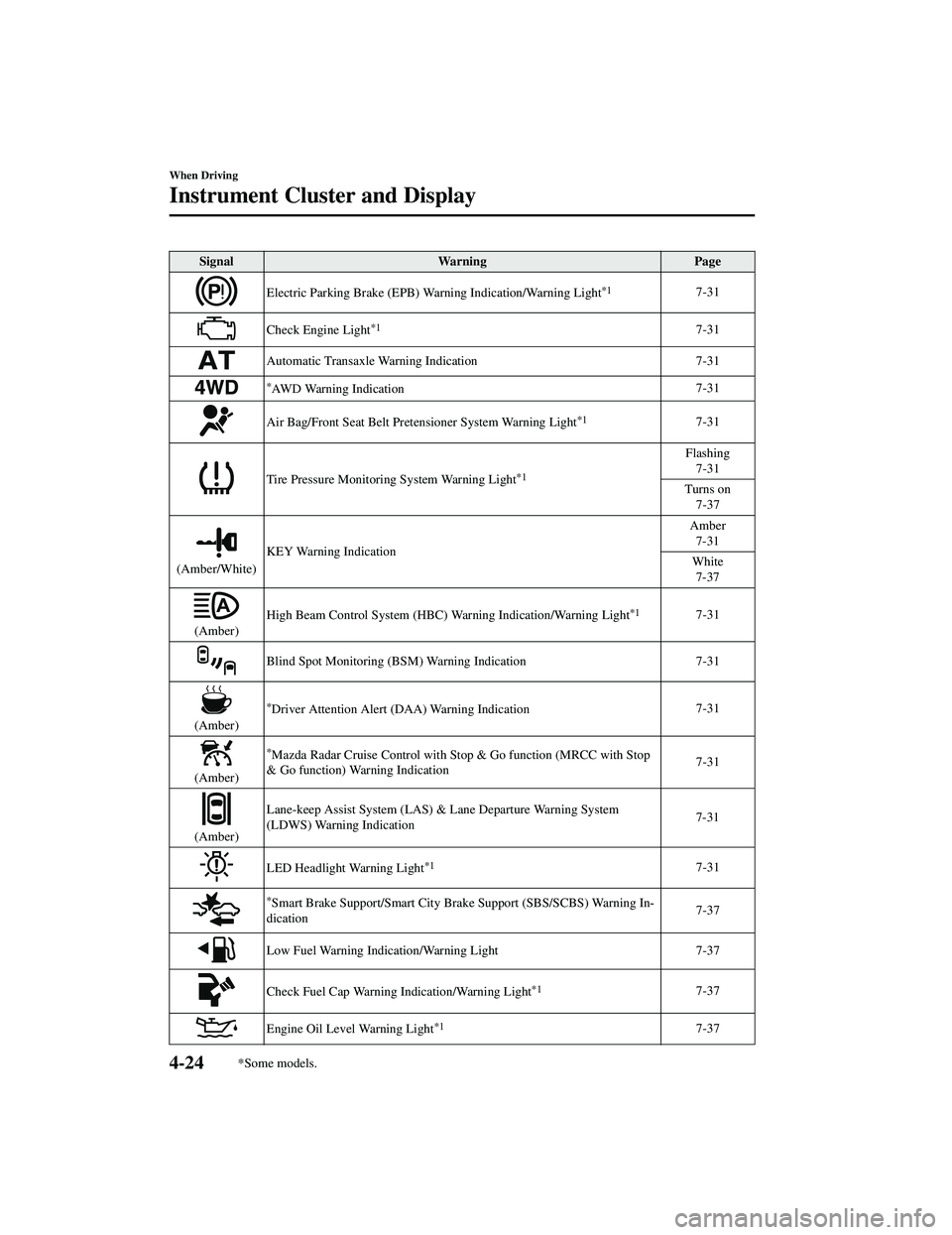
SignalWarning Page
Electric Parking Brake (EPB) Warning Indication/Warning Light*17-31
Check Engine Light*17-31
Automatic Transaxle Warning Indication 7-31
*AWD Warning Indication7-31
Air Bag/Front Seat Belt Pretensioner System Warning Light*17-31
Tire Pressure Monitoring System Warning Light*1
Flashing
7-31
Turns on 7-37
(Amber/White) KEY Warning Indication Amber
7-31
White 7-37
(Amber) High Beam Control System (HBC) Warning Indication/Warning Light
*17-31
Blind Spot Monitoring (BSM) Warning Indication
7-31
(Amber)
*Driver Attention Alert (DAA) Warning Indication 7-31
(Amber)
*Mazda Radar Cruise Control with Stop & Go function (MRCC with Stop
& Go function) Wa rning Indication 7-31
(Amber)Lane-keep Assist System (LAS) & Lane Departure Warning System
(LDWS) Warning Indication
7-31
LED Headlight Warning Light*17-31
*Smart Brake Support/Smart City Br
ake Support (SBS/SCBS) Warning In ‐
dication 7-37
Low Fuel Warning Indication/Warning Light
7-37
Check Fuel Cap Warning Indication/Warning Light*17-37
Engine Oil Level Warning Light*17-37
When Driving
Instrument Cluster and Display
4-24*Some models.
CX-9_8JK1-EA-20G_Edition6_old 2021-12-8 9:30:44
Page 208 of 723
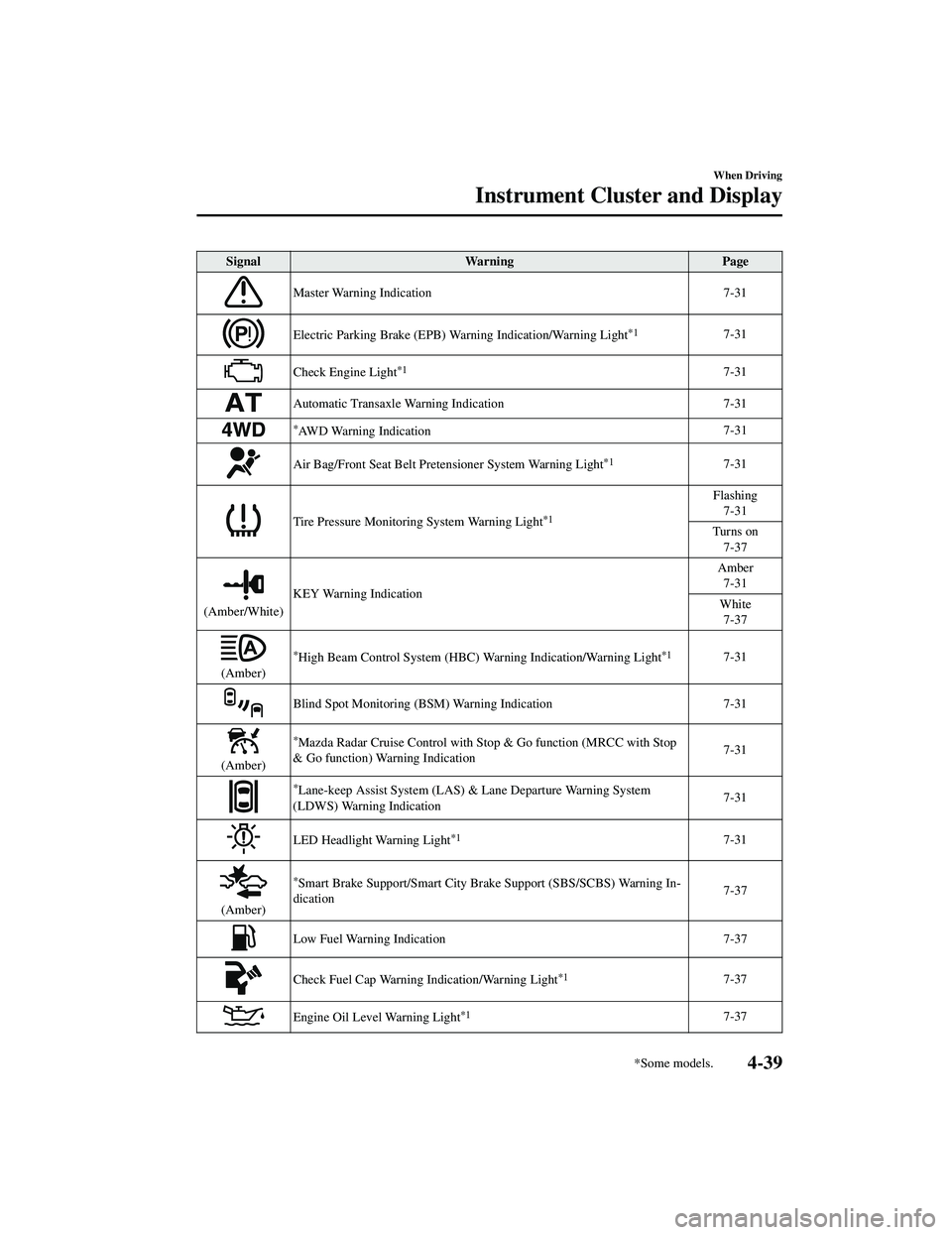
SignalWarning Page
Master Warning Indication 7-31
Electric Parking Brake (EPB) Warning Indication/Warning Light*17-31
Check Engine Light*17-31
Automatic Transaxle Warning Indication7-31
*AWD Warning Indication7-31
Air Bag/Front Seat Belt Preten
sioner System Warning Light*17-31
Tire Pressure Monitoring System Warning Light*1
Flashing
7-31
Turns on 7-37
(Amber/White) KEY Warning Indication Amber
7-31
White 7-37
(Amber)
*High Beam Control System (HBC) Warning Indication/Warning Light*17-31
Blind Spot Monitoring (B SM) Warning Indication 7-31
(Amber)
*Mazda Radar Cruise Control with Stop & Go function (MRCC with Stop
& Go function) Warning Indication 7-31
*Lane-keep Assist System (LAS) & Lane Departure Warning System
(LDWS) Warning Indication 7-31
LED Headlight Warning Light*17-31
(Amber)
*Smart Brake Support/Smart City Br
ake Support (SBS/SCBS) Warning In ‐
dication 7-37
Low Fuel Warnin
g Indication 7-37
Check Fuel Cap Warning Indication/Warning Light*17-37
Engine Oil Level Warning Light*17-37
When Driving
Instrument Cluster and Display
*Some models.4-39
CX-9_8JK1-EA-20G_Edition6_old 2021-12-8 9:30:44
Page 221 of 723

SignalWarning Page
(Red)Electric Parking Brake (EPB) Warning Light
*1
Flashing
4-96
Buzzer & Flash ‐
ing
7-31
Check Engine Light*17-31
Automatic Transaxle Warning Light*17-31
*AWD Warning Light 7-31
Air Bag/Front Seat Belt Pretensioner System Warning Light*17-31
Tire Pressure Monitoring System Warning Light*1
Flashing
7-31
Turns on 7-37
(Red) KEY Warning Light
*1
Turns on
7-31
Flashing 7-37
LED Headlight Warning Light*17-31
*Smart City Brake Support (SCBS) Warning Light 7-37
Low Fuel Warning Light
7-37
Check Fuel Cap Warning Light*17-37
Engine Oil Level Warning Light*17-37
Seat Belt Warning Light (Front seat) 7-37
(Red)Seat Belt Warning Light (Rear seat) 7-37
*Low Washer Fluid Level Warning Light
7-37
Door-Ajar Warning Light
7-37
When Driving
Instrument Cluster and Display
4-52*Some models.
CX-9_8JK1-EA-20G_Edition6_old 2021-12-8 9:30:44
Page 280 of 723
i-ACTIV AWD Operation*
AWD provides excellent drivability on
snow-covered and ice-packed roads, sand
and mud, as well as on steep slopes and
other slippery surfaces.
A system malfunction or operation
conditions are indicated by a warning.
Refer to Contact Authorized Mazda
Dealer and Have Vehicle Inspected on
page 7-31.
WARNING
Never spin a wheel that is off the ground:
Spinning a wheel that is off the ground as a
result of the vehicle being stuck or in a
ditch is dangerous. The drive assembly
could be seriously damaged which could
lead to an accident or could even lead to
overheating, oil leakage, and a fire.
▼ AWD Driving
WARNING
Avoid sharp turns, excessive speed and
abrupt maneuvers when driving this
vehicle:
Sharp turns, excessive speed and abrupt
maneuvering of this vehicle is dangerous
as it could result in the increased risk of loss
of vehicle control, vehicle roll-over,
personal injury or death.
This vehicle has a higher center of gravity.
Vehicles with a higher center of gravity
such as utility and AWD vehicles handle
differently than vehicles with a lower center
of gravity.
Utility and AWD vehicles are not designed
for cornering at high speeds any more than
low profile sports cars are designed to
perform satisfactorily under off-road
conditions. In addition, utility vehicles have
a significantly higher rollover rate than
other types of vehicles.
Drive carefully when the vehicle is loaded
by lowering vehicle speed and applying the
brakes earlier:
Abrupt maneuvering and sudden braking
when driving a loaded vehicle is dangerous
as the driving behavior of a vehicle with a
high center of gravity is different when it is
loaded compared to when it is not, and
could result in the loss of vehicle control
and an accident.
▼Tires and Tire Chains
The condition of the tires plays a large role
in the performance of the vehicle.
Moreover, to prevent adverse effects to the
drive assembly, please note the following:
Tires
When replacing tires, always replace all
front and rear tires at the same time.
All tires must be of the same size,
manufacture, brand and tread pattern.
Pay particular attention when equipping
snow or other types of winter tires.
Do not mix tread-worn tires with normal
tires.
Inspect tire inflation pressures at the
specified periods adjust to the specified
pressures.
NOTE
Check the tire inflation pressure label
attached to driver's door frame for the
correct tire inflation pressure.
When Driving
i-ACTIV AWD
*Some models.4 - 111
CX-9_8JK1-EA-20G_Edition6_old
2021-12-8 9:30:44
Page 297 of 723
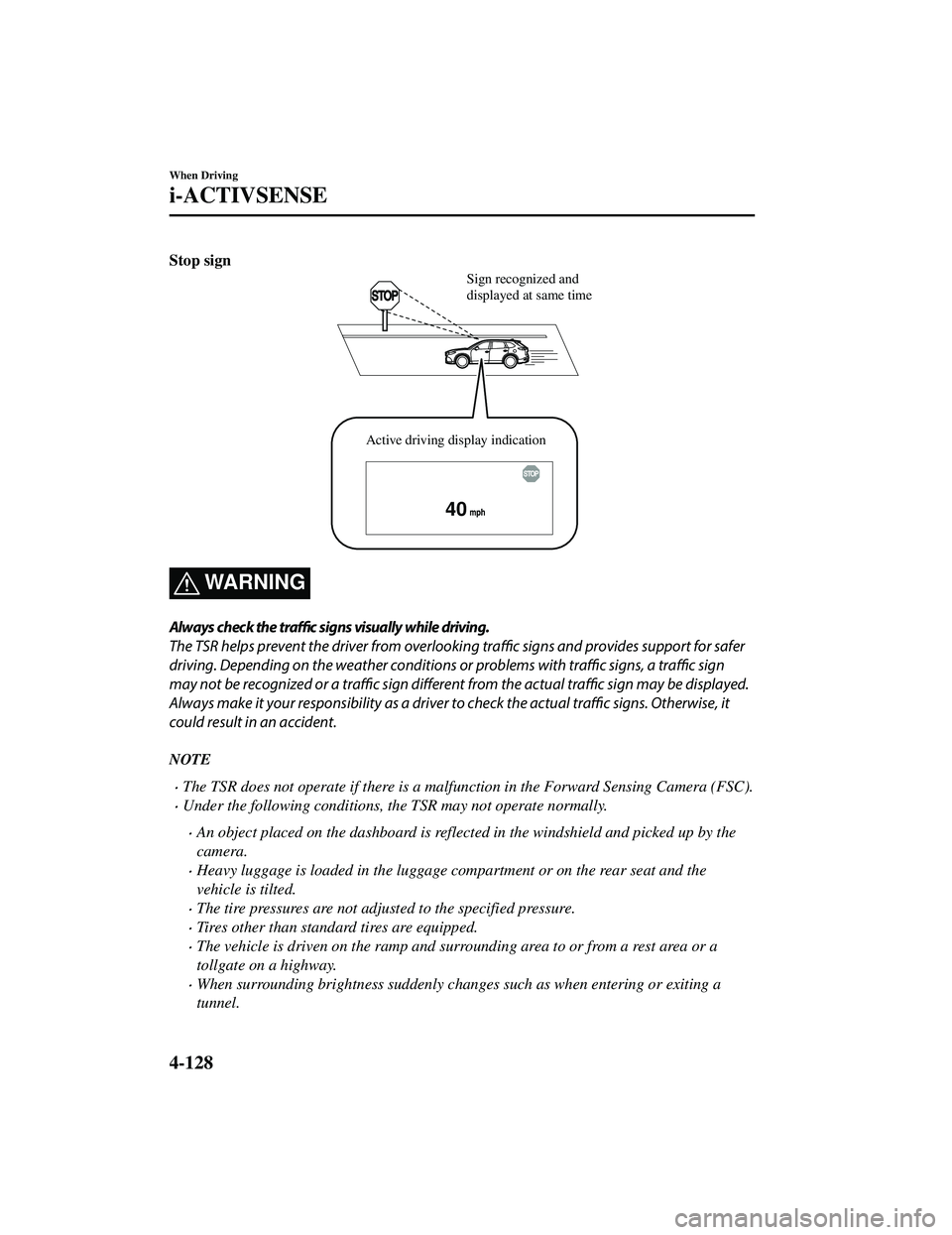
Stop sign
40
Sign recognized and
displayed at same time
Active driving display indication
WA R N I N G
Always check the traffic signs visually while driving.
The TSR helps prevent the driver from overlookin g traffic signs and provides support for safer
driving. Depending on the weather conditions or problems with traffic signs, a traffic sign
may not be recognized or a traffic sign different from the actual traffic sign may be displayed.
Always make it your responsibility as a driver to check the actual traffic signs. Otherwise, it
could result in an accident.
NOTE
The TSR does not operate if there is a malfunction in the Forward Sensing Camera (FSC).
Under the following conditions, the TSR may not operate normally.
An object placed on the dashboard is reflected in the windshield and picked up by the
camera.
Heavy luggage is loaded in the luggage compartment or on the rear seat and the
vehicle is tilted.
The tire pressures are not adjusted to the specified pressure.
Tires other than standard tires are equipped.
The vehicle is driven on the ramp and surrounding area to or from a rest area or a
tollgate on a highway.
When surrounding brightness suddenly changes such as when entering or exiting a
tunnel.
When Driving
i-ACTIVSENSE
4-128
CX-9_8JK1-EA-20G_Edition6_old 2021-12-8 9:30:44
Page 328 of 723

Driving on roads with tight curves.
Driving under bad weather conditions (rain, fog, and snow).
Slippery roads such as ice or snow-bound roads.
Roads with heavy traffic and insufficient distance between vehicles.
Roads with no white (yellow) lane lines.
Narrow roads resulting from road construction or lane closures.
The vehicle is driven on a temporary lane or section with a closed lane resulting from road
construction where there may be multiple white (yellow) lane lines or they are interrupted.
Vehicle is driven on roads oth er than expressways and highways.
The tire pressures are not adjusted to the
specified pressure.
The vehicle is being used to tow a camper or boat trailer.
Tires of a
different
specified size are used, such as an emergency spare tire.
CAUTION
Heed the following cautions so that the LAS & LDWS can operate normally.
Do not modify the suspensions.
Always use wheels of the specified type and size for the front and rear wheels. Consult an
Authorized Mazda Dealer for tire replacement.
NOTE
When the turn signal lever is operated for a lane change, the LAS & LDWS is
automatically disabled. The LAS & LDWS becomes operational again when the turn
signal lever is returned and the system detects white (yellow) lane lines while the vehicle
is being driven normally within its vehicle lane.
If the steering wheel, accelerator pedal, or brake pedal is operated abruptly and the
vehicle moves close to a white (yellow) line, the system de termines that the driver is
making a lane change and the LAS & LDWS operation is temporarily canceled. The LAS
& LDWS becomes operational again when the system detects white (yellow) lane lines
while the vehicle is being driven normally within its vehicle lane.
If the vehicle deviates from its lane repeatedly within a short period of time, the LAS &
LDWS may not operate.
When white (yellow) lane lines are not detected, the LAS & LDWS does not operate.
Under the following conditions, the LAS & LDWS may not be able to detect white (yellow)
lane lines correctly and it may not operate normally.
If an object placed on the dashboard is reflected in the windshield and picked up by the
camera.
Heavy luggage is loaded in the luggage compartment or on the rear seat and the
vehicle is tilted.
When Driving
i-ACTIVSENSE
4-159
CX-9_8JK1-EA-20G_Edition6_old 2021-12-8 9:30:44
Page 329 of 723

The tire pressures are not adjusted to the specified pressure.
Tires other than conventional tires are equipped.
Vehicle is driven on an intersection or junction, or on a forked road.
The white (yellow) lane lines are less visible because of dirt or fading/patchiness.
A vehicle in front of your vehicle is running near a white (yellow) lane line making it
less visible.
A white (yellow) lane line is less visible because of bad weather (rain, fog, or snow).
The vehicle is driven on a temporary lane or section with a closed lane resulting from
construction where there may be multiple white (yellow) lane lines or they are
interrupted.
A misleading line is picked up on the road such as a temporary line for construction, or
because of shade, lingering snow, or grooves filled with water.
The surrounding brightness suddenly changes such as when entering or exiting a
tunnel.
The illumination of the headlights is weakened because of dirt or the optical axis is
deviated.
The windshield is dirty or foggy.
The windshield, camera is fogged (water droplets).
Back-light is reflected off the road surface.
The road surface is wet and shiny after rain, or there are puddles on the road.
The shade of a guardrail parallel to a white (yellow) lane line is cast on the road.
The width of the driving lane is narrow or wide.
Driving on roads with tight curves.
The road is excessively uneven.
The vehicle is shaken after hitting a road bump.
There are 2 or more adjacent white (yellow) lane lines.
There are various road markings or lane markings of various shapes near an
intersection.
▼System Operation
Make sure that the LAS & LDWS OFF
switch indicator light is turned off. When
the LAS & LDWS OFF switch indicator
light is turned on, press the switch and
make sure that the switch indicator light
turns off.
Indicator light
When Driving
i-ACTIVSENSE
4-160
CX-9_8JK1-EA-20G_Edition6_old
2021-12-8 9:30:44