brakes MAZDA MODEL CX-9 2022 Owner's Manual
[x] Cancel search | Manufacturer: MAZDA, Model Year: 2022, Model line: MODEL CX-9, Model: MAZDA MODEL CX-9 2022Pages: 715, PDF Size: 81.06 MB
Page 324 of 715

Advanced Smart City Brake Support (Advanced SCBS)*
The Advanced SCBS alerts the driver of a possible collision usi ng the display and a warning
sound when the Forward Sensing Camera (FSC) detects a vehicle a head or pedestrian and
determines that a collision with the object is unavoidable whil e the vehicle is driven at a
vehicle speed of about 4 to 80 km/h (2 to 50 mph) if the object is a vehicle ahead and about
10 to 80 km/h (6.2 to 50 mph) if the object is a pedestrian. In addition, the system reduces
damage in the event of a collision by operating the brake contr ol (Advanced SCBS brake)
when the system determines that a collision is unavoidable. In addition, when the driver
depresses the brake pedal, the brakes are applied firmly and qu ickly to assist. (Brake Assist
(Advanced SCBS brake assist))
Forward Sensing
Camera (FSC)
WARNING
Do not rely completely on the Advanced SCBS system:
The Advanced SCBS system is only designed to reduce damage in the event of a collision.
Over reliance on the system leading to the accelerator pedal or brake pedal being
mistakenly operated could result in an accident.
The Advanced SCBS system operates in response to a vehicle ahead or a pedestrian. The
system does not operate in response to obstru ctions such as a wall, 2-wheeled vehicles, or
animals.
When Driving
i-ACTIVSENSE
*Some models.4-157
CX-9_8KH5-EA-21K_Edition2_old 2021-9-16 14:11:22
Page 325 of 715

CAUTION
In the following cases, turn the system off to prevent a mis-operation:
The vehicle is being towed or when towing another vehicle.
The vehicle is on a chassis roller.
When driving on rough roads such as in areas of dense grass or off-road.
Refer to Stopping the Advanced Smart City Brake Support (Advanced SCBS) System Operation
on page 4-159 on how to turn off the Advanced SCBS system.
NOTE
The Advanced SCBS system will operate under the following conditions.
The engine is running.
The Smart City Brake Support (SCBS) warning indication (amber) does not illuminate.
(Object is vehicle ahead)
The vehicle speed is between about 4 to 80 km/h (2 to 50 mph).
(Object is a pedestrian)
The vehicle speed is between about 10 to 80 km/h (6.2 to 50 mph).
The Advanced SCBS system is not turned off.
Under the following conditions, the Advanced SCBS system may not operate normally:
The Advanced SCBS system will not operate if the driver is deliberately performing
driving operations (accelerator pedal and steering wheel).
If there is the possibility of pa rtial contact with a vehicle ahead.
The vehicle is driven on a slippery road surface such as wet roads or icy or snow-bound
roads.
The braking performance is adversely affected due to cold temperatures or wet brakes.
The vehicle is driven at the same speed as the vehicle ahead.
The accelerator pedal is depressed.
The brake pedal is depressed.
The steering wheel is being operated.
The selector lever is being operated.
In the following cases, the Advanced SCBS may operate.
Objects on the road at the entrance to a curve.
Vehicles passing in the opposite lane while making a curve.
When passing through a toll gate.
When passing through low gates, narrow gates, car washing machines, or tunnels.
If you suddenly come close to a vehicle ahead.
2-wheeled vehicles, animals, or standing trees.
When Driving
i-ACTIVSENSE
4-158
CX-9_8KH5-EA-21K_Edition2_old 2021-9-16 14:11:22
Page 327 of 715
![MAZDA MODEL CX-9 2022 Owners Manual Smart City Brake Support [Forward] (SCBS F)*
The SCBS F system alerts the driver of a possible collision using an indication in the
display and a warning sound when the Forward Sensing Camera (FS C) d](/img/28/40969/w960_40969-326.png "MAZDA MODEL CX-9 2022 Owners Manual Smart City Brake Support [Forward] (SCBS F)*
The SCBS F system alerts the driver of a possible collision using an indication in the
display and a warning sound when the Forward Sensing Camera (FS C) d")
Smart City Brake Support [Forward] (SCBS F)*
The SCBS F system alerts the driver of a possible collision using an indication in the
display and a warning sound when the Forward Sensing Camera (FS C) detects a vehicle
ahead and determines that a colli sion with a vehicle ahead is unavoidable while the vehicle
is being driven at a vehicle speed of about 4 to 80 km/h (2 to 50 mph). In addition, the
system reduces damage in the event of a collision by operating the brake control (Smart City
Brake Support (SCBS) brake) when t he system determines that a collision is unavoidable
while the vehicle is being driven at a vehicle speed of about 4 to 30 km/h (2 to 18 mph). It
may also be possible to avoid a collision if the relative speed between your vehicle and the
vehicle in front of you is les s than about 20 km/h (12 mph). In addition, when the driver
depresses the brake pedal while the system is in the operation range at about 4 to 30 km/h (2
to 18 mph), the brakes are applied firmly and quickly to assist . (Brake Assist (Smart City
Brake Support (SCBS) brake assist))
Forward Sensing
Camera (FSC)
WA R N I N G
Do not rely completely on the SCBS F system:
The SCBS F system is only designed to red uce damage in the event of a collision. Over
reliance on the system leading to the accel erator pedal or brake pedal being mistakenly
operated could result in an accident.
The SCBS F is a system which operates in response to a vehicle ahead. The system may not
be able to detect or react to 2-wheeled vehicles or pedestrians.
When Driving
i-ACTIVSENSE
4-160*Some models.
CX-9_8KH5-EA-21K_Edition2_old 2021-9-16 14:11:22
Page 328 of 715

CAUTION
In the following cases, turn the system off to prevent a mis-operation:
The vehicle is being towed or when towing another vehicle.
The vehicle is on a chassis roller.
When driving on rough roads such as in areas of dense grass or off-road.
Refer to Stopping the Smart Ci ty Brake Support (SCBS) system Operation on page 4-162 on
how to turn off the SCBS F system.
NOTE
The SCBS F system will operate under the following conditions.
The engine is running.
The Smart Brake Support/Smart City Brake Support (SBS/SCBS) system warning
indication (amber) does not illuminate.
(Rear-end collision warning)
The vehicle speed is about 4 to 80 km/h (2 to 50 mph).
(Brake control (Smart City Brake Support (SCBS) brake))
The vehicle speed is about 4 to 30 km/h (2 to 18 mph).
The SCBS F system is not turned off.
Under the following conditions, the SCBS F system may not operate normally:
The SCBS F system will not operate if the driver is deliberately performing driving
operations (accelerator pedal and steering wheel).
If there is the possibility of partial contact with a vehicle ahead.
The vehicle is driven on a slippery road surface such as wet roads or icy or snow-bound
roads.
The braking performance is adversely affected due to cold temperatures or wet brakes.
The vehicle is driven at the same speed as the vehicle ahead.
The accelerator pedal is depressed.
The brake pedal is depressed.
The steering wheel is being operated.
The selector lever is being operated.
In the following cases, the Forward Sensing Camera (FSC) determines that there is a
vehicle ahead and the SCBS F may operate.
Objects on the road at the entrance to a curve.
Vehicles passing in the opposite lane while making a curve.
Metal objects, bumps, or protruding objects on the road.
When passing through a toll gate.
When passing through low gates, narrow gates, car washing machines, or tunnels.
When Driving
i-ACTIVSENSE
4-161
CX-9_8KH5-EA-21K_Edition2_old 2021-9-16 14:11:22
Page 334 of 715

Smart Brake Support(SBS)
*
The SBS system alerts the driver of a
possible collision using a display and
warning sound if the radar sensor (front)
and the Forward Sensing Camera (FSC)
determine that there is the possibility of a
collision with a vehic le ahead while the
vehicle is being driven at about 15 km/h or
faster (10 mph or faster). Furthermore, if
the radar sensor (front) and the Forward
Sensing Camera (FSC) determines that a
collision is unavoidable, the automatic
brake control is performed to reduce
damage in the event of a collision.
In addition, when the driver depresses the
brake pedal, the brakes are applied firmly
and quickly to assist. (Brake Assist (SBS
brake assist))
WARNING
Do not rely completely on the SBS system
and always drive carefully:
The SBS is designed to reduce damage in
the event of a collision, not avoid an
accident. The ability to detect an
obstruction is limited depending on the
obstruction, weather conditions, or traffic
conditions. Therefore, if the accelerator
pedal or brake pedal is mistakenly
operated it could result in an accident.
Always verify the safety of the surrounding
area and depress the brake pedal or
accelerator pedal while keeping a safer
distance from vehicles ahead or on-coming
vehicles.
CAUTION
In the following cases, turn the system off
to prevent a mis-operation:
The vehicle is being towed or when
towing another vehicle.
The vehicle is on a chassis roller.
When driving on rough roads such as in
areas of dense grass or
off-road.
NOTE
The SBS system operates when all of the
following conditions are met:
The ignition is switched ON.
The SBS system is on.
The vehicle speed is about 15 km/h or
faster (10 mph or faster).
The relative speed between your
vehicle and the vehicle ahead is about
15 km/h or faster (10 mph or faster).
The Dynamic Stability Control (DSC)
is not operating.
The SBS system may not operate under
the following conditions:
If the vehicle is accelerated rapidly
and it comes close to a vehicle ahead.
The vehicle is driven at the same
speed as the vehicle ahead.
The accelerator pedal is depressed.
The brake pedal is depressed.
The steering wheel is being operated.
The selector lever is being operated.
The turn signal is being used.
When the vehicle ahead is not
equipped with taillights or the
taillights are turned off.
When Driving
i-ACTIVSENSE
*Some models.4-167
CX-9_8KH5-EA-21K_Edition2_old 2021-9-16 14:11:22
Page 525 of 715
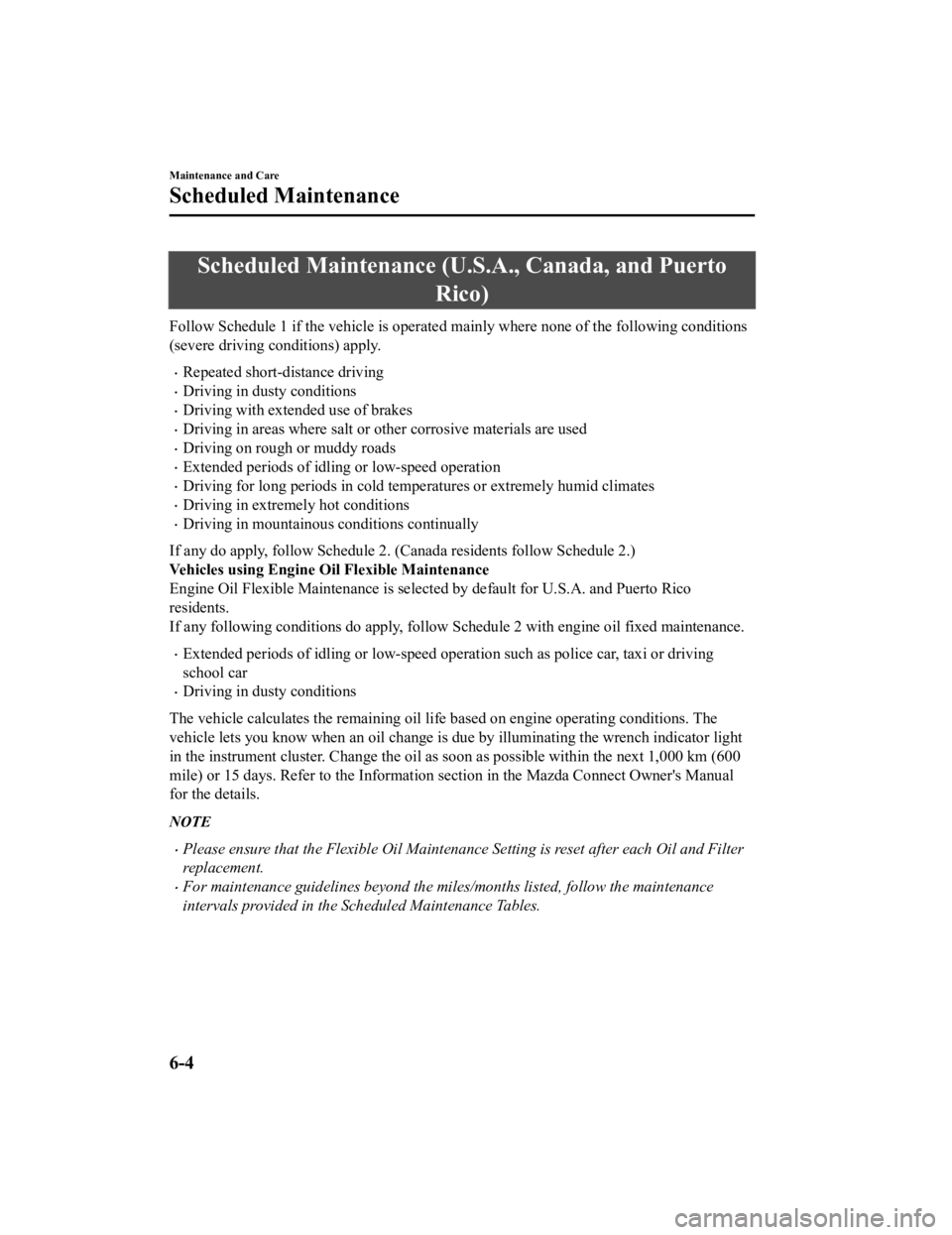
Scheduled Maintenance (U.S.A., Canada, and Puerto
Rico)
Follow Schedule 1 if the vehicle is operated mainly where none of the following conditions
(severe driving conditions) apply.
Repeated short-distance driving
Driving in dusty conditions
Driving with extended use of brakes
Driving in areas where salt or other corrosive materials are us ed
Driving on rough or muddy roads
Extended periods of idling or low-speed operation
Driving for long periods in cold temperatures or extremely humi d climates
Driving in extremely hot conditions
Driving in mountainous conditions continually
If any do apply, follow Schedule 2. (Canada residents follow Sc hedule 2.)
Vehicles using Engine Oil Flexible Maintenance
Engine Oil Flexible Maintenance is selected by default for U.S.A. and Puerto Rico
residents.
If any following conditions do apply, follow Schedule 2 with en gine oil fixed maintenance.
Extended periods of idling or low-speed operation such as police car, taxi or driving
school car
Driving in dusty conditions
The vehicle calculates the remaining oil life based on engine o perating conditions. The
vehicle lets you know when an oil change is due by illuminating the wrench indicator light
in the instrument cluster. Change the oil as soon as possible w ithin the next 1,000 km (600
mile) or 15 days. Refer to the Information section in the Mazda Connect Owner's Manual
for the details.
NOTE
Please ensure that the Flexible Oil Maintenance Setting is reset after each Oil and Filter
replacement.
For maintenance guidelines beyond the miles/months listed, follow the maintenance
intervals provided in the Scheduled Maintenance Tables.
Maintenance and Care
Scheduled Maintenance
6-4
CX-9_8KH5-EA-21K_Edition2_old 2021-9-16 14:11:22
Page 526 of 715
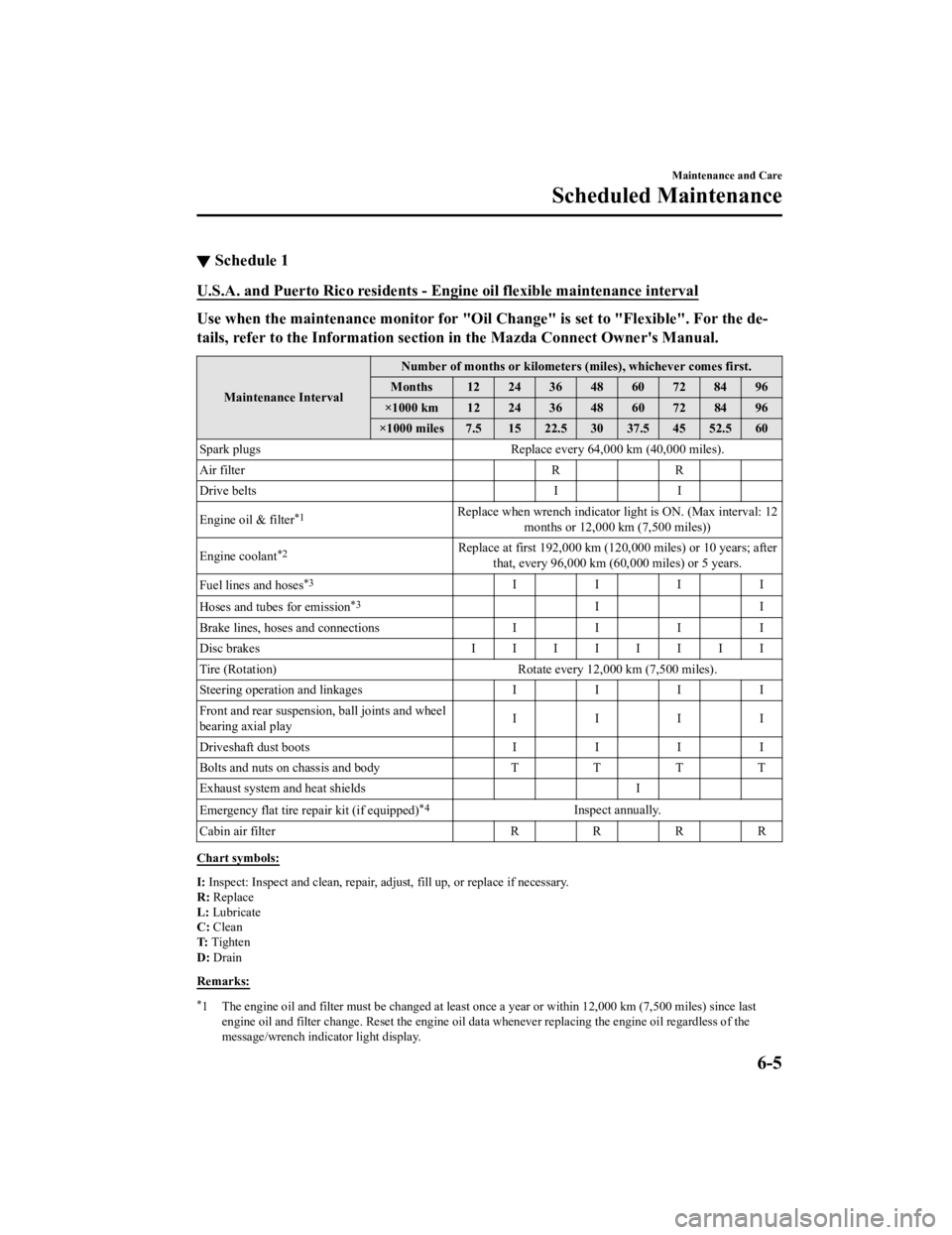
▼Schedule 1
U.S.A. and Puerto Rico residents
- Engine oil flexible maintenance interval
Use when the maintenance monitor for "Oil Change" is set to "Fl exible". For the de‐
tails, refer to the Information se ction in the Mazda Connect Owner's Manual.
Maintenance Interval Number of months or kilometers (miles), whichever comes first.
Months 12 24 36 48 60 72 84 96
×1000 km 12 24 36 48 60 72 84 96
×1000 miles 7.5 15 22.5 30 37.5 45 52.5 60
Spark plugs Replace every 64,000 km (40,000 miles).
Air filter RR
Drive belts II
Engine oil & filter
*1Replace when wrench indicator light is ON. (Max interval: 12 months or 12,000 km (7,500 miles))
Engine coolant
*2Replace at first 192,000 km (120,000 miles) or 10 years; after that, every 96,000 km (60,000 miles) or 5 years.
Fuel lines and hoses
*3IIII
Hoses and tubes for emission
*3II
Brake lines, hoses and connections I I I I
Disc brakes IIIIIIII
Tire (Rotation) Rotate every 12,000 km (7,500 miles).
Steering operation and linkages II II
Front and rear suspension, ball joints and wheel
bearing axial play IIII
Driveshaft dust boots II II
Bolts and nuts on chassis and body TTTT
Exhaust system and heat shields I
Emergency flat tire repair kit (if equipped)
*4Inspect annually.
Cabin air filter R R R R
Chart symbols:
I: Inspect: Inspect and clean, re pair, adjust, fill up, or replac e if necessary.
R: Replace
L: Lubricate
C: Clean
T: Tighten
D: Drain
Remarks:
*1 The engine oil and filter must b e changed at least once a year or within 12,000 km (7 ,500 miles) since last
engine oil and filter change. Res et the engine oil data whenever replacing the engine oil regardless of the
message/wrench indicator light display.
Maintenance and Care
Scheduled Maintenance
6-5
CX-9_8KH5-EA-21K_Edition2_old 2021-9-16 14:11:22
Page 527 of 715
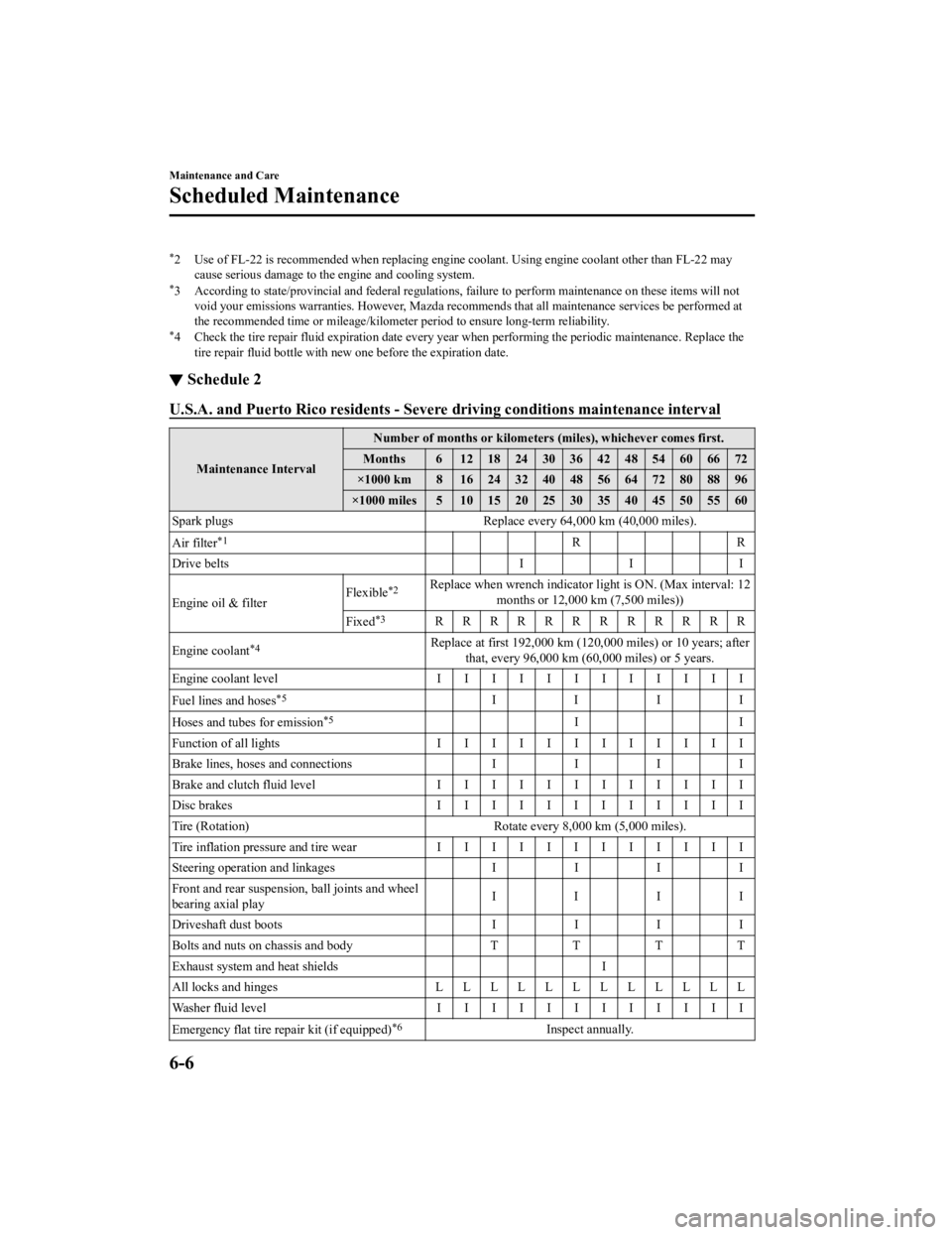
*2 Use of FL-22 is recommended when replacing engine coolant. Using engine coolant other than FL-22 may
cause serious damage to the engine and cooling system.
*3 According to state/provincial and federal regulations, failure to perform maintenance on these items will not
void your emissions warranties. H owever, Mazda recommends that all maintenance services be performed at
the recommended time or mileage/kilometer period to ensure long -term reliability.
*4 Check the tire repair fluid expiration date every year when performing the periodic maintenance. Replace the
tire repair fluid bottle with ne w one before the expiration dat e.
▼Schedule 2
U.S.A. and Puerto Rico residents - Severe driving conditions ma
intenance interval
Maintenance IntervalNumber of months or kilometers (miles), whichever comes first.
Months 6 1218243036424854606672
×1000 km 8 16 24 32 40 48 56 64 72 80 88 96
×1000 miles 5 10 15 20 25 30 35 40 45 50 55 60
Spark plugs Replace every 64,000 km (40, 000 miles).
Air filter
*1RR
Drive belts I I I
Engine oil & filter Flexible
*2Replace when wrench indicator light is ON. (Max interval: 12
months or 12,000 km (7,500 miles))
Fixed
*3RRRRRRRRRRRR
Engine coolant
*4Replace at first 192,000 km (120, 000 miles) or 10 years; after
that, every 96,000 km (60,000 miles) or 5 years.
Engine coolant level IIIIIIIIIIII
Fuel lines and hoses
*5IIII
Hoses and tubes for emission
*5II
Function of all lights IIIIIIIIIIII
Brake lines, hoses and connections II II
Brake and clutch fluid level I I I I I I I I I I I I
Disc brakes IIIIIIIIIIII
Tire (Rotation) Rotate every 8,000 km (5,000 miles).
Tire inflation pressure and tire wear IIIIIIIIIIII
Steering operation and linkages II II
Front and rear suspensi on, ball joints and wheel
bearing axial play IIII
Driveshaft dust boots II II
Bolts and nuts on chassis and body TTT T
Exhaust system and heat shields I
All locks and hinges LLLLLLLLLLLL
Washer fluid level IIIIIIIIIIII
Emergency flat tire re pair kit (if equipped)
*6Inspect annually.
Maintenance and Care
Scheduled Maintenance
6-6
CX-9_8KH5-EA-21K_Edition2_old 2021-9-16 14:11:22
Page 529 of 715

Maintenance IntervalNumber of months or kilometers (miles), whichever comes first.
Months 6 1218243036424854606672
×1000 km 8 16 24 32 40 48 56 64 72 80 88 96
×1000 miles 5 10 15 20 25 30 35 40 45 50 55 60
Engine oil & filter
*1RRRRRRRRRRRR
Engine coolant
*2Replace at first 192,000 km (120, 000 miles) or 10 years; after
that, every 96,000 km (60,000 miles) or 5 years.
Engine coolant level IIIIIIIIIIII
Fuel lines and hoses
*3III
Hoses and tubes for emission
*3I
Function of all lights IIIIIIIIIIII
Brake lines, hoses and connections II I
Brake and clutch fluid level I I I I I I I I I I I I
Disc brakes Inspect every 24,000 km (15,000 miles) or 1 year.
Tire (Rotation) Rotate every 8,000 km (5,000 miles).
Tire inflation pressure and tire wear IIIIIIIIIIII
Steering operation and linkages II I
Front and rear suspensi on, ball joints and wheel
bearing axial play III
Driveshaft dust boots II I
Bolts and nuts on chassis and body TTT
Exhaust system and heat shields Inspect every 72,000 km (45,000 miles) or 5 years.
All locks and hinges LLLLLLLLLLLL
Washer fluid level IIIIIIIIIIII
Emergency flat tire re pair kit (if equipped)
*4Inspect annually.
Cabin air filter RRR
Chart symbols:
I: Inspect: Inspect and clean, r epair, adjust, fill up, or replac e if necessary.
R: Replace
L: Lubricate
C: Clean
T: Tighten
D: Drain
Remarks:
*1 Reset the engine oil data whenever replacing the engine oil re gardless of the message/wrench indicator light
display.
*2 Use of FL-22 is recommended when replacing engine coolant. Using engine coolant other than FL-22 may
cause serious damage to the engine and cooling system.
Maintenance and Care
Scheduled Maintenance
6-8
CX-9_8KH5-EA-21K_Edition2_old 2021-9-16 14:11:22
Page 531 of 715
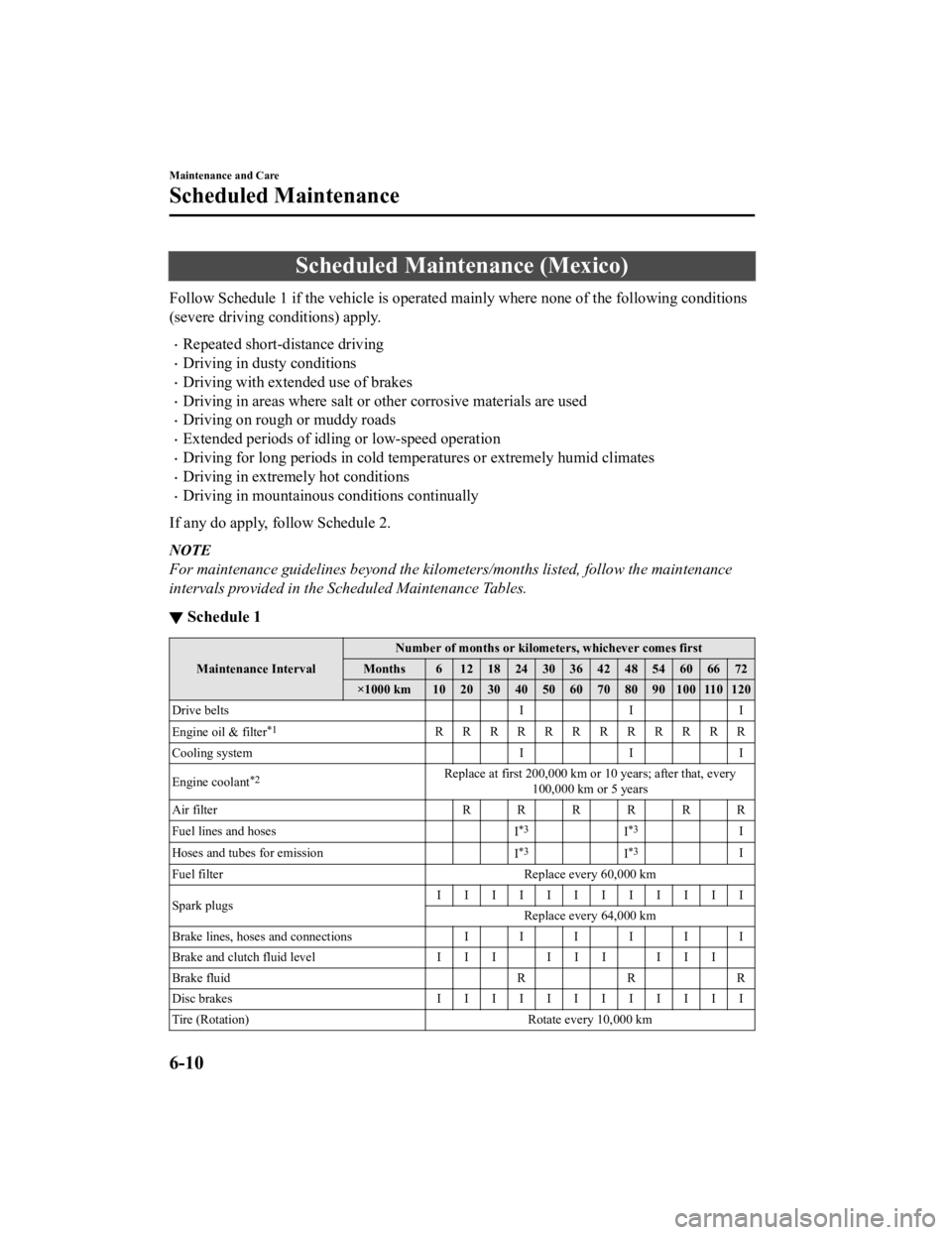
Scheduled Maintenance (Mexico)
Follow Schedule 1 if the vehicle is operated mainly where none of the following conditions
(severe driving conditions) apply.
Repeated short-distance driving
Driving in dusty conditions
Driving with extended use of brakes
Driving in areas where salt or other corrosive materials are us ed
Driving on rough or muddy roads
Extended periods of idling or low-speed operation
Driving for long periods in cold temperatures or extremely humi d climates
Driving in extremely hot conditions
Driving in mountainous conditions continually
If any do apply, follow Schedule 2.
NOTE
For maintenance guidelines beyond the kilome ters/months listed, follow the maintenance
intervals provided in the Scheduled Maintenance Tables.
▼ Schedule 1
Maintenance Interval Number of months or kilometers, whichever comes first
Months 6 1218243036424854606672
×1000 km 102030405060708090100110120
Drive belts II I
Engine oil & filter
*1RRRRRRRRRRRR
Cooling system I I I
Engine coolant
*2Replace at first 200,000 km or 10 years; after that, every 100,000 km or 5 years
Air filter RRRRRR
Fuel lines and hoses I
*3I*3I
Hoses and tubes for emission I
*3I*3I
Fuel filter Replace every 60,000 km
Spark plugs IIIIIIIIIIII
Replace every 64,000 km
Brake lines, hoses and connections IIIIII
Brake and clutch fluid level I I I I I I I I I
Brake fluid RRR
Disc brakes IIIIIIIIIIII
Tire (Rotation) Rotate every 10,000 km
Maintenance and Care
Scheduled Maintenance
6-10
CX-9_8KH5-EA-21K_Edition2_old 2021-9-16 14:11:22