radio MAZDA MODEL MX-30 EV 2022 User Guide
[x] Cancel search | Manufacturer: MAZDA, Model Year: 2022, Model line: MODEL MX-30 EV, Model: MAZDA MODEL MX-30 EV 2022Pages: 547, PDF Size: 79.35 MB
Page 224 of 547
Your vehicle is tilted (such as when
heavy luggage is in the luggage
compartment or on the rear seat).
Your vehicle is towing another
vehicle.
The vehicle is making a sharp curve,
or ascending or descending a steep
slope.
The vehicle is driven on roads with
sharp curves or undulations.
The vehicle is driven on uneven
roads.
The vehicle is driven next to walls
with no patterning (including fences
and longitudinally striped walls).
There are water puddles on the road.The road surface is shiny.
Front Radar Sensor*
▼Front Radar Sensor
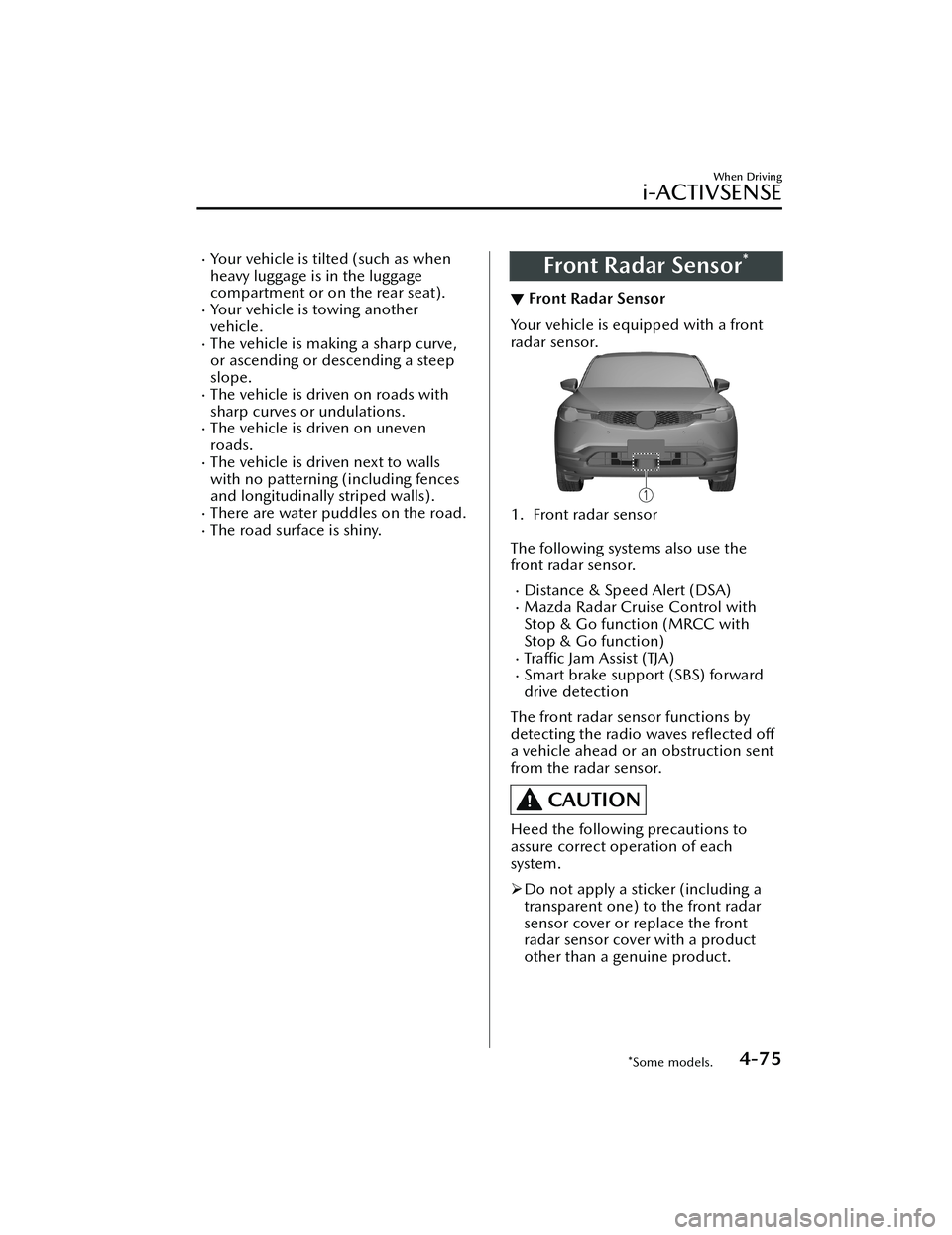
Your vehicle is equipped with a front
radar sensor.
1. Front radar sensor
The following systems also use the
front radar sensor.
Distance & Speed Alert (DSA)Mazda Radar Cruise Control with
Stop & Go function (MRCC with
Stop & Go function)
Tra
ffic Jam Assist (TJA)Smart brake support (SBS) forward
drive detection
The front radar sensor functions by
detecting the radio waves re flected o ff
a vehicle ahead or an obstruction sent
from the radar sensor.
CAUTION
Heed the following precautions to
assure correct operation of each
system.
Do not apply a sticker (including a
transparent one) to the front radar
sensor cover or replace the front
radar sensor cover with a product
other than a genuine product.
When Driving
i-ACTIVSENSE
*Some models.4-75
MX -30_8JD4-EA -21G_Edition2_new 2021-5-18 14:38:07
Page 225 of 547
The front radar sensor includes a
function for detecting soiling of the
radar sensor's front surface and
informing the driver, however,
depending on the conditions, it may
require time to detect or it may not
detect plastic shopping bags, ice or
snow. If this occurs, the system may
not operate correctly, therefore
always keep the front radar sensor
clean.
If “Safety and Driver Support Systems
Temporarily Disabled. Front Radar
Obscured. Drive Safely” is displayed
on the multi-information display of
the instrument cluster, clean the area
around the front radar sensor.
Do not install a grille guard.
If the front part of the vehicle has
been damaged in a vehicle accident,
the position of the front radar sensor
may have moved. Stop the system
immediately and always have the
vehicle inspected at an Authorized
Mazda Dealer.
Do not use the front bumper to push
other vehicles or obstructions such
as when pulling out of a parking
space. Otherwise, the front radar
sensor could be hit and its position
deviated.
For repairs, replacement or paint
work around the front radar sensor,
consult an Authorized Mazda Dealer.
Always use tires for all wheels that
are of the speci fied size, and the
same manufacturer, brand, and tread
pattern. In addition, do not use tires
with signi ficantly di fferent wear
patterns on the same vehicle as the
system may not operate normally.
NOTE
If the lead-acid battery power is
weak, the system may not operate
correctly.
When driving on roads with little tra ffic and few vehicles ahead or
obstructions for the front radar
sensor to detect, “Safety and Driver
Support Systems Temporarily
Disabled. Front Radar Obscured.
Drive Safely” may be temporarily
displayed, however, this does not
indicate a problem.
The radar sensors are regulated by
the relevant radio wave laws of the
country in which the vehicle is
driven. If the vehicle is driven
abroad, authorization from the
country in which the vehicle is driven
may be required.
When the vehicle is driven on roads in
which there is an elevated road on one
side, the front radar sensor function
may be restricted temporarily.
When any of the following conditions
is met, the front radar sensor may not
be able to detect vehicles ahead or
obstructions correctly and each system
may not operate normally.
The rear surface of a vehicle ahead
does not re flect radio waves
e ff ectively (such as an unloaded
trailer, a vehicle with a loading
platform covered by a soft top, a
vehicle with a hard plastic liftgate,
and a round-shaped vehicle).
A vehicle ahead has limited areas
that can re flect radio waves (such as
a low pro file vehicle).
Under bad weather conditions (rain,
fog, and snow).
Front visibility is reduced (due to a
vehicle ahead casting o ff water,
snow, or sand).
Foreign matter (ice, snow, or dirt) is
on the surface of the front radar
sensor cover.
When Driving
i-ACTIVSENSE
4-76
MX -30_8JD4-EA -21G_Edition2_new 2021-5-18 14:38:07
Page 226 of 547

Your vehicle is tilted (such as when
heavy luggage is in the luggage
compartment or on the rear seat).
The vehicle is driven near facilities or
objects emitting strong radio waves.
When any of the following conditions
is met, the front radar sensor may
detect vehicles in the opposite lane or
surrounding obstructions, or it may not
be able to detect vehicles ahead or
obstructions, and each system may not
operate normally.
The vehicle ahead enters the front
radar sensor’s blind spot.
The distance to the vehicle ahead is
extremely close.
The vehicle ahead is being driven in
an unstable condition.
A vehicle suddenly comes close such
as by cutting into your lane.
The vehicle is entering or exiting a
curve.
The vehicle is driven on a
continuously curving road.
The vehicle is driven on roads with
repeated up and downslopes.
The vehicle is driven on roads with
narrow lanes.
The vehicle is driven on poor roads
or unpaved roads.
Front Side Radar Sensor*
▼ Front Side Radar Sensor
Your vehicle is equipped with front
side radar sensor.
1. Front side radar sensor
The following systems also use the
front side radar sensor.
Front Cross
Traffic Alert (FCTA)
The front side radar sensor function by
detecting the radio waves re flected o ff
a vehicle approaching from the front or
an obstruction sent from the radar
sensor.
CAUTION
Heed the following precautions to
assure correct operation of each
system.
Always keep the surface of the front
bumper near the front side radar
sensors clean so that they operate
normally. Also, do not apply items
such as stickers.
Refer to Exterior Care on page
6-34.
If the front bumper receives a severe
impact, the system may no longer
operate normally. Stop the system
immediately and have the vehicle
inspected at an Authorized Mazda
Dealer.
When Driving
i-ACTIVSENSE
*Some models.4-77
MX -30_8JD4-EA -21G_Edition2_new 2021-5-18 14:38:07
Page 227 of 547

Vehicles are shipped with the
direction of the front side radar
sensor adjusted for each vehicle to a
loaded vehicle condition so that the
front side radar sensor detect
approaching vehicles correctly. If the
direction of the front side radar
sensor has deviated for some reason,
have the vehicle inspected at an
Authorized Mazda Dealer.
For repairs or replacement of the
front side radar sensor, or bumper
repairs, paintwork, and replacement
near the radar sensors, consult an
Authorized Mazda Dealer.
NOTE
The radar sensors are regulated by the
relevant radio wave laws of the country
in which the vehicle is driven. If the
vehicle is driven abroad, authorization
from the country in which the vehicle is
driven may be required.
When any of the fo llowing conditions
is met, the detection ability of the front
side radar sensors may decrease and
each system may not operate normally.
Under bad weather conditions (rain,
fog , and snow).
The front bumper around a front side
radar sensor is deformed.
Foreign matter (such as ice, snow,
and mud) is adhering to the front
bumper around a front side radar
sensor.
The front side radar sensors may not
detect the following target objects.
Small motorcyclesBicyclesPe de s tr ia n sAnimalsShopping cartsStationary objects on the road or
roadside
Vehicles with shapes that may not re flect radar waves (such as
unloaded trailers with low vehicle
heights and sports cars).
When Driving
i-ACTIVSENSE
4-78
MX -30_8JD4-EA -21G_Edition2_new 2021-5-18 14:38:07
Page 228 of 547

Rear Side Radar Sensor*
▼Rear Side Radar Sensor
Your vehicle is equipped with rear side
radar sensor.
1. Rear side radar sensor
The following systems also use the rear
side radar sensor.
Blind Spot Monitoring (BSM)Rear Cross Tra
ffic Alert (RCTA)Smart brake support (SBS) reverse
drive detection
Emergency Lane Keeping (ELK)
The rear side radar sensors emit radio
waves and detect the radio waves
re flected off a vehicle approaching
from the rear or an obstruction.
CAUTION
Heed the following precautions to
assure correct operation of each
system.
Always keep the surface of the rear
bumper near the rear side radar
sensors clean so that they operate
normally. Also, do not apply items
such as stickers.
Refer to Exterior Care on page
6-34.
If the rear bumper receives a severe
impact, the system may no longer
operate normally. Stop the system
immediately and have the vehicle
inspected at an Authorized Mazda
Dealer.
Vehicles are shipped with the
direction of the rear side radar
sensor adjusted for each vehicle to a
loaded vehicle condition so that the
rear side radar sensor detect
approaching vehicles correctly. If the
direction of the rear side radar
sensor has deviated for some reason,
have the vehicle inspected at an
Authorized Mazda Dealer.
For repairs or replacement of the rear
side radar sensor, or bumper repairs,
paintwork, and replacement near the
radar sensors, consult an Authorized
Mazda Dealer.
NOTE
The radar sensors are regulated by the
relevant radio wave laws of the country
in which the vehicle is driven. If the
vehicle is driven abroad, authorization
from the country in which the vehicle is
driven may be required.
When any of the following conditions
is met, the detection ability of the rear
side radar sensors may decrease and
each system may not operate normally.
Under bad weather conditions (rain,
fog , and snow).
The rear bumper around a rear side
radar sensor is deformed.
Foreign matter (such as ice, snow,
and mud) is adhering to the rear
bumper around a rear side radar
sensor.
The rear side radar sensors may not
detect the following target objects.
Small motorcycles
When Driving
i-ACTIVSENSE
*Some models.4-79
MX -30_8JD4-EA -21G_Edition2_new 2021-5-18 14:38:07
Page 238 of 547

The rear bumper around the rear
side radar sensor is deformed.
Radio wave interference from a
radar sensor equipped on a nearby
vehicle.
The approaching vehicle is any of
the following shapes.
a) The size of the vehicle body isextremely small.
b) The vehicle height is extremely low or high.
c) A special type of vehicle with a complex shape.
A vehicle is in the detection area at
the rear in an adjacent driving lane
but it does not approach. The BSM
determines the condition based on
radar detection data.
A vehicle is traveling alongside
your vehicle at nearly the same
speed for an exte nded period of
time.
Vehicles approaching in the
opposite direction.
A vehicle in an adjacent driving
lane is attempting to pass your
vehicle.
A vehicle is in an adjacent lane on
a road with extremely wide driving
lanes. The detection area of the
rear side radar sensor is set at the
road width of expressways.
In the following case, the flashing of
the BSM warning indicator light, and
the activation of the warning sound
and the warning screen indicator
display may not occur or they may be
delayed.
A vehicle makes a lane change
from a driving lane two lanes over
to an adjacent lane.
Driving on steep slopes.Crossing the summit of a hill or
mountain pass.
When there is a di fference in the
height between your driving lane
and the adjacent lane.
Directly after the BSM system
becomes operable by changing the
setting.
If the road width is extremely
narrow, vehicles two lanes over may
be detected. The detection area of
the rear side radar sensor is set
according to the road width of
expressways.
The BSM warning indicator light may
turn on and the vehicle detection
screen may be displayed in the
display in reaction to stationary
objects (guardrails, tunnels,
sidewalls, and parked vehicles) on
the road or the roadside.
When Driving
i-ACTIVSENSE
4-89
MX -30_8JD4-EA -21G_Edition2_new 2021-5-18 14:38:07
Page 239 of 547

Objects such as guardrails and
concrete walls running alongside
the vehicle.
Places where the width between
guardrails or walls on each side of
the vehicle narrows.
The walls at the entrance and exits
of tunnels, turnouts.
A BSM warning indicator light mayfl ash or the warning beep may be
activated several times when making
a turn at a city intersection.
Tu r n o ff the BSM while pulling a
trailer or while an accessory such as a
bicycle carrier is installed to the rear
of the vehicle. Otherwise, the radar’s
radio waves will be blocked causing
the system to not operate normally.
In the following cases, it may be diffi cult to view the illumination/
fl ashing of the BSM warning
indicator lights equipped on the
door mirrors.
Snow or ice is adhering to the door
mirrors.
The front door glass is fogged or
covered in snow, frost or dirt.
The rear side radar sensor of the BSM
may be regulated under the radio
wave related laws of the country
where the vehicle is driven. If this
system is used abroad, it may be
necessary to turn off the system.
Refer to Rear Side Radar Sensor on
page 4-79.
The system switches to the Rear
Cross Tra ffic Alert (RCTA) function
when the selector lever is shifted to
the reverse (R) position.
Refer to Rear Cross Traffi c Alert
(RCTA) on page 4-107.
▼ Blind Spot Monitoring (BSM)
Warning Indicator Lights/Display
Indicator/Blind Spot Monitoring
(BSM) Warning Beep
The BSM system notifies the driver of
the presence of vehicles in adjacent
lanes or at the rear of the vehicle using
the BSM warning indicator light, the
warning sound and the display
indicator while the systems are
operational.
When Driving
i-ACTIVSENSE
4-90
MX
-30_8JD4-EA -21G_Edition2_new 2021-5-18 14:38:07
Page 254 of 547

When your vehicle is driven at less
than about 10 km/h (6 mph).
The selector lever is in the D
position.
When a vehicle approaches from the
front side of your vehicle at a vehicle
speed of about 5 km/h (3 mph) or
faster.
FCTA operation
When your vehicle is stopped
When a vehicle is approaching, the
system noti fies the driver that a vehicle
is approaching on the following display
(white arrow).
Multi-information display
Active driving display (vehicles with
active driving display)
360°view monitor (vehicles with
360°view monitor)
When your vehicle is being driven
If there is a possibility of a collision
with an approaching vehicle, a warning
indication is displayed on the following
display (amber arrow) and the warning
sound is activated at the same time.
Multi-information display
Active driving display (vehicles with
active driving display)
360°view monitor (vehicles with
360°view monitor)
NOTE
The system may operate under the
following conditions even if a vehicle
is not approaching.
An object that re flects the radio
waves of the radar such as a
parked vehicle, guardrail, or wall is
directly next to your vehicle.
Vehicles are stopped in the area
around your vehicle such as during
heavy traffi c.
A vehicle approaching from the
front or side of your vehicle slows
down.
A vehicle approaching from the
front or left side of your vehicle
makes a right or left turn directly in
front of your vehicle.
When Driving
i-ACTIVSENSE
4-105
MX-30_8JD4-EA -21G_Edition2_new 2021-5-18 14:38:07
Page 255 of 547

A vehicle or pedestrian moves in
the parking lot or on the sidewalk
in the area surrounding your
vehicle.
After making a left or right turn, an
on-coming vehicle is present.
When passing an on-coming
vehicle.
A vehicle overtakes your vehicle
while it is stopped.
Your vehicle is in an area where
strong radio waves or electrical
noise may occur such as near a
television tower or power plant.
Under the following conditions, the
front side radar sensor cannot detect
approaching vehicles or it might bedi fficult to detect them, and the
system may not operate normally.
The front side radar sensor
detection area is obstructed by a
nearby wall or vehicle.
Directly after the system becomes
operable.
Radio wave interference from a
radar sensor equipped on a nearby
vehicle.
The approaching vehicle has any of
the following shapes.
a) The size of the vehicle body is extremely small.
b) The vehicle height is extremely low or high.
c) A special type of vehicle with a complex shape
A vehicle suddenly enters the
detection area from the front or
side of your vehicle.
A vehicle that has stopped
suddenly starts to move.
Multiple objects move at the same
time.
The vehicle is driven in bad
weather conditions such as heavy
rain, fog, snow, or sand storms.
The vehicle is driven on a sharp
curve or on bumpy roads.
An object that re flects the radio
waves of the radar such as a
parked vehicle, guardrail, or wall is
directly next to your vehicle.
A vehicle approaches while turning
(Such as roundabout)
The vehicle is driven at an
extremely slow speed.
In the following cases, the system
turns on the i-ACTIVSENSE warning
indication/warning light and
operation of the system is stopped. If
the i-ACTIVSENSE warning
indication/warning light remains on,
have the vehicle inspected by an
Authorized Mazda Dealer as soon as
possible.
Some problem with the system has
occurred.
The front side radar sensor
installation position is greatly
deviated.
There is a large accumulation of
snow or ice on the front bumper
near a front side radar sensor.
The temperature near the radar
sensors becomes extremely hot
due to driving for a long time on
slopes during the summer.
The lead-acid battery voltage has
decreased.
The front side radar sensor of the
FCTA may be regulated under the
radio wave related laws of the
country where the vehicle is driven.
If this system is used abroad, it may
be necessary to turn o ff the system.
Refer to Front Side Radar Sensor
on page 4-77.
▼ Canceling Operation of Front
Cross
Traffic Alert (FCTA)
The FCTA can be set to inoperable.
When Driving
i-ACTIVSENSE
4-106
MX
-30_8JD4-EA -21G_Edition2_new 2021-5-18 14:38:07
Page 257 of 547

WARNING
Always check the surrounding area
visually before actually putting the
vehicle in reverse:
The system is only designed to assist
you in checking for vehicles at the rear
when putting the vehicle in reverse.
Due to certain limitations with the
operation of this system, the Blind Spot
Monitoring (BSM) warning indicator
lights may not flash or it might be
delayed even though a vehicle is
behind your vehicle. Always make it
your responsibility as a driver to check
the rear.
RCTA operation
1. The RCTA system operates when the selector lever is shifted to the
reverse (R) position.
2. If there is the possibility of a collision with an approaching
vehicle, the Blind Spot Monitoring
(BSM) warning indicator lights
flashes and the warning beep is
activated simultaneously.
Rear view monitor (vehicles with
Rear view monitor)
The RCTA warning indication in the
rearview monitor also synchronizes
with the Blind Spot Monitoring
(BSM) warning indicator light on
the door mirrors.
360°view monitor (vehicles with
360°view monitor)
The RCTA warning indication in the
360°view monitor also
synchronizes with the Blind Spot
Monitoring (BSM) warning
indicator light on the door mirrors.
Function for canceling illumination
dimmer
If the BSM warning indicator lights turn
on when the parking lights are turned
on, the brightness of the BSM warning
indicator lights is dimmed.
If the BSM warning indicator lights are
di fficult to see due to glare from
surrounding brightness when traveling
on snow-covered roads or under foggy
conditions, press the dimmer
cancellation button to cancel the
dimmer and increase the brightness of
BSM warning indicator lights when
they turn on.
Refer to Dashboard Illumination on
page 4-14.
NOTE
The system may operate under the
following conditions even if a vehicle
is not approaching.
An object that re flects the radio
waves of the radar such as a
parked vehicle, guardrail, or wall is
directly next to your vehicle.
A vehicle approaching from the
rear left and right side of your
vehicle slows down.
A vehicle approaching from the
rear left and right side of your
vehicle makes a right or left turn
directly in front of your vehicle.
When Driving
i-ACTIVSENSE
4-108
MX -30_8JD4-EA -21G_Edition2_new 2021-5-18 14:38:07