towing MAZDA MODEL MX-5 MIATA 2018 Owners Manual
[x] Cancel search | Manufacturer: MAZDA, Model Year: 2018, Model line: MODEL MX-5 MIATA, Model: MAZDA MODEL MX-5 MIATA 2018Pages: 576, PDF Size: 55.37 MB
Page 59 of 576

3Before Driving
Use of various features, including keys, doors, mirrors and windows.
Keys.................................................... 3-2 Keys.............................................. 3-2
Keyless Entry System................... 3-3
Advanced Keyless Entry
System.................................................3-9 Advanced Keyless Entry System
*.....
...................................................... 3-9
Operational Range...................... 3-10
Doors and Locks.............................. 3-11 Door Locks................................. 3-11
Trunk Lid................. ................... 3-19
Inside Trunk Release Lever
*...... 3-21
Fuel and Emission........................... 3-23 Fuel and Engine Exhaust
Precautions................................. 3-23
Fuel-Filler Lid and Cap.............. 3-26
Steering Wheel................................. 3-28 Steering Wheel....... .................... 3-28
Mirrors............................................. 3-29 Mirrors........................................ 3-29
Windows........................................... 3-32 Power Windows..........................3-32
Convertible Top (Soft Top)............. 3-35
Convertible Top (Sof t Top).........3-35
Convertible Top (Hardtop)............. 3-40 Convertible Top (Har dtop)......... 3-40
Security System............................... 3-46 Modification and Add-On
Equipment...................................3-46
Immobilizer System....................3-46
Theft-Deterrent System
*.............3-48
Driving Tips..................................... 3-50 Break-In Period.......................... 3-50
Saving Fuel and Protection of the
Environment............................... 3-50
Hazardous Driving.... ..................3-51
Floor Mat.................................... 3-51
Rocking the Vehicle....................3-52
Winter Driving............................3-52
Driving In Flooded A rea............ 3-54
Overloading................................ 3-55
Driving on Uneven Road............ 3-56
Towing.............................................. 3-57 Trailer Towing............................ 3-57
Recreational Towing................... 3-57
*Some models.3-1
MX-5_8GF7-EA-17J_Edition2 2017-10-31 14:07:27
Page 115 of 576

Trailer Towing
Your Mazda is not designed for towing.
Never tow a trailer with your Mazda.
Recreational Towing
An example of "recreational towing" is
towing your vehicle behind a motorhome.
The transmission is not designed for
towing this vehicle on all 4 wheels.
When doing recreational towing refer to
"Towing Description " (page 7-30) and
"Tiedown Hooks" (page 7-31) and
carefully follow the instructions.
Before Driving
To w i n g
3-57
MX-5_8GF7-EA-17J_Edition2 2017-10-31 14:07:27
Page 178 of 576

WA R N I N G
Do not drive with worn disc pads:
Driving with worn disc pads is dangerous.
The brakes could fail and cause a serious
accident. As soon as you hear a screeching
noise consult an Authorized Mazda Dealer.
▼Brake Assist
During emergency braking situations
when it is necessary to depress the brake
pedal with greater force, the brake assist
system provides braking assistance, thus
enhancing braking performance.
When the brake pedal is depressed hard or
depressed more quickly, the brakes apply
more firmly.
NOTE
When the brake pedal is depressed hard
or depressed more quickly, the pedal
will feel softer but the brakes will apply
more firmly. This is a normal effect of
the brake assist operation and does not
indicate a malfunction.
When the brake pedal is depressed hard
or depressed more quickly, a motor/
pump operation noise may be heard.
This is a normal effect of the brake
assist and does not indicate a
malfunction.
The brake assist equipment does not
supersede the functionality of the
vehicle's main braking system.
Hill Launch Assist (HLA)*
HLA is a function which assists the driver
in accelerating from a stop while on a
slope. When the driver releases the brake
pedal and depresses the accelerator pedal
while on a slope, the f
unction prevents the
vehicle from rolling. The braking force is
maintained automatically after the brake
pedal is released on a steep grade.
For vehicles with a manual transmission,
HLA operates on a downward slope when
the shift lever is in the reverse (R)
position, and on an upward slope when the
shift lever is in a po sition other than the
reverse (R) position.
For vehicles with an automatic
transmission, HLA operates on a
downward slope when the selector lever is
in the reverse (R) position, and on an
upward slope when the selector lever is in
a forward gear.
WA R N I N G
Do not rely completely on HLA:
HLA is an auxiliary device for accelerating
from a stop on a slope. The system only
operates for about two seconds and
therefore, relying only on the system, when
accelerating from a stop is dangerous
because the vehicle may move (roll)
unexpectedly and cause an accident.
The vehicle could roll depending on the
vehicle's load or if it is towing something. In
addition, for vehicles with a manual
transmission, the vehicle could still roll
depending on how the clutch pedal or the
accelerator pedal is operated.
Always confirm the safety around the
vehicle before starting to drive the vehicle.
When Driving
Brake
4-62*Some models.
MX-5_8GF7-EA-17J_Edition2 2017-10-31 14:07:27
Page 211 of 576

Consult an Authorized Mazda Dealer regardi ng cleaning the interior side of the
windshield around the Forw ard Sensing Camera (FSC).
Consult an Authorized Mazda Dealer before performing repairs around the Forward
Sensing Camera (FSC).
The Forward Sensing Camera (FSC) is installe d to the windshield. Consult an Authorized
Mazda Dealer for windshield repair and replacement.
When performing repairs around the rearvi ew mirror, consult an Authorized Mazda
Dealer.
Do not hit or apply strong force to the Forward Sensing Camera (FSC) or the area around
it. If strong force is applied, stop using the Lane Departure Warning System (LDWS), and
the High Beam Control System (HBC) and consult an Authorized Mazda Dealer.
The direction in which the Forward Sensing Camera (FSC) is pointed has been finely
adjusted. Do not change the installation position of the Forward Sensing Camera (FSC) or
remove it. Otherwise, it could result in damage or malfunction.
NOTE
In the following cases, the Forward Sensing Camera (FSC) cannot detect target objects
correctly, and each system may be unable to operate normally.
The height of the vehicle ahead is low.
You drive your vehicle at the same speed as the vehicle ahead.
Headlights are not turned on during the night or when going through a tunnel.
In the following cases, the Forward Sensing Camera (FSC) may not be able to detect
target objects correctly.
When driving next to walls with no patterning (including fences and longitudinally
striped walls).
The taillights of the vehicle ahead are turned off.
A vehicle is outside the illumi nation range of the headlights.
The vehicle is making a sharp turn, or ascending or descending a steep slope.
Entering or exiting a tunnel.
Heavy luggage is loaded causing the vehicle to tilt.
Strong light is shone at the front of the vehicle (back light or high-beam light from
on-coming vehicles).
There are many light emitters on the vehicle ahead.
When the vehicle ahead is not equipped with taillights or the taillights are turned off at
nighttime.
The vehicle ahead has a special shape. For example, a vehicle towing a trailer house or
a boat, or a vehicle carrier carrying a vehicle with its front pointed rearward.
When Driving
i-ACTIVSENSE
4-95
MX-5_8GF7-EA-17J_Edition2 2017-10-31 14:07:27
Page 437 of 576
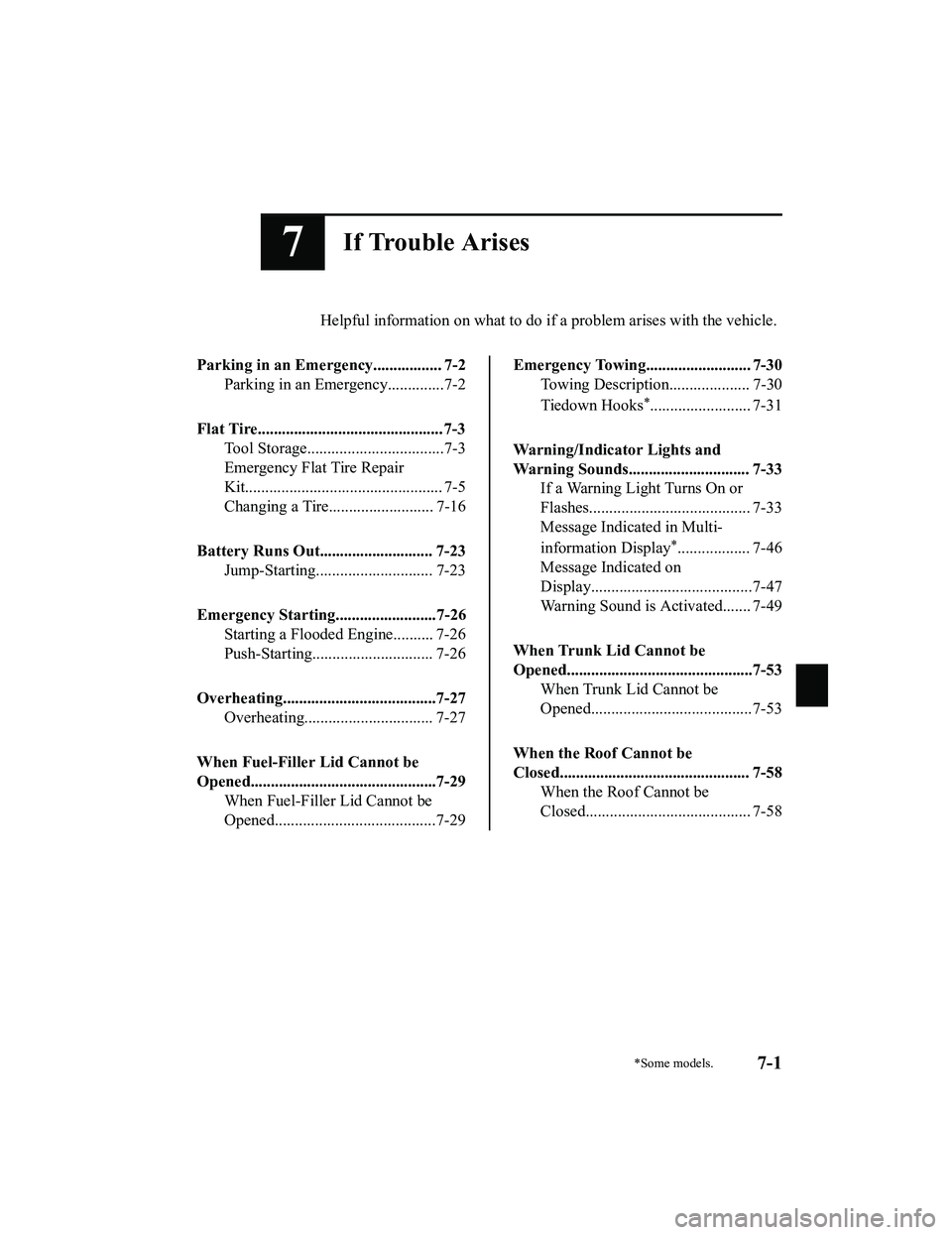
7If Trouble Arises
Helpful information on what to do if a problem arises with the vehicle.
Parking in an Emergency................. 7-2 Parking in an Emergency..............7-2
Flat Tire.............................................. 7-3 Tool Storage..................................7-3
Emergency Flat Tire Repair
Kit................................................. 7-5
Changing a Tire.......................... 7-16
Battery Runs Out............................ 7-23 Jump-Starting............................. 7-23
Emergency Starting.........................7-26 Starting a Flooded Engine.......... 7-26
Push-Starting.............................. 7-26
Overheating......................................7-27 Overheating................................ 7-27
When Fuel-Filler Lid Cannot be
Opened..............................................7-29 When Fuel-Filler Lid Cannot be
Opened........................................7-29
Emergency Towing.......................... 7-30
Towing Description.................... 7-30
Tiedown Hooks
*......................... 7-31
Warning/Indicator Lights and
Warning Sounds.............................. 7-33 If a Warning Light Turns On or
Flashes........................................ 7-33
Message Indicated in Multi-
information Display
*.................. 7-46
Message Indicated on
Display........................................7-47
Warning Sound is Activated....... 7-49
When Trunk Lid Cannot be
Opened..............................................7-53 When Trunk Lid Cannot be
Opened........................................7-53
When the Roof Cannot be
Closed............................................... 7-58 When the Roof Cannot be
Closed......................................... 7-58
*Some models.7-1
MX-5_8GF7-EA-17J_Edition2 2017-10-31 14:07:27
Page 462 of 576

Starting a Flooded Engine
If the engine fails to start, it may be
flooded (excessive fuel in the engine).
Follow this procedure:
1. If the engine does not start within fiveseconds on the first try, wait ten
seconds and try again.
2. Make sure the parking brake is on.
3. Depress the accelerator all the way and hold it there.
4. Depress the clutch pedal (Manual transmission) or the brake pedal
(Automatic transmission), then press
the push button start. If the engine
starts, release the accelerator
immediately because the engine will
suddenly rev up.
5. If the engine fails to start, crank it
without depressing the accelerator.
If the engine still does not start using the
previous procedure, have your vehicle
inspected by an Authorized Mazda Dealer.
Push-Starting
Do not push-start your Mazda.
WA R N I N G
Never tow a vehicle to start it:
Towing a vehicle to start it is dangerous.
The vehicle being towed could surge
forward when its engine starts, causing the
two vehicles to collide. The occupants
could be injured.
CAUTION
Do not push-start a vehicle that has a
manual transmission. It can damage the
emission control system.
NOTE
You cannot start a vehicle with an
automatic transmission by pushing it.
If Trouble Arises
Emergency Starting
7-26
MX-5_8GF7-EA-17J_Edition2 2017-10-31 14:07:27
Page 466 of 576

Towing Description
We recommend that towing be done only
by an Authorized Mazda Dealer or a
commercial tow-truck service.
Proper lifting and towing are necessary to
prevent damage to the vehicle.
Government and local laws must be
followed.
A towed vehicle usually should have its
drive wheels (rear wheels) off the ground.
If excessive damage or other conditions
prevent this, use wheel dollies.
Wheel dollies
When towing with the rear wheels on the
ground, release the parking brake.
CAUTION
Do not tow the vehicle pointed backward
with driving wheels on the ground. This
may cause internal damage to the
transmission.
Do not tow with sling-type equipment.
This could damage your vehicle. Use
wheel-lift or
flatbed equipment.
If Trouble Arises
Emergency Towing
7-30
MX-5_8GF7-EA-17J_Edition2
2017-10-31 14:07:27
Page 467 of 576

Tiedown Hooks*
CAUTION
Do not use the front and rear tiedown
eyelets for towing the vehicle.
They have been designed only for securing
the vehicle to a transport vessel during
shipping.
Using the eyelets for any other purpose
could result in the vehicle being damaged.
▼Tiedown Hooks
1. Remove the tiedown eyelet and the lug
wrench from the luggage compartment
(page 7-3).
2. Wrap a flathead screwdriver or similar
tool with a soft c loth to prevent
damage to a painted bumper, and open
the cap located on the front or rear
bumper.
Front
Rear
CAUTION
Do not use excessive force as it may
damage the cap or scratch the painted
bumper surface.
NOTE
Remove the cap completely and store it
so as not to lose it.
3. Securely install the tiedown eyelet using the lug wrench or equivalent.
Consult an Authorized Mazda Dealer.
Front
Lug wrench
Tiedown eyelet
If Trouble Arises
Emergency Towing
*Some models.7-31
MX-5_8GF7-EA-17J_Edition2 2017-10-31 14:07:27
Page 468 of 576

Rear
Lug wrench
Tiedown eyelet
4. Hook the tying rope to the tiedown eyelet.
CAUTION
If the tiedown eyelet is not securely
tightened, it may loosen or disengage
from the bumper when tying the
vehicle. Make sure that the tiedown
eyelet is securely tightened to the
bumper.
If Trouble Arises
Emergency Towing
7-32
MX-5_8GF7-EA-17J_Edition2 2017-10-31 14:07:27
Page 539 of 576

Vehicle Loading
WA R N I N G
Do not tow a trailer with this vehicle:
Towing a trailer with this vehicle is dangerous because it has not been designed to tow a
trailer and doing so will affect the drive sy stem which could result in vehicle damage.
This section will guide you in the proper loading of your vehic le, to keep your loaded
vehicle weight within its desig n rating capability. Properly loading your vehicle will provide
maximum return of vehicle design performance. Before loading yo ur vehicle, familiarize
yourself with the following term s for determining your vehicle's weight ratings, from the
vehicle's Safety Certification La bel and Tire and Load Information Label:
WA R N I N G
Overloaded Vehicle:
Overloading a vehicle is dangerous. The results of overloading can have serious consequences
in terms of passenger safety. Too much weight on a vehicle's suspension system can cause
spring or shock absorber failure, brake failure , handling or steering problems, irregular tire
wear, tire failure or other damage.
Overloading makes a vehicle harder to drive and control. It also increases the distance
required for stopping. In cases of serious overl oading, brakes can fail completely, particularly
on steep grades. The load a tire will carry safely is a combination of the size of the tire, its load
range, and corresponding inflation pressure.
Never overload the vehicle and always observe th e vehicle's weight ratings from the vehicle's
Safety Certification and Tire and Load Information labels.
Customer Information and Reporting Safety Defects
Tire Information (U.S.A.)
8-37
MX-5_8GF7-EA-17J_Edition2 2017-10-31 14:07:27