flat MAZDA MODEL MX-5 MIATA PRHT 2012 User Guide
[x] Cancel search | Manufacturer: MAZDA, Model Year: 2012, Model line: MODEL MX-5 MIATA PRHT, Model: MAZDA MODEL MX-5 MIATA PRHT 2012Pages: 456, PDF Size: 5.68 MB
Page 47 of 456

Black plate (47,1)
Supplemental Restraint System Components
Driver/Passenger inflators and air bags
Crash sensor, and diagnostic module (SAS unit)
Seat belt pretensioner and load limiting systems (page 2-13)
Front air bag sensor
Side crash sensorsí
Air bag/seat belt pretensioner system warning light (page 2-38)
Side inflators and air bagsí
Passenger air bag deactivation indicator light (page 2-47)
Passenger air bag deactivation switch (page 2-43)
Passenger seat weight sensors (page 2-47)
Passenger seat weight sensor control module
Driver and passenger seat belt buckle switches (page 2-50)
Driver seat slide position sensor (page 2-47)
Essential Safety Equipment
SRS Air Bags
2-35íSome models.
MX-5_8CC1-EA-11F_Edition2 Page47
Monday, July 18 2011 10:7 AM
Form No.8CC1-EA-11F
Page 48 of 456

Black plate (48,1)
How the SRS Air Bags Work
Your Mazda is equipped with the following types of SRS air bags. SRS air bags are
designed to work together with the seat belts to help to reduce injuries during an accident.
The SRS air bags are designed to provide further protection for passengers in addition to
the seat belt functions. Be sure to wear seat belts properly.
qSeat Belt Pretensioners
The seat belt pretensioners are designed to deploy in moderate or severe frontal, near
frontal collisions.
qDriver Air Bag
The driver's air bag is mounted in the steering wheel.
When air bag crash sensors detect a frontal impact of greater than moderate force, the
driver's air bag inflates quickly helping to reduce injury mainly to the driver's head or chest
caused by directly hitting the steering wheel.
For more details about air bag deployment, refer to “SRS Air Bag Deployment Criteria ”
(page 2-40).
The driver's dual-stage air bag controls air bag inflation in two energy stages. During an
impact of moderate severity the driver's air bag deploys with lesser energy, whereas during
more severe impacts, it deploys with more energy.
2-36
Essential Safety Equipment
SRS Air Bags
MX-5_8CC1-EA-11F_Edition2 Page48
Monday, July 18 2011 10:7 AM
Form No.8CC1-EA-11F
Page 49 of 456

Black plate (49,1)
qPassenger Air Bag
The passenger air bag is mounted in the passenger dashboard.
The inflation mechanism for the passenger air bag is the same as the driver's air bag, as
mentioned above.
For more details about air bag deployment, refer to “SRS Air Bag Deployment Criteria ”
(page 2-40).
In addition, the passenger air bag is designed to only deploy in accordance with the total
seated weight on the passenger seat. For details, refer to the driver and passenger occupant
classification system (page 2-47).
Essential Safety Equipment
SRS Air Bags
2-37
MX-5_8CC1-EA-11F_Edition2 Page49
Monday, July 18 2011 10:7 AM
Form No.8CC1-EA-11F
Page 50 of 456

Black plate (50,1)
qSide Air Bagsí
The side air bags are mounted in the outboard sides of the front seatbacks.
When the air bag crash sensors detect a side impact of greater than moderate force, the
system inflates the side air bag only on the side in which the vehicle was hit. The side air
bag inflates quickly to reduce injury to the driver or front passenger's chest caused by
directly hitting interior parts such as a door or window.
For more details about air bag deployment, refer to “SRS Air Bag Deployment Criteria ”
(page 2-40).
In addition, the front passenger side air bag is designed to only deploy in accordance with
the total seated weight on the front passenger seat. For details, refer to the driver and front
passenger occupant classification system (page 2-47).
q Air Bag/Seat Belt Pretensioner System Warning Light
If the air bag/seat belt pretensioner system is working properly, the warning light
illuminates when the ignition is switched ON or after the engine is cranked. The warning
light turns off after a specified period of time.
A system malfunction is indicated if the warning light constantly flashes, constantly
illuminates or does not illuminate at all when the ignition is switched ON. If any of these
occur, consult an Authorized Mazda Dealer as soon as possible. The system may not
operate in an accident.
2-38
Essential Safety Equipment
íSome models.
SRS Air Bags
MX-5_8CC1-EA-11F_Edition2 Page50
Monday, July 18 2011 10:7 AM
Form No.8CC1-EA-11F
Page 69 of 456
Black plate (69,1)
qAdvanced Key Maintenance
CAUTION
Ø Make sure the battery is installed
with the correct pole facing
upward. Battery leakage could
occur if it is not installed correctly.
Ø When replacing the battery, be
careful not to touch any of the
internal circuitry and electrical
terminals, bend the electrical
terminals, or get dirt in the
transmitter as the transmitter
could be damaged.
Ø There is the danger of explosion if
the battery is not correctly
replaced.
Ø Replace only with the same type
battery (CR2025 or equivalent).
Ø Dispose of used batteries
according to the following
instructions.
ØInsulate the plus and minus
terminals of the battery using
cellophane or equivalent tape.
ØNever disassemble.
ØNever throw the battery into
fire or water.
ØNever deform or crush.
The following conditions indicate that the
battery power is low:
lThe KEY indicator light (green) flashes
in the instrument cluster for about 30
seconds after the engine is turned off.
lThe system does not operate and the
operation indicator light on the
transmitter does not flash when the
buttons are pressed.
lThe system's operational range is
reduced. Replacing the battery at an Authorized
Mazda Dealer is recommended to prevent
damage to the advanced key. If replacing
the battery by yourself, follow the
instruction below.
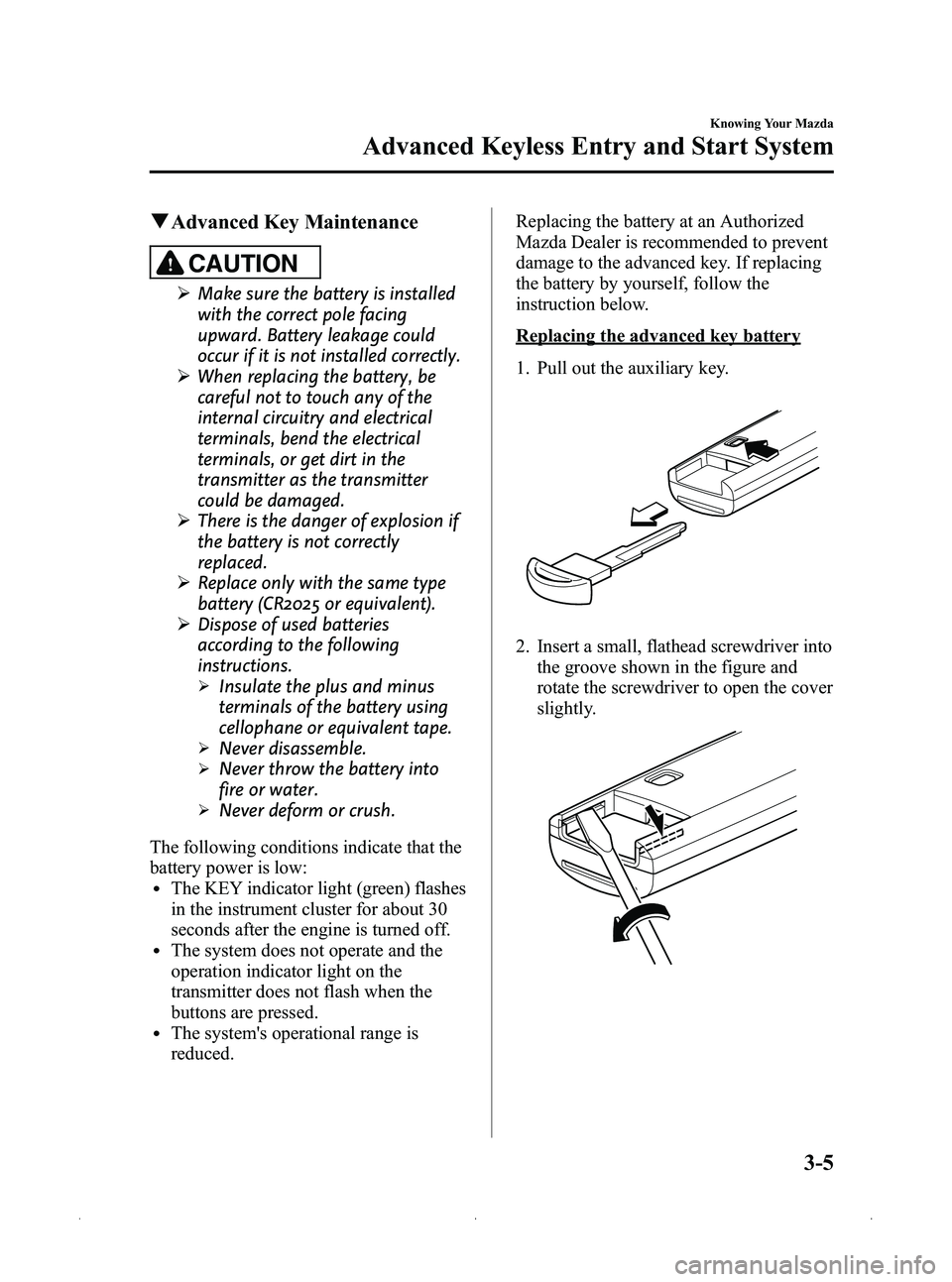
Replacing the advanced key battery
1. Pull out the auxiliary key.
2. Insert a small, flathead screwdriver into
the groove shown in the figure and
rotate the screwdriver to open the cover
slightly.
Knowing Your Mazda
Advanced Keyless Entry and Start System
3-5
MX-5_8CC1-EA-11F_Edition2 Page69
Monday, July 18 2011 10:7 AM
Form No.8CC1-EA-11F
Page 70 of 456

Black plate (70,1)
3. Insert the small, flathead screwdriverinto the gap between the cover and the
transmitter, and then rotate the
screwdriver to detach the cover.
4. Remove the battery cap, then removethe battery.
5. Insert a new battery with the positivepole facing up, and then cover the
battery with the battery cap.
6. Close the cover.
7. Reinsert the auxiliary key.
3-6
Knowing Your Mazda
Advanced Keyless Entry and Start System
MX-5_8CC1-EA-11F_Edition2 Page70
Monday, July 18 2011 10:7 AM
Form No.8CC1-EA-11F
Page 138 of 456

Black plate (138,1)
Steering Wheel
WARNING
Never adjust the steering wheel while
the vehicle is moving:Adjusting the steering wheel while
the vehicle is moving is dangerous.
Moving it can very easily cause the
driver to abruptly turn to the left or
right. This can lead to loss of control
or an accident.
qTilt Steering Wheel
To change the angle of the steering wheel,
stop the vehicle, pull the tilt wheel release
lever under the steering column down,
adjust the wheel, then push the release
lever up to lock the column.
Tilt wheel release
lever
After adjusting, push the wheel up and
down to be certain it's locked before
driving.
Mirrors
qOutside Mirrors
Check the mirror angles before driving.
Mirror type
Flat type (driver's side)
Flat surface mirror.
Convex type (passenger side)
The mirror has single curvature on its
surface.
WARNING
Be sure to look over your shoulder
before changing lanes:
Changing lanes without taking into
account the actual distance of the
vehicle in the convex mirror is
dangerous. You could have a serious
accident. What you see in the convex
mirror is closer than it appears.
Power mirror
The ignition must be switched to ACC or
ON.
To adjust:
1. Press the left or right side of the
selector switch to choose the left or
right side mirror.
3-74
Knowing Your Mazda
Steering Wheel and Mirrors
MX-5_8CC1-EA-11F_Edition2 Page138
Monday, July 18 2011 10:8 AM
Form No.8CC1-EA-11F
Page 147 of 456

Black plate (147,1)
Before Getting In
lBe sure the windows, outside mirrors,
and outside lights are clean.
lInspect inflation pressures and
condition of tires.
lLook under the vehicle for any sign of
fluid leaks.
lIf you plan to back up, make sure
nothing is in your way.
NOTE
Engine oil, engine coolant, brake/clutch fluid,
washer fluid, and other fluid levels should be
inspected. See Maintenance, Section 8.
After Getting In
lAre all doors closed and locked?lIs the seat adjusted properly?lAre the inside and outside mirrors
adjusted?
lIs the steering wheel adjusted properly?lIs each occupant's seat belt fastened?lCheck all gauges.lCheck all warning lights when the
ignition is switched ON.
lRelease the parking brake and make
sure the brake warning light goes off.
Always be thoroughly familiar with your
Mazda.
Before Driving Your Mazda
Before Starting the Engine
4-5
MX-5_8CC1-EA-11F_Edition2 Page147
Monday, July 18 2011 10:8 AM
Form No.8CC1-EA-11F
Page 148 of 456

Black plate (148,1)
Break-In Period
No special break-in is necessary, but a few
precautions in the first 1,000 km (600
miles) may add to the performance,
economy, and life of your Mazda.
lDo not race the engine.lDo not maintain one constant speed,
either slow or fast, for a long period of
time.
lDo not drive constantly at full-throttle
or high engine rpm for extended
periods of time.
lAvoid unnecessary hard stops.lAvoid full-throttle starts.
Money-Saving Suggestions
How you operate your Mazda determines
how far it will travel on a tank of fuel. Use
these suggestions to help save money on
fuel and repairs.
lAvoid long warm-ups. Once the engine
runs smoothly, begin driving.
lAvoid fast starts.lKeep the engine tuned. Follow the
maintenance schedule (page 8-3) and
have an Authorized Mazda Dealer
perform inspections and servicing.
lUse the air conditioner only when
necessary.
lSlow down on rough roads.lKeep the tires properly inflated.lDo not carry unnecessary weight.lDo not rest your foot on the brake
pedal while driving.
lKeep the wheels in correct alignment.lKeep windows closed at high speeds.lSlow down when driving in crosswinds
and headwinds.
WARNING
Never stop the engine when going
down a hill:Stopping the engine when going
down a hill is dangerous. This causes
the loss of power steering and power
brake control, and may cause
damage to the drivetrain. Any loss of
steering or braking control could
cause an accident.
4-6
Before Driving Your Mazda
Driving Tips
MX-5_8CC1-EA-11F_Edition2 Page148
Monday, July 18 2011 10:8 AM
Form No.8CC1-EA-11F
Page 151 of 456

Black plate (151,1)
Winter Driving
lCarry emergency gear, including tire
chains, window scraper, flares, a small
shovel, jumper cables, and a small bag
of sand or salt.
Ask an Authorized Mazda Dealer to
perform the following precautions:
lHave the proper ratio of antifreeze in
the radiator.
Refer to Engine Coolant on page 8-20.
lInspect the battery and its cables. Cold
reduces battery capacity.
lInspect the ignition system for damage
and loose connections.
lUse washer fluid made with
antifreeze ―but do not use engine
coolant antifreeze for washer fluid
(page 8-23).
lDo not use the parking brake in
freezing weather as it may freeze.
Instead, shift to P with an automatic
transmission and to 1 or R with a
manual transmission. Block the rear
wheels.
lDo not apply excessive force to a
window scraper when removing ice or
frozen snow on the mirror glass and
windshield.
lNever use warm or hot water for
removing snow or ice from windows
and mirrors as it could result in the
glass cracking.
lBraking performance can be adversely
affected if snow or ice adheres to the
brake equipment. If this situation
occurs, drive the vehicle slowly,
releasing the accelerator pedal and
lightly applying the brakes several
times until the brake performance
returns to normal.
q Snow Tires
Use snow tires on all four wheels
Do not go faster than 120 km/h (75 mph)
while driving with snow tires. Inflate
snow tires 30 kPa (0.3 kgf/cm
2, 4.3 psi)
more than recommended on the tire
pressure label (driver's door frame), but
never more than the maximum cold-tire
pressure shown on the tires.
Your vehicle is originally equipped with
summer tires designed for optimum
traction on wet and dry roads. If your
vehicle is to be used on snow and ice
covered roads, Mazda recommends that
you replace the tires originally equipped
on your vehicle with snow tires during the
winter months.
WARNING
Use only the same size and type tires
(snow, radial, or non-radial) on all four
wheels: Using tires different in size or type is
dangerous. Your vehicle's handling
could be greatly affected and result
in an accident.
CAUTION
Check local regulations before using
studded tires.
NOTE
If your vehicle is equipped with the tire
pressure monitoring system, the system may
not function correctly when using tires with
steel wire reinforcement in the sidewalls (page
5-34).
Before Driving Your Mazda
Driving Tips
4-9
MX-5_8CC1-EA-11F_Edition2 Page151
Monday, July 18 2011 10:8 AM
Form No.8CC1-EA-11F