spare tire MAZDA MODEL RX 8 2006 Owners Manual (in English)
[x] Cancel search | Manufacturer: MAZDA, Model Year: 2006, Model line: MODEL RX 8, Model: MAZDA MODEL RX 8 2006Pages: 434
Page 126 of 434

Black plate (126,1)
qSnow Tires
Use snow tires on all four wheels
Don't go faster than 120 km/h (75 mph)
while driving with snow tires. Inflate
snow tires 30 kPa (0.3 kgf/cm
2, 4.3 psi)
more than recommended on the tire
pressure label (rear door on the driver's
side), but never more than the maximum
cold-tire pressure shown on the tires.
Your vehicle is originally equipped with
summer tires designed for optimum
traction on wet and dry roads. If your
vehicle is to be used on snow and ice
covered roads, Mazda recommends that
you replace the tires originally equipped
on your vehicle with snow tires during the
winter months.
WARNING
Mixing Tire Types:
Using tires different in size or type is
dangerous. Your vehicle's handling
could be greatly affected and result in
an accident. Use only the same size
and type tires (snow, radial, or non-
radial) on all four wheels.
CAUTION
Check local regulations before using
studded tires.
NOTE
If your vehicle is equipped with the tire
pressure monitoring system, the system
may not function correctly when using
tires with steel wire reinforcement in
the sidewalls (page 5-29).
qTire Chains
Check local regulations before using tire
chains.
CAUTION
lChains may scratch or chip
aluminum wheels. Install tire chains
on steel wheels only.
lChains may affect handling.
lDon't go faster than 50 km/h (30
mph) or the chain manufacturer's
recommended limit, whichever is
lower.
lDrive carefully and avoid bumps,
holes, and sharp turns.
lAvoid locked-wheel braking.
lDon't use chains on a temporary
spare tire; it may result in damage to
the vehicle and to the tire. Your
vehicle is not equipped with a
factory installed temporary spare
tire.
lDon't use chains on roads that are
free of snow or ice. The tires and
chains could be damaged.
NOTE
If your vehicle is equipped with the tire
pressure monitoring system, the system
may not function correctly when using
tire chains.
Install the chains on the rear tires.
Don't use chains on the front tires.
Use only SAE Class“S”chains, and make
sure they fit.
4-10
Before Driving Your Mazda
Driving Tips
RX-8_8U58-EA-05J_Edition1 Page126
Thursday, August 25 2005 4:54 PM
Form No.8U58-EA-05J
Page 154 of 434
Black plate (154,1)
CAUTION
lThe DSC may not operate correctly
unless the following are observed:
lUse tires of the correct size
specified for your Mazda on all
four wheels.
lUse tires of the same
manufacturer, brand and tread
pattern on all four wheels.
lDo not mix worn tires.
lThe DSC may not operate correctly
when tire chains are used or a
temporary spare tire is installed
because the tire diameter changes.
lIf repair or replacement of the
steering or other surrounding
equipment is necessary, have it done
at an Authorized Mazda Dealer. If
the center position of the steering
deviates, the DSC may not operate
correctly because there is a sensor in
the steering which detects driving
conditions.
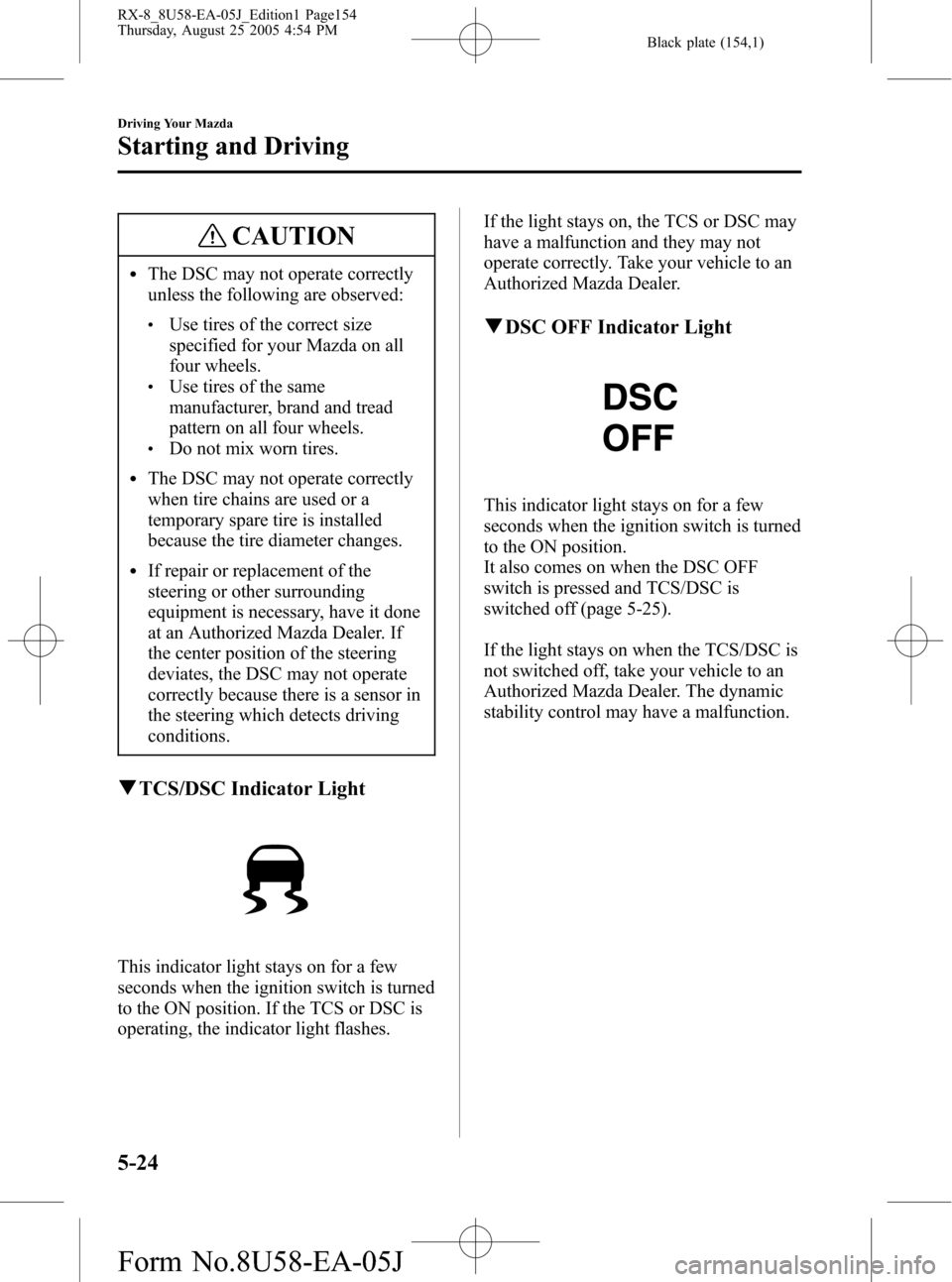
qTCS/DSC Indicator Light
This indicator light stays on for a few
seconds when the ignition switch is turned
to the ON position. If the TCS or DSC is
operating, the indicator light flashes.If the light stays on, the TCS or DSC may
have a malfunction and they may not
operate correctly. Take your vehicle to an
Authorized Mazda Dealer.
qDSC OFF Indicator Light
This indicator light stays on for a few
seconds when the ignition switch is turned
to the ON position.
It also comes on when the DSC OFF
switch is pressed and TCS/DSC is
switched off (page 5-25).
If the light stays on when the TCS/DSC is
not switched off, take your vehicle to an
Authorized Mazda Dealer. The dynamic
stability control may have a malfunction.
5-24
Driving Your Mazda
Starting and Driving
RX-8_8U58-EA-05J_Edition1 Page154
Thursday, August 25 2005 4:54 PM
Form No.8U58-EA-05J
Page 157 of 434

Black plate (157,1)
TPMS does not alleviate your need to
check the pressure and condition of all
four tires before you drive each day.
CAUTION
lEach tire, including the spare (if
provided), should be checked
monthly when cold and inflated to
the inflation pressure recommended
by the vehicle manufacturer on the
vehicle placard or tire inflation
pressure label. (If your vehicle has
tires of a different size than the size
indicated on the vehicle placard or
tire inflation pressure label, you
should determine the proper tire
inflation pressure for those tires.)
As an added safety feature, your
vehicle has been equipped with a tire
pressure monitoring system (TPMS)
that illuminates a low tire pressure
telltale when one or more of your
tires is significantly under-inflated.
Accordingly, when the low tire
pressure telltale illuminates, you
should stop and check your tires as
soon as possible, and inflate them to
the proper pressure. Driving on a
significantly under-inflated tire
causes the tire to overheat and can
lead to tire failure. Under-inflation
also reduces fuel efficiency and tire
tread life, and may affect the
vehicle's handling and stopping
ability.
Please note that the TPMS is not a
substitute for proper tire
maintenance, and it is the driver's
responsibility to maintain correct tire
pressure, even if under-inflation has
not reached the level to trigger
illumination of the TPMS low tire
pressure telltale.
CAUTION
lTo avoid false readings, the system
samples for a little while before
indicating a problem. As a result it
will not instantaneously register a
rapid tire deflation or blow out.
NOTE
This device complies with part 15 of the
FCC Rules. Operation is subject to the
following two conditions: (1) This
device may not cause harmful
interference, and (2) this device must
accept any interference received,
including interference that may cause
undesired operation.
qTire Pressure Monitoring System
Warning Light
This warning light illuminates for a few
seconds when the ignition switch is turned
to the ON position.
Thereafter, the warning light illuminates
when tire pressure is too low in one or
more tires, and flashes when there is a
system malfunction.
Driving Your Mazda
Starting and Driving
5-27
RX-8_8U58-EA-05J_Edition1 Page157
Thursday, August 25 2005 4:54 PM
Form No.8U58-EA-05J
Page 159 of 434

Black plate (159,1)
NOTE
lAfter adjusting the tire air pressures,
it may require some time for the
TPMS warning light to go out. If the
TPMS warning light remains
illuminated, drive the vehicle at a
speed of at least 25 km/h (16 mph)
for 10 minutes, and then verify that it
goes out.
If the warning light illuminates again even
after the tire pressures are adjusted, there
may be a tire puncture.
Vehicles with Instant Mobility System
(IMS) emergency flat tire repair kit
If an emergency tire repair is needed,
repair the punctured tire with the
emergency flat tire repair kit (page 7-5).
CAUTION
Do not use non-genuine tire sealant. It
may damage the tire pressure sensor.
Vehicles with optional temporary spare
tire
If you have bought the optional temporary
spare tire, replace the punctured tire with
the temporary spare tire . Refer to the
manufacturer's instructions.
NOTE
A tire pressure sensor is not installed to
the temporary spare tire. The warning
light will flash continuously while the
temporary spare tire is being used.
Warning light flashes
When the warning light flashes, there may
be a system malfunction. Consult an
Authorized Mazda Dealer.
qSystem Error Activation
When the warning light flashes, there may
be a system malfunction. Consult an
Authorized Mazda Dealer.
A system error activation may occur in
the following cases:
lWhen there is equipment or a device
near the vehicle using the same radio
frequency as that of the tire pressure
sensors.
lWhen a metallic device such as a non-
genuine navigation system is equipped
near the center of the dashboard, which
may block radio signals from the tire
pressure sensor to the receiver unit.
lWhen using the following devices in
the vehicle that may cause radio
interference with the receiver unit.
lA digital device such as a personal
computer.
lA current converter device such as a
DC-AC converter.
lWhen excess snow or ice adheres to
the vehicle, especially around the
wheels.
lWhen the tire pressure sensor batteries
are exhausted.
lWhen using a wheel with no tire
pressure sensor installed.
lWhen using tires with steel wire
reinforcement in the side walls.
lWhen using tire chains.
Driving Your Mazda
Starting and Driving
5-29
RX-8_8U58-EA-05J_Edition1 Page159
Thursday, August 25 2005 4:54 PM
Form No.8U58-EA-05J
Page 177 of 434

Black plate (177,1)
NOTE
lAfter adjusting the tire air pressures,
it may require some time for the
TPMS warning light to go out. If the
TPMS warning light remains
illuminated, drive the vehicle at a
speed of at least 25 km/h (16 mph)
for 10 minutes, and then verify that it
goes out.
If the warning light illuminates again even
after the tire pressures are adjusted, there
may be a tire puncture.
Vehicles with Instant Mobility System
(IMS) emergency flat tire repair kit
If an emergency tire repair is needed,
repair the punctured tire with the
emergency flat tire repair kit (page 7-5).
CAUTION
Do not use non-genuine tire sealant. It
may damage the tire pressure sensor.
Vehicles with optional temporary spare
tire
If you have bought the optional temporary
spare tire, replace the punctured tire with
the temporary spare tire . Refer to the
manufacturer's instructions.
NOTE
A tire pressure sensor is not installed to
the temporary spare tire. The warning
light will flash continuously while the
temporary spare tire is being used.
Warning light flashes
When the warning light flashes, there may
be a system malfunction. Consult an
Authorized Mazda Dealer.
qKEY Warning Light (Red)/KEY
Indicator Light (Green) (with
Advanced Key)
This indicator has two colors.
KEY Warning Light (Red)
When illuminated
lWhen the ignition switch is turned to
the ON position, it illuminates
momentarily and then goes out.
lIf any malfunction occurs in the
advanced keyless system, it illuminates
continuously.
WARNING
KEY Warning Light:
If the KEY warning light remains
illuminated, do not continue to drive
using the advanced key system. Park
the vehicle in a safe place and use the
auxiliary key to continue driving the
vehicle. Have the vehicle inspected at
an Authorized Mazda Dealer as soon
as possible.
Driving Your Mazda
Warning/Indicator Lights and Beep Sounds
5-47
RX-8_8U58-EA-05J_Edition1 Page177
Thursday, August 25 2005 4:56 PM
Form No.8U58-EA-05J
Page 247 of 434

Black plate (247,1)
7In Case of an Emergency
Helpful information on what to do in an emergency.
Parking in an Emergency ............................................................. 7-2
Parking in an Emergency .......................................................... 7-2
Flat Tire ......................................................................................... 7-3
Spare Tire and Tool Storage ...................................................... 7-3
Instant Mobility System (IMS) Emergency Flat Tire Repair
Kit ............................................................................................. 7-5
Changing the Tire .................................................................... 7-12
Overheating ................................................................................. 7-18
Overheating ............................................................................. 7-18
Emergency Starting .................................................................... 7-20
Starting a Flooded Engine ....................................................... 7-20
Jump-Starting .......................................................................... 7-21
Push-Starting ........................................................................... 7-24
Emergency Towing ..................................................................... 7-25
Towing Description ................................................................. 7-25
Tiedown Hooks ....................................................................... 7-26
Recreational Towing ............................................................... 7-27
7-1
RX-8_8U58-EA-05J_Edition1 Page247
Thursday, August 25 2005 4:58 PM
Form No.8U58-EA-05J
Page 249 of 434

Black plate (249,1)
Spare Tire and Tool Storage
Tools are stored in the locations illustrated in the diagram.
Lug wrench
Tiedown eyelet Jack handle
JackInstant Mobility System (IMS) Emergency Flat Tire Repair Kit
Tool box
In Case of an Emergency
Flat Tire
7-3
RX-8_8U58-EA-05J_Edition1 Page249
Thursday, August 25 2005 4:58 PM
Form No.8U58-EA-05J
Page 250 of 434

Black plate (250,1)
qJack
To remove the jack
1. Open the tool box.
2. Turn the jack screw counterclockwise.
To secure the jack
Perform the removal procedure in reverse.
qSpare Tire
A temporary spare tire is not equipped
with your Mazda. If an emergency tire
repair is needed, repair the flat tire with
the emergency flat tire repair kit (page
7-5). If you require a temporary spare tire,
consult an Authorized Mazda Dealer.
When installing a temporary spare tire,
follow the manufacturer's instructions for
the temporary spare tire.The temporary spare tire is lighter and
smaller than a conventional tire, and is
designed only for emergency use and
should be used only for VERY short
periods. Temporary spares should
NEVER be used for long drives or
extended periods.
WARNING
Driving with a Temporary Spare Tire
on Ice or Snow:
Driving with a spare tire on the rear
(driving) wheels on ice or snow is
dangerous. Handling will be affected.
You could lose control of the vehicle
and have an accident. Put the spare
tire on the front axle and move a
regular tire to the rear.
CAUTION
lWhen using the temporary spare tire,
driving stability may decrease
compared to when using only the
conventional tire.
Drive carefully.
7-4
In Case of an Emergency
Flat Tire
RX-8_8U58-EA-05J_Edition1 Page250
Thursday, August 25 2005 4:58 PM
Form No.8U58-EA-05J
Page 251 of 434

Black plate (251,1)
CAUTION
lTo avoid damage to the temporary
spare or to the vehicle, observe the
following precautions:
lDon't exceed 80 km/h (50 mph).lAvoid driving over obstacles.
Also, don't drive through an
automatic car wash. This tire's
diameter is smaller than a
conventional tire's, so the ground
clearance is reduced about 25 mm
(1 in).
lDon't use a tire chain on this tire
because it won't fit properly.
lDon't use your temporary spare
on any other vehicle; it has been
designed only for your Mazda.
lUse only one temporary spare tire
on your vehicle at the same time.
(With limited slip differential)
When using the temporary spare tire on
the rear axle, replace it with a standard
tire as soon as possible. The size
difference between the spare and the
standard tire will cause the limited slip
differential to malfunction.
NOTE
(With Tire Pressure Monitoring
System)
A tire pressure sensor is not installed to
the temporary spare tire. The warning
light will flash continuously while the
temporary spare tire is being used (page
5-27).
Instant Mobility System
(IMS) Emergency Flat
Tire Repair Kit
The IMS emergency flat tire repair kit
included with your Mazda is for a
temporary repair of a slightly damaged
flat tire resulting from running over nails
or similar sharp objects on the road
surface.
NOTE
Your vehicle is not equipped with a
spare tire. In the event of a flat tire, use
the emergency flat tire repair kit to
repair the tire temporarily. When doing
the repair, refer to the instructions
included in the emergency flat tire
repair kit. After temporarily repairing a
tire with the emergency flat tire repair
kit, take your vehicle to an Authorized
Mazda Dealer to have the tire replaced.
In Case of an Emergency
Flat Tire
7-5
RX-8_8U58-EA-05J_Edition1 Page251
Thursday, August 25 2005 4:58 PM
Form No.8U58-EA-05J
Page 252 of 434

Black plate (252,1)
qAbout the IMS Emergency Flat
Tire Repair Kit
The IMS emergency flat tire repair kit
includes the following items.
Tire sealant
Injection hoseCompressor
CaseInstruction
Repaired tire
stickerValve core
tool Spare valve
core
Speed restriction
sticker
WARNING
Ingestion of Tire Sealant:
Ingestion of tire sealant is dangerous.
In the event tire sealant is accidentally
swallowed, drink large amounts of
water immediately and seek medical
assistance. Do not allow children to
touch the tire sealant.
Tire Sealant Contacting Eyes and
Skin:
Tire sealant that comes into contact
with the eyes and skin is dangerous. If
tire sealant enters the eyes or contacts
the skin, flush immediately with large
amounts of water and seek medical
assistance. Do not allow children to
touch the tire sealant.
7-6
In Case of an Emergency
Flat Tire
RX-8_8U58-EA-05J_Edition1 Page252
Thursday, August 25 2005 4:58 PM
Form No.8U58-EA-05J