ECU MAZDA MODEL TRIBUTE 2003 (in English) User Guide
[x] Cancel search | Manufacturer: MAZDA, Model Year: 2003, Model line: MODEL TRIBUTE, Model: MAZDA MODEL TRIBUTE 2003Pages: 248, PDF Size: 2.5 MB
Page 73 of 248

3. Insert the new battery. Refer to the diagram inside the remote entry
transmitter for the correct orientation of the battery.
4. Snap the two halves back together.
Note:Replacement of the battery willnotcause the remote transmitter
to become deprogrammed from your vehicle. The remote transmitter
should operate normally after battery replacement.
Replacing lost remote entry transmitters
If you would like to have your remote entry transmitter reprogrammed
because you lost one, or would like to buy additional remote entry
transmitters, you can either reprogram them yourself, or takeall
remote entry transmittersto your authorized Mazda dealer for
reprogramming.
How to reprogram your remote entry transmitters
You must haveall remote entry transmitters(maximum of four)
available before beginning this procedure.
Note:This procedure must be
completed within the specified
times. If not completed within the
specified time period,
reprogramming procedures must be
restarted from the beginning.
To reprogram the remote entry
transmitters:
1. Ensure the vehicle is electronically unlocked.
2. Put the key in the ignition.
3. Turn the key from the 1 (LOCK) position to 3 (ON).
4. Cycle, eight times, rapidly (within 10 seconds) between the 1
(LOCK) position and 3 (ON).Note:The eighth turn must end in the
3 (ON) position.
5. The doors will lock, then unlock, to confirm that the programming
mode has been activated.
6. Within 20 seconds press any button on the remote entry transmitter.
Note:If more than 20 seconds have passed you will need to start
the procedure over again.
Locks and Security
73
Page 74 of 248

7. The doors will lock, then unlock, to confirm that this remote entry
transmitter has been programmed.
8. Repeat Step 6 to program each additional remote entry transmitter.
9. Turn the ignition to the 1 (LOCK) position after you have finished
programming all of the remote entry transmitters.
10. The doors will lock, then unlock, to confirm that the programming
mode has been exited.
Illuminated entry
The interior lamps illuminate when the remote entry system is used to
unlock the door(s) or sound the personal alarm.
The illuminated entry system will turn off the interior lights if:
²the ignition switch is turned to the RUN position, or
²the remote transmitter lock control is pressed, or
²after 30 seconds of illumination.
NOTE:The dome lamp control (if equipped) mustnotbe set to the
OFF position for the illuminated entry system to operate.
The inside lights will not turn off if:
²they have been turned on with the dimmer control, or
²any door is open.
NOTE:The battery saver will shut off the interior lamps 30 minutes
after the ignition has been turned to the OFF position.
SECURILOCKYPASSIVE ANTI-THEFT SYSTEM
SecuriLockypassive anti-theft system is an engine immobilization
system. This system is designed to prevent the engine from being started
unless acoded key programmed to your vehicleis used.
The SecuriLockypassive anti-theft system is not compatible with
non-Mazda aftermarket remote start systems. Use of these systems may
result in vehicle starting problems and a loss of security protection.
Your vehicle comes with two coded keys; additional coded keys may be
purchased from your dealer. The dealer can program your spare keys to
your vehicle or you can program the keys yourself. Refer to
Programming spare keysfor instructions on how to program the coded
key.
Note:A maximum of eight keys can be coded to your vehicle.
Locks and Security
74
Page 75 of 248

Note:Large metallic objects, electronic devices that are used to
purchase gasoline or similar items, or a second coded key on the same
key chain may cause vehicle starting issues. You need to prevent these
objects from touching the coded key while starting the engine. These
objects will not cause damage to the coded key, but may cause a
momentary issue if they are too close to the key when starting the
engine. If a problem occurs, turn the ignition off, remove all objects on
the key chain away from the coded key and restart the engine.
Theft indicator
The theft indicator is located in the instrument cluster.
²When the ignition is in the OFF position, the indicator will flash once
every 2 seconds to indicate the SecuriLockysystem is functioning as
a theft deterrent.
²When the ignition is in the ON position, the indicator will glow for 3
seconds, then turn off, to indicate normal system functionality.
If a problem occurs with the SecuriLockysystem, the indicator will flash
rapidly or glow steadily when the ignition is in the ON position. If this
occurs, the vehicle should be taken to an authorized Mazda dealer for
service.
Automatic arming
The vehicle is armed immediately
after switching the ignition to the 2
(ACC) position.
The light in the instrument cluster
will flash every two seconds when
the vehicle is armed.
Automatic disarming
Switching the ignition to the 3 (ON) position with acoded keydisarms
the vehicle.
Locks and Security
75
Page 76 of 248

²The indicator will illuminate for
three seconds and then go out.
²If the indicator stays on for an
extended period of time or
flashes rapidly, have the system serviced by your authorized Mazda
dealer.
Replacement keys
If your keys are lost or stolen and you don't have an extra coded key,
you will need to have your vehicle towed to a dealership. The key codes
need to be erased from your vehicle and new coded keys and key codes
will need to be programmed.
Replacing coded keys can be very costly. Store an extra programmed key
away from the vehicle in a safe place to help prevent any
inconveniences. Please visit an authorized Mazda dealer to purchase
additional spare or replacement keys.
WARNING: If an unprogrammed key is used in the ignition it
will cause a ªno startº condition.
Programming spare keys
You can program your own coded keys to your vehicle. Please read and
understand the entire procedure before you begin.
Tips:
²Only use Securilockykeys.
²You must have two previously programmed coded keys (keys that
already operate your vehicle's engine) and the new unprogrammed
key(s) readily accessible.
²If you do not have at least 2 previously programmed keys, you must
take your vehicle to your authorized Mazda dealer to have the spare
key(s) programmed.
Locks and Security
76
Page 77 of 248
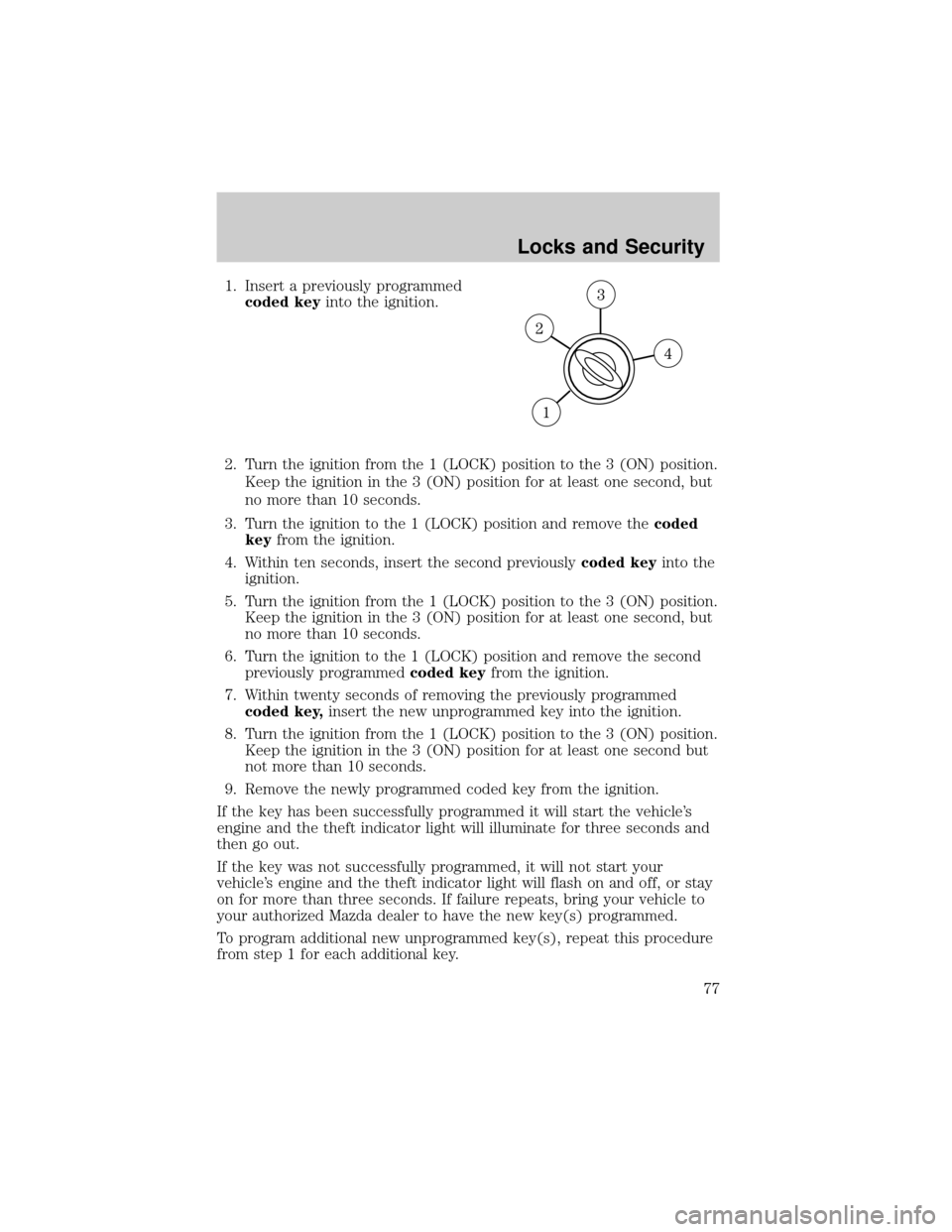
1. Insert a previously programmed
coded keyinto the ignition.
2. Turn the ignition from the 1 (LOCK) position to the 3 (ON) position.
Keep the ignition in the 3 (ON) position for at least one second, but
no more than 10 seconds.
3. Turn the ignition to the 1 (LOCK) position and remove thecoded
keyfrom the ignition.
4. Within ten seconds, insert the second previouslycoded keyinto the
ignition.
5. Turn the ignition from the 1 (LOCK) position to the 3 (ON) position.
Keep the ignition in the 3 (ON) position for at least one second, but
no more than 10 seconds.
6. Turn the ignition to the 1 (LOCK) position and remove the second
previously programmedcoded keyfrom the ignition.
7. Within twenty seconds of removing the previously programmed
coded key,insert the new unprogrammed key into the ignition.
8. Turn the ignition from the 1 (LOCK) position to the 3 (ON) position.
Keep the ignition in the 3 (ON) position for at least one second but
not more than 10 seconds.
9. Remove the newly programmed coded key from the ignition.
If the key has been successfully programmed it will start the vehicle's
engine and the theft indicator light will illuminate for three seconds and
then go out.
If the key was not successfully programmed, it will not start your
vehicle's engine and the theft indicator light will flash on and off, or stay
on for more than three seconds. If failure repeats, bring your vehicle to
your authorized Mazda dealer to have the new key(s) programmed.
To program additional new unprogrammed key(s), repeat this procedure
from step 1 for each additional key.
Locks and Security
77
Page 78 of 248

PERIMETER ALARM SYSTEM (IF EQUIPPED)
The perimeter anti-theft system will help prevent your vehicle from
unauthorized entry.
If there is any potential perimeter anti-theft problem with your vehicle,
ensureALL remote entry transmittersare taken to the dealership to
aid in troubleshooting.
Arming the system
When armed, this system will respond if unauthorized entry is
attempted. When unauthorized entry occurs, the system will flash the
headlamps, parking lamps and will sound the horn.
The system is ready to arm whenever key is removed from the ignition.
Either of the following actions will prearm the alarm system:
²Press the
control on the remote entry transmitter.
²Lock the doors using the key.
NOTE:If a door is open, the system is not armed.
²The system will become prearmed, when all doors are closed. When
the system becomes prearmed the flashers will flash to confirm the
prearming.
²Once the system is prearmed, the system will arm in 20 seconds. If
any door is opened during these 20 seconds, the arming will be
canceled.
Disarming the system
You can disarm the system by any of the following actions:
²Unlock the doors by pressing the
control on your remote entry
transmitter.
²Unlock the doors with a key.
²Pressing the
control on the remote entry transmitter. This will
disarm the system only if the alarm is sounding.
Locks and Security
78
Page 90 of 248
WARNING: In a rollover crash, an unbelted person is
significantly more likely to die or be seriously injured than a
person wearing a seat belt.
WARNING: Each seating position in your vehicle has a specific
safety belt assembly which is made up of one buckle and one
tongue that are designed to be used as a pair. 1) Use the
shoulder belt on the outside shoulder only. Never wear the
shoulder belt under the arm. 2) Never swing the safety belt
around your neck over the inside shoulder. 3) Never use a
single belt for more than one person.
WARNING: Placing a child, 12 years or younger, in the front
seat is dangerous. The child could be hit by a deploying air bag
and be seriously injured or even killed. A sleeping child is more
likely to lean against the door and be hit by the side air bag in a
moderate collision. Whenever possible, always secure a child, 12
years or younger, in the rear seat, with an appropriate child
restraint system for the child's age and size. Never use a
rear-facing child restraint system in the front seat with an air
bag that could deploy.
Energy Management Feature
²This vehicle has a safety belt system with an energy management
feature at the front seating positions to help further reduce the risk of
injury in the event of a head-on collision.
²This safety belt system has a retractor assembly that is designed to
pay out webbing in a controlled manner. This feature is designed to
help reduce the belt force acting on the occupant's chest.
WARNING: All safety belts should be checked for proper
function. Additionally, if the front air bags have deployed, the
front pretensioners have also deployed and the front seat
restraint system must be replaced. After any vehicle collision,
the safety belt system at all outboard seating positions (except
driver, which has no ªautomatic locking retractorº feature)
must be checked by a qualified technician to verify that the
ªautomatic locking retractorº feature for child seats is still
functioning properly.
Seating and Safety Restraints
90
Page 91 of 248

WARNING: BELT AND RETRACTOR ASSEMBLY MUST BE
REPLACED if the safety belt assembly ªautomatic locking
retractorº feature or any other safety belt function is not
operating properly when checked according to the procedures in
Workshop Manual.
WARNING: Failure to replace the Belt and Retractor assembly
could increase the risk of injury in collisions.
Combination lap and shoulder belts
1. Insert the belt tongue into the
proper buckle (the buckle
closest to the direction the
tongue is coming from) until
you hear a snap and feel it
latch. Make sure the tongue is
securely fastened in the buckle.
2. To unfasten, push the release
button and remove the tongue
from the buckle.
The front and rear outboard safety restraints in the vehicle are
combination lap and shoulder belts. The front passenger and rear seat
outboard safety belts have two types of locking modes described below:
Vehicle sensitive mode
This is the normal retractor mode, which allows free shoulder belt length
adjustment to your movements and locking in response to vehicle
movement. For example, if the driver brakes suddenly or turns a corner
Seating and Safety Restraints
91
Page 101 of 248
Children and air bags
For additional important safety
information, read all information on
safety restraints in this guide.
WARNING: Children must
always be properly restrained.
Accident statistics suggest that
children are safer when
properly restrained in the rear
seating positions than in the
front seating position. Failure
to follow these instructions
may increase the risk of injury
in a collision.
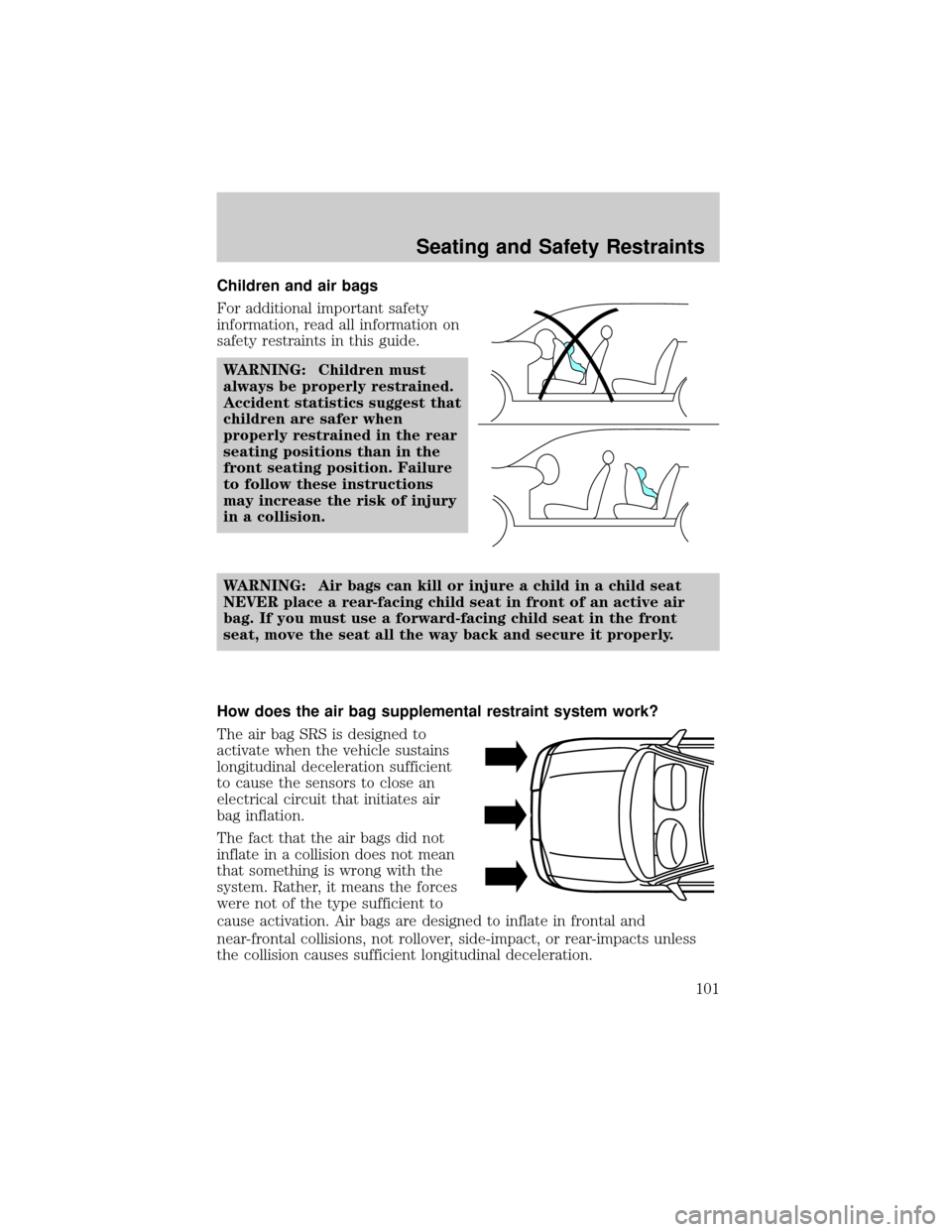
WARNING: Air bags can kill or injure a child in a child seat
NEVER place a rear-facing child seat in front of an active air
bag. If you must use a forward-facing child seat in the front
seat, move the seat all the way back and secure it properly.
How does the air bag supplemental restraint system work?
The air bag SRS is designed to
activate when the vehicle sustains
longitudinal deceleration sufficient
to cause the sensors to close an
electrical circuit that initiates air
bag inflation.
The fact that the air bags did not
inflate in a collision does not mean
that something is wrong with the
system. Rather, it means the forces
were not of the type sufficient to
cause activation. Air bags are designed to inflate in frontal and
near-frontal collisions, not rollover, side-impact, or rear-impacts unless
the collision causes sufficient longitudinal deceleration.
Seating and Safety Restraints
101
Page 109 of 248

WARNING: Do not leave children, unreliable adults, or pets
unattended in your vehicle.
WARNING: Placing a child, 12 years or younger, in the front
seat is dangerous. The child could be hit by a deploying air bag
and be seriously injured or even killed. A sleeping child is more
likely to lean against the door and be hit by the side air bag in a
moderate collision. Whenever possible, always secure a child, 12
years or younger, in the rear seat, with an appropriate child
restraint system for the child's age and size. Never use a
rear-facing child restraint system in the front seat with an air
bag that could deploy.
Child booster seats
Children outgrow a typical convertible or toddler seat when they weigh
40 pounds and are around 4 years of age. Although the lap/shoulder belt
will provide some protection, these children are still too small for
lap/shoulder belts to fit properly, which could increase the risk of serious
injury.
To improve the fit of both the lap and shoulder belt on children who
have outgrown child safety seats, Mazda recommends use of a
belt-positioning booster.
Booster seats position a child so that safety belts fit better. They lift the
child up so that the lap belt rests low across the hips and the knees
bend comfortably. Booster seats also make the shoulder belt fit better
and more comfortably for growing children.
When children should use booster seats
Children need to use booster seats from the time they outgrow the
toddler seat until they are big enough for the vehicle seat and
lap/shoulder belt to fit properly. Generally this is when they weigh about
80 lbs (about 8 to 12 years old).
Seating and Safety Restraints
109