light MAZDA MODEL TRIBUTE 2003 (in English) Workshop Manual
[x] Cancel search | Manufacturer: MAZDA, Model Year: 2003, Model line: MODEL TRIBUTE, Model: MAZDA MODEL TRIBUTE 2003Pages: 248, PDF Size: 2.5 MB
Page 158 of 248
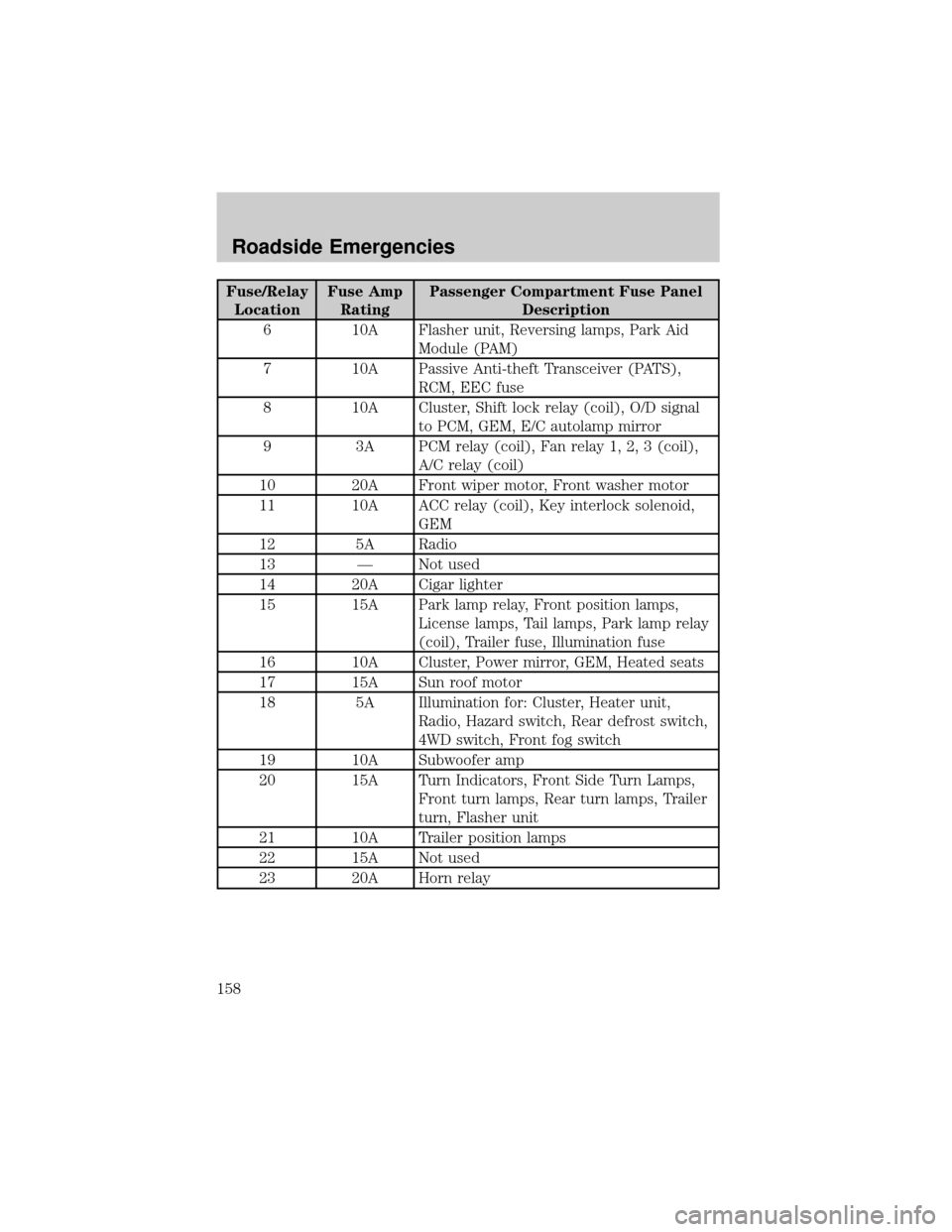
Fuse/Relay
LocationFuse Amp
RatingPassenger Compartment Fuse Panel
Description
6 10A Flasher unit, Reversing lamps, Park Aid
Module (PAM)
7 10A Passive Anti-theft Transceiver (PATS),
RCM, EEC fuse
8 10A Cluster, Shift lock relay (coil), O/D signal
to PCM, GEM, E/C autolamp mirror
9 3A PCM relay (coil), Fan relay 1, 2, 3 (coil),
A/C relay (coil)
10 20A Front wiper motor, Front washer motor
11 10A ACC relay (coil), Key interlock solenoid,
GEM
12 5A Radio
13 Ð Not used
14 20A Cigar lighter
15 15A Park lamp relay, Front position lamps,
License lamps, Tail lamps, Park lamp relay
(coil), Trailer fuse, Illumination fuse
16 10A Cluster, Power mirror, GEM, Heated seats
17 15A Sun roof motor
18 5A Illumination for: Cluster, Heater unit,
Radio, Hazard switch, Rear defrost switch,
4WD switch, Front fog switch
19 10A Subwoofer amp
20 15A Turn Indicators, Front Side Turn Lamps,
Front turn lamps, Rear turn lamps, Trailer
turn, Flasher unit
21 10A Trailer position lamps
22 15A Not used
23 20A Horn relay
Roadside Emergencies
158
Page 161 of 248
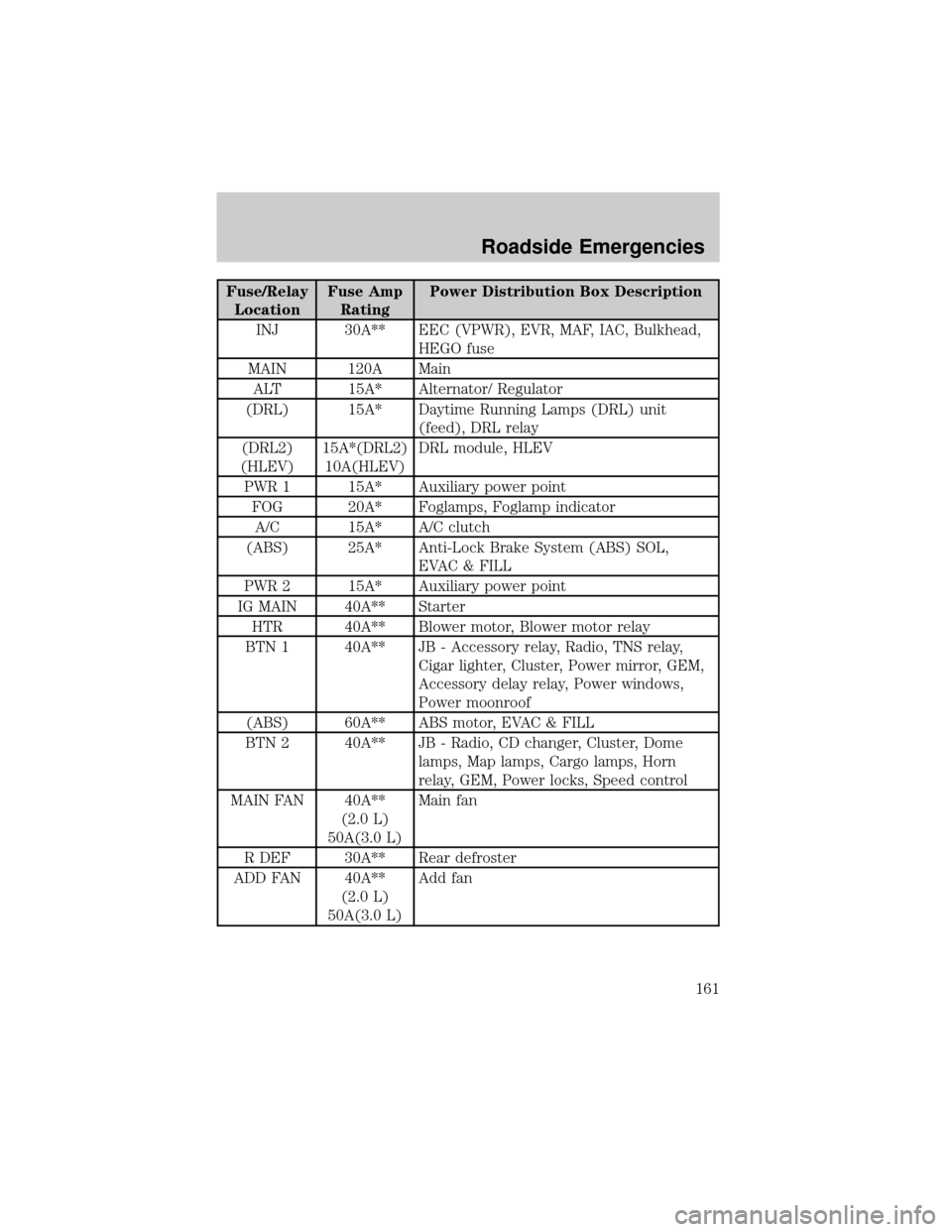
Fuse/Relay
LocationFuse Amp
RatingPower Distribution Box Description
INJ 30A** EEC (VPWR), EVR, MAF, IAC, Bulkhead,
HEGO fuse
MAIN 120A Main
ALT 15A* Alternator/ Regulator
(DRL) 15A* Daytime Running Lamps (DRL) unit
(feed), DRL relay
(DRL2)
(HLEV)15A*(DRL2)
10A(HLEV)DRL module, HLEV
PWR 1 15A* Auxiliary power point
FOG 20A* Foglamps, Foglamp indicator
A/C 15A* A/C clutch
(ABS) 25A* Anti-Lock Brake System (ABS) SOL,
EVAC & FILL
PWR 2 15A* Auxiliary power point
IG MAIN 40A** Starter
HTR 40A** Blower motor, Blower motor relay
BTN 1 40A** JB - Accessory relay, Radio, TNS relay,
Cigar lighter, Cluster, Power mirror, GEM,
Accessory delay relay, Power windows,
Power moonroof
(ABS) 60A** ABS motor, EVAC & FILL
BTN 2 40A** JB - Radio, CD changer, Cluster, Dome
lamps, Map lamps, Cargo lamps, Horn
relay, GEM, Power locks, Speed control
MAIN FAN 40A**
(2.0 L)
50A(3.0 L)Main fan
R DEF 30A** Rear defroster
ADD FAN 40A**
(2.0 L)
50A(3.0 L)Add fan
Roadside Emergencies
161
Page 170 of 248

Connecting the jumper cables
1. Connect the positive (+) booster cable to the positive (+) terminal of
the discharged battery.
Note:In the illustrations,lightning boltsare used to designate the
assisting (boosting) battery.
2. Connect the other end of the positive (+) cable to the positive (+)
terminal of the assisting battery.
+–+–
+–+–
Roadside Emergencies
170
Page 172 of 248

3. Once the disabled vehicle has been started, run both engines for an
additional three minutes before disconnecting the jumper cables.
Removing the jumper cables
Remove the jumper cables in the reverse order that they were
connected.
1. Remove the jumper cable from thegroundmetal surface.
Note:In the illustrations,lightning boltsare used to designate the
assisting (boosting) battery.
2. Remove the jumper cable on the negative (-) connection of the
booster vehicle's battery.
+–+–
+–+–
Roadside Emergencies
172
Page 187 of 248

WASHING THE EXTERIOR
Wash your vehicle regularly with cool or lukewarm water and a neutral
Ph shampoo, such as an approved shampoo available from your Mazda
dealer.
²Never use strong household detergents or soap, such as dish washing
or laundry liquid. These products can discolor and spot painted
surfaces.
²Never wash a vehicle that is ªhot to the touchº or during exposure to
strong, direct sunlight.
²Always use a clean sponge or carwash mitt with plenty of water for
best results.
²Dry the vehicle with a chamois or soft terry cloth towel in order to
eliminate water spotting.
²It is especially important to wash the vehicle regularly during the
winter months, as dirt and road salt are difficult to remove and cause
damage to the vehicle.
²Immediately remove items such as gasoline, diesel fuel, bird droppings
and insect deposits because they can cause damage to the vehicle's
paintwork and trim over time.
²Remove any exterior accessories, such as antennas, before entering a
car wash.
²Suntan lotions and insect repellents can damage any painted
surface; if these substances come in contact with your vehicle,
wash off as soon as possible.
WAXING
Applying a polymer paint sealant to your vehicle every six months will
assist in reducing minor scratches and paint damage.
²Wash the vehicle first.
²Do not use waxes that contain abrasives.
²Do not allow paint sealant to come in contact with any non-body
(low-gloss black) colored trim, such as grained door handles, roof
racks, bumpers, side moldings, mirror housings or the windshield cowl
area. The paint sealant will ªgrayº or stain the parts over time.
Cleaning
187
Page 188 of 248

PAINT CHIPS
Your dealer has touch-up paint to match your vehicle's color. Touch-up
paint can be used to repair minor scratches to painted surfaces.
²Remove particles such as bird droppings, tree sap, insect deposits, tar
spots, road salt and industrial fallout before repairing paint chips.
²Always read the instructions before using the products.
ALUMINUM WHEELS AND COVERS
Aluminum wheel rims or covers are coated with a clearcoat paint finish.
In order to maintain their shine:
²Clean with One Step Wash and Wax Concentrate, which is available
from your authorized Mazda dealer.
²Never apply any cleaning chemical to hot or warm wheel rims or
covers.
²Some automatic car washes may cause damage to the finish on your
wheel rims or covers. Chemical-strength cleaners, or cleaning
chemicals, in combination with brush agitation to remove brake dust
and dirt, could wear away the clearcoat finish over time.
²Do not use hydrofluoric acid-based or high caustic-based wheel
cleaners, steel wool, fuels or strong household detergent.
²To remove tar and grease, use Extra Strength Tar and Road Oil
Removal, available from your authorized Mazda dealer.
ENGINE
Engines are more efficient when they are clean because grease and dirt
buildup keep the engine warmer than normal. When washing:
²Take care when using a power washer to clean the engine. The
high-pressure fluid could penetrate the sealed parts and cause
damage.
²Never spray the engine or other engine components with water. Water
will damage the engine or other engine components.
²Spray Engine Shampoo and Degreaser, available at your authorized
Mazda dealer, on all parts that require cleaning and pressure rinse
clean.
²Cover the highlighted areas to prevent water damage when cleaning
the engine.
Cleaning
188
Page 190 of 248
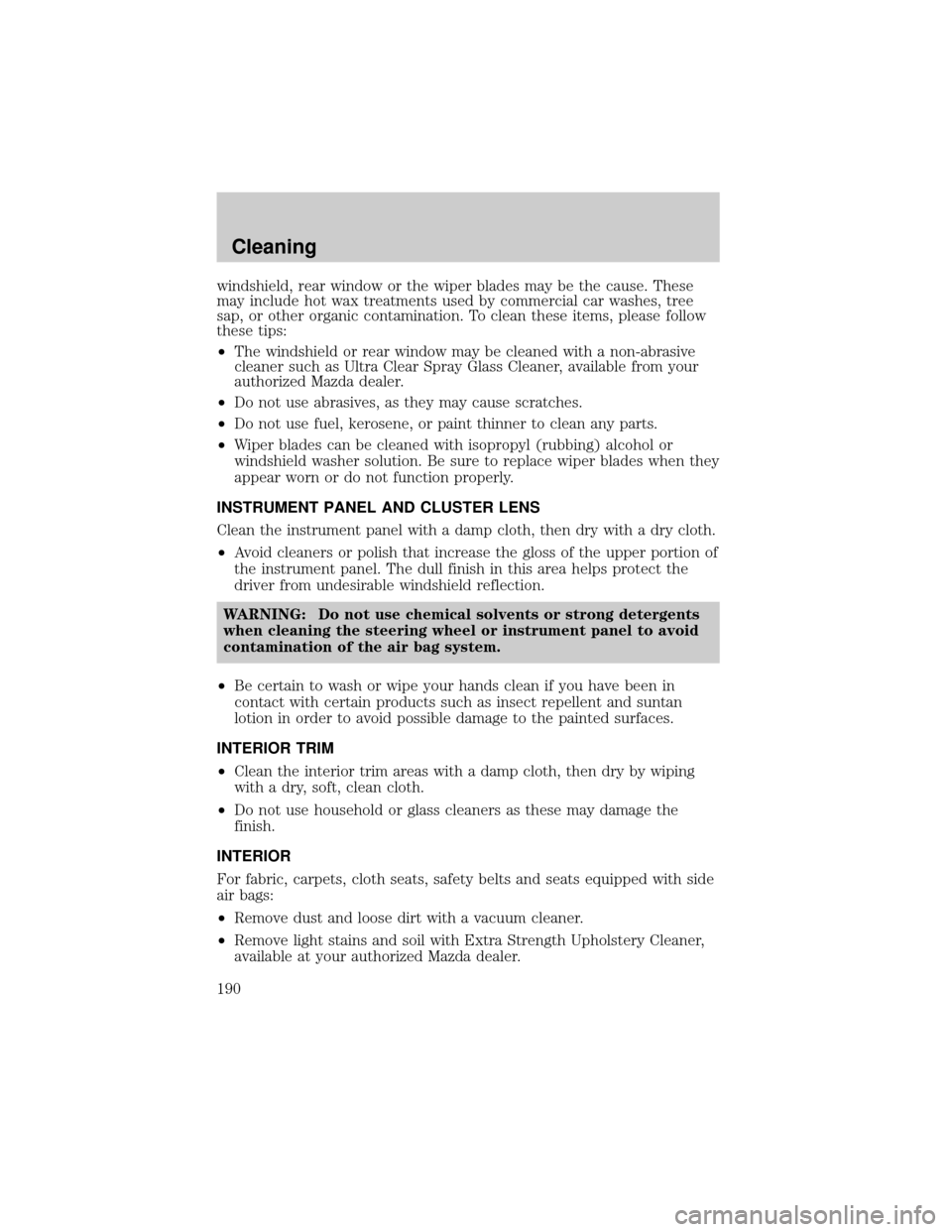
windshield, rear window or the wiper blades may be the cause. These
may include hot wax treatments used by commercial car washes, tree
sap, or other organic contamination. To clean these items, please follow
these tips:
²The windshield or rear window may be cleaned with a non-abrasive
cleaner such as Ultra Clear Spray Glass Cleaner, available from your
authorized Mazda dealer.
²Do not use abrasives, as they may cause scratches.
²Do not use fuel, kerosene, or paint thinner to clean any parts.
²Wiper blades can be cleaned with isopropyl (rubbing) alcohol or
windshield washer solution. Be sure to replace wiper blades when they
appear worn or do not function properly.
INSTRUMENT PANEL AND CLUSTER LENS
Clean the instrument panel with a damp cloth, then dry with a dry cloth.
²Avoid cleaners or polish that increase the gloss of the upper portion of
the instrument panel. The dull finish in this area helps protect the
driver from undesirable windshield reflection.
WARNING: Do not use chemical solvents or strong detergents
when cleaning the steering wheel or instrument panel to avoid
contamination of the air bag system.
²Be certain to wash or wipe your hands clean if you have been in
contact with certain products such as insect repellent and suntan
lotion in order to avoid possible damage to the painted surfaces.
INTERIOR TRIM
²Clean the interior trim areas with a damp cloth, then dry by wiping
with a dry, soft, clean cloth.
²Do not use household or glass cleaners as these may damage the
finish.
INTERIOR
For fabric, carpets, cloth seats, safety belts and seats equipped with side
air bags:
²Remove dust and loose dirt with a vacuum cleaner.
²Remove light stains and soil with Extra Strength Upholstery Cleaner,
available at your authorized Mazda dealer.
Cleaning
190
Page 195 of 248
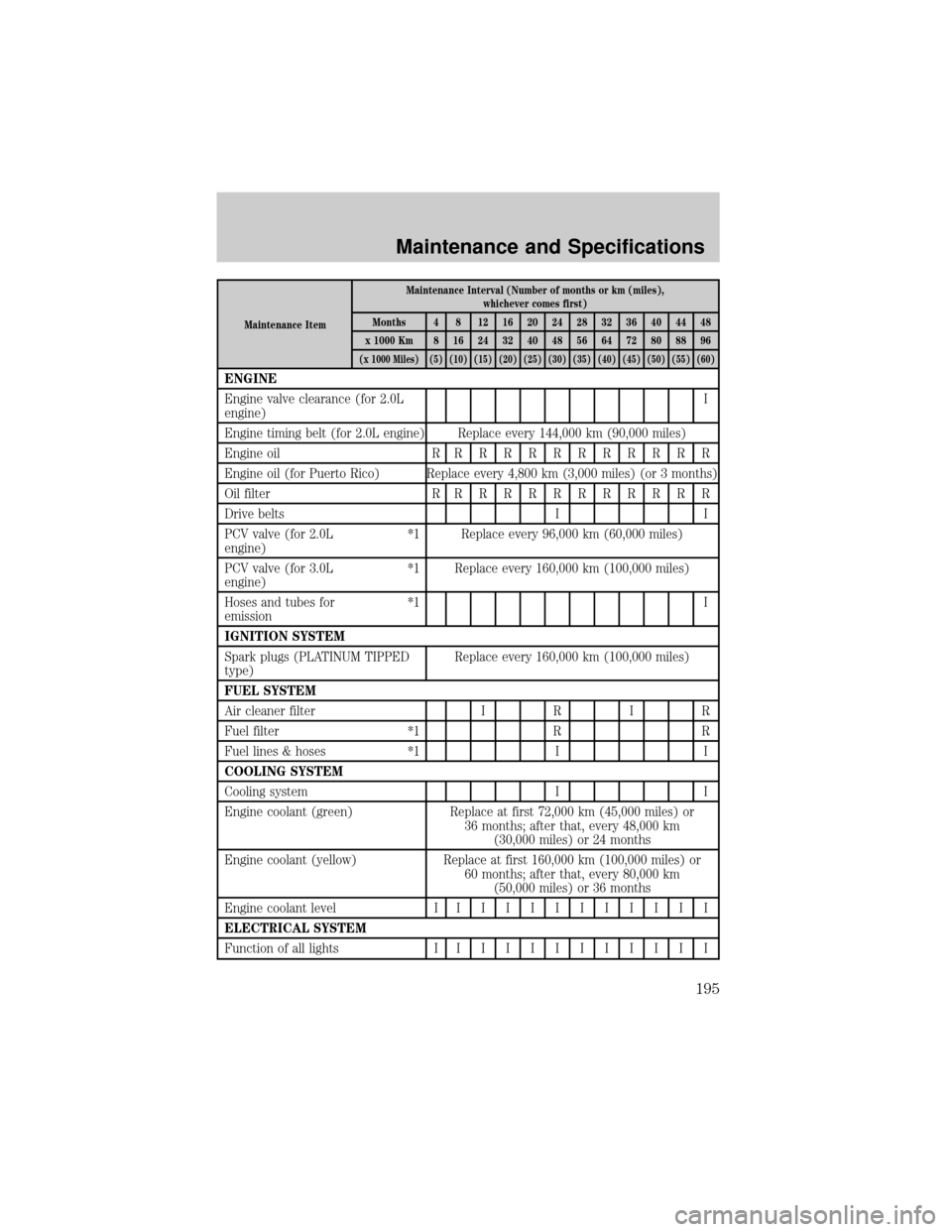
Maintenance ItemMaintenance Interval (Number of months or km (miles),
whichever comes first)
Months 4 8 12 16 20 24 28 32 36 40 44 48
x 1000 Km 8 16 24 32 40 48 56 64 72 80 88 96
(x 1000 Miles) (5) (10) (15) (20) (25) (30) (35) (40) (45) (50) (55) (60)
ENGINE
Engine valve clearance (for 2.0L
engine)I
Engine timing belt (for 2.0L engine) Replace every 144,000 km (90,000 miles)
Engine oil RRRRRRRRRRRR
Engine oil (for Puerto Rico) Replace every 4,800 km (3,000 miles) (or 3 months)
Oil filter RRRRRRRRRRRR
Drive belts I I
PCV valve (for 2.0L
engine)*1 Replace every 96,000 km (60,000 miles)
PCV valve (for 3.0L
engine)*1 Replace every 160,000 km (100,000 miles)
Hoses and tubes for
emission*1 I
IGNITION SYSTEM
Spark plugs (PLATINUM TIPPED
type)Replace every 160,000 km (100,000 miles)
FUEL SYSTEM
Air cleaner filterIRIR
Fuel filter *1 R R
Fuel lines & hoses *1 I I
COOLING SYSTEM
Cooling system I I
Engine coolant (green) Replace at first 72,000 km (45,000 miles) or
36 months; after that, every 48,000 km
(30,000 miles) or 24 months
Engine coolant (yellow) Replace at first 160,000 km (100,000 miles) or
60 months; after that, every 80,000 km
(50,000 miles) or 36 months
Engine coolant level IIIIIIIIIIII
ELECTRICAL SYSTEM
Function of all lights IIIIIIIIIIII
Maintenance and Specifications
195
Page 197 of 248
SERVICE RECOMMENDATIONS
To help you service your vehicle:
²We highlight do-it-yourself items in the engine compartment for easy
location.
²We provide a Scheduled Maintenance section which makes tracking
routine service easy.
If your vehicle requires professional service, your dealership can provide
necessary parts and service. Check your ªWarranty Informationº to find
out which parts and services are covered.
Use only recommended fuels, lubricants, fluids and service parts
conforming to specifications. Genuine Mazda parts are designed and built
to provide the best performance in your vehicle.
PRECAUTIONS WHEN SERVICING YOUR VEHICLE
WARNING: A hot engine is dangerous. If the engine has been
running, parts of the engine compartment can become very hot.
You could be burned. Don't inspect the coolant system or add
coolant when the engine is hot.
²Do not work on a hot engine.
²Make sure that nothing gets caught in moving parts.
²Do not work on a vehicle with the engine running in an enclosed
space, unless you are sure you have enough ventilation.
²Keep all open flames and other lit material away from the battery and
all fuel related parts.
Working with the engine off
²Automatic transmission:
1. Set the parking brake and shift to P (Park).
2. Turn off the engine and remove the key.
3. Block the wheels.
²Manual transmission:
1. Set the parking brake, depress the clutch and place the gearshift in 1
(First).
2. Turn off the engine and remove the key.
3. Block the wheels.
Maintenance and Specifications
197
Page 202 of 248
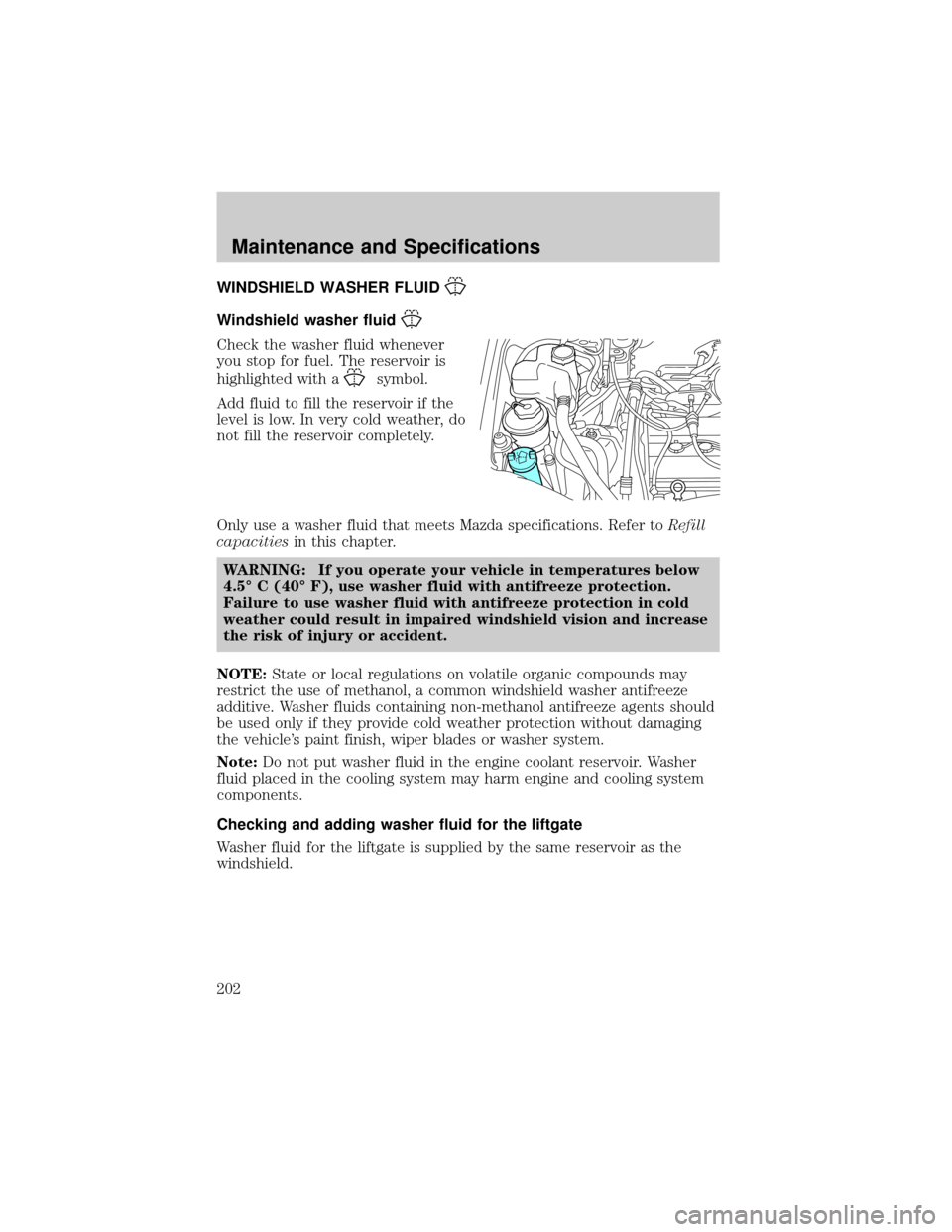
WINDSHIELD WASHER FLUID
Windshield washer fluid
Check the washer fluid whenever
you stop for fuel. The reservoir is
highlighted with a
symbol.
Add fluid to fill the reservoir if the
level is low. In very cold weather, do
not fill the reservoir completely.
Only use a washer fluid that meets Mazda specifications. Refer toRefill
capacitiesin this chapter.
WARNING: If you operate your vehicle in temperatures below
4.5É C (40É F), use washer fluid with antifreeze protection.
Failure to use washer fluid with antifreeze protection in cold
weather could result in impaired windshield vision and increase
the risk of injury or accident.
NOTE:State or local regulations on volatile organic compounds may
restrict the use of methanol, a common windshield washer antifreeze
additive. Washer fluids containing non-methanol antifreeze agents should
be used only if they provide cold weather protection without damaging
the vehicle's paint finish, wiper blades or washer system.
Note:Do not put washer fluid in the engine coolant reservoir. Washer
fluid placed in the cooling system may harm engine and cooling system
components.
Checking and adding washer fluid for the liftgate
Washer fluid for the liftgate is supplied by the same reservoir as the
windshield.
Maintenance and Specifications
202