warning MAZDA MODEL TRIBUTE 2003 (in English) Workshop Manual
[x] Cancel search | Manufacturer: MAZDA, Model Year: 2003, Model line: MODEL TRIBUTE, Model: MAZDA MODEL TRIBUTE 2003Pages: 248, PDF Size: 2.5 MB
Page 113 of 248
²Put the safety belt in the automatic locking mode. Refer toAutomatic
locking mode(passenger side front seat).
Mazda recommends the use of a child safety seat having a top tether
strap. Install the child safety seat in a seating position which is capable
of providing a tether anchorage. For more information on top tether
straps, refer toAttaching child safety seats with tether straps.
WARNING: Carefully follow all of the manufacturer's
instructions included with the safety seat you put in your
vehicle. If you do not install and use the safety seat properly,
the child may be injured in a sudden stop or collision.
Installing child safety seats with combination lap and shoulder
belts (front outboard passenger seat only)
The rear seat head restraints must be removed when using a child
seat.
WARNING: Air bags can kill or injure a child in a child seat.
NEVER place a rear-facing child seat in front of an active air
bag. If you must use a forward-facing child seat in the front
seat, move the seat all the way back.
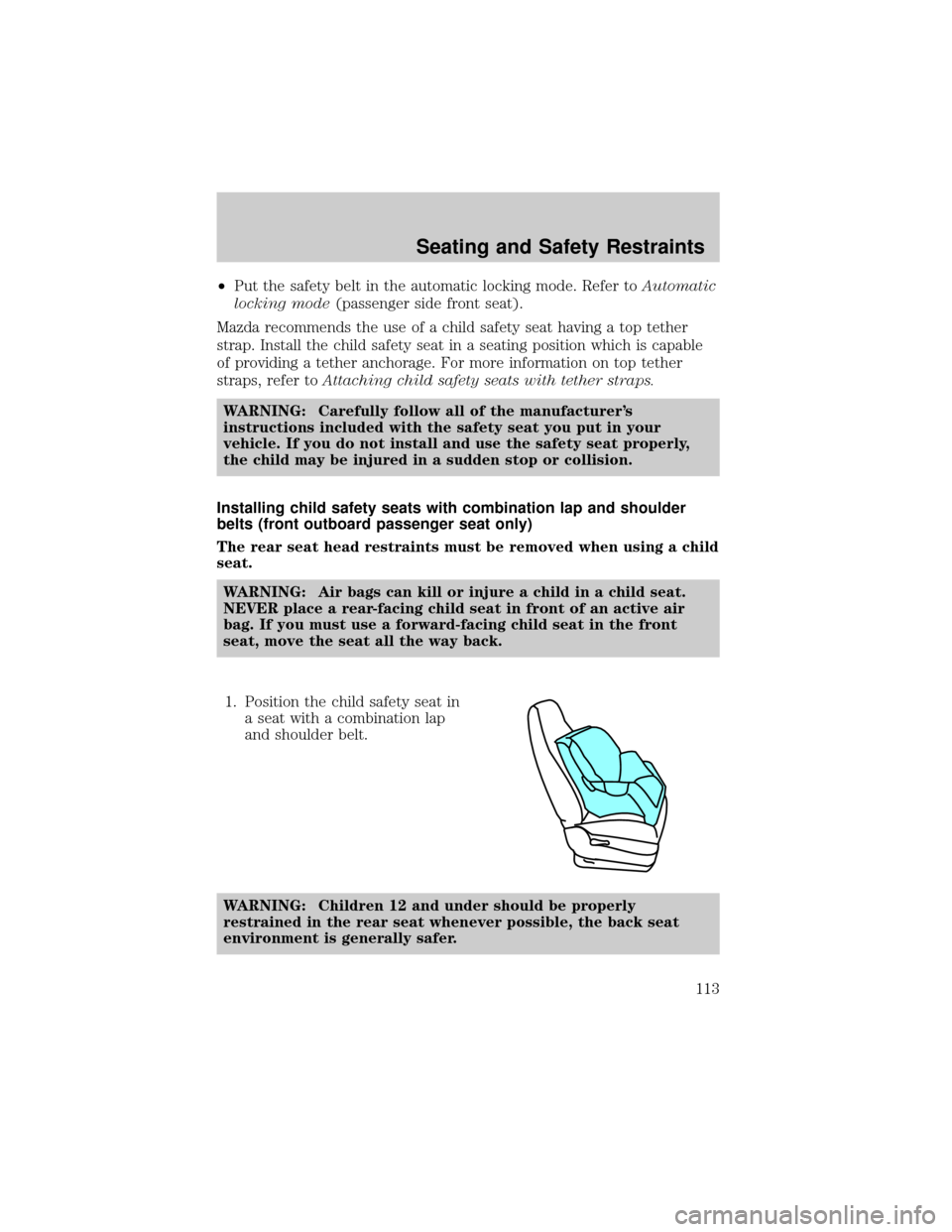
1. Position the child safety seat in
a seat with a combination lap
and shoulder belt.
WARNING: Children 12 and under should be properly
restrained in the rear seat whenever possible, the back seat
environment is generally safer.
Seating and Safety Restraints
113
Page 116 of 248
Check to make sure the child seat is properly secured before each use.
Attaching child safety seats with tether straps
Most new forward-facing child safety seats include a tether strap which
goes over the back of the seat and hooks to an anchoring point. Tether
straps are available as an accessory for many older safety seats. Contact
the manufacturer of your child seat for information about ordering a
tether strap.
The rear seating positions of your vehicle are equipped with built-in
tether strap anchors located behind the seats as described below.
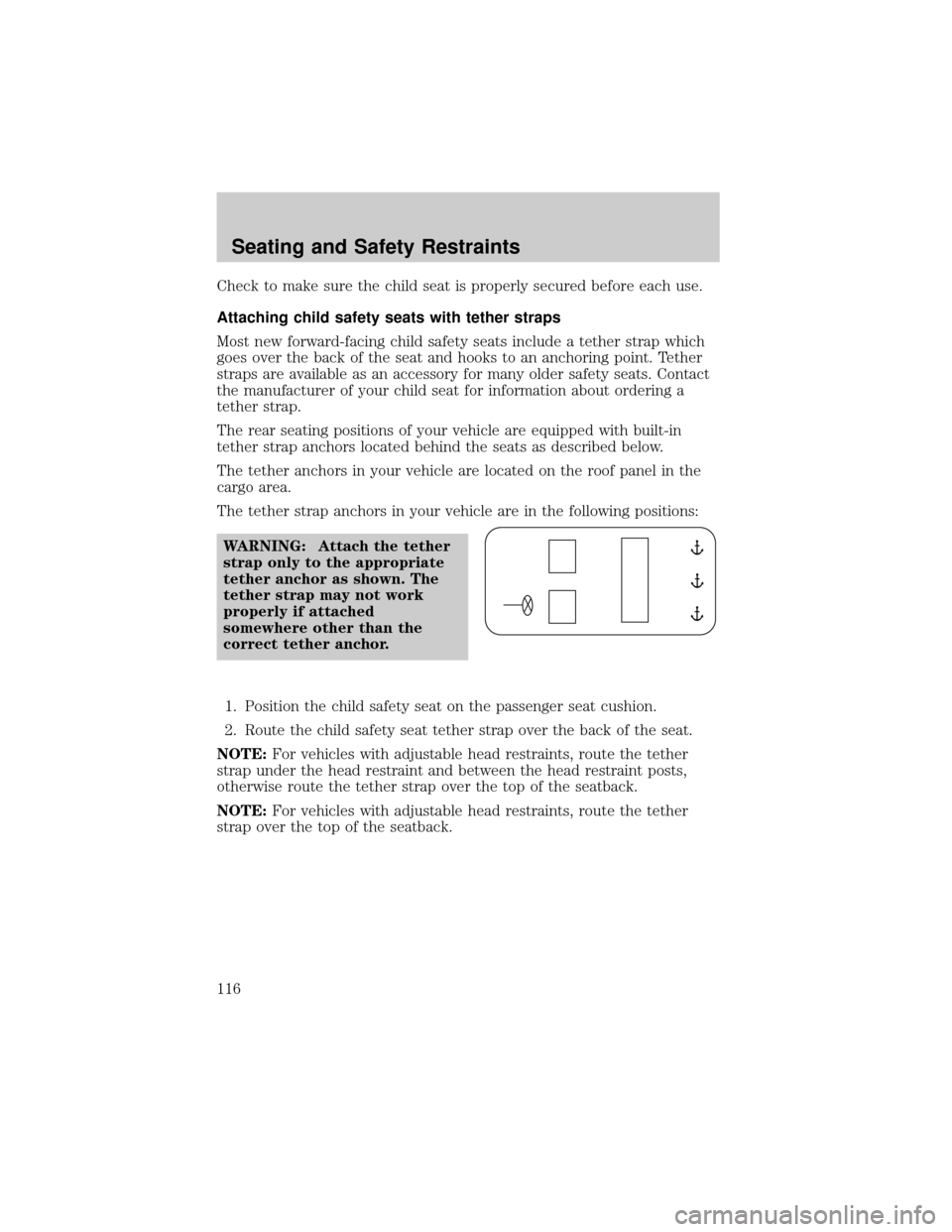
The tether anchors in your vehicle are located on the roof panel in the
cargo area.
The tether strap anchors in your vehicle are in the following positions:
WARNING: Attach the tether
strap only to the appropriate
tether anchor as shown. The
tether strap may not work
properly if attached
somewhere other than the
correct tether anchor.
1. Position the child safety seat on the passenger seat cushion.
2. Route the child safety seat tether strap over the back of the seat.
NOTE:For vehicles with adjustable head restraints, route the tether
strap under the head restraint and between the head restraint posts,
otherwise route the tether strap over the top of the seatback.
NOTE:For vehicles with adjustable head restraints, route the tether
strap over the top of the seatback.
Seating and Safety Restraints
116
Page 117 of 248
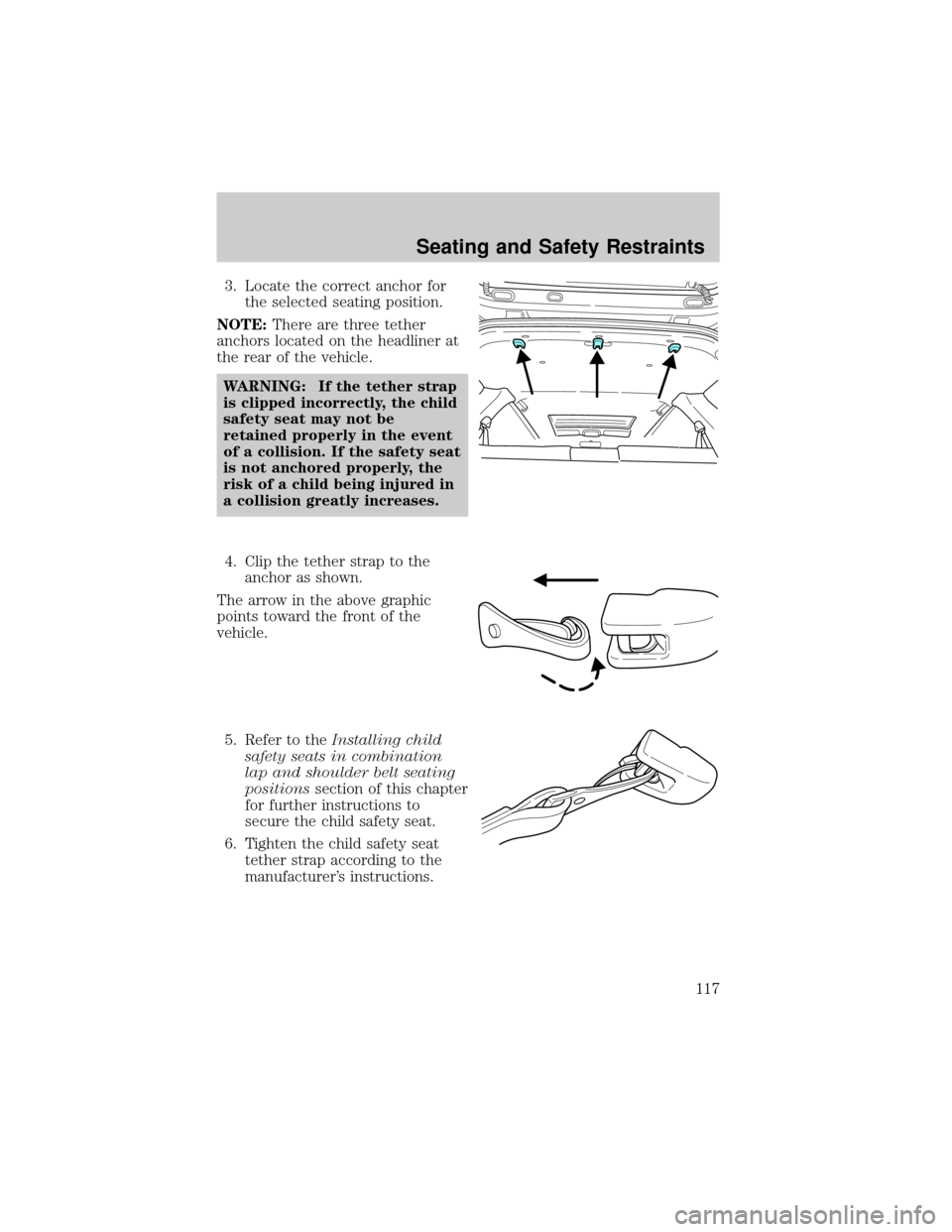
3. Locate the correct anchor for
the selected seating position.
NOTE:There are three tether
anchors located on the headliner at
the rear of the vehicle.
WARNING: If the tether strap
is clipped incorrectly, the child
safety seat may not be
retained properly in the event
of a collision. If the safety seat
is not anchored properly, the
risk of a child being injured in
a collision greatly increases.
4. Clip the tether strap to the
anchor as shown.
The arrow in the above graphic
points toward the front of the
vehicle.
5. Refer to theInstalling child
safety seats in combination
lap and shoulder belt seating
positionssection of this chapter
for further instructions to
secure the child safety seat.
6. Tighten the child safety seat
tether strap according to the
manufacturer's instructions.
Seating and Safety Restraints
117
Page 118 of 248
Attaching safety seats with LATCH (Lower Anchors and Tethers for
Children) attachments for child seat anchors
Some child safety seats have two rigid or webbing mounted attachments
that connect to two anchors at certain seating positions in your vehicle.
When properly installed, this type of seat eliminates the need to use seat
belts to attach the child seat. For forward-facing child seats, the tether
strap must also be attached to the proper tether anchor. SeeAttaching
safety seats with tether strapsin this chapter.
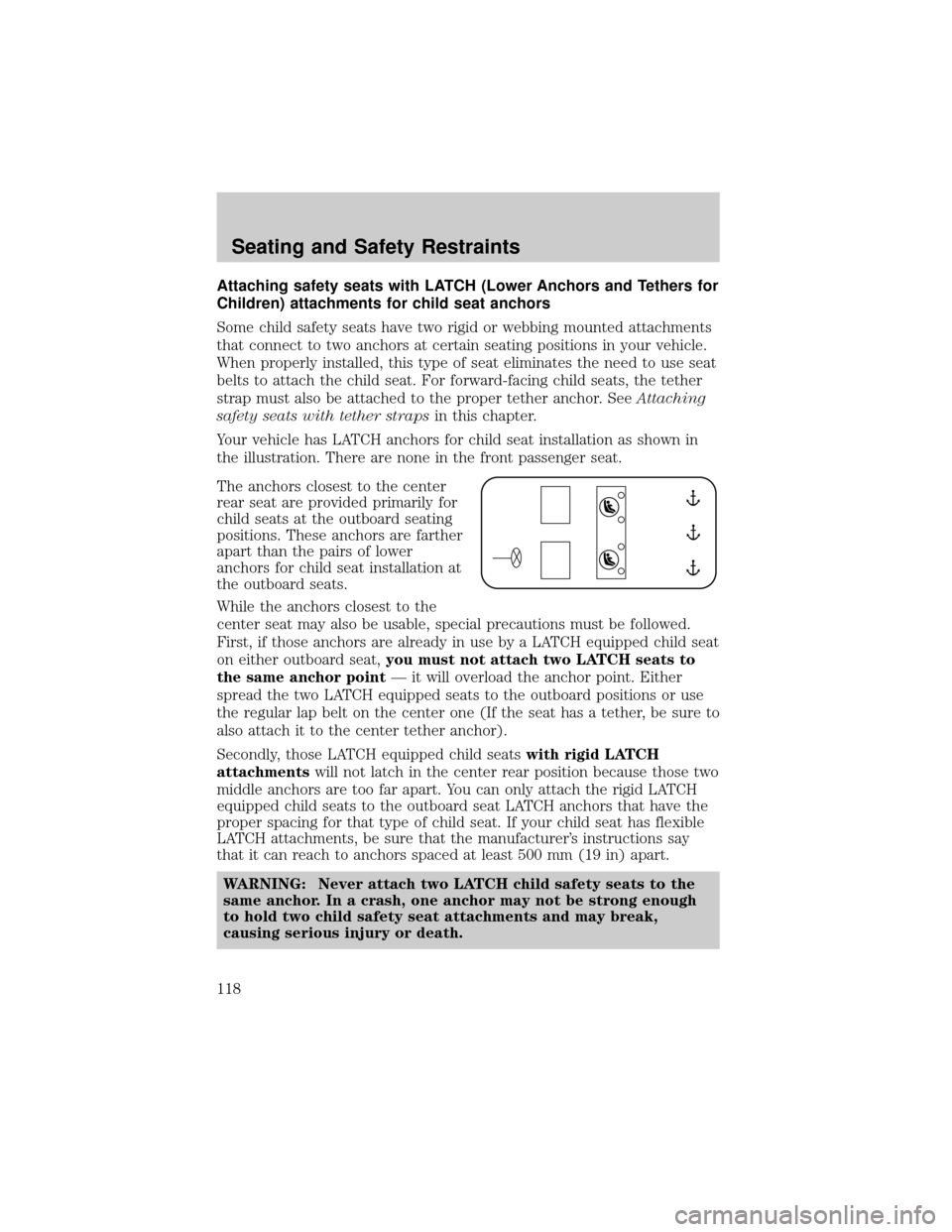
Your vehicle has LATCH anchors for child seat installation as shown in
the illustration. There are none in the front passenger seat.
The anchors closest to the center
rear seat are provided primarily for
child seats at the outboard seating
positions. These anchors are farther
apart than the pairs of lower
anchors for child seat installation at
the outboard seats.
While the anchors closest to the
center seat may also be usable, special precautions must be followed.
First, if those anchors are already in use by a LATCH equipped child seat
on either outboard seat,you must not attach two LATCH seats to
the same anchor pointÐ it will overload the anchor point. Either
spread the two LATCH equipped seats to the outboard positions or use
the regular lap belt on the center one (If the seat has a tether, be sure to
also attach it to the center tether anchor).
Secondly, those LATCH equipped child seatswith rigid LATCH
attachmentswill not latch in the center rear position because those two
middle anchors are too far apart. You can only attach the rigid LATCH
equipped child seats to the outboard seat LATCH anchors that have the
proper spacing for that type of child seat. If your child seat has flexible
LATCH attachments, be sure that the manufacturer's instructions say
that it can reach to anchors spaced at least 500 mm (19 in) apart.
WARNING: Never attach two LATCH child safety seats to the
same anchor. In a crash, one anchor may not be strong enough
to hold two child safety seat attachments and may break,
causing serious injury or death.
Seating and Safety Restraints
118
Page 119 of 248
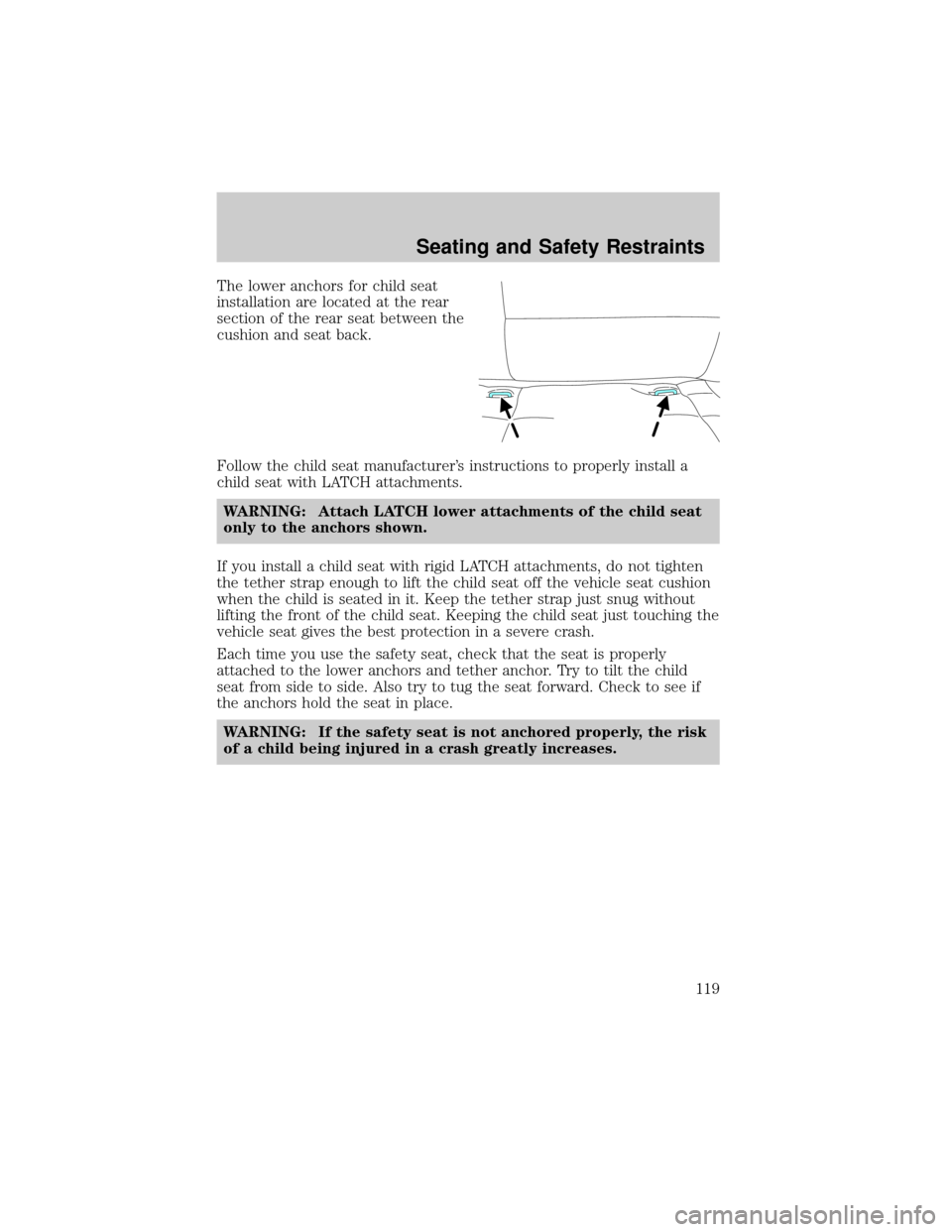
The lower anchors for child seat
installation are located at the rear
section of the rear seat between the
cushion and seat back.
Follow the child seat manufacturer's instructions to properly install a
child seat with LATCH attachments.
WARNING: Attach LATCH lower attachments of the child seat
only to the anchors shown.
If you install a child seat with rigid LATCH attachments, do not tighten
the tether strap enough to lift the child seat off the vehicle seat cushion
when the child is seated in it. Keep the tether strap just snug without
lifting the front of the child seat. Keeping the child seat just touching the
vehicle seat gives the best protection in a severe crash.
Each time you use the safety seat, check that the seat is properly
attached to the lower anchors and tether anchor. Try to tilt the child
seat from side to side. Also try to tug the seat forward. Check to see if
the anchors hold the seat in place.
WARNING: If the safety seat is not anchored properly, the risk
of a child being injured in a crash greatly increases.
Seating and Safety Restraints
119
Page 120 of 248
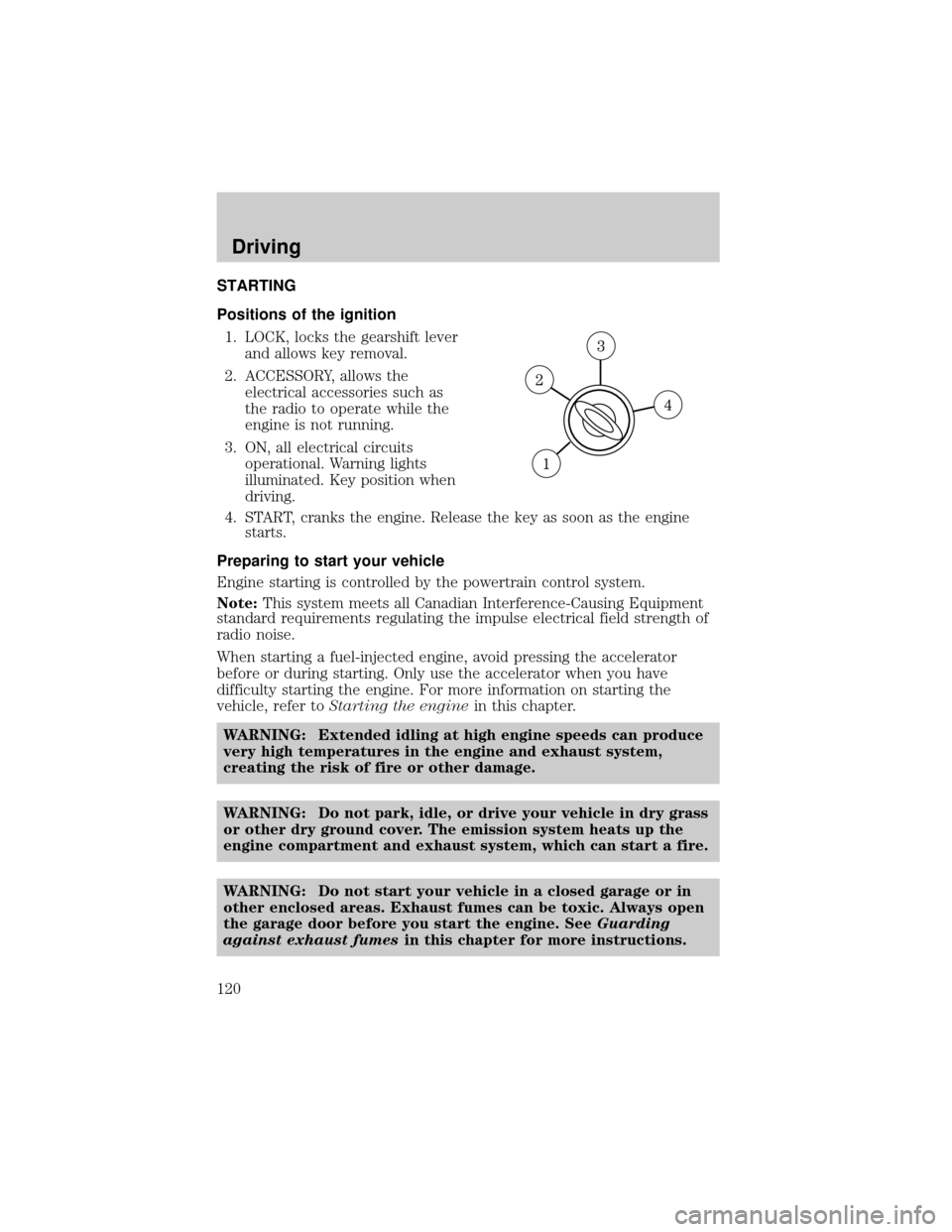
STARTING
Positions of the ignition
1. LOCK, locks the gearshift lever
and allows key removal.
2. ACCESSORY, allows the
electrical accessories such as
the radio to operate while the
engine is not running.
3. ON, all electrical circuits
operational. Warning lights
illuminated. Key position when
driving.
4. START, cranks the engine. Release the key as soon as the engine
starts.
Preparing to start your vehicle
Engine starting is controlled by the powertrain control system.
Note:This system meets all Canadian Interference-Causing Equipment
standard requirements regulating the impulse electrical field strength of
radio noise.
When starting a fuel-injected engine, avoid pressing the accelerator
before or during starting. Only use the accelerator when you have
difficulty starting the engine. For more information on starting the
vehicle, refer toStarting the enginein this chapter.
WARNING: Extended idling at high engine speeds can produce
very high temperatures in the engine and exhaust system,
creating the risk of fire or other damage.
WARNING: Do not park, idle, or drive your vehicle in dry grass
or other dry ground cover. The emission system heats up the
engine compartment and exhaust system, which can start a fire.
WARNING: Do not start your vehicle in a closed garage or in
other enclosed areas. Exhaust fumes can be toxic. Always open
the garage door before you start the engine. SeeGuarding
against exhaust fumesin this chapter for more instructions.
Driving
120
Page 121 of 248

WARNING: If you smell exhaust fumes inside your vehicle,
have your authorized Mazda dealer inspect your vehicle
immediately. Do not drive if you smell exhaust fumes.
Important safety precautions
A computer system controls the engine's idle revolutions per minute
(RPM). When the engine starts, the idle RPM runs higher than normal in
order to warm the engine. If the engine idle speed does not slow down
automatically, have the vehicle checked by your authorized Mazda
dealership.
Before starting the vehicle:
1. Make sure all vehicle occupants have buckled their safety belts. For
more information on safety belts and their proper usage, refer to the
Seating and safety restraintschapter.
2. Make sure the headlamps and vehicle accessories are off.
If starting a vehicle with an
automatic transmission:
²Make sure the parking brake is
set.
²Make sure the gearshift is in P
(Park).
R D 2 1ODO
Driving
121
Page 123 of 248
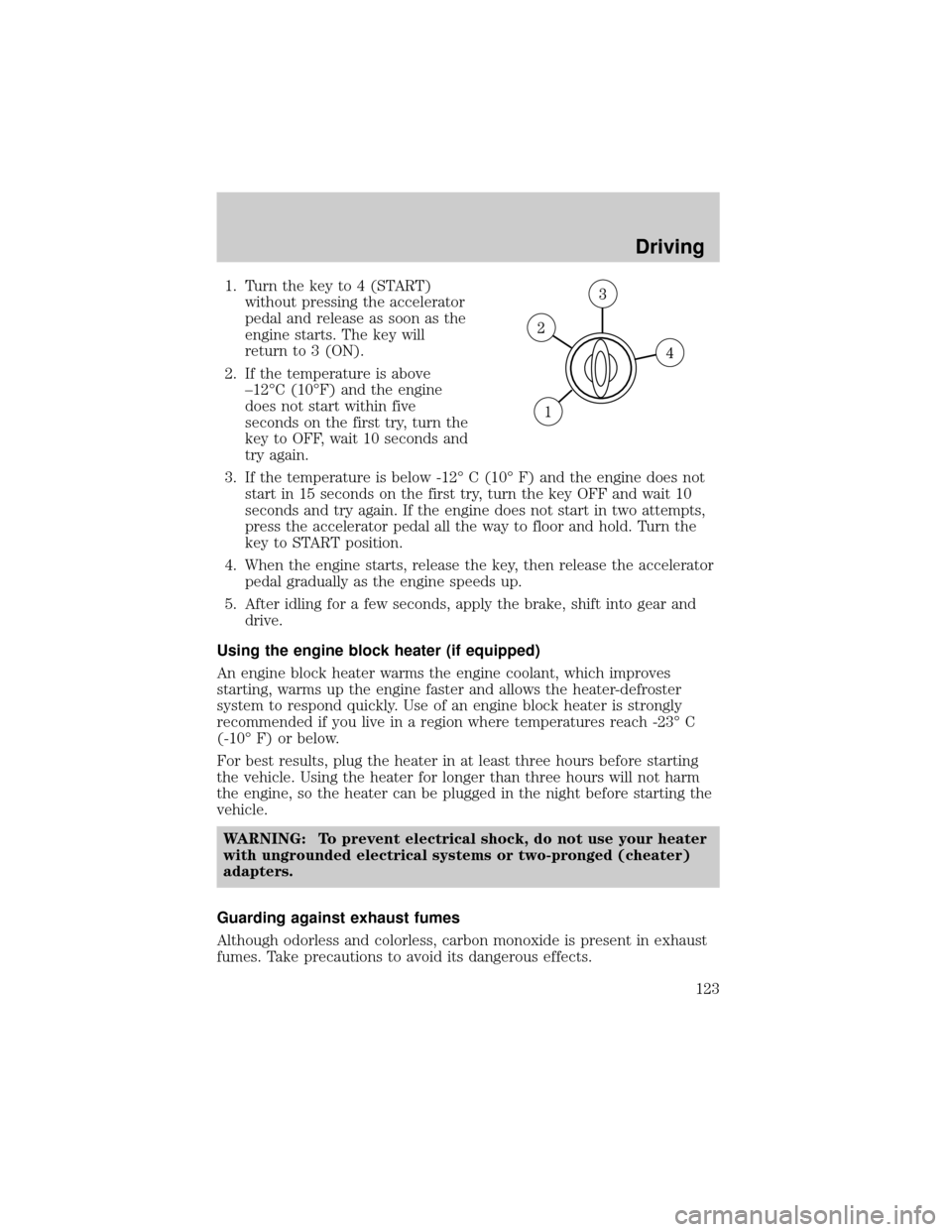
1. Turn the key to 4 (START)
without pressing the accelerator
pedal and release as soon as the
engine starts. The key will
return to 3 (ON).
2. If the temperature is above
±12ÉC (10ÉF) and the engine
does not start within five
seconds on the first try, turn the
key to OFF, wait 10 seconds and
try again.
3. If the temperature is below -12É C (10É F) and the engine does not
start in 15 seconds on the first try, turn the key OFF and wait 10
seconds and try again. If the engine does not start in two attempts,
press the accelerator pedal all the way to floor and hold. Turn the
key to START position.
4. When the engine starts, release the key, then release the accelerator
pedal gradually as the engine speeds up.
5. After idling for a few seconds, apply the brake, shift into gear and
drive.
Using the engine block heater (if equipped)
An engine block heater warms the engine coolant, which improves
starting, warms up the engine faster and allows the heater-defroster
system to respond quickly. Use of an engine block heater is strongly
recommended if you live in a region where temperatures reach -23É C
(-10É F) or below.
For best results, plug the heater in at least three hours before starting
the vehicle. Using the heater for longer than three hours will not harm
the engine, so the heater can be plugged in the night before starting the
vehicle.
WARNING: To prevent electrical shock, do not use your heater
with ungrounded electrical systems or two-pronged (cheater)
adapters.
Guarding against exhaust fumes
Although odorless and colorless, carbon monoxide is present in exhaust
fumes. Take precautions to avoid its dangerous effects.
Driving
123
Page 124 of 248
WARNING: If you ever smell exhaust fumes of any kind inside
your vehicle, have your authorized Mazda dealer inspect and fix
your vehicle immediately. Do not drive if you smell exhaust
fumes. These fumes are harmful and result in accident or death.
Have the exhaust and body ventilation systems checked whenever:
²the vehicle is raised for service.
²the sound of the exhaust system changes.
²the vehicle has been damaged in a collision.
WARNING: Engine exhaust, some of its constituents, and
certain vehicle components contain or emit chemicals known to
the State of California to cause cancer and birth defects or
other reproductive harm. In addition, certain fluids contained in
vehicles and certain products of component wear contain or
emit chemicals known to the State of California to cause cancer
and birth defects or other reproductive harm.
Important ventilating information
If the engine is idling while the vehicle is stopped in an open area for
long periods of time, open the windows at least 2.5 cm (one inch).
Adjust the heating or air conditioning (if equipped) to bring in fresh air.
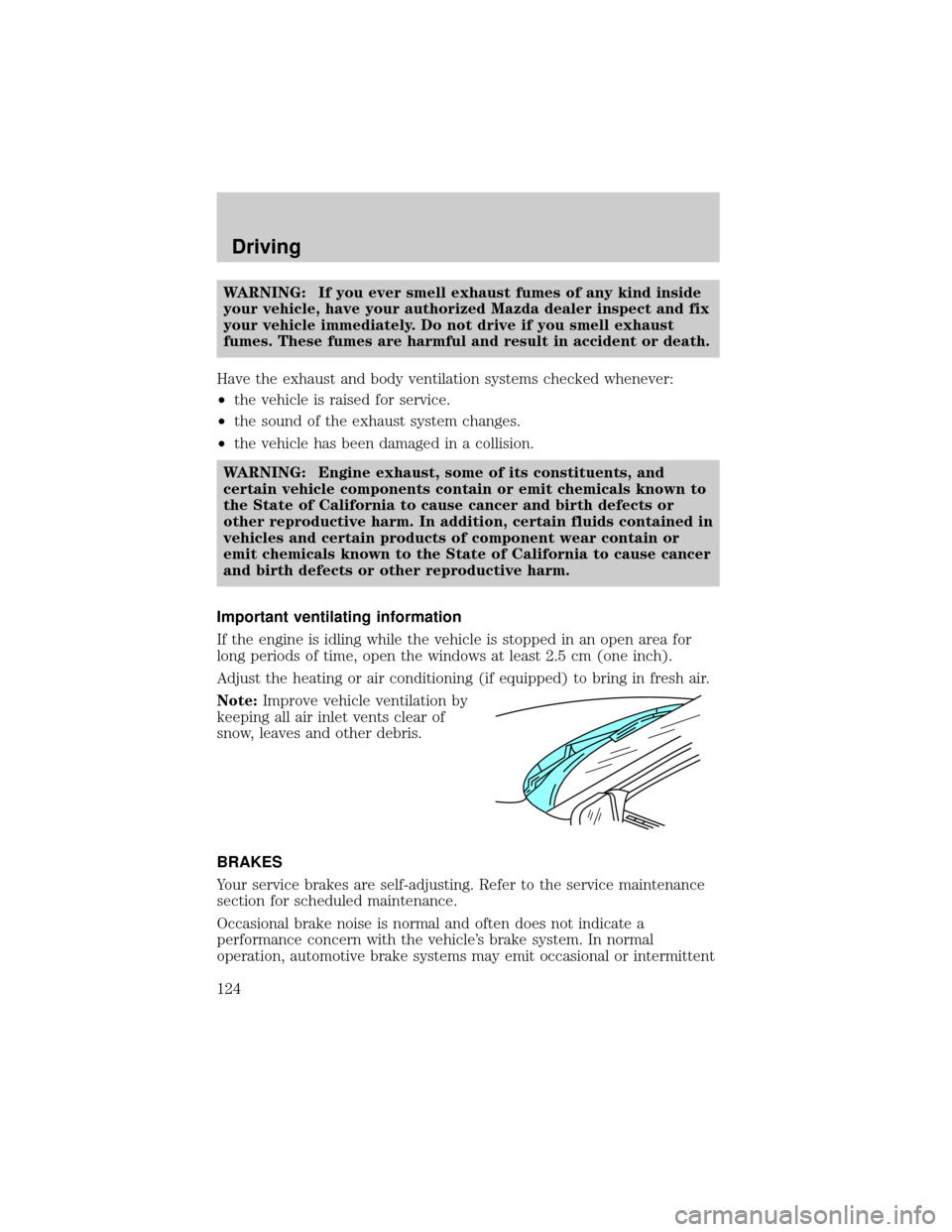
Note:Improve vehicle ventilation by
keeping all air inlet vents clear of
snow, leaves and other debris.
BRAKES
Your service brakes are self-adjusting. Refer to the service maintenance
section for scheduled maintenance.
Occasional brake noise is normal and often does not indicate a
performance concern with the vehicle's brake system. In normal
operation, automotive brake systems may emit occasional or intermittent
Driving
124
Page 125 of 248
squeal or groan noises when the brakes are applied. Such noises are
usually heard during the first few brake applications in the morning;
however, they may be heard at any time while braking and can be
aggravated by environmental conditions such as cold, heat, moisture,
road dust, salt or mud. If a ªmetal-to-metal,º ªcontinuous grindingº or
ªcontinuous squealº sound is present while braking, the brake linings
may be worn-out and should be inspected by an authorized Mazda
dealership.
Four-wheel anti-lock brake system (ABS) (if equipped)
If the vehicle is equipped with an anti-lock braking system (ABS), a
noise from the hydraulic pump motor and pulsation in the pedal may be
observed during ABS braking events. Pedal pulsation coupled with noise
while braking under panic conditions or on loose gravel, bumps, wet or
snowy roads is normal and indicates proper functioning of the vehicle's
anti-lock brake system.
NOTE:The ABS performs a self-check after you start the engine and
begin to drive away.
A brief mechanical noise may be heard during this test. This is normal. If
a malfunction is found, the ABS warning light will come on. If the vehicle
has continuous vibration or shudder in the steering wheel while braking,
the vehicle should be inspected by an authorized Mazda dealership.
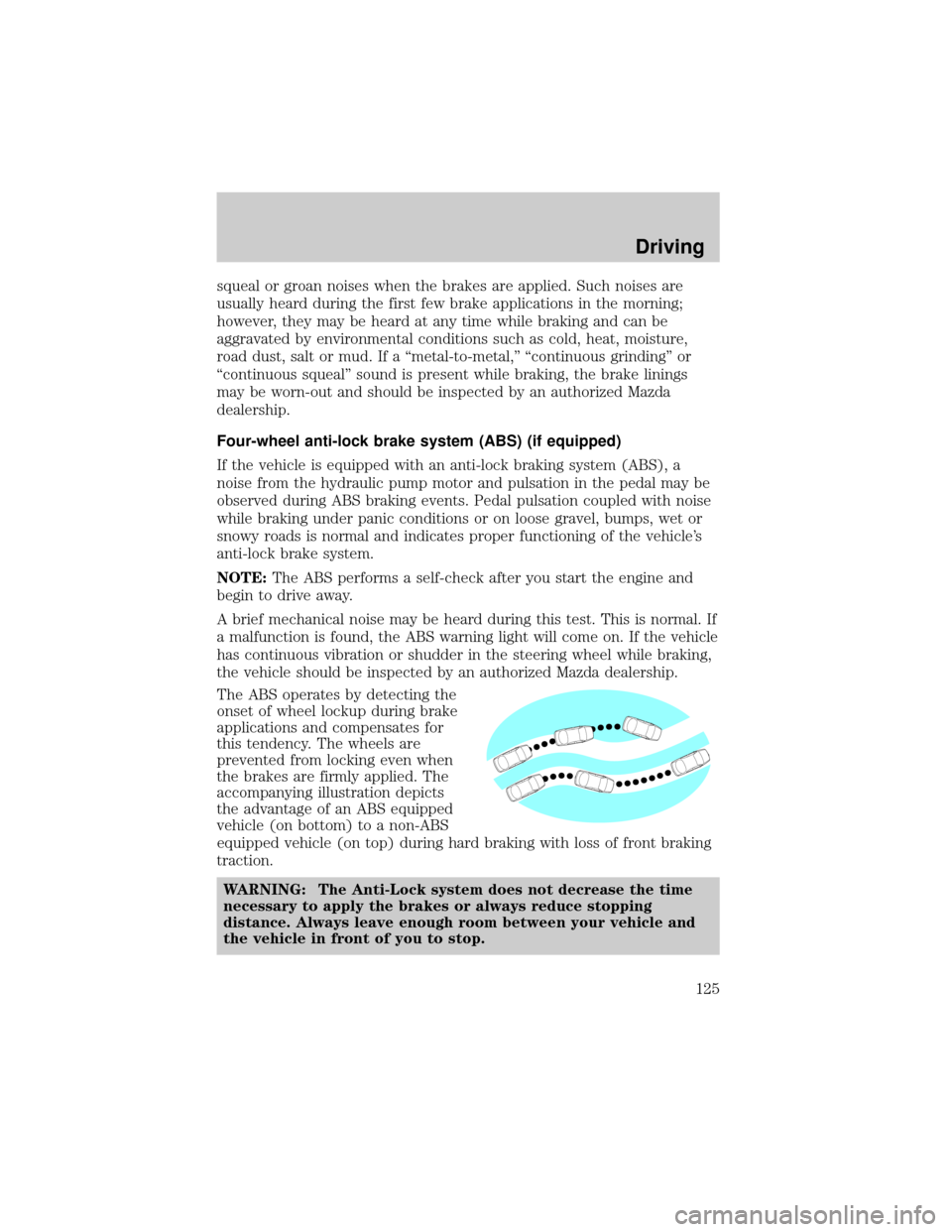
The ABS operates by detecting the
onset of wheel lockup during brake
applications and compensates for
this tendency. The wheels are
prevented from locking even when
the brakes are firmly applied. The
accompanying illustration depicts
the advantage of an ABS equipped
vehicle (on bottom) to a non-ABS
equipped vehicle (on top) during hard braking with loss of front braking
traction.
WARNING: The Anti-Lock system does not decrease the time
necessary to apply the brakes or always reduce stopping
distance. Always leave enough room between your vehicle and
the vehicle in front of you to stop.
Driving
125