remove seats MAZDA MODEL TRIBUTE 2003 Owners Manual (in English)
[x] Cancel search | Manufacturer: MAZDA, Model Year: 2003, Model line: MODEL TRIBUTE, Model: MAZDA MODEL TRIBUTE 2003Pages: 248, PDF Size: 2.5 MB
Page 46 of 248
Operating tips
²In humid weather conditions, place the climate control system in
Defrost mode before driving. This will reduce fogging on your
windshield. Once the windshield has been cleared, operate the climate
control system as desired.
²To reduce humidity buildup inside the vehicle in cold weather
conditions, don't drive with the climate control system in the OFF or
MAX A/C position.
²To reduce humidity buildup inside the vehicle in warm weather
conditions, don't drive with the climate control system in the OFF
position.
²Under normal weather conditions, your vehicle's climate control
system should be left in any position other than the MAX A/C or OFF
when the vehicle is parked. This allows the vehicle to ªbreatheº
through the outside air inlet duct.
²Under snowy or dirty weather conditions, your vehicle's climate
control system should be left in the OFF position when the vehicle is
parked. This allows the climate control system to be free from
contamination of outside pollutants.
²If your vehicle has been parked with the windows closed during warm
weather conditions, the air conditioner will perform more efficiently in
cooling the vehicle if driven for two or three minutes with the
windows open. This will force most of the hot, stale air out of the
vehicle. Once the vehicle has been ªaired outº, operate the climate
control system as desired.
²Do not put objects under the front seat which may interfere with the
airflow to the rear seats.
²Remove any snow, ice or leaves from the air intake area (at the
bottom of the windshield and underneath the hood).
²Do not place objects over the defroster outlets. These objects can
block airflow and reduce visibility through your windshield. Avoid
placing small objects on top of the instrument panel. These objects
may fall down into the defroster outlets and block airflow, in addition
to, damaging the climate control system.
To aid in side window defogging/demisting in cold weather conditions:
1. Select the position that distributes air through the Panel and Floor.
2. Set the temperature control to full heat.
3. Set the fan speed to full fan.
Climate Controls
46
Page 83 of 248

Push control to lower head restraint.
Folding down rear seats (60/40 split bench)
1. Raise the rear seat head
restraint and remove.
2. Place the head restraints under the front passenger seat for storage.
3. Pull the seat release control.
Seating and Safety Restraints
83
Page 85 of 248

NOTE:Make sure the floor is clear of all objects before folding the
seatback.
Returning the rear seats to upright position
1. Pull seatback up and into
upright position making sure
seatback locks into place. While
holding the seatback, pull the
release and push seatback
backward into the desired
position.
2. Rotate seat cushion down into
the seating position making sure
that the seat cushion is locked
into place and that the seat belt
buckles are exposed.
3. Remove the head restraints stored under the front passenger seat
and return them to the original position on the seat backs.
Seating and Safety Restraints
85
Page 86 of 248

To remove the rear cushion
1. Pull the Yellow tab
2. Pull the cushion to the outboard
side of the vehicle.
To install the rear cushion
1. Push the cushion to the inboard
side of the vehicle.
2. Make sure that the hinges are
locked into place.
Folding down rear seats (bench)
1. Raise the rear seat head
restraint and remove.
2. Place the head restraints under the front passenger seat for storage.
Seating and Safety Restraints
86
Page 88 of 248

Returning the rear seats to upright position
1. Pull seatback up and into upright position making sure seatback
locks into place.
2. Rotate seat cushion down into
the seating position making sure
that the seat cushion is locked
into place and that the seat belt
buckles are exposed.
3. Remove the head restraints stored under the front passenger seat
and return them to the original position on the seat backs.
WARNING: Make sure that the seat is fimrly locked into
position and that the safety belt buckles are exposed.
To remove the rear cushion
1. Pull the Yellow tab
2. Pull the cushion so that the
rods remove from the locking
tabs.
Seating and Safety Restraints
88
Page 92 of 248
sharply, or the vehicle receives an impact of approximately 8 km/h
(5 mph) or more, the combination safety belts will lock to help reduce
forward movement of the driver and passengers.
Automatic locking mode (outboard front passenger seating
position only) for use with child safety seats
The automatic locking mode is not available on the driver safety belt.
When to use the automatic locking mode
In this mode, the shoulder belt is automatically pre-locked. The belt will
still retract to remove any slack in the shoulder belt. The automatic
locking mode is not available on the driver safety belt.
This mode should be usedany timea child safety seat is installed in a
passenger front or outboard rear seating position (if equipped). Children
12 years old and under should be properly restrained in the rear seat
whenever possible. Refer toSafety restraints for childrenorSafety
seats for childrenlater in this chapter.
How to use the automatic locking mode (Outboard front passenger
seating position only) for use with child safety seats
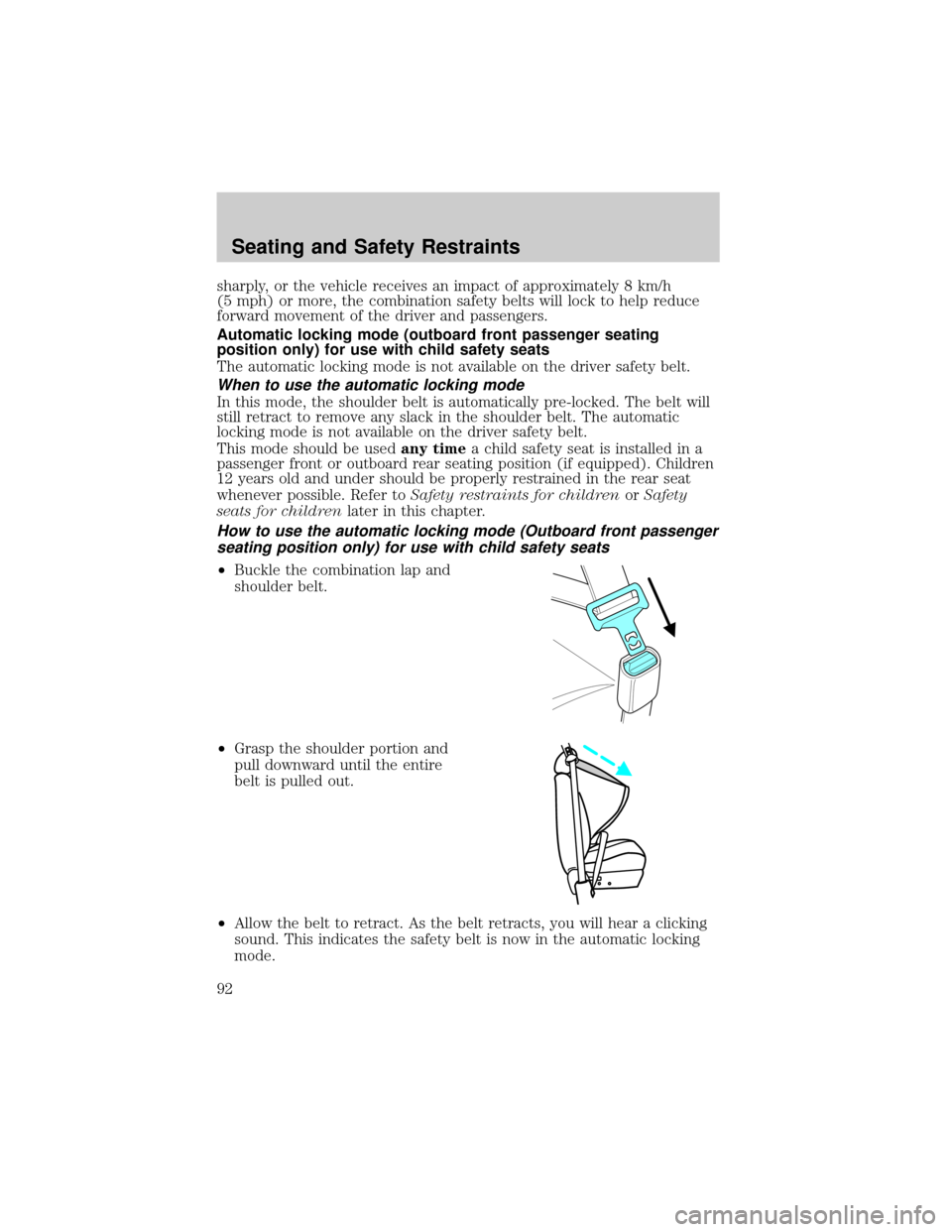
²Buckle the combination lap and
shoulder belt.
²Grasp the shoulder portion and
pull downward until the entire
belt is pulled out.
²Allow the belt to retract. As the belt retracts, you will hear a clicking
sound. This indicates the safety belt is now in the automatic locking
mode.
Seating and Safety Restraints
92
Page 110 of 248
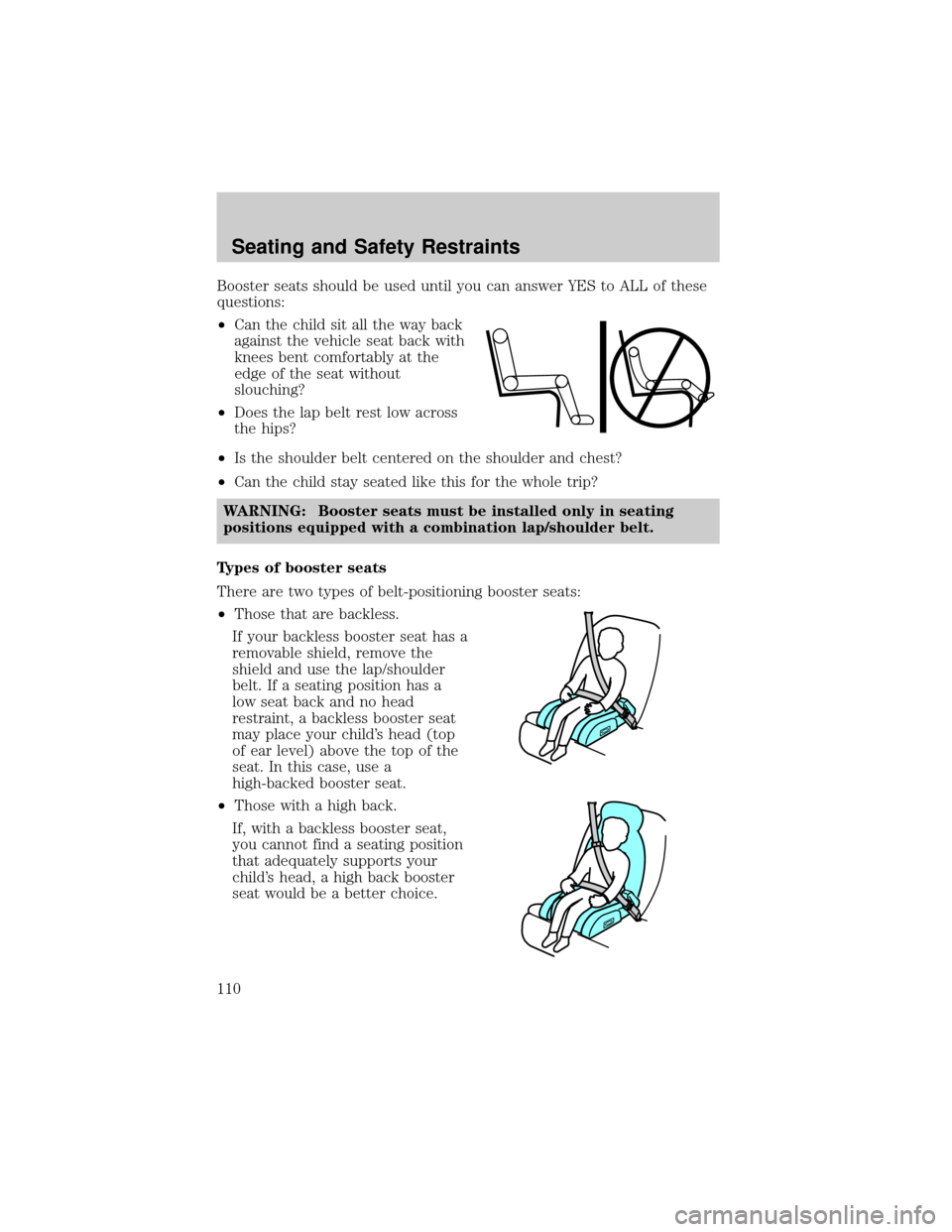
Booster seats should be used until you can answer YES to ALL of these
questions:
²Can the child sit all the way back
against the vehicle seat back with
knees bent comfortably at the
edge of the seat without
slouching?
²Does the lap belt rest low across
the hips?
²Is the shoulder belt centered on the shoulder and chest?
²Can the child stay seated like this for the whole trip?
WARNING: Booster seats must be installed only in seating
positions equipped with a combination lap/shoulder belt.
Types of booster seats
There are two types of belt-positioning booster seats:
²Those that are backless.
If your backless booster seat has a
removable shield, remove the
shield and use the lap/shoulder
belt. If a seating position has a
low seat back and no head
restraint, a backless booster seat
may place your child's head (top
of ear level) above the top of the
seat. In this case, use a
high-backed booster seat.
²Those with a high back.
If, with a backless booster seat,
you cannot find a seating position
that adequately supports your
child's head, a high back booster
seat would be a better choice.
Seating and Safety Restraints
110
Page 113 of 248
²Put the safety belt in the automatic locking mode. Refer toAutomatic
locking mode(passenger side front seat).
Mazda recommends the use of a child safety seat having a top tether
strap. Install the child safety seat in a seating position which is capable
of providing a tether anchorage. For more information on top tether
straps, refer toAttaching child safety seats with tether straps.
WARNING: Carefully follow all of the manufacturer's
instructions included with the safety seat you put in your
vehicle. If you do not install and use the safety seat properly,
the child may be injured in a sudden stop or collision.
Installing child safety seats with combination lap and shoulder
belts (front outboard passenger seat only)
The rear seat head restraints must be removed when using a child
seat.
WARNING: Air bags can kill or injure a child in a child seat.
NEVER place a rear-facing child seat in front of an active air
bag. If you must use a forward-facing child seat in the front
seat, move the seat all the way back.
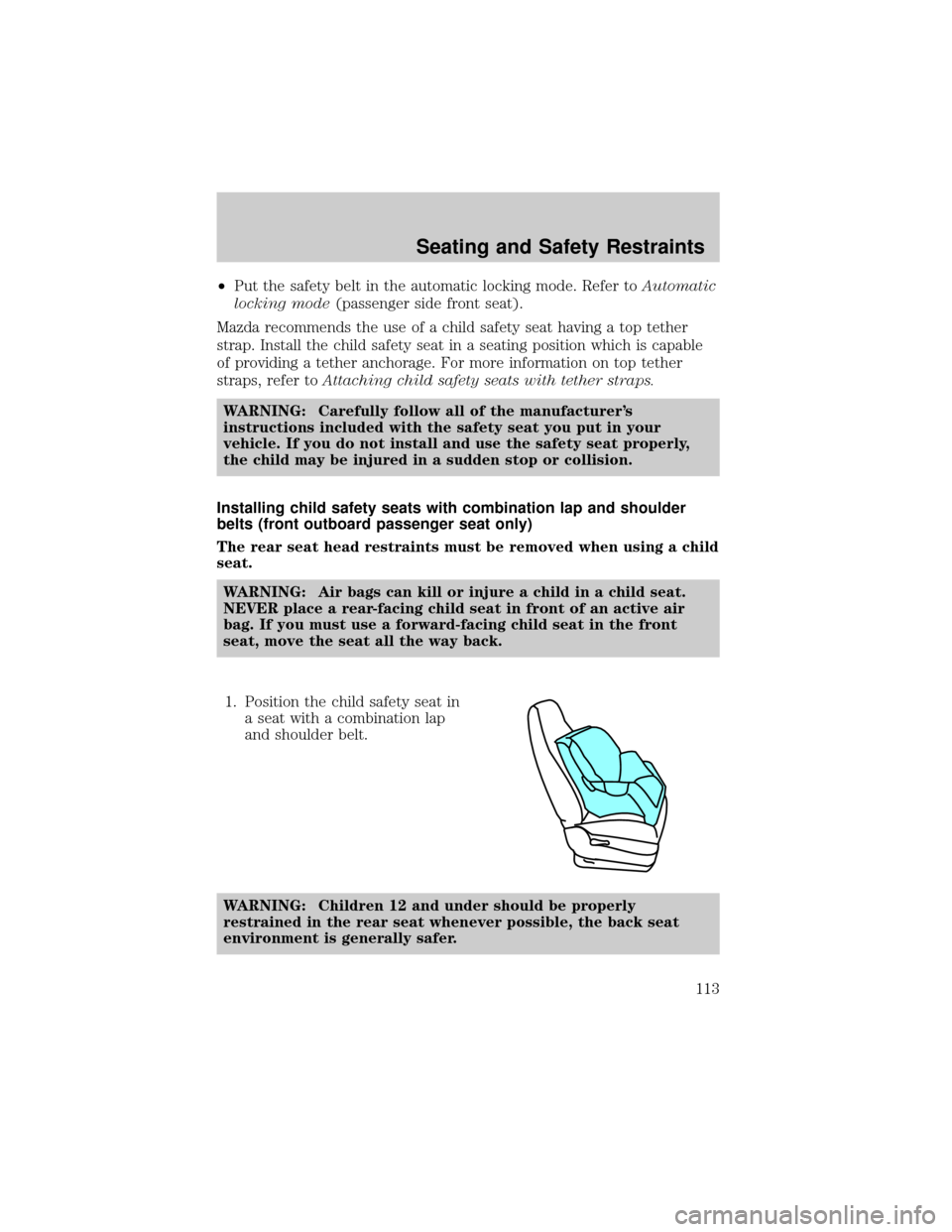
1. Position the child safety seat in
a seat with a combination lap
and shoulder belt.
WARNING: Children 12 and under should be properly
restrained in the rear seat whenever possible, the back seat
environment is generally safer.
Seating and Safety Restraints
113
Page 115 of 248
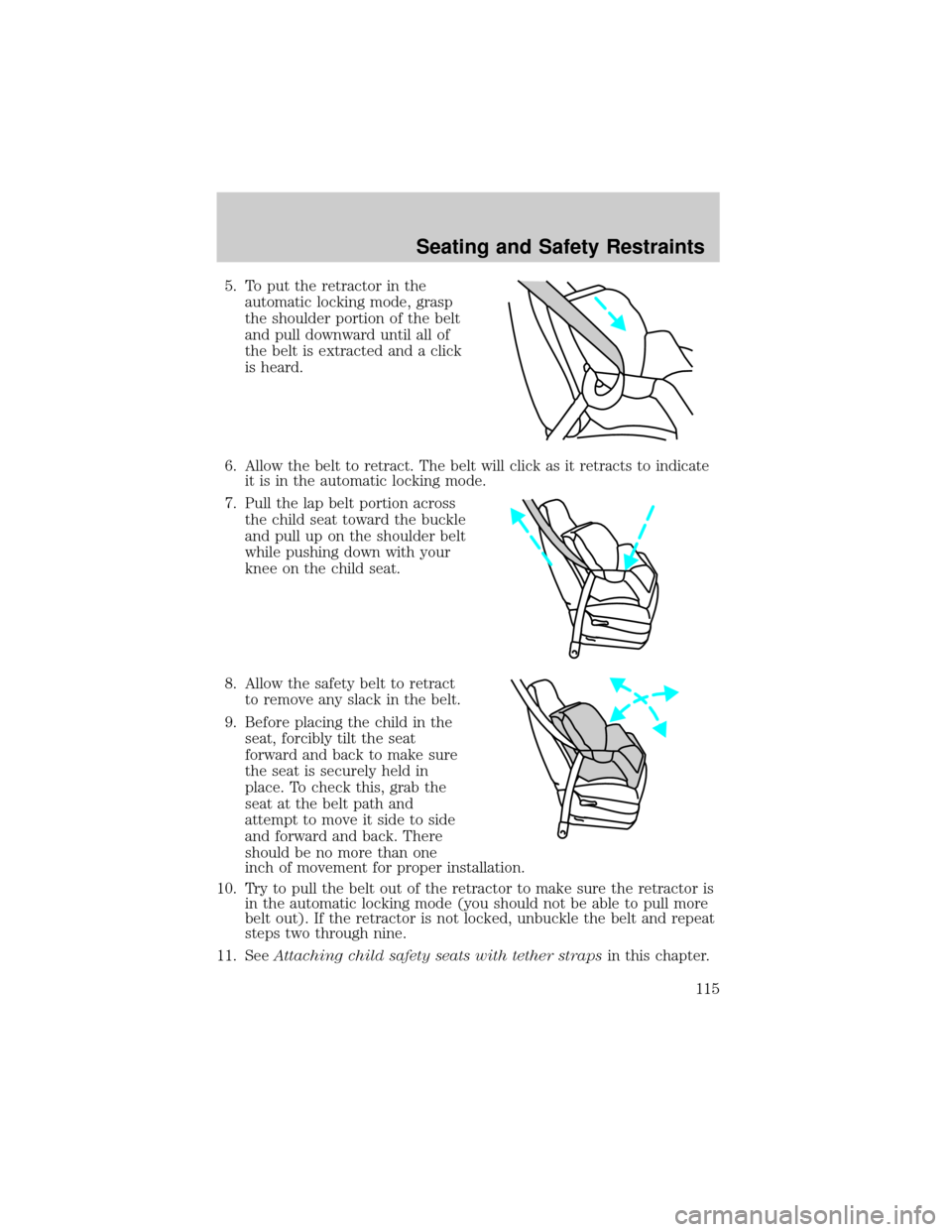
5. To put the retractor in the
automatic locking mode, grasp
the shoulder portion of the belt
and pull downward until all of
the belt is extracted and a click
is heard.
6. Allow the belt to retract. The belt will click as it retracts to indicate
it is in the automatic locking mode.
7. Pull the lap belt portion across
the child seat toward the buckle
and pull up on the shoulder belt
while pushing down with your
knee on the child seat.
8. Allow the safety belt to retract
to remove any slack in the belt.
9. Before placing the child in the
seat, forcibly tilt the seat
forward and back to make sure
the seat is securely held in
place. To check this, grab the
seat at the belt path and
attempt to move it side to side
and forward and back. There
should be no more than one
inch of movement for proper installation.
10. Try to pull the belt out of the retractor to make sure the retractor is
in the automatic locking mode (you should not be able to pull more
belt out). If the retractor is not locked, unbuckle the belt and repeat
steps two through nine.
11. SeeAttaching child safety seats with tether strapsin this chapter.
Seating and Safety Restraints
115
Page 190 of 248
windshield, rear window or the wiper blades may be the cause. These
may include hot wax treatments used by commercial car washes, tree
sap, or other organic contamination. To clean these items, please follow
these tips:
²The windshield or rear window may be cleaned with a non-abrasive
cleaner such as Ultra Clear Spray Glass Cleaner, available from your
authorized Mazda dealer.
²Do not use abrasives, as they may cause scratches.
²Do not use fuel, kerosene, or paint thinner to clean any parts.
²Wiper blades can be cleaned with isopropyl (rubbing) alcohol or
windshield washer solution. Be sure to replace wiper blades when they
appear worn or do not function properly.
INSTRUMENT PANEL AND CLUSTER LENS
Clean the instrument panel with a damp cloth, then dry with a dry cloth.
²Avoid cleaners or polish that increase the gloss of the upper portion of
the instrument panel. The dull finish in this area helps protect the
driver from undesirable windshield reflection.
WARNING: Do not use chemical solvents or strong detergents
when cleaning the steering wheel or instrument panel to avoid
contamination of the air bag system.
²Be certain to wash or wipe your hands clean if you have been in
contact with certain products such as insect repellent and suntan
lotion in order to avoid possible damage to the painted surfaces.
INTERIOR TRIM
²Clean the interior trim areas with a damp cloth, then dry by wiping
with a dry, soft, clean cloth.
²Do not use household or glass cleaners as these may damage the
finish.
INTERIOR
For fabric, carpets, cloth seats, safety belts and seats equipped with side
air bags:
²Remove dust and loose dirt with a vacuum cleaner.
²Remove light stains and soil with Extra Strength Upholstery Cleaner,
available at your authorized Mazda dealer.
Cleaning
190