seats MAZDA MODEL TRIBUTE 2003 Owners Manual (in English)
[x] Cancel search | Manufacturer: MAZDA, Model Year: 2003, Model line: MODEL TRIBUTE, Model: MAZDA MODEL TRIBUTE 2003Pages: 248, PDF Size: 2.5 MB
Page 46 of 248
Operating tips
²In humid weather conditions, place the climate control system in
Defrost mode before driving. This will reduce fogging on your
windshield. Once the windshield has been cleared, operate the climate
control system as desired.
²To reduce humidity buildup inside the vehicle in cold weather
conditions, don't drive with the climate control system in the OFF or
MAX A/C position.
²To reduce humidity buildup inside the vehicle in warm weather
conditions, don't drive with the climate control system in the OFF
position.
²Under normal weather conditions, your vehicle's climate control
system should be left in any position other than the MAX A/C or OFF
when the vehicle is parked. This allows the vehicle to ªbreatheº
through the outside air inlet duct.
²Under snowy or dirty weather conditions, your vehicle's climate
control system should be left in the OFF position when the vehicle is
parked. This allows the climate control system to be free from
contamination of outside pollutants.
²If your vehicle has been parked with the windows closed during warm
weather conditions, the air conditioner will perform more efficiently in
cooling the vehicle if driven for two or three minutes with the
windows open. This will force most of the hot, stale air out of the
vehicle. Once the vehicle has been ªaired outº, operate the climate
control system as desired.
²Do not put objects under the front seat which may interfere with the
airflow to the rear seats.
²Remove any snow, ice or leaves from the air intake area (at the
bottom of the windshield and underneath the hood).
²Do not place objects over the defroster outlets. These objects can
block airflow and reduce visibility through your windshield. Avoid
placing small objects on top of the instrument panel. These objects
may fall down into the defroster outlets and block airflow, in addition
to, damaging the climate control system.
To aid in side window defogging/demisting in cold weather conditions:
1. Select the position that distributes air through the Panel and Floor.
2. Set the temperature control to full heat.
3. Set the fan speed to full fan.
Climate Controls
46
Page 50 of 248

AIMING THE HEADLAMPS
The headlamps on your vehicle are properly aimed at the assembly plant.
If your vehicle has been in an accident the alignment of your headlamps
should be checked by your authorized Mazda dealer.
TURN SIGNAL CONTROL
²Push down to activate the left
turn signal.
²Push up to activate the right turn
signal.
INTERIOR LAMPS
Cargo and dome lamp
Rear cargo lamp equipped with an
ON/OFF/DOOR control will light
when:
²the doors are closed and the
control is in the ON position.
²the control is in the DOOR
position and any door is open.
When the control is in the OFF
position, it will not illuminate when
you open the doors or fully rotate
the headlamp control.
Dome lamps and map lamps
The front dome lamp is located overhead between the driver and
passenger seats.
The dome lamp will stay on if the
control is moved to the passenger
side position. When the control is in
the middle position, the lamp will
only come on when a door is
opened. If the control is moved to
the driver's side position, the lamp
will not come on at all.
OFF
Lights
50
Page 82 of 248
Heated seats (if equipped)
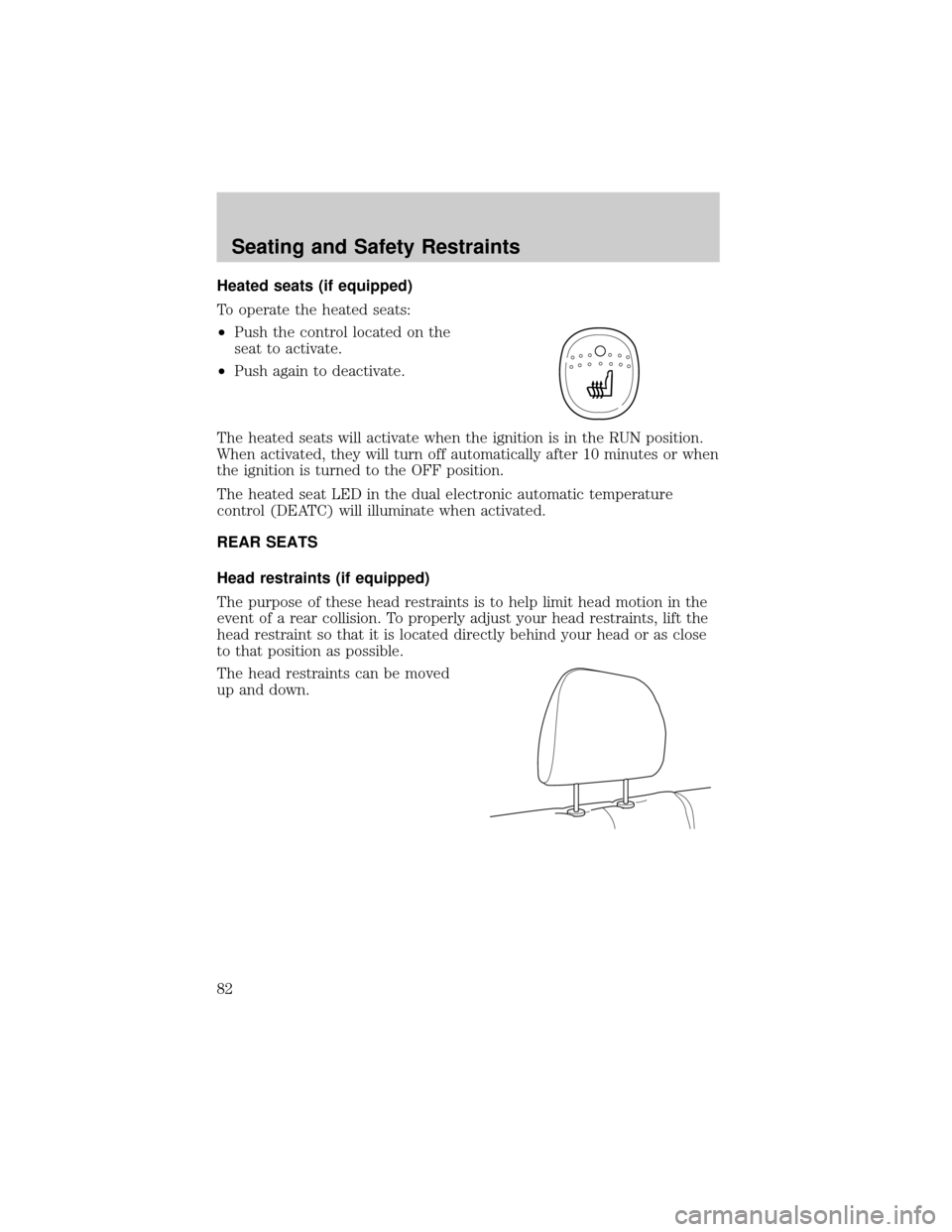
To operate the heated seats:
²Push the control located on the
seat to activate.
²Push again to deactivate.
The heated seats will activate when the ignition is in the RUN position.
When activated, they will turn off automatically after 10 minutes or when
the ignition is turned to the OFF position.
The heated seat LED in the dual electronic automatic temperature
control (DEATC) will illuminate when activated.
REAR SEATS
Head restraints (if equipped)
The purpose of these head restraints is to help limit head motion in the
event of a rear collision. To properly adjust your head restraints, lift the
head restraint so that it is located directly behind your head or as close
to that position as possible.
The head restraints can be moved
up and down.
Seating and Safety Restraints
82
Page 83 of 248

Push control to lower head restraint.
Folding down rear seats (60/40 split bench)
1. Raise the rear seat head
restraint and remove.
2. Place the head restraints under the front passenger seat for storage.
3. Pull the seat release control.
Seating and Safety Restraints
83
Page 85 of 248

NOTE:Make sure the floor is clear of all objects before folding the
seatback.
Returning the rear seats to upright position
1. Pull seatback up and into
upright position making sure
seatback locks into place. While
holding the seatback, pull the
release and push seatback
backward into the desired
position.
2. Rotate seat cushion down into
the seating position making sure
that the seat cushion is locked
into place and that the seat belt
buckles are exposed.
3. Remove the head restraints stored under the front passenger seat
and return them to the original position on the seat backs.
Seating and Safety Restraints
85
Page 86 of 248

To remove the rear cushion
1. Pull the Yellow tab
2. Pull the cushion to the outboard
side of the vehicle.
To install the rear cushion
1. Push the cushion to the inboard
side of the vehicle.
2. Make sure that the hinges are
locked into place.
Folding down rear seats (bench)
1. Raise the rear seat head
restraint and remove.
2. Place the head restraints under the front passenger seat for storage.
Seating and Safety Restraints
86
Page 88 of 248

Returning the rear seats to upright position
1. Pull seatback up and into upright position making sure seatback
locks into place.
2. Rotate seat cushion down into
the seating position making sure
that the seat cushion is locked
into place and that the seat belt
buckles are exposed.
3. Remove the head restraints stored under the front passenger seat
and return them to the original position on the seat backs.
WARNING: Make sure that the seat is fimrly locked into
position and that the safety belt buckles are exposed.
To remove the rear cushion
1. Pull the Yellow tab
2. Pull the cushion so that the
rods remove from the locking
tabs.
Seating and Safety Restraints
88
Page 89 of 248
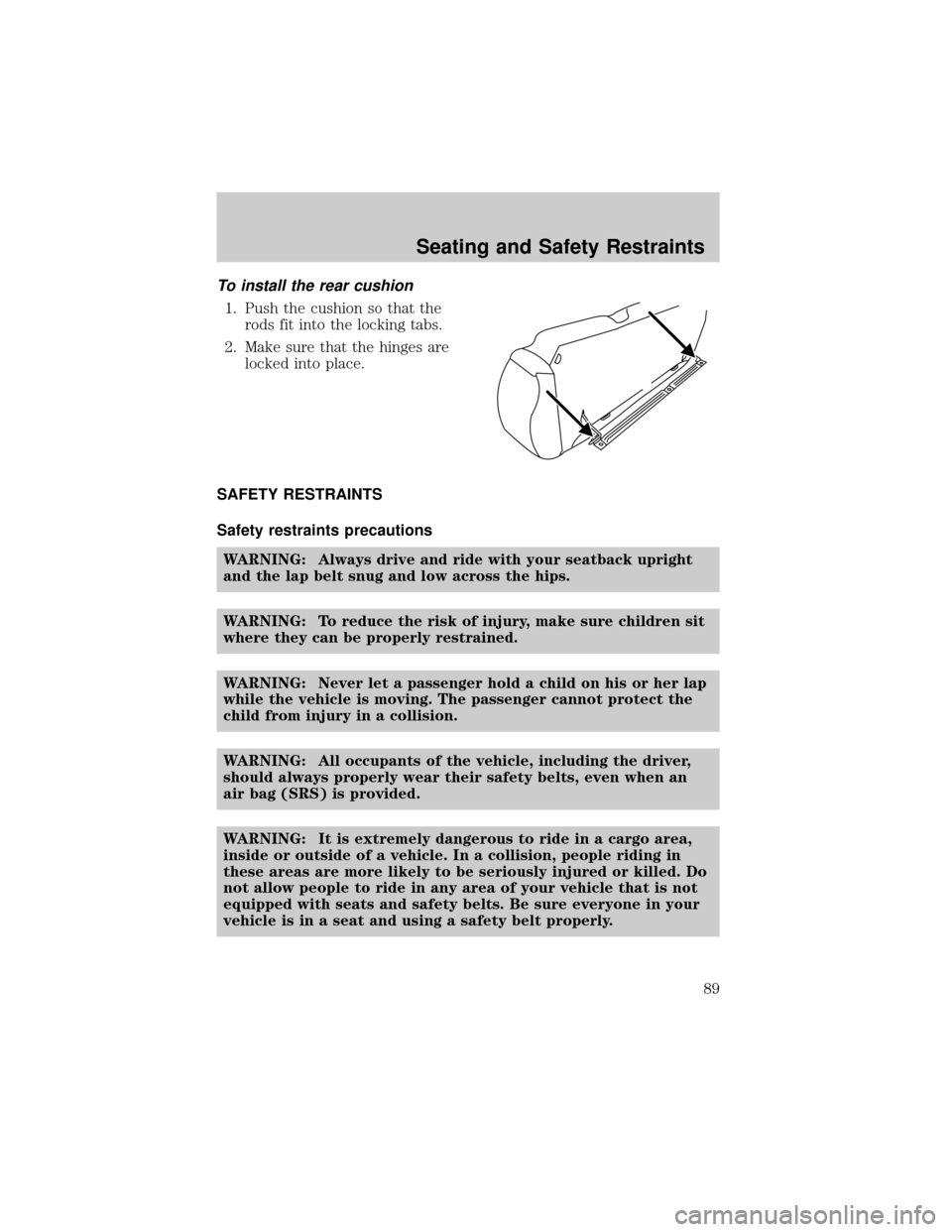
To install the rear cushion
1. Push the cushion so that the
rods fit into the locking tabs.
2. Make sure that the hinges are
locked into place.
SAFETY RESTRAINTS
Safety restraints precautions
WARNING: Always drive and ride with your seatback upright
and the lap belt snug and low across the hips.
WARNING: To reduce the risk of injury, make sure children sit
where they can be properly restrained.
WARNING: Never let a passenger hold a child on his or her lap
while the vehicle is moving. The passenger cannot protect the
child from injury in a collision.
WARNING: All occupants of the vehicle, including the driver,
should always properly wear their safety belts, even when an
air bag (SRS) is provided.
WARNING: It is extremely dangerous to ride in a cargo area,
inside or outside of a vehicle. In a collision, people riding in
these areas are more likely to be seriously injured or killed. Do
not allow people to ride in any area of your vehicle that is not
equipped with seats and safety belts. Be sure everyone in your
vehicle is in a seat and using a safety belt properly.
Seating and Safety Restraints
89
Page 90 of 248
WARNING: In a rollover crash, an unbelted person is
significantly more likely to die or be seriously injured than a
person wearing a seat belt.
WARNING: Each seating position in your vehicle has a specific
safety belt assembly which is made up of one buckle and one
tongue that are designed to be used as a pair. 1) Use the
shoulder belt on the outside shoulder only. Never wear the
shoulder belt under the arm. 2) Never swing the safety belt
around your neck over the inside shoulder. 3) Never use a
single belt for more than one person.
WARNING: Placing a child, 12 years or younger, in the front
seat is dangerous. The child could be hit by a deploying air bag
and be seriously injured or even killed. A sleeping child is more
likely to lean against the door and be hit by the side air bag in a
moderate collision. Whenever possible, always secure a child, 12
years or younger, in the rear seat, with an appropriate child
restraint system for the child's age and size. Never use a
rear-facing child restraint system in the front seat with an air
bag that could deploy.
Energy Management Feature
²This vehicle has a safety belt system with an energy management
feature at the front seating positions to help further reduce the risk of
injury in the event of a head-on collision.
²This safety belt system has a retractor assembly that is designed to
pay out webbing in a controlled manner. This feature is designed to
help reduce the belt force acting on the occupant's chest.
WARNING: All safety belts should be checked for proper
function. Additionally, if the front air bags have deployed, the
front pretensioners have also deployed and the front seat
restraint system must be replaced. After any vehicle collision,
the safety belt system at all outboard seating positions (except
driver, which has no ªautomatic locking retractorº feature)
must be checked by a qualified technician to verify that the
ªautomatic locking retractorº feature for child seats is still
functioning properly.
Seating and Safety Restraints
90
Page 92 of 248
sharply, or the vehicle receives an impact of approximately 8 km/h
(5 mph) or more, the combination safety belts will lock to help reduce
forward movement of the driver and passengers.
Automatic locking mode (outboard front passenger seating
position only) for use with child safety seats
The automatic locking mode is not available on the driver safety belt.
When to use the automatic locking mode
In this mode, the shoulder belt is automatically pre-locked. The belt will
still retract to remove any slack in the shoulder belt. The automatic
locking mode is not available on the driver safety belt.
This mode should be usedany timea child safety seat is installed in a
passenger front or outboard rear seating position (if equipped). Children
12 years old and under should be properly restrained in the rear seat
whenever possible. Refer toSafety restraints for childrenorSafety
seats for childrenlater in this chapter.
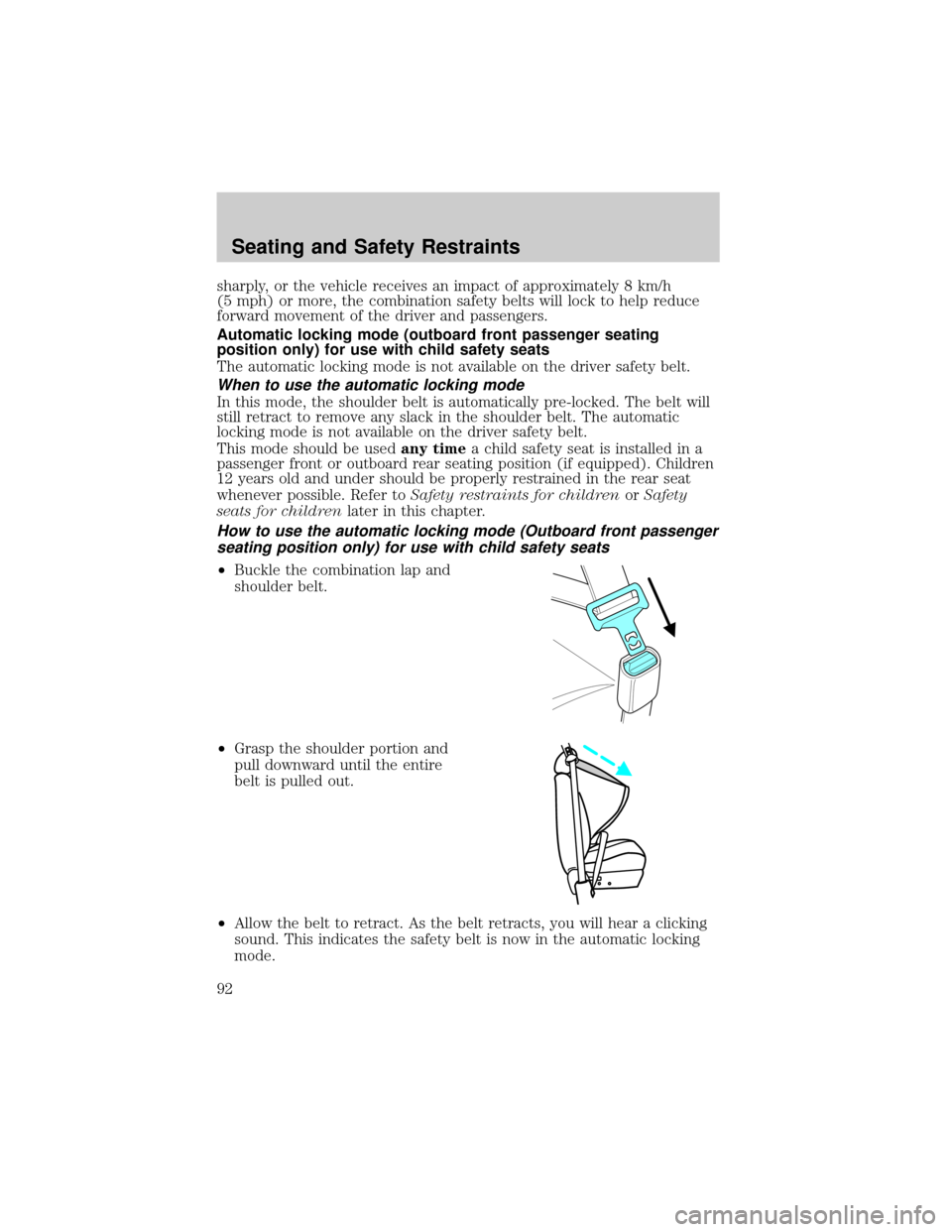
How to use the automatic locking mode (Outboard front passenger
seating position only) for use with child safety seats
²Buckle the combination lap and
shoulder belt.
²Grasp the shoulder portion and
pull downward until the entire
belt is pulled out.
²Allow the belt to retract. As the belt retracts, you will hear a clicking
sound. This indicates the safety belt is now in the automatic locking
mode.
Seating and Safety Restraints
92