weight MAZDA MODEL TRIBUTE 2003 Owners Manual (in English)
[x] Cancel search | Manufacturer: MAZDA, Model Year: 2003, Model line: MODEL TRIBUTE, Model: MAZDA MODEL TRIBUTE 2003Pages: 248, PDF Size: 2.5 MB
Page 112 of 248
SAFETY SEATS FOR CHILDREN
Child and infant or child safety seats
Use a safety seat that is recommended for the size and weight of the
child. Carefully follow all of the manufacturer's instructions with the
safety seat you put in your vehicle. If you do not install and use the
safety seat properly, the child may be injured in a sudden stop or
collision.
When installing a child safety seat:
²Review and follow the information
presented in theAir Bag
Supplemental Restraint System
section in this chapter.
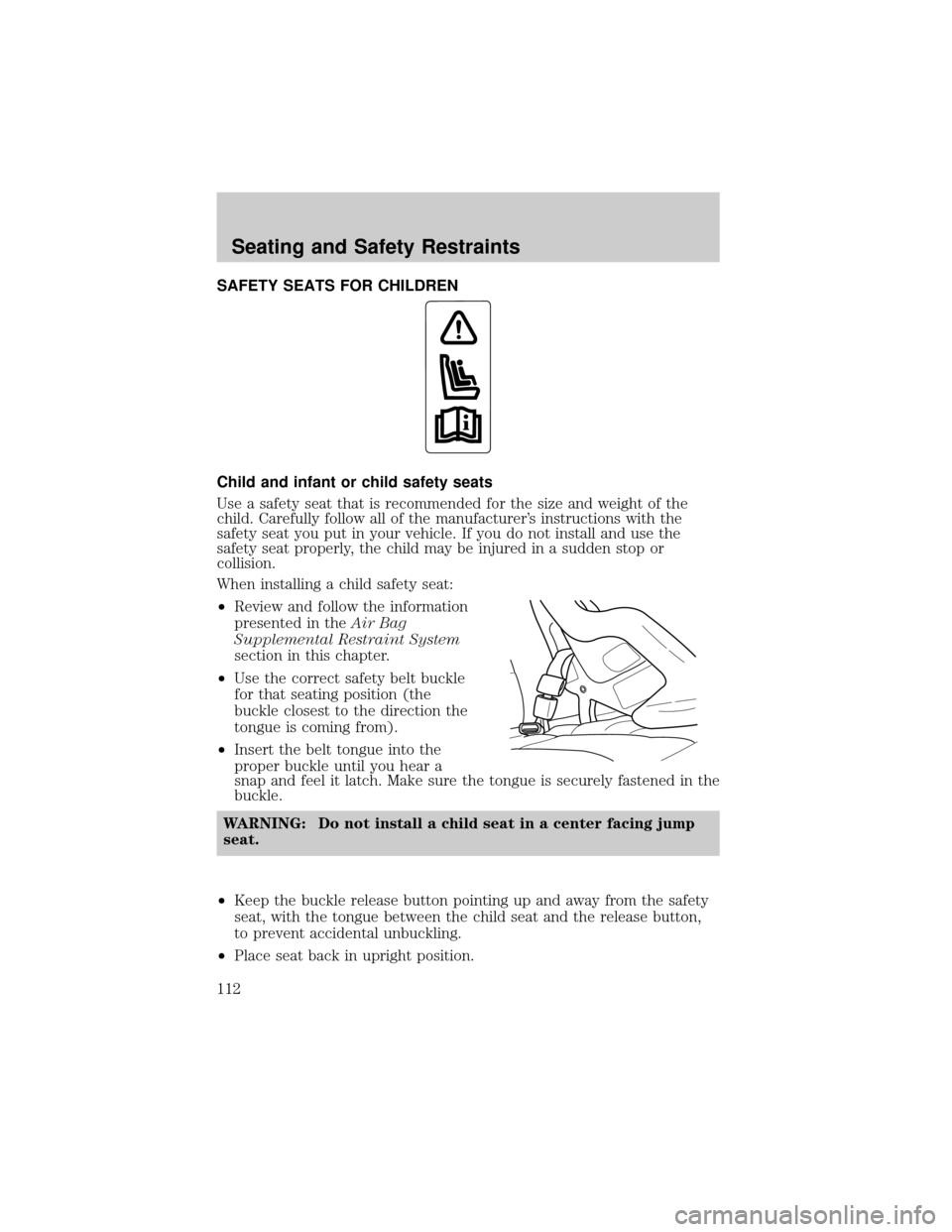
²Use the correct safety belt buckle
for that seating position (the
buckle closest to the direction the
tongue is coming from).
²Insert the belt tongue into the
proper buckle until you hear a
snap and feel it latch. Make sure the tongue is securely fastened in the
buckle.
WARNING: Do not install a child seat in a center facing jump
seat.
²Keep the buckle release button pointing up and away from the safety
seat, with the tongue between the child seat and the release button,
to prevent accidental unbuckling.
²Place seat back in upright position.
Seating and Safety Restraints
112
Page 147 of 248

DRIVING THROUGH WATER
Do not drive quickly through standing water, especially if the
depth is unknown. Traction or brake capability may be limited
and if the ignition system gets wet, your engine may stall. Water
may also enter your engine's air intake and severely damage your
engine.
If driving through deep or standing water is unavoidable, proceed very
slowly. Never drive through water that is higher than the bottom of the
hubs (for trucks) or the bottom of the wheel rims (for cars).
Once through the water, always try the brakes. Wet brakes do not stop
the vehicle as effectively as dry brakes. Drying can be improved by
moving your vehicle slowly while applying light pressure on the brake
pedal.
Driving through deep water where the transmission vent tube is
submerged may allow water into the transmission and cause
internal transmission damage. Have the fluid checked and, if
water is found, replace the fluid.
VEHICLE LOADING
Before loading a vehicle, familiarize yourself with the following terms:
²Base Curb Weight:Weight of the vehicle including any standard
equipment, fluids, lubricants, etc. It does not include occupants or
aftermarket equipment.
²Payload:Combined maximum allowable weight of cargo, occupants
and optional equipment. The payload equals the gross vehicle weight
rating minus base curb weight.
²GVW (Gross Vehicle Weight):Base curb weight plus payload
weight. The GVW is not a limit or a specification.
²GVWR (Gross Vehicle Weight Rating):Maximum permissible total
weight of the base vehicle, occupants, optional equipment and cargo.
The GVWR is specific to each vehicle and is listed on the Safety
Certification Label on the driver's door pillar.
²GAWR (Gross Axle Weight Rating):Carrying capacity for each axle
system. The GAWR is specific to each vehicle and is listed on the
Safety Certification Label on the driver's door pillar.
²GCW (Gross Combined Weight):The combined weight of the
towing vehicle (including occupants and cargo) and the loaded trailer.
²GCWR (Gross Combined Weight Rating):Maximum permissible
combined weight of towing vehicle (including occupants and cargo)
and the loaded trailer.
Driving
147
Page 148 of 248
²Maximum Trailer Weight Rating:Maximum weight of a trailer the
vehicle is permitted to tow. The maximum trailer weight rating is
determined by subtracting the vehicle curb weight for each
engine/transmission combination, any required option weight for trailer
towing and the weight of the driver from the GCWR for the towing
vehicle.
²Maximum Trailer Weight:Maximum weight of a trailer the loaded
vehicle (including occupants and cargo) is permitted to tow. It is
determined by subtracting the weight of the loaded trailer towing
vehicle from the GCWR for the towing vehicle.
²Trailer Weight Range:Specified weight range that the trailer must
fall within that ranges from zero to the maximum trailer weight rating.
NOTE: Remember to figure in the tongue load of your loaded trailer
when figuring the total weight.
WARNING: Do not exceed the GVWR or the GAWR specified on
the certification label, this could affect vehicle handling and
cause an accident.
Do not use replacement tires with lower load carrying capacities
than the originals because they may lower the vehicle's GVWR
and GAWR limitations. Replacement tires with a higher limit than
the originals do not increase the GVWR and GAWR limitations.
The Safety Certification Label, found on the driver's door pillar, lists
several important vehicle weight rating limitations. Before adding any
additional equipment, refer to these limitations. If you are adding weight
to the front of your vehicle, (potentially including weight added to the
cab), the weight added should not exceed the front axle reserve capacity
(FARC). Additional frontal weight may be added to the front axle reserve
capacity provided you limit your payload in other ways (i.e. restrict the
number of occupants or amount of cargo carried).
You may add equipment throughout your vehicle if the total weight
added is equal to or less than the total axle reserve capacity (TARC)
weight. You should NEVER exceed the total axle reserve capacity.
Always ensure that the weight of occupants, cargo and equipment being
carried is within the weight limitations that have been established for
your vehicle including both gross vehicle weight and front and rear gross
axle weight rating limits.
Driving
148
Page 149 of 248

WARNING: Exceeding any vehicle weight rating limitation
could result in serious damage to the vehicle loss of vehicle
control, vehicle rollover, and/or personal injury.
Special loading instructions for owners of pickup trucks and
utility-type vehicles
WARNING: For important information regarding safe operation
of this type of vehicle, see the Preparing to drive your vehicle
section in this chapter.
WARNING: Loaded vehicles may handle differently than
unloaded vehicles. Extra precautions, such as slower speeds and
increased stopping distance, should be taken when driving a
heavily loaded vehicle.
Your vehicle can haul more cargo and people than most passenger cars.
Depending upon the type and placement of the load, hauling cargo and
people may raise the center of gravity of the vehicle.
Calculating the load your vehicle can carry/tow
1. Use the appropriate maximum GCWR chart (in theTrailer Towing
section in this chapter) for your type of engine and rear axle ratio.
2. Weigh your vehicle without cargo. To obtain correct weights, take
your vehicle to a shipping company or an inspection station for
trucks.
3. Subtract your loaded weight from the maximum GCWR in the chart.
This is the maximum trailer weight your vehicle can tow. It must be
below the maximum trailer weight shown in the chart.
TRAILER TOWING
Trailer towing with your vehicle may require the use of a trailer tow
option package.
Trailer towing puts additional loads on your vehicle's engine, transaxle,
axle, brakes, tires, and suspension. For your safety and to maximize
vehicle performance, be sure to use the proper equipment while towing.
Follow these guidelines to ensure safe towing procedure:
²Stay within your vehicle's load limits.
Driving
149
Page 150 of 248
²Thoroughly prepare your vehicle for towing. Refer toPreparing to
towin this chapter.
²Use extra caution when driving while trailer towing. Refer toDriving
while you towin this chapter.
²Service your vehicle more frequently if you tow a trailer. Refer to the
ªScheduled Maintenanceº section of this manual.
²Do not tow a trailer until your vehicle has been driven at least 800 km
(500 miles).
²Refer to the instructions included with towing accessories for the
proper installation and adjustment specifications.
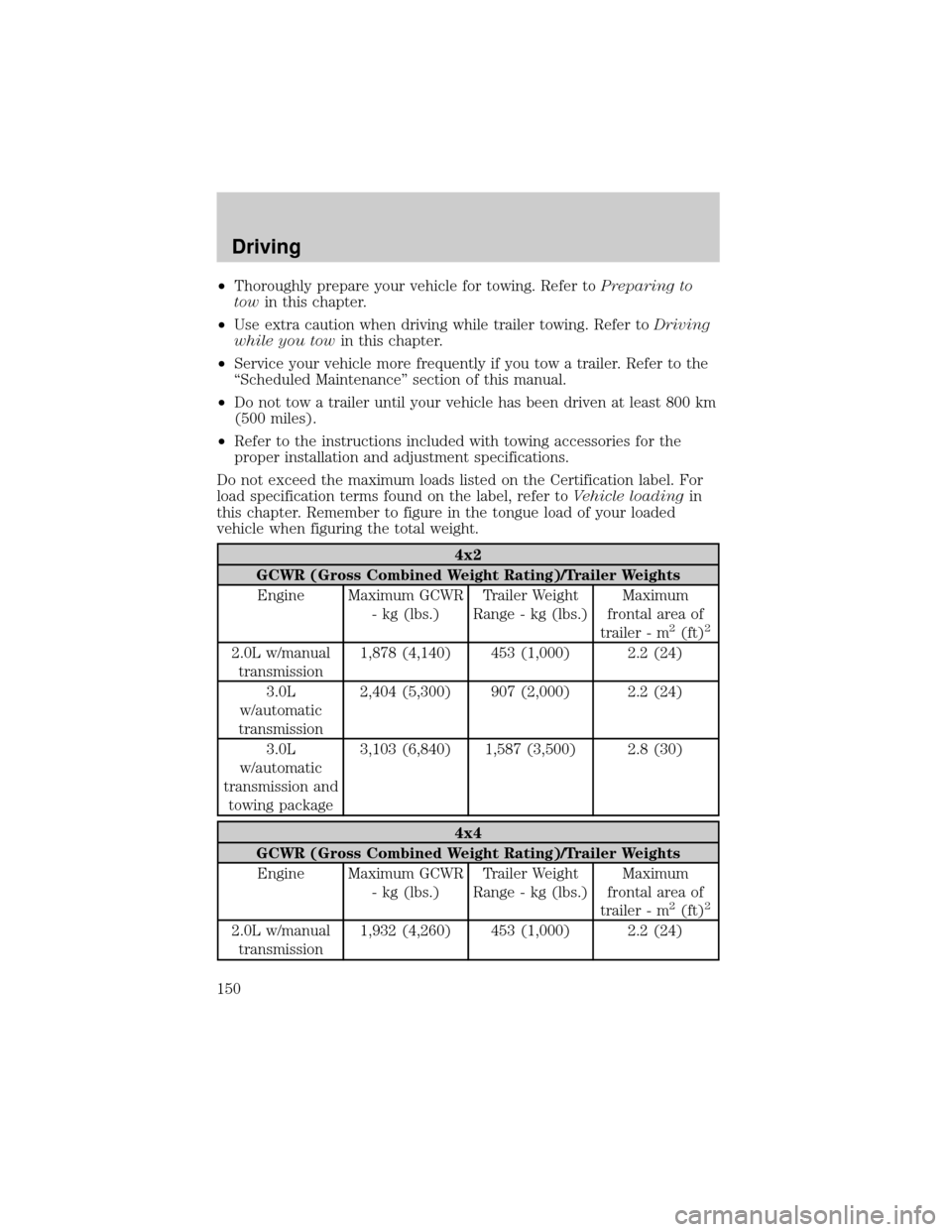
Do not exceed the maximum loads listed on the Certification label. For
load specification terms found on the label, refer toVehicle loadingin
this chapter. Remember to figure in the tongue load of your loaded
vehicle when figuring the total weight.
4x2
GCWR (Gross Combined Weight Rating)/Trailer Weights
Engine Maximum GCWR
- kg (lbs.)Trailer Weight
Range - kg (lbs.)Maximum
frontal area of
trailer - m
2(ft)2
2.0L w/manual
transmission1,878 (4,140) 453 (1,000) 2.2 (24)
3.0L
w/automatic
transmission2,404 (5,300) 907 (2,000) 2.2 (24)
3.0L
w/automatic
transmission and
towing package3,103 (6,840) 1,587 (3,500) 2.8 (30)
4x4
GCWR (Gross Combined Weight Rating)/Trailer Weights
Engine Maximum GCWR
- kg (lbs.)Trailer Weight
Range - kg (lbs.)Maximum
frontal area of
trailer - m
2(ft)2
2.0L w/manual
transmission1,932 (4,260) 453 (1,000) 2.2 (24)
Driving
150
Page 151 of 248
4x4
GCWR (Gross Combined Weight Rating)/Trailer Weights
Engine Maximum GCWR
- kg (lbs.)Trailer Weight
Range - kg (lbs.)Maximum
frontal area of
trailer - m
2(ft)2
3.0L
w/automatic
transmission2,477 (5,460) 907 (2,000) 2.2 (24)
3.0L
w/automatic
transmission and
towing package3,175 (7,000) 1, 587 (3,500) 2.8 (30)
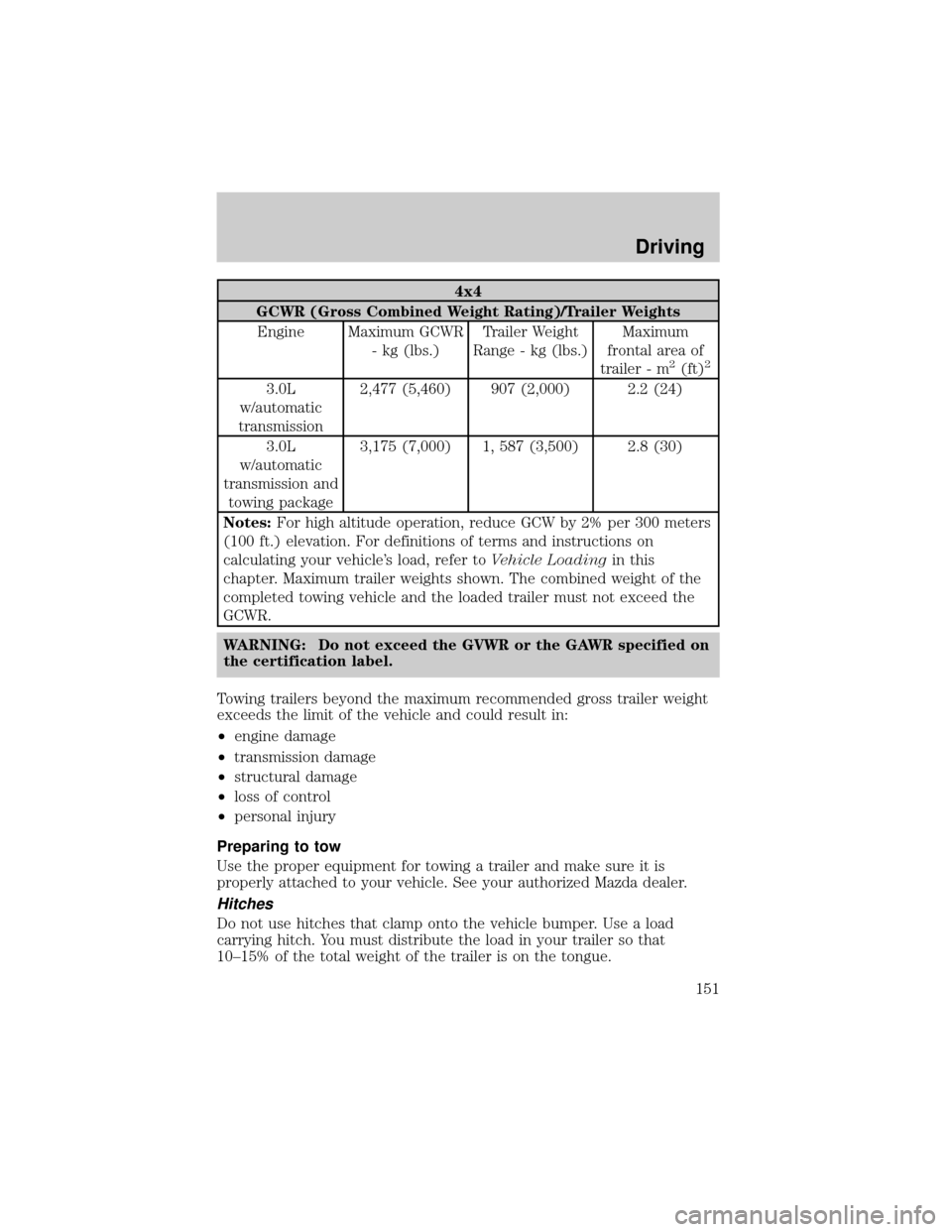
Notes:For high altitude operation, reduce GCW by 2% per 300 meters
(100 ft.) elevation. For definitions of terms and instructions on
calculating your vehicle's load, refer toVehicle Loadingin this
chapter. Maximum trailer weights shown. The combined weight of the
completed towing vehicle and the loaded trailer must not exceed the
GCWR.
WARNING: Do not exceed the GVWR or the GAWR specified on
the certification label.
Towing trailers beyond the maximum recommended gross trailer weight
exceeds the limit of the vehicle and could result in:
²engine damage
²transmission damage
²structural damage
²loss of control
²personal injury
Preparing to tow
Use the proper equipment for towing a trailer and make sure it is
properly attached to your vehicle. See your authorized Mazda dealer.
Hitches
Do not use hitches that clamp onto the vehicle bumper. Use a load
carrying hitch. You must distribute the load in your trailer so that
10±15% of the total weight of the trailer is on the tongue.
Driving
151
Page 153 of 248

Servicing after towing
If you tow a trailer for long distances, your vehicle will require more
frequent service intervals. Refer to the ªScheduled Maintenanceº section
for more information.
Trailer towing tips
²Practice turning, stopping and backing up before starting on a trip to
get the feel of the vehicle trailer combination. When turning, make
wider turns so the trailer wheels will clear curbs and other obstacles.
²Allow more distance for stopping with a trailer attached.
²The trailer tongue weight should be 10±15% of the loaded trailer
weight.
²After you have traveled 80 km (50 miles), thoroughly check your
hitch, electrical connections and trailer wheel lug nuts.
²To aid in engine/transmission cooling and A/C efficiency during hot
weather while stopped in traffic, place the gearshift lever in P (Park)
(automatic transmission) or N (Neutral) (manual transmissions).
²Vehicles with trailers should not be parked on a grade. If you must
park on a grade, place wheel chocks under the trailer's wheels.
Launching or retrieving a boat
When backing down a ramp during boat launching or retrieval,
²Do not allow the static water level to rise above the bottom edge of
the rear bumper.
²Do not allow waves to break higher than 15 cm (6 inches) above the
bottom edge of the rear bumper.
Exceeding these limits may allow water to enter critical vehicle
components, adversely affecting driveability, emissions, reliability
and causing internal transmission damage.
Replace the rear axle lubricant any time the axle has been
submerged in water. Rear axle lubricant quantities are not to be
checked or changed unless a leak is suspected or repair required.
Disconnect the wiring to the trailer before backing the trailer into the
water. Reconnect the wiring to the trailer after the trailer is removed
from the water. Water entering these areas, while connected, could
short-circuit the system.
Driving
153
Page 222 of 248
![MAZDA MODEL TRIBUTE 2003 Owners Manual (in English) ²Carrying unnecessary weight may reduce fuel economy (approximately
0.4 km/L [1 mpg] is lost for every 180 kg [400 lb] of weight carried).
²Adding certain accessories to your vehicle (for example bu](/img/28/15635/w960_15635-221.png "MAZDA MODEL TRIBUTE 2003 Owners Manual (in English) ²Carrying unnecessary weight may reduce fuel economy (approximately
0.4 km/L [1 mpg] is lost for every 180 kg [400 lb] of weight carried).
²Adding certain accessories to your vehicle (for example bu")
²Carrying unnecessary weight may reduce fuel economy (approximately
0.4 km/L [1 mpg] is lost for every 180 kg [400 lb] of weight carried).
²Adding certain accessories to your vehicle (for example bug
deflectors, rollbars/light bars, running boards, ski/luggage racks) may
reduce fuel economy.
²Using fuel blended with alcohol may lower fuel economy.
²Fuel economy may decrease with lower temperatures during the first
12±16 km (8±10 miles) of driving.
²Driving on flat terrain offers improved fuel economy as compared to
driving on hilly terrain.
²Transmissions give their best fuel economy when operated in the top
cruise gear and with steady pressure on the gas pedal.
²Close windows for high speed driving.
EPA window sticker
Every new vehicle should have the EPA window sticker. Contact your
dealer if the window sticker is not supplied with your vehicle. The EPA
window sticker should be your guide for the fuel economy comparisons
with other vehicles.
It is important to note the box in the lower left corner of the window
sticker. These numbers represent the Range of L/100 km (MPG)
expected on the vehicle under optimum conditions. Your fuel economy
may vary depending upon the method of operation and conditions.
EMISSION CONTROL SYSTEM
Your vehicle is equipped with various emission control components and a
catalytic converter which will enable your vehicle to comply with
applicable exhaust emission standards. To make sure that the catalytic
converter and other emission control components continue to work
properly:
²Use only the specified fuel listed.
²Avoid running out of fuel.
²Do not turn off the ignition while your vehicle is moving, especially at
high speeds.
²Have the items listed in your service maintenance section performed
according to the specified schedule.
The scheduled maintenance items listed in the scheduled maintenance
section are essential to the life and performance of your vehicle and to
its emissions system.
Maintenance and Specifications
222
Page 242 of 248

preparing to drive your
vehicle .....................................128
Fuel ............................................214
calculating fuel economy .......219
cap ...........................................218
capacity ...................................234
choosing the right fuel ...........216
comparisons with EPA fuel
economy estimates .................222
detergent in fuel .....................217
filling your vehicle with
fuel ...........................214, 218±219
filter, specifications ................219
fuel filler door release ..............65
improving fuel economy ........219
octane rating ...................217, 236
quality ......................................217
running out of fuel .................218
safety information relating to
automotive fuels .....................214
Fuses ..........................................156
G
Garage door opener ....................59
Gas cap (see Fuel cap) ............218
Gas mileage
(see Fuel economy) .................219
Gauges .........................................15
engine coolant temperature
gauge .........................................17
fuel gauge ..................................17
odometer ...................................17
tachometer ................................17
trip odometer ............................17
GAWR (Gross Axle Weight
Rating) .......................................147
calculating ...............................149
definition .................................147
driving with a heavy load ......147location ....................................147
GVWR (Gross Vehicle Weight
Rating) .......................................147
calculating .......................147, 149
definition .................................147
driving with a heavy load ......147
location ....................................147
H
Hazard flashers .........................155
Head restraints .....................80, 82
Headlamps ...................................48
aiming ........................................50
bulb specifications ....................51
daytime running lights .............48
flash to pass ..............................49
high beam .................................49
replacing bulbs .........................52
turning on and off ....................48
Heating
heating and air conditioning
system .......................................44
Hood ..........................................198
I
Ignition ...............................120, 236
Infant seats
(see Safety seats) .....................112
Inspection/maintenance (I/M)
testing ........................................223
Instrument panel
cleaning ...................................190
cluster ........................................10
lighting up panel and
interior .......................................49
location of components ............10
J
Jump-starting your vehicle ......169
Index
242