ignition MAZDA MODEL TRIBUTE 2004 (in English) Service Manual
[x] Cancel search | Manufacturer: MAZDA, Model Year: 2004, Model line: MODEL TRIBUTE, Model: MAZDA MODEL TRIBUTE 2004Pages: 256, PDF Size: 2.64 MB
Page 143 of 256
Sand
When driving over sand, try to keep all four wheels on the most solid
area of the trail. Avoid reducing the tire pressures but shift to a lower
gear and drive steadily through the terrain. Apply the accelerator slowly
and avoid spinning the wheels.
If you must reduce the tire pressure for whatever reason in sand, make
sure you re-inflate the tires as soon as possible.
Avoid excessive speed because vehicle momentum can work against you
and cause the vehicle to become stuck to the point that assistance may
be required from another vehicle. Remember, you may be able to back
out the way you came if you proceed with caution.
Mud and water
NOTE:
²If you must drive through high
water, drive slowly. Traction or
brake capability may be limited.
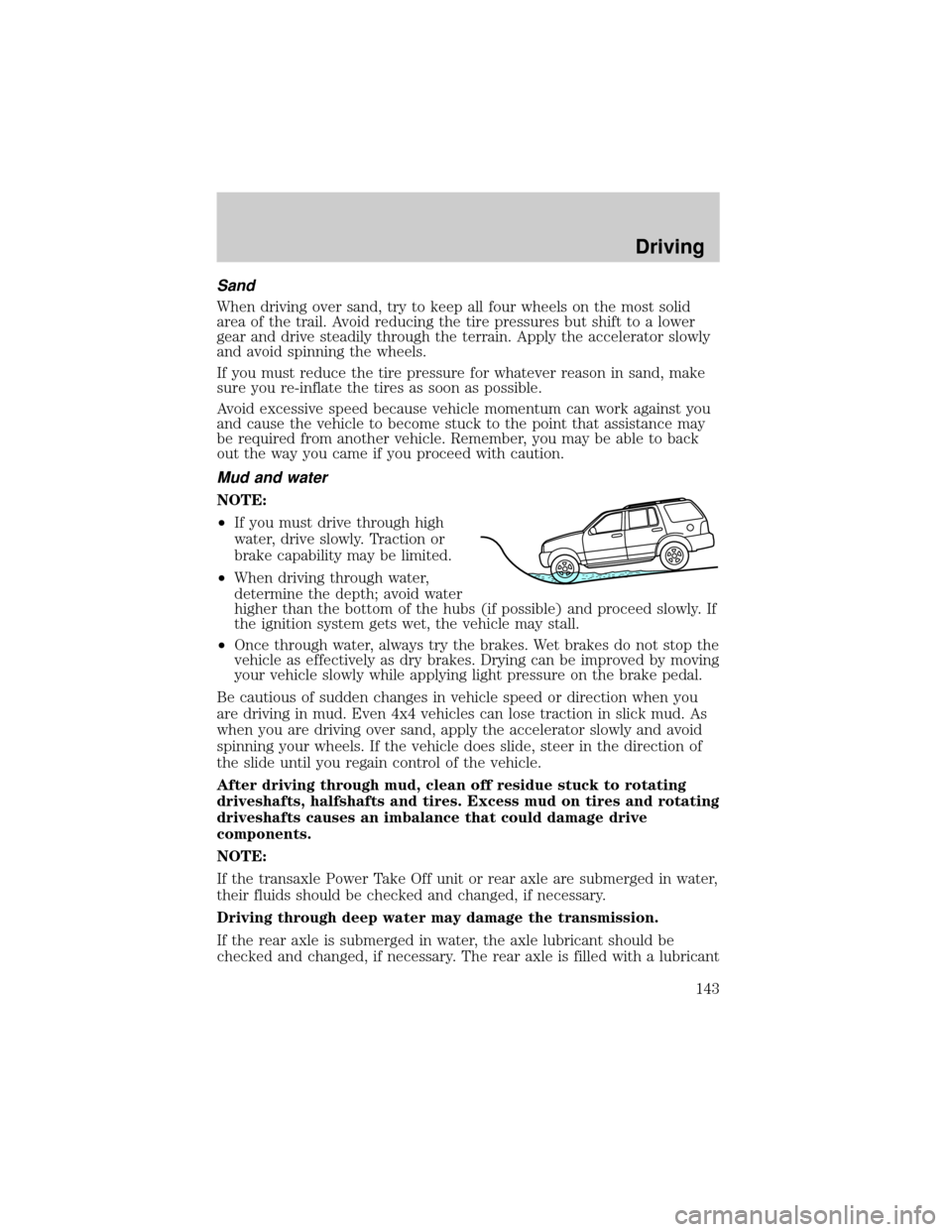
²When driving through water,
determine the depth; avoid water
higher than the bottom of the hubs (if possible) and proceed slowly. If
the ignition system gets wet, the vehicle may stall.
²Once through water, always try the brakes. Wet brakes do not stop the
vehicle as effectively as dry brakes. Drying can be improved by moving
your vehicle slowly while applying light pressure on the brake pedal.
Be cautious of sudden changes in vehicle speed or direction when you
are driving in mud. Even 4x4 vehicles can lose traction in slick mud. As
when you are driving over sand, apply the accelerator slowly and avoid
spinning your wheels. If the vehicle does slide, steer in the direction of
the slide until you regain control of the vehicle.
After driving through mud, clean off residue stuck to rotating
driveshafts, halfshafts and tires. Excess mud on tires and rotating
driveshafts causes an imbalance that could damage drive
components.
NOTE:
If the transaxle Power Take Off unit or rear axle are submerged in water,
their fluids should be checked and changed, if necessary.
Driving through deep water may damage the transmission.
If the rear axle is submerged in water, the axle lubricant should be
checked and changed, if necessary. The rear axle is filled with a lubricant
Driving
143
Page 148 of 256
and if the ignition system gets wet, your engine may stall. Water
may also enter your engine's air intake and severely damage your
engine.
If driving through deep or standing water is unavoidable, proceed very
slowly. Never drive through water that is higher than the bottom of the
hubs (for trucks) or the bottom of the wheel rims (for cars).
Once through the water, always try the brakes. Wet brakes do not stop
the vehicle as effectively as dry brakes. Drying can be improved by
moving your vehicle slowly while applying light pressure on the brake
pedal.
Driving through deep water where the transmission vent tube is
submerged may allow water into the transmission and cause
internal transmission damage. Have the fluid checked and, if
water is found, replace the fluid.
VEHICLE LOADING ± WITH AND WITHOUT A TRAILER
This section will guide you in the proper loading of your vehicle and/or
trailer, to keep your loaded vehicle weight within its design rating
capability, with or without a trailer. Properly loading your vehicle will
provide maximum return of vehicle design performance. Before loading
your vehicle, familiarize yourself with the following terms for determining
your vehicle's weight ratings, with or without a trailer, from the vehicle's
Safety Certification Label and Tire and Load Information Label:
Base Curb Weight± is the weight of the vehicle including a full tank of
fuel and all standard equipment. It does not include passengers, cargo, or
optional equipment.
Vehicle Curb Weight± is the weight of your new vehicle when you
picked it up from your dealer plus any aftermarket equipment.
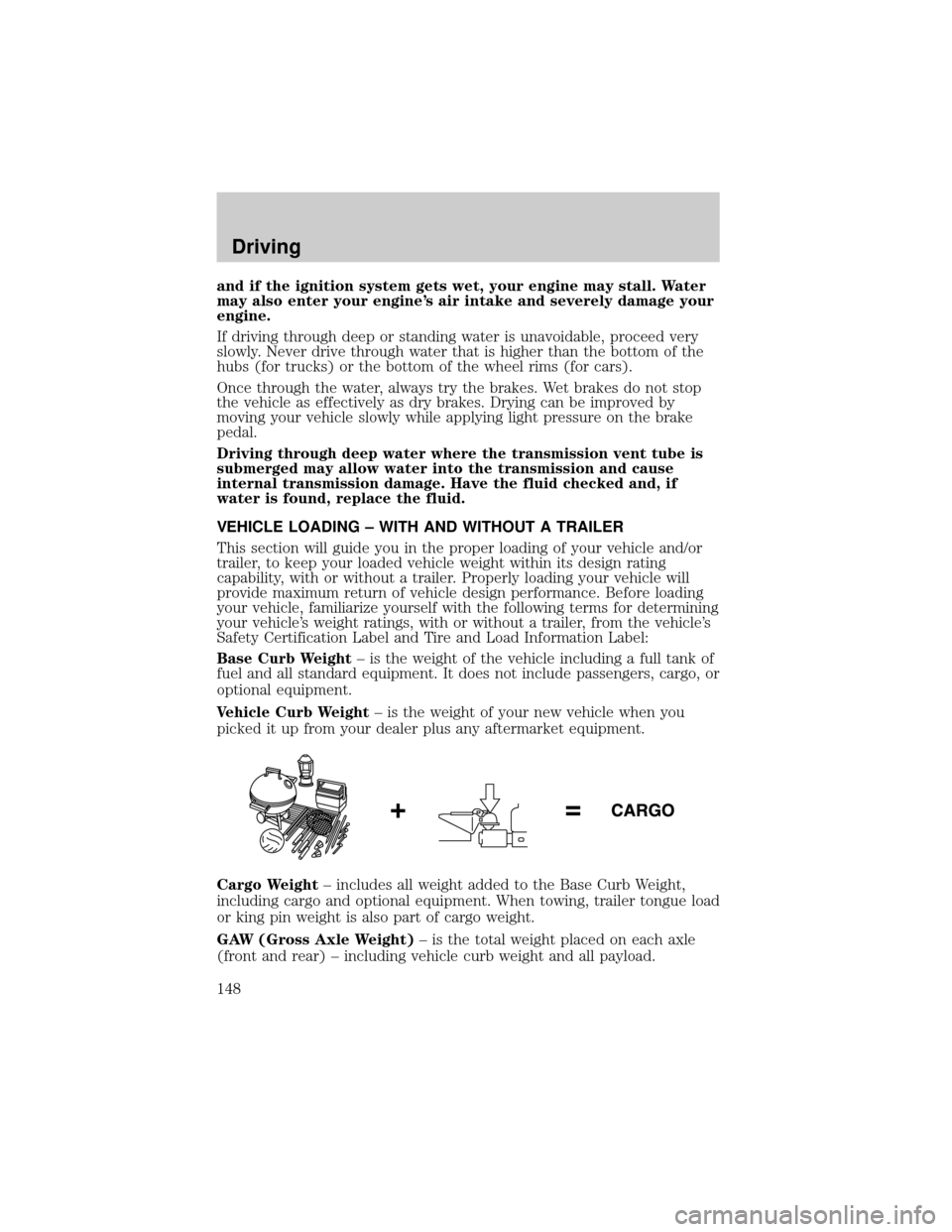
Cargo Weight± includes all weight added to the Base Curb Weight,
including cargo and optional equipment. When towing, trailer tongue load
or king pin weight is also part of cargo weight.
GAW (Gross Axle Weight)± is the total weight placed on each axle
(front and rear) ± including vehicle curb weight and all payload.
Driving
148
Page 157 of 256

HAZARD FLASHER CONTROL
The hazard flasher is located on the
instrument panel by the radio. The
hazard flashers will operate when
the ignition is off.
Push in the flasher control and all front and rear direction signals will
flash. Press the flasher control again to turn them off. Use it when your
vehicle is disabled and is creating a safety hazard for other motorists.
Note:With extended use, the flasher may run down your battery.
FUEL PUMP SHUT-OFF SWITCH
FUEL
RESET
This device stops the electric fuel pump from sending fuel to the engine
when your vehicle has had a substantial jolt.
After an accident, if the engine cranks but does not start, this switch
may have been activated.
This switch is located in the front
passenger's footwell, by the kick
panel access cover.
To reset the switch:
1. Turn the ignition OFF.
2. Check the fuel system for leaks.
3. Remove the kick panel access
cover, located in the front
passenger's footwell.
4. If no leaks are apparent, reset
the switch by pushing in on the
reset button.
5. Turn the ignition ON.
6. Wait a few seconds and return
the key to OFF.
7. Make another check of leaks.
Roadside Emergencies
Roadside Emergencies
157
Page 165 of 256
3. Turn off the air conditioner.
WARNING: Steam from an overheated engine is dangerous. The
escaping steam could seriously burn you. Open the hood ONLY
after steam is no longer escaping from the engine.
4. Check whether coolant or steam is escaping from under the hood or
from the engine compartment.
²If steam is coming from the engine compartment:do not go near
the front of the vehicle. Stop the engine, then turn the ignition switch
to the ON position without starting the engine. The radiator cooling
fans will start to cool the engine.
²If neither coolant nor steam is escaping:open the hood and idle
the engine until it cools. If this does not lower the temperature, stop
the engine and let it cool.
5. Check the coolant level. If it is low, look for leaks in the radiator
hoses and connections, heater hoses and connections, radiator and
water pump.
If you find a leak or other damage, or if coolant is still leaking, stop the
engine and call an Authorized Mazda dealer.
SeeAdding coolantin theMaintenance and specificationssection. If
you find no problems, the engine is cool and no leaks are obvious,
carefully add coolant as required.
WARNING: When the engine and radiator are hot, scalding
coolant and steam may shoot out under pressure and cause
serious injury. Do not remove the cooling system cap when the
engine and radiator are hot.
Note:If the engine continues to overheat or frequently overheats, have
the cooling system inspected. The engine could be seriously damaged
unless repairs are made.
TEMPORARY SPARE TIRE INFORMATION
Your vehicle may have a temporary or conventional spare tire. The
temporary spare tire for your vehicle is labeled as such. It is smaller than
a regular tire and is designed for emergency use only. Replace this tire
with a full-size tire as soon as possible.
It is not recommended that the vehicle be operated in 4WD modes with
a temporary spare. If 4WD operation is necessary, do not operate above
speeds of 16 km/h (10 mph) or for distances above 80 km (50 miles).
Roadside Emergencies
165
Page 197 of 256
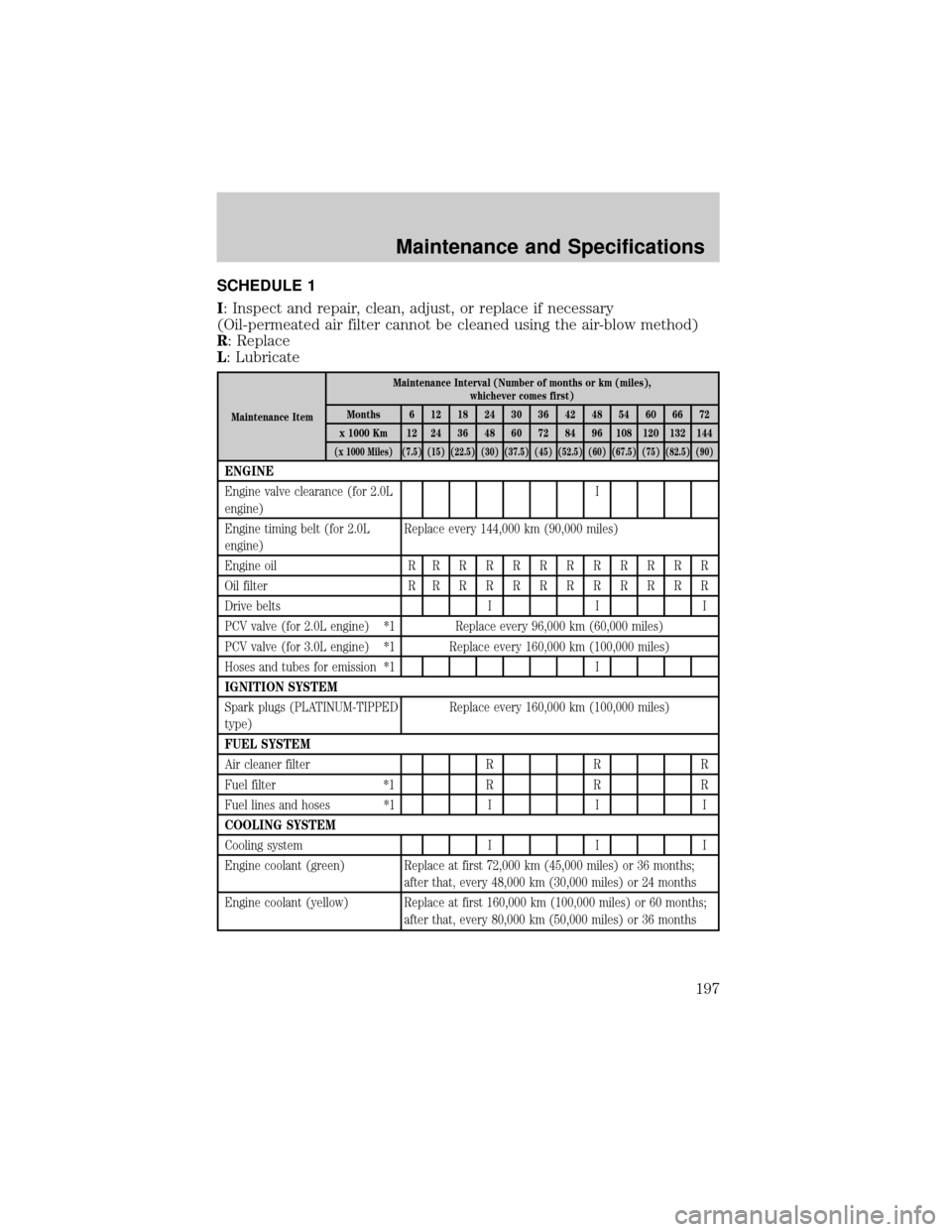
SCHEDULE 1
I: Inspect and repair, clean, adjust, or replace if necessary
(Oil-permeated air filter cannot be cleaned using the air-blow method)
R: Replace
L: Lubricate
Maintenance ItemMaintenance Interval (Number of months or km (miles),
whichever comes first)
Months 6 12 18 24 30 36 42 48 54 60 66 72
x 1000 Km 12 24 36 48 60 72 84 96 108 120 132 144
(x 1000 Miles) (7.5) (15) (22.5) (30) (37.5) (45) (52.5) (60) (67.5) (75) (82.5) (90)
ENGINE
Engine valve clearance (for 2.0L
engine)I
Engine timing belt (for 2.0L
engine)Replace every 144,000 km (90,000 miles)
Engine oil RRRRRRRRRRRR
Oil filter RRRRRRRRRRRR
Drive belts I I I
PCV valve (for 2.0L engine) *1 Replace every 96,000 km (60,000 miles)
PCV valve (for 3.0L engine) *1 Replace every 160,000 km (100,000 miles)
Hoses and tubes for emission *1 I
IGNITION SYSTEM
Spark plugs (PLATINUM-TIPPED
type)Replace every 160,000 km (100,000 miles)
FUEL SYSTEM
Air cleaner filter R R R
Fuel filter *1 R R R
Fuel lines and hoses *1 I I I
COOLING SYSTEM
Cooling system I I I
Engine coolant (green) Replace at first 72,000 km (45,000 miles) or 36 months;
after that, every 48,000 km (30,000 miles) or 24 months
Engine coolant (yellow) Replace at first 160,000 km (100,000 miles) or 60 months;
after that, every 80,000 km (50,000 miles) or 36 months
Maintenance and Specifications
197
Page 199 of 256
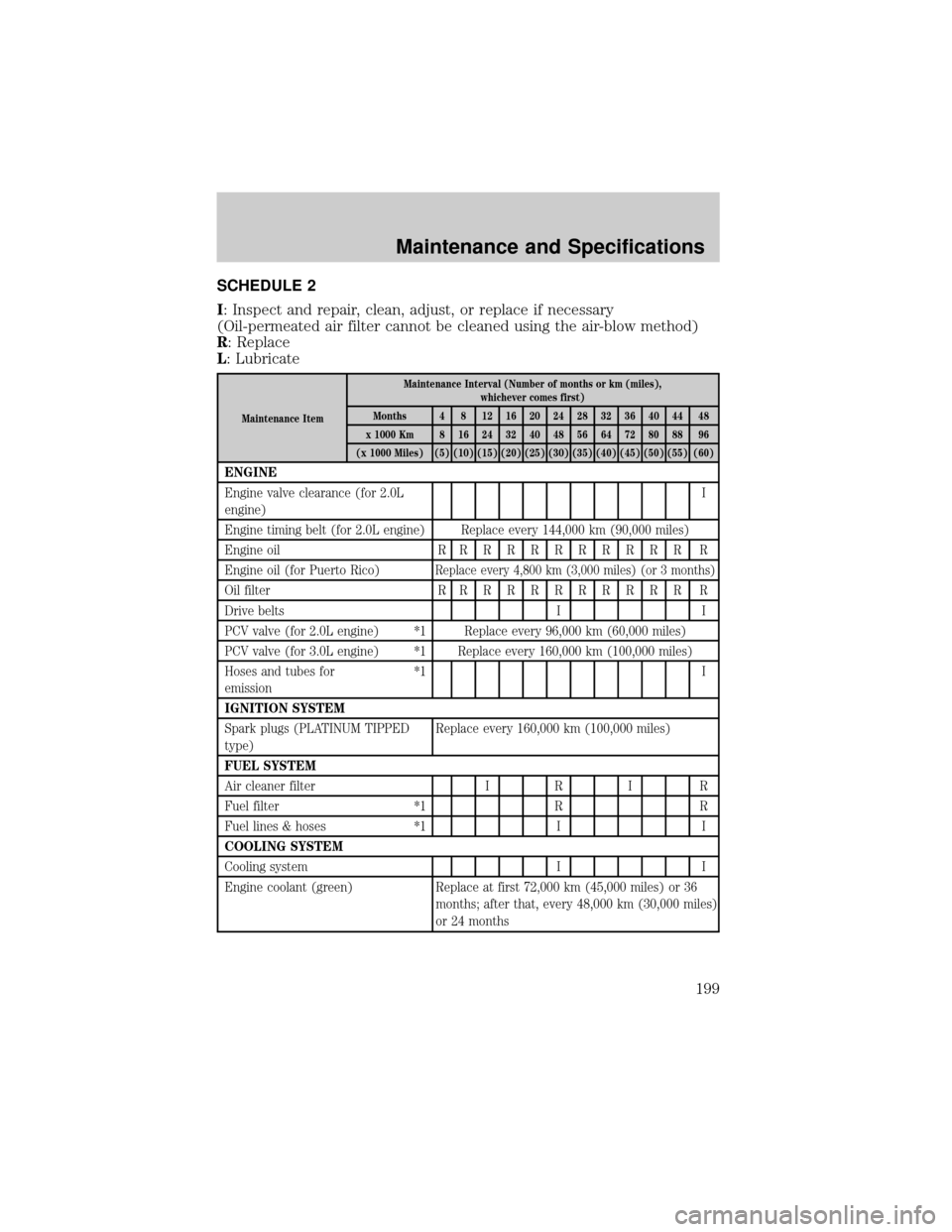
SCHEDULE 2
I: Inspect and repair, clean, adjust, or replace if necessary
(Oil-permeated air filter cannot be cleaned using the air-blow method)
R: Replace
L: Lubricate
Maintenance ItemMaintenance Interval (Number of months or km (miles),
whichever comes first)
Months 4 8 12 16 20 24 28 32 36 40 44 48
x 1000 Km 8 16 24 32 40 48 56 64 72 80 88 96
(x 1000 Miles) (5) (10) (15) (20) (25) (30) (35) (40) (45) (50) (55) (60)
ENGINE
Engine valve clearance (for 2.0L
engine)I
Engine timing belt (for 2.0L engine) Replace every 144,000 km (90,000 miles)
Engine oil RRRRRRRRRRR R
Engine oil (for Puerto Rico)
Replace every 4,800 km (3,000 miles) (or 3 months)
Oil filter RRRRRRRRRRR R
Drive belts I I
PCV valve (for 2.0L engine) *1 Replace every 96,000 km (60,000 miles)
PCV valve (for 3.0L engine) *1 Replace every 160,000 km (100,000 miles)
Hoses and tubes for
emission*1 I
IGNITION SYSTEM
Spark plugs (PLATINUM TIPPED
type)Replace every 160,000 km (100,000 miles)
FUEL SYSTEM
Air cleaner filter I R I R
Fuel filter *1 R R
Fuel lines & hoses *1 I I
COOLING SYSTEM
Cooling system I I
Engine coolant (green) Replace at first 72,000 km (45,000 miles) or 36
months; after that, every 48,000 km (30,000 miles)
or 24 months
Maintenance and Specifications
199
Page 220 of 256

NOTE:Do not be concerned if your engine sometimes knocks lightly.
However, if it knocks heavily under most driving conditions while you are
using fuel with the recommended octane rating, see your authorized
Mazda dealer to prevent any engine damage.
Fuel quality
NOTE:If you are experiencing starting, rough idle or hesitation
driveability problems during a cold start, try a different brand of
ªRegularº unleaded gasoline. ªPremiumº unleaded gasoline is not
recommended (particularly in the United States) because it may cause
these problems to become more pronounced. If the problems persist, see
your authorized Mazda dealer.
It should not be necessary to add any aftermarket products to your fuel
tank if you continue to use high quality fuel of the recommended octane
rating.
Aftermarket products could cause damage to the fuel system.
Repairs to correct the effects of using an aftermarket product in
your fuel may not be covered by your warranty.
Many of the world's automakers approved the World-wide Fuel Charter
that recommends gasoline specifications to provide improved
performance and emission control system protection for your vehicle.
Gasolines that meet the World-wide Fuel Charter should be used when
available. Ask your fuel supplier about gasolines that meet the
World-wide Fuel Charter.
Cleaner air
Mazda endorses the use of reformulated ªcleaner-burningº gasolines to
improve air quality.
Running out of fuel
Avoid running out of fuel because this situation may have an adverse
affect on powertrain components.
If you have run out of fuel:
²You may need to cycle the ignition from OFF to ON several times after
refueling, to allow the fuel system to pump the fuel from the tank to
the engine.
²The
indicator may come on. For more information on the ªCheck
Engineº indicator, refer to theInstrument Clusterchapter.
Fuel Filler Cap
Your fuel tank filler cap has an indexed design with a 1/8 turn on/off
feature.
Maintenance and Specifications
220
Page 222 of 256

ESSENTIALS OF GOOD FUEL ECONOMY
Measuring techniques
Your best source of information about actual fuel economy is you, the
driver. You must gather information as accurately and consistently as
possible. Fuel expense, frequency of fillups or fuel gauge readings are
NOT accurate as a measure of fuel economy. We do not recommend
taking fuel economy measurements during the first 1,600 km (1,000
miles) of driving (engine break-in period). You will get a more accurate
measurement after 3,000 km±5,000 km (2,000 miles-3,000 miles).
Filling the tank
The advertised fuel capacity of the fuel tank on your vehicle is equal to
the rated refill capacity of the fuel tank as listed in theRefill capacities
section of this chapter.
The advertised capacity is the amount of the indicated capacity and the
empty reserve combined. Indicated capacity is the difference in the
amount of fuel in a full tank and a tank when the fuel gauge indicates
empty. Empty reserve is the small amount of fuel remaining in the fuel
tank after the fuel gauge indicates empty.
The amount of usable fuel in the empty reserve varies and should
not be relied upon to increase driving range. When refueling your
vehicle after the fuel gauge indicates empty, you might not be
able to refuel the full amount of the advertised capacity of the
fuel tank due to the empty reserve still present in the tank.
For consistent results when filling the fuel tank:
²Turn the engine/ignition switch to the off position prior to refueling,
an error in the reading will result if the engine is left running.
²Use the same filling rate setting (low Ð medium Ð high) each time
the tank is filled.
²Allow no more than 2 automatic click-offs when filling.
²Always use fuel with the recommended octane rating.
²Use a known quality gasoline, preferably a national brand.
²Use the same side of the same pump and have the vehicle facing the
same direction each time you fill up.
²Have the vehicle loading and distribution the same every time.
Your results will be most accurate if your filling method is consistent.
Calculating fuel economy
1. Fill the fuel tank completely and record the initial odometer reading
(in kilometers or miles).
Maintenance and Specifications
222
Page 225 of 256
It is important to note the box in the lower left corner of the window
sticker. These numbers represent the Range of L/100 km (MPG)
expected on the vehicle under optimum conditions. Your fuel economy
may vary depending upon the method of operation and conditions.
EMISSION CONTROL SYSTEM
Your vehicle is equipped with various emission control components and a
catalytic converter which will enable your vehicle to comply with
applicable exhaust emission standards. To make sure that the catalytic
converter and other emission control components continue to work
properly:
²Use only the specified fuel listed.
²Avoid running out of fuel.
²Do not turn off the ignition while your vehicle is moving, especially at
high speeds.
²Have the items listed in your service maintenance section performed
according to the specified schedule.
The scheduled maintenance items listed in the scheduled maintenance
section are essential to the life and performance of your vehicle and to
its emissions system.
If other than Mazda authorized parts are used for maintenance
replacements or for service of components affecting emission control,
such non-Mazda parts should be equivalent to genuine Mazda parts in
performance and durability.
WARNING: Do not park, idle, or drive your vehicle in dry grass
or other dry ground cover. The emission system heats up the
engine compartment and exhaust system, which can start a fire.
Illumination of the
indicator, charging system warning light or the
temperature warning light, fluid leaks, strange odors, smoke or loss of
engine power, could indicate that the emission control system is not
working properly.
WARNING: Exhaust leaks may result in entry of harmful and
potentially lethal fumes into the passenger compartment.
Maintenance and Specifications
225
Page 246 of 256

3Indicates only approximate dry-fill capacity. Some applications may vary
based on cooler size and if equipped with an in-tank cooler. The amount
of transmission fluid and fluid level should be set by the indication on
the dipstick's normal operating range.
4Add the coolant type originally equipped in your vehicle. DO NO MIX
different colors or types of coolant. DO NOT USE Extended Life Engine
Coolant (orange in color). Refer toAdding engine coolantin this
chapter.
5Fill to 6 mm to 14 mm (1/4 inch to 9/16 inch) below bottom of fill hole.
For further information on your lubrication specifications, see your
authorized Mazda dealer.
WHEEL AND TIRE SIZES
Vehicle
GradeWheel Tire Spare
WheelSpare Tire
DX 6.5JJx16 215/70R16 17x4T 135/90R17
LX-V6/ES-V6
DX-V6
±(Puerto
Rico only)7.0JJx16 235/70R16 17x4T 145/90R17
ENGINE SPECIFICATIONS
Engine 2.0L DOHC I4 Zetec
engine3.0L DOHC V6
Duratec engine
Cubic inches 121 181
Required fuel 87 octane 87 octane
Firing order 1-3-4-2 1-4-2-5-3-6
Spark plug gap 1.22-1.32 mm
(0.048-0.052 inch)1.32-1.42 mm
(0.052-0.056 inch)
Ignition system DIS Coil on plug
Compression ratio 9.6:1 10.0:1
Maintenance and Specifications
246