engine MAZDA MODEL TRIBUTE 2008 (in English) Owner's Manual
[x] Cancel search | Manufacturer: MAZDA, Model Year: 2008, Model line: MODEL TRIBUTE, Model: MAZDA MODEL TRIBUTE 2008Pages: 288, PDF Size: 3.9 MB
Page 154 of 288
•A final example for your vehicle with 1400 lb. (635 kg) of cargo and
luggage capacity. You and one of your friends decide to pick up
cement from the local home improvement store to finish that patio
you have been planning for the past 2 years. Measuring the inside of
the vehicle with the rear seat folded down, you have room for 12-100 lb.(45 kg) bags of cement. Do you have enough load capacity to
transport the cement to your home? If you and your friend each weigh
220 lb. (99 kg), the calculation would be: 1400 - (2 x 220) - (12 x 100)=
1400 - 440 - 1200 = - 240 lb. No, you do not have enough cargo
capacity to carry that much weight. In metric units, the calculation
would be: 635 kg - (2 x 99 kg) - (12 x 45 kg) = 635 - 198 - 540 =
-103 kg. You will need to reduce the load weight by at least 240 lb.
(104 kg). If you remove 3-100 lb. (45 kg) cement bags, then the load
calculation would be:
1400 - (2 x 220) - (9 x 100) = 1400 - 440 - 900 = 60 lb. Now you have
the load capacity to transport the cement and your friend home. In
metric units, the calculation would be: 635 kg - (2 x 99 kg) - (9 x 45 kg)= 635 - 198 - 405 = 32 kg.
The above calculations also assume that the loads are positioned in your
vehicle in a manner that does not overload the Front or the Rear Gross
Axle Weight Rating specified for your vehicle on the Safety Compliance
Certification Label found on the edge of the driver’s door.
Special loading instructions for owners of pickup trucks and
utility-type vehicles
WARNING: For important information regarding safe operation
of this type of vehicle, see the Preparing to drive your vehicle
section in the Drivingchapter of this Owner’s Manual.
WARNING: Loaded vehicles may handle differently than
unloaded vehicles. Extra precautions, such as slower speeds and
increased stopping distance, should be taken when driving a
heavily loaded vehicle.
Your vehicle can haul more cargo and people than most passenger cars.
Depending upon the type and placement of the load, hauling cargo and
people may raise the center of gravity of the vehicle.
TRAILER TOWING
Trailer towing with your vehicle may require the use of a trailer tow
option package.
Trailer towing puts additional loads on your vehicle’s engine, transaxle,
axle, brakes, tires, and suspension. For your safety and to maximize
vehicle performance, be sure to use the proper equipment while towing.
2008 Tribute (j14)
Owners Guide (post-2002-fmt)
USA (fus)
Tires, Wheels and Loading
154
Page 156 of 288
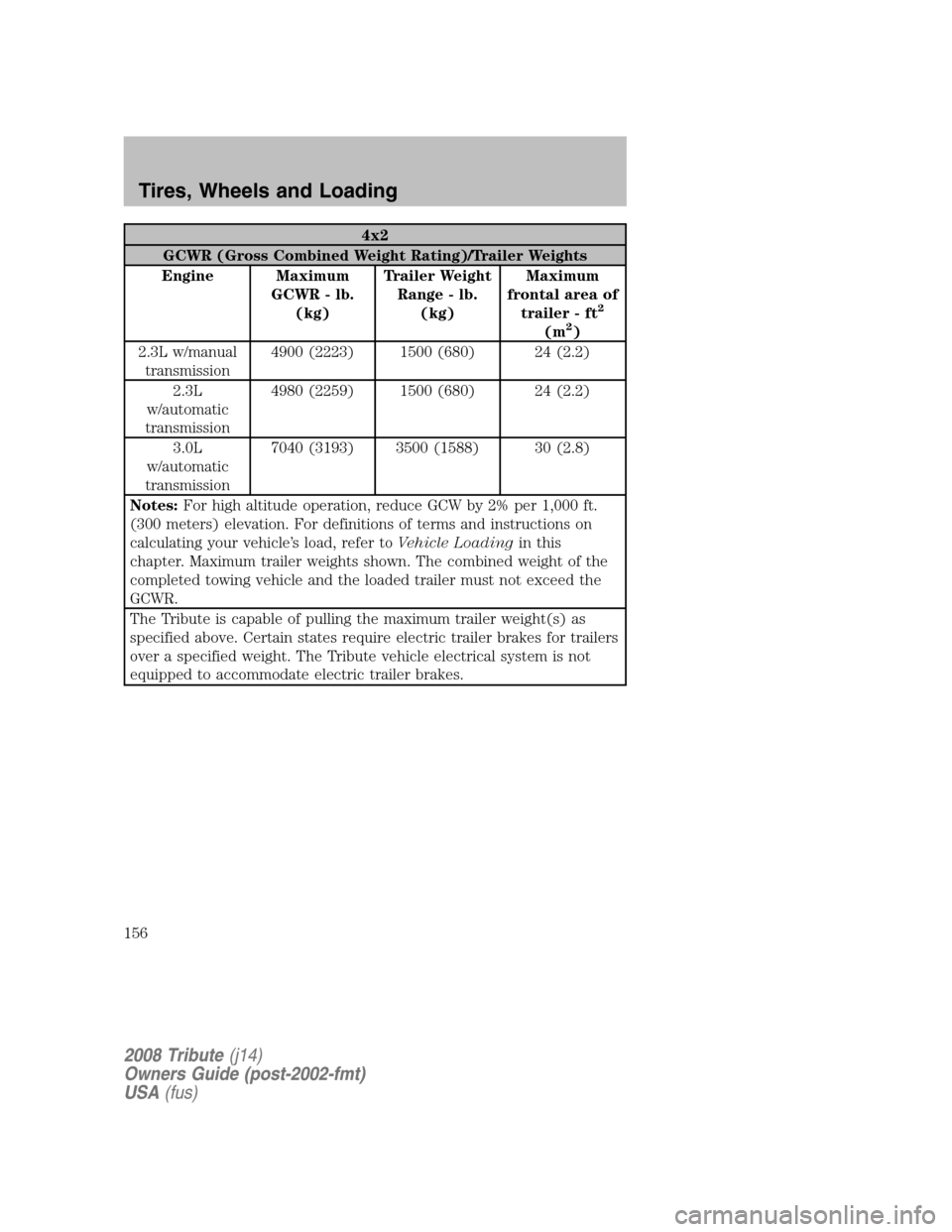
4x2
GCWR (Gross Combined Weight Rating)/Trailer Weights
Engine Maximum GCWR - lb.(kg) Trailer Weight
Range - lb. (kg) Maximum
frontal area of trailer - ft
2
(m2)
2.3L w/manual transmission 4900 (2223) 1500 (680) 24 (2.2)
2.3L
w/automatic
transmission 4980 (2259) 1500 (680) 24 (2.2)
3.0L
w/automatic
transmission 7040 (3193) 3500 (1588) 30 (2.8)
Notes: For high altitude operation, reduce GCW by 2% per 1,000 ft.
(300 meters) elevation. For definitions of terms and instructions on
calculating your vehicle’s load, refer to Vehicle Loadingin this
chapter. Maximum trailer weights shown. The combined weight of the
completed towing vehicle and the loaded trailer must not exceed the
GCWR.
The Tribute is capable of pulling the maximum trailer weight(s) as
specified above. Certain states require electric trailer brakes for trailers
over a specified weight. The Tribute vehicle electrical system is not
equipped to accommodate electric trailer brakes.
2008 Tribute (j14)
Owners Guide (post-2002-fmt)
USA (fus)
Tires, Wheels and Loading
156
Page 157 of 288
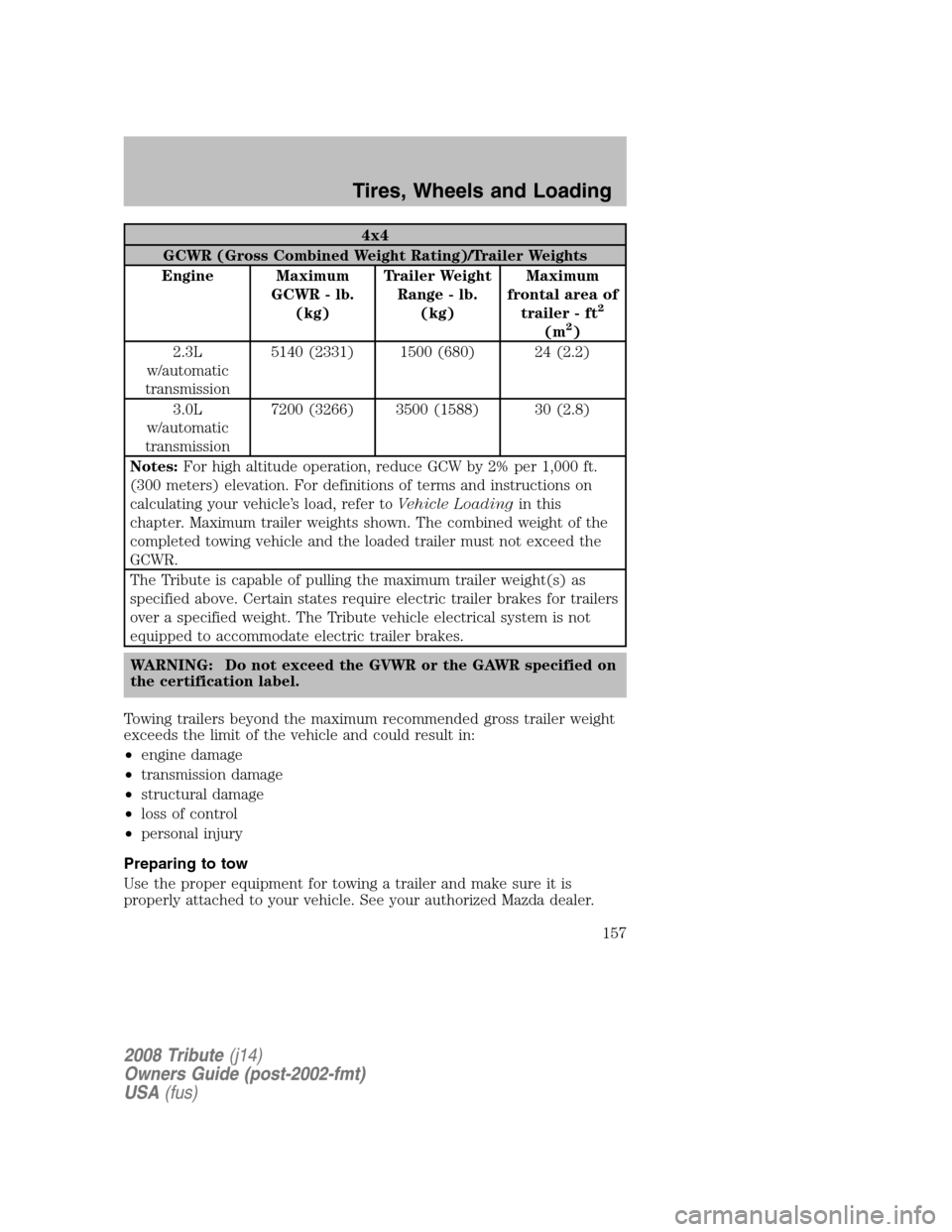
4x4
GCWR (Gross Combined Weight Rating)/Trailer Weights
Engine Maximum GCWR - lb.(kg) Trailer Weight
Range - lb. (kg) Maximum
frontal area of trailer - ft
2
(m2)
2.3L
w/automatic
transmission 5140 (2331) 1500 (680) 24 (2.2)
3.0L
w/automatic
transmission 7200 (3266) 3500 (1588) 30 (2.8)
Notes: For high altitude operation, reduce GCW by 2% per 1,000 ft.
(300 meters) elevation. For definitions of terms and instructions on
calculating your vehicle’s load, refer to Vehicle Loadingin this
chapter. Maximum trailer weights shown. The combined weight of the
completed towing vehicle and the loaded trailer must not exceed the
GCWR.
The Tribute is capable of pulling the maximum trailer weight(s) as
specified above. Certain states require electric trailer brakes for trailers
over a specified weight. The Tribute vehicle electrical system is not
equipped to accommodate electric trailer brakes.
WARNING: Do not exceed the GVWR or the GAWR specified on
the certification label.
Towing trailers beyond the maximum recommended gross trailer weight
exceeds the limit of the vehicle and could result in:
• engine damage
• transmission damage
• structural damage
• loss of control
• personal injury
Preparing to tow
Use the proper equipment for towing a trailer and make sure it is
properly attached to your vehicle. See your authorized Mazda dealer.
2008 Tribute (j14)
Owners Guide (post-2002-fmt)
USA (fus)
Tires, Wheels and Loading
157
Page 159 of 288

•Turn off the speed control. The speed control may shut off
automatically when you are towing on long, steep grades.
• Consult your local motor vehicle speed regulations for towing a trailer.
• To eliminate excessive shifting, use a lower gear. This will also assist
in transmission cooling. (For additional information, refer to
Understanding the gearshift positions of the 4–speed automatic
transmission in theDriving chapter .
• Anticipate stops and brake gradually.
• Do not exceed the GCWR rating or transmission damage may occur.
Servicing after towing
If you tow a trailer for long distances, your vehicle will require more
frequent service intervals. Refer to your scheduled maintenance
information for more information.
Trailer towing tips
• Practice turning, stopping and backing up before starting on a trip to
get the feel of the vehicle trailer combination. When turning, make
wider turns so the trailer wheels will clear curbs and other obstacles.
• Allow more distance for stopping with a trailer attached.
• If you are driving down a long or steep hill, shift to a lower gear. Do
not apply the brakes continuously, as they may overheat and become
less effective.
• The trailer tongue weight should be 10–15% of the loaded trailer
weight.
• If you will be towing a trailer frequently in hot weather, hilly
conditions, at GCWR, or any combination of these factors, consider
refilling your rear axle with synthetic gear lube if not already so
equipped. Refer to the Maintenance and Specifications chapter for
the lubricant specification. Remember that regardless of the rear axle
lube used, do not tow a trailer for the first 500 miles (800 km) of a
new vehicle, and that the first 500 miles (800 km) of towing be done
at no faster than 70 mph (112 km/h) with no full throttle starts.
• After you have traveled 50 miles (80 km), thoroughly check your
hitch, electrical connections and trailer wheel lug nuts.
• To aid in engine/transmission cooling and A/C efficiency during hot
weather while stopped in traffic, place the gearshift lever in P (Park).
• Vehicles with trailers should not be parked on a grade. If you must
park on a grade, place wheel chocks under the trailer’s wheels.
2008 Tribute (j14)
Owners Guide (post-2002-fmt)
USA (fus)
Tires, Wheels and Loading
159
Page 161 of 288
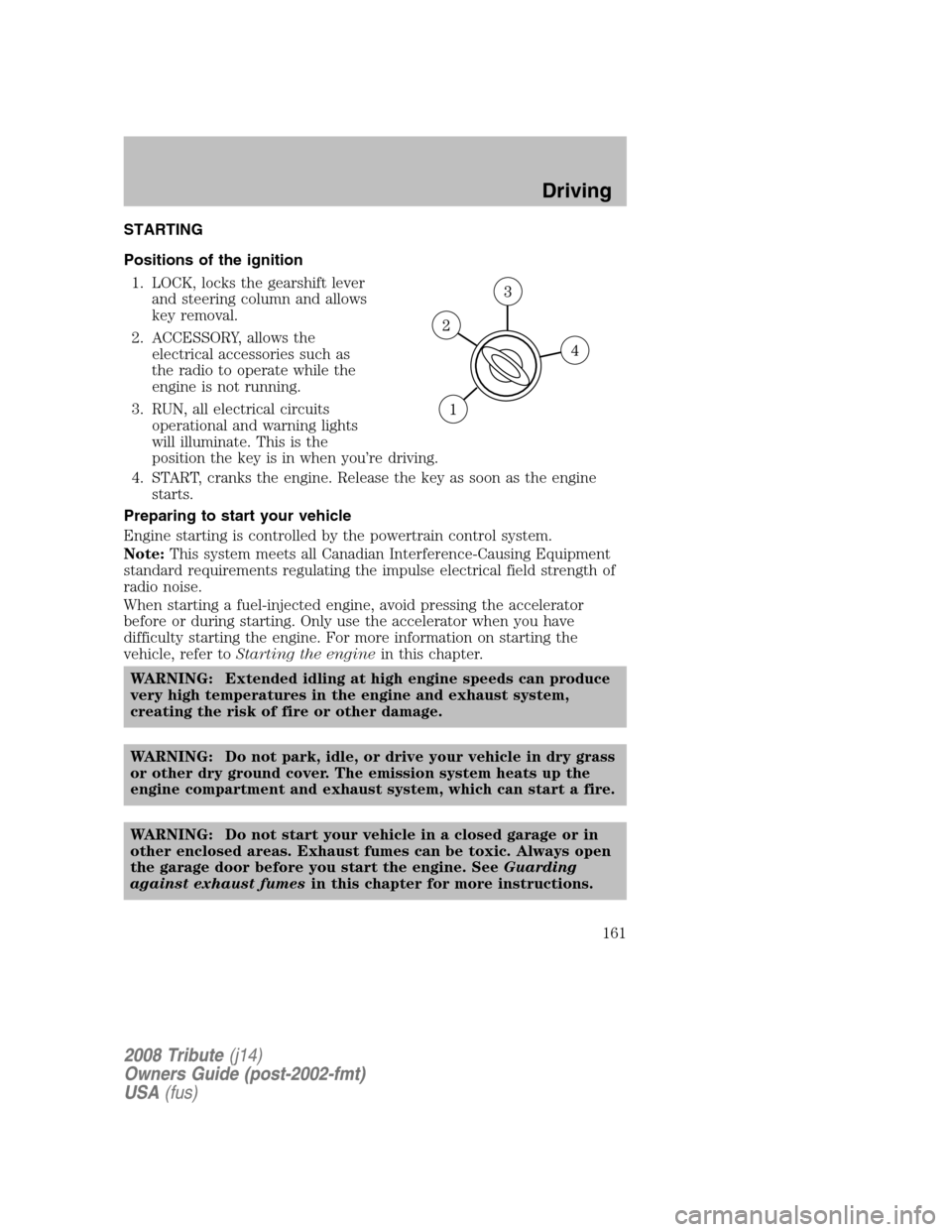
STARTING
Positions of the ignition 1. LOCK, locks the gearshift lever and steering column and allows
key removal.
2. ACCESSORY, allows the electrical accessories such as
the radio to operate while the
engine is not running.
3. RUN, all electrical circuits operational and warning lights
will illuminate. This is the
position the key is in when you’re driving.
4. START, cranks the engine. Release the key as soon as the engine starts.
Preparing to start your vehicle
Engine starting is controlled by the powertrain control system.
Note: This system meets all Canadian Interference-Causing Equipment
standard requirements regulating the impulse electrical field strength of
radio noise.
When starting a fuel-injected engine, avoid pressing the accelerator
before or during starting. Only use the accelerator when you have
difficulty starting the engine. For more information on starting the
vehicle, refer to Starting the engine in this chapter.
WARNING: Extended idling at high engine speeds can produce
very high temperatures in the engine and exhaust system,
creating the risk of fire or other damage.
WARNING: Do not park, idle, or drive your vehicle in dry grass
or other dry ground cover. The emission system heats up the
engine compartment and exhaust system, which can start a fire.
WARNING: Do not start your vehicle in a closed garage or in
other enclosed areas. Exhaust fumes can be toxic. Always open
the garage door before you start the engine. See Guarding
against exhaust fumes in this chapter for more instructions.
2008 Tribute(j14)
Owners Guide (post-2002-fmt)
USA (fus)
Driving
161
Page 162 of 288
WARNING: If you smell exhaust fumes inside your vehicle,
have your authorized dealer inspect your vehicle immediately.
Do not drive if you smell exhaust fumes.
Important safety precautions
A computer system controls the engine’s idle revolutions per minute
(RPM). When the engine starts, the idle RPM runs higher than normal in
order to warm the engine. If the engine idle speed does not slow down
automatically, have the vehicle checked by your authorized dealer.
Before starting the vehicle: 1. Make sure all vehicle occupants have buckled their seat belts. For more information on seat belts and their proper usage, refer to the
Seating and Safety Restraints chapter.
2. Make sure the headlamps and vehicle accessories are off.
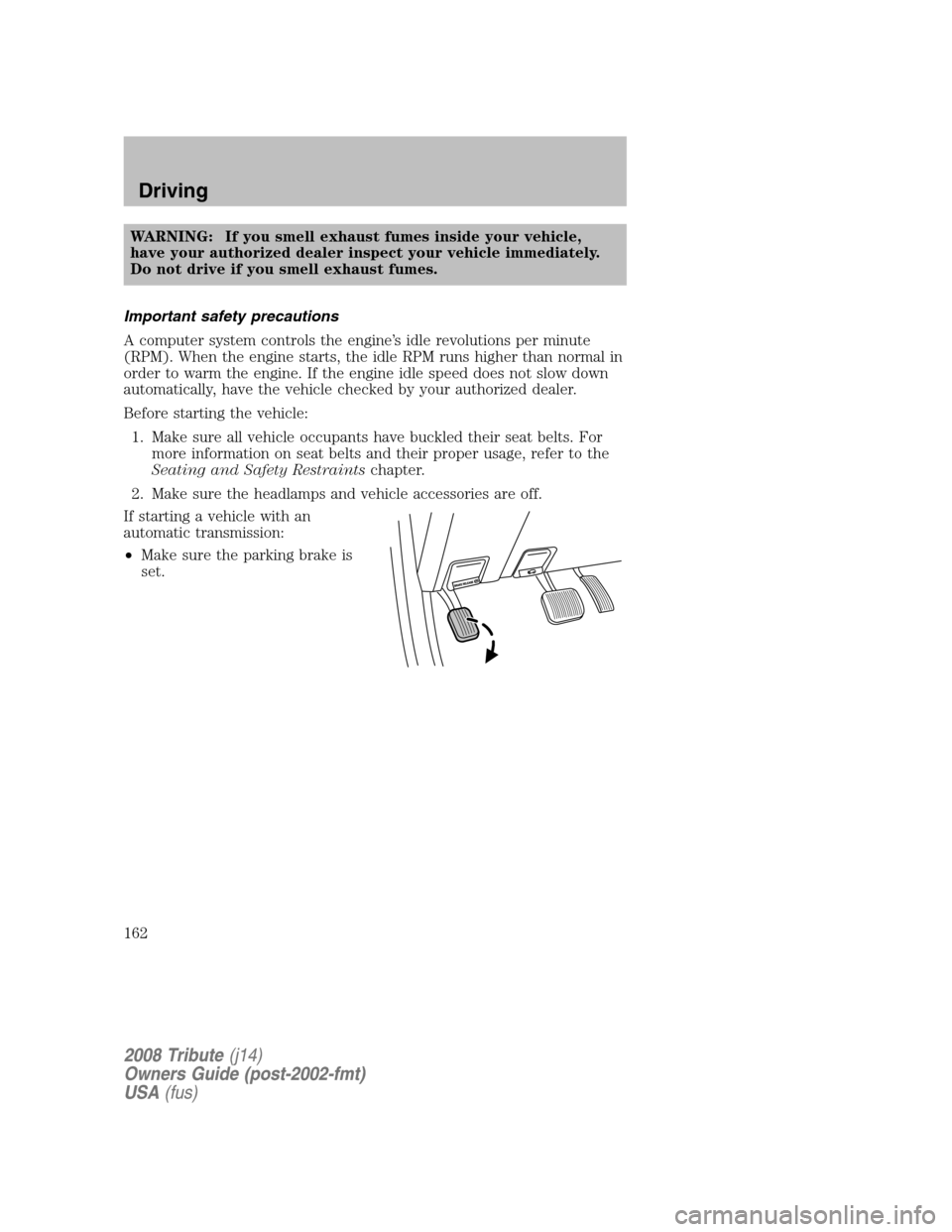
If starting a vehicle with an
automatic transmission:
• Make sure the parking brake is
set.
2008 Tribute (j14)
Owners Guide (post-2002-fmt)
USA (fus)
Driving
162
Page 164 of 288
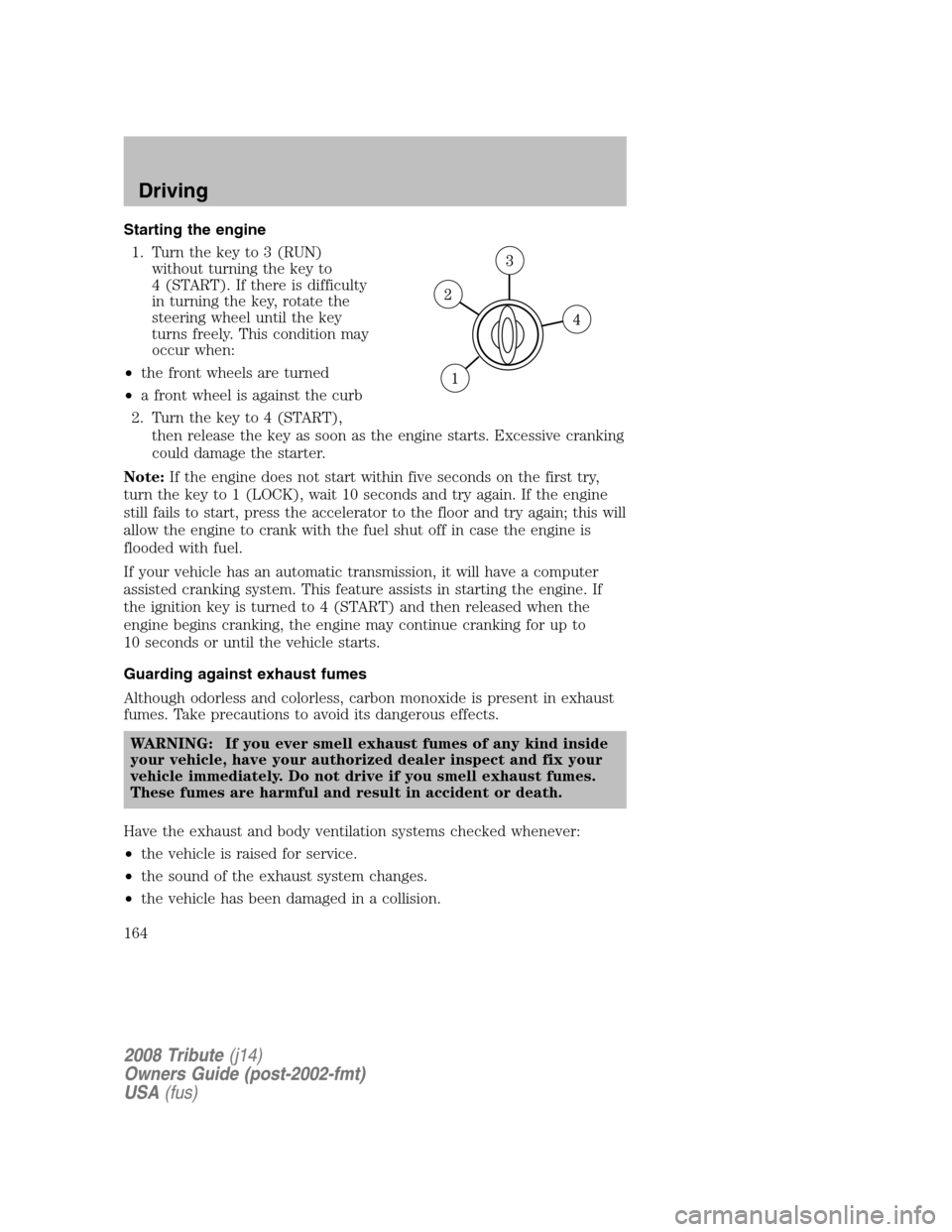
Starting the engine 1. Turn the key to 3 (RUN) without turning the key to
4 (START). If there is difficulty
in turning the key, rotate the
steering wheel until the key
turns freely. This condition may
occur when:
• the front wheels are turned
• a front wheel is against the curb
2. Turn the key to 4 (START), then release the key as soon as the engine starts. Excessive cranking
could damage the starter.
Note: If the engine does not start within five seconds on the first try,
turn the key to 1 (LOCK), wait 10 seconds and try again. If the engine
still fails to start, press the accelerator to the floor and try again; this will
allow the engine to crank with the fuel shut off in case the engine is
flooded with fuel.
If your vehicle has an automatic transmission, it will have a computer
assisted cranking system. This feature assists in starting the engine. If
the ignition key is turned to 4 (START) and then released when the
engine begins cranking, the engine may continue cranking for up to
10 seconds or until the vehicle starts.
Guarding against exhaust fumes
Although odorless and colorless, carbon monoxide is present in exhaust
fumes. Take precautions to avoid its dangerous effects.
WARNING: If you ever smell exhaust fumes of any kind inside
your vehicle, have your authorized dealer inspect and fix your
vehicle immediately. Do not drive if you smell exhaust fumes.
These fumes are harmful and result in accident or death.
Have the exhaust and body ventilation systems checked whenever:
• the vehicle is raised for service.
• the sound of the exhaust system changes.
• the vehicle has been damaged in a collision.
2008 Tribute (j14)
Owners Guide (post-2002-fmt)
USA (fus)
Driving
164
Page 165 of 288
WARNING: Engine exhaust, some of its constituents, and
certain vehicle components contain or emit chemicals known to
the State of California to cause cancer and birth defects or
other reproductive harm. In addition, certain fluids contained in
vehicles and certain products of component wear contain or
emit chemicals known to the State of California to cause cancer
and birth defects or other reproductive harm.
Important ventilating information
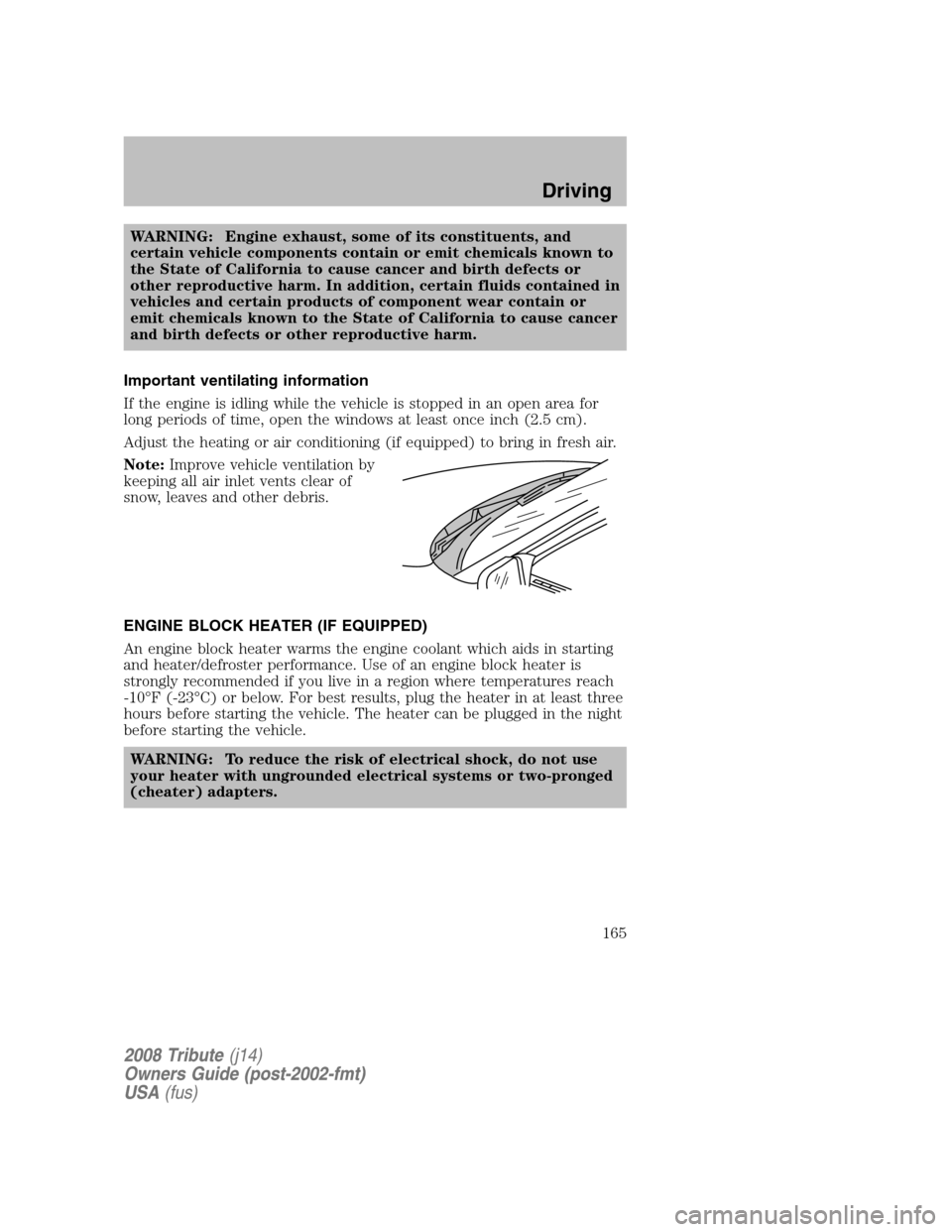
If the engine is idling while the vehicle is stopped in an open area for
long periods of time, open the windows at least once inch (2.5 cm).
Adjust the heating or air conditioning (if equipped) to bring in fresh air.
Note: Improve vehicle ventilation by
keeping all air inlet vents clear of
snow, leaves and other debris.
ENGINE BLOCK HEATER (IF EQUIPPED)
An engine block heater warms the engine coolant which aids in starting
and heater/defroster performance. Use of an engine block heater is
strongly recommended if you live in a region where temperatures reach
-10°F (-23°C) or below. For best results, plug the heater in at least three
hours before starting the vehicle. The heater can be plugged in the night
before starting the vehicle.
WARNING: To reduce the risk of electrical shock, do not use
your heater with ungrounded electrical systems or two-pronged
(cheater) adapters.
2008 Tribute (j14)
Owners Guide (post-2002-fmt)
USA (fus)
Driving
165
Page 166 of 288
BRAKES
Occasional brake noise is normal. If a metal-to-metal, continuous grinding
or continuous squeal sound is present, the brake linings may be worn-out
and should be inspected by an authorized dealer. If the vehicle has
continuous vibration or shudder in the steering wheel while braking, the
vehicle should be inspected by an authorized dealer.
Refer to Brake system warning
light in the Instrument Cluster
chapter for information on the brake
system warning light.
Four-wheel anti-lock brake system (ABS)
Since your vehicle is equipped with an Anti-lock Braking System (ABS),
a noise from the hydraulic pump motor and pulsation in the pedal may
be observed during ABS braking events. Pedal pulsation coupled with
noise while braking under panic conditions or on loose gravel, bumps,
wet or snowy roads is normal and indicates proper functioning of the
vehicle’s anti-lock brake system.
NOTE: The ABS performs a self-check after you start the engine and
begin to drive away.
A brief mechanical noise may be heard during this test. This is normal. If
a malfunction is found, the ABS warning light will come on. If the vehicle
has continuous vibration or shudder in the steering wheel while braking,
the vehicle should be inspected by an authorized dealer.
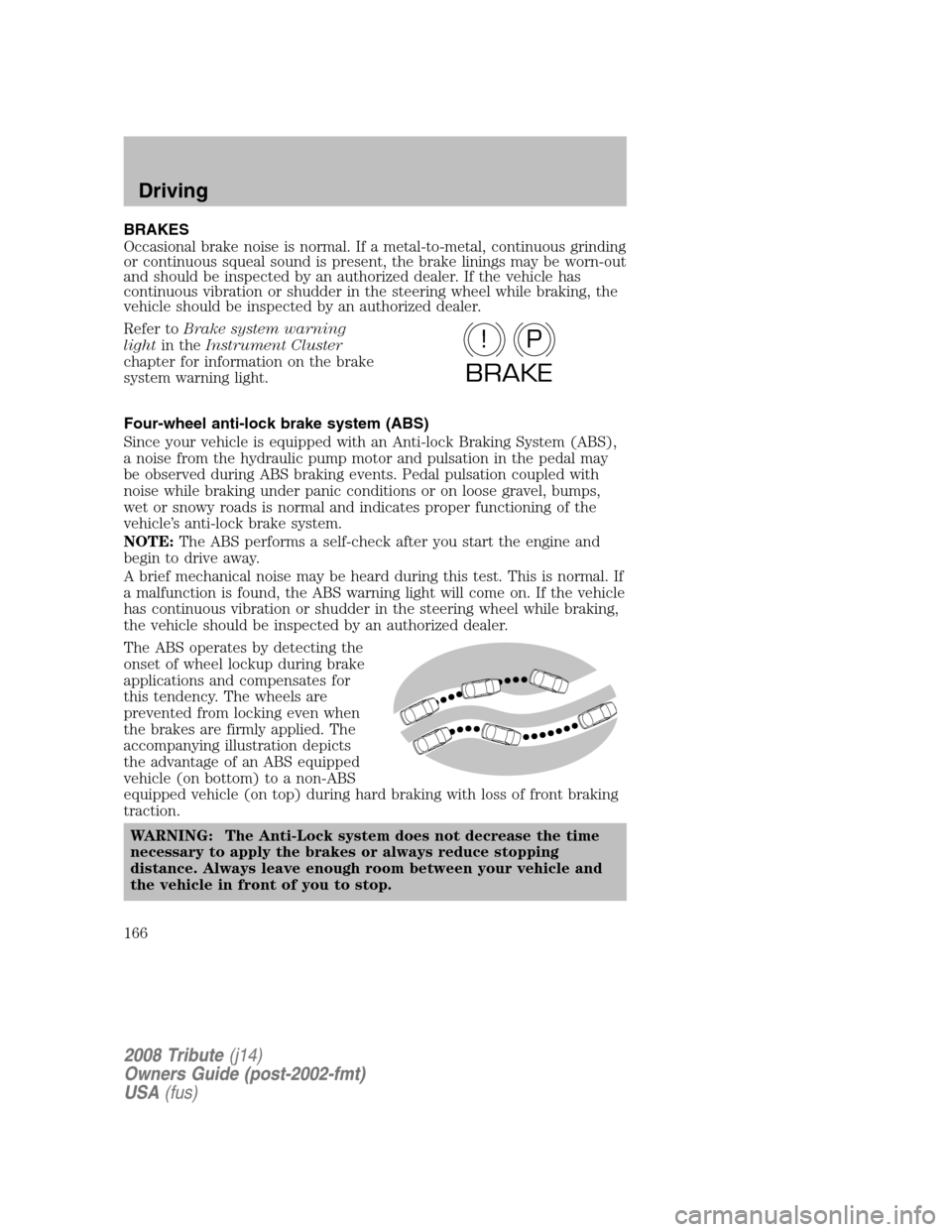
The ABS operates by detecting the
onset of wheel lockup during brake
applications and compensates for
this tendency. The wheels are
prevented from locking even when
the brakes are firmly applied. The
accompanying illustration depicts
the advantage of an ABS equipped
vehicle (on bottom) to a non-ABS
equipped vehicle (on top) during hard braking with loss of front braking
traction.
WARNING: The Anti-Lock system does not decrease the time
necessary to apply the brakes or always reduce stopping
distance. Always leave enough room between your vehicle and
the vehicle in front of you to stop.
P!
BRAKE
2008 Tribute (j14)
Owners Guide (post-2002-fmt)
USA (fus)
Driving
166
Page 169 of 288

Traction Control
Traction Control helps your vehicle maintain traction, when driving on
slippery and/or hilly road surfaces, by detecting and controlling wheel
spin. Excessive wheel spin is controlled by momentarily reducing engine
power and/or applying the anti-lock brakes. Traction Control is a driver
aid that helps your vehicle.
If your vehicle should become stuck in deep snow or mud, try switching
the ESC system off by pressing the ESC button momentarily. This will
allow your tires to “dig” for traction.
If the ESC system is activated excessively in a short period of time, the
brake portion of the system will disable to allow the brakes to cool down.
In this situation, Traction Control will use only engine power reduction to
help control the wheels from over-spinning. When the brakes have cooled
down, the system will again function normally. Anti-lock braking, RSC
and DSC are not affected by this condition and will function normally
during the cool-down period.
If the vehicle is stuck in snow or mud or when driving in deep sand,
switching off the ESC system may be beneficial so the wheels are
allowed to spin. If your vehicle seems to lose engine power while driving
in deep sand or very deep snow, switching off the ESC stability
enhancement feature will restore full engine power and will enhance
momentum through the obstacle.
During Traction Control events the “sliding car” icon in the instrument
cluster will flash momentarily.
Dynamic Stability Control (DSC)
The Dynamic Stability Control (DSC) system may enhance your vehicle’s
stability during adverse maneuvers.
The ESC system helps the driver maintain steering control. ESC will
attempt to correct the vehicle motion by applying brake force at
individual tires and, if necessary, by reducing engine power.
During Dynamic Stability Control events the “sliding car” icon in the
instrument cluster will flash momentarily.
Driving maneuvers which may activate ESC system include:
• Taking a turn too fast.
• Maneuvering quickly to avoid an accident, pedestrian or obstacle.
• Driving over a patch of ice.
• Changing lanes on a snow-rutted road.
2008 Tribute (j14)
Owners Guide (post-2002-fmt)
USA (fus)
Driving
169