clock MAZDA MODEL TRIBUTE 4WD 2001 User Guide
[x] Cancel search | Manufacturer: MAZDA, Model Year: 2001, Model line: MODEL TRIBUTE 4WD, Model: MAZDA MODEL TRIBUTE 4WD 2001Pages: 232, PDF Size: 1.74 MB
Page 146 of 232
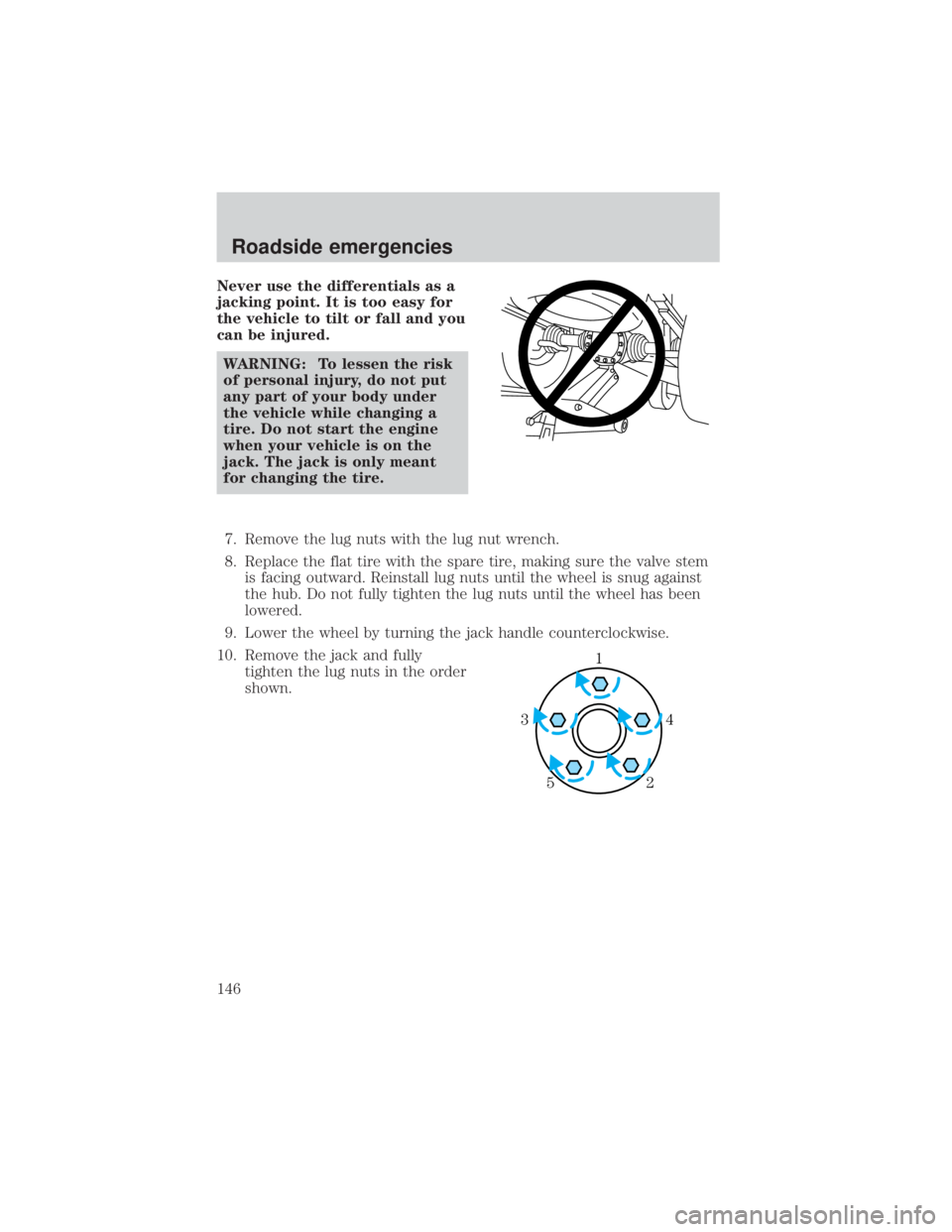
Never use the differentials as a
jacking point. It is too easy for
the vehicle to tilt or fall and you
can be injured.WARNING: To lessen the risk
of personal injury, do not put
any part of your body under
the vehicle while changing a
tire. Do not start the engine
when your vehicle is on the
jack. The jack is only meant
for changing the tire.
7. Remove the lug nuts with the lug nut wrench.
8. Replace the flat tire with the spare tire, making sure the valve stem is facing outward. Reinstall lug nuts until the wheel is snug against
the hub. Do not fully tighten the lug nuts until the wheel has been
lowered.
9. Lower the wheel by turning the jack handle counterclockwise.
10. Remove the jack and fully tighten the lug nuts in the order
shown.
1
4
3
2
5
Roadside emergencies
146
Page 167 of 232
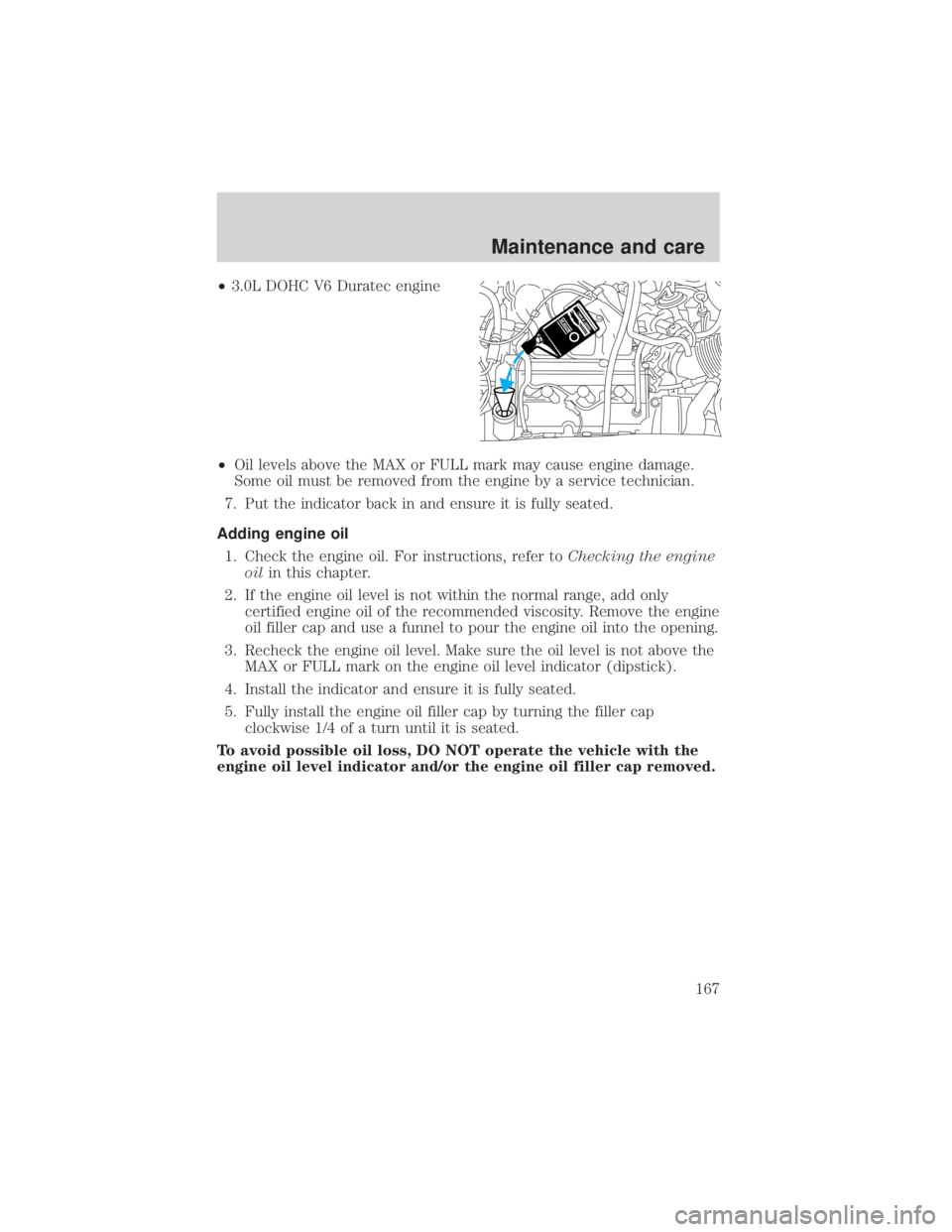
²3.0L DOHC V6 Duratec engine
² Oil levels above the MAX or FULL mark may cause engine damage.
Some oil must be removed from the engine by a service technician.
7. Put the indicator back in and ensure it is fully seated.
Adding engine oil 1. Check the engine oil. For instructions, refer to Checking the engine
oil in this chapter.
2. If the engine oil level is not within the normal range, add only certified engine oil of the recommended viscosity. Remove the engine
oil filler cap and use a funnel to pour the engine oil into the opening.
3. Recheck the engine oil level. Make sure the oil level is not above the MAX or FULL mark on the engine oil level indicator (dipstick).
4. Install the indicator and ensure it is fully seated.
5. Fully install the engine oil filler cap by turning the filler cap clockwise 1/4 of a turn until it is seated.
To avoid possible oil loss, DO NOT operate the vehicle with the
engine oil level indicator and/or the engine oil filler cap removed.
Maintenance and care
167
Page 174 of 232
For vehicles with overflow coolant systems with a non-pressurized cap
on the coolant recovery system, add coolant to the coolant recovery
reservoir when the engine is cool. Add the proper mixture of coolant and
water to the ªcold fullº level. For all other vehicles, which have a coolant
degas system with a pressurized cap, or if it is necessary to remove the
coolant pressure relief cap on the radiator of a vehicle with an overflow
system, follow these steps to add engine coolant.WARNING: To avoid personal injury, make sure the engine is
cool before unscrewing the coolant pressure relief cap. The
cooling system is under pressure; steam and hot liquid can come
out forcefully when the cap is loosened slightly.
1. Before you begin, turn the engine off and let it cool.
2. When the engine is cool, wrap a thick cloth around the coolant pressure relief cap on the coolant reservoir (an opaque plastic
bottle). Slowly turn cap counterclockwise (left) until pressure begins
to release.
3. Step back while the pressure releases.
4. When you are sure that all the pressure has been released, use the cloth to turn it counterclockwise and remove the cap.
5. Fill the coolant reservoir slowly with the proper coolant mixture (see above), to within the ªcold fill rangeº or the ªcold fullº level on the
reservoir. If you removed the radiator cap in an overflow system, fill
the radiator until the coolant is visible and radiator is almost full.
6. Replace the cap. Turn until tightly installed. (Cap must be tightly installed to prevent coolant loss.)
After any coolant has been added, run the engine for a few minutes to
mix the coolant. Check the coolant concentration. Make sure the engine
is off and cool before removing the coolant pressure relief cap (see
preceding steps on cap removal). Check the concentration per the
Checking Engine Coolant section. If the concentration is not 50/50
(protection to ±34ÉF/±36ÉC), drain some coolant and adjust the
concentraction. It may take several drains and additions to obtain a 50/50
coolant concentration.
Whenever coolant has been added, the coolant level in the coolant
reservoir should be checked the next few times you drive the vehicle. If
necessary, add enough 50/50 concentration of engine coolant and
distilled water to bring the liquid level to the proper level.
Maintenance and care
174
Page 182 of 232
If the battery has been disconnected or a new battery has been installed,
the clock and the preset radio stations must be reset once the battery is
reconnected.
²Always dispose of automotive
batteries in a responsible manner.
Follow your local authorized
standards for disposal. Call your
local authorized recycling center
to find out more about recycling
automotive batteries.
AIR FILTER MAINTENANCE
Refer to the service maintenance section for the appropriate intervals for
changing the air filter element.
When changing the air filter element, only use a Genuine Mazda air filter
element. WARNING: Do not start your engine with the air cleaner
removed and do not remove it while the engine is running.
Changing the air filter element 1. Loosen the clamp that secures the air inlet tube to the engine air filter cover and disconnect the tube from the cover.
2. Release the clamps that secure the air filter housing cover.
3. Carefully separate the two halves of the air filter housing.
4. Remove the air filter element from the air filter housing.
5. Wipe the air filter housing and cover clean to remove any dirt or debris and to ensure good sealing.
LEAD
RETURN
RECYCLE
Maintenance and care
182
Page 193 of 232
Many of the world's automakers
issued the World-wide Fuel Charter
that recommends gasoline
specifications to provide improved
performance and emission control
system protection for your vehicle.
Gasolines that meet the World-wide
Fuel Charter should be used when
available. Ask your fuel supplier
about gasolines that meet the
World-wide Fuel Charter. In Canada,
look for fuels that display theAuto Makers' Choiceylogo.
Cleaner air
Mazda endorses the use of reformulated ªcleaner-burningº gasolines to
improve air quality.
Running out of fuel
Avoid running out of fuel because this situation may have an adverse
affect on powertrain components.
If you have run out of fuel:
² You may need to cycle the ignition from OFF to ON several times after
refueling, to allow the fuel system to pump the fuel from the tank to
the engine.
² The
indicator may come on. For more information on the ªCheck
Engineº indicator, refer to the Instrumentationchapter.
Fuel Filler Cap
Your fuel tank filler cap has an indexed design with a 1/8 turn on/off
feature.
When fueling your vehicle: 1. Turn the engine off.
2. Carefully turn the filler cap counterclockwise 1/8 of a turn until it stops.
3. Pull to remove the cap from the fuel filler pipe.
4. To install the cap, align the tabs on the cap with the notches on the filler pipe.
5. Turn the filler cap clockwise 1/8 of a turn until it stops.
Maintenance and care
193
Page 202 of 232
9. Install rubber boot on the lamp assembly.
10. Connect the electrical connector into the rear of the plastic base until it ªsnaps.º
Replacing brake/tail/turn/backup lamps bulbs
The brake/tail/turn/backup lamp bulbs are located in the tail lamp
assembly, one just below the other. Follow the same steps to replace
either bulb:
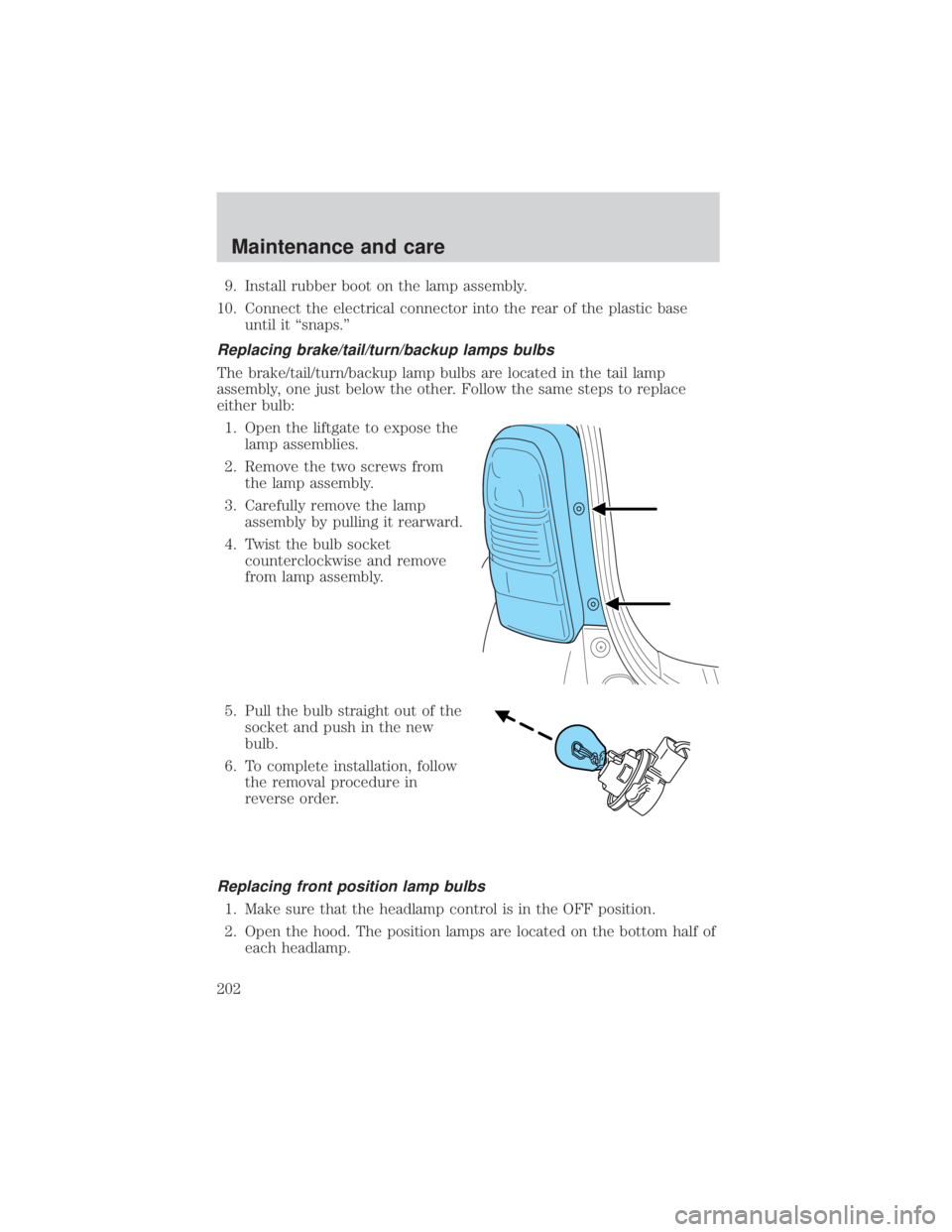
1. Open the liftgate to expose the lamp assemblies.
2. Remove the two screws from the lamp assembly.
3. Carefully remove the lamp assembly by pulling it rearward.
4. Twist the bulb socket counterclockwise and remove
from lamp assembly.
5. Pull the bulb straight out of the socket and push in the new
bulb.
6. To complete installation, follow the removal procedure in
reverse order.
Replacing front position lamp bulbs
1. Make sure that the headlamp control is in the OFF position.
2. Open the hood. The position lamps are located on the bottom half ofeach headlamp.
Maintenance and care
202
Page 203 of 232
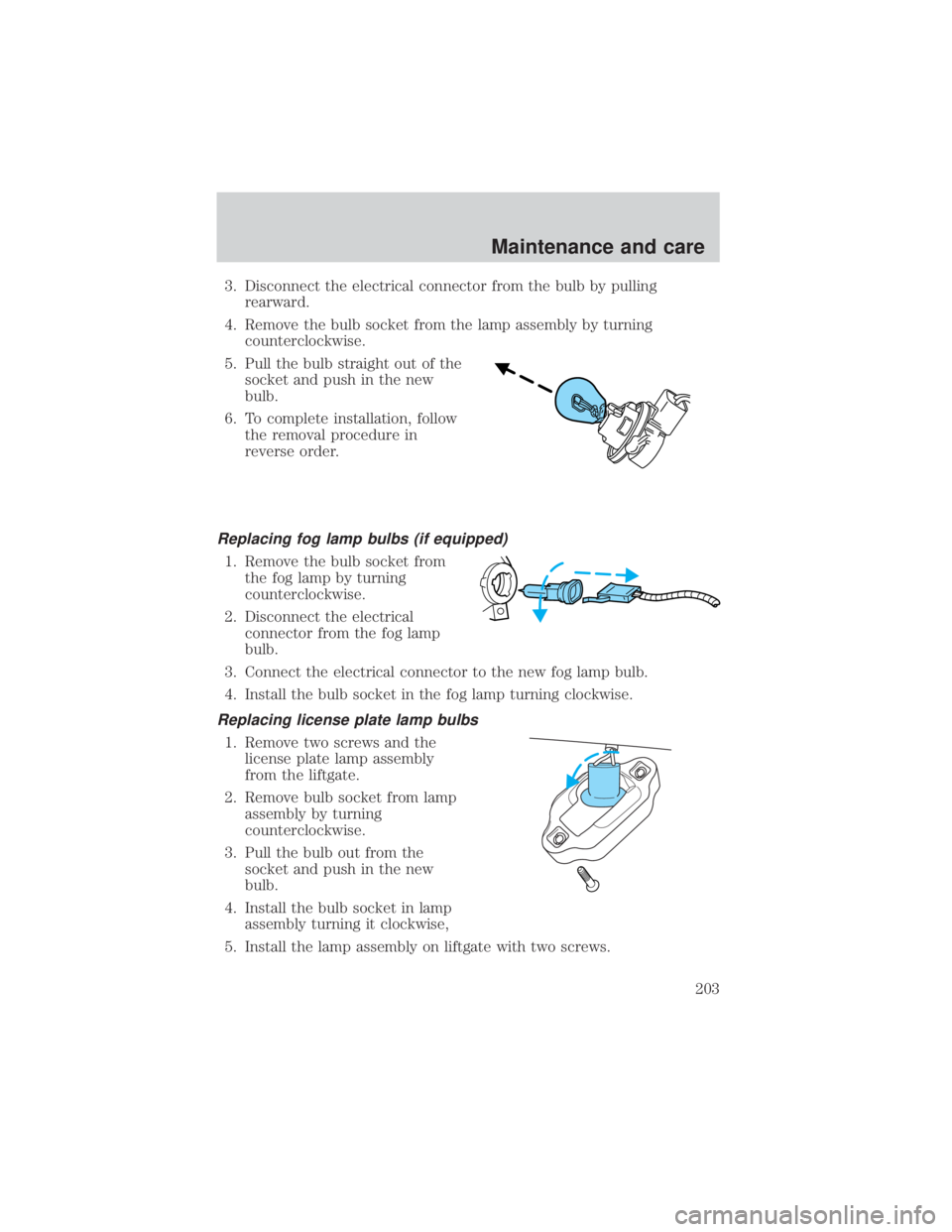
3. Disconnect the electrical connector from the bulb by pullingrearward.
4. Remove the bulb socket from the lamp assembly by turning counterclockwise.
5. Pull the bulb straight out of the socket and push in the new
bulb.
6. To complete installation, follow the removal procedure in
reverse order.
Replacing fog lamp bulbs (if equipped)
1. Remove the bulb socket fromthe fog lamp by turning
counterclockwise.
2. Disconnect the electrical connector from the fog lamp
bulb.
3. Connect the electrical connector to the new fog lamp bulb.
4. Install the bulb socket in the fog lamp turning clockwise.
Replacing license plate lamp bulbs
1. Remove two screws and the license plate lamp assembly
from the liftgate.
2. Remove bulb socket from lamp assembly by turning
counterclockwise.
3. Pull the bulb out from the socket and push in the new
bulb.
4. Install the bulb socket in lamp assembly turning it clockwise,
5. Install the lamp assembly on liftgate with two screws.
Maintenance and care
203
Page 206 of 232
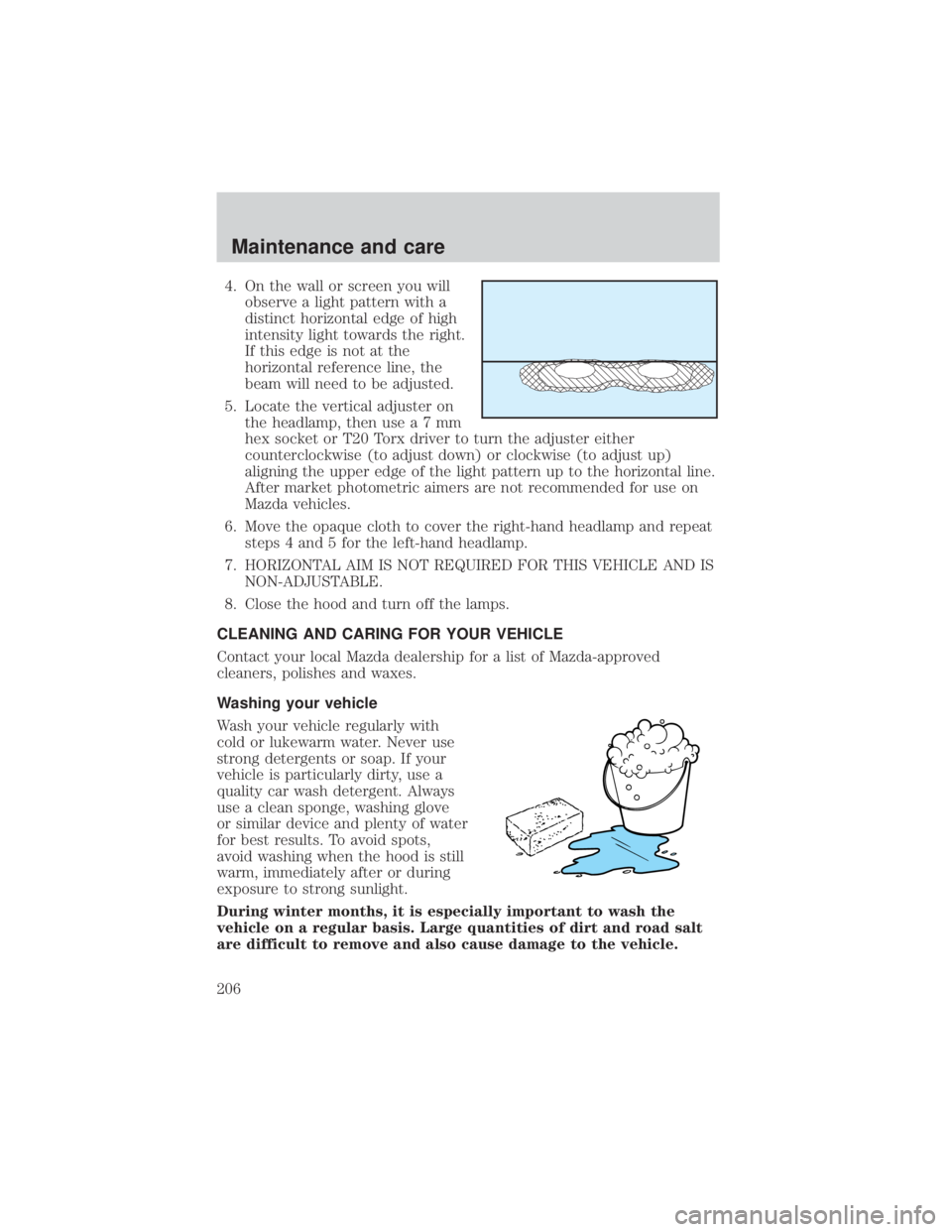
4. On the wall or screen you willobserve a light pattern with a
distinct horizontal edge of high
intensity light towards the right.
If this edge is not at the
horizontal reference line, the
beam will need to be adjusted.
5. Locate the vertical adjuster on the headlamp, then us ea7mm
hex socket or T20 Torx driver to turn the adjuster either
counterclockwise (to adjust down) or clockwise (to adjust up)
aligning the upper edge of the light pattern up to the horizontal line.
After market photometric aimers are not recommended for use on
Mazda vehicles.
6. Move the opaque cloth to cover the right-hand headlamp and repeat steps 4 and 5 for the left-hand headlamp.
7. HORIZONTAL AIM IS NOT REQUIRED FOR THIS VEHICLE AND IS NON-ADJUSTABLE.
8. Close the hood and turn off the lamps.
CLEANING AND CARING FOR YOUR VEHICLE
Contact your local Mazda dealership for a list of Mazda-approved
cleaners, polishes and waxes.
Washing your vehicle
Wash your vehicle regularly with
cold or lukewarm water. Never use
strong detergents or soap. If your
vehicle is particularly dirty, use a
quality car wash detergent. Always
use a clean sponge, washing glove
or similar device and plenty of water
for best results. To avoid spots,
avoid washing when the hood is still
warm, immediately after or during
exposure to strong sunlight.
During winter months, it is especially important to wash the
vehicle on a regular basis. Large quantities of dirt and road salt
are difficult to remove and also cause damage to the vehicle.
Maintenance and care
206
Page 226 of 232
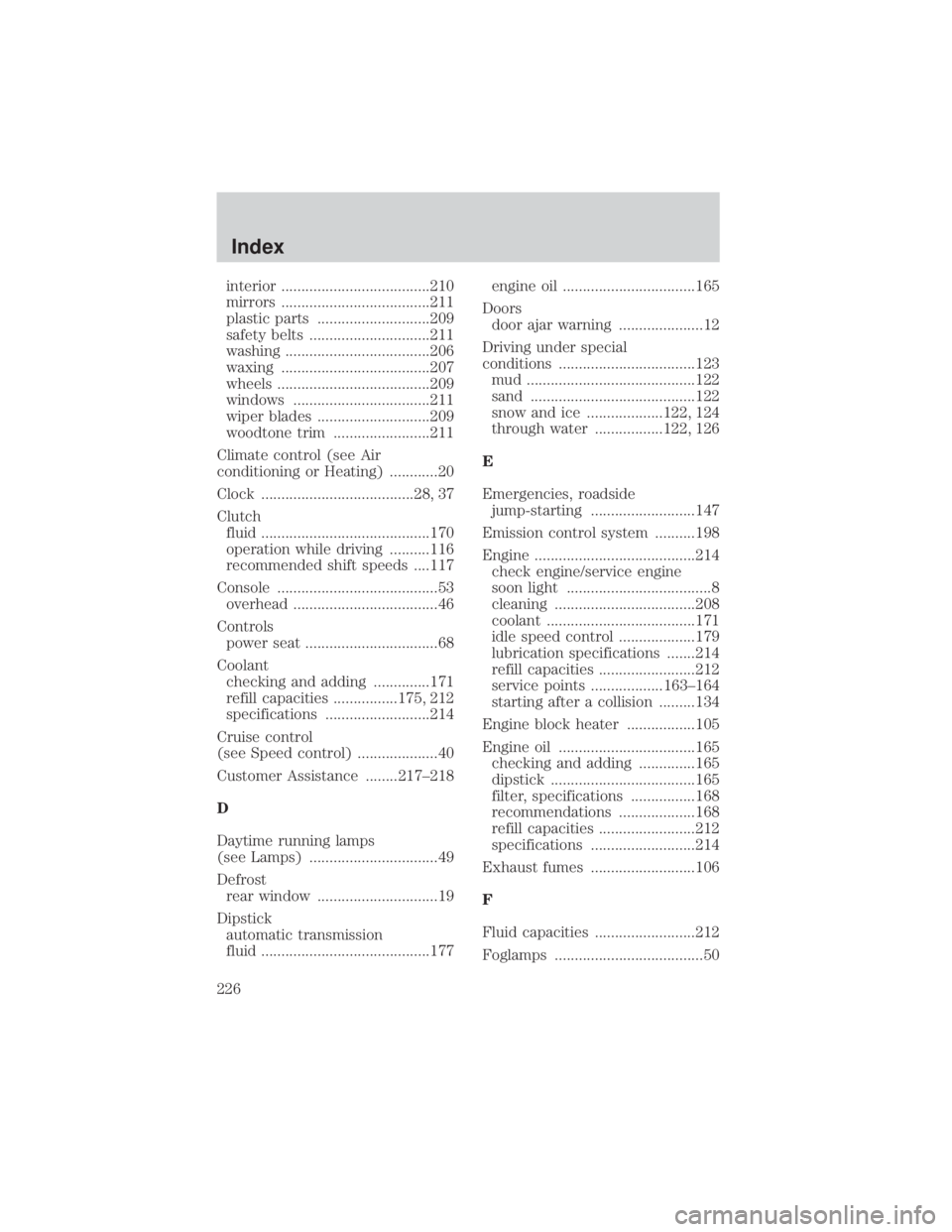
interior .....................................210
mirrors .....................................211
plastic parts ............................209
safety belts ..............................211
washing ....................................206
waxing .....................................207
wheels ......................................209
windows ..................................211
wiper blades ............................209
woodtone trim ........................211
Climate control (see Air
conditioning or Heating) ............20
Clock ......................................28, 37
Clutch fluid ..........................................170
operation while driving ..........116
recommended shift speeds ....117
Console ........................................53 overhead ....................................46
Controls power seat .................................68
Coolant checking and adding ..............171
refill capacities ................175, 212
specifications ..........................214
Cruise control
(see Speed control) ....................40
Customer Assistance ........217±218
D
Daytime running lamps
(see Lamps) ................................49
Defrost rear window ..............................19
Dipstick automatic transmission
fluid ..........................................177 engine oil .................................165
Doors door ajar warning .....................12
Driving under special
conditions ..................................123 mud ..........................................122
sand .........................................122
snow and ice ...................122, 124
through water .................122, 126
E
Emergencies, roadside jump-starting ..........................147
Emission control system ..........198
Engine ........................................214 check engine/service engine
soon light ....................................8
cleaning ...................................208
coolant .....................................171
idle speed control ...................179
lubrication specifications .......214
refill capacities ........................212
service points ..................163±164
starting after a collision .........134
Engine block heater .................105
Engine oil ..................................165 checking and adding ..............165
dipstick ....................................165
filter, specifications ................168
recommendations ...................168
refill capacities ........................212
specifications ..........................214
Exhaust fumes ..........................106
F
Fluid capacities .........................212
Foglamps .....................................50
Index
226