transmission MAZDA MODEL TRIBUTE 4WD 2001 User Guide
[x] Cancel search | Manufacturer: MAZDA, Model Year: 2001, Model line: MODEL TRIBUTE 4WD, Model: MAZDA MODEL TRIBUTE 4WD 2001Pages: 232, PDF Size: 1.74 MB
Page 144 of 232
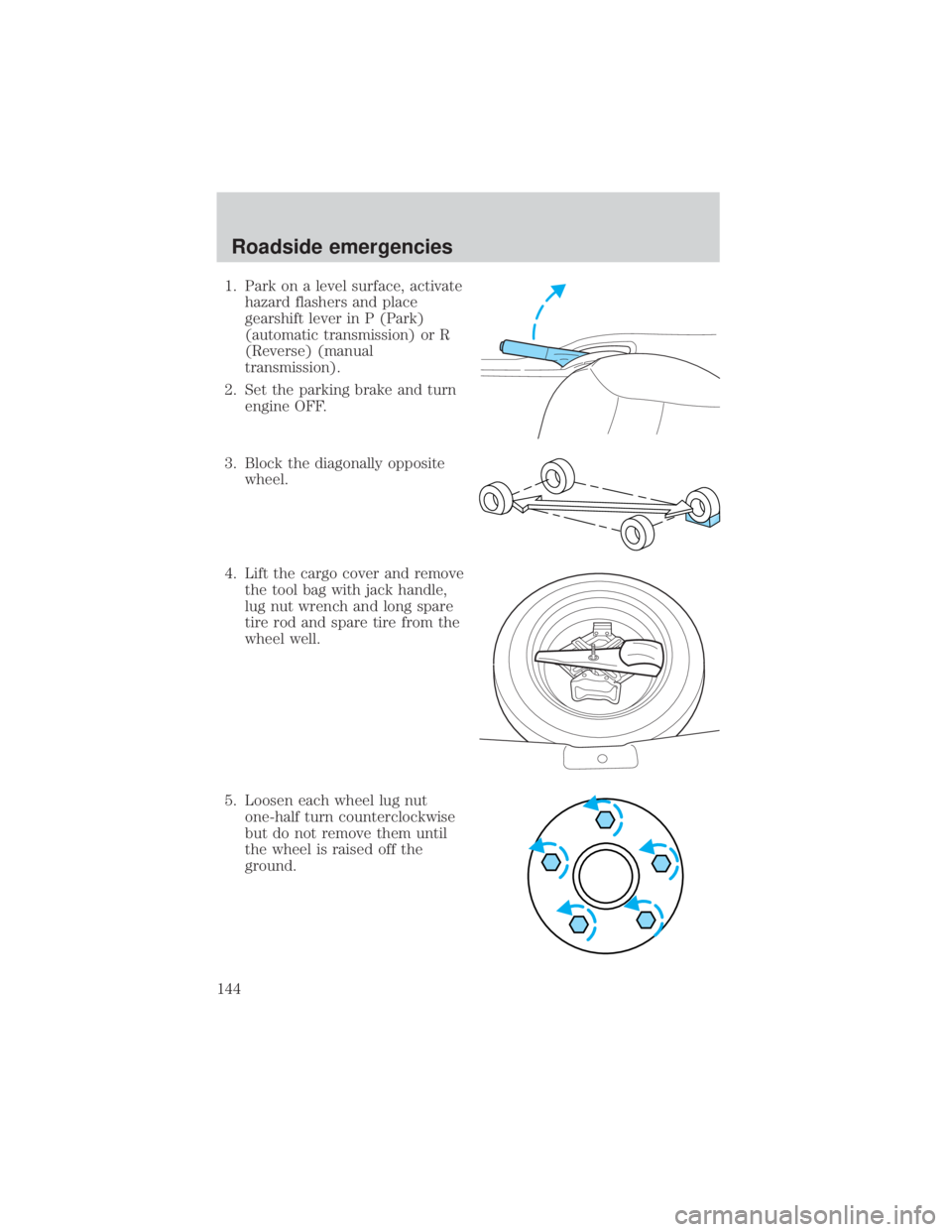
1. Park on a level surface, activatehazard flashers and place
gearshift lever in P (Park)
(automatic transmission) or R
(Reverse) (manual
transmission).
2. Set the parking brake and turn engine OFF.
3. Block the diagonally opposite wheel.
4. Lift the cargo cover and remove the tool bag with jack handle,
lug nut wrench and long spare
tire rod and spare tire from the
wheel well.
5. Loosen each wheel lug nut one-half turn counterclockwise
but do not remove them until
the wheel is raised off the
ground.
Roadside emergencies
144
Page 148 of 232
Do not attempt to push start your vehicle. Automatic
transmissions do not have push-start capability.
Preparing your vehicle
When the battery is disconnected or a new battery is installed, the
transmission must relearn its adaptive strategy. As a result of this, the
transmission may shift firmly. This operation is considered normal and
will not effect function or durability of the transmission. Over time, the
adaptive learning process will fully update transmission operation to its
optimum shift feel.
²Use only a 12±volt supply to start your vehicle.
² Do not disconnect the battery of the disabled vehicle as this could
damage the vehicle's electrical system.
² Park the booster vehicle close to the hood of the disabled vehicle
making sure the two vehicles do nottouch. Set the parking brake on
both vehicles and stay clear of the engine cooling fan and other
moving parts.
² Check all battery terminals and remove any excessive corrosion before
you attach the battery cables. Ensure that vent caps are tight and
level.
² Turn the heater fan on in both vehicles to protect any electrical
surges. Turn all other accessories off.
Roadside emergencies
148
Page 152 of 232
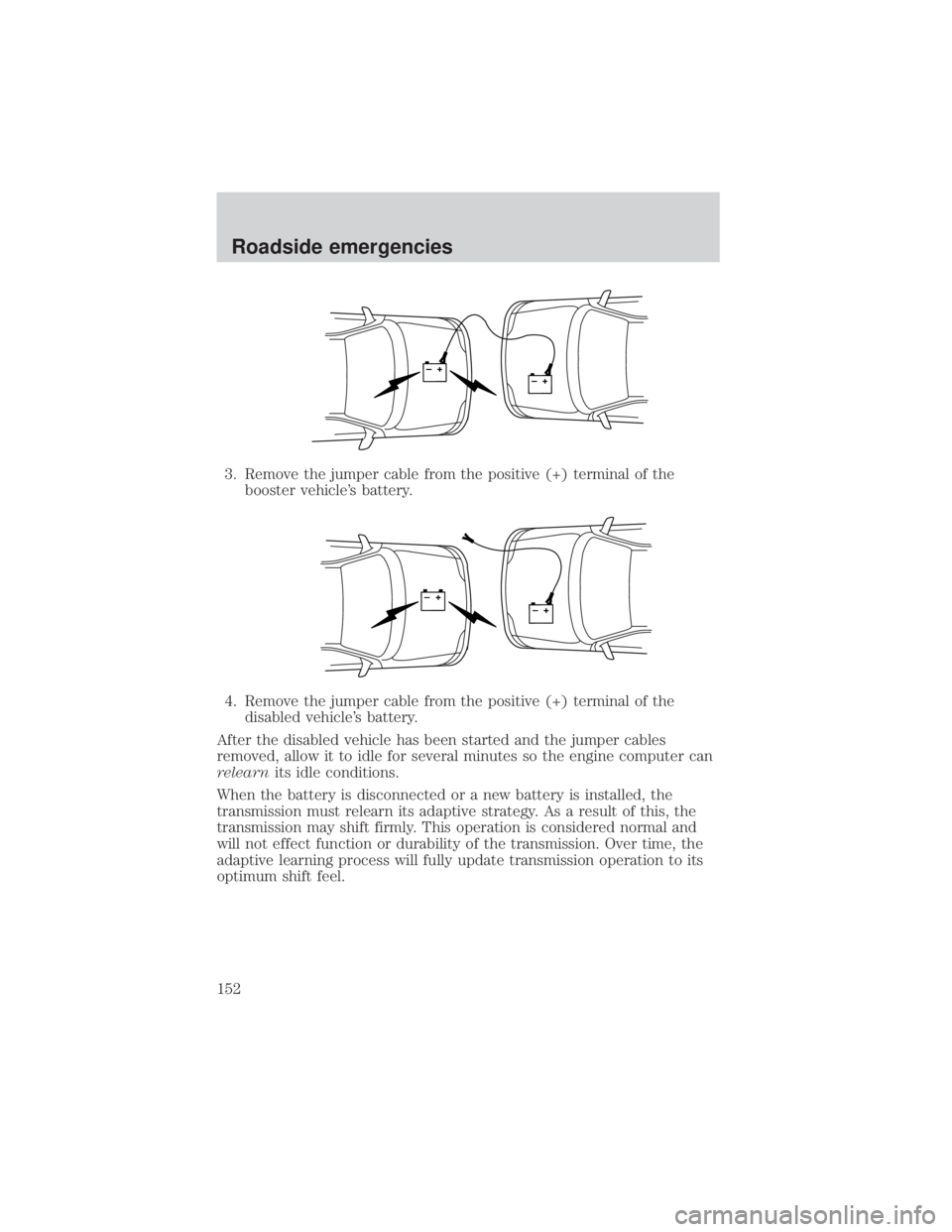
3. Remove the jumper cable from the positive (+) terminal of thebooster vehicle's battery.
4. Remove the jumper cable from the positive (+) terminal of the disabled vehicle's battery.
After the disabled vehicle has been started and the jumper cables
removed, allow it to idle for several minutes so the engine computer can
relearn its idle conditions.
When the battery is disconnected or a new battery is installed, the
transmission must relearn its adaptive strategy. As a result of this, the
transmission may shift firmly. This operation is considered normal and
will not effect function or durability of the transmission. Over time, the
adaptive learning process will fully update transmission operation to its
optimum shift feel.
+–+–
+–+–
Roadside emergencies
152
Page 154 of 232
On 4x4 vehicles, it is recommended that your vehicle be towed with a
wheel lift and dollies or flatbed equipment with all the wheels off the
ground.
If the vehicle is towed by other means or incorrectly, vehicle
damage may occur.
In case of a roadside emergency with a disabled vehicle (without access
to wheel dollies, car hauling trailer or flatbed transport vehicle) your
vehicle (regardless of powertrain configuration) can be flat towed (all
wheels on the ground) under the following conditions:
²Place the transmission in N (Neutral).
² Maximum speed is 56 km/h (35 mph).
² Maximum distance is 80 km (50 miles).
Mazda provides a towing manual for all authorized tow truck operators.
Have your tow truck operator refer to this manual for proper hook-up
and towing procedures for your vehicle.
Roadside emergencies
154
Page 161 of 232
Working with the engine off
²Automatic transmission:
1. Set the parking brake and ensure the gearshift is securely latched in P (Park).
2. Turn off the engine and remove the key.
3. Block the wheels to prevent the vehicle from moving unexpectedly.
² Manual transmission:
1. Set the parking brake.
2. Depress the clutch and place the gearshift in 1 (First).
3. Turn off the engine and remove the key.
4. Block the wheels to prevent the vehicle from moving unexpectedly.
Working with the engine on
² Automatic transmission:
1. Set the parking brake and ensure the gearshift is securely latched in P (Park).
2. Block the wheels to prevent the vehicle from moving unexpectedly.
Do not start your engine with the air cleaner removed and do not
remove it while the engine is running.
² Manual transmission:
1. Set the parking brake, depress the clutch and place the gearshift in N (Neutral).
2. Block the wheels to prevent the vehicle from moving unexpectedly.
Do not start your engine with the air cleaner removed and do not
remove it while the engine is running.
Maintenance and care
161
Page 164 of 232
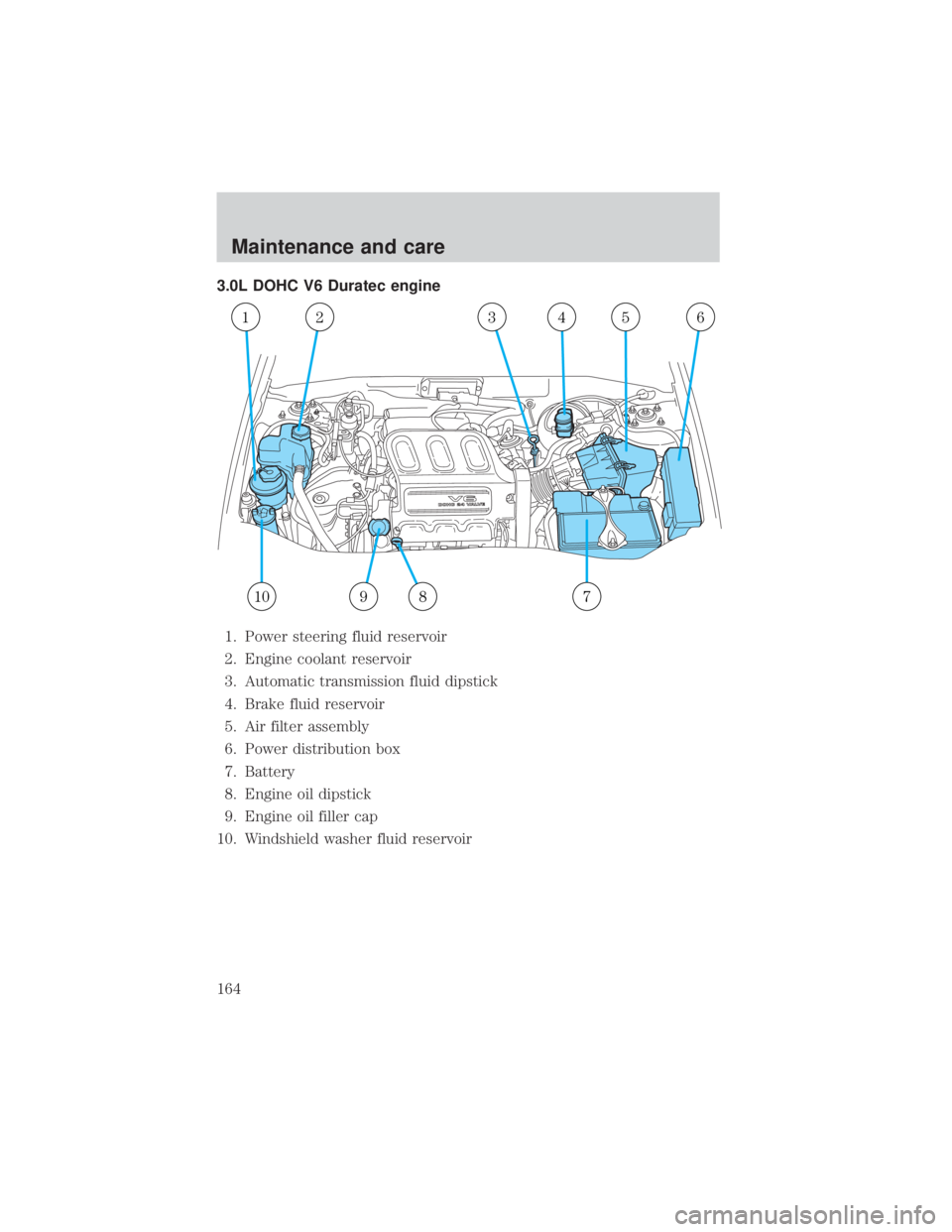
3.0L DOHC V6 Duratec engine1. Power steering fluid reservoir
2. Engine coolant reservoir
3. Automatic transmission fluid dipstick
4. Brake fluid reservoir
5. Air filter assembly
6. Power distribution box
7. Battery
8. Engine oil dipstick
9. Engine oil filler cap
10. Windshield washer fluid reservoir
10987
123456
Maintenance and care
164
Page 165 of 232
ENGINE OIL
Checking the engine oil
Refer to the service maintenance section for the appropriate intervals for
checking the engine oil.1. Make sure the vehicle is on level ground.
2. Turn the engine off and wait a few minutes for the oil to drain into the oil pan.
3. Set the parking brake and ensure the gearshift is securely latched in P (Park) (automatic transmissions) or 1 (First) (manual
transmissions).
4. Open the hood. Protect yourself from engine heat.
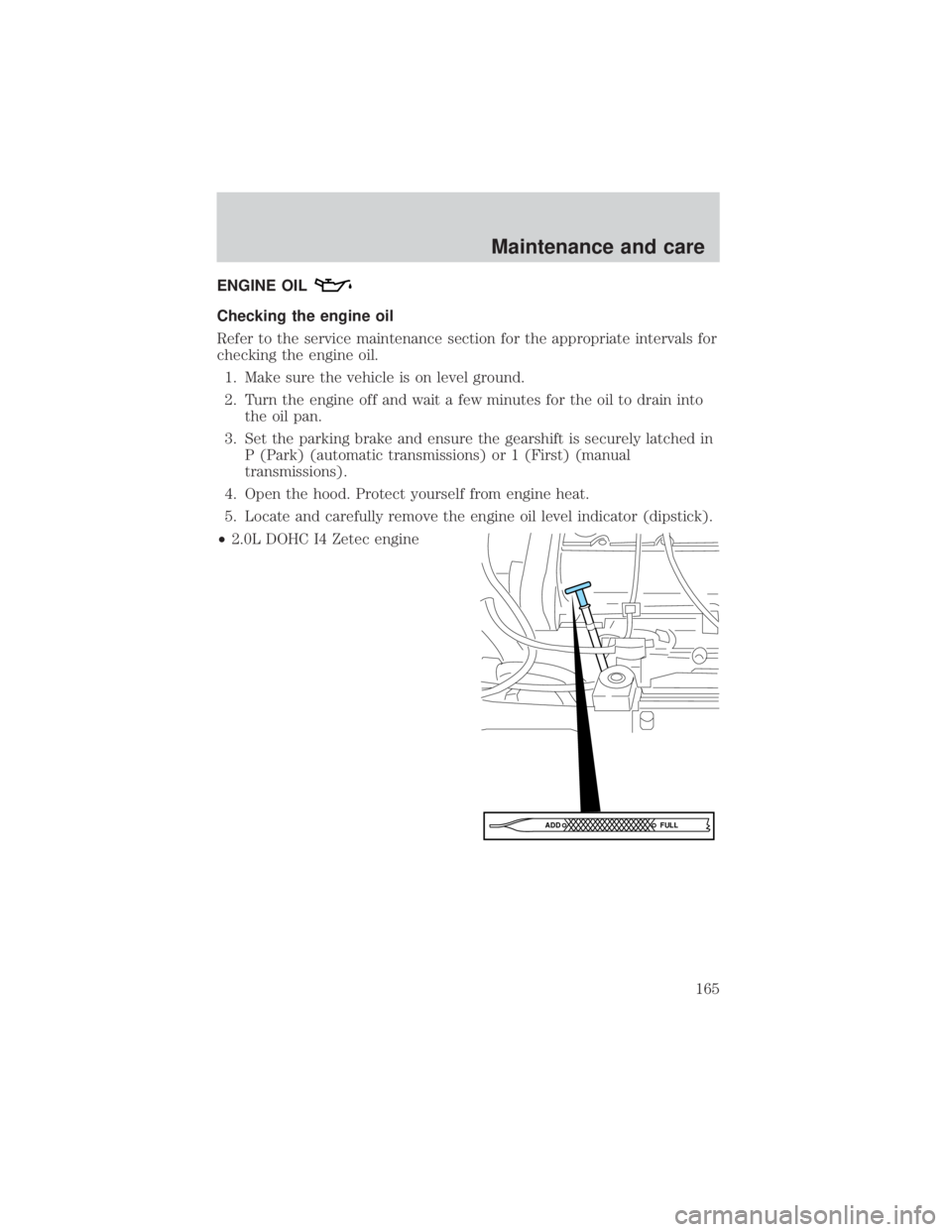
5. Locate and carefully remove the engine oil level indicator (dipstick).
² 2.0L DOHC I4 Zetec engine
FULL
ADD
Maintenance and care
165
Page 177 of 232
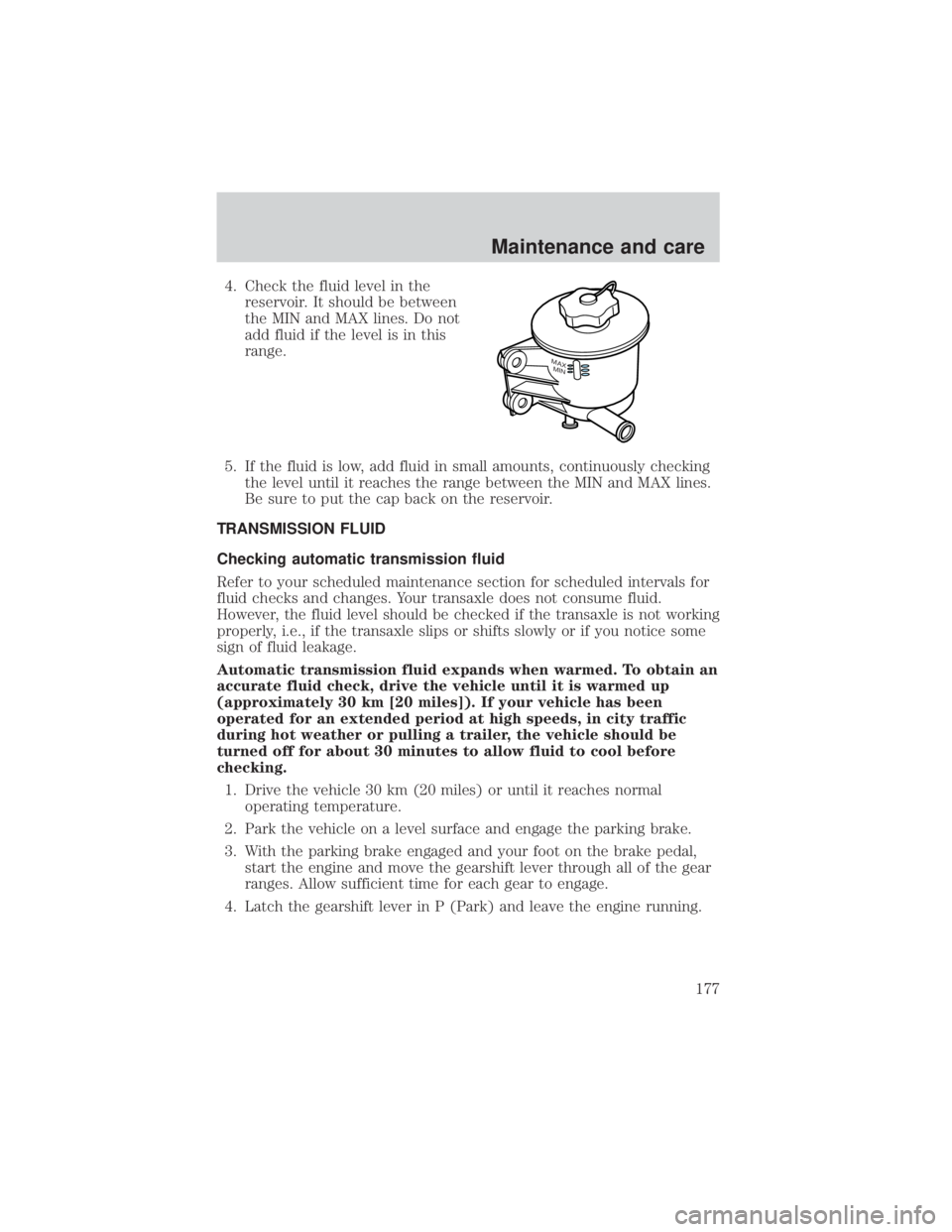
4. Check the fluid level in thereservoir. It should be between
the MIN and MAX lines. Do not
add fluid if the level is in this
range.
5. If the fluid is low, add fluid in small amounts, continuously checking the level until it reaches the range between the MIN and MAX lines.
Be sure to put the cap back on the reservoir.
TRANSMISSION FLUID
Checking automatic transmission fluid
Refer to your scheduled maintenance section for scheduled intervals for
fluid checks and changes. Your transaxle does not consume fluid.
However, the fluid level should be checked if the transaxle is not working
properly, i.e., if the transaxle slips or shifts slowly or if you notice some
sign of fluid leakage.
Automatic transmission fluid expands when warmed. To obtain an
accurate fluid check, drive the vehicle until it is warmed up
(approximately 30 km [20 miles]). If your vehicle has been
operated for an extended period at high speeds, in city traffic
during hot weather or pulling a trailer, the vehicle should be
turned off for about 30 minutes to allow fluid to cool before
checking. 1. Drive the vehicle 30 km (20 miles) or until it reaches normal operating temperature.
2. Park the vehicle on a level surface and engage the parking brake.
3. With the parking brake engaged and your foot on the brake pedal, start the engine and move the gearshift lever through all of the gear
ranges. Allow sufficient time for each gear to engage.
4. Latch the gearshift lever in P (Park) and leave the engine running.
MAXMIN
Maintenance and care
177
Page 178 of 232
5. Remove the dipstick, wiping it clean with a clean, dry lint free rag. Ifnecessary, refer to Identifying components in the engine
compartment in this chapter for the location of the dipstick.
6. Install the dipstick making sure it is fully seated in the filler tube.
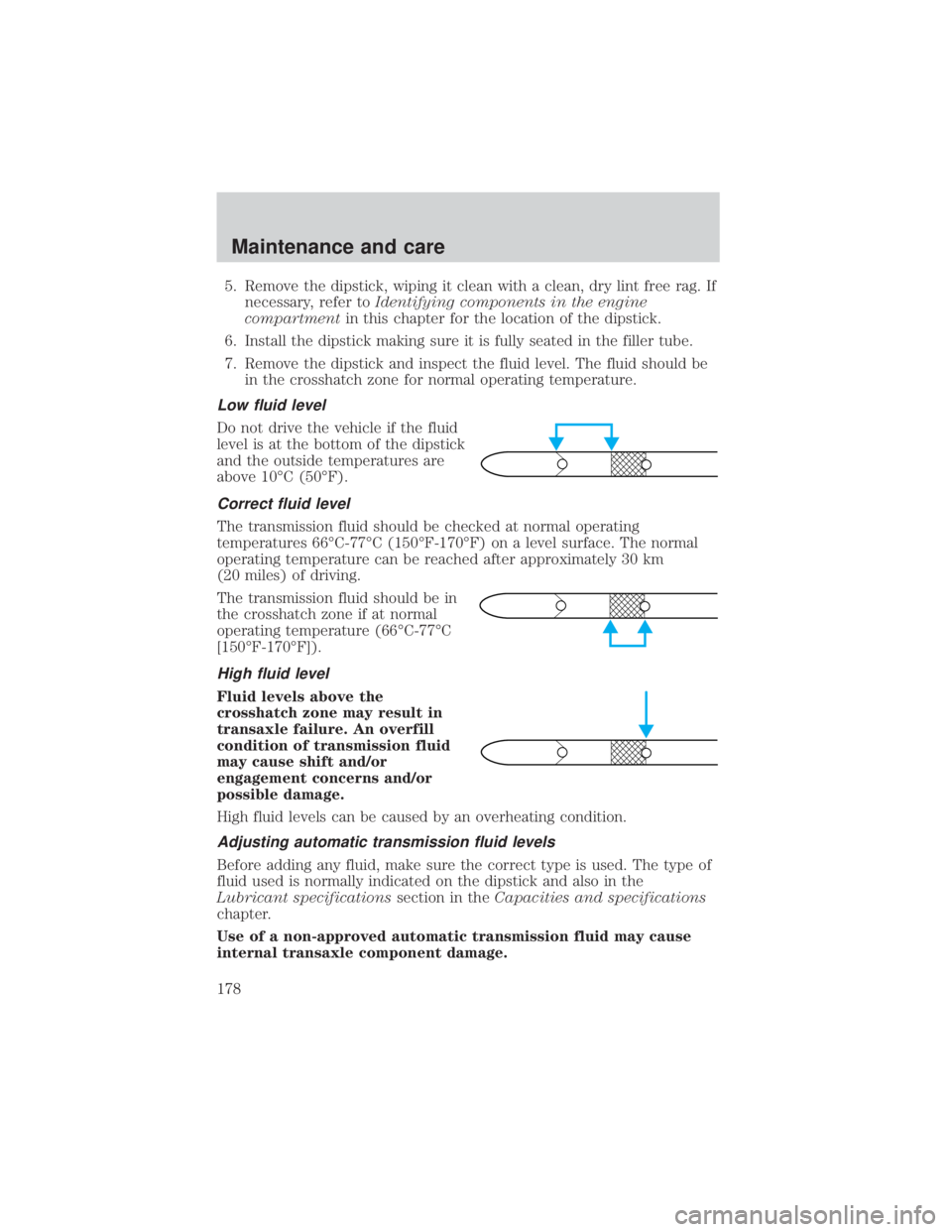
7. Remove the dipstick and inspect the fluid level. The fluid should be in the crosshatch zone for normal operating temperature.
Low fluid level
Do not drive the vehicle if the fluid
level is at the bottom of the dipstick
and the outside temperatures are
above 10ÉC (50ÉF).
Correct fluid level
The transmission fluid should be checked at normal operating
temperatures 66ÉC-77ÉC (150ÉF-170ÉF) on a level surface. The normal
operating temperature can be reached after approximately 30 km
(20 miles) of driving.
The transmission fluid should be in
the crosshatch zone if at normal
operating temperature (66ÉC-77ÉC
[150ÉF-170ÉF]).
High fluid level
Fluid levels above the
crosshatch zone may result in
transaxle failure. An overfill
condition of transmission fluid
may cause shift and/or
engagement concerns and/or
possible damage.
High fluid levels can be caused by an overheating condition.
Adjusting automatic transmission fluid levels
Before adding any fluid, make sure the correct type is used. The type of
fluid used is normally indicated on the dipstick and also in the
Lubricant specifications section in theCapacities and specifications
chapter.
Use of a non-approved automatic transmission fluid may cause
internal transaxle component damage.
Maintenance and care
178
Page 179 of 232
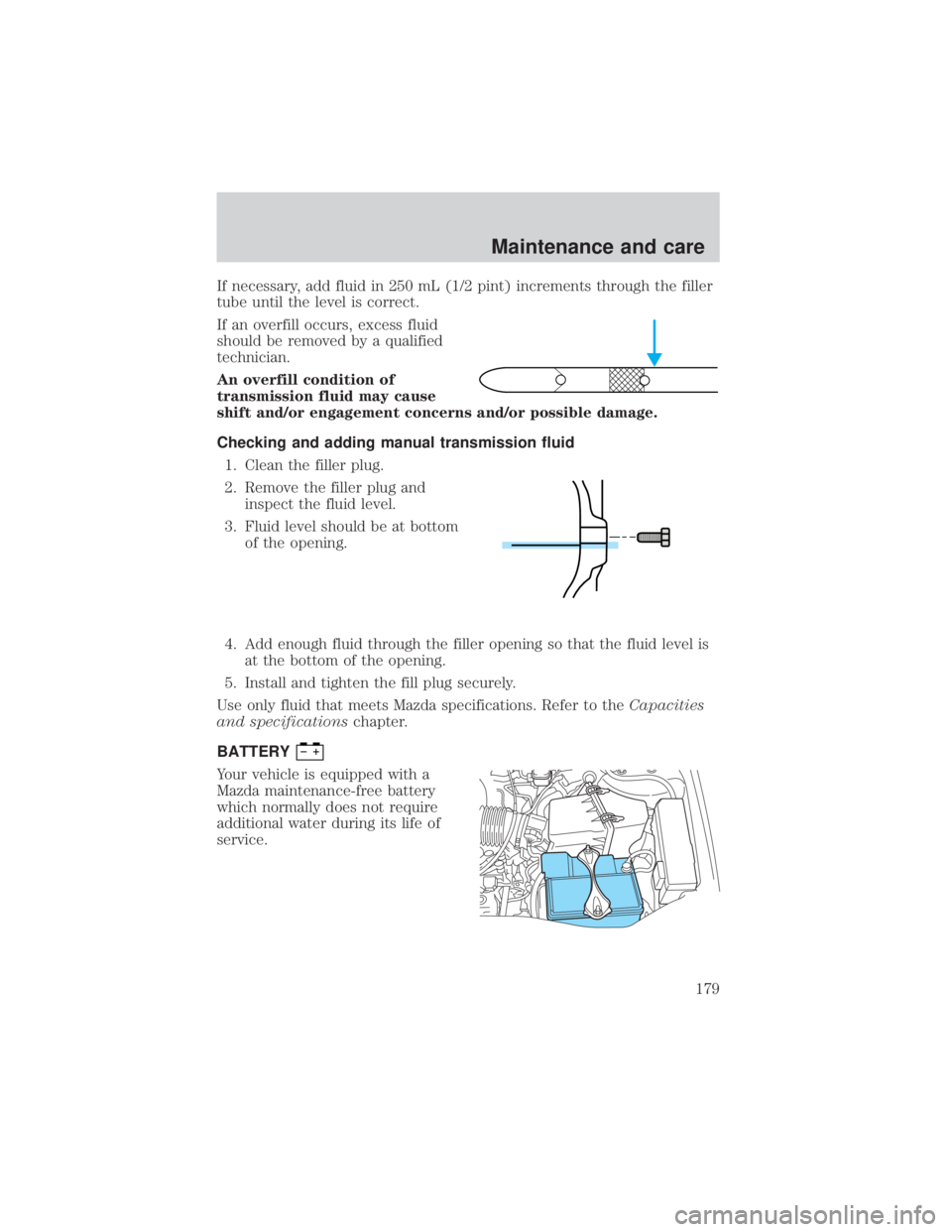
If necessary, add fluid in 250 mL (1/2 pint) increments through the filler
tube until the level is correct.
If an overfill occurs, excess fluid
should be removed by a qualified
technician.
An overfill condition of
transmission fluid may cause
shift and/or engagement concerns and/or possible damage.
Checking and adding manual transmission fluid1. Clean the filler plug.
2. Remove the filler plug and inspect the fluid level.
3. Fluid level should be at bottom of the opening.
4. Add enough fluid through the filler opening so that the fluid level is at the bottom of the opening.
5. Install and tighten the fill plug securely.
Use only fluid that meets Mazda specifications. Refer to the Capacities
and specifications chapter.
BATTERY
Your vehicle is equipped with a
Mazda maintenance-free battery
which normally does not require
additional water during its life of
service.
Maintenance and care
179