fuel MAZDA MODEL TRIBUTE 4WD 2001 Owner's Manual
[x] Cancel search | Manufacturer: MAZDA, Model Year: 2001, Model line: MODEL TRIBUTE 4WD, Model: MAZDA MODEL TRIBUTE 4WD 2001Pages: 232, PDF Size: 1.74 MB
Page 158 of 232
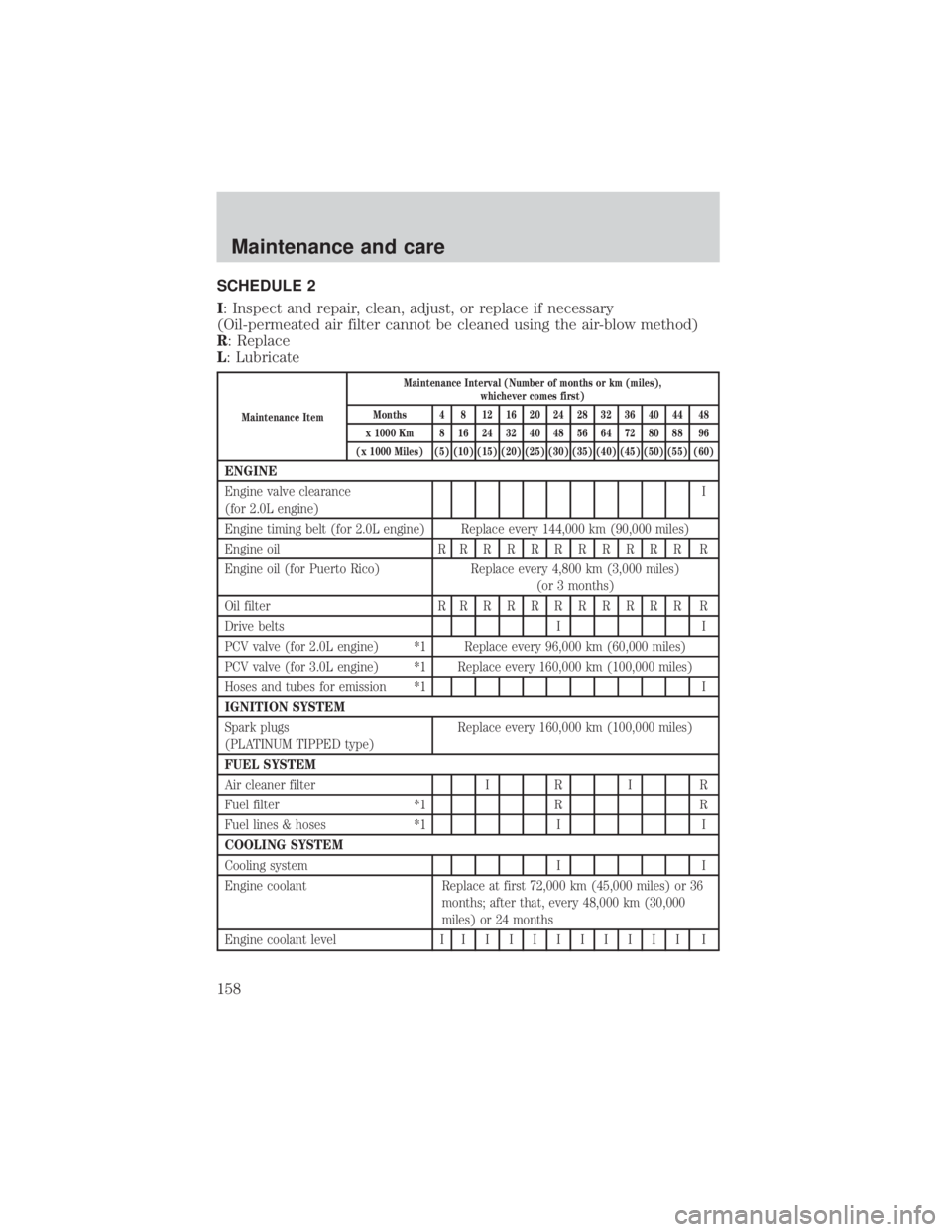
SCHEDULE 2
I: Inspect and repair, clean, adjust, or replace if necessary
(Oil-permeated air filter cannot be cleaned using the air-blow method)
R: Replace
L: Lubricate
Maintenance ItemMaintenance Interval (Number of months or km (miles),
whichever comes first)
Months 4 8 12 16 20 24 28 32 36 40 44 48
x 1000 Km 8 16 24 32 40 48 56 64 72 80 88 96
(x 1000 Miles) (5) (10) (15) (20) (25) (30) (35) (40) (45) (50) (55) (60)
ENGINE
Engine valve clearance
(for 2.0L engine) I
Engine timing belt (for 2.0L engine) Replace every 144,000 km (90,000 miles)
Engine oil R RRRRRRRRRR R
Engine oil (for Puerto Rico) Replace every 4,800 km (3,000 miles) (or 3 months)
Oil filter R RRRRRRRRRR R
Drive belts I I
PCV valve (for 2.0L engine) *1 Replace every 96,000 km (60,000 miles)
PCV valve (for 3.0L engine) *1 Replace every 160,000 km (100,000 miles)
Hoses and tubes for emission *1 I
IGNITION SYSTEM
Spark plugs
(PLATINUM TIPPED type) Replace every 160,000 km (100,000 miles)
FUEL SYSTEM
Air cleaner filter I R I R
Fuel filter *1 R R
Fuel lines & hoses *1 I I
COOLING SYSTEM
Cooling system I I
Engine coolant Replace at first 72,000 km (45,000 miles) or 36 months; after that, every 48,000 km (30,000
miles) or 24 months
Engine coolant level I IIIIIIIIII I
Maintenance and care
158
Page 160 of 232
SERVICE RECOMMENDATIONS
To help you service your vehicle:
²We highlight do-it-yourself items in the engine compartment for easy
location.
² We provide a Scheduled Maintenance section which makes tracking
routine service easy.
If your vehicle requires professional service, your dealership can provide
necessary parts and service. Check your ªWarranty Informationº to find
out which parts and services are covered.
Use only recommended fuels, lubricants, fluids and service parts
conforming to specifications. Genuine Mazda parts are designed and built
to provide the best performance in your vehicle.
PRECAUTIONS WHEN SERVICING YOUR VEHICLE
Be especially careful when inspecting or servicing your vehicle. To avoid
damage and/or personal injury:
² Do not work on a hot engine.
² When the engine is running, make sure that loose clothing, jewelry or
long hair does not get caught up in moving parts.
² Do not work on a vehicle with the engine running in an enclosed
space, unless you are sure you have enough ventilation.
² Keep all lit cigarettes, open flames and other lit material away from
the battery and all fuel related parts.
If you disconnect the battery, the engine must ªrelearnº its idle
conditions before your vehicle will drive properly, as explained in Battery
in this chapter.
Maintenance and care
160
Page 170 of 232
WARNING: Do not let the fluid level in the reservoir for the
master cylinder fall below the MIN mark. If master cylinder
runs dry, this may cause the brakes to fail.
CLUTCH FLUID (MANUAL TRANSAXLE)
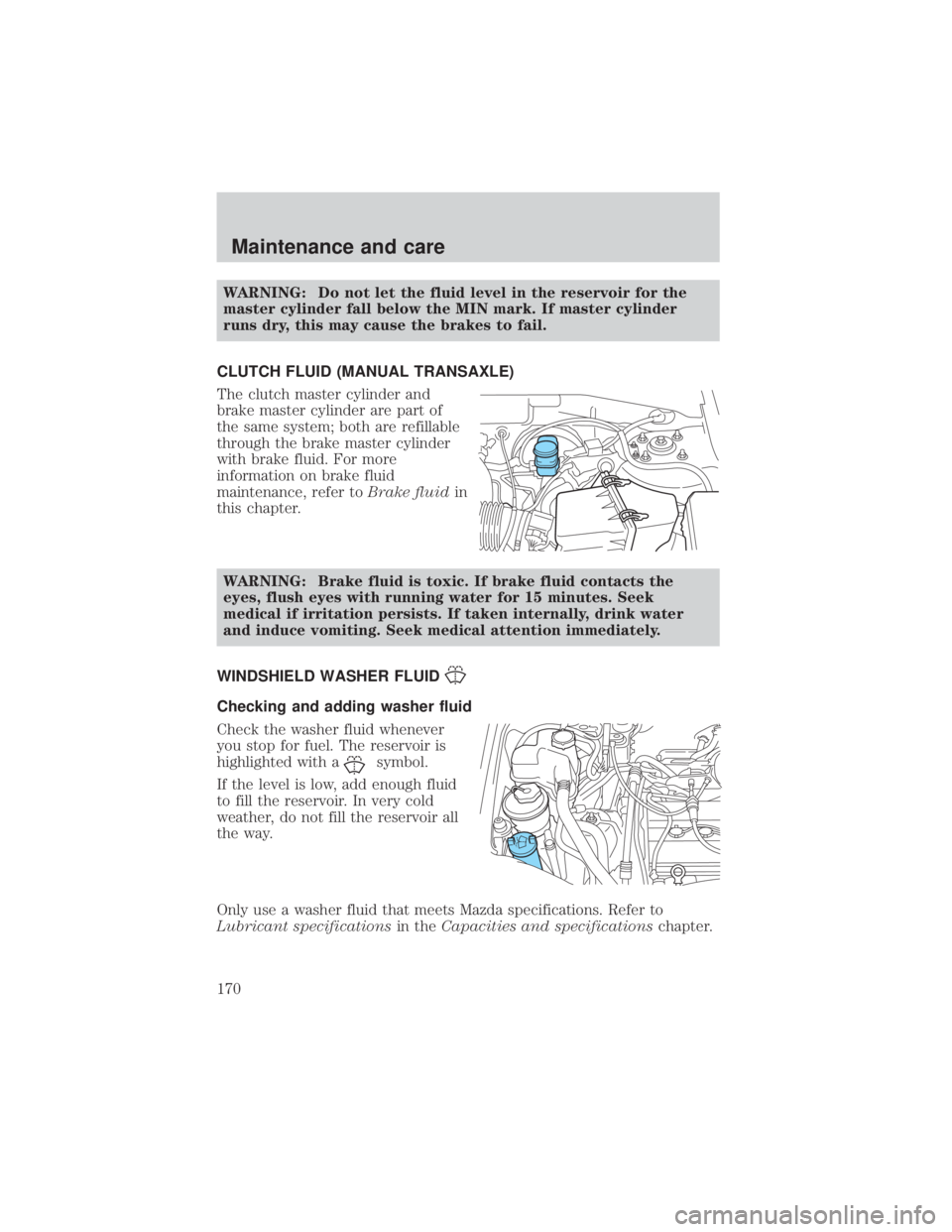
The clutch master cylinder and
brake master cylinder are part of
the same system; both are refillable
through the brake master cylinder
with brake fluid. For more
information on brake fluid
maintenance, refer to Brake fluidin
this chapter.
WARNING: Brake fluid is toxic. If brake fluid contacts the
eyes, flush eyes with running water for 15 minutes. Seek
medical if irritation persists. If taken internally, drink water
and induce vomiting. Seek medical attention immediately.
WINDSHIELD WASHER FLUID
Checking and adding washer fluid
Check the washer fluid whenever
you stop for fuel. The reservoir is
highlighted with a
symbol.
If the level is low, add enough fluid
to fill the reservoir. In very cold
weather, do not fill the reservoir all
the way.
Only use a washer fluid that meets Mazda specifications. Refer to
Lubricant specifications in theCapacities and specifications chapter.
Maintenance and care
170
Page 181 of 232
WARNING: Keep batteries out of reach of children. Batteries
contain sulfuric acid. Avoid contact with skin, eyes or clothing.
Shield your eyes when working near the battery to protect
against possible splashing of acid solution. In case of acid
contact with skin or eyes, flush immediately with water for a
minimum of 15 minutes and get prompt medical attention. If
acid is swallowed, call a physician immediately.
WARNING: Battery posts, terminals and related accessories
contain lead and lead compounds. Wash hands after handling.
Because your vehicle's engine is electronically controlled by a computer,
some control conditions are maintained by power from the battery. When
the battery is disconnected or a new battery is installed, the engine must
relearn its idle and fuel trim strategy for optimum driveability and
performance. To begin this process: 1. With the vehicle at a complete stop, set the parking brake.
2. Put the gearshift in P (Park) (automatic transmission) or the neutral position (manual transmission), turn off all accessories and start the
engine.
3. Run the engine until it reaches normal operating temperature.
4. Allow the engine to idle for at least one minute.
5. Turn the A/C on and allow the engine to idle for at least one minute.
6. Drive the vehicle to complete the relearning process.
NOTE:
² The vehicle may need to be driven to relearn the idle and fuel trim
strategy.
² If you do not allow the engine to relearn its idle trim, the idle
quality of your vehicle may be adversely affected until the idle
trim is eventually relearned.
When the battery is disconnected or a new battery installed, the
transmission must relearn its adaptive strategy. As a result of this, the
transmission may shift firmly. This operation is considered normal and
will not affect function or durability of the transmission. Over time the
adaptive learning process will fully update transmission operation to its
optimum shift feel.
Maintenance and care
181
Page 183 of 232
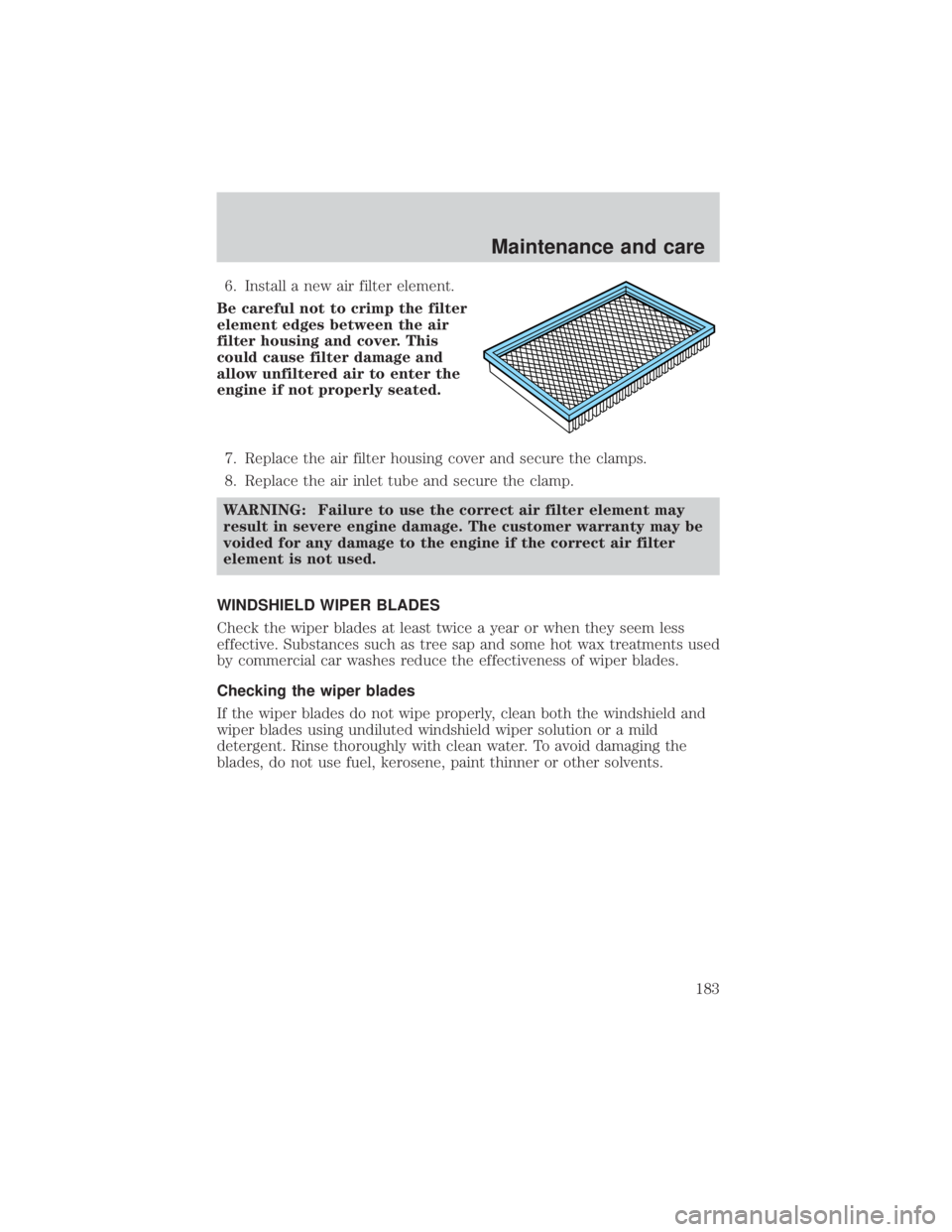
6. Install a new air filter element.
Be careful not to crimp the filter
element edges between the air
filter housing and cover. This
could cause filter damage and
allow unfiltered air to enter the
engine if not properly seated.
7. Replace the air filter housing cover and secure the clamps.
8. Replace the air inlet tube and secure the clamp.
WARNING: Failure to use the correct air filter element may
result in severe engine damage. The customer warranty may be
voided for any damage to the engine if the correct air filter
element is not used.
WINDSHIELD WIPER BLADES
Check the wiper blades at least twice a year or when they seem less
effective. Substances such as tree sap and some hot wax treatments used
by commercial car washes reduce the effectiveness of wiper blades.
Checking the wiper blades
If the wiper blades do not wipe properly, clean both the windshield and
wiper blades using undiluted windshield wiper solution or a mild
detergent. Rinse thoroughly with clean water. To avoid damaging the
blades, do not use fuel, kerosene, paint thinner or other solvents.
Maintenance and care
183
Page 189 of 232
The tires on your vehicle have all-weather treads to provide traction in
rain and snow. However, in some climates, using snow tires and traction
devices may be necessary. See your authorized Mazda dealer for more
information on tire cables and other traction devices for your vehicle.
Follow these guidelines when using snow tires and traction devices:
²Install cables securely, verifying that the cables do not touch any
wiring, brake lines or fuel lines.
Drive cautiously. If you hear the cables rub or bang against the
vehicle, stop and retighten them. If this does not work, remove
the cables to prevent vehicle damage.
² Avoid overloading your vehicle.
² Remove the tire cables when they are no longer needed.
² Do not use cables on dry roads.
² The suspension insulation and bumpers will help prevent vehicle
damage. Do not remove these components from the vehicle when
using snow tires and traction devices.
² Do not exceed 48 km/h (30 mph) with tire cables on your vehicle.
Consult your dealer for information on other Mazda approved methods of
traction control.
WHAT YOU SHOULD KNOW ABOUT AUTOMOTIVE FUELS
Important safety precautions
WARNING: Do not overfill the fuel tank. The pressure in an
overfilled tank may cause leakage and lead to fuel spray and
fire.
WARNING: The fuel system may be under pressure. If the fuel
filler cap is venting vapor or if you hear a hissing sound, wait
until it stops before completely removing the fuel filler cap.
Otherwise, fuel may spray out and injure you or others.
Maintenance and care
189
Page 190 of 232
WARNING: If you do not use the proper fuel filler cap,
excessive pressure or vacuum in the fuel tank may damage the
fuel system or cause the fuel cap to disengage in a collision,
which may result in possible personal injury.
WARNING: Automotive fuels can cause serious injury or death
if misused or mishandled.
WARNING: Gasoline may contain benzene, which is a
cancer-causing agent.
Observe the following guidelines when handling automotive fuel: WARNING: Automotive fuels
can be harmful or fatal if
swallowed. Fuel such as
gasoline is highly toxic and if
swallowed can cause death or
permanent injury. If fuel is
swallowed, call a physician
immediately, even if no
symptoms are immediately
apparent. The toxic effects of
fuel may not be visible for
hours.
² Extinguish all smoking materials and any open flames before fueling
your vehicle.
² Always turn off the vehicle before fueling.
² Avoid inhaling fuel vapors. Inhaling too much fuel vapor of any kind
can lead to eye and respiratory tract irritation. In severe cases,
excessive or prolonged breathing of fuel vapor can cause serious
illness and permanent injury.
Maintenance and care
190
Page 191 of 232
²Avoid getting fuel liquid in your eyes. If fuel is splashed in the eyes,
remove contact lenses (if worn), flush with water for 15 minutes and
seek medical attention. Failure to seek proper medical attention could
lead to permanent injury.
² Fuels can also be harmful if absorbed through the skin. If fuel is
splashed on the skin and/or clothing, promptly remove contaminated
clothing and wash skin thoroughly with soap and water. Repeated or
prolonged skin contact with fuel liquid or vapor causes skin irritation.
² Be particularly careful if you are taking ªAntabuseº or other forms of
disulfiram for the treatment of alcoholism. Breathing gasoline vapors,
or skin contact could cause an adverse reaction. In sensitive
individuals, serious personal injury or sickness may result. If fuel is
splashed on the skin, promptly wash skin thoroughly with soap and
water. Consult a physician immediately if you experience an adverse
reaction.
WARNING: When refueling always shut the engine off and
never allow sparks or open flames near the filler neck. Never
smoke while refueling. Fuel vapor is extremely hazardous under
certain conditions. Care should be taken to avoid inhaling
excess fumes.
WARNING: The flow of fuel through a fuel pump nozzle can
produce static electricity, which can cause a fire if fuel is
pumped into an ungrounded fuel container. Be very careful to
put the container on the ground before adding fuel to it.
Use the following guidelines to avoid static build-up when filling an
ungrounded fuel container:
² Place approved fuel container on the ground.
² DO NOT fill a fuel container while it is in the vehicle.
² Keep the fuel pump nozzle in contact with the fuel container while
filling.
² DO NOT use a device that would hold the fuel pump handle in the fill
position.
Maintenance and care
191
Page 192 of 232
Choosing the right fuel
²Use only UNLEADED FUEL. The use of leaded fuel is
prohibited by law and could damage your vehicle.
² Do not use fuel containing methanol. It can damage critical fuel
system components.
² Your vehicle was not designed to use fuel or fuel additives with
metallic compounds, including manganese-based compounds
containing MMT.
² Repairs to correct the effects of using a fuel for which your
vehicle was not designed may not be covered by your warranty.
Octane recommendations
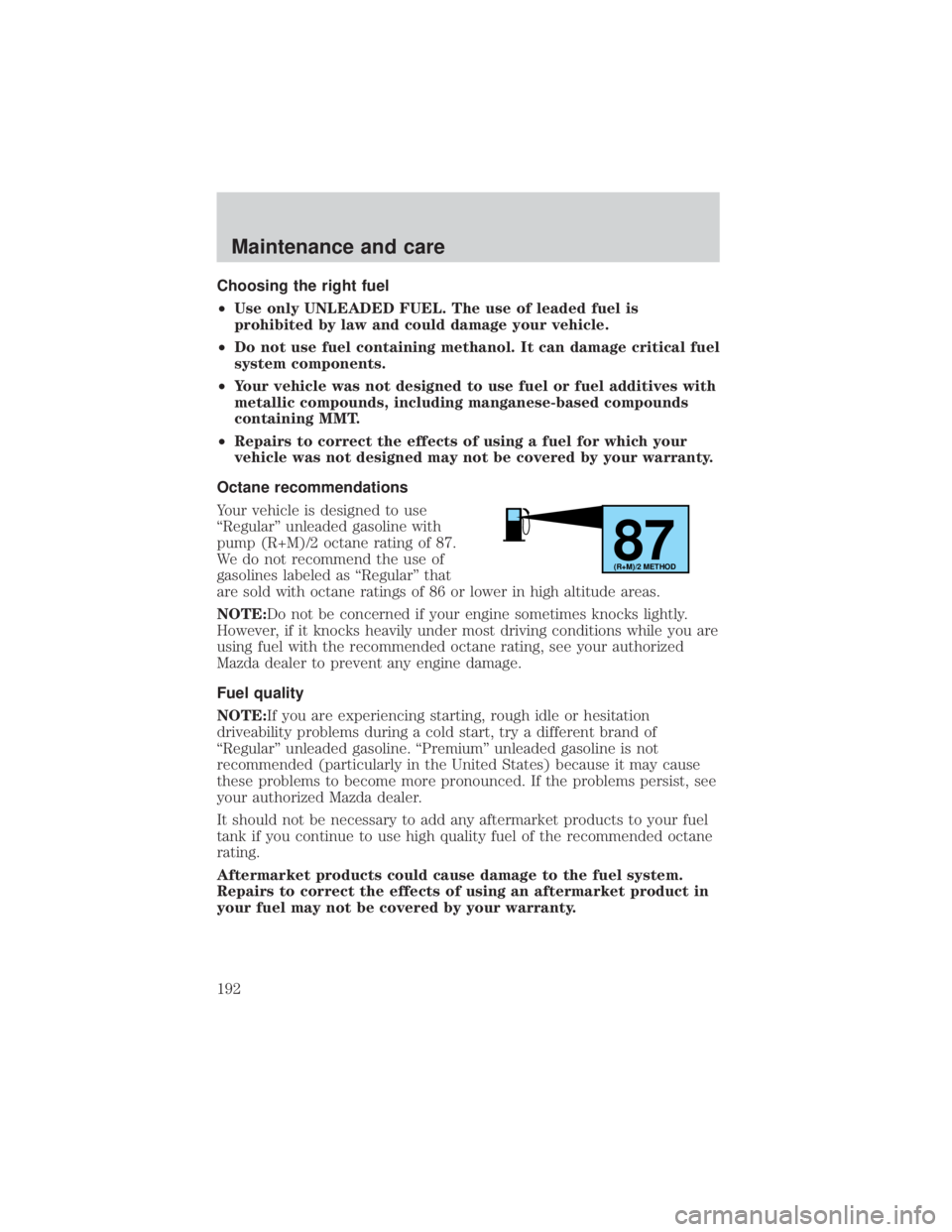
Your vehicle is designed to use
ªRegularº unleaded gasoline with
pump (R+M)/2 octane rating of 87.
We do not recommend the use of
gasolines labeled as ªRegularº that
are sold with octane ratings of 86 or lower in high altitude areas.
NOTE:Do not be concerned if your engine sometimes knocks lightly.
However, if it knocks heavily under most driving conditions while you are
using fuel with the recommended octane rating, see your authorized
Mazda dealer to prevent any engine damage.
Fuel quality
NOTE:If you are experiencing starting, rough idle or hesitation
driveability problems during a cold start, try a different brand of
ªRegularº unleaded gasoline. ªPremiumº unleaded gasoline is not
recommended (particularly in the United States) because it may cause
these problems to become more pronounced. If the problems persist, see
your authorized Mazda dealer.
It should not be necessary to add any aftermarket products to your fuel
tank if you continue to use high quality fuel of the recommended octane
rating.
Aftermarket products could cause damage to the fuel system.
Repairs to correct the effects of using an aftermarket product in
your fuel may not be covered by your warranty.
87(R+M)/2 METHOD
Maintenance and care
192
Page 193 of 232
Many of the world's automakers
issued the World-wide Fuel Charter
that recommends gasoline
specifications to provide improved
performance and emission control
system protection for your vehicle.
Gasolines that meet the World-wide
Fuel Charter should be used when
available. Ask your fuel supplier
about gasolines that meet the
World-wide Fuel Charter. In Canada,
look for fuels that display theAuto Makers' Choiceylogo.
Cleaner air
Mazda endorses the use of reformulated ªcleaner-burningº gasolines to
improve air quality.
Running out of fuel
Avoid running out of fuel because this situation may have an adverse
affect on powertrain components.
If you have run out of fuel:
² You may need to cycle the ignition from OFF to ON several times after
refueling, to allow the fuel system to pump the fuel from the tank to
the engine.
² The
indicator may come on. For more information on the ªCheck
Engineº indicator, refer to the Instrumentationchapter.
Fuel Filler Cap
Your fuel tank filler cap has an indexed design with a 1/8 turn on/off
feature.
When fueling your vehicle: 1. Turn the engine off.
2. Carefully turn the filler cap counterclockwise 1/8 of a turn until it stops.
3. Pull to remove the cap from the fuel filler pipe.
4. To install the cap, align the tabs on the cap with the notches on the filler pipe.
5. Turn the filler cap clockwise 1/8 of a turn until it stops.
Maintenance and care
193