General Information MAZDA MX-5 1997 Factory Repair Manual
[x] Cancel search | Manufacturer: MAZDA, Model Year: 1997, Model line: MX-5, Model: MAZDA MX-5 1997Pages: 514, PDF Size: 17.89 MB
Page 22 of 514
ANTI-LOCK BRAKE SYSTEM
1997 BRAKES Mazda - Anti-Lock
DESCRIPTION
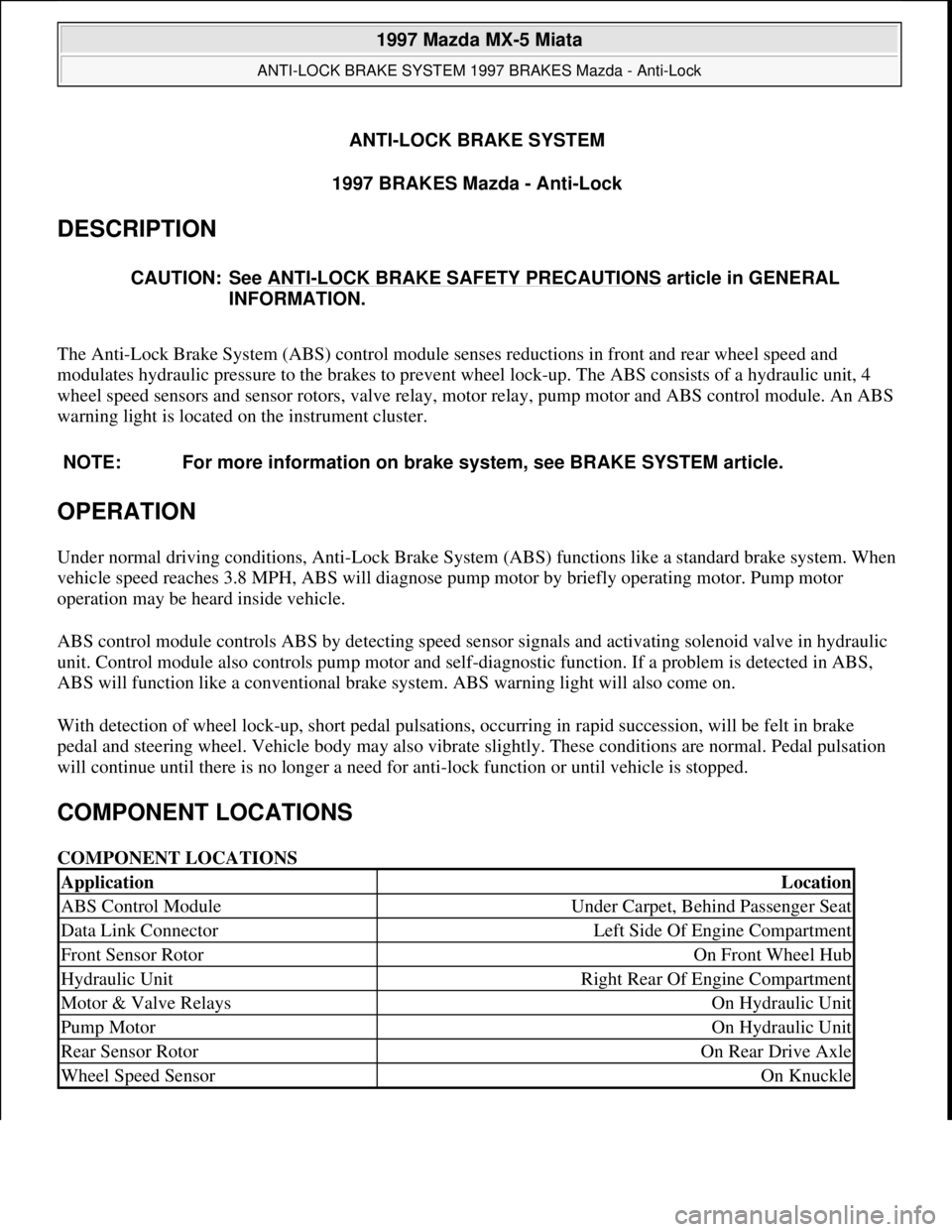
The Anti-Lock Brake System (ABS) control module senses reductions in front and rear wheel speed and
modulates hydraulic pressure to the brakes to prevent wheel lock-up. The ABS consists of a hydraulic unit, 4
wheel speed sensors and sensor rotors, valve relay, motor relay, pump motor and ABS control module. An ABS
warning light is located on the instrument cluster.
OPERATION
Under normal driving conditions, Anti-Lock Brake System (ABS) functions like a standard brake system. When
vehicle speed reaches 3.8 MPH, ABS will diagnose pump motor by briefly operating motor. Pump motor
operation may be heard inside vehicle.
ABS control module controls ABS by detecting speed sensor signals and activating solenoid valve in hydraulic
unit. Control module also controls pump motor and self-diagnostic function. If a problem is detected in ABS,
ABS will function like a conventional brake system. ABS warning light will also come on.
With detection of wheel lock-up, short pedal pulsations, occurring in rapid succession, will be felt in brake
pedal and steering wheel. Vehicle body may also vibrate slightly. These conditions are normal. Pedal pulsation
will continue until there is no longer a need for anti-lock function or until vehicle is stopped.
COMPONENT LOCATIONS
COMPONENT LOCATIONS CAUTION: See ANTI
-LOCK BRAKE SAFETY PRECAUTIONS article in GENERAL
INFORMATION.
NOTE: For more information on brake system, see BRAKE SYSTEM article.
ApplicationLocation
ABS Control ModuleUnder Carpet, Behind Passenger Seat
Data Link ConnectorLeft Side Of Engine Compartment
Front Sensor RotorOn Front Wheel Hub
Hydraulic UnitRight Rear Of Engine Compartment
Motor & Valve RelaysOn Hydraulic Unit
Pump MotorOn Hydraulic Unit
Rear Sensor RotorOn Rear Drive Axle
Wheel Speed SensorOn Knuckle
1997 Mazda MX-5 Miata
ANTI-LOCK BRAKE SYSTEM 1997 BRAKES Mazda - Anti-Lock
1997 Mazda MX-5 Miata
ANTI-LOCK BRAKE SYSTEM 1997 BRAKES Mazda - Anti-Lock
Microsoft
Sunday, July 05, 2009 1:48:48 PMPage 1 © 2005 Mitchell Repair Information Company, LLC.
Microsoft
Sunday, July 05, 2009 1:48:54 PMPage 1 © 2005 Mitchell Repair Information Company, LLC.
Page 31 of 514
GENERAL NOTE
ABS CONTROL MODULE
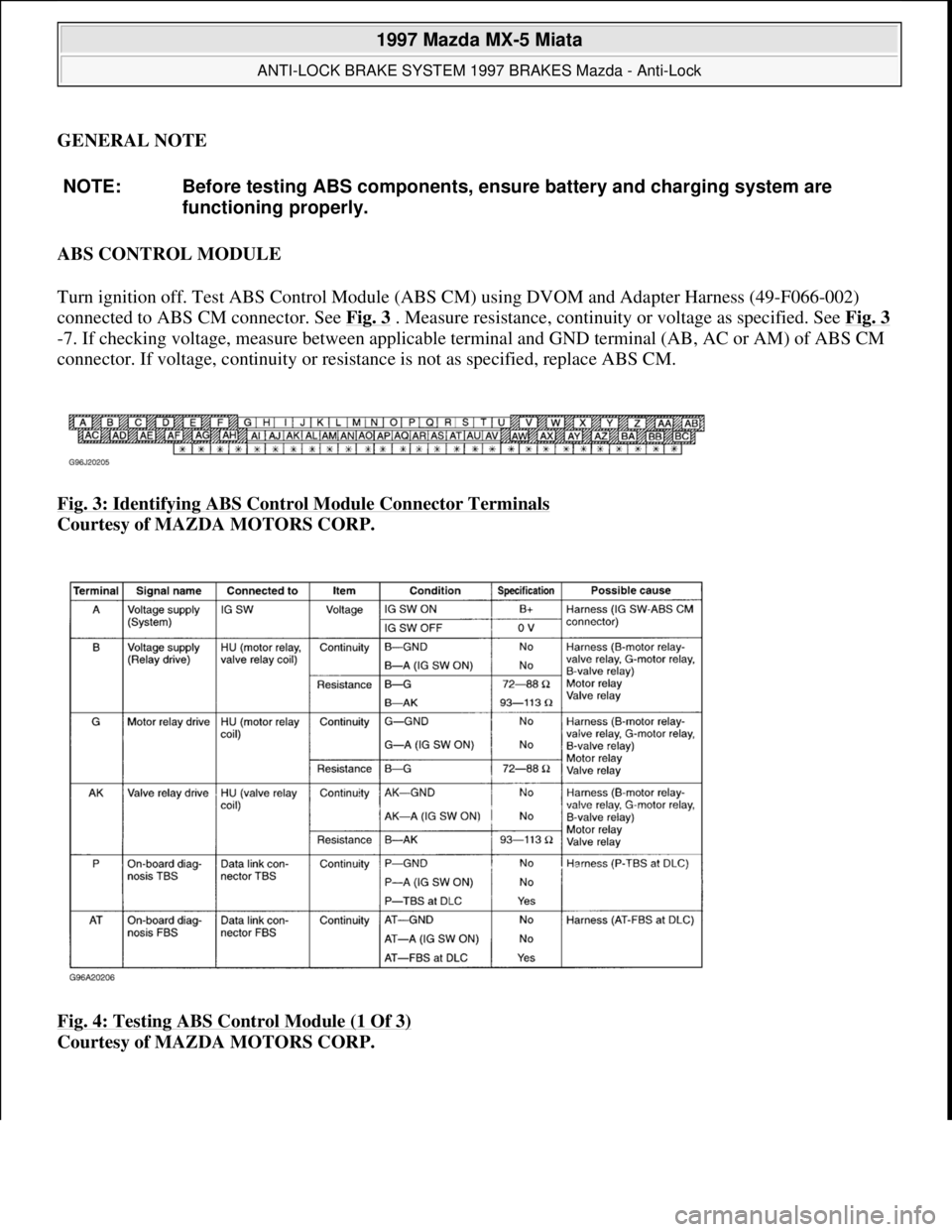
Turn ignition off. Test ABS Control Module (ABS CM) using DVOM and Adapter Harness (49-F066-002)
connected to ABS CM connector. See Fig. 3
. Measure resistance, continuity or voltage as specified. See Fig. 3
-7. If checking voltage, measure between applicable terminal and GND terminal (AB, AC or AM) of ABS CM
connector. If voltage, continuity or resistance is not as specified, replace ABS CM.
Fig. 3: Identifying ABS Control Module Connector Terminals
Courtesy of MAZDA MOTORS CORP.
Fig. 4: Testing ABS Control Module (1 Of 3)
Courtesy of MAZDA MOTORS CORP. NOTE: Before testing ABS components, ensure battery and charging system are
functioning properly.
1997 Mazda MX-5 Miata
ANTI-LOCK BRAKE SYSTEM 1997 BRAKES Mazda - Anti-Lock
Microsoft
Sunday, July 05, 2009 1:48:48 PMPage 10 © 2005 Mitchell Repair Information Company, LLC.
Page 49 of 514
1997 AUTOMATIC TRANSMISSIONS
NC4A-EL Electronic Controls
APPLICATION
TRANSMISSION APPLICATION
DESCRIPTION
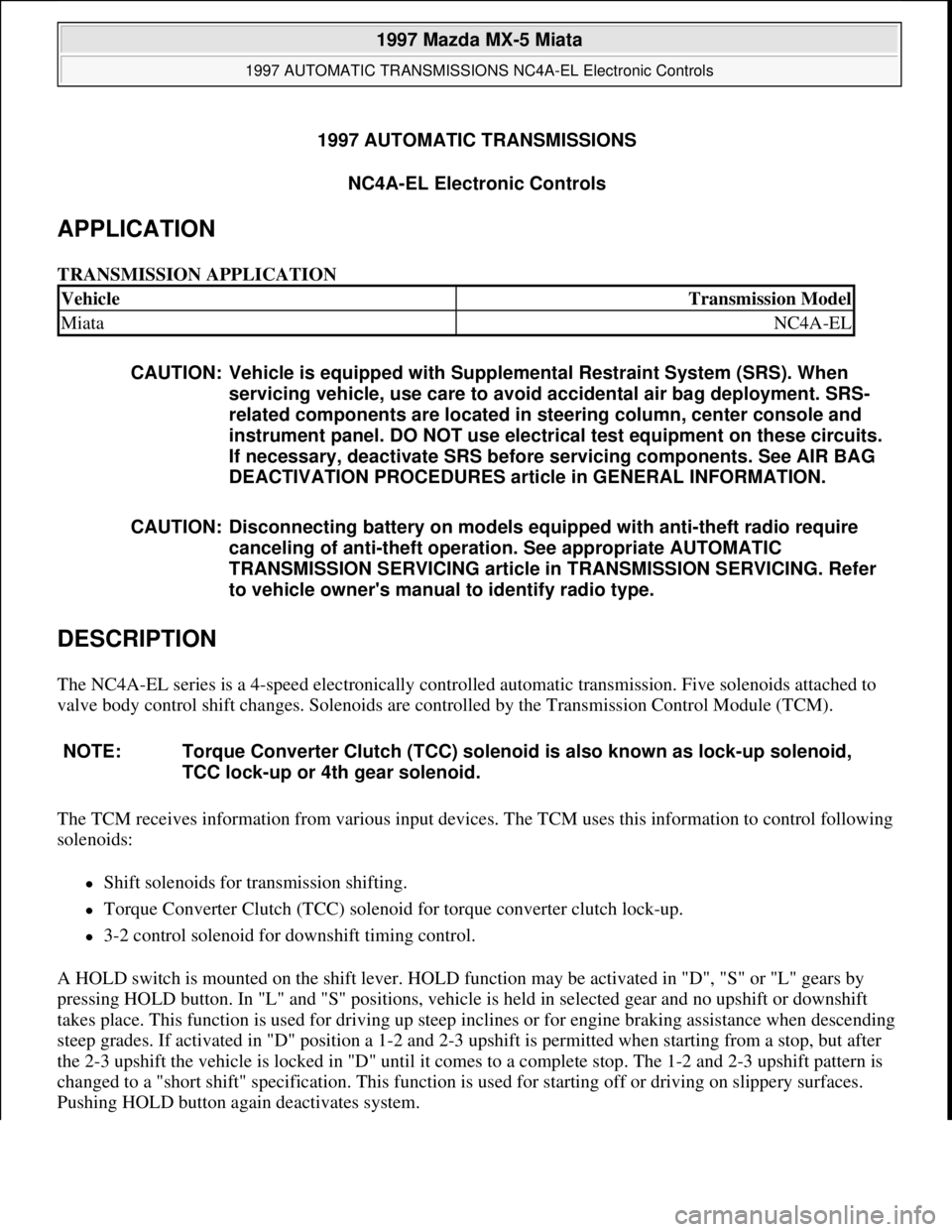
The NC4A-EL series is a 4-speed electronically controlled automatic transmission. Five solenoids attached to
valve body control shift changes. Solenoids are controlled by the Transmission Control Module (TCM).
The TCM receives information from various input devices. The TCM uses this information to control following
solenoids:
Shift solenoids for transmission shifting.
Torque Converter Clutch (TCC) solenoid for torque converter clutch lock-up.
3-2 control solenoid for downshift timing control.
A HOLD switch is mounted on the shift lever. HOLD function may be activated in "D", "S" or "L" gears by
pressing HOLD button. In "L" and "S" positions, vehicle is held in selected gear and no upshift or downshift
takes place. This function is used for driving up steep inclines or for engine braking assistance when descending
steep grades. If activated in "D" position a 1-2 and 2-3 upshift is permitted when starting from a stop, but after
the 2-3 upshift the vehicle is locked in "D" until it comes to a complete stop. The 1-2 and 2-3 upshift pattern is
changed to a "short shift" specification. This function is used for starting off or driving on slippery surfaces.
Pushin
g HOLD button again deactivates system.
VehicleTransmission Model
MiataNC4A-EL
CAUTION: Vehicle is equipped with Supplemental Restraint System (SRS). When
servicing vehicle, use care to avoid accidental air bag deployment. SRS-
related components are located in steering column, center console and
instrument panel. DO NOT use electrical test equipment on these circuits.
If necessary, deactivate SRS before servicing components. See AIR BAG
DEACTIVATION PROCEDURES article in GENERAL INFORMATION.
CAUTION: Disconnecting battery on models equipped with anti-theft radio require
canceling of anti-theft operation. See appropriate AUTOMATIC
TRANSMISSION SERVICING article in TRANSMISSION SERVICING. Refer
to vehicle owner's manual to identify radio type.
NOTE: Torque Converter Clutch (TCC) solenoid is also known as lock-up solenoid,
TCC lock-up or 4th gear solenoid.
1997 Mazda MX-5 Miata
1997 AUTOMATIC TRANSMISSIONS NC4A-EL Electronic Controls
1997 Mazda MX-5 Miata
1997 AUTOMATIC TRANSMISSIONS NC4A-EL Electronic Controls
Microsoft
Sunday, July 05, 2009 1:35:03 PMPage 1 © 2005 Mitchell Repair Information Company, LLC.
Microsoft
Sunday, July 05, 2009 1:35:38 PMPage 1 © 2005 Mitchell Repair Information Company, LLC.
Page 79 of 514
1997-2001 DRIVE AXLES
Axle Shafts - MX-5 Miata
TROUBLE SHOOTING
Inspect CV joint boot on axle shaft for cracks, damage, leaking, grease, and looseness in boot band. Inspect axle
shaft for bending, cracks, and wear of joint splines. Repair or replace as necessary.
REMOVAL & INSTALLATION
AXLE SHAFTS
Removal
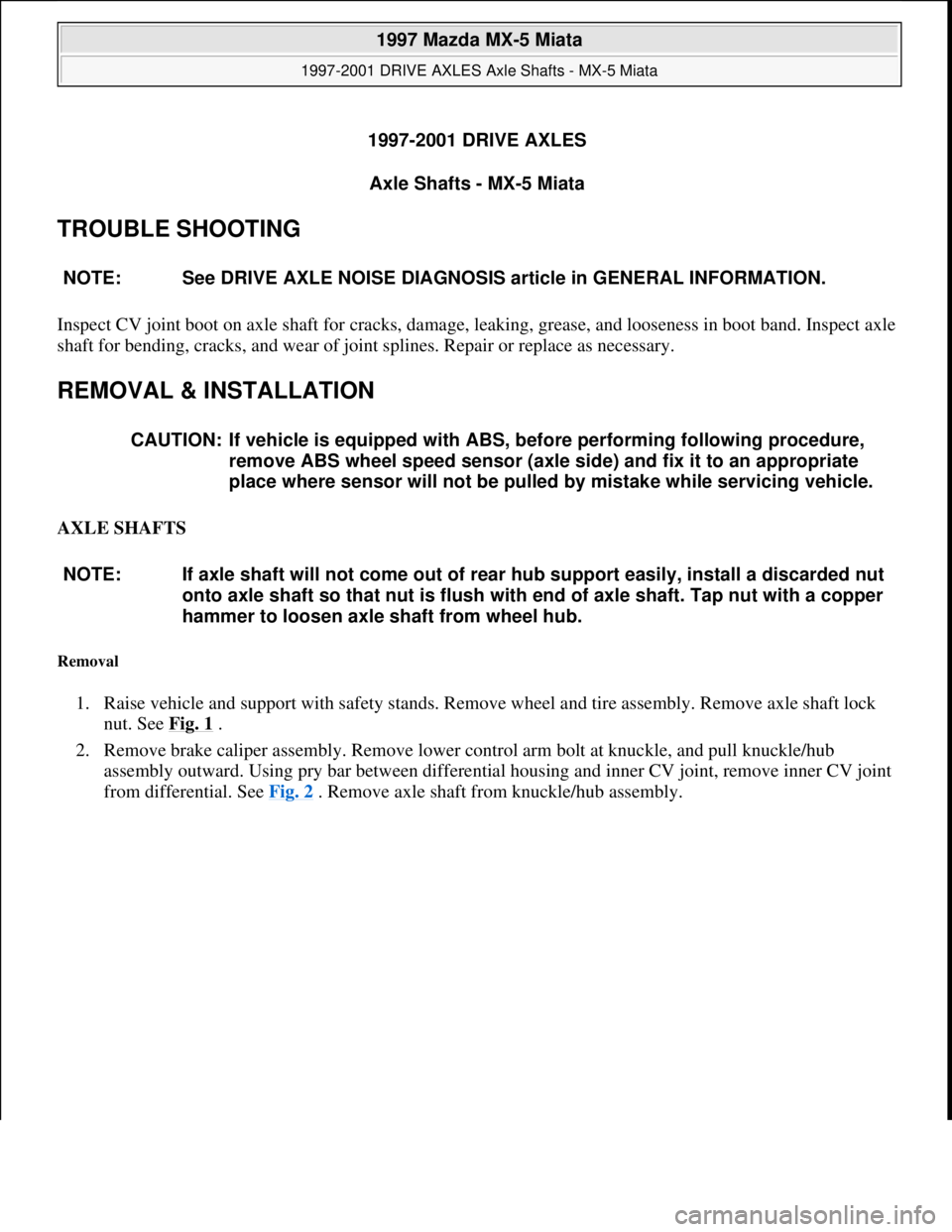
1. Raise vehicle and support with safety stands. Remove wheel and tire assembly. Remove axle shaft lock
nut. See Fig. 1
.
2. Remove brake caliper assembly. Remove lower control arm bolt at knuckle, and pull knuckle/hub
assembly outward. Using pry bar between differential housing and inner CV joint, remove inner CV joint
from differential. See Fig. 2
. Remove axle shaft from knuckle/hub assembly. NOTE: See DRIVE AXLE NOISE DIAGNOSIS article in GENERAL INFORMATION.
CAUTION: If vehicle is equipped with ABS, before performing following procedure,
remove ABS wheel speed sensor (axle side) and fix it to an appropriate
place where sensor will not be pulled by mistake while servicing vehicle.
NOTE: If axle shaft will not come out of rear hub support easily, install a discarded nut
onto axle shaft so that nut is flush with end of axle shaft. Tap nut with a copper
hammer to loosen axle shaft from wheel hub.
1997 Mazda MX-5 Miata
1997-2001 DRIVE AXLES Axle Shafts - MX-5 Miata
1997 Mazda MX-5 Miata
1997-2001 DRIVE AXLES Axle Shafts - MX-5 Miata
Microsoft
Sunday, July 05, 2009 1:51:37 PMPage 1 © 2005 Mitchell Repair Information Company, LLC.
Microsoft
Sunday, July 05, 2009 1:51:53 PMPage 1 © 2005 Mitchell Repair Information Company, LLC.
Page 137 of 514
GENERATOR & REGULATOR
1997 STARTING & CHARGING SYSTEMS Mazda - Generators & Regulators
DESCRIPTION & OPERATION
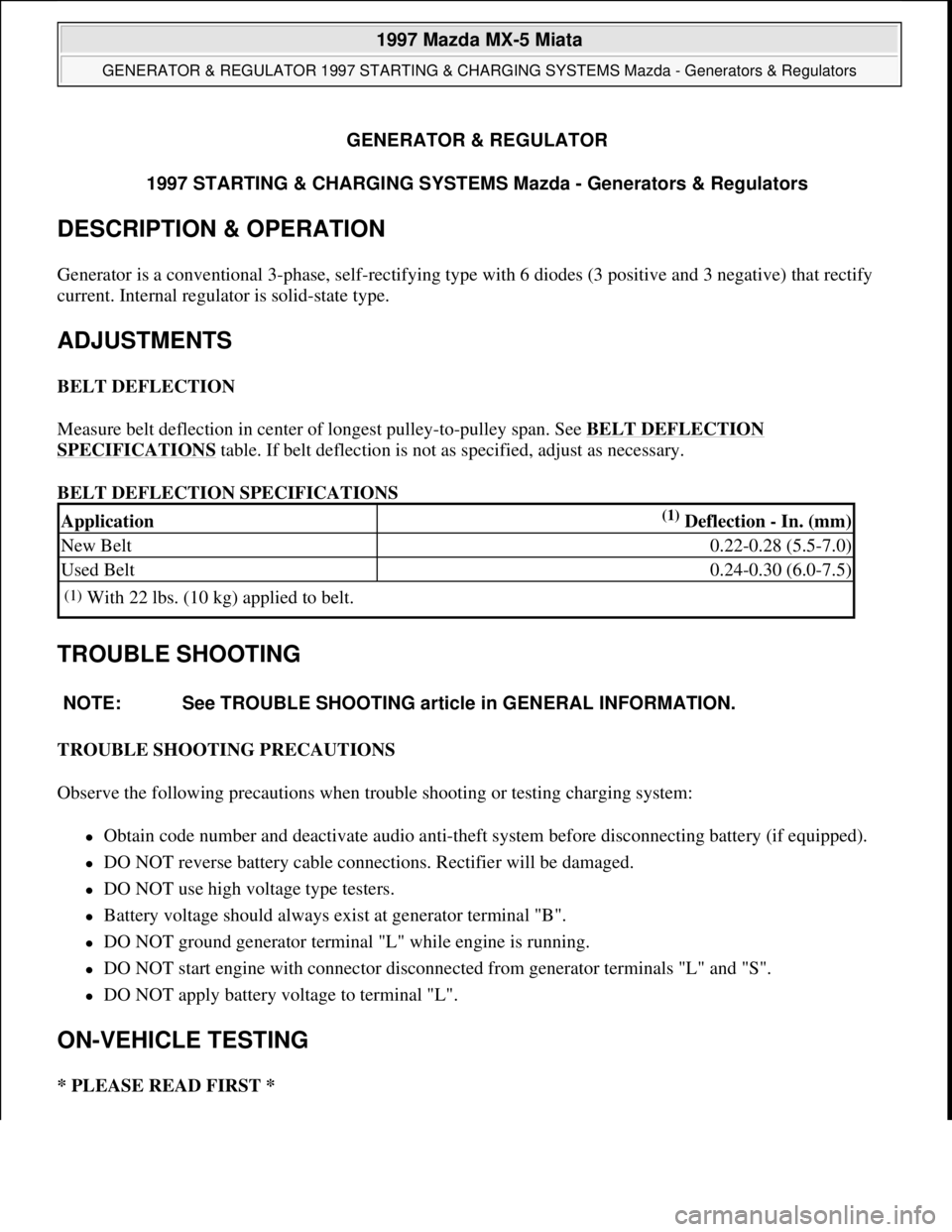
Generator is a conventional 3-phase, self-rectifying type with 6 diodes (3 positive and 3 negative) that rectify
current. Internal regulator is solid-state type.
ADJUSTMENTS
BELT DEFLECTION
Measure belt deflection in center of longest pulley-to-pulley span. See BELT DEFLECTION
SPECIFICATIONS table. If belt deflection is not as specified, adjust as necessary.
BELT DEFLECTION SPECIFICATIONS
TROUBLE SHOOTING
TROUBLE SHOOTING PRECAUTIONS
Observe the following precautions when trouble shooting or testing charging system:
Obtain code number and deactivate audio anti-theft system before disconnecting battery (if equipped).
DO NOT reverse battery cable connections. Rectifier will be damaged.
DO NOT use high voltage type testers.
Battery voltage should always exist at generator terminal "B".
DO NOT ground generator terminal "L" while engine is running.
DO NOT start engine with connector disconnected from generator terminals "L" and "S".
DO NOT apply battery voltage to terminal "L".
ON-VEHICLE TESTING
* PLEASE READ FIRST *
Application(1) Deflection - In. (mm)
New Belt0.22-0.28 (5.5-7.0)
Used Belt0.24-0.30 (6.0-7.5)
(1)With 22 lbs. (10 kg) applied to belt.
NOTE: See TROUBLE SHOOTING article in GENERAL INFORMATION.
1997 Mazda MX-5 Miata
GENERATOR & REGULATOR 1997 STARTING & CHARGING SYSTEMS Mazda - Generators & Regulators
1997 Mazda MX-5 Miata
GENERATOR & REGULATOR 1997 STARTING & CHARGING SYSTEMS Mazda - Generators & Regulators
Microsoft
Sunday, July 05, 2009 1:53:15 PMPage 1 © 2005 Mitchell Repair Information Company, LLC.
Microsoft
Sunday, July 05, 2009 1:53:20 PMPage 1 © 2005 Mitchell Repair Information Company, LLC.
Page 173 of 514
GENERAL INFORMATION
Computer Relearn Procedures
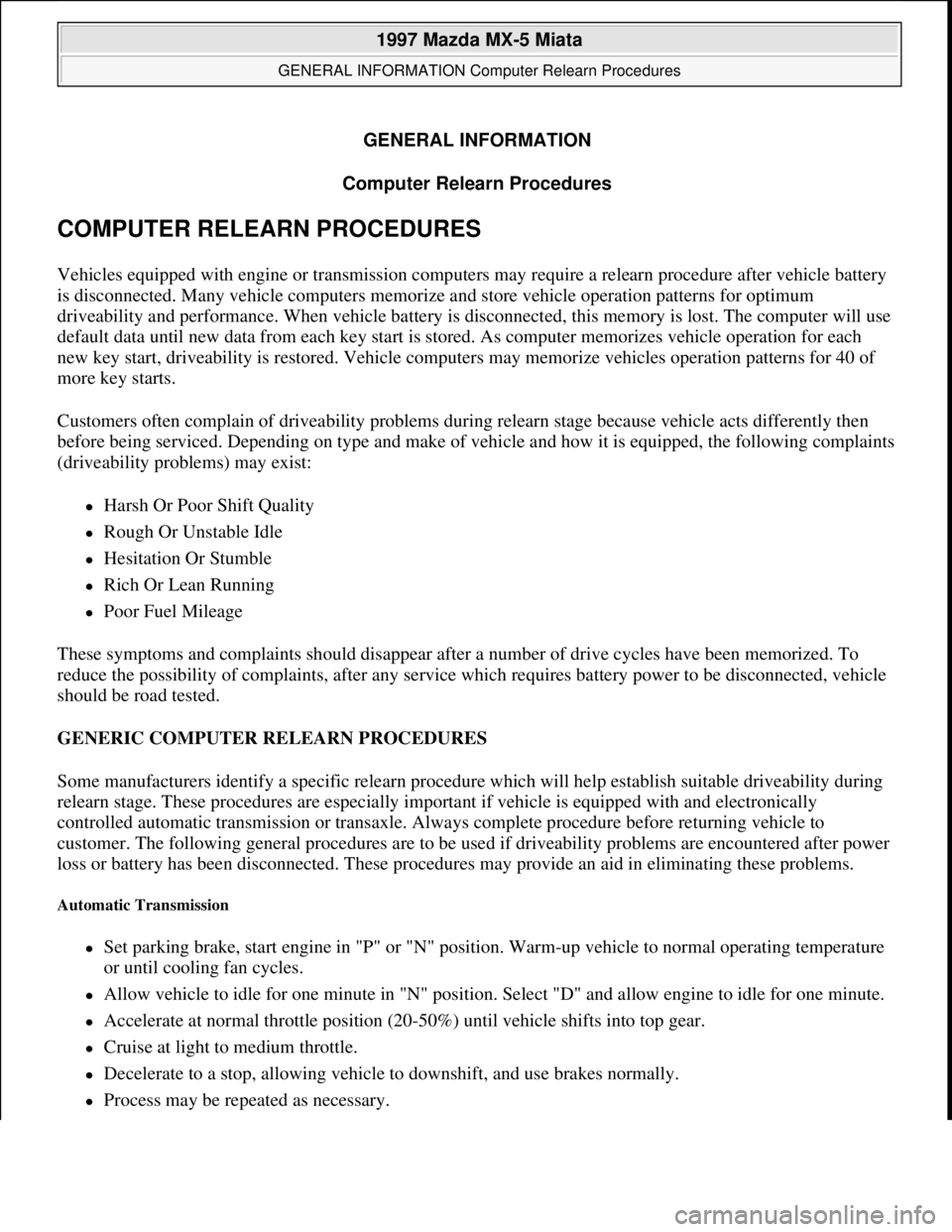
COMPUTER RELEARN PROCEDURES
Vehicles equipped with engine or transmission computers may require a relearn procedure after vehicle battery
is disconnected. Many vehicle computers memorize and store vehicle operation patterns for optimum
driveability and performance. When vehicle battery is disconnected, this memory is lost. The computer will use
default data until new data from each key start is stored. As computer memorizes vehicle operation for each
new key start, driveability is restored. Vehicle computers may memorize vehicles operation patterns for 40 of
more key starts.
Customers often complain of driveability problems during relearn stage because vehicle acts differently then
before being serviced. Depending on type and make of vehicle and how it is equipped, the following complaints
(driveability problems) may exist:
Harsh Or Poor Shift Quality
Rough Or Unstable Idle
Hesitation Or Stumble
Rich Or Lean Running
Poor Fuel Mileage
These symptoms and complaints should disappear after a number of drive cycles have been memorized. To
reduce the possibility of complaints, after any service which requires battery power to be disconnected, vehicle
should be road tested.
GENERIC COMPUTER RELEARN PROCEDURES
Some manufacturers identify a specific relearn procedure which will help establish suitable driveability during
relearn stage. These procedures are especially important if vehicle is equipped with and electronically
controlled automatic transmission or transaxle. Always complete procedure before returning vehicle to
customer. The following general procedures are to be used if driveability problems are encountered after power
loss or battery has been disconnected. These procedures may provide an aid in eliminating these problems.
Automatic Transmission
Set parking brake, start engine in "P" or "N" position. Warm-up vehicle to normal operating temperature
or until cooling fan cycles.
Allow vehicle to idle for one minute in "N" position. Select "D" and allow engine to idle for one minute.
Accelerate at normal throttle position (20-50%) until vehicle shifts into top gear.
Cruise at light to medium throttle.
Decelerate to a stop, allowing vehicle to downshift, and use brakes normally.
Process may be repeated as necessary.
1997 Mazda MX-5 Miata
GENERAL INFORMATION Computer Relearn Procedures
1997 Mazda MX-5 Miata
GENERAL INFORMATION Computer Relearn Procedures
Microsoft
Sunday, July 05, 2009 1:47:32 PMPage 1 © 2005 Mitchell Repair Information Company, LLC.
Microsoft
Sunday, July 05, 2009 1:47:35 PMPage 1 © 2005 Mitchell Repair Information Company, LLC.
Page 174 of 514
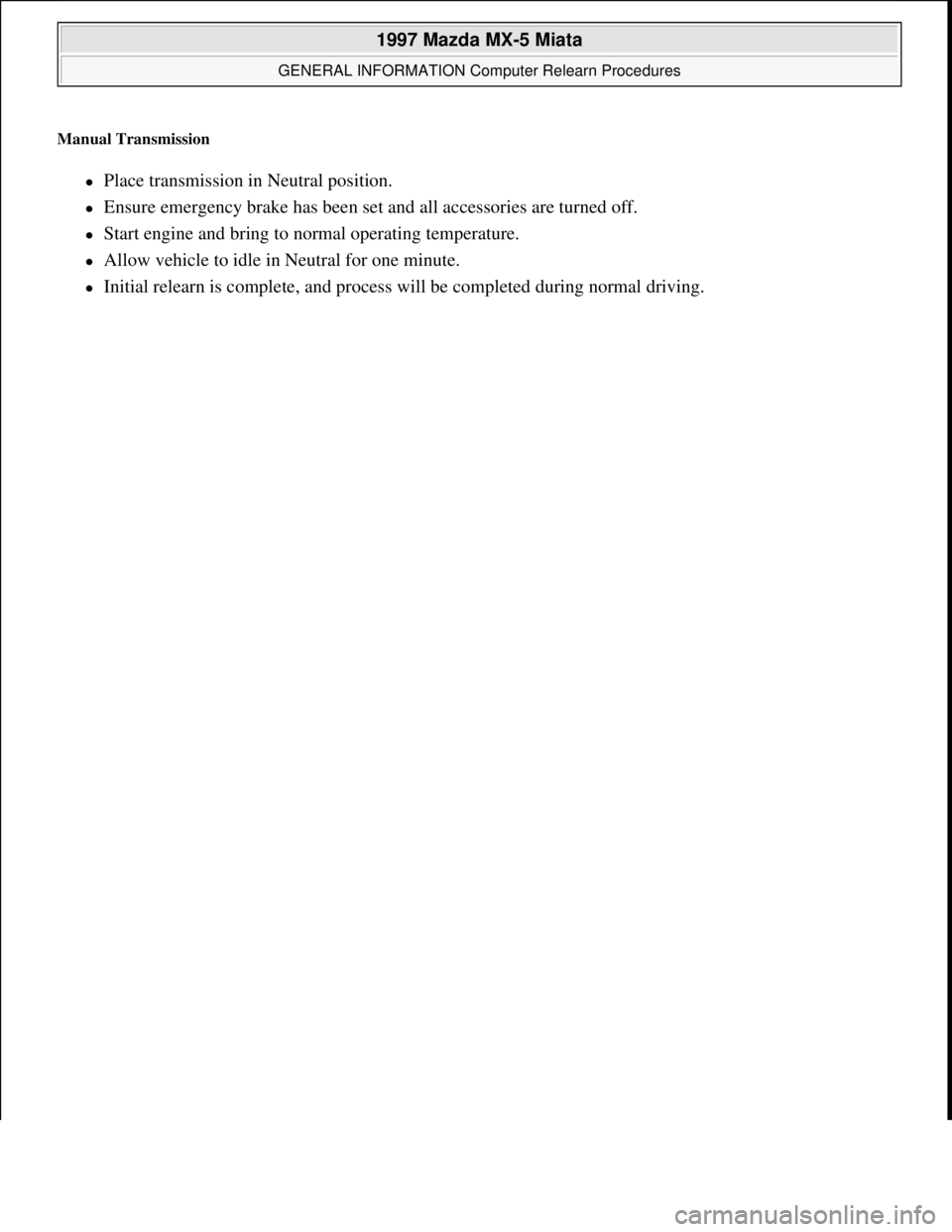
Manual Transmission
Place transmission in Neutral position.
Ensure emergency brake has been set and all accessories are turned off.
Start engine and bring to normal operating temperature.
Allow vehicle to idle in Neutral for one minute.
Initial relearn is complete, and process will be completed during normal driving.
1997 Mazda MX-5 Miata
GENERAL INFORMATION Computer Relearn Procedures
Microsoft
Sunday, July 05, 2009 1:47:32 PMPage 2 © 2005 Mitchell Repair Information Company, LLC.
Page 176 of 514
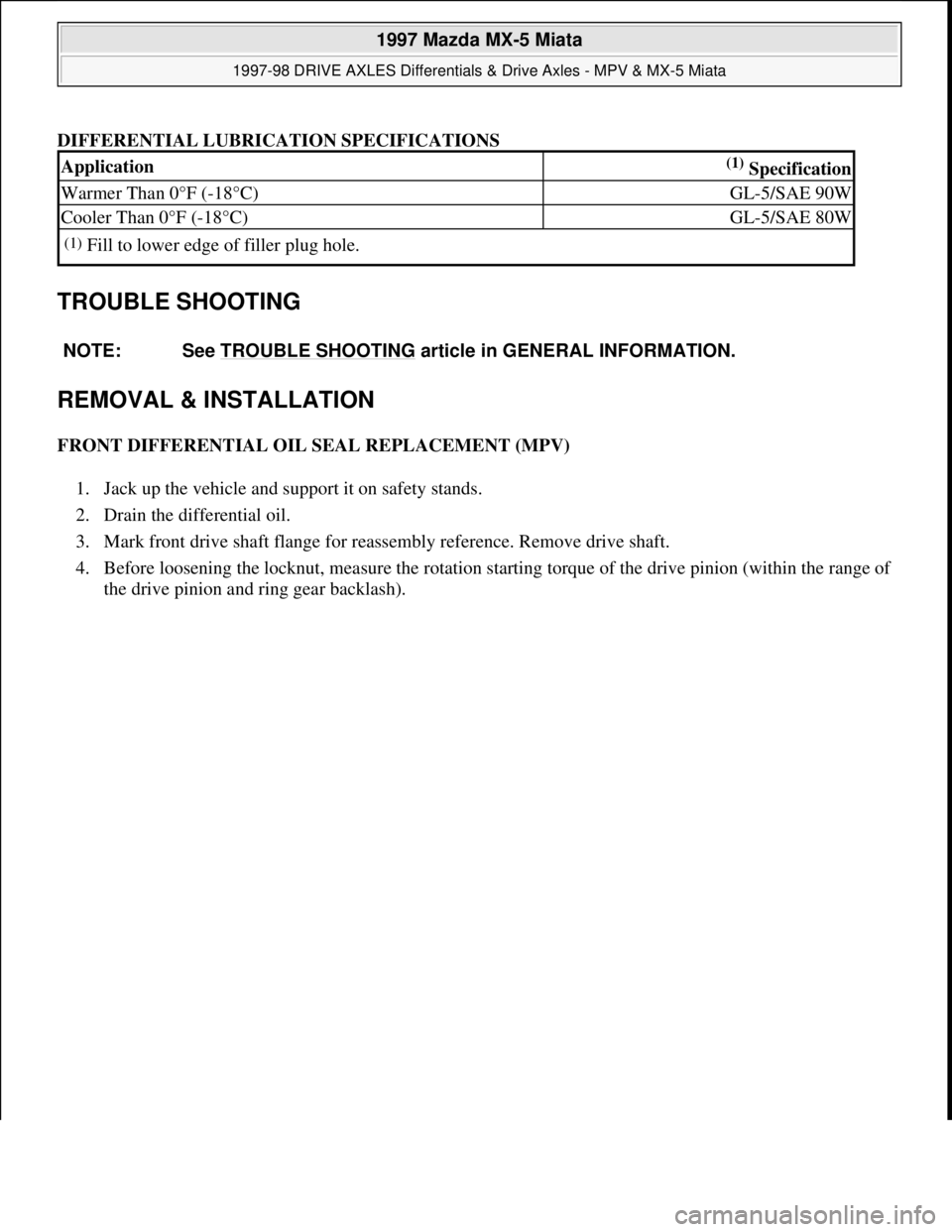
DIFFERENTIAL LUBRICATION SPECIFICATIONS
TROUBLE SHOOTING
REMOVAL & INSTALLATION
FRONT DIFFERENTIAL OIL SEAL REPLACEMENT (MPV)
1. Jack up the vehicle and support it on safety stands.
2. Drain the differential oil.
3. Mark front drive shaft flange for reassembly reference. Remove drive shaft.
4. Before loosening the locknut, measure the rotation starting torque of the drive pinion (within the range of
the drive pinion and rin
g gear backlash).
Application(1) Specification
Warmer Than 0°F (-18°C)GL-5/SAE 90W
Cooler Than 0°F (-18°C)GL-5/SAE 80W
(1)Fill to lower edge of filler plug hole.
NOTE: See TROUBLE SHOOTING
article in GENERAL INFORMATION.
1997 Mazda MX-5 Miata
1997-98 DRIVE AXLES Differentials & Drive Axles - MPV & MX-5 Miata
Microsoft
Sunday, July 05, 2009 1:52:42 PMPage 2 © 2005 Mitchell Repair Information Company, LLC.
Page 195 of 514
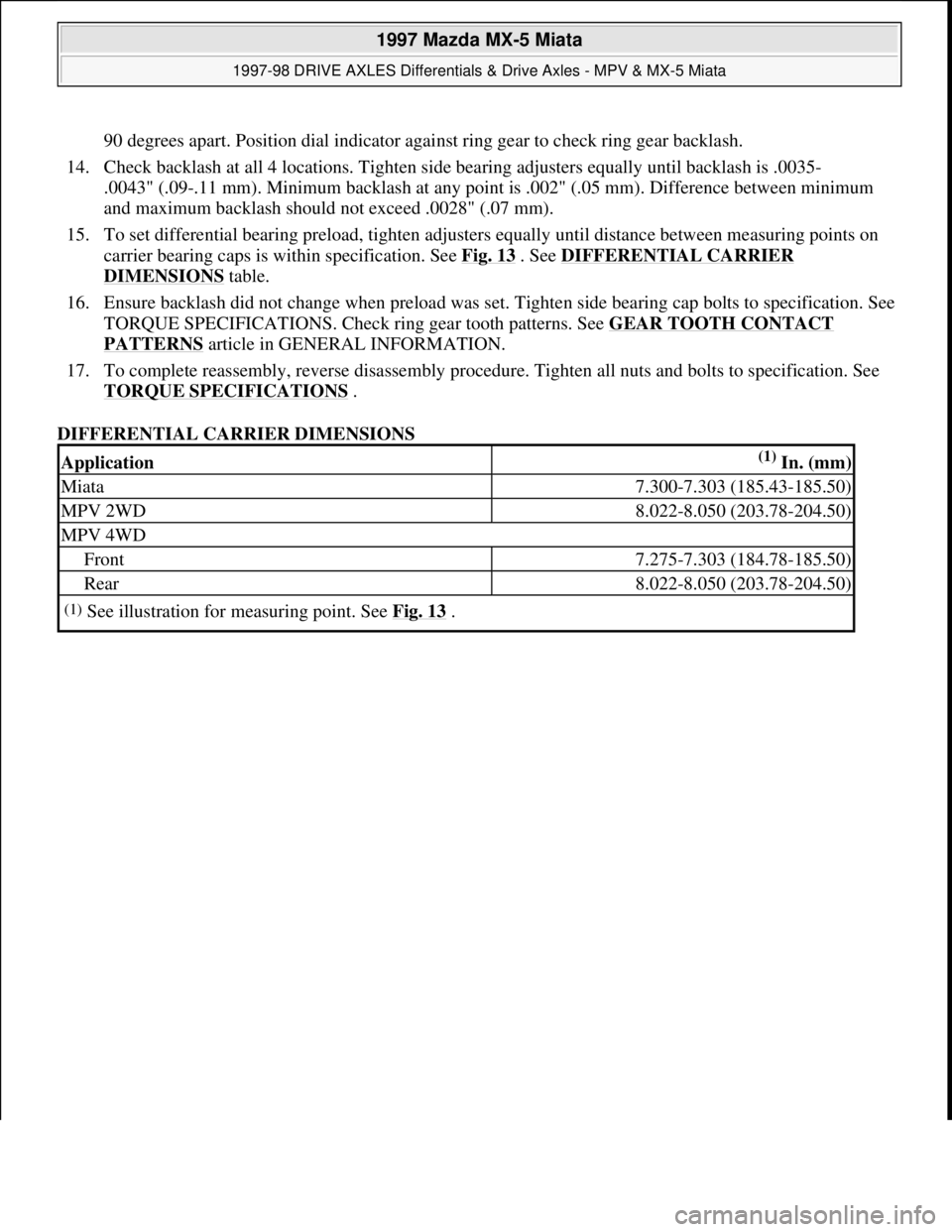
90 degrees apart. Position dial indicator against ring gear to check ring gear backlash.
14. Check backlash at all 4 locations. Tighten side bearing adjusters equally until backlash is .0035-
.0043" (.09-.11 mm). Minimum backlash at any point is .002" (.05 mm). Difference between minimum
and maximum backlash should not exceed .0028" (.07 mm).
15. To set differential bearing preload, tighten adjusters equally until distance between measuring points on
carrier bearing caps is within specification. See Fig. 13
. See DIFFERENTIAL CARRIER
DIMENSIONS table.
16. Ensure backlash did not change when preload was set. Tighten side bearing cap bolts to specification. See
TORQUE SPECIFICATIONS. Check ring gear tooth patterns. See GEAR TOOTH CONTACT
PATTERNS article in GENERAL INFORMATION.
17. To complete reassembly, reverse disassembly procedure. Tighten all nuts and bolts to specification. See
TORQUE SPECIFICATIONS
.
DIFFERENTIAL CARRIER DIMENSIONS
Application(1) In. (mm)
Miata7.300-7.303 (185.43-185.50)
MPV 2WD8.022-8.050 (203.78-204.50)
MPV 4WD
Front7.275-7.303 (184.78-185.50)
Rear8.022-8.050 (203.78-204.50)
(1)See illustration for measuring point. See Fig. 13 .
1997 Mazda MX-5 Miata
1997-98 DRIVE AXLES Differentials & Drive Axles - MPV & MX-5 Miata
Microsoft
Sunday, July 05, 2009 1:52:42 PMPage 21 © 2005 Mitchell Repair Information Company, LLC.
Page 207 of 514
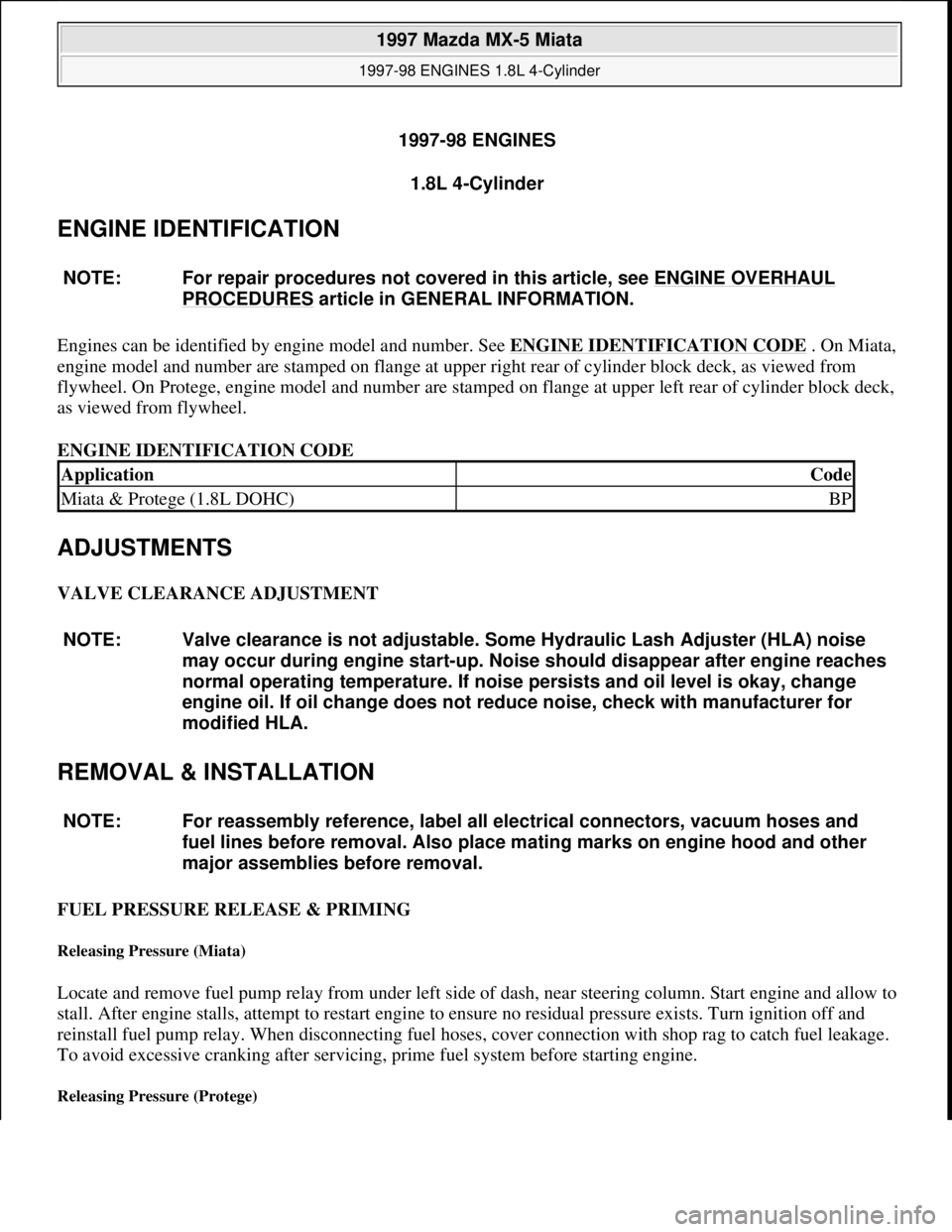
1997-98 ENGINES
1.8L 4-Cylinder
ENGINE IDENTIFICATION
Engines can be identified by engine model and number. See ENGINE IDENTIFICATION CODE. On Miata,
engine model and number are stamped on flange at upper right rear of cylinder block deck, as viewed from
flywheel. On Protege, engine model and number are stamped on flange at upper left rear of cylinder block deck,
as viewed from flywheel.
ENGINE IDENTIFICATION CODE
ADJUSTMENTS
VALVE CLEARANCE ADJUSTMENT
REMOVAL & INSTALLATION
FUEL PRESSURE RELEASE & PRIMING
Releasing Pressure (Miata)
Locate and remove fuel pump relay from under left side of dash, near steering column. Start engine and allow to
stall. After engine stalls, attempt to restart engine to ensure no residual pressure exists. Turn ignition off and
reinstall fuel pump relay. When disconnecting fuel hoses, cover connection with shop rag to catch fuel leakage.
To avoid excessive cranking after servicing, prime fuel system before starting engine.
Releasing Pressure (Protege)
NOTE: For repair procedures not covered in this article, see ENGINE OVERHAUL
PROCEDURES article in GENERAL INFORMATION.
ApplicationCode
Miata & Protege (1.8L DOHC)BP
NOTE: Valve clearance is not adjustable. Some Hydraulic Lash Adjuster (HLA) noise
may occur during engine start-up. Noise should disappear after engine reaches
normal operating temperature. If noise persists and oil level is okay, change
engine oil. If oil change does not reduce noise, check with manufacturer for
modified HLA.
NOTE: For reassembly reference, label all electrical connectors, vacuum hoses and
fuel lines before removal. Also place mating marks on engine hood and other
major assemblies before removal.
1997 Mazda MX-5 Miata
1997-98 ENGINES 1.8L 4-Cylinder
1997 Mazda MX-5 Miata
1997-98 ENGINES 1.8L 4-Cylinder
Microsoft
Sunday, July 05, 2009 1:55:15 PMPage 1 © 2005 Mitchell Repair Information Company, LLC.
Microsoft
Sunday, July 05, 2009 1:55:19 PMPage 1 © 2005 Mitchell Repair Information Company, LLC.