tires MAZDA MX5 MIATA 2016 User Guide
[x] Cancel search | Manufacturer: MAZDA, Model Year: 2016, Model line: MX5 MIATA, Model: MAZDA MX5 MIATA 2016Pages: 526, PDF Size: 10.44 MB
Page 171 of 526

4–67
When Driving
i-ACTIVSENSE
NOTE
The timing in which the system switches the headlights changes under the\
following
conditions. If the system does not switch the headlights appropriately, manually switch
between high and low beams according to the visibility as well as road and traffic
conditions.
When there are sources of light in the area such as street lamps, illuminated signboards,
and traffic signals. When there are reflective objects in the surrounding area such as reflective plates and
signs. When visibility is reduced under rain, snow and foggy conditions. When driving on roads with sharp turn or hilly terrain. When the headlights/rear lamps of vehicles in front of you or in the opposite lane are dim
or not illuminated. When there is sufficient darkness such as at dawn or dusk. When the luggage compartment is loaded with heavy objects. When visibility is reduced due to a vehicle in front of you spraying water from its tires
onto your windshield.
MX-5_8EU4-EA-15D_Edition3.indb 672015/10/21 16:53:27
Page 197 of 526
 monitors the air pressure of all\
four tires. If
the air")
4–93
When Driving
Tire Pressure Monitoring System
*Some models.
Tire Pressure Monitoring System*
The Tire Pressure Monitoring System (TPMS) monitors the air pressure of all\
four tires. If
the air pressure of one or more tires is too low, the system warns the driver by indicating the
tire pressure monitoring system warning light in the instrument cluster \
and operating a beep
sound. The system monitors the tire pressures indirectly using the data sent from the ABS
wheel speed sensors.
To allow the system to operate correctly, the system needs to be initialized with the specified
tire pressure (value on the tire pressure label). Follow the procedure\
and perform the
initialization.
Refer to Tire Pressure Monitoring System Initialization on page 4-96.
The warning light flashes when the system has a malfunction.
Refer to Warning Lights on page 4-16.
ABS wheel speed sensor
MX-5_8EU4-EA-15D_Edition3.indb 932015/10/21 16:53:40
Page 198 of 526

4–94
When Driving
Tire Pressure Monitoring System
CAUTION
Each tire, including the spare (if provided), should be checked monthly when cold and
inflated to the inflation pressure recommended by the vehicle manufacturer on the vehicle
placard or tire inflation pressure label. (If your vehicle has tires of a different size than the
size indicated on the vehicle placard or tire inflation pressure label, you should determine
the proper tire inflation pressure for those tires.)
As an added safety feature, your vehicle has been equipped with a tire pressure monitoring
system (TPMS) that illuminates a low tire pressure telltale when one or more of your tires
is significantly under-inflated. Accordingly, when the low tire pressure telltale illuminates,
you should stop and check your tires as soon as possible, and inflate them to the proper
pressure. Driving on a significantly under-inflated tire causes the tire to overheat and can
lead to tire failure. Under-inflation also reduces fuel efficiency and tire tread life, and may
affect the vehicle's handling and stopping ability.
Please note that the TPMS is not a substitute for proper tire maintenance, and it is the
driver's responsibility to maintain correct tire pressure, even if under-inflation has not
reached the level to trigger illumination of the TPMS low tire pressure telltale.
Your vehicle has also been equipped with a TPMS malfunction indicator to indicate when
the system is not operating properly.
The TPMS malfunction indicator is combined with the low tire pressure telltale. When the
system detects a malfunction, the telltale will flash for approximately one minute and then
remain continuously illuminated. This sequence will continue upon subsequent vehicle
start-ups as long as the malfunction exists. When the malfunction indicator is illuminated,
the system may not be able to detect or signal low tire pressure as intended. TPMS
malfunctions may occur for a variety of reasons, including the installation of replacement
or alternate tires or wheels on the vehicle that prevent the TPMS from functioning properly.
Always check the TPMS malfunction telltale after replacing one or more tires or wheels on
your vehicle to ensure that the replacement or alternate tires and wheels allow the TPMS to
continue to function properly.
To avoid false readings, the system samples for a little while before indicating a problem. As
a result it will not instantaneously register a rapid tire deflation or blow out.
MX-5_8EU4-EA-15D_Edition3.indb 942015/10/21 16:53:40
Page 199 of 526
4–95
When Driving
Tire Pressure Monitoring System
NOTE
Because this system detects slight changes in tire conditions, the timing of the warning may
be faster or slower in the following cases:
The size, manufacturer, or the type of tires is different from the specification. The size, manufacturer, or the type of a tire is differ ent from the others, or the level of tire
wear is excessively different between them. A run-flat tire, studless tire, snow tire, or tire chains are used. An emergency tire is used (The tire pressure monitoring system warning light may flash
and then continue illuminating). A tire is repaired using the emergency flat tire repair kit. The tire pressure is excessively higher than the specified pressure, or the tire pressure is
suddenly lowered for some reason such as a tire burst during driving. The vehicle speed is lower than about 15 km/h (9.3 mph) (including wh\
en the vehicle is
stopped), or the drive period is shorter than 5 minutes. The vehicle is driven on an extremely rough road or a slippery , icy road. Hard steering and rapid acceleration/deceleration are repeated such as during aggressive
driving on a winding road. Load on the vehicle is applied to a tire such as by loading heavy luggage to one side of
the vehicle. System initialization has not been implemented with the specified tire pressur e.
MX-5_8EU4-EA-15D_Edition3.indb 952015/10/21 16:53:40
Page 200 of 526
4–96
When Driving
Tire Pressure Monitoring System
Tire Pressure Monitoring System
Initialization
In the following cases, system
initialization must be performed so that the
system operates normally.
A tire pressure is adjusted. Tire rotation is performed. A tire or wheel is replaced. The battery is replaced or completely
drained. The tire pressure monitoring system
warning light is illuminated.
Initialization method
1. Park the car in a safe place and firmly
apply the parking brake.
2. Let the tires cool, then adjust the tire
pressure of all four (4) tires to the
specified pressure indicated on the tire
pressure label located on the driver's
door frame (door open).
Refer to Tires on page 9-8.
3. Switch the ignition ON.
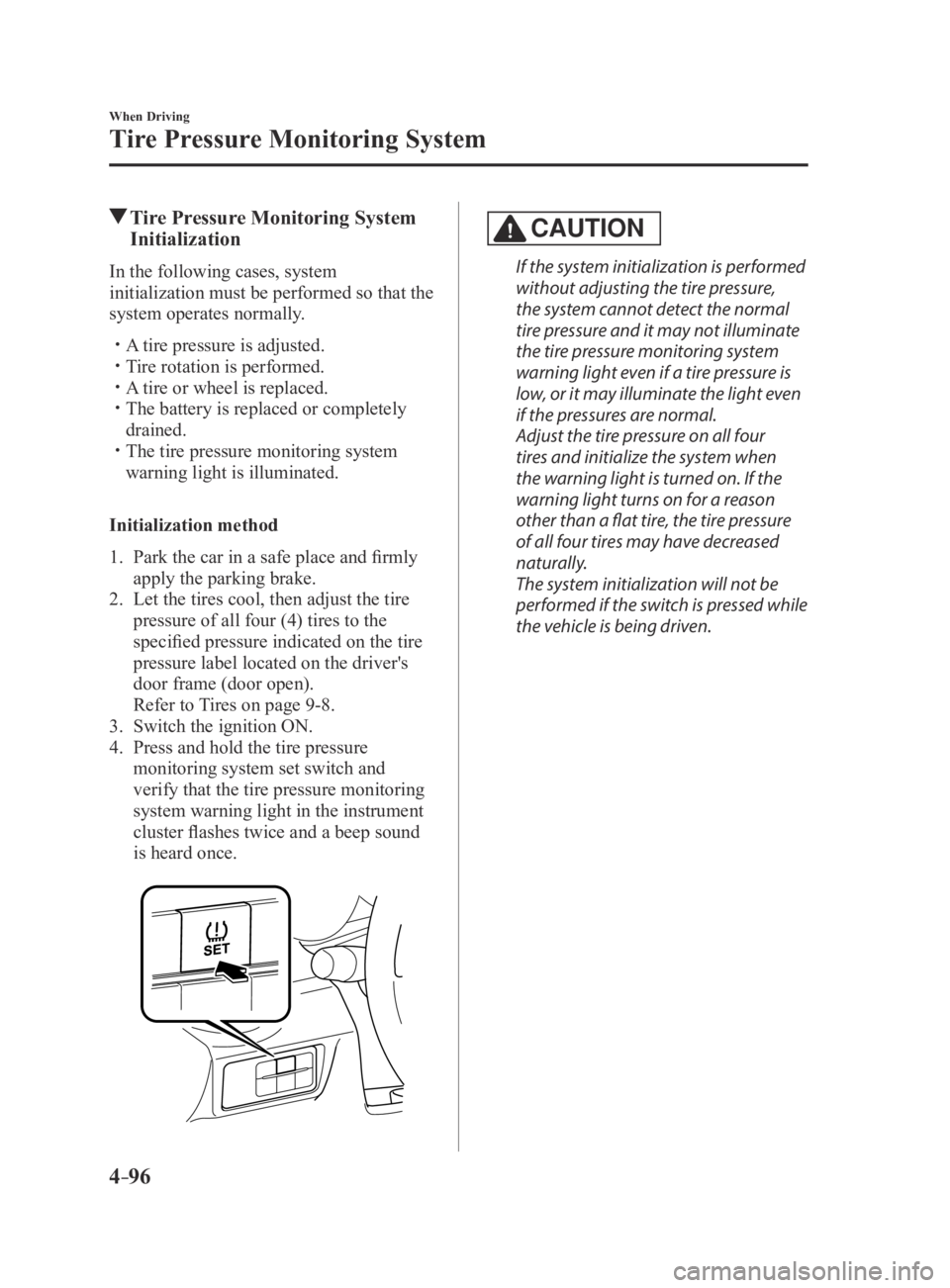
4. Press and hold the tire pressure
monitoring system set switch and
verify that the tire pressure monitoring
system warning light in the instrument
cluster flashes twice and a beep sound
is heard once.
CAUTION
If the system initialization is performed
without adjusting the tire pressure,
the system cannot detect the normal
tire pressure and it may not illuminate
the tire pressure monitoring system
warning light even if a tire pressure is
low, or it may illuminate the light even
if the pressures are normal.
Adjust the tire pressure on all four
tires and initialize the system when
the warning light is turned on. If the
warning light turns on for a reason
other than a flat tire, the tire pressure
of all four tires may have decreased
naturally.
The system initialization will not be
performed if the switch is pressed while
the vehicle is being driven.
MX-5_8EU4-EA-15D_Edition4.indb 962016/01/20 11:05:24
Page 339 of 526

6–1
6Maintenance and Care
How to keep your Mazda in top condition.
Essential Information
........................................................................\
6-2
Introduction
........................................................................\
...........6-2
Scheduled Maintenance
.....................................................................6-4
Scheduled Maintenance (U.S.A., Canada, and Puerto Rico)
........6-4
Scheduled Maintenance (Mexico)
..............................................6-13
Maintenance Monitor
..................................................................6-20
Owner Maintenance
........................................................................\
.6-22
Owner Maintenance Precautions
................................................6-22
Hood
........................................................................\
....................6-24
Engine Compartment Overview
.................................................6-26
Engine Oil
........................................................................\
...........6-27
Engine Coolant
........................................................................\
....6-29
Brake/Clutch Fluid
......................................................................6-31
Washer Fluid
........................................................................\
.......6-31
Body Lubrication
........................................................................\
6-32
Wiper Blades
........................................................................\
.......6-33
Battery
........................................................................\
.................6-36
Key Battery Replacement
...........................................................6-38
Tires ........................................................................\
..................... 6-41
Light Bulbs
........................................................................\
..........6-45
Fuses
........................................................................\
...................6-54
Appearance Care ........................................................................\
...... 6-59
Exterior Care
........................................................................\
.......6-59
Interior Care
........................................................................\
........6-66
MX-5_8EU4-EA-15D_Edition3.indb 12015/10/21 16:55:03
Page 346 of 526

6–8
Maintenance and Care
Scheduled Maintenance
Remarks:
*1 Use of FL-22 is recommended when replacing engine coolant. Using engine \
coolant other than FL-22 may cause serious damage to the engine and cooling system.*2 According to state/provincial and federal regulations, failure to perfor\
m maintenance on these items will not void your emissions warranties. However, Mazda recommends that all maintenance services be performed at the
recommended time or mileage/kilometer period to ensure long-term reliabi\
lity.
*3 To equalize tread wear for maintaining good performance in handling and b\
raking, rotate the tires every 12,000 km (7,500 miles). However Mazda recommends to rotate every 8,000 km (\
5,000 miles) to help increase tire life
and distribute wear more evenly.
*4 The Tire Pressure Monitoring System (TPMS) initialization must be performed\
so that the system operates normally (if equipped).*5 If this component has been submerged in water, the oil should be replaced.*6 Check the tire repair fluid expiration date every year when performing the periodic maintenance. Replace the tire repair fluid bottle with new one before the expiration date.
MX-5_8EU4-EA-15D_Edition3.indb 82015/10/21 16:55:03
Page 359 of 526
6–21
Maintenance and Care
Scheduled Maintenance
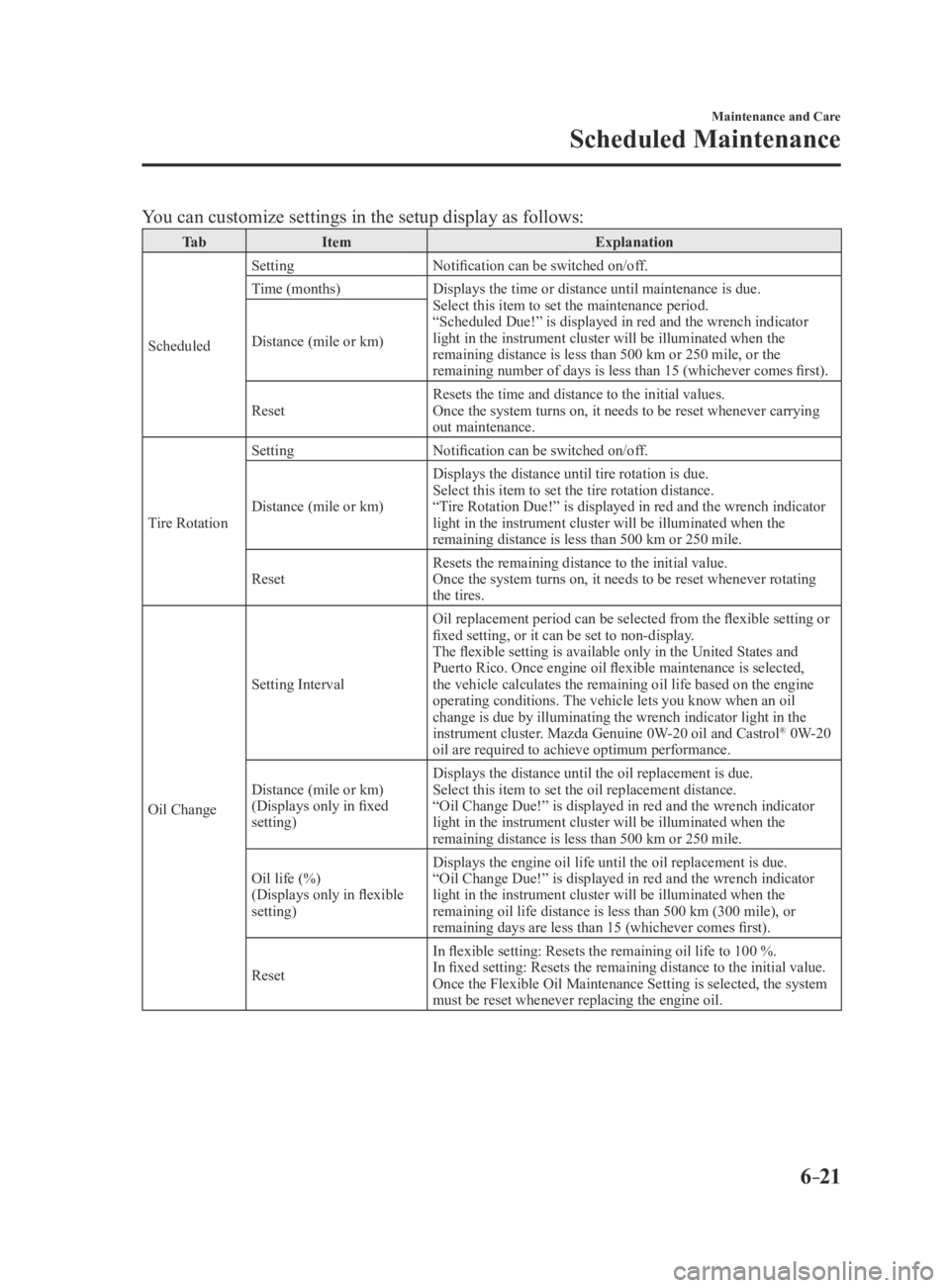
You can customize settings in the setup display as follows:
Ta bItem Explanation
Scheduled Setting
Notification can be switched on/off.
Time (months) Displays the time or distance until maintenance is due.
Select this item to set the maintenance period.
“Scheduled Due!” is displayed in red and the wrench indicator
light in the instrument cluster will be illuminated when the
remaining distance is less than 500 km or 250 mile, or the
remaining number of days is less than 15 (whichever comes first).
Distance (mile or km)
Reset
Resets the time and distance to the initial values.
Once the system turns on, it needs to be reset whenever carrying
out maintenance.
Tire Rotation Setting
Notification can be switched on/off.
Distance (mile or km) Displays the distance until tire rotation is due.
Select this item to set the tire rotation distance.
“Tire Rotation Due!” is displayed in red and the wrench indicator
light in the instrument cluster will be illuminated when the
remaining distance is less than 500 km or 250 mile.
Reset Resets the remaining distance to the initial value.
Once the system turns on, it needs to be reset whenever rotating
the tires.
Oil Change Setting Interval
Oil replacement period can be selected from the flexible setting or
fixed setting, or it can be set to non-display.
The flexible setting is available only in the United States and
Puerto Rico. Once engine oil flexible maintenance is selected,
the vehicle calculates the remaining oil life based on the engine
operating conditions. The vehicle lets you know when an oil
change is due by illuminating the wrench indicator light in the
instrument cluster. Mazda Genuine 0W-20 oil and Castrol
® 0W-20
oil are required to achieve optimum performance.
Distance (mile or km)
(Displays only in fixed
setting) Displays the distance until the oil replacement is due.
Select this item to set the oil replacement distance.
“Oil Change Due!” is displayed in red and the wrench indicator
light in the instrument cluster will be illuminated when the
remaining distance is less than 500 km or 250 mile.
Oil life (%)
(Displays only in flexible
setting) Displays the engine oil life until the oil replacement is due.
“Oil Change Due!” is displayed in red and the wrench indicator
light in the instrument cluster will be illuminated when the
remaining oil life distance is less than 500 km (300 mile), or
remaining days are less than 15 (whichever comes first).
Reset In flexible setting: Resets the remaining oil life to 100 %.
In fixed setting: Resets the remaining distance to the initial value.
Once the Flexible Oil Maintenance Setting is selected, the system
must be reset whenever replacing the engine oil.
MX-5_8EU4-EA-15D_Edition3.indb 212015/10/21 16:55:07
Page 379 of 526
6–41
Maintenance and Care
Owner Maintenance
Tires
For reasons of proper performance, safety,
and better fuel economy, always maintain
recommended tire inflation pressures and
stay within the recommended load limits
and weight distribution.
WARNING
Using Different Tire Types:
Driving your vehicle with different
types of tires is dangerous. It could
cause poor handling and poor braking;
leading to loss of control.
Except for the limited use of the
temporary spare tire, use only the
same type tires (radial, bias-belted,
bias-type) on all four wheels.
Using Wrong-Sized Tires: Using any other tire size than what is
specified for the vehicle (page 9-8)
is dangerous. It could seriously affect
ride, handling, ground clearance,
tire clearance, and speedometer
calibration. This could cause you to
have an accident. Use only tires that
are the correct size specified for the
vehicle.
Tire Inflation Pressure
WARNING
Always inflate the tires to the correct
pressure:Overinflation or underinflation of tires
is dangerous. Adverse handling or
unexpected tire failure could result in a
serious accident.
Refer to Tires on page 9-8.
Use only a Mazda-genuine tire valve
cap: Use of a non-genuine part is
dangerous as the correct tire air
pressure cannot be maintained if the
tire valve becomes damaged. If the
vehicle is driven under this condition,
the tire air pressure will decrease which
could result in a serious accident. Do
not use any part for the tire valve cap
that is not a Mazda-genuine part.
Inspect all tire pressures monthly when
the tires are cold. Maintain recommended
pressures for the best ride, handling, and
minimum tire wear.
Refer to the specification charts (page
9-8).
(With tire pressure monitoring system)
After adjusting the tire pressure,
initialization of the tire pressure
monitoring system is necessary to make
the system operate normally.
Refer to Tire Pressure Monitoring System
Initialization on page 4-96.
NOTE
Always check tire pressure when tir es
are cold. Warm tires normally exceed
recommended pressures. Do not release
air from warm tires to adjust the
pressure.
MX-5_8EU4-EA-15D_Edition3.indb 412015/10/21 16:55:19
Page 380 of 526

6–42
Maintenance and Care
Owner Maintenance
Underinflation can cause reduced fuel
economy, uneven and accelerated tire
wear, and poor sealing of the tire bead,
which will deform the wheel and cause
separation of tire from rim.
Overinflation can produce a harsh ride,
uneven and accelerated tire wear, and a
greater possibility of damage from road
hazards.
Keep your tire pressure at the correct
levels. If one frequently needs inflating,
have it inspected.
Tire Rotation
WARNING
Rotate tires periodically:
Irregular tire wear is dangerous. To
equalize tread wear for maintaining
good performance in handling and
braking, rotate the tires every 12,000
km (7,500 miles). However Mazda
recommends to rotate every 8,000 km
(5,000 miles) to help increase tire life
and distribute wear more evenly.
Refer to Scheduled Maintenance on
page 6-4.
During rotation, inspect them for correct
balance.
Do not include (TEMPORARY USE ONLY) spare tire in rotation.
Forward
Also, inspect them for uneven wear and
damage. Abnormal wear is usually caused
by one or a combination of the following:
Incorrect tire pressure Improper wheel alignment Out-of-balance wheel Severe braking
After rotation, inflate all tire pressures to
specification (page 9-8) and inspect the
lug nuts for tightness.
(With tire pressure monitoring system)
After adjusting the tire pressure,
initialization of the tire pressure
monitoring system is necessary to make
the system operate normally.
Refer to Tire Pressure Monitoring System
Initialization on page 4-96.
CAUTION
Rotate unidirectional tires and radial
tires that have an asymmetrical tread
pattern or studs only from front to rear,
not from side to side. Tire performance
will be reduced if rotated from side to
side.
(With limited-slip differential)
Don't use the following:
Tires not of the designated size Tires of different sizes or types at
the same time Tires not sufficiently inflated
If these instructions aren't followed,
the rotation of the left and right wheels
will be different and will thus apply
a constant load on the limited-slip
differential.
This will cause a malfunction.
MX-5_8EU4-EA-15D_Edition3.indb 422015/10/21 16:55:20