tires MAZDA MX5 MIATA 2016 Owner's Manual
[x] Cancel search | Manufacturer: MAZDA, Model Year: 2016, Model line: MX5 MIATA, Model: MAZDA MX5 MIATA 2016Pages: 526, PDF Size: 10.44 MB
Page 381 of 526

6–43
Maintenance and Care
Owner Maintenance
*Some models.
Replacing a Tire
WARNING
Always use tires that are in good
condition:Driving with worn tires is dangerous.
Reduced braking, steering, and
traction could result in an accident.
Replace all four tires at the same time: Replacing just one tire is dangerous. It
could cause poor handling and poor
braking resulting in loss of vehicle
control. Mazda strongly recommends
that you replace all four tires at the
same time.
If a tire wears evenly, a wear indicator will
appear as a solid band across the tread.
Replace the tire when this happens.
New tread Tread wear indicator
Worn tread
You should replace the tire before the band
crosses the entire tread.
(With tire pressure monitoring system)
After adjusting the tire pressure,
initialization of the tire pressure
monitoring system is necessary to make
the system operate normally.
Refer to Tire Pressure Monitoring System
Initialization on page 4-96.
NOTE
Tires degrade over time, even when
they are not being used on the road. It
is recommended that tires generally be
replaced when they are 6 years or older.
Heat caused by hot climates or frequent
high loading conditions can accelerate the
aging process. The period in which the tire
was manufactured (both week and year) is
indicated by a 4-digit number.
Refer to Tire Labeling on page 8-24.
Replacing a Wheel
WARNING
Always use wheels of the correct size on
your vehicle:
Using a wrong-sized wheel is
dangerous. Braking and handling
could be affected, leading to loss of
control and an accident.
CAUTION
A wrong-sized wheel may adversely
affect:
Tire fit Wheel and bearing life Ground clearance Snow-chain clearance Speedometer calibration Headlight aim Bumper height Tire Pressure Monitoring System*
MX-5_8EU4-EA-15D_Edition3.indb 432015/10/21 16:55:20
Page 382 of 526
6–44
Maintenance and Care
Owner Maintenance
NOTE
When replacing a wheel, make sure
the new one is the same as the original
factory wheel in diameter, rim width,
and offset (inset/outset).
For details, contact an Authorized
Mazda Dealer.
Proper tire balancing provides the best
riding comfort and helps reduce tread
wear. Out-of-balance tires can cause
vibration and uneven wear, such as
cupping and flat spots.
MX-5_8EU4-EA-15D_Edition3.indb 442015/10/21 16:55:20
Page 398 of 526
6–60
Maintenance and Care
Appearance Care
Water Marks
Occurrence
Rain, fog, dew, and even tap water can
contain harmful minerals such as salt and
lime. If moisture containing these minerals
settles on the vehicle and evaporates, the
minerals will concentrate and harden to
form white rings. The rings can damage
your vehicle's finish.
Prevention
It is necessary to wash and wax your
vehicle to preserve its finish according to
the instructions in this section. These steps
should be taken immediately after you find
water marks on your vehicle's finish.
Paint Chipping
Occurrence
Paint chipping occurs when gravel thrown
in the air by another vehicle's tires hits
your vehicle.
How to avoid paint chipping
Keeping a safe distance between you and
the vehicle ahead reduces the chances
of having your paint chipped by flying
gravel.NOTE
The paint chipping zone varies with the
speed of the vehicle. For example, when
traveling at 90 km/h (56 mph), the paint
chipping zone is 50 m (164 ft).
In low temperatures a vehicle's finish
hardens. This increases the chance of
paint chipping.
Chipped paint can lead to rust forming
on your Mazda. Before this happens,
repair the damage by using Mazda
touch-up paint according to the
instructions in this section. Failure to
repair the affected area could lead to
serious rusting and expensive repairs.
Follow all label and container directions
when using a chemical cleaner or polish.
Read all warnings and cautions.
MX-5_8EU4-EA-15D_Edition3.indb 602015/10/21 16:55:31
Page 427 of 526

7–19
If Trouble Arises
Flat Tire
*Some models.
WARNING
Do not jack up the vehicle higher than is
necessary:Jacking up the vehicle higher than
is necessary is dangerous as it could
destabilize the vehicle resulting in an
accident.
Do not start the engine or shake the
vehicle while it is jacked up: Starting the engine or shaking
the vehicle while it is jacked up is
dangerous as it could cause the vehicle
to fall off the jack resulting in an
accident.
Never go under the vehicle while it is
jacked up: Going under the vehicle while it is
jacked up is dangerous as it could
result in death or serious injury if the
vehicle were to fall off the jack.
8. Remove the lug nuts by turning them
counterclockwise; then remove the
wheel.
Locking Lug Nuts*
If your vehicle has Mazda optional
antitheft wheel lug nuts, one on each
wheel will lock the tires and you must
use a special key to unlock them. This
key will attach to the lug wrench.
Register them with the lock manufacturer
by filling out the card provided in the
glove compartment and mailing it in the
accompanying envelope. If you lose this
key, consult an Authorized Mazda Dealer
or use the lock manufacturer's order form,
which is with the registration card.
Accessory wheel locks cannot be used on
steel wheels. This includes situations when
the spare tire is installed. If the spare tire
is installed, one of the original lug nuts
(which should still be in the vehicle) must
be installed in place of the wheel lock.
Special ke y
Antitheft lug nut
To remove an antitheft lug nut
1. Obtain the special key for the antitheft
lug nut.
2. Place the special key on top of the
antitheft lug nut, and be sure to hold
the key square to it. If you hold the key
at an angle, you may damage both key
and nut. Do not use a power impact
wrench.
3. Place the lug wrench on top of the key
and apply pressure. Turn the wrench
counterclockwise.
MX-5_8EU4-EA-15D_Edition3.indb 192015/10/21 16:55:47
Page 428 of 526
7–20
If Trouble Arises
Flat Tire
To install the antitheft lug nut
1. Place the special key on top of the nut,
and be sure to hold the key square to
it. If you hold the key at an angle, you
may damage both key and nut. Do not
use a power impact wrench.
2. Place the lug wrench on top of the
special key, apply pressure, and turn it
clockwise.
Nut tightening torque
N·m (kgf·m, ft·lbf) 108—147
(12—14, 80—108)
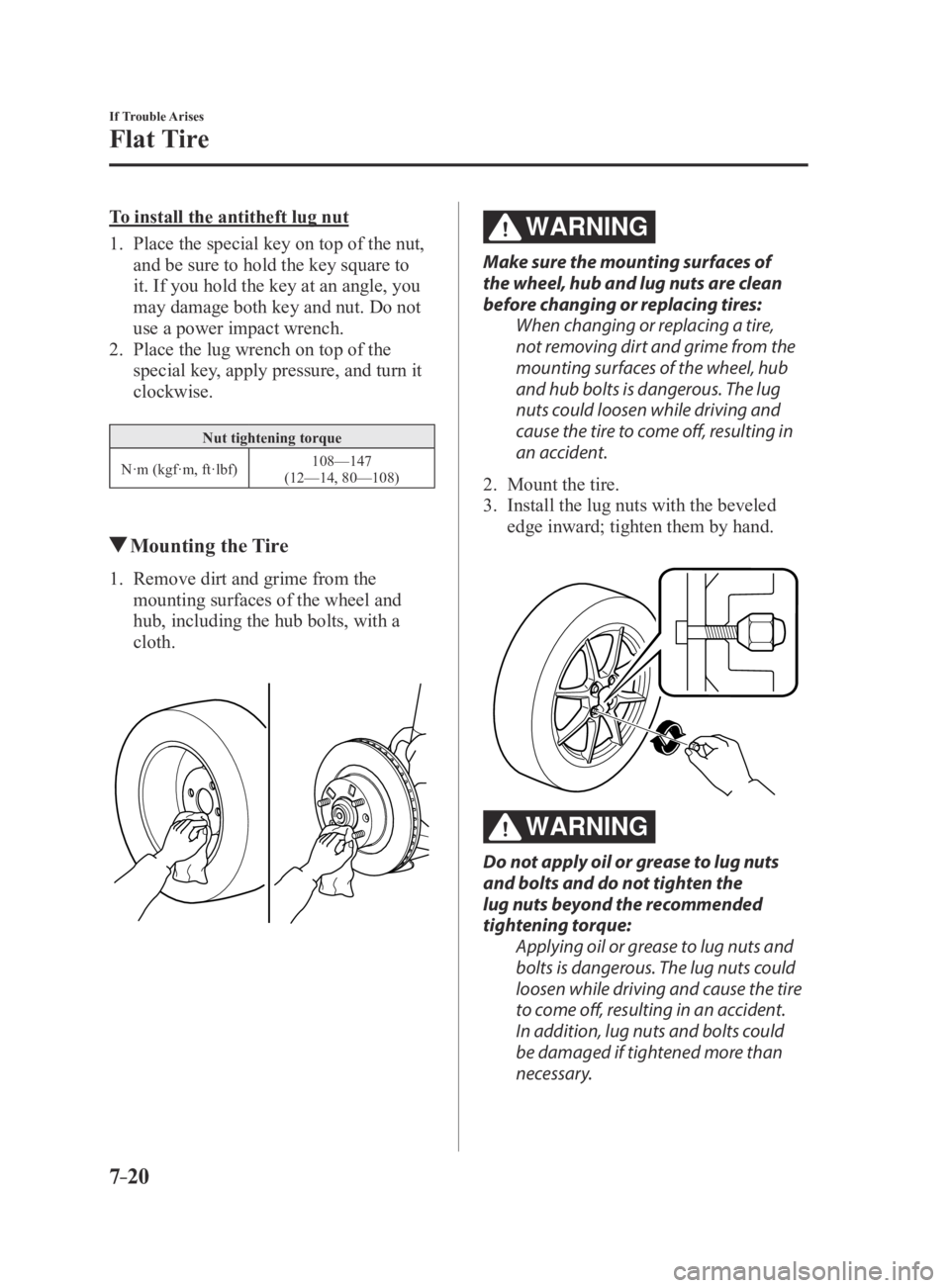
Mounting the Tire
1. Remove dirt and grime from the
mounting surfaces of the wheel and
hub, including the hub bolts, with a
cloth.
WARNING
Make sure the mounting surfaces of
the wheel, hub and lug nuts are clean
before changing or replacing tires:
When changing or replacing a tire,
not removing dirt and grime from the
mounting surfaces of the wheel, hub
and hub bolts is dangerous. The lug
nuts could loosen while driving and
cause the tire to come off, resulting in
an accident.
2. Mount the tire.
3. Install the lug nuts with the beveled
edge inward; tighten them by hand.
WARNING
Do not apply oil or grease to lug nuts
and bolts and do not tighten the
lug nuts beyond the recommended
tightening torque:Applying oil or grease to lug nuts and
bolts is dangerous. The lug nuts could
loosen while driving and cause the tire
to come off, resulting in an accident.
In addition, lug nuts and bolts could
be damaged if tightened more than
necessary.
MX-5_8EU4-EA-15D_Edition3.indb 202015/10/21 16:55:47
Page 429 of 526
7–21
If Trouble Arises
Flat Tire
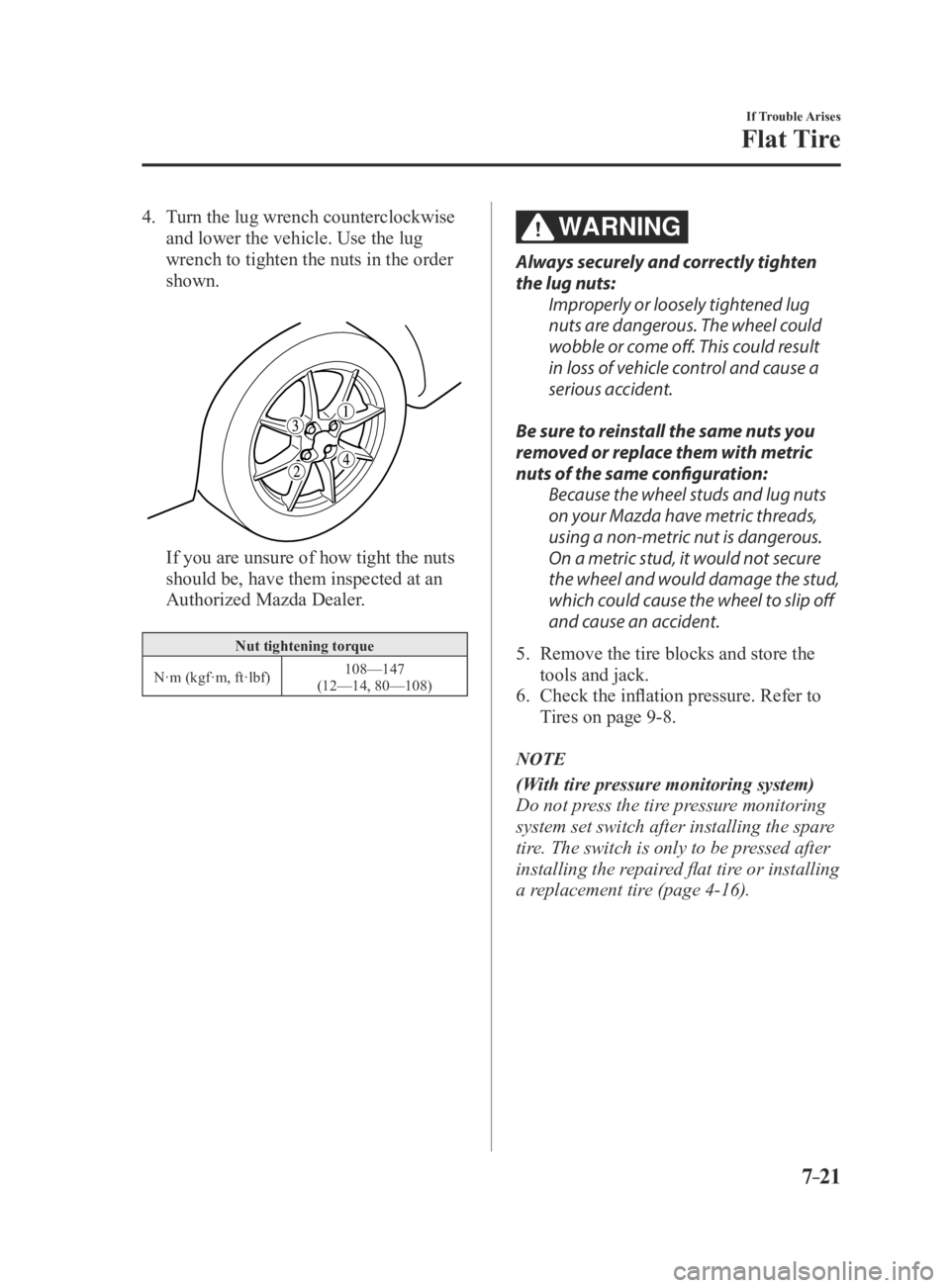
4. Turn the lug wrench counterclockwise
and lower the vehicle. Use the lug
wrench to tighten the nuts in the order
shown.
If you are unsure of how tight the nuts
should be, have them inspected at an
Authorized Mazda Dealer.
Nut tightening torque
N·m (kgf·m, ft·lbf) 108—147
(12—14, 80—108)
WARNING
Always securely and correctly tighten
the lug nuts:
Improperly or loosely tightened lug
nuts are dangerous. The wheel could
wobble or come off. This could result
in loss of vehicle control and cause a
serious accident.
Be sure to reinstall the same nuts you
removed or replace them with metric
nuts of the same configuration: Because the wheel studs and lug nuts
on your Mazda have metric threads,
using a non-metric nut is dangerous.
On a metric stud, it would not secure
the wheel and would damage the stud,
which could cause the wheel to slip off
and cause an accident.
5. Remove the tire blocks and store the
tools and jack.
6. Check the inflation pressure. Refer to
Tires on page 9-8.
NOTE
(With tire pressure monitoring system)
Do not press the tire pressure monitoring
system set switch after installing the spare
tire. The switch is only to be pressed after
installing the repaired flat tire or installing
a replacement tire (page 4-16).
MX-5_8EU4-EA-15D_Edition3.indb 212015/10/21 16:55:48
Page 430 of 526
7–22
If Trouble Arises
Flat Tire
WARNING
Do not drive with any tires that have
incorrect air pressure:Driving on tires with incorrect air
pressure is dangerous. Tires with
incorrect pressure could affect
handling and result in an accident.
When you check the regular tires' air
pressure, check the spare tire, too.
NOTE
To prevent the jack and tool from rattling,
store them properly.
MX-5_8EU4-EA-15D_Edition3.indb 222015/10/21 16:55:48
Page 446 of 526
7–38
If Trouble Arises
Warning/Indicator Lights and Warning Sounds
*Some models.
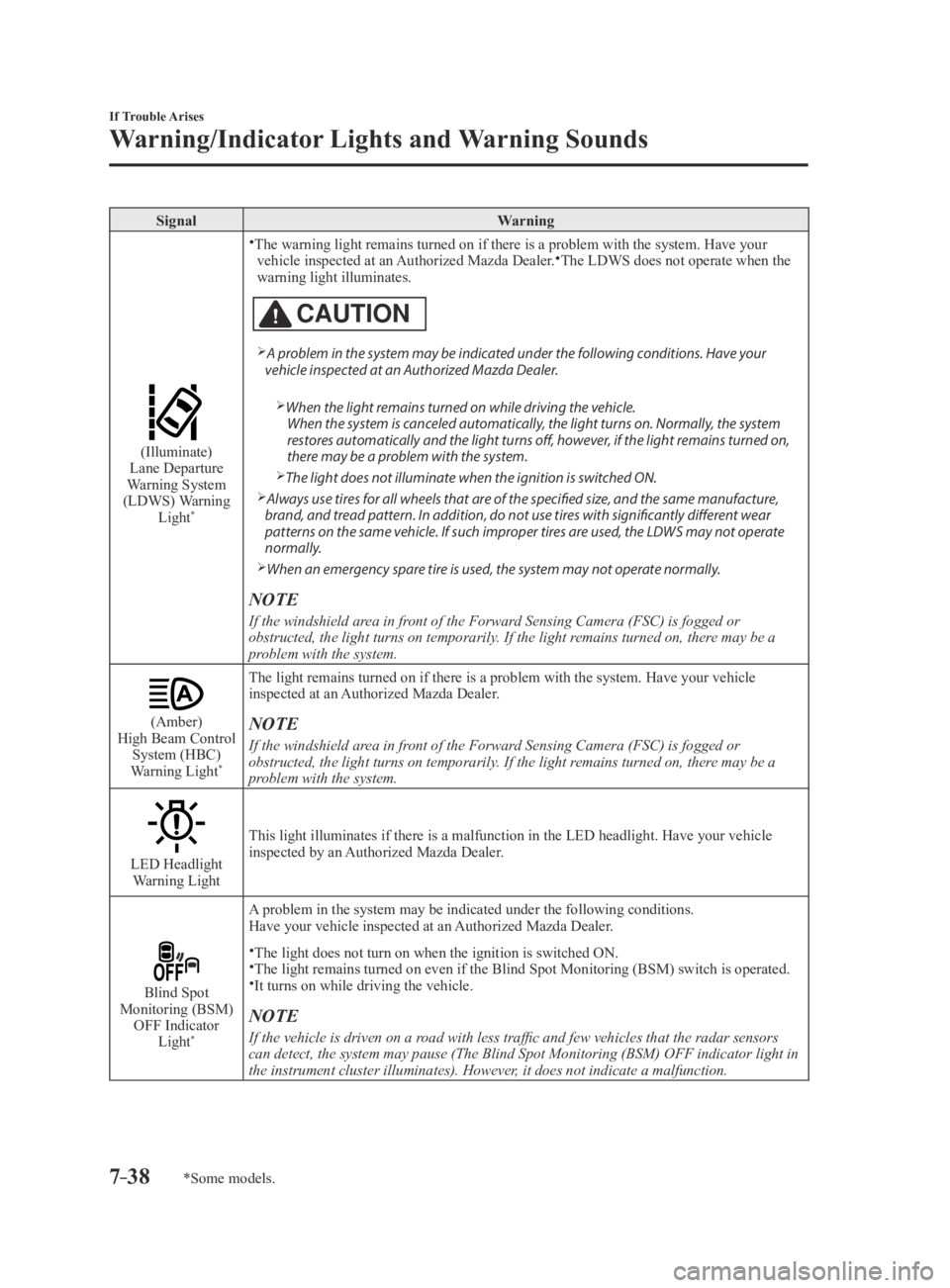
SignalWarning
(Illuminate)Lane Departure
Warning System
(LDWS) Warning Light
*
The warning light remains turned on if there is a problem with the syste\
m. Have your vehicle inspected at an Authorized Mazda Dealer.The LDWS does not operate when the
warning light illuminates.
CAUTION
A problem in the system may be indicated under the following conditions. Have your
vehicle inspected at an Authorized Mazda Dealer.
When the light remains turned on while driving the vehicle. When the system is canceled automatically, the light turns on. Normally, the system
restores automatically and the light turns off, however, if the light remains turned on,
there may be a problem with the system.
The light does not illuminate when the ignition is switched ON.Always use tires for all wheels that are of the specified size, and the same manufacture,
brand, and tread pattern. In addition, do not use tires with significantly different wear
patterns on the same vehicle. If such improper tires are used, the LDWS may not operate
normally.
When an emergency spare tire is used, the system may not operate normally.
NOTE
If the windshield area in front of the Forward Sensing Camera (FSC) is fogged or
obstructed, the light turns on temporarily. If the light remains turned on, there may be a
problem with the system.
(Amber)High Beam Control System (HBC)
Warning Light
*
The light remains turned on if there is a problem with the system. Have \
your vehicle
inspected at an Authorized Mazda Dealer.
NOTE
If the windshield area in front of the Forward Sensing Camera (FSC) is fogged or
obstructed, the light turns on temporarily. If the light remains turned on, there may be a
problem with the system.
LED Headlight Warning Light This light illuminates if there is a malfunction in the LED headlight. H\
ave your vehicle
inspected by an Authorized Mazda Dealer.
Blind Spot Monitoring (BSM)
OFF Indicator Light
*
A problem in the system may be indicated under the following conditions.
Have your vehicle inspected at an Authorized Mazda Dealer.
The light does not turn on when the ignition is switched ON.The light remains turned on even if the Blind Spot Monitoring (BSM) switch is operated.It turns on while driving the vehicle.
NOTE
If the vehicle is driven on a road with less traffic and few vehicles that the radar sensors
can detect, the system may pause (The Blind Spot Monitoring (BSM) OFF\
indicator light in
the instrument cluster illuminates). However, it does not indicate a malfunction.
MX-5_8EU4-EA-15D_Edition3.indb 382015/10/21 16:56:00
Page 449 of 526

7–41
If Trouble Arises
Warning/Indicator Lights and Warning Sounds
*Some models.
SignalWarning Action to be taken
Door-Ajar Warning LightThe light turns on if any door is not closed
securely.
Close the door securely.
Low Washer Fluid Level Warning
Light*
This warning light indicates that little
washer fluid remains. Add washer fluid (page 6-31).
(Illuminate)Tire Pressure
Monitoring System Warning Light
*
When the warning light illuminates, and
the warning beep sound is heard (about 3
seconds), tire pressure is too low in one or
more tires.
WARNING
If the tire pressure monitoring system warning light illuminates or flashes,
or the tire pressure warning beep
sound is heard, decrease vehicle
speed immediately and avoid sudden
maneuvering and braking: If the tire pressure monitoring system
warning light illuminates or flashes, or
the tire pressure warning beep sound
is heard, it is dangerous to drive the
vehicle at high speeds, or perform
sudden maneuvering or braking.
Vehicle drivability could worsen and
result in an accident.
To determine if you have a slow leak or
a flat, pull over to a safe position where
you can check the visual condition
of the tire and determine if you have
enough air to proceed to a place where
air may be added and the system
monitored again by an Authorized
Mazda Dealer or a tire repair station.
Do not ignore the TPMS Warning Light: Ignoring the TPMS warning light is
dangerous, even if you know why it is
illuminated. Have the problem taken
care of as soon as possible before it
develops into a more serious situation
that could lead to tire failure and a
dangerous accident. Inspect the tires and adjust to the specified
inflation pressure (page
6-41).
NOTE
Perform tire pressure adjustment when
the tires are cold. Tire pressure will vary
according to the tire temperature, therefore
let the vehicle stand for 1 hour or only
drive it 1.6 km (1 mile) or less before
adjusting the tire pressures. When pressure
is adjusted on hot tires to the cold inflation
pressure, the TPMS warning light/beep may
turn on after the tires cool and pressure
drops below specification.
Also, an illuminated TPMS warning
light, resulting from the tire air pressure
dropping due to cold ambient temperature
will remain illuminated even if the ambient
temperature rises. In this case, it will also
be necessary to adjust the tire air pressures.
If the TPMS warning light illuminates due
to a drop in tire air pressure, make sure to
check and adjust the tire air pressures.
Tires lose air naturally over time and the TPMS cannot tell if the tires are getting too
soft over time or you have a flat. However,
when you find one low tire in a set of four-
that is an indication of trouble; you should
have someone drive the vehicle slowly
forward so you can inspect any low tire for
cuts and any metal objects sticking through
tread or sidewall. Put a few drops of
water in the valve stem to see if it bubbles
indicating a bad valve. Leaks need to be
addressed by more than simply reinflating
the tire as leaks are dangerous — take it to
an Authorized Mazda Dealer.
MX-5_8EU4-EA-15D_Edition3.indb 412015/10/21 16:56:01
Page 480 of 526

8–22
Customer Information and Reporting Safety Defects
Uniform Tire Quality Grading System (UTQGS)
Uniform Tire Quality Grading System (UTQGS)
This information relates to the tire grading system developed by the U.S\
. National Highway
Traffic Safety Administration for grading tires by tread wear, traction, and temperature
performance.
Tread Wear
The tread wear grade is a comparative rating based on the wear rate of t\
he tire when tested
under controlled conditions on a specified government test course.
For example, a tire graded 150 would wear one-and-a-half times as well o\
n the government
course as a tire graded 100.
The relative performance of tires depends upon the actual conditions of \
their use, however,
and may depart significantly from the norm because of variations in driving habits, service
practices and differences in road characteristics and climate.
Traction-AA, A, B, C
The traction grades, from highest to lowest, are AA, A, B, and C. These grades represent the
tire's ability to stop on wet pavement as measured under controlled conditions on specified
government test surfaces of asphalt and concrete. A tire marked C may have poor traction
performance.
WARNING
The traction grade assigned to this tire is based on braking (straight ahead) traction tests
and does not include acceleration cornering (turning), hydroplaning, or peak traction
characteristics.
Temperature-A, B, C
The temperature grades A (the highest), B, and C, represent the tire's resistance to the
generation of heat and its ability to dissipate heat when tested under c\
ontrolled conditions on
a specified indoor laboratory test wheel.
Sustained high temperature can cause the material of the tire to degener\
ate and reduce tire
life, and excessive temperatures can lead to sudden tire failure.
Grade C corresponds to a level of performance which all passenger vehicle tires must meet
under the Federal Motor Vehicle Safety Standard No. 109. Grades B and A represent higher
levels of performance on the laboratory test wheel than the minimum requ\
ired by law.
MX-5_8EU4-EA-15D_Edition3.indb 222015/10/21 16:56:09