tire pressure MAZDA MX5 MIATA 2016 Owner's Manual
[x] Cancel search | Manufacturer: MAZDA, Model Year: 2016, Model line: MX5 MIATA, Model: MAZDA MX5 MIATA 2016Pages: 526, PDF Size: 10.44 MB
Page 357 of 526

6–19
Maintenance and Care
Scheduled Maintenance
Maintenance IntervalNumber of months or kilometers, whichever comes first
Months 394245485154576063666972
×1000 km 65707580859095
100 10511 011 5120
Emergency flat tire repair kit (if installed)*5Inspect annually.
Chart symbols:
I: Inspect: Inspect and clean, repair, adjust, fill up, or replace if necessary.
R: Replace
C: Clean
T: Tighten
L: Lubricate
D: Drain
Remarks:
*1 Use of FL-22 is recommended when replacing engine coolant. Using engine \
coolant other than FL-22 may cause serious damage to the engine and cooling system.*2 According to state/provincial and federal regulations, failure to perfor\
m maintenance on these items will not void your emissions warranties. However, Mazda recommends that all maintenance services be performed at the
recommended time or kilometer period to ensure long-term reliability.
*3 The Tire Pressure Monitoring System (TPMS) initialization must be performed\
so that the system operates normally (if equipped).*4 If this component has been submerged in water, the oil should be replaced.*5 Check the tire repair fluid expiration date every year when performing the periodic maintenance. Replace the tire repair fluid bottle with new one before the expiration date.
MX-5_8EU4-EA-15D_Edition3.indb 192015/10/21 16:55:06
Page 360 of 526
6–22
Maintenance and Care
Owner Maintenance
Owner Maintenance Precautions
The owner or a qualified service technician should make these vehicle inspections at the
indicated intervals to ensure safe and dependable operation.
Bring any problem to the attention of an Authorized Mazda Dealer or qualified service
technician as soon as possible.
When Refueling
Brake and clutch fluid level (page 6-31) Engine coolant level (page 6-29) Engine oil level (page 6-28) Washer fluid level (page 6-31)
At Least Monthly
Tire inflation pressures (page 6-41)
At Least Twice a Year (For Example, Every Spring and Fall)
You can do the following scheduled maintenance items if you have some mec\
hanical ability
and a few basic tools and if you closely follow the directions in this m\
anual.
Engine coolant (page 6-29) Engine oil (page 6-27)
Improper or incomplete service may result in problems. This section gives instructions only
for items that are easy to perform.
As explained in the Introduction (page 6-2), several procedures can be done only by a
qualified service technician with special tools.
Improper owner maintenance during the warranty period may affect warranty coverage.
Refer to Introduction (page 6-2) for owner's responsibility in protecting your investment.
For details, read the separate Mazda Warranty statement provided with the vehicle. If you
are unsure about any servicing or maintenance procedure, have it done by\
an Authorized
Mazda Dealer.
There are strict environmental laws regarding the disposal of waste oil and fluids. Please
dispose of your waste properly and with due regard to the environment.
We recommend that you entrust the oil and fluid changes of your vehicle to an Authorized
Mazda Dealer.
MX-5_8EU4-EA-15D_Edition3.indb 222015/10/21 16:55:07
Page 379 of 526
6–41
Maintenance and Care
Owner Maintenance
Tires
For reasons of proper performance, safety,
and better fuel economy, always maintain
recommended tire inflation pressures and
stay within the recommended load limits
and weight distribution.
WARNING
Using Different Tire Types:
Driving your vehicle with different
types of tires is dangerous. It could
cause poor handling and poor braking;
leading to loss of control.
Except for the limited use of the
temporary spare tire, use only the
same type tires (radial, bias-belted,
bias-type) on all four wheels.
Using Wrong-Sized Tires: Using any other tire size than what is
specified for the vehicle (page 9-8)
is dangerous. It could seriously affect
ride, handling, ground clearance,
tire clearance, and speedometer
calibration. This could cause you to
have an accident. Use only tires that
are the correct size specified for the
vehicle.
Tire Inflation Pressure
WARNING
Always inflate the tires to the correct
pressure:Overinflation or underinflation of tires
is dangerous. Adverse handling or
unexpected tire failure could result in a
serious accident.
Refer to Tires on page 9-8.
Use only a Mazda-genuine tire valve
cap: Use of a non-genuine part is
dangerous as the correct tire air
pressure cannot be maintained if the
tire valve becomes damaged. If the
vehicle is driven under this condition,
the tire air pressure will decrease which
could result in a serious accident. Do
not use any part for the tire valve cap
that is not a Mazda-genuine part.
Inspect all tire pressures monthly when
the tires are cold. Maintain recommended
pressures for the best ride, handling, and
minimum tire wear.
Refer to the specification charts (page
9-8).
(With tire pressure monitoring system)
After adjusting the tire pressure,
initialization of the tire pressure
monitoring system is necessary to make
the system operate normally.
Refer to Tire Pressure Monitoring System
Initialization on page 4-96.
NOTE
Always check tire pressure when tir es
are cold. Warm tires normally exceed
recommended pressures. Do not release
air from warm tires to adjust the
pressure.
MX-5_8EU4-EA-15D_Edition3.indb 412015/10/21 16:55:19
Page 380 of 526

6–42
Maintenance and Care
Owner Maintenance
Underinflation can cause reduced fuel
economy, uneven and accelerated tire
wear, and poor sealing of the tire bead,
which will deform the wheel and cause
separation of tire from rim.
Overinflation can produce a harsh ride,
uneven and accelerated tire wear, and a
greater possibility of damage from road
hazards.
Keep your tire pressure at the correct
levels. If one frequently needs inflating,
have it inspected.
Tire Rotation
WARNING
Rotate tires periodically:
Irregular tire wear is dangerous. To
equalize tread wear for maintaining
good performance in handling and
braking, rotate the tires every 12,000
km (7,500 miles). However Mazda
recommends to rotate every 8,000 km
(5,000 miles) to help increase tire life
and distribute wear more evenly.
Refer to Scheduled Maintenance on
page 6-4.
During rotation, inspect them for correct
balance.
Do not include (TEMPORARY USE ONLY) spare tire in rotation.
Forward
Also, inspect them for uneven wear and
damage. Abnormal wear is usually caused
by one or a combination of the following:
Incorrect tire pressure Improper wheel alignment Out-of-balance wheel Severe braking
After rotation, inflate all tire pressures to
specification (page 9-8) and inspect the
lug nuts for tightness.
(With tire pressure monitoring system)
After adjusting the tire pressure,
initialization of the tire pressure
monitoring system is necessary to make
the system operate normally.
Refer to Tire Pressure Monitoring System
Initialization on page 4-96.
CAUTION
Rotate unidirectional tires and radial
tires that have an asymmetrical tread
pattern or studs only from front to rear,
not from side to side. Tire performance
will be reduced if rotated from side to
side.
(With limited-slip differential)
Don't use the following:
Tires not of the designated size Tires of different sizes or types at
the same time Tires not sufficiently inflated
If these instructions aren't followed,
the rotation of the left and right wheels
will be different and will thus apply
a constant load on the limited-slip
differential.
This will cause a malfunction.
MX-5_8EU4-EA-15D_Edition3.indb 422015/10/21 16:55:20
Page 381 of 526

6–43
Maintenance and Care
Owner Maintenance
*Some models.
Replacing a Tire
WARNING
Always use tires that are in good
condition:Driving with worn tires is dangerous.
Reduced braking, steering, and
traction could result in an accident.
Replace all four tires at the same time: Replacing just one tire is dangerous. It
could cause poor handling and poor
braking resulting in loss of vehicle
control. Mazda strongly recommends
that you replace all four tires at the
same time.
If a tire wears evenly, a wear indicator will
appear as a solid band across the tread.
Replace the tire when this happens.
New tread Tread wear indicator
Worn tread
You should replace the tire before the band
crosses the entire tread.
(With tire pressure monitoring system)
After adjusting the tire pressure,
initialization of the tire pressure
monitoring system is necessary to make
the system operate normally.
Refer to Tire Pressure Monitoring System
Initialization on page 4-96.
NOTE
Tires degrade over time, even when
they are not being used on the road. It
is recommended that tires generally be
replaced when they are 6 years or older.
Heat caused by hot climates or frequent
high loading conditions can accelerate the
aging process. The period in which the tire
was manufactured (both week and year) is
indicated by a 4-digit number.
Refer to Tire Labeling on page 8-24.
Replacing a Wheel
WARNING
Always use wheels of the correct size on
your vehicle:
Using a wrong-sized wheel is
dangerous. Braking and handling
could be affected, leading to loss of
control and an accident.
CAUTION
A wrong-sized wheel may adversely
affect:
Tire fit Wheel and bearing life Ground clearance Snow-chain clearance Speedometer calibration Headlight aim Bumper height Tire Pressure Monitoring System*
MX-5_8EU4-EA-15D_Edition3.indb 432015/10/21 16:55:20
Page 416 of 526
7–8
If Trouble Arises
Flat Tire
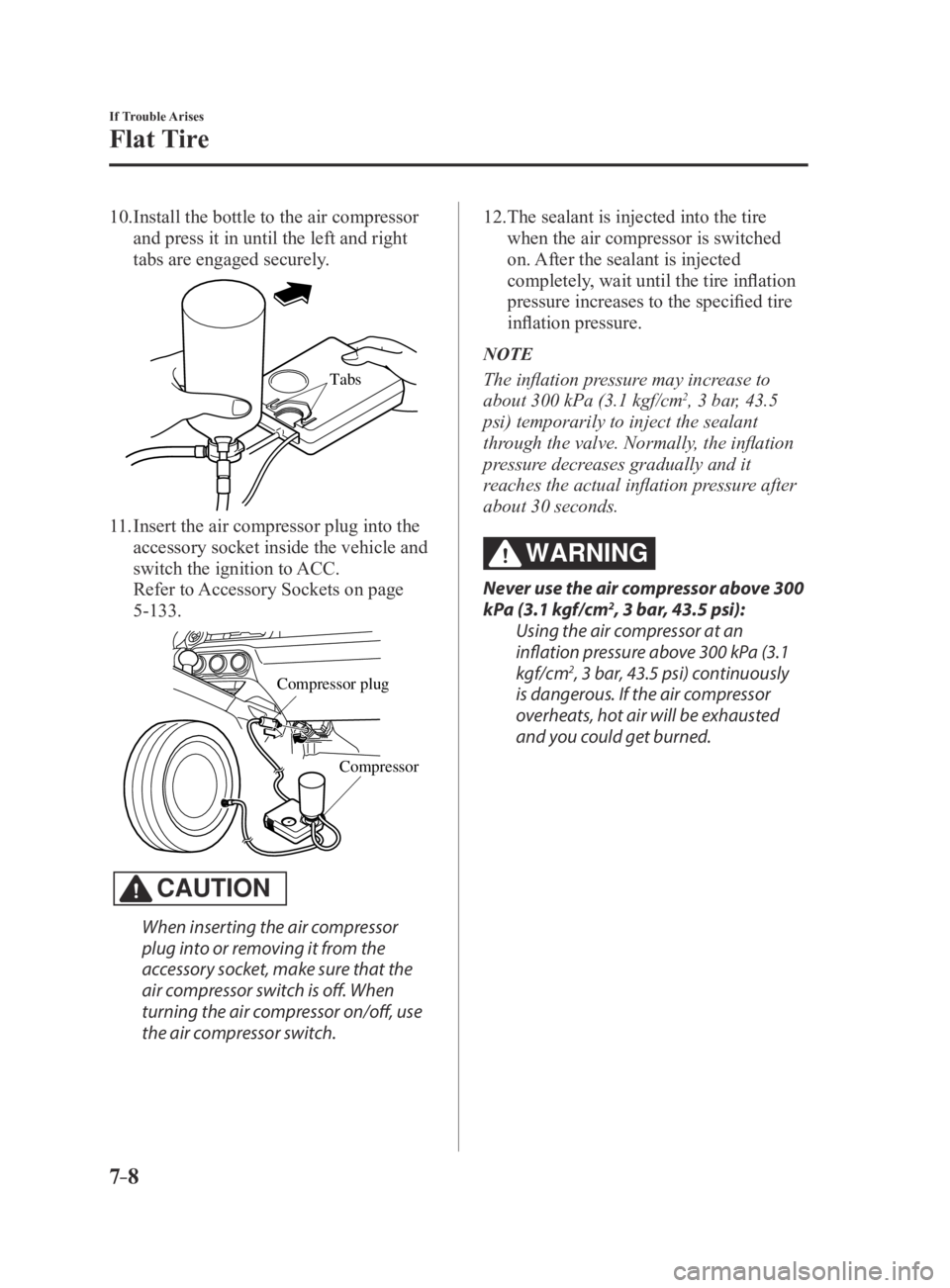
10. Install the bottle to the air compressor
and press it in until the left and right
tabs are engaged securely.
Tabs
11. Insert the air compressor plug into the
accessory socket inside the vehicle and
switch the ignition to ACC.
Refer to Accessory Sockets on page
5-133.
Compressor
Compressor plug
CAUTION
When inserting the air compressor
plug into or removing it from the
accessory socket, make sure that the
air compressor switch is off. When
turning the air compressor on/off, use
the air compressor switch.
12. The sealant is injected into the tire
when the air compressor is switched
on. After the sealant is injected
completely, wait until the tire inflation
pressure increases to the specified tire
inflation pressure.
NOTE
The inflation pressure may increase to
about 300 kPa (3.1 kgf/cm2, 3 bar, 43.5
psi) temporarily to inject the sealant
through the valve. Normally, the inflation
pressure decreases gradually and it
reaches the actual inflation pressure after
about 30 seconds.
WARNING
Never use the air compressor above 300
kPa (3.1 kgf/cm2, 3 bar, 43.5 psi):
Using the air compressor at an
inflation pressure above 300 kPa (3.1
kgf/cm
2, 3 bar, 43.5 psi) continuously
is dangerous. If the air compressor
overheats, hot air will be exhausted
and you could get burned.
MX-5_8EU4-EA-15D_Edition3.indb 82015/10/21 16:55:40
Page 417 of 526
7–9
If Trouble Arises
Flat Tire
NOTE
Check the tire inflation pressure label
driver's door frame for the correct tire
inflation pressure.
Do not operate the air compressor
for a continuous 10 minutes or longer
because using it for long periods could
cause a malfunction.
If the tire inflation pressure does
not increase, repair of the tire is not
possible. If the tire does not reach the
specified tire inflation pressure within
10 minutes, it may have received
extensive damage. In this case, the
repair using the emergency flat tire
repair kit was not successful. Contact
an Authorized Mazda Dealer.
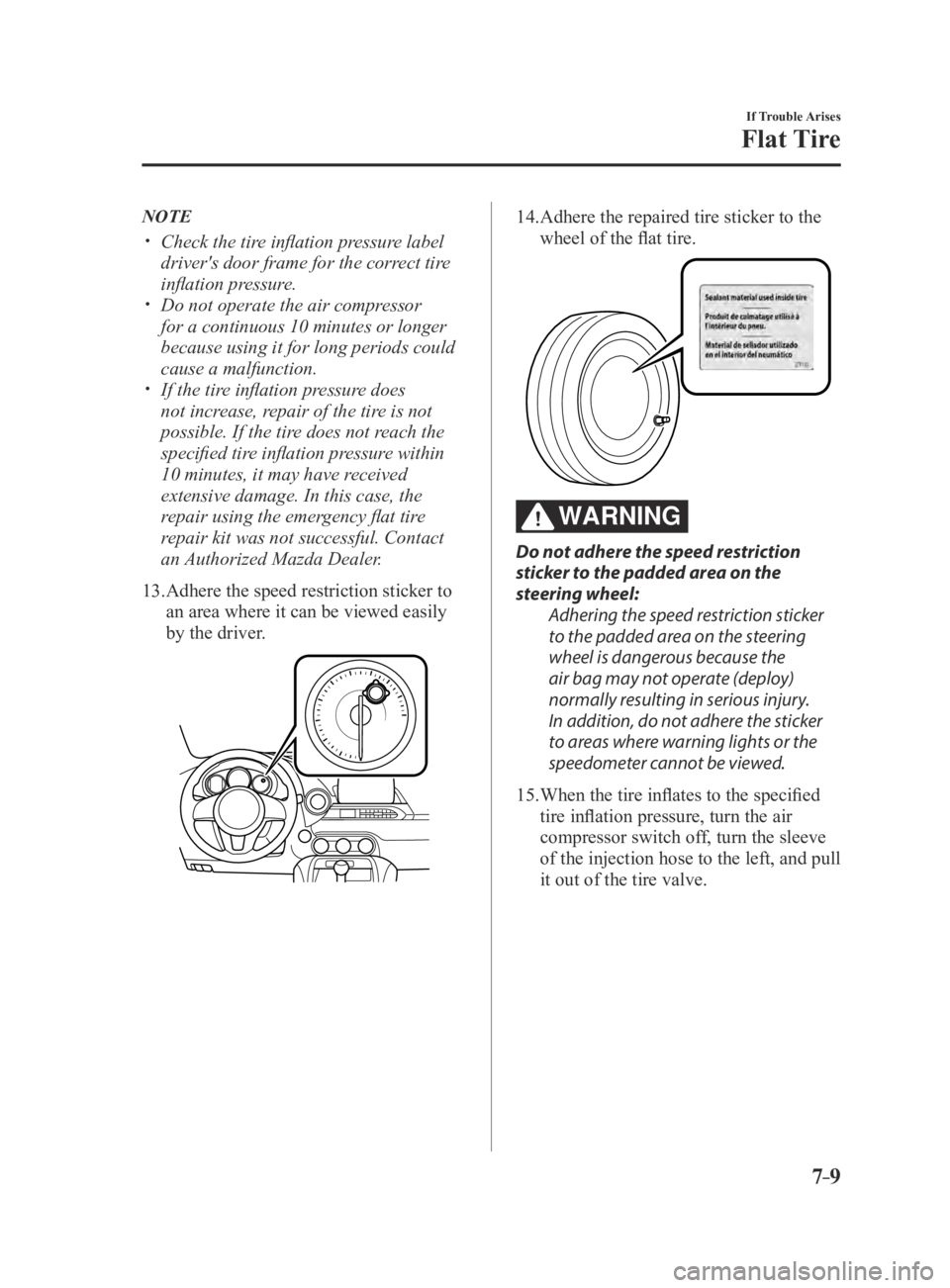
13. Adhere the speed restriction sticker to
an area where it can be viewed easily
by the driver.
14. Adhere the repaired tire sticker to the
wheel of the flat tire.
WARNING
Do not adhere the speed restriction
sticker to the padded area on the
steering wheel: Adhering the speed restriction sticker
to the padded area on the steering
wheel is dangerous because the
air bag may not operate (deploy)
normally resulting in serious injury.
In addition, do not adhere the sticker
to areas where warning lights or the
speedometer cannot be viewed.
15. When the tire inflates to the specified
tire inflation pressure, turn the air
compressor switch off, turn the sleeve
of the injection hose to the left, and pull
it out of the tire valve.
MX-5_8EU4-EA-15D_Edition3.indb 92015/10/21 16:55:40
Page 418 of 526
7–10
If Trouble Arises
Flat Tire
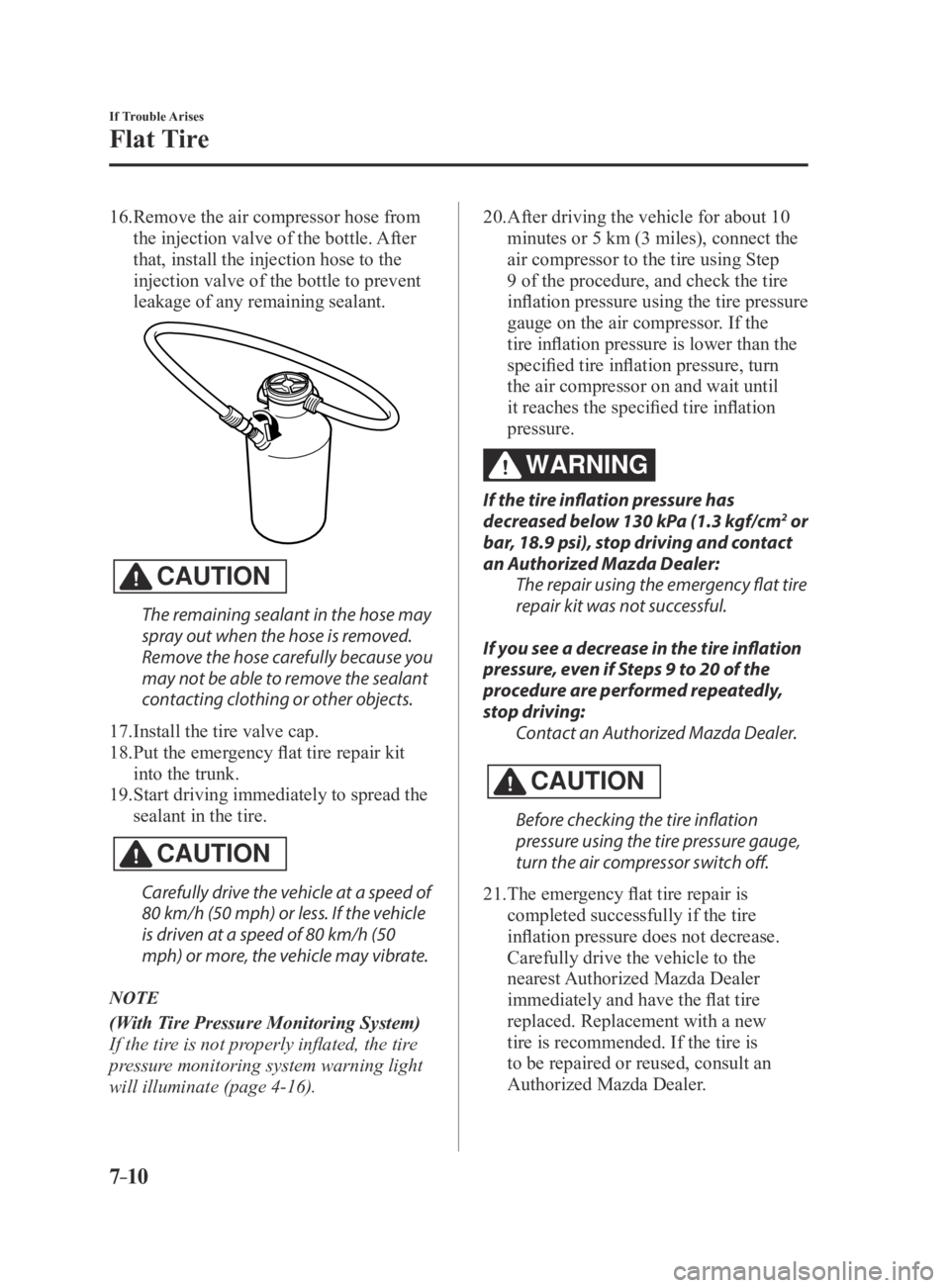
16. Remove the air compressor hose from
the injection valve of the bottle. After
that, install the injection hose to the
injection valve of the bottle to prevent
leakage of any remaining sealant.
CAUTION
The remaining sealant in the hose may
spray out when the hose is removed.
Remove the hose carefully because you
may not be able to remove the sealant
contacting clothing or other objects.
17. Install the tire valve cap.
18. Put the emergency flat tire repair kit
into the trunk.
19. Start driving immediately to spread the
sealant in the tire.
CAUTION
Carefully drive the vehicle at a speed of
80 km/h (50 mph) or less. If the vehicle
is driven at a speed of 80 km/h (50
mph) or more, the vehicle may vibrate.
NOTE
(With Tire Pressure Monitoring System)
If the tire is not properly inflated, the tire
pressure monitoring system warning light
will illuminate (page 4-16).
20. After driving the vehicle for about 10
minutes or 5 km (3 miles), connect the
air compressor to the tire using Step
9 of the procedure, and check the tire
inflation pressure using the tire pressure
gauge on the air compressor. If the
tire inflation pressure is lower than the
specified tire inflation pressure, turn
the air compressor on and wait until
it reaches the specified tire inflation
pressure.
WARNING
If the tire inflation pressure has
decreased below 130 kPa (1.3 kgf/cm2 or
bar, 18.9 psi), stop driving and contact
an Authorized Mazda Dealer: The repair using the emergency flat tire
repair kit was not successful.
If you see a decrease in the tire inflation
pressure, even if Steps 9 to 20 of the
procedure are performed repeatedly,
stop driving: Contact an Authorized Mazda Dealer.
CAUTION
Before checking the tire inflation
pressure using the tire pressure gauge,
turn the air compressor switch off.
21. The emergency flat tire repair is
completed successfully if the tire
inflation pressure does not decrease.
Carefully drive the vehicle to the
nearest Authorized Mazda Dealer
immediately and have the flat tire
replaced. Replacement with a new
tire is recommended. If the tire is
to be repaired or reused, consult an
Authorized Mazda Dealer.
MX-5_8EU4-EA-15D_Edition3.indb 102015/10/21 16:55:41
Page 422 of 526
7–14
If Trouble Arises
Flat Tire
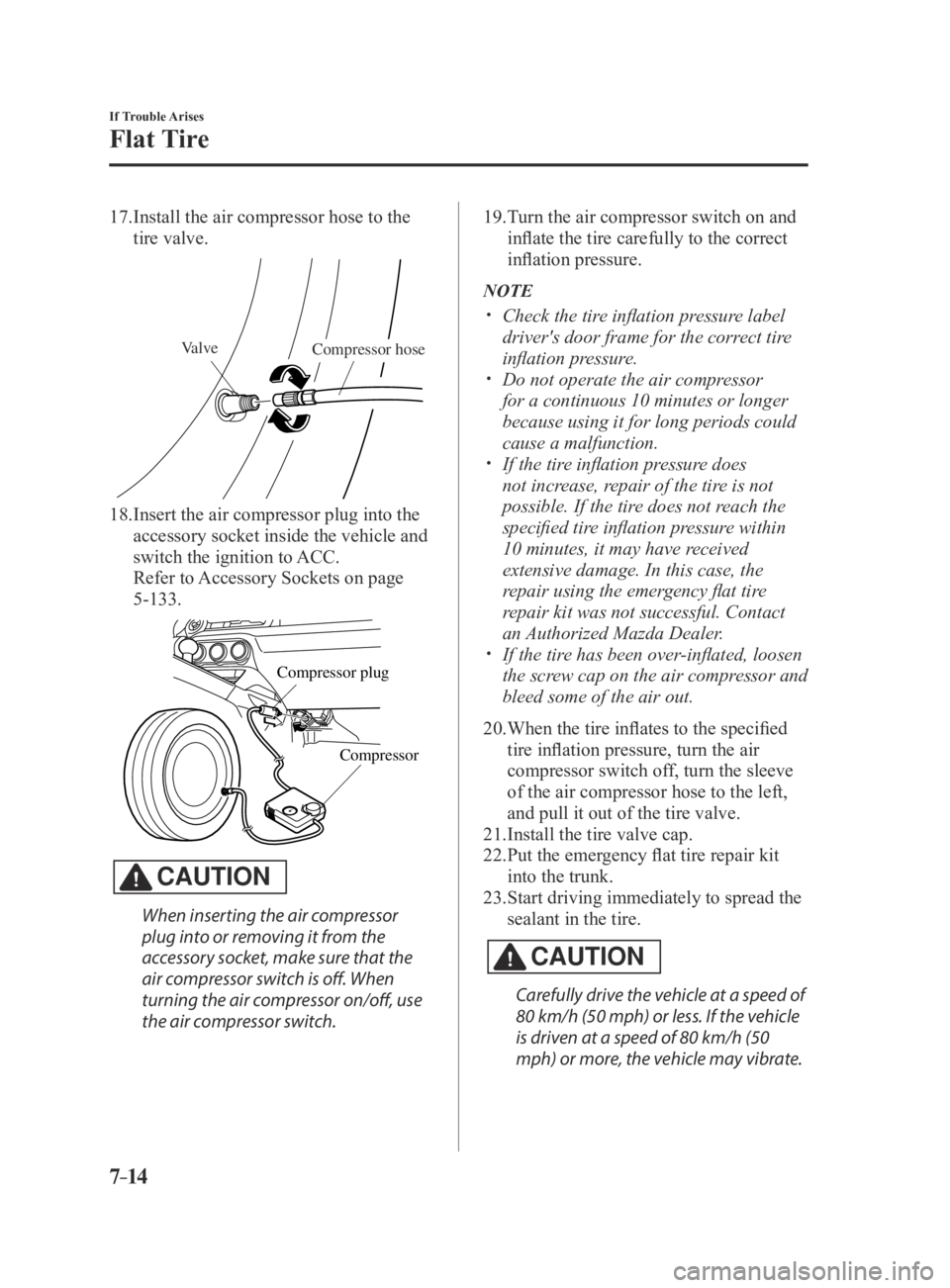
17. Install the air compressor hose to the
tire valve.
ValveCompressor hose
18. Insert the air compressor plug into the
accessory socket inside the vehicle and
switch the ignition to ACC.
Refer to Accessory Sockets on page
5-133.
Compressor
Compressor plug
CAUTION
When inserting the air compressor
plug into or removing it from the
accessory socket, make sure that the
air compressor switch is off. When
turning the air compressor on/off, use
the air compressor switch.
19. Turn the air compressor switch on and
inflate the tire carefully to the correct
inflation pressure.
NOTE
Check the tire inflation pressure label
driver's door frame for the correct tire
inflation pressure.
Do not operate the air compressor
for a continuous 10 minutes or longer
because using it for long periods could
cause a malfunction.
If the tire inflation pressure does
not increase, repair of the tire is not
possible. If the tire does not reach the
specified tire inflation pressure within
10 minutes, it may have received
extensive damage. In this case, the
repair using the emergency flat tire
repair kit was not successful. Contact
an Authorized Mazda Dealer.
If the tire has been over-inflated, loosen
the screw cap on the air compressor and
bleed some of the air out.
20. When the tire inflates to the specified
tire inflation pressure, turn the air
compressor switch off, turn the sleeve
of the air compressor hose to the left,
and pull it out of the tire valve.
21. Install the tire valve cap.
22. Put the emergency flat tire repair kit
into the trunk.
23. Start driving immediately to spread the
sealant in the tire.
CAUTION
Carefully drive the vehicle at a speed of
80 km/h (50 mph) or less. If the vehicle
is driven at a speed of 80 km/h (50
mph) or more, the vehicle may vibrate.
MX-5_8EU4-EA-15D_Edition3.indb 142015/10/21 16:55:44
Page 423 of 526
7–15
If Trouble Arises
Flat Tire
24. After driving the vehicle for about 10
minutes or 5 km (3 miles), connect the
air compressor to the tire using Step
17 of the procedure, and check the tire
inflation pressure using the tire pressure
gauge on the air compressor. If the
tire inflation pressure is lower than the
specified tire inflation pressure, turn
the air compressor on and wait until
it reaches the specified tire inflation
pressure.
WARNING
If the tire inflation pressure has
decreased below 130 kPa (1.3 kgf/cm2 or
bar, 18.9 psi), stop driving and contact
an Authorized Mazda Dealer: The repair using the emergency flat tire
repair kit was not successful.
If you see a decrease in the tire inflation
pressure, even if Steps 17 to 24 of the
procedure are performed repeatedly,
stop driving: Contact an Authorized Mazda Dealer.
CAUTION
Before checking the tire inflation
pressure using the tire pressure gauge,
turn the air compressor switch off.
25. The emergency flat tire repair is
completed successfully if the tire
inflation pressure does not decrease.
Carefully drive the vehicle to the
nearest Authorized Mazda Dealer
immediately and have the flat tire
replaced. Replacement with a new
tire is recommended. If the tire is
to be repaired or reused, consult an
Authorized Mazda Dealer.
NOTE
If an emergency flat tire repair has been
performed using the emergency flat tire
repair kit, Mazda recommends that the
tire be replaced with a new one as soon
as possible. If the tire is to be repaired
or reused, consult an Authorized Mazda
Dealer.
The wheel can be reused if the sealant
adhering to it is removed. However,
replace the valve with a new one.
Inspecting the Emergency Flat
Tire Repair Kit
Inspect the emergency flat tire repair kit at
regular intervals.
Check the tire sealant period of effective
use. Check the operation of the tire
compressor.
NOTE
The tire sealant has a period of effective
use. Check the period of effective use
indicated on the bottle label and do not
use it if it has expired. Have the tire
sealant replaced at an Authorized Mazda
Dealer before the period of effective use
has expired.
MX-5_8EU4-EA-15D_Edition3.indb 152015/10/21 16:55:44