child restraint MAZDA MX5 MIATA 2017 User Guide
[x] Cancel search | Manufacturer: MAZDA, Model Year: 2017, Model line: MX5 MIATA, Model: MAZDA MX5 MIATA 2017Pages: 568, PDF Size: 16.58 MB
Page 34 of 568
2 –20 Essential Safety Equipment
Child Restraint
Child-Restraint System
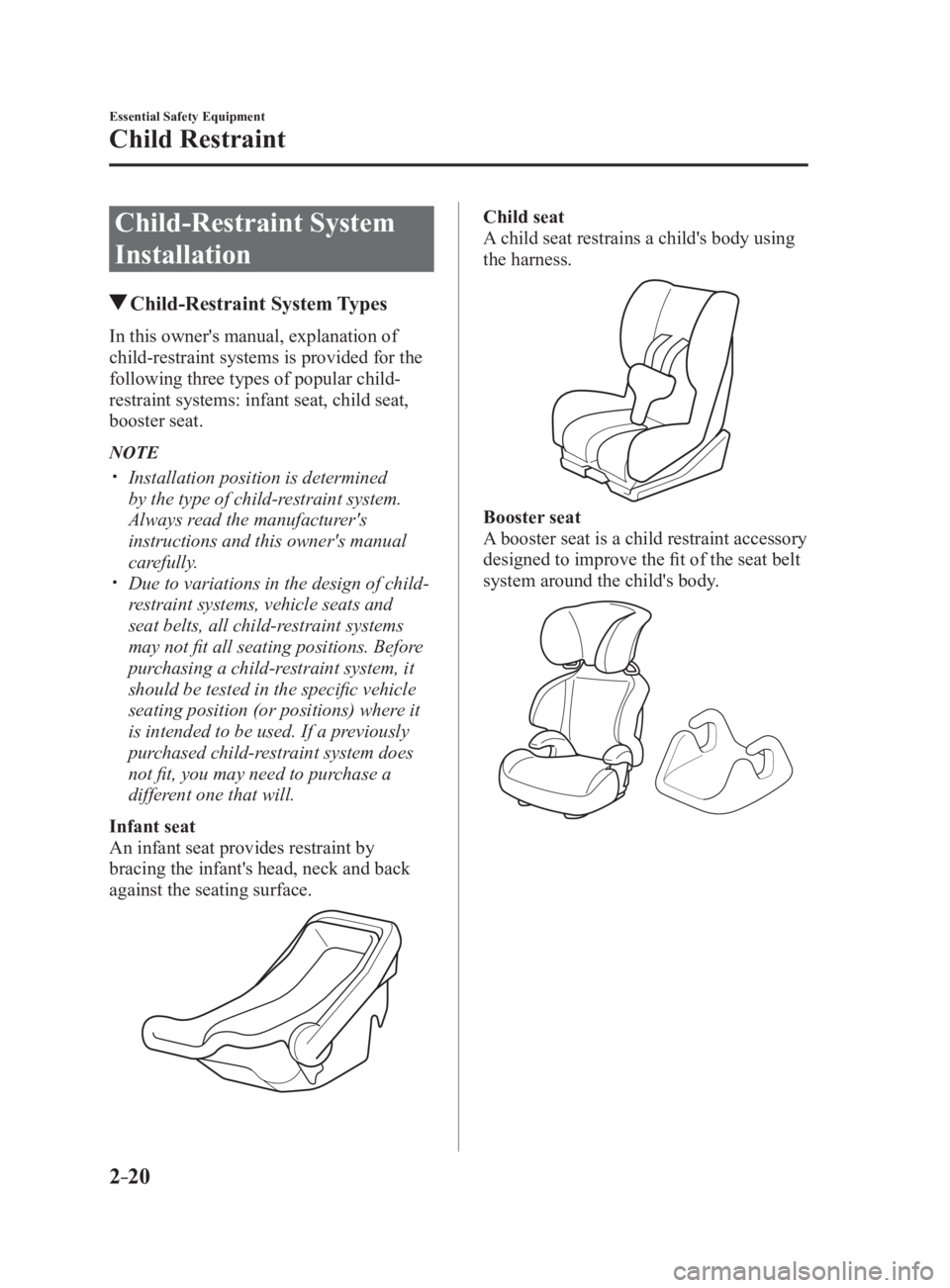
Installation Child-Restraint System TypesIn this owner's manual, explanation of
child-restraint systems is provided for the
following three types of popular child-
restraint systems: infant seat, child seat,
booster seat.
NOTE
Installation position is determined
by the type of child-restraint system.
Always read the manufacturer's
instructions and this owner's manual
carefully.
Due to variations in the design of child-
restraint systems, vehicle seats and
seat belts, all child-restraint systems
may not fit all seating positions. Before
purchasing a child-restraint system, it
should be tested in the specific vehicle
seating position (or positions) where it
is intended to be used. If a previously
purchased child-restraint system does
not fit, you may need to purchase a
different one that will.
Infant seat
An infant seat provides restraint by
bracing the infant's head, neck and back
against the seating surface. Child seat
A child seat restrains a child's body using
the harness.
Booster seat
A booster seat is a child restraint accessory
designed to improve the fit of the seat belt
system around the child's body.
MX-5_8FR4-EA-16J_Edition1.indb 20 2016/08/11 20:28:24
Page 35 of 568
2 –21 Essential Safety Equipment
Child Restraint
Installing Child-Restraint
Systems The passenger lap/shoulder belt can easily
be converted into the automatic locking
mode, which must be done to hold the
child-restraint system.
NOTE
To check if your seats have side air
bags:
Mazda vehicles equipped with side
air bag will have an embossed "SRS
AIRBAG" marking on the outboard
shoulder of the seats.
Follow the child-restraint system
manufacturer's instructions carefully.
Depending on the type of child-restraint
system, it may not employ seat belts
which are in automatic locking mode,
however if it uses an upper tether, it
may not be mounted properly in this
vehicle as there is no safe way to anchor
the tether. Confirm whether the child-
restraint system can be used with seat
belts by reading the child-restraint
system manufacturer's instructions. WARNING Do not allow a child or anyone to lean
over or against the side window of a
vehicle with side air bags:
It is dangerous to allow anyone to
lean over or against the side window,
the area of the passenger seat from
which the side air bags deploy, even
if a child-restraint system is used. The
impact of inflation from a side air bag
could cause serious injury or death to
an out of position child. Furthermore,
leaning over or against the door could
block the side air bags and eliminate
the advantages of supplemental
protection. Because the side air bag
deploys from the outboard shoulder of
the seat, do not allow the child to lean
over or against the side window, even
if the child is seated in a child-restraint
system.
CAUTION When moving the seats forward and
rearward, make sure you hold onto
the seatback with your hand while
operating. If the seatback is not held,
the seat will move suddenly and could
cause injury.
MX-5_8FR4-EA-16J_Edition1.indb 21 2016/08/11 20:28:24
Page 36 of 568
2 –22 Essential Safety Equipment
Child Restraint Passenger's Seat Child-Restraint
System Installation (With Passenger
Occupant Classification System)
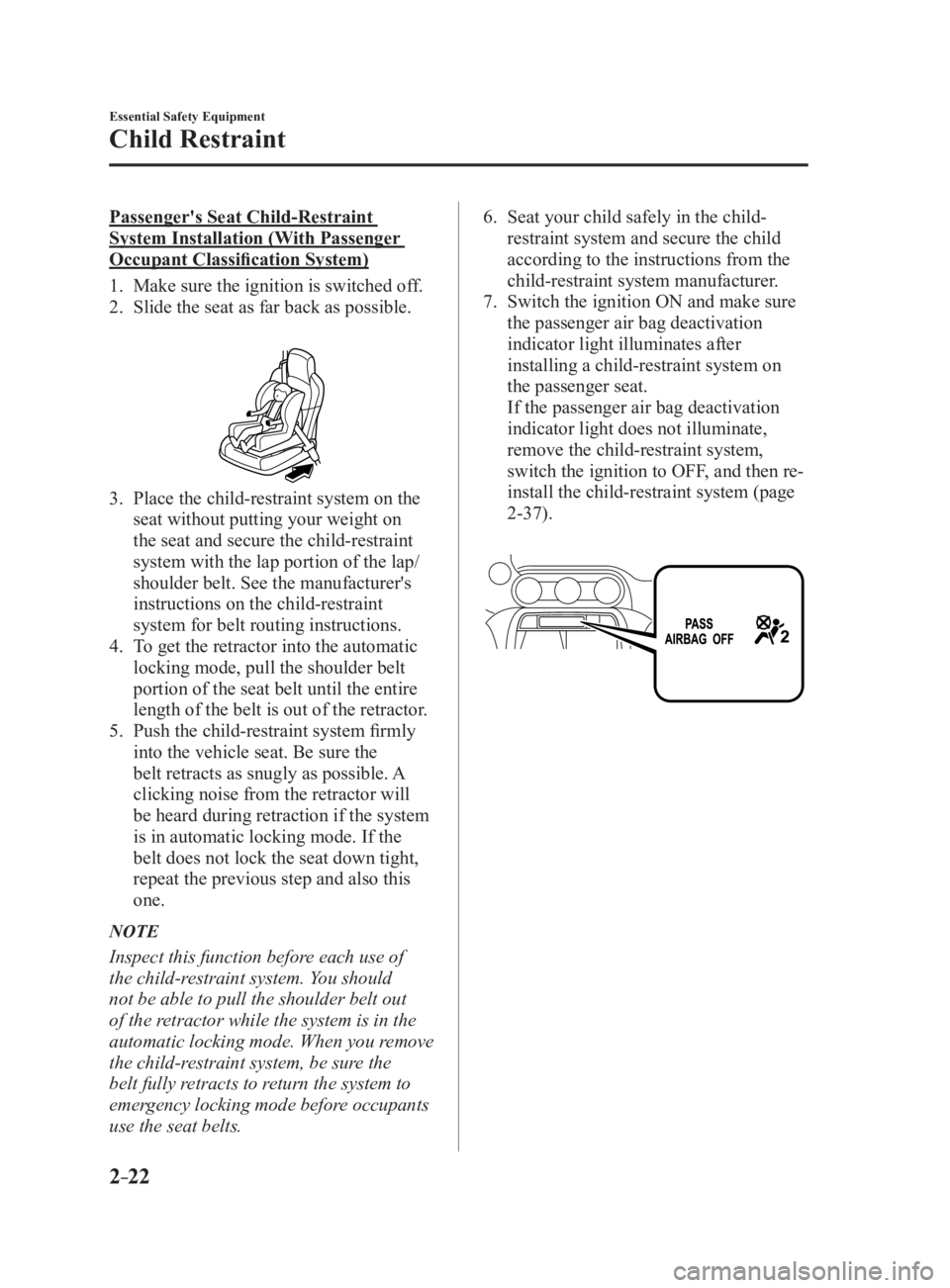
1. Make sure the ignition is switched off.
2. Slide the seat as far back as possible.
3. Place the child-restraint system on the
seat without putting your weight on
the seat and secure the child-restraint
system with the lap portion of the lap/
shoulder belt. See the manufacturer's
instructions on the child-restraint
system for belt routing instructions.
4. To get the retractor into the automatic
locking mode, pull the shoulder belt
portion of the seat belt until the entire
length of the belt is out of the retractor.
5. Push the child-restraint system firmly
into the vehicle seat. Be sure the
belt retracts as snugly as possible. A
clicking noise from the retractor will
be heard during retraction if the system
is in automatic locking mode. If the
belt does not lock the seat down tight,
repeat the previous step and also this
one.
NOTE
Inspect this function before each use of
the child-restraint system. You should
not be able to pull the shoulder belt out
of the retractor while the system is in the
automatic locking mode. When you remove
the child-restraint system, be sure the
belt fully retracts to return the system to
emergency locking mode before occupants
use the seat belts. 6. Seat your child safely in the child-
restraint system and secure the child
according to the instructions from the
child-restraint system manufacturer.
7. Switch the ignition ON and make sure
the passenger air bag deactivation
indicator light illuminates after
installing a child-restraint system on
the passenger seat.
If the passenger air bag deactivation
indicator light does not illuminate,
remove the child-restraint system,
switch the ignition to OFF, and then re-
install the child-restraint system (page
2-37 ).
MX-5_8FR4-EA-16J_Edition1.indb 22 2016/08/11 20:28:24
Page 37 of 568

2 –23 Essential Safety Equipment
Child Restraint
WARNING Do not seat a child in a child-restraint
system on the passenger seat if the
passenger air bag deactivation
indicator light does not illuminate (With
Passenger Occupant Classification
System):
Seating a child in a child-restraint
system installed on the passenger
seat with the passenger air bag
deactivation indicator light not
illuminated is dangerous. If this
indicator light does not illuminate,
this means that the passenger front
and side air bags, and seat belt
pretensioner are ready for deployment.
If an accident were to deploy an air
bag, a child in a child-restraint system
sitting in the passenger seat could
be seriously injured or killed. If the
indicator light does not illuminate
after seating a child in a child-restraint
system on the passenger seat consult
an Authorized Mazda Dealer as soon
as possible.
MX-5_8FR4-EA-16J_Edition1.indb 23 2016/08/11 20:28:24
Page 39 of 568

2 –25 Essential Safety Equipment
SRS Air BagsSmall children must be protected by a child-restraint system as stipulated by law in every
state and province. In certain states and provinces, larger children must use a child-restraint
system (page 2-15 ).
Carefully consider which child-restraint system is necessary for your child and follow
the installation directions in this Owner's Manual as well as the child-restraint system
manufacturer's instructions.
Do not use a child-restraint system which employs an upper tether because there is no
appropriate means to anchor the tether.
WARNING Seat belts must be worn in air bag equipped vehicles:
Depending only on the air bags for protection during an accident is dangerous. Alone, air
bags may not prevent serious injuries. The appropriate air bags can be expected to inflate
only in the first accident, such as frontal, near frontal or side collisions that are at least
moderate. Vehicle occupants should always wear seat belts.
Always make sure the passenger air bag deactivation indicator light is illuminated
when using a child-restraint system (With Passenger Occupant Classification System):
Seating a child in a child-restraint system that is installed on the passenger seat with the
passenger air bag deactivation indicator light not illuminated is extremely dangerous. In
an accident, an air bag could inflate and cause serious injuries or even death to the child
seated in the child-restraint system. Always make sure the passenger air bag deactivation
indicator light is illuminated.
Refer to Occupant Classification System on page 2-37 .
Do not sit too close to the driver and passenger air bags:
Sitting too close to the driver and passenger air bag modules or placing hands or feet on
them is extremely dangerous. The driver and passenger air bags inflate with great force
and speed. Serious injuries could occur if someone is too close. The driver should always
hold onto only the rim of the steering wheel. The passenger should keep both feet on
the floor. Seat occupants should adjust their seats as far back as possible and always sit
upright against the seatbacks with seat belts worn properly.
Do not sit too close to a door or lean against doors in vehicles with side air bags:
Sitting too close to the side air bag modules or placing hands on them is extremely
dangerous. A side air bag inflates with great force and speed directly out of the outboard
shoulder of the seat and expands along the door on the side the car is hit. Serious injury
could occur if someone is sitting too close to the door or leaning against a window in the
seats. Furthermore, sleeping up against the door or hanging out the driver-side window
while driving could block the side air bag and eliminate the advantages of supplemental
protection. Give the side air bags room to work by sitting in the center of the seat while
the vehicle is moving with seat belts worn properly.
MX-5_8FR4-EA-16J_Edition1.indb 25 2016/08/11 20:28:24
Page 42 of 568

2 –28 Essential Safety Equipment
SRS Air Bags Properly dispose of the air bag system:
Improper disposal of an air bag or a vehicle with live air bags in it can be extremely
dangerous. Unless all safety procedures are followed, injury could result. Have an
Authorized Mazda Dealer safely dispose of the air bag system or scrap an air bag
equipped vehicle.
NOTE
If it becomes necessary to have the components or wiring system for the supplementary
restraint system modified to accommodate a person with certain medical conditions in
accordance with a certified physician, contact an Authorized Mazda Dealer, refer to
“Customer Assistance (U.S.A.)” (page 8-2 ).
When an air bag deploys, a loud inflation noise can be heard and some smoke will be
released. Neither is likely to cause injury, however, the texture of the air bags may cause
light skin injuries on body parts not covered with clothing through friction.
Should you sell your Mazda, we urge you to tell the new owner of its air bag systems
and that familiarization with all instructions about them, from the Owner's Manual, is
important.
Vehicles with a passenger air bag have a warning label attached as shown in the
following.
(Except Mexico)
This warning label is displayed in compliance with regulations.
(Mexico)
This warning label reminds you not to put a rear-facing child-restraint system on the
passenger seat at any time.
MX-5_8FR4-EA-16J_Edition1.indb 28 2016/08/11 20:28:25
Page 52 of 568

2 –38 Essential Safety Equipment
SRS Air Bags If the passenger occupant classification sensor is normal, the i ndicator light turns on when
the ignition is switched ON. The light turns off after a few seconds. Then, the indicator light
turns on or is off under the following conditions: Passenger air bag deactivation indicator light on/off condition chart
Condition detected by
the passenger occupant
classification system Passenger air bag
deactivation indicator
light Passenger front and
side air bags Passenger seat belt
pretensioner system
Empty (Not occupied) On Deactivated Deactivated
A child is seated in a child-
restraint system *1
On Deactivated Deactivated
Adult *2
Off Ready Ready
*1 The occupant classification sensor may not detect a child seated on the seat, in a child-restraint system, or a
junior seat depending on the child's physical size and seated posture.
*2 If a smaller adult sits on the passenger seat, the sensors might detect the person as being a child depending on
the person's physique.
If the passenger air bag deactivation indicator light does not turn on when the ignition
is switched ON and does not turn on as indicated in the passeng er air bag deactivation
indicator light on/off condition chart, do not allow an occupant to sit in the passenger seat
and consult an Authorized Mazda Dealer as soon as possible. The system may not work
properly in an accident.
MX-5_8FR4-EA-16J_Edition1.indb 38 2016/08/11 20:28:26
Page 54 of 568

2 –40 Essential Safety Equipment
SRS Air Bags
Luggage or other items placed under the passenger seat or between the passenger
seat and driver seat that push up the passenger seat bottom.
An object, such as a seat cushion, is put on the passenger's seat or between the
passenger's back and the seatback.
A seat cover is put on the passenger's seat.
Luggage or other items are placed on the seat with the child in the child-restraint
system.
The seat is washed.
Liquids are spilled on the seat.
The passenger seat is moved backward, pushing into luggage or other items placed
behind it.
Luggage or other items are placed between the passenger seat and driver seat.
An electric device is put on the passenger's seat.
An additional electrical device, such as a seat warmer is installed to the surface of the
passenger seat.
The passenger front and side air bags and seat belt pretensioner systems will deactivate if
the passenger air bag deactivation indicator light turns on.
CAUTION
To assure proper deployment of the front air bag and to prevent damage to the sensor in
the seat cushion:
Do not place sharp objects on the seat cushion or leave heavy luggage on them.
Do not spill any liquids on the seats or under the seats.
To allow the sensors to function properly, always perform the following:
Adjust the seats as far back as possible and always sit upright against the seatbacks
with seat belts worn properly.
If you place your child on the passenger seat, secure the child-restraint system properly
and slide the passenger seat as far back as possible.
MX-5_8FR4-EA-16J_Edition1.indb 40 2016/08/11 20:28:27
Page 55 of 568

2 –41 Essential Safety Equipment
SRS Air BagsNOTE
The system requires about 10 seconds to alternate between turning the passenger front
and side air bags and seat belt pretensioner system on or off.
The passenger air bag deactivation indicator light may turn on repeatedly if luggage or
other items are put on the passenger seat, or if the temperature of the vehicle's interior
changes suddenly.
The passenger air bag deactivation indicator light may turn on for 10 seconds if the
electrostatic capacity on the passenger seat changes.
The air bag/seat belt pretensioner system warning light might turn on if the passenger
seat receives a severe impact.
If the passenger air bag deactivation indicator light does not turn on after installing a
child-restraint system on the passenger seat, first, re-install your child-restraint system
according to the procedure in this owner's manual. Then, if the passenger air bag
deactivation indicator light still does not turn on, and consult an Authorized Mazda
Dealer as soon as possible.
If the passenger air bag deactivation indicator light turns on when an occupant is seated
directly in the passenger seat, have the passenger re-adjust their posture by sitting
with their feet on the floor, and then re-fastening the seat belt. If the passenger air bag
deactivation indicator light remains turned on, slide the passenger seat as far back as
possible. Consult an Authorized Mazda Dealer as soon as possible.
MX-5_8FR4-EA-16J_Edition1.indb 41 2016/08/11 20:28:27
Page 562 of 568

10 –2 Index
A Accessory Socket .............................. 5-134
Adaptive Front Lighting System
(AFS) ................................................... 4-75
Add-On Non-Genuine Parts and
Accessories
......................................... 8-18
Advanced Key
Advanced keyless entry system
...... 3-8
Operational range
............................ 3-9
Air Bag/Seat Belt Pretensioner System
Warning Beep
...................................... 7-48
Air Bag Systems
................................. 2-24
Ambient Temperature Display
... 4-15, 4-22
Antilock Brake System (ABS)
............ 4-65
Audio Control Switch
Adjusting the volume
.................... 5-55
Seek switch .................................... 5-56
Audio System
...................................... 5-13
AUX/USB mode
........................... 5-57
Antenna
......................................... 5-13
Audio control switch
..................... 5-55
Audio set
[Type A (non-touchscreen)]
........... 5-22
Audio set
[Type B (touchscreen)]
................... 5-34
Operating tips for audio system
.... 5-14
Satellite radio
................................ 5-46
Automatic Transmission
..................... 4-34
Active Adaptive Shift (AAS)
........ 4-36
Direct mode
................................... 4-43
Driving tips .................................... 4-43
Manual shift mode ......................... 4-37
Shift-lock override
........................ 4-36
Shift-lock system
........................... 4-36
Shift position indication
................ 4-35
Transmission ranges
...................... 4-35
Warning light
................................. 4-35B Back Trim Storage Box ..................... 5-139
Battery
................................................. 6-36
Maintenance
.................................. 6-38
Replacement
.................................. 6-38
Specifications
.................................. 9-4
Battery Runs Out
................................. 7-23
Jump-starting
................................. 7-23
Blind Spot Monitoring (BSM)
............ 4-85
Blind Spot Monitoring (BSM) System
Warning Beep
...................................... 7-51
Bluetooth ®
........................................... 5-74
Bluetooth ®
audio (Type A) .......... 5-113
Bluetooth ®
audio (Type B) .......... 5-115
Bluetooth ®
Hands-Free (Type A) ... 5-97
Bluetooth ®
Hands-Free (Type B) ... 5-103
Troubleshooting
.......................... 5-129
Body Lubrication
................................ 6-32
Brakes
Brakes assist
.................................. 4-63
Foot brake ...................................... 4-61
Pad wear indicator
......................... 4-62
Parking brake
................................ 4-62
Warning light
................................. 4-62
Break-In Period
................................... 3-51
C Capacities .............................................. 9-5
Carbon Monoxide
............................... 3-24
Cell Phones
......................................... 8-19
Child Restraint
Child-restraint precautions
............ 2-15
Child-restraint system installation ... 2-20
Installing child-restraint systems ... 2-21
Climate Control System
........................ 5-2
Fully automatic type
........................ 5-9
Gas specifications
............................ 9-6
Manual type
..................................... 5-5
Operating tips
.................................. 5-2
Vent operation
................................. 5-3
Clock
................................................... 5-26
MX-5_8FR4-EA-16J_Edition1.indb 2 2016/08/11 20:30:24