rear MAZDA MX5 MIATA 2017 Owner's Guide
[x] Cancel search | Manufacturer: MAZDA, Model Year: 2017, Model line: MX5 MIATA, Model: MAZDA MX5 MIATA 2017Pages: 568, PDF Size: 16.58 MB
Page 152 of 568

4 –38 When Driving
Transmission
*Some models.Manually shifting up
You can shift gears up by operating
the selector lever or the steering shift
switches *
.
M1 → M2 → M3 → M4 → M5 → M6
Using selector lever
To shift up to a higher gear, tap the
selector lever back
once.
Using steering shift switch *
To shift up to a higher gear with the
steering shift switches, pull the UP switch
(
) toward you once with your
fingers. UP switch (+/OFF) WARNING Keep your hands on the steering wheel
rim when using fingers on the steering
shift switches:
Putting your hands inside the rim of
the steering wheel when using the
steering shift switches is dangerous.
If the driver's air bag were to deploy
in a collision, your hands could be
impacted causing injury.
NOTE
When driving slowly, the gears may not
shift up.
Do not drive the vehicle with the
tachometer needle in the RED ZONE
while in manual shift mode. In
addition, manual shift mode switches
to automatic shift mode while the
accelerator pedal is completely
depressed.
This function is canceled while the DSC
is turned off. However, if the vehicle
is continuously driven at a high rpm,
the gears may automatically shift up to
protect the engine.
The steering shift switch can be used
temporarily even if the selector lever is
in the D position while driving. In
addition, it returns to automatic shift
mode when the UP switch (
) is
pulled rearward for a sufficient amount
of time.
MX-5_8FR4-EA-16J_Edition1.indb 38 2016/08/11 20:28:51
Page 157 of 568

4 –43 When Driving
Transmission
*Some models. Direct Mode *
Direct mode can be used for temporarily
switching gears by operating the steering
shift switch while the vehicle is being
driven with the selector lever in the D
range.
While in direct mode, the D and M
indication illuminate and the gear position
in use is illuminated.
Direct mode is canceled (released) under
the following conditions.
The UP switch ( ) is pulled
rearward for a certain amount of time or
longer.
The vehicle is driven for a certain
amount of time or longer (time differs
depending on the driving conditions
while operating).
The vehicle is stopped or moving at a
slow speed.
Gear position indicationDirect mode indication NOTE
Shifting up and down while in direct mode
may not be possible depending on the
vehicle speed. In addition, because direct
mode is canceled (released) depending
on the rate of acceleration or if the
accelerator is fully depressed, use of the
manual shift mode is recommended if you
need to drive the vehicle in a particular
gear for long periods.
Driving Tips
WARNING Do not let the vehicle move in a
direction opposite to the direction
selected by the selector lever:
Do not let the vehicle move backward
with the selector lever in a forward
position, or do not let the vehicle
move forward with the selector lever
in the reverse position. Otherwise, the
engine may stop, causing the loss of
the power brake and power steering
functions, and make it difficult to
control the vehicle which could result
in an accident.
Passing
For extra power when passing another
vehicle or climbing steep grades, depress
the accelerator fully. The transmission will
shift to a lower gear, depending on vehicle
speed.
MX-5_8FR4-EA-16J_Edition1.indb 43 2016/08/11 20:28:52
Page 169 of 568

4 –55 When Driving
Switches and Controls
Rear Window Defogger The rear window defogger clears fog from
the rear window.
The ignition must be switched ON to use
the defogger.
Press the switch to turn on the rear
window defogger. The rear window
defogger operates for about 15 minutes
and then turns off automatically.
The indicator light illuminates when the
defogger is operating.
To turn off the rear window defogger
before the 15 minutes has elapsed, press
the switch again.
Manual Climate Control Indicator light
Fully Automatic Climate Control Indicator light CAUTION
Do not use sharp instruments or window
cleaners with abrasives to clean the
inside of the rear window surface. They
may damage the defogger grid inside
the window.
Before opening the convertible top,
make sure the rear window defogger
switch is turned off. Otherwise the heat
generated from the defogger could
damage the convertible top and the
internal material.
NOTE
This defogger is not designed for melting
snow. If there is an accumulation of snow
on the rear window, remove it before using
the defogger.
MX-5_8FR4-EA-16J_Edition1.indb 55 2016/08/11 20:28:55
Page 170 of 568

4 –56 When Driving
Switches and Controls
*Some models. Mirror Defogger *
The mirror defoggers defrost the outside
mirrors.
The mirror defoggers operate in
conjunction with the rear window
defogger.
To turn on the mirror defoggers, switch
the ignition ON and press the rear window
defogger switch (page 4-55 ).
Manual Climate Control Indicator light
Fully Automatic Climate Control Indicator light Horn To sound the horn, press the mark on
the steering wheel.
MX-5_8FR4-EA-16J_Edition1.indb 56 2016/08/11 20:28:55
Page 188 of 568
4 –74 When Driving
i-ACTIVSENSE
*Some models. i-ACTIVSENSE *
i-ACTIVSENSE is a collective term covering a series of advanced safety and driver support
systems which make use of a Forward Sensing Camera (FSC) and ra dar sensors.
Because each system has its limitations, always drive carefully and do not rely solely on the
systems.
Driver awareness support systems
Nighttime visibility
Adaptive Front Lighting System (AFS)
.............................................................................. 4-75
High Beam Control System (HBC)
.................................................................................... 4-76
Left/right side and rear side detection
Lane Departure Warning System (LDWS) ......................................................................... 4-79
Blind Spot Monitoring (BSM) System
............................................................................... 4-85
Rear obstruction detection when leaving a parking space
Rear Cross Traffic Alert (RCTA) ........................................................................................ 4-92
Camera and SensorsForward sensing camera (FSC)
The Forward Sensing Camera (FSC) determines the conditions ahea d of the vehicle while
traveling at night and detects traffic lanes. The following systems also use the Forward
Sensing Camera (FSC).
High Beam Control system (HBC)
Lane Departure Warning System (LDWS)
The Forward Sensing Camera (FSC) is installed at the top of the windshield near the
rearview mirror.
Refer to Forward Sensing Camera (FSC) on page 4-95 .
Radar sensors (rear)
The radar sensors (rear) function by detecting the radio waves reflected off a vehicle
approaching from the rear or an obstruction sent from the radar sensors. The following
systems also use the radar sensors (rear).
Blind Spot Monitoring (BSM) System
Rear Cross Traffic Alert (RCTA)
The radar sensors (rear) are installed inside the rear bumper, one each on the left and right
sides.
Refer to Radar Sensors (Rear) on page 4-98 .
MX-5_8FR4-EA-16J_Edition1.indb 74 2016/08/11 20:29:00
Page 191 of 568

4 –77 When Driving
i-ACTIVSENSENOTE
The timing in which the system switches the headlights changes under the following
conditions. If the system does not switch the headlights appropriately, manually switch
between high and low beams according to the visibility as well as road and traffic
conditions.
When there are sources of light in the area such as street lamps, illuminated signboards,
and traffic signals.
When there are reflective objects in the surrounding area such as reflective plates and
signs.
When visibility is reduced under rain, snow and foggy conditions.
When driving on roads with sharp turn or hilly terrain.
When the headlights/rear lamps of vehicles in front of you or in the opposite lane are dim
or not illuminated.
When there is sufficient darkness such as at dawn or dusk.
When the luggage compartment is loaded with heavy objects.
When visibility is reduced due to a vehicle in front of you spraying water from its tires
onto your windshield.
MX-5_8FR4-EA-16J_Edition1.indb 77 2016/08/11 20:29:00
Page 199 of 568

4 –85 When Driving
i-ACTIVSENSE
*Some models.Blind Spot Monitoring (BSM) System *
The Blind Spot Monitoring (BSM) is designed to assist the drive r in checking the area to the
rear of the vehicle on both sides during lane changes by alerting the driver to the presence of
vehicles approaching from the rear in an adjacent lane.
The Blind Spot Monitoring (BSM) detects vehicles approaching fr om the rear while
traveling in the forward direction at a speed of 10 km/h (6.3 mph) or faster and turns on the
Blind Spot Monitoring (BSM) warning lights equipped on the door mirrors depending on
the conditions. If the turn signal lever is operated to signal a lane change in the direction
in which the Blind Spot Monitoring (BSM) warning light is illum inated, the system warns
the driver of a vehicle in the detection area by flashing the Bl ind Spot Monitoring (BSM)
warning light and activating a beep sound.
The detection area on this system covers the driving lanes on both sides of the vehicle and
from the rear part of the doors to about 50 m (164 ft) behind the vehicle.
Detection areasYour vehicle
WARNING Always check the surrounding area visually before making an actual lane change:
The system is only designed to assist you in checking for vehicles at your rear when
making a lane change. Due to certain limitations with the operation of this system, the
Blind Spot Monitoring (BSM) warning light may not flash or it might be delayed even
though a vehicle is in an adjacent driving lane. Always make it your responsibility as a
driver to check the rear.
MX-5_8FR4-EA-16J_Edition1.indb 85 2016/08/11 20:29:02
Page 200 of 568

4 –86 When Driving
i-ACTIVSENSE NOTE
The Blind Spot Monitoring (BSM) will operate when all of the following conditions are
met:
The ignition is switched ON.
The Blind Spot Monitoring (BSM) switch is pressed and the Blind Spot Monitoring
(BSM) OFF indicator light in the instrument cluster is turned off.
The vehicle speed is about 10 km/h (6.3 mph) or faster.
The Blind Spot Monitoring (BSM) will not operate under the following circumstances.
The vehicle speed falls below about 10 km/h (6.3 mph) even though the Blind Spot
Monitoring (BSM) OFF indicator light is turned off.
The shift lever (manual transmission)/selector lever (automatic transmission) is shifted
to reverse (R) and the vehicle is reversing.
In the following cases, the Blind Spot Monitoring (BSM) OFF indicator light turns on and
operation of the system is stopped. If the Blind Spot Monitoring (BSM) OFF indicator
light remains illuminated, have the vehicle inspected at an Authorized Mazda Dealer as
soon as possible.
Some problem with the system including the Blind Spot Monitoring (BSM) warning
lights is detected.
A large deviation in the installation position of a radar sensor (rear) on the vehicle has
occurred.
There is a large accumulation of snow or ice on the rear bumper near a radar sensor
(rear). Remove any snow, ice or mud on the rear bumper.
Driving on snow-covered roads for long periods.
The temperature near the radar sensors (rear) becomes extremely hot due to driving
for long periods on slopes during the summer.
The battery voltage has decreased.
Under the following conditions, the radar sensors (rear) cannot detect target objects or it
may be difficult to detect them.
A vehicle is in the detection area at the rear in an adjacent driving lane but it does not
approach. The Blind Spot Monitoring (BSM) determines the condition based on radar
detection data.
A vehicle is traveling alongside your vehicle at nearly the same speed for an extended
period of time.
Vehicles approaching in the opposite direction.
A vehicle in an adjacent driving lane is attempting to pass your vehicle.
A vehicle is in an adjacent lane on a road with extremely wide driving lanes. The
detection area of the radar sensors (rear) is set at the road width of expressways.
MX-5_8FR4-EA-16J_Edition1.indb 86 2016/08/11 20:29:02
Page 201 of 568
4 –87 When Driving
i-ACTIVSENSE
In the following cases, the activation of the Blind Spot Monitoring (BSM) warning lights
and the warning beep may not occur or they may be delayed.
A vehicle makes a lane change from a driving lane two lanes over to an adjacent lane.
Driving on steep slopes.
Crossing the summit of a hill or mountain pass.
The turning radius is small (making a sharp turn, turning at intersections).
When there is a difference in the height between your driving lane and the adjacent
lane.
Directly after pressing the Blind Spot Monitoring (BSM) switch and the system
becomes operable.
If the road width is extremely narrow, vehicles two lanes over may be detected.
The detection area of the radar sensors (rear) is set according to the road width of
expressways.
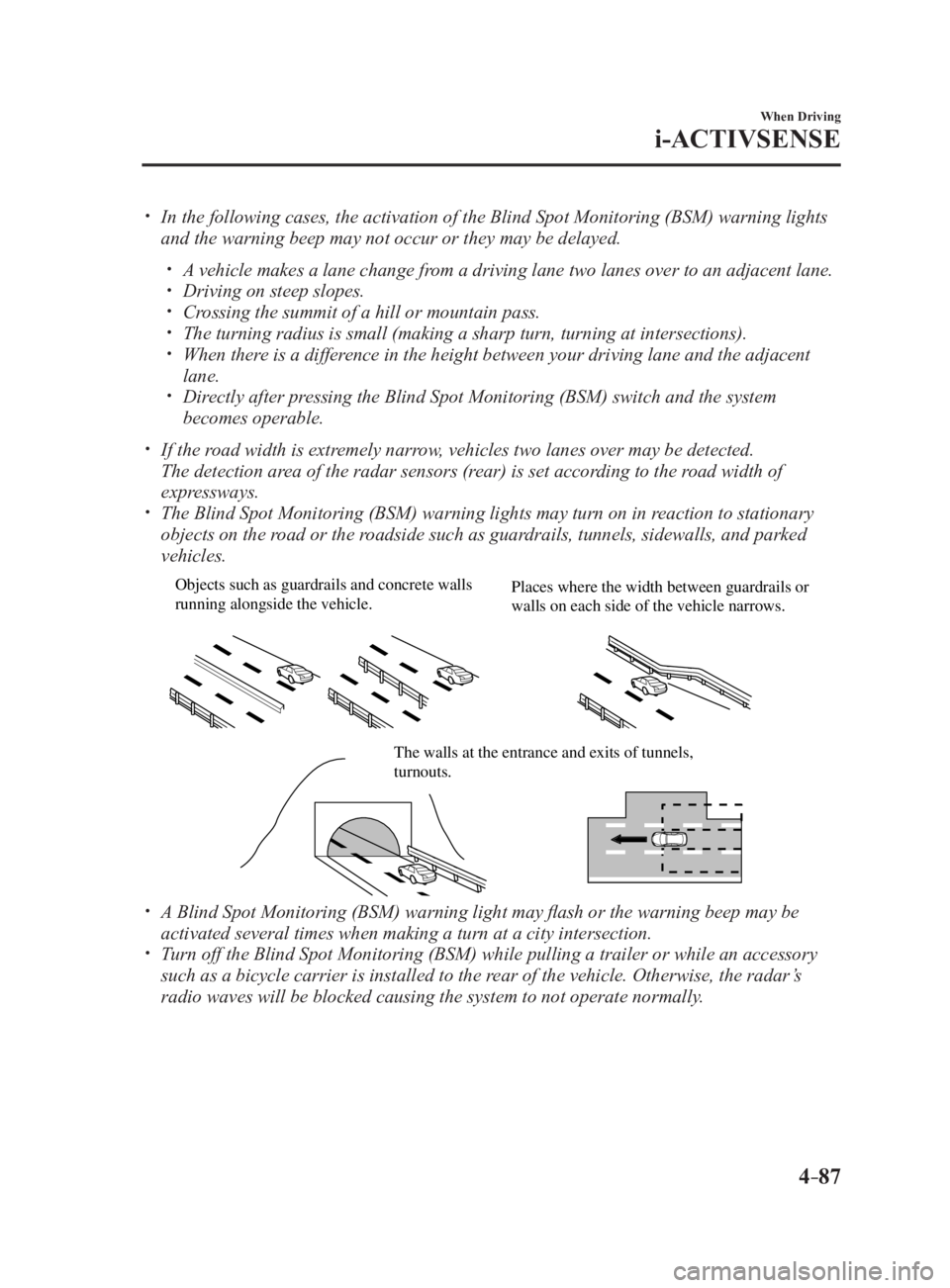
The Blind Spot Monitoring (BSM) warning lights may turn on in reaction to stationary
objects on the road or the roadside such as guardrails, tunnels, sidewalls, and parked
vehicles. Objects such as guardrails and concrete walls
running alongside the vehicle. Places where the width between guardrails or
walls on each side of the vehicle narrows.
The walls at the entrance and exits of tunnels,
turnouts.
A Blind Spot Monitoring (BSM) warning light may flash or the warning beep may be
activated several times when making a turn at a city intersection.
Turn off the Blind Spot Monitoring (BSM) while pulling a trailer or while an accessory
such as a bicycle carrier is installed to the rear of the vehicle. Otherwise, the radar’s
radio waves will be blocked causing the system to not operate normally.
MX-5_8FR4-EA-16J_Edition1.indb 87 2016/08/11 20:29:02
Page 202 of 568

4 –88 When Driving
i-ACTIVSENSE
In the following cases, it may be difficult to view the illumina tion/flashing of the Blind
Spot Monitoring (BSM) warning lights equipped on the door mirrors.
Snow or ice is adhering to the door mirrors.
The door glass is fogged or covered in snow, frost or dirt.
The system switches to the Rear Cross Traffic Alert function when the shift lever (manual
transmission) or the selector lever (automatic transmission) is shifted to the reverse (R)
position.
Refer to Rear Cross Traffic Alert (RCTA) on page 4-92 .
Blind Spot Monitoring (BSM) Warning Lights/Blind Spot Monitoring (BSM)
Warning BeepThe Blind Spot Monitoring (BSM) or Rear Cross Traffic Alert (RCTA) system notifies the
driver of the presence of vehicles in adjacent lanes to the rear of your vehicle using the
Blind Spot Monitoring (BSM) warning lights and the warning beep while the systems are
operational.
Blind Spot Monitoring (BSM) warning lights
The Blind Spot Monitoring (BSM) warning lights are equipped on the left and right door
mirrors. The warning lights turn on when a vehicle approaching from the rear in an adjacent
lane is detected.
When the ignition is switched ON, the malfunction warning light turns on momentarily and
then turns off after a few seconds.
Forward driving (Blind Spot Monitoring (BSM) system operation)
The Blind Spot Monitoring (BSM) system detects vehicles approac hing from the rear and
turns on the Blind Spot Monitoring (BSM) warning lights equippe d on the door mirrors
according to the conditions. Additionally, while a Blind Spot Monitoring (BSM) warning
light is illuminated, if the turn signal lever is operated to signal a turn in the direction
in which the Blind Spot Monitoring (BSM) warning light is illum inated, the Blind Spot
Monitoring (BSM) warning light flashes.
MX-5_8FR4-EA-16J_Edition1.indb 88 2016/08/11 20:29:02