fuel MAZDA MX5 MIATA 2017 Workshop Manual
[x] Cancel search | Manufacturer: MAZDA, Model Year: 2017, Model line: MX5 MIATA, Model: MAZDA MX5 MIATA 2017Pages: 568, PDF Size: 16.58 MB
Page 390 of 568

6 –28 Maintenance and Care
Owner Maintenance Except U.S.A., Canada, and Puerto Rico
Use SAE 5W-30 engine oil.
Oil container labels provide important
information.
A chief contribution this type of oil makes
to fuel economy is reducing the amount of
fuel necessary to overcome engine friction.
For maintenance service, Mazda
recommends Mazda Genuine Parts and
Castrol ®
(Mexico only).
(ILSAC)
(Mexico)
Use SAE 5W-30 engine oil. If SAE 5W-30
engine oil is not available, use SAE 5W-20
engine oil. The quality designation SM, or ILSAC
must be on the label. 80
60
4020
0–40 –20 30
100 4020
100
–10–20
–30–40
Inspecting Engine Oil Level 1. Be sure the vehicle is on a level
surface.
2. Warm up the engine to normal
operating temperature.
3. Turn it off and wait at least 5 minutes
for the oil to return to the oil pan.
4. Pull out the dipstick, wipe it clean, and
reinsert it fully.
MINMAX
OK
5. Pull it out again and examine the level.
The level is normal if it is between the
MIN and MAX marks.
If it is near or below MIN, add enough
oil to bring the level to MAX.
CAUTION Do not overfill the engine oil. This may
cause engine damage.
MX-5_8FR4-EA-16J_Edition1.indb 28 2016/08/11 20:29:43
Page 403 of 568

6 –41 Maintenance and Care
Owner Maintenance
TiresFor reasons of proper performance, safety,
and better fuel economy, always maintain
recommended tire inflation pressures and
stay within the recommended load limits
and weight distribution.
WARNING Using Different Tire Types:
Driving your vehicle with different
types of tires is dangerous. It could
cause poor handling and poor braking;
leading to loss of control.
Except for the limited use of the
temporary spare tire, use only the
same type tires (radial, bias-belted,
bias-type) on all four wheels.
Using Wrong-Sized Tires:
Using any other tire size than what is
specified for the vehicle (page 9-8 )
is dangerous. It could seriously affect
ride, handling, ground clearance,
tire clearance, and speedometer
calibration. This could cause you to
have an accident. Use only tires that
are the correct size specified for the
vehicle. Tire Inflation Pressure
WARNING Always inflate the tires to the correct
pressure:
Overinflation or underinflation of tires
is dangerous. Adverse handling or
unexpected tire failure could result in a
serious accident.
Refer to Tires on page 9-8 .
Use only a Mazda-genuine tire valve
cap:
Use of a non-genuine part is
dangerous as the correct tire air
pressure cannot be maintained if the
tire valve becomes damaged. If the
vehicle is driven under this condition,
the tire air pressure will decrease which
could result in a serious accident. Do
not use any part for the tire valve cap
that is not a Mazda-genuine part.
Inspect all tire pressures monthly when
the tires are cold. Maintain recommended
pressures for the best ride, handling, and
minimum tire wear.
Refer to the specification charts (page
9-8 ).
(With tire pressure monitoring system)
After adjusting the tire pressure,
initialization of the tire pressure
monitoring system is necessary to make
the system operate normally.
Refer to Tire Pressure Monitoring System
Initialization on page 4-108 .
NOTE
Always check tire pressure when tires
are cold.
Warm tires normally exceed
recommended pressures. Do not release
air from warm tires to adjust the
pressure.
MX-5_8FR4-EA-16J_Edition1.indb 41 2016/08/11 20:29:46
Page 404 of 568

6 –42 Maintenance and Care
Owner Maintenance
Underinflation can cause reduced fuel
economy, uneven and accelerated tire
wear, and poor sealing of the tire bead,
which will deform the wheel and cause
separation of tire from rim.
Overinflation can produce a harsh ride,
uneven and accelerated tire wear, and a
greater possibility of damage from road
hazards.
Keep your tire pressure at the correct
levels. If one frequently needs inflating,
have it inspected.
Tire Rotation
WARNINGRotate tires periodically:
Irregular tire wear is dangerous. To
equalize tread wear for maintaining
good performance in handling and
braking, rotate the tires every 12,000
km (7,500 miles). However Mazda
recommends to rotate every 8,000 km
(5,000 miles) to help increase tire life
and distribute wear more evenly.
Refer to Scheduled Maintenance on
page 6-4 .
During rotation, inspect them for correct
balance.
Do not include (TEMPORAR Y USE ONLY)
spare tire in rotation. Forward Also, inspect them for uneven wear and
damage. Abnormal wear is usually caused
by one or a combination of the following:
Incorrect tire pressure
Improper wheel alignment
Out-of-balance wheel
Severe braking
After rotation, inflate all tire pressures to
specification (page 9-8 ) and inspect the
lug nuts for tightness.
(With tire pressure monitoring system)
After adjusting the tire pressure,
initialization of the tire pressure
monitoring system is necessary to make
the system operate normally.
Refer to Tire Pressure Monitoring System
Initialization on page 4-108 .
CAUTION Rotate unidirectional tires and radial
tires that have an asymmetrical tread
pattern or studs only from front to rear,
not from side to side. Tire performance
will be reduced if rotated from side to
side.
(With limited-slip differential)
Do not use the following:
Tires not of the designated size
Tires of different sizes or types at
the same time
Tires not sufficiently inflated
If these instructions are not followed,
the rotation of the left and right wheels
will be different and will thus apply
a constant load on the limited-slip
differential.
This will cause a malfunction.
MX-5_8FR4-EA-16J_Edition1.indb 42 2016/08/11 20:29:47
Page 419 of 568

6 –57 Maintenance and Care
Owner Maintenance
*Some models.DESCRIPTION FUSE
RATING PROTECTED COMPONENT
18 A/C MAG 7.5 A Air conditioner
19 AT PUMP
H/L HI 20 A Transmission control system *
20 AT 15 A Transmission control system *
21 D LOCK 25 A Power door locks
22 H/L RH 20 A Headlight (RH)
23
ENG
B2 7.5 A Engine control system
24 TAIL 20 A Taillights, License plate lights, Parking lights
25 DRL 15 A —
26 ROOM 25 A Overhead light
27 FOG 15 A —
28 H/CLEAN 20 A —
29 STOP 10 A Brake lights
30 HORN 15 A Horn
31 H/L LH 20 A Headlight (LH)
32 ABS/DSC S 30 A ABS, Dynamic stability control system
33 HAZARD 15 A Hazard warning flashers, Turn signal lights
34 FUEL PUMP 15 A Fuel system
35
ENG B3 5 A —
36 WIPER 20 A Windshield wipers
37
CABIN
B 50 A For protection of various circuits
38 — — —
39 — — —
40 ABS/DSC M 50 A ABS, Dynamic stability control system
41 EVVT
A/R PUMP 20 A Engine control system
42 EVPS 30 A Brake control system
43 FAN1 30 A Cooling fan
44 FAN2 40 A —
45 ENG.MAIN 40 A Engine control system
46 EPS 60 A Power steering system
47 DEFOG 30 A Rear window defogger
48 IG2 30 A For protection of various circuits
49 INJECTOR 30 A Engine control system
50 HEATER 40 A Air conditioner
51 — — —
52 — — —
MX-5_8FR4-EA-16J_Edition1.indb 57 2016/08/11 20:29:50
Page 423 of 568

6 –61 Maintenance and Care
Appearance Care Maintaining the FinishWashing
CAUTION
When the wiper lever is in the
position and the ignition is switched ON,
the wipers may move automatically in
the following cases:
If the windshield above the rain
sensor is touched or wiped with a
cloth.
If the windshield is struck with a hand
or other object from either outside or
inside the vehicle.
Keep hands and scrapers clear of the
windshield when the wiper lever is in the
position and the ignition is
switched ON as fingers could be pinched
or the wipers and wiper blades damaged
when the wipers activate automatically.
If you are going to clean the windshield,
be sure the wipers are turned off
completely (when it is most likely
that the engine is left running) this is
particularly important when clearing ice
and snow.
Do not spray water in the engine
compartment. Otherwise, it could result
in engine-starting problems or damage
to electrical parts.
When washing and waxing the vehicle,
be careful not to apply excessive force
to any single area of the vehicle hood.
Otherwise, you could dent the vehicle.
Do not use automatic car washing
machines and car washing devices using
high water pressure.
Make sure that the fuel lid is closed
and lock the doors. Otherwise, the fuel
lid may be forcefully opened by water
pressure causing damage to the vehicle
or fuel lid.
To help protect the finish from rust
and deterioration, wash your Mazda
thoroughly and frequently, at least once a
month, with lukewarm or cold water.
If the vehicle is washed improperly, the
paint surface could be scratched. Here are
some examples of how scratching could
occur.
Scratches occur on the paint surface when:
The vehicle is washed without first
rinsing off dirt and other foreign matter.
The vehicle is washed with a rough, dry,
or dirty cloth.
The vehicle is washed at a car wash that
uses brushes that are dirty or too stiff.
Cleansers or wax containing abrasives
are used.
NOTE
Mazda is not responsible for scratches
caused by automatic car washes or
improper washing.
Scratches are more noticeable on
vehicles with darker paint finishes.
MX-5_8FR4-EA-16J_Edition1.indb 61 2016/08/11 20:29:51
Page 425 of 568

6 –63 Maintenance and Care
Appearance Care Repairing Damage to the FinishDeep scratches or chips on the finish
should be repaired promptly. Exposed
metal quickly rusts and can lead to major
repairs.
CAUTION If your Mazda is damaged and needs
metal parts repaired or replaced,
make sure the body shop applies anti-
corrosion materials to all parts, both
repaired and new. This will prevent
them from rusting.
Bright-Metal Maintenance
Use tar remover to remove road tar and
insects. Never do this with a knife or
similar tool.
To prevent corrosion on bright-
metal surfaces, apply wax or chrome
preservative and rub it to a high luster.
During cold weather or in coastal areas,
cover bright-metal parts with a coating
of wax or preservative heavier than
usual. It would also help to coat them
with noncorrosive petroleum jelly or
some other protective compound.
CAUTION Do not use steel wool, abrasive
cleaners, or strong detergents
containing highly alkaline or caustic
agents on chrome-plated or anodized
aluminum parts. This may result in
damage to the protective coating
and cause discoloration or paint
deterioration. Underbody Maintenance Road chemicals and salt used for ice and
snow removal and solvents used for dust
control may collect on the underbody. If
not removed, they will speed up rusting
and deterioration of such underbody parts
as fuel lines, frame, floor pan, and exhaust
system, even though these parts may be
coated with anti-corrosive material.
Thoroughly flush the underbody and wheel
housings with lukewarm or cold water at
the end of each winter. Try also to do this
every month.
Pay special attention to these areas
because they easily hide mud and dirt.
It will do more harm than good to wet
down the road grime without removing
it.
The lower edges of doors, rocker panels,
and frame members have drain holes that
should not be clogged. Water trapped there
will cause rusting.
WARNING Dry off brakes that have become
wet by driving slowly, releasing the
accelerator pedal and lightly applying
the brakes several times until the brake
performance returns to normal:
Driving with wet brakes is dangerous.
Increased stopping distance or the
vehicle pulling to one side when
braking could result in a serious
accident. Light braking will indicate
whether the brakes have been affected.
MX-5_8FR4-EA-16J_Edition1.indb 63 2016/08/11 20:29:51
Page 435 of 568

7 –1 *Some models.7 If Trouble Arises Helpful information on what to do if a problem arises with the vehicle.
Parking in an Emergency ................... 7-2
Parking in an Emergency
............... 7-2
Flat Tire ................................................ 7-3
Tool Storage
................................... 7-3
Emergency Flat Tire Repair Kit
..... 7-5
Changing a Tire
............................ 7-16
Battery Runs Out .............................. 7-23
Jump-Starting
............................... 7-23
Emergency Starting .......................... 7-26
Starting a Flooded Engine
............ 7-26
Push-Starting
................................ 7-26
Overheating ....................................... 7-27
Overheating
.................................. 7-27
When Fuel-Filler Lid Cannot be
Opened ............................................... 7-29
When Fuel-Filler Lid Cannot be
Opened
......................................... 7-29
Emergency Towing ............................ 7-30
Towing Description
...................... 7-30
Tiedown Hooks *
........................... 7-31 Warning/Indicator Lights and Warning
Sounds
................................................ 7-33
If a Warning Light Turns On or
Flashes
.......................................... 7-33
Message Indicated in Multi-
information Display *
.................... 7-45
Message Indicated on Display
..... 7-46
Warning Sound is Activated
......... 7-48
When Trunk Lid Cannot be
Opened
............................................... 7-52
When Trunk Lid Cannot be
Opened
......................................... 7-52
When the Roof Cannot be Closed .... 7-57
When the Roof Cannot be
Closed
.......................................... 7-57
MX-5_8FR4-EA-16J_Edition1.indb 1 2016/08/11 20:29:55
Page 460 of 568

7 –26 If Trouble Arises
Emergency Starting
Starting a Flooded Engine If the engine fails to start, it may be
flooded (excessive fuel in the engine).
Follow this procedure:
1. If the engine does not start within
five seconds on the first try, wait ten
seconds and try again.
2. Make sure the parking brake is on.
3. Depress the accelerator all the way and
hold it there.
4. Depress the clutch pedal (Manual
transmission) or the brake pedal
(Automatic transmission), then
press the push button start. If the
engine starts, release the accelerator
immediately because the engine will
suddenly rev up.
5. If the engine fails to start, crank it
without depressing the accelerator.
If the engine still does not start using the
previous procedure, have your vehicle
inspected by an Authorized Mazda Dealer. Push-Starting Do not push-start your Mazda.
WARNING Never tow a vehicle to start it:
Towing a vehicle to start it is
dangerous. The vehicle being towed
could surge forward when its engine
starts, causing the two vehicles to
collide. The occupants could be injured.
CAUTION Do not push-start a vehicle that has a
manual transmission. It can damage
the emission control system.
NOTE
You cannot start a vehicle with an
automatic transmission by pushing it.
MX-5_8FR4-EA-16J_Edition1.indb 26 2016/08/11 20:30:00
Page 463 of 568

7 –29 If Trouble Arises
When Fuel-Filler Lid Cannot be Opened
When Fuel-Filler Lid
Cannot be Opened If the battery is dead, the fuel-filler lid
cannot be opened.
In this case, the fuel-filler lid can be
opened by taking care of the dead battery
situation.
Refer to Jump-Starting on page 7-23 .
If the fuel-filler lid cannot be opened
even if the dead battery situation has been
resolved, the electrical system may have a
malfunction.
In this case, the fuel-filler lid can be
opened using the following procedure as
an emergency measure.
1. Open the trunk lid.
Refer to Opening and Closing the
Trunk Lid on page 3-19 .
2. Pull the center section of the plastic
fastener and remove the fasteners.
3. Partially peel back the cover inside the
trunk, then pull the emergency release
lever.
Emergency release
le ve r
MX-5_8FR4-EA-16J_Edition1.indb 29 2016/08/11 20:30:01
Page 470 of 568
7 –36 If Trouble Arises
Warning/Indicator Lights and Warning Sounds
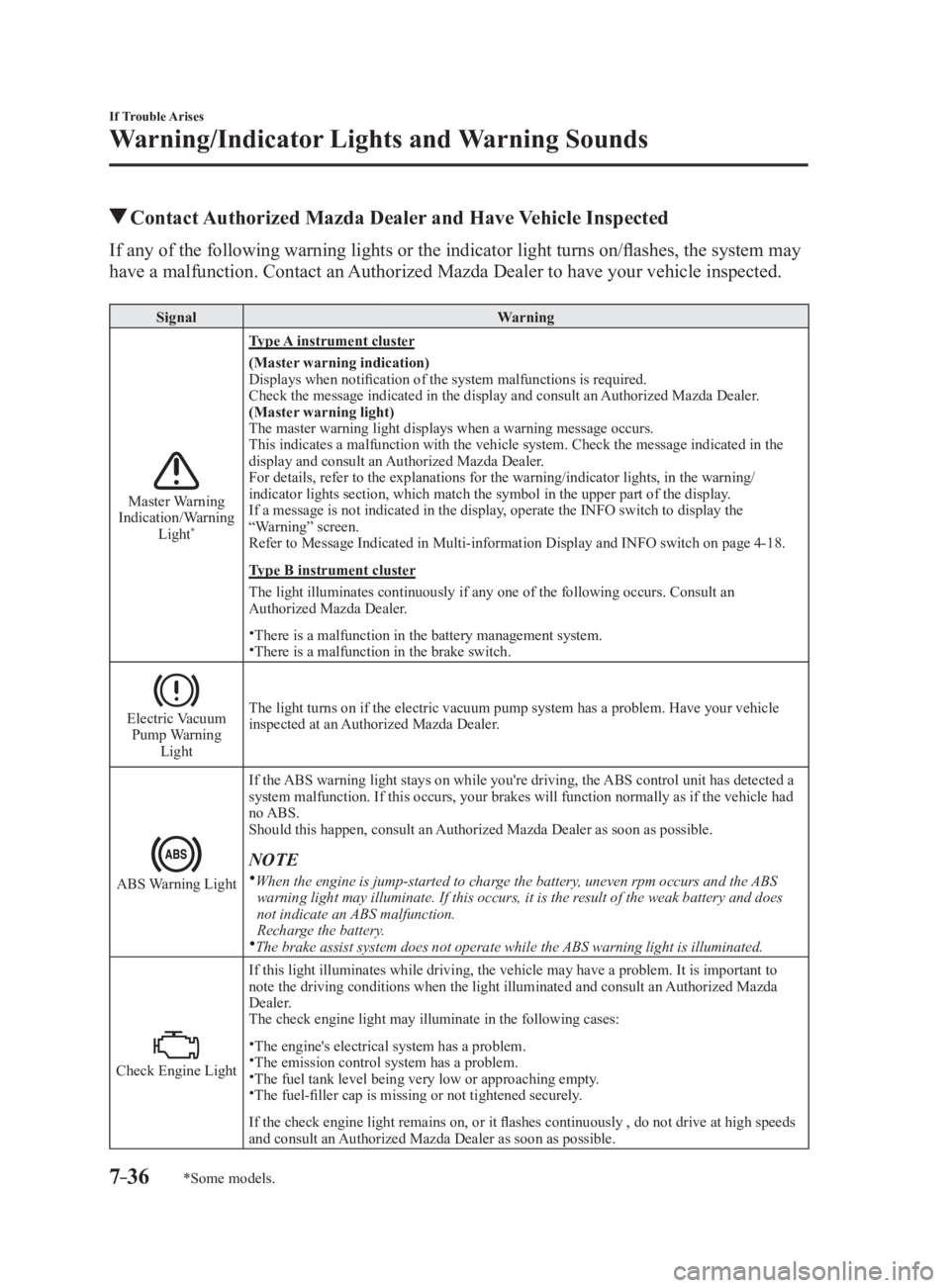
*Some models. Contact Authorized Mazda Dealer and Have Vehicle InspectedIf any of the following warning lights or the indicator light t urns on/flashes, the system may
have a malfunction. Contact an Authorized Mazda Dealer to have your vehicle inspected. Signal Warning
Master Warning
Indication/Warning
Light *
Type A instrument cluster
(Master warning indication)
Displays when notification of the system malfunctions is require d.
Check the message indicated in the display and consult an Authorized Mazda Dealer.
(Master warning light)
The master warning light displays when a warning message occurs.
This indicates a malfunction with the vehicle system. Check the message indicated in the
display and consult an Authorized Mazda Dealer.
For details, refer to the explanations for the warning/indicato r lights, in the warning/
indicator lights section, which match the symbol in the upper part of the display.
If a message is not indicated in the display, operate the INFO switch to display the
“Warning” screen.
Refer to Message Indicated in Multi-information Display and INF O switch on page 4-18 .
Type B instrument cluster
The light illuminates continuously if any one of the following occurs. Consult an
Authorized Mazda Dealer.
There is a malfunction in the battery management system.
There is a malfunction in the brake switch.
Electric Vacuum
Pump Warning
Light The light turns on if the electric vacuum pump system has a problem. Have your vehicle
inspected at an Authorized Mazda Dealer.
ABS Warning Light If the ABS warning light stays on while you're driving, the ABS control unit has detected a
system malfunction. If this occurs, your brakes will function normally as if the vehicle had
no ABS.
Should this happen, consult an Authorized Mazda Dealer as soon as possible.
NOTE
When the engine is jump-started to charge the battery, uneven rpm occurs and the ABS
warning light may illuminate. If this occurs, it is the result of the weak battery and does
not indicate an ABS malfunction.
Recharge the battery.
The brake assist system does not operate while the ABS warning light is illuminated.
Check Engine Light If this light illuminates while driving, the vehicle may have a problem. It is important to
note the driving conditions when the light illuminated and consult an Authorized Mazda
Dealer.
The check engine light may illuminate in the following cases:
The engine's electrical system has a problem.
The emission control system has a problem.
The fuel tank level being very low or approaching empty.
The fuel-filler cap is missing or not tightened securely.
If the check engine light remains on, or it flashes continuously , do not drive at high speeds
and consult an Authorized Mazda Dealer as soon as possible.
MX-5_8FR4-EA-16J_Edition1.indb 36 2016/08/11 20:30:03