tire pressure MAZDA MX5 MIATA 2017 Owners Manual
[x] Cancel search | Manufacturer: MAZDA, Model Year: 2017, Model line: MX5 MIATA, Model: MAZDA MX5 MIATA 2017Pages: 568, PDF Size: 16.58 MB
Page 8 of 568

1 –2 Pictorial Index
Interior Overview
Interior Equipment (View A)
Door-lock knob ..................................................................................................... page 3-17
Turn and lane-change signal ................................................................................. page 4-50
Lighting control ..................................................................................................... page 4-45
Wiper and washer lever ......................................................................................... page 4-51
DSC OFF switch ................................................................................................... page 4-68
Tire pressure monitoring system set switch ........................................................ page 4-108
Blind Spot Monitoring (BSM) switch ................................................................... page 4-90
LDWS switch ........................................................................................................ page 4-82
Outside mirror switch ............................................................................................ page 3-28
Door-lock switch ................................................................................................... page 3-14
Power window lock switch ................................................................................... page 3-33
Power window switches ........................................................................................ page 3-31
The equipment and installation position varies by vehicle
MX-5_8FR4-EA-16J_Edition1.indb 2 2016/08/11 20:28:18
Page 110 of 568
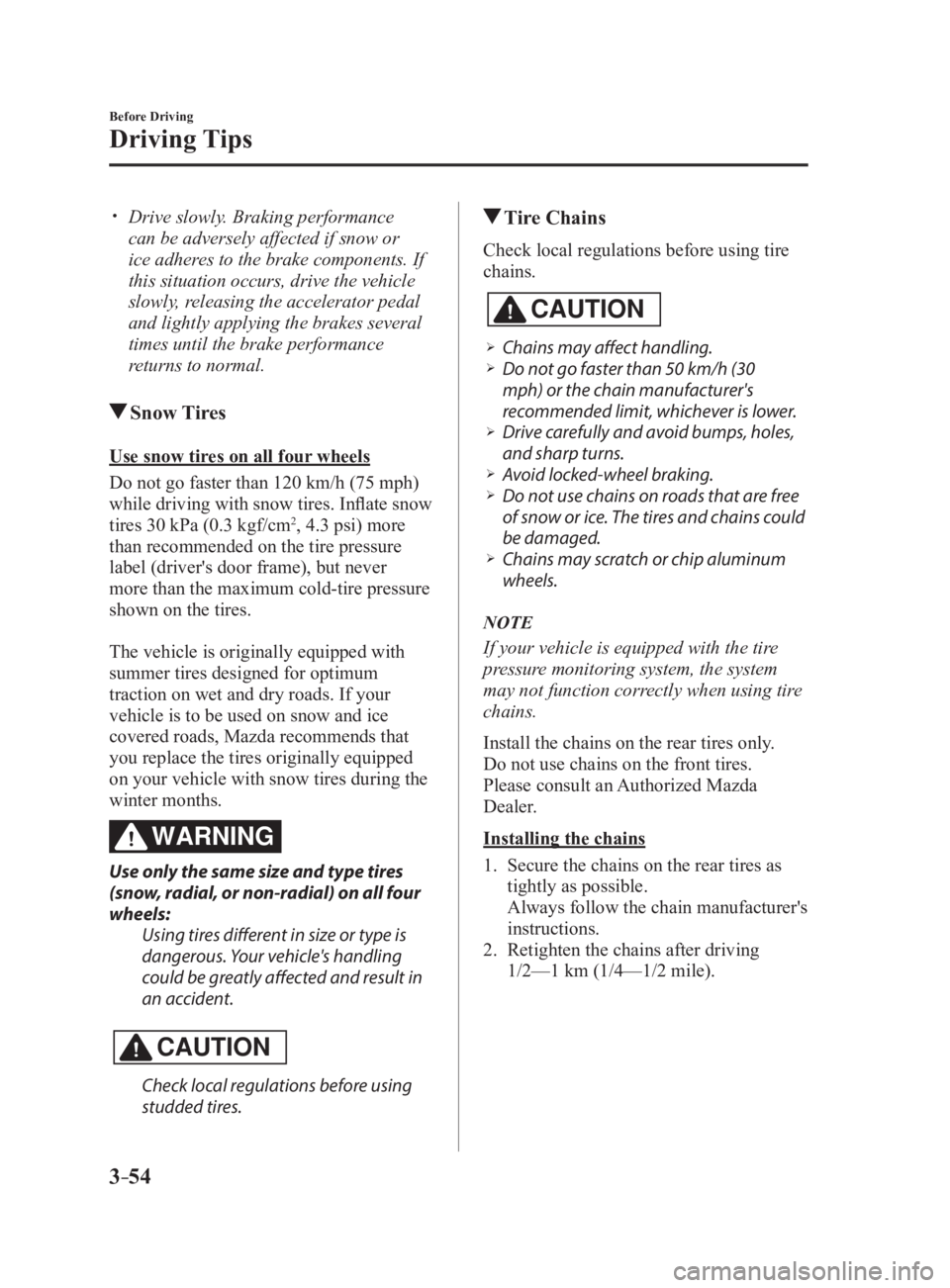
3 –54 Before Driving
Driving Tips
Drive slowly. Braking performance
can be adversely affected if snow or
ice adheres to the brake components. If
this situation occurs, drive the vehicle
slowly, releasing the accelerator pedal
and lightly applying the brakes several
times until the brake performance
returns to normal.
Snow TiresUse snow tires on all four wheels
Do not go faster than 120 km/h (75 mph)
while driving with snow tires. Inflate snow
tires 30 kPa (0.3 kgf/cm 2
, 4.3 psi) more
than recommended on the tire pressure
label (driver's door frame), but never
more than the maximum cold-tire pressure
shown on the tires.
The vehicle is originally equipped with
summer tires designed for optimum
traction on wet and dry roads. If your
vehicle is to be used on snow and ice
covered roads, Mazda recommends that
you replace the tires originally equipped
on your vehicle with snow tires during the
winter months.
WARNINGUse only the same size and type tires
(snow, radial, or non-radial) on all four
wheels:
Using tires different in size or type is
dangerous. Your vehicle's handling
could be greatly affected and result in
an accident.
CAUTION Check local regulations before using
studded tires. Tire Chains Check local regulations before using tire
chains.
CAUTION
Chains may affect handling.
Do not go faster than 50 km/h (30
mph) or the chain manufacturer's
recommended limit, whichever is lower.
Drive carefully and avoid bumps, holes,
and sharp turns.
Avoid locked-wheel braking.
Do not use chains on roads that are free
of snow or ice. The tires and chains could
be damaged.
Chains may scratch or chip aluminum
wheels.
NOTE
If your vehicle is equipped with the tire
pressure monitoring system, the system
may not function correctly when using tire
chains.
Install the chains on the rear tires only.
Do not use chains on the front tires.
Please consult an Authorized Mazda
Dealer.
Installing the chains
1. Secure the chains on the rear tires as
tightly as possible.
Always follow the chain manufacturer's
instructions.
2. Retighten the chains after driving
1/2—1 km (1/4—1/2 mile).
MX-5_8FR4-EA-16J_Edition1.indb 54 2016/08/11 20:28:39
Page 116 of 568

4 –2 *Some models.Tire Pressure Monitoring System ... 4-105
Tire Pressure Monitoring
System *
....................................... 4-105
MX-5_8FR4-EA-16J_Edition1.indb 2 2016/08/11 20:28:40
Page 141 of 568

4 –27 When Driving
Instrument Cluster and Display
*Some models.Signal Warning Lights Page
Electric Vacuum Pump Warning Light *1
7-36
ABS Warning Light *1
Electronic Brake Force
Distribution System
Warning
7-33
ABS warning
7-36
Check Engine Light *1
7-36*
Automatic Transmission Warning Indication/Warning Light *1
7-36
Air Bag/Seat Belt Pretensioner System Warning Light *1
7-36*
Tire Pressure Monitoring System Warning Light *1
Flashing
7-36
Illuminate
7-41
(Red) *
KEY Warning Indication/Warning Light *1
Malfunction
7-36
Except malfunction
7-41
(Amber) *
KEY Warning Indication 7-36*
Lane Departure Warning System (LDWS) Warning Indication/
Warning Light *1
Illuminated
7-36
Flashing
4-83
(Amber) *
High Beam Control System (HBC) Warning Indication/
Warning Light *1
7-36*
Blind Spot Monitoring (BSM) Warning Indication 7-36*
Retractable Fastback Warning Indication 7-36
LED Headlight Warning Light *1
7-36
MX-5_8FR4-EA-16J_Edition1.indb 27 2016/08/11 20:28:48
Page 143 of 568
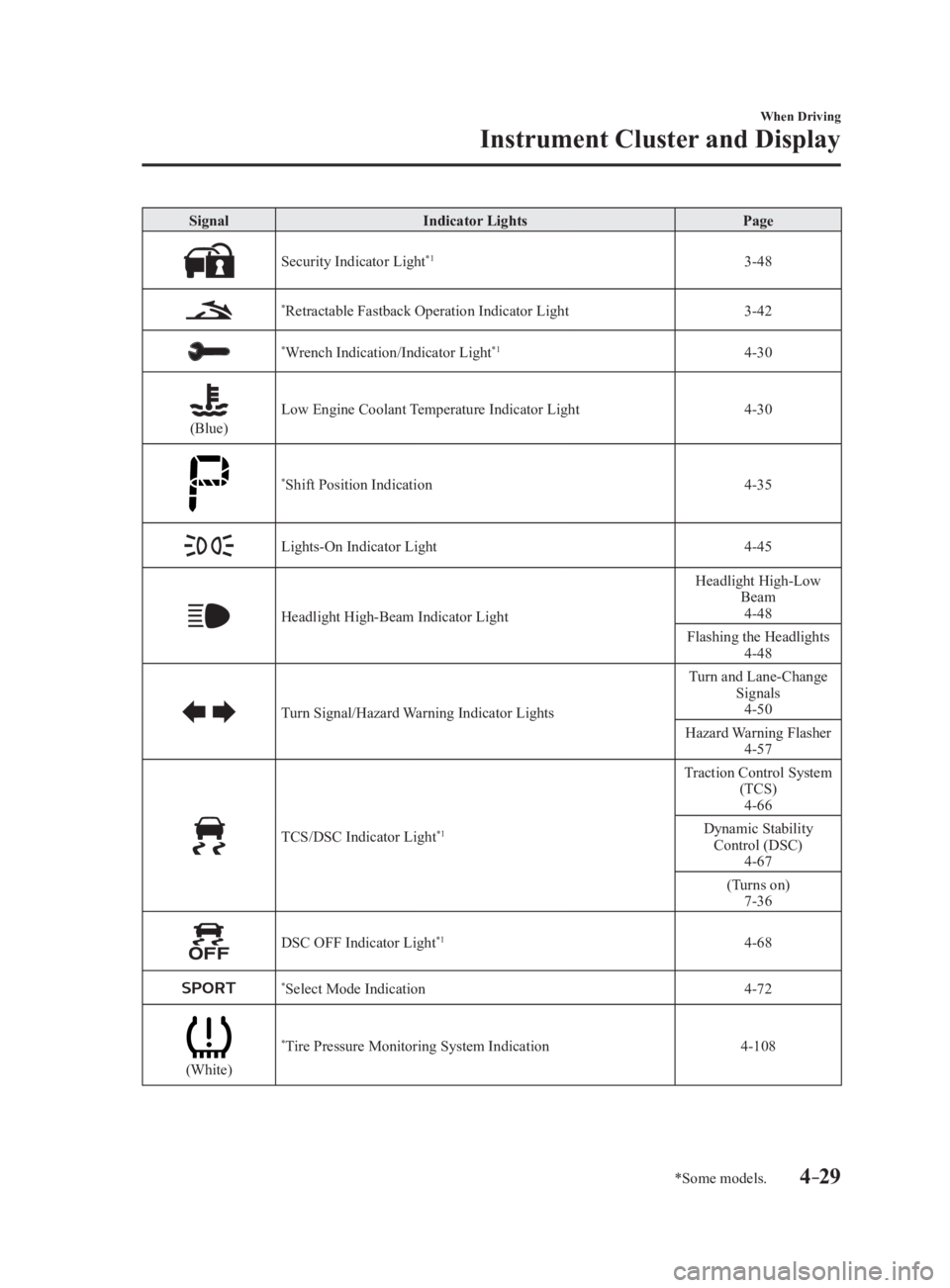
4 –29 When Driving
Instrument Cluster and Display
*Some models.Signal Indicator Lights Page
Security Indicator Light *1
3-48*
Retractable Fastback Operation Indicator Light 3-42*
Wrench Indication/Indicator Light *1
4-30
(Blue) Low Engine Coolant Temperature Indicator Light 4-30*
Shift Position Indication 4-35
Lights-On Indicator Light 4-45
Headlight High-Beam Indicator Light Headlight High-Low
Beam
4-48
Flashing the Headlights
4-48
Turn Signal/Hazard Warning Indicator Lights Turn and Lane-Change
Signals
4-50
Hazard Warning Flasher
4-57
TCS/DSC Indicator Light *1
Traction Control System
(TCS)
4-66
Dynamic Stability
Control (DSC)
4-67
(Turns on)
7-36
DSC OFF Indicator Light *1
4-68*
Select Mode Indication 4-72
(White) *
Tire Pressure Monitoring System Indication 4-108
MX-5_8FR4-EA-16J_Edition1.indb 29 2016/08/11 20:28:48
Page 195 of 568

4 –81 When Driving
i-ACTIVSENSE
Under the following conditions, the LDWS may not be able to detect white or yellow lines
correctly and the LDWS may not operate correctly.
If an object placed on the dashboard is reflected in the windshield and picked up by the
camera.
Heavy luggage is loaded in the luggage compartment the vehicle is inclined.
The tire pressures are not adjusted to the specified pressure.
When the vehicle is driven on the entry and exit to or from the rest area or tollgate of a
highway.
The white or yellow lines are less visible because of dirt or paint flaking.
The vehicle ahead is running near a white or yellow line and the line is less visible.
A white or yellow line is less visible because of bad weather (rain, fog, or snow).
The vehicle is driven on a temporary lane or section with a closed lane due to
construction.
A misleading line is picked up on the road such as a temporary line for construction,
or because of shade, lingering snow, or grooves filled with water.
The surrounding brightness suddenly changes such as when entering or exiting a
tunnel.
The illumination of the headlights is weakened because of dirt or the optical axis is
deviated.
The windshield is dirty or foggy.
Back-light is reflecting from the road surface.
The road surface is wet and shiny after rain, or there are puddles on the road.
The shade of a guardrail parallel to a white or yellow line is on the road.
The width of a lane is excessively narrow or wide.
The road is excessively uneven.
The vehicle is shaken after hitting a road bump.
There are two or more adjacent white or yellow lines.
There are various road markings or lane markings of various shapes near an
intersection.
MX-5_8FR4-EA-16J_Edition1.indb 81 2016/08/11 20:29:01
Page 219 of 568

4 –105 When Driving
Tire Pressure Monitoring System
*Some models.Tire Pressure Monitoring System *
The Tire Pressure Monitoring System (TPMS) monitors the air pressure of all four tires. If
the air pressure of one or more tires is too low, the system warns the driver by indicating the
tire pressure monitoring system warning light in the instrument cluster and operating a beep
sound. The system monitors the tire pressures indirectly using the data sent from the ABS
wheel speed sensors.
To allow the system to operate correctly, the system needs to be initialized with the specified
tire pressure (value on the tire pressure label). Follow the pr ocedure and perform the
initialization.
Refer to Tire Pressure Monitoring System Initialization on page 4-108 .
The warning light flashes when the system has a malfunction.
Refer to Warning Indication/Warning Lights on page 4-26 .
ABS wheel speed sensor
MX-5_8FR4-EA-16J_Edition1.indb 105 2016/08/11 20:29:05
Page 220 of 568

4 –106 When Driving
Tire Pressure Monitoring System
CAUTION
Each tire, including the spare (if provided), should be checked monthly when cold and
inflated to the inflation pressure recommended by the vehicle manufacturer on the vehicle
placard or tire inflation pressure label. (If your vehicle has tires of a different size than the
size indicated on the vehicle placard or tire inflation pressure label, you should determine
the proper tire inflation pressure for those tires.)
As an added safety feature, your vehicle has been equipped with a tire pressure monitoring
system (TPMS) that illuminates a low tire pressure telltale when one or more of your tires
is significantly under-inflated. Accordingly, when the low tire pressure telltale illuminates,
you should stop and check your tires as soon as possible, and inflate them to the proper
pressure. Driving on a significantly under-inflated tire causes the tire to overheat and can
lead to tire failure. Under-inflation also reduces fuel efficiency and tire tread life, and may
affect the vehicle's handling and stopping ability.
Please note that the TPMS is not a substitute for proper tire maintenance, and it is the
driver's responsibility to maintain correct tire pressure, even if under-inflation has not
reached the level to trigger illumination of the TPMS low tire pressure telltale.
Your vehicle has also been equipped with a TPMS malfunction indicator to indicate when
the system is not operating properly.
The TPMS malfunction indicator is combined with the low tire pressure telltale. When the
system detects a malfunction, the telltale will flash for approximately one minute and then
remain continuously illuminated. This sequence will continue upon subsequent vehicle
start-ups as long as the malfunction exists. When the malfunction indicator is illuminated,
the system may not be able to detect or signal low tire pressure as intended. TPMS
malfunctions may occur for a variety of reasons, including the installation of replacement
or alternate tires or wheels on the vehicle that prevent the TPMS from functioning properly.
Always check the TPMS malfunction telltale after replacing one or more tires or wheels on
your vehicle to ensure that the replacement or alternate tires and wheels allow the TPMS to
continue to function properly.
To avoid false readings, the system samples for a little while before indicating a problem. As
a result it will not instantaneously register a rapid tire deflation or blow out.
MX-5_8FR4-EA-16J_Edition1.indb 106 2016/08/11 20:29:05
Page 221 of 568

4 –107 When Driving
Tire Pressure Monitoring SystemNOTE
Because this system detects slight changes in tire conditions, the timing of the warning may
be faster or slower in the following cases:
The size, manufacturer, or the type of tires is different from the specification.
The size, manufacturer, or the type of a tire is different from the others, or the level of tire
wear is excessively different between them.
A run-flat tire, studless tire, snow tire, or tire chains are used.
An emergency tire is used (The tire pressure monitoring system warning light may flash
and then continue illuminating).
A tire is repaired using the emergency flat tire repair kit.
The tire pressure is excessively higher than the specified pressure, or the tire pressure is
suddenly lowered for some reason such as a tire burst during driving.
The vehicle speed is lower than about 15 km/h (9.3 mph) (including when the vehicle is
stopped), or the drive period is shorter than 5 minutes.
The vehicle is driven on an extremely rough road or a slippery, icy road.
Hard steering and rapid acceleration/deceleration are repeated such as during aggressive
driving on a winding road.
Load on the vehicle is applied to a tire such as by loading heavy luggage to one side of
the vehicle.
System initialization has not been implemented with the specifie d tire pressure.
MX-5_8FR4-EA-16J_Edition1.indb 107 2016/08/11 20:29:05
Page 222 of 568

4 –10 8 When Driving
Tire Pressure Monitoring System Tire Pressure Monitoring System
InitializationIn the following cases, system
initialization must be performed so that the
system operates normally.
A tire pressure is adjusted.
Tire rotation is performed.
A tire or wheel is replaced.
The battery is replaced or completely
drained.
The tire pressure monitoring system
warning light is illuminated.
Initialization method
1. Park the car in a safe place and firmly
apply the parking brake.
2. Let the tires cool, then adjust the tire
pressure of all four (4) tires to the
specified pressure indicated on the tire
pressure label located on the driver's
door frame (door open).
Refer to Tires on page 9-8 .
3. Switch the ignition ON.
4. Press and hold the tire pressure
monitoring system set switch and
verify that the tire pressure monitoring
system warning light in the instrument
cluster flashes twice and a beep sound
is heard once. CAUTION If the system initialization is performed
without adjusting the tire pressure,
the system cannot detect the normal
tire pressure and it may not illuminate
the tire pressure monitoring system
warning light even if a tire pressure is
low, or it may illuminate the light even
if the pressures are normal.
Adjust the tire pressure on all four
tires and initialize the system when
the warning light is turned on. If the
warning light turns on for a reason
other than a flat tire, the tire pressure
of all four tires may have decreased
naturally.
The system initialization will not be
performed if the switch is pressed while
the vehicle is being driven.
MX-5_8FR4-EA-16J_Edition1.indb 108 2016/08/11 20:29:06