tow MERCEDES-BENZ A CLASS 2012 User Guide
[x] Cancel search | Manufacturer: MERCEDES-BENZ, Model Year: 2012, Model line: A CLASS, Model: MERCEDES-BENZ A CLASS 2012Pages: 356, PDF Size: 4.96 MB
Page 20 of 356
Outside temperature ...................... 209
Setting (climate control)
................128
TEMPOMAT
Function/notes ............................. 168
Theft-deterrent system
ATA (Anti-Theft Alarm system) .........69
Immobiliser ...................................... 69
Through-loading ................................ 271
Time see Separate Owner's manual
Timing (RACETIMER) .........................226
TIREFIT kit .......................................... 301
Top Tether ............................................ 54
Tow-away protection .......................... 70
Towing Important safety notes .................. 310
Towing a trailer
Active Parking Assist .....................190
Axle load, permissible .................... 349
Bulb failure indicator for LED lamps 206
ESP ®
(Electronic Stability Program) . 68
Pulling away with a trailer ..............145
Trailer tow hitch display message .. 255
Towing away
Fitting the towing eye ....................311
Removing the towing eye ...............312
With both axles on the ground ....... 312
With front axle raised ..................... 312
Tow-starting
Emergency engine starting ............ 314
Fitting the towing eye ....................311
Important safety notes .................. 310
Removing the towing eye ...............312
Trailer coupling
see Towing a trailer
Trailer towing
7-pin connector ............................. 206
Blind Spot Assist ............................ 199
Cleaning the trailer tow hitch ......... 294
Coupling up a trailer ......................204
Decoupling a trailer ....................... 204
Driving tips .................................... 201
Folding in the ball coupling ............205
Folding out the ball coupling ..........203
Important safety notes .................. 201
Lights display message .................. 239
Mounting dimensions .................... 348Parktronic ......................................
185
Power supply ................................. 206
Trailer loads ................................... 349
Transmission
see Automatic transmission
see Manual transmission
Transmission position display
(DIRECT SELECT lever) ......................152
Transporting the vehicle .................. 313
Trim pieces (cleaning instructions) . 295
Trip computer (on-board computer) 211
Trip meter Calling up ....................................... 211
Resetting (on-board computer) ...... 213
Turn signals
Changing bulbs (front) ................... 115
Changing bulbs (rear) .................... 116
Switching on/off ........................... 107
TV
Operating (on-board computer) ..... 215
see Separate operating instructions
Two-way radio
Frequencies ................................... 336
Installation ..................................... 336
Transmission output (maximum) .... 336
Type identification plate
see Vehicle identification plate
Tyre pressure
Display message ............................ 251
Not reached (TIREFIT) .................... 303
Reached (TIREFIT) .......................... 303
Recommended ............................... 321
Tyre pressure loss warning
Important safety notes .................. 323
Restarting ...................................... 323
Tyres
Changing a wheel .......................... 324
Checking ........................................ 319
Direction of rotation ......................324
Display message ............................ 251
Important safety notes .................. 318
M+S tyres ...................................... 320
MOExtended tyres .........................320
Replacing ....................................... 324
Service life ..................................... 319
Storing ........................................... 324
Summer tyres ........................ 168, 32018
Index
Page 21 of 356
Tyre size (data)
.............................. 329
Tyre tread ...................................... 319
see Flat tyre
U
Unladen weight ................................. 346
Unlocking Emergency unlocking .......................81
From inside the vehicle (central
unlocking button) ............................. 80V
Vanity mirror (in sun visor) .............. 277
Variable SPEEDTRONIC see SPEEDTRONIC
Vehicle
Correct use ...................................... 24
Data acquisition ............................... 25
Electronics ..................................... 336
Equipment ....................................... 22
Implied warranty .............................. 24
Individual settings ..........................220
Leaving parked up ......................... 164
Locking (in an emergency) ............... 81
Locking (key) ................................... 75
Lowering ........................................ 329
Pulling away ................................... 144
Raising ........................................... 326
Registration ..................................... 24
Securing from rolling away ............325
Towing away .................................. 310
Tow-starting ................................... 310
Transporting .................................. 313
Unlocking (in an emergency) ........... 81
Unlocking (key) ................................ 75
Vehicle data ................................... 346
Vehicle data ....................................... 346
Vehicle dimensions ...........................346
Vehicle emergency locking ................81
Vehicle identification number see VIN
Vehicle identification plate ..............338
Vehicle maintenance see ASSYST PLUS
Vehicle tool kit .................................. 299
Vehicle weights ................................. 346Video (DVD)
........................................
215
Video DVD (on-board computer) ......215
VIN ...................................................... 338 W
Warning and indicator lamps ABS
................................................ 258
Brakes ........................................... 258
Distance warning signal ................. 266
ESP ®
.............................................. 260
ESP ®
OFF ....................................... 261
Fuel tank ........................................ 264
LIM (cruise control) ........................ 169
LIM (DISTRONIC PLUS) .................. 174
LIM (variable SPEEDTRONIC) ......... 171
Overview .......................................... 32
PASSENGER AIRBAG OFF ................ 52
Reserve fuel ................................... 264
Seat belt ........................................ 257
SRS ................................................ 263
Warning triangle ................................ 298
Washer fluid
Display message ............................ 256
Wheel bolt tightening torque ...........329
Wheel chock ...................................... 325
Wheels Changing/replacing .......................324
Changing a wheel .......................... 324
Checking ........................................ 319
Cleaning ......................................... 292
Cleaning (warning) .........................324
Emergency spare wheel ................. 332
Fitting a new wheel ........................328
Fitting a wheel ............................... 325
Important safety notes .................. 318
Removing a wheel ..........................328
Storing ........................................... 324
Tightening torque ........................... 329
Wheel size/tyre size ......................329
Windowbag
Display message ............................ 239
Operation ......................................... 45
Windows
Cleaning ......................................... 293
see Side windows
Windscreen
Demisting ...................................... 130 Index
19
Page 26 of 356
G
WARNING
Objects in the driver's footwell can restrict the
pedal travel or obstruct a depressed pedal.
The operating and road safety of the vehicle
is jeopardised. There is a risk of an accident.
Make sure that all objects in the vehicle are
stowed correctly, and that they cannot enter
the driver's footwell. Fit the floormats
securely and as specified in order to ensure
sufficient
clearance for the pedals. Do not use
loose floormats.
! If the engine is switched off and equip-
ment on the diagnostics connection is
used, the starter battery may discharge.
Connecting equipment to the diagnostics
connection can lead to emissions monitoring
information being reset, for example. This
may lead to the vehicle failing to meet the
requirements of the next emissions test dur-
ing the main inspection. Qualified specialist workshop
A qualified specialist workshop has the nec-
essary special skills, tools and qualifications
to correctly carry out any necessary work on
your
vehicle. This particularly applies to work
relevant to safety.
Observe the notes in the Service Booklet.
Always have the following work carried out at
a qualified specialist workshop:
R work relevant to safety
R service and maintenance work
R repair work
R modifications, installations and conver-
sions
R work on electronic components
Mercedes-Benz recommends that you use a
Mercedes-Benz Service Centre. Vehicle registration
Mercedes-Benz may ask its Service Centres
to carry out technical inspections on certain
vehicles. The quality or safety of the vehicle
is improved as a result of the inspection.
Mercedes-Benz can only inform you about
vehicle
checks if it has your registration data.
It is possible that your vehicle has not yet
been registered in your name in the following
cases:
R if your vehicle was not purchased at an
authorised specialist dealer.
R if your vehicle has not yet been examined
at a Mercedes-Benz Service Centre.
It is advisable to register your vehicle with a
Mercedes-Benz Service Centre.
Inform Mercedes-Benz as soon as possible
about any change in address or vehicle own-
ership. Correct use
If you remove any warning stickers, you or
others
could fail to recognise certain dangers.
Leave warning stickers in position.
Observe the following information when driv-
ing your vehicle:
R the safety notes in this manual
R the technical data in this manual
R traffic rules and regulations
R laws and safety standards pertaining to
motor vehicles Implied warranty
! Follow the instructions in this manual
about the proper operation of your vehicle
as well as about possible vehicle damage.
Damage to your vehicle that arises from
culpable contraventions against these
instructions are not covered either by
Mercedes-Benz implied warranty or by the
New or Used-Vehicle Warranty. 24
Introduction
Page 37 of 356
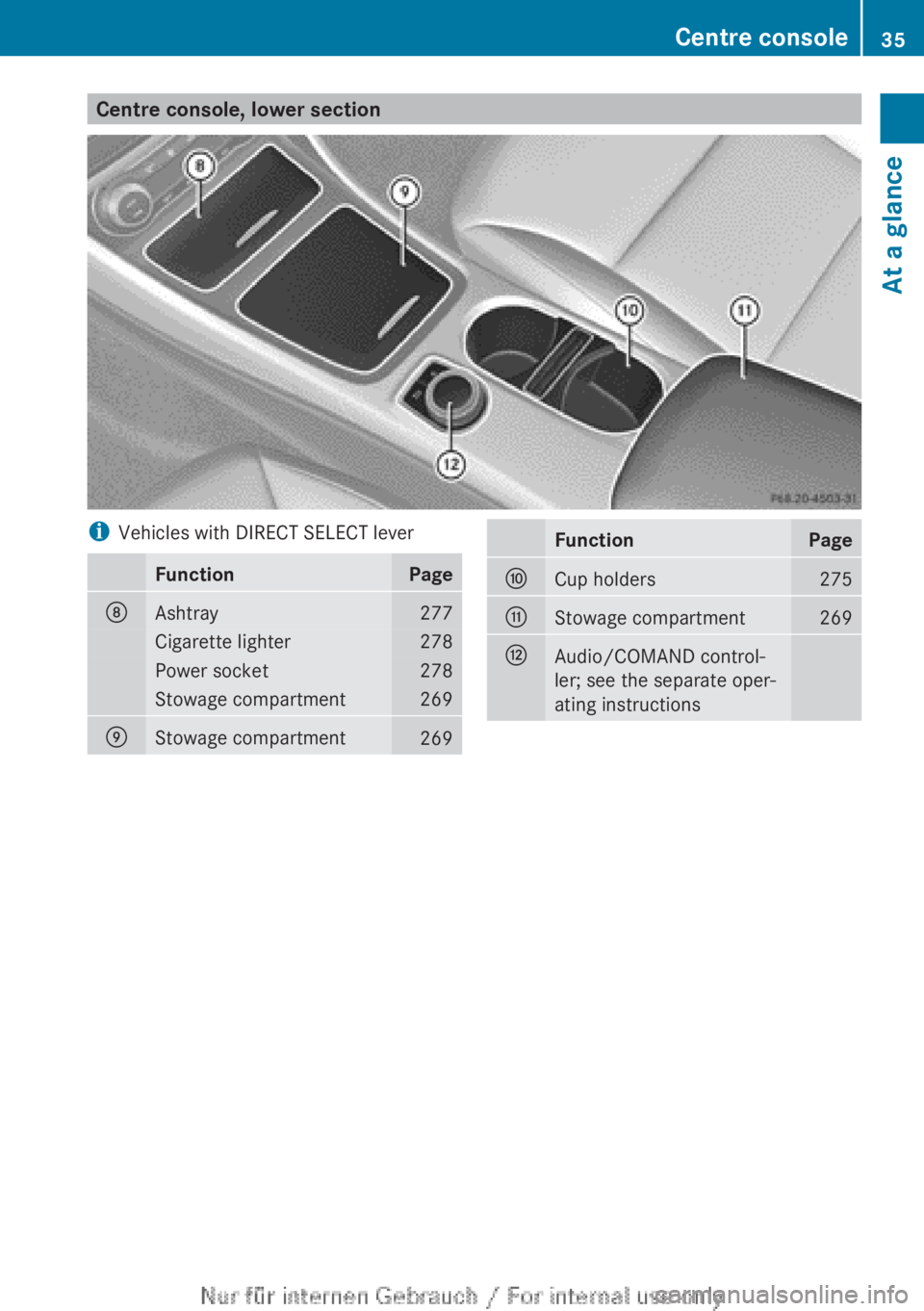
Centre console, lower section
i
Vehicles with DIRECT SELECT lever Function Page
D
Ashtray 277
Cigarette lighter 278
Power socket 278
Stowage compartment 269
E
Stowage compartment
269 Function Page
F
Cup holders 275
G
Stowage compartment 269
H
Audio/COMAND control-
ler; see the separate oper-
ating instructions Centre console
35At a glance
Page 38 of 356
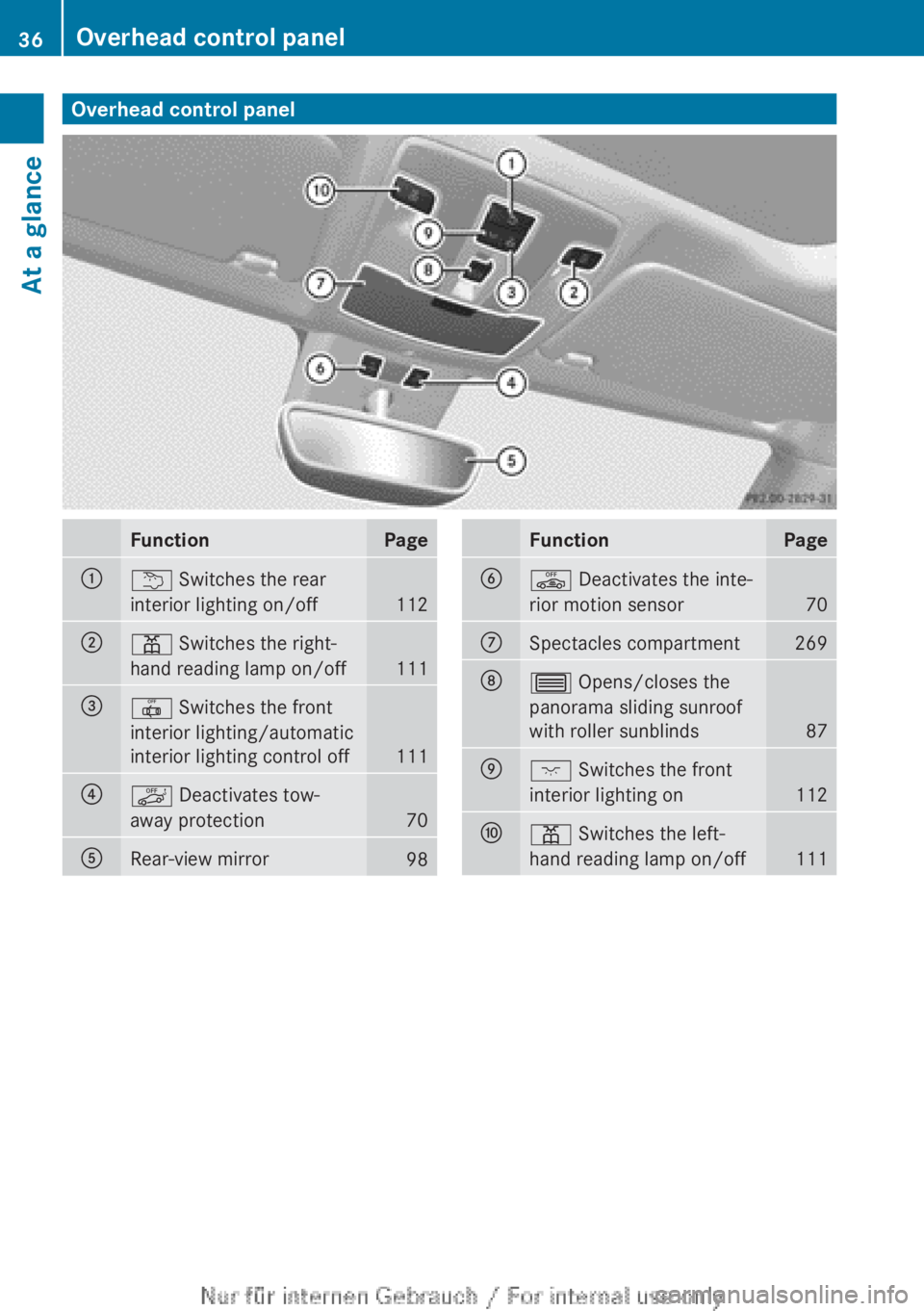
Overhead control panel
Function Page
:
u Switches the rear
interior lighting on/off
112
;
p Switches the right-
hand reading lamp on/off
111
=
| Switches the front
interior lighting/automatic
interior lighting control off
111
?
ë Deactivates tow-
away protection
70
A
Rear-view mirror
98 Function Page
B
ê Deactivates the inte-
rior motion sensor
70
C
Spectacles compartment 269
D
3 Opens/closes the
panorama sliding sunroof
with roller sunblinds
87
E
c Switches the front
interior lighting on
112
F
p Switches the left-
hand reading lamp on/off
11136
Overhead control panelAt a glance
Page 42 of 356
Useful information
i This Owner's Manual describes all mod-
els,
series and optional equipment for your
vehicle that were available at the time of
going to press. National variations are pos-
sible. Note that your vehicle may not be
equipped with all of the functions descri-
bed. This is also the case for systems and
functions relevant to safety.
i Read the information on qualified special-
ist workshops: (Y page 24). Occupant safety
Important safety notes
G
WARNING
If service work is not carried out correctly, the
operating
safety of your vehicle may be affec-
ted. This could cause you to lose control of
your vehicle and cause an accident. More-
over, the safety systems may no longer be
able to protect you or others as they are
designed to do.
Always have service work carried out at a
qualified specialist workshop. G
WARNING
Modifications to or work performed incor-
rectly on the following parts can result in the
restraint
systems not functioning as intended:
R the restraint system, consisting of seat
belts and their anchorage points, belt ten-
sioners, belt force limiters and airbags
R the wiring
R networked electronic systems
Airbags and belt tensioners could fail to
deploy or be triggered in an accident despite
the deceleration force being sufficient to trig-
ger the systems, or could be triggered unin-
tentionally. For this reason, never make any
modifications to the restraint systems.
Therefore, you must not tamper with elec-
tronic components or their software. The seat belts, together with SRS (Supple-
mental Restraint System), are complemen-
tary, co-ordinated restraint systems
(Y page 41). They reduce the risk of injury
in specific, pre-defined types of accident sit-
uations and thereby increase occupant
safety. However, seat belts and airbags gen-
erally do not protect against objects pene-
trating the vehicle from the outside.
To ensure that the restraint systems can
deliver their full potential protection, make
sure that:
R
the seat and head restraint are adjusted
properly
(Y page 92)
R the seat belt has been fastened properly
(Y page 46)
R the airbags can inflate unrestricted if
deployed ( Y page 42)
R the steering wheel is adjusted properly
(Y page 98)
R the restraint systems have not been modi-
fied
An airbag increases the protection of vehicle
occupants wearing a seat belt. However, air-
bags are only an additional restraint system
which complements, but does not replace,
the seat belt. All vehicle occupants must wear
their seat belt correctly at all times, even if
the vehicle is equipped with airbags. The air-
bags are not deployed in all types of acci-
dents. For example, if the protective capacity
of correctly fastened seat belts is not
increased by deploying the airbags, the air-
bags will not deploy.
Airbag deployment only provides increased
protection if the seat belt is worn correctly.
The seat belt helps, firstly, to keep the vehicle
occupant in the best position in relation to the
airbag. Secondly, in a head-on collision, for
example, the seat belt prevents the vehicle
occupant from being propelled towards the
point of impact. 40
Occupant safety
Safety
Page 51 of 356
the driver and the front passenger have fas-
tened their seat belts.
i
For more information on the 7 seat
belt warning lamp, see "Warning and indi-
cator
lamps in the instrument cluster, seat
belt" ( Y page 257).
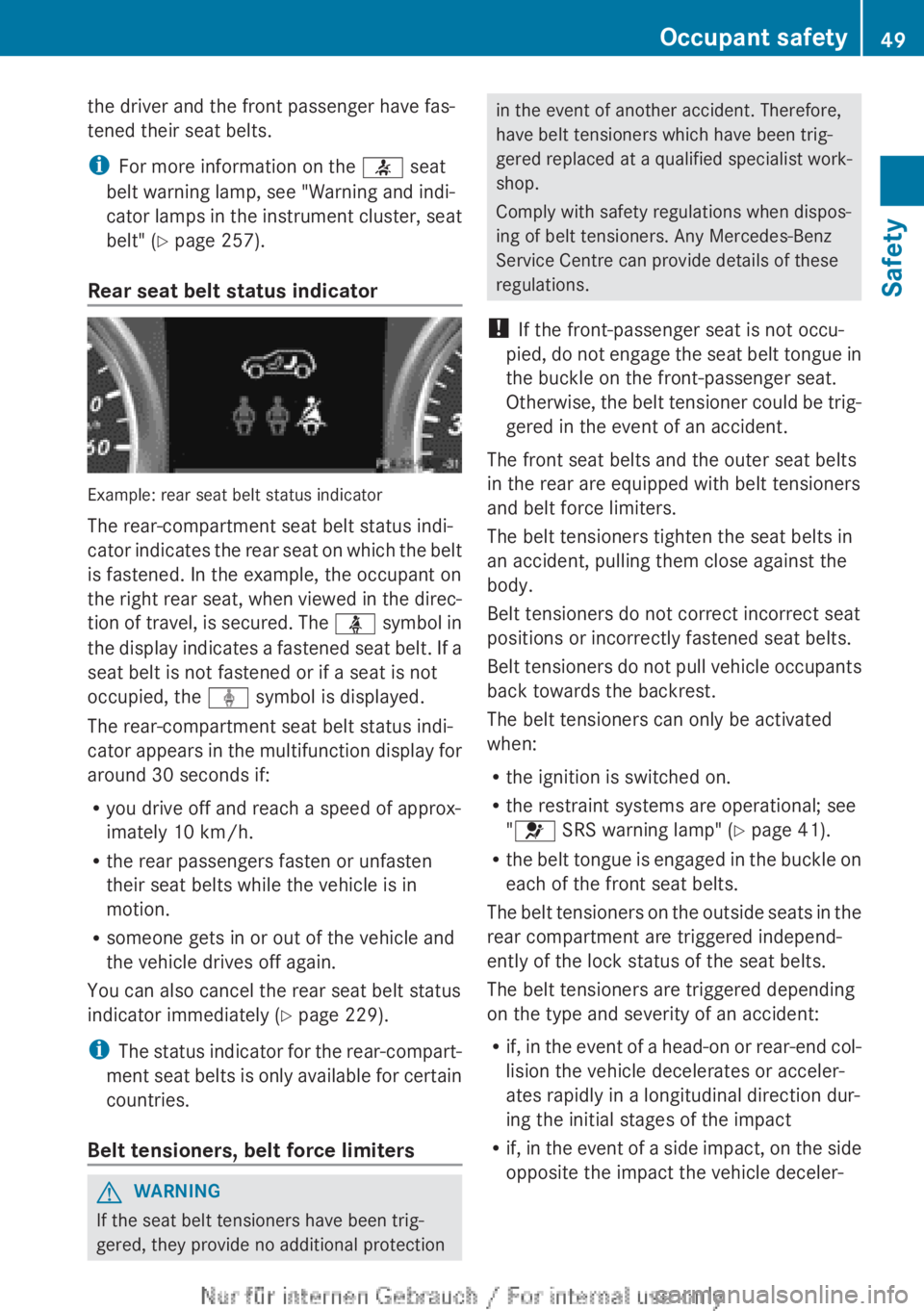
Rear seat belt status indicator Example: rear seat belt status indicator
The rear-compartment seat belt status indi-
cator
indicates the rear seat on which the belt
is fastened. In the example, the occupant on
the right rear seat, when viewed in the direc-
tion of travel, is secured. The ü symbol in
the display indicates a fastened seat belt. If a
seat belt is not fastened or if a seat is not
occupied, the ý symbol is displayed.
The rear-compartment seat belt status indi-
cator appears in the multifunction display for
around 30 seconds if:
R you drive off and reach a speed of approx-
imately 10 km/h.
R the rear passengers fasten or unfasten
their seat belts while the vehicle is in
motion.
R someone gets in or out of the vehicle and
the vehicle drives off again.
You can also cancel the rear seat belt status
indicator immediately ( Y page 229).
i The status indicator for the rear-compart-
ment seat belts is only available for certain
countries.
Belt tensioners, belt force limiters G
WARNING
If the seat belt tensioners have been trig-
gered, they provide no additional protection in the event of another accident. Therefore,
have belt tensioners which have been trig-
gered replaced at a qualified specialist work-
shop.
Comply with safety regulations when dispos-
ing of belt tensioners. Any Mercedes-Benz
Service Centre can provide details of these
regulations.
! If the front-passenger seat is not occu-
pied,
do not engage the seat belt tongue in
the buckle on the front-passenger seat.
Otherwise, the belt tensioner could be trig-
gered in the event of an accident.
The front seat belts and the outer seat belts
in the rear are equipped with belt tensioners
and belt force limiters.
The belt tensioners tighten the seat belts in
an accident, pulling them close against the
body.
Belt tensioners do not correct incorrect seat
positions or incorrectly fastened seat belts.
Belt tensioners do not pull vehicle occupants
back towards the backrest.
The belt tensioners can only be activated
when:
R the ignition is switched on.
R the restraint systems are operational; see
"6 SRS warning lamp" (Y page 41).
R the belt tongue is engaged in the buckle on
each of the front seat belts.
The belt tensioners on the outside seats in the
rear compartment are triggered independ-
ently of the lock status of the seat belts.
The belt tensioners are triggered depending
on the type and severity of an accident:
R if, in the event of a head-on or rear-end col-
lision the vehicle decelerates or acceler-
ates rapidly in a longitudinal direction dur-
ing the initial stages of the impact
R if, in the event of a side impact, on the side
opposite the impact the vehicle deceler- Occupant safety
49
Safety Z
Page 67 of 356
Adaptive brake lamps
If you brake sharply from a speed of more
than
50 km/h or if braking is assisted by BAS
or adaptive Brake Assist, the brake lamps
flash rapidly. In this way, traffic travelling
behind you is warned in an even more notice-
able manner.
If you brake sharply from a speed of more
than 70 km/h to a standstill, the hazard warn-
ing lamps are activated automatically. If the
brakes are applied again, the brake lamps
light up continuously. The hazard warning
lamps switch off automatically if you travel
faster than 10 km/h. You can also switch off
the hazard warning lamps using the hazard
warning switch button (Y page 108).
i Adaptive brake lamps are only available in
certain countries. ESP
®
(Electronic Stability Program)
General notes i
Observe
the "Important safety notes" sec-
tion (Y page 61).
ESP ®
monitors driving stability and traction,
i.e. power transmission between the tyres
and the road surface.
If ESP ®
detects that the vehicle is deviating
from the direction desired by the driver, one
or more wheels are braked to stabilise the
vehicle. The engine output is also modified to
keep the vehicle on the desired course within
physical limits. ESP ®
assists the driver when
pulling away on wet or slippery roads. ESP ®
can also stabilise the vehicle during braking.
ETS/4ETS (Electronic Traction System) i
Observe
the "Important safety notes" sec-
tion (Y page 61).
ETS/4ETS traction control is part of ESP ®
.
ETS brakes the drive wheels individually if
they spin. This enables you to pull away and
accelerate on slippery surfaces, for example if the road surface is slippery on one side. In
addition, more drive torque is transferred to
the wheel or wheels with traction.
ETS remains active when you deactivate
ESP
®
.
Important safety notes G
WARNING
If ESP ®
is malfunctioning, ESP ®
is unable to
stabilise
the vehicle. In addition, other driving
safety systems are switched off. This increa-
ses the risk of skidding and an accident.
Drive on carefully. Have ESP ®
checked at a
qualified specialist workshop.
! When testing the electric parking brake
on a braking dynamometer, switch off the
ignition. Application of the brakes by
ESP ®
may otherwise destroy the brake sys-
tem.
! Vehicles with 4MATIC: switch off the igni-
tion when the electric parking brake is
being tested using a dynamometer.
Application of the brakes by ESP ®
may oth-
erwise destroy the brake system.
! Vehicles with 4MATIC: function or per-
formance tests may only be carried out on
a 2-axle dynamometer. Before operating
the vehicle on such a dynamometer, please
consult a qualified specialist workshop.
You could otherwise damage the drive train
or the brake system.
! Do not tow vehicles with 4MATIC with the
front or rear axle raised.
Vehicles without 4MATIC: when towing your
vehicle with the front axle raised, it is impor-
tant that you observe the notes on
ESP ®
(Y page 312).
Vehicles with 4MATIC: when towing your
vehicle with both axles on the ground, it is
important that you observe the notes on
ESP ®
(Y page 312). Driving safety systems
65
Safety Z
Page 72 of 356
A visual and audible alarm is triggered if the
alarm system is primed and you open:
R
the vehicle with the emergency key ele-
ment
R a door
R the tailgate
R the bonnet
X To stop the alarm: insert the key into the
ignition lock.
The alarm is switched off.
or
X Press the % or & button on the key.
The alarm is switched off.
The alarm is not switched off, even if you
close the open door that has triggered it, for
example. Tow-away protection
Function An audible and visual alarm is triggered if your
vehicle's angle of inclination is altered while
tow-away
protection is primed. This can occur
if the vehicle is jacked up on one side, for
example.
Activating X
Make sure that:
R
the doors are closed.
R the tailgate is closed.
Only then is the tow-away protection
primed.
X Lock the vehicle with the key.
Tow-away protection is primed after
approximately
60 seconds.
Deactivating X
Unlock the vehicle with the key.
or
X Insert the key into the ignition lock.
Tow-away protection is switched off auto-
matically. Deactivating
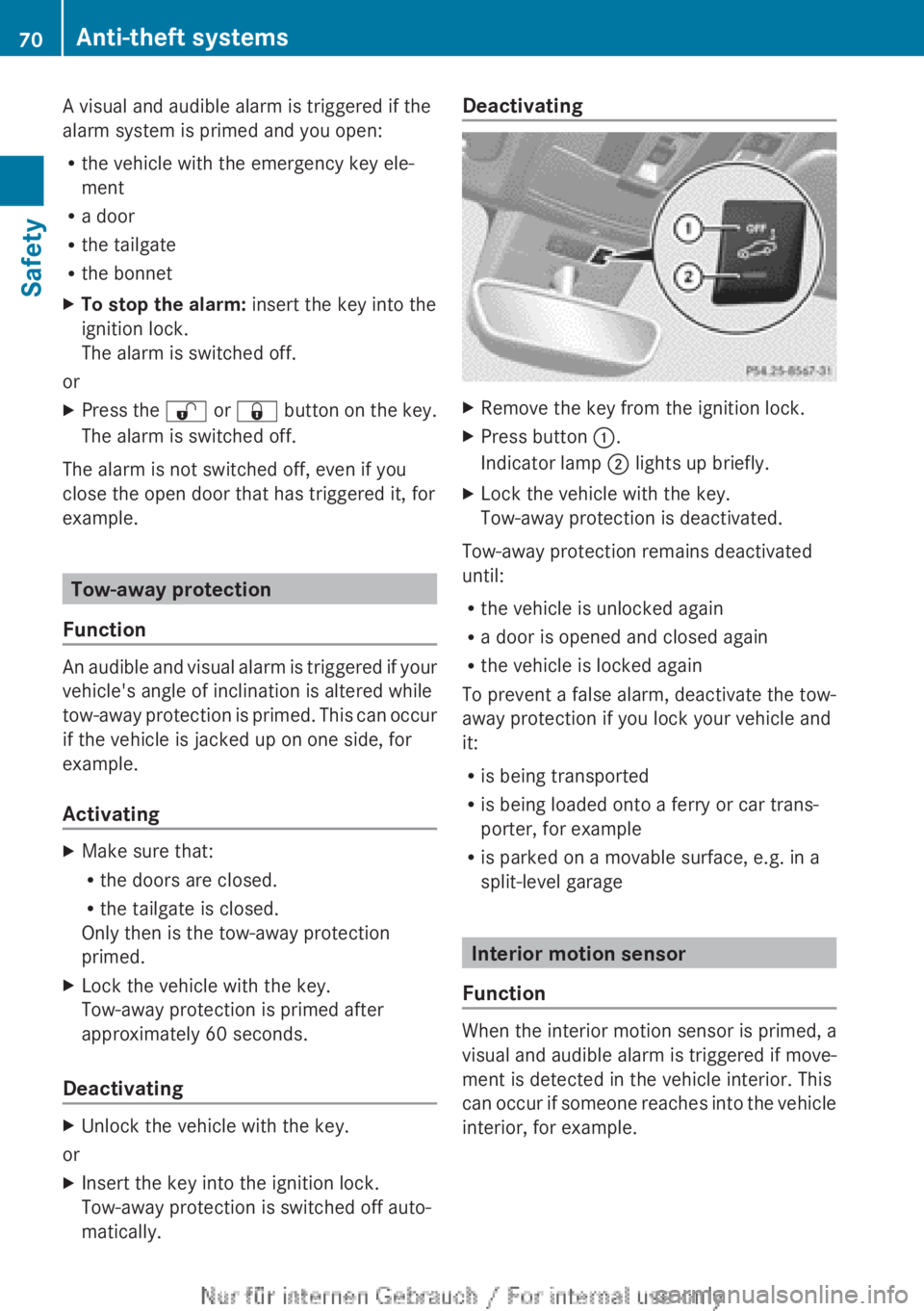
X
Remove the key from the ignition lock.
X Press button :.
Indicator lamp ; lights up briefly.
X Lock the vehicle with the key.
Tow-away protection is deactivated.
Tow-away protection remains deactivated
until:
R the vehicle is unlocked again
R a door is opened and closed again
R the vehicle is locked again
To prevent a false alarm, deactivate the tow-
away protection if you lock your vehicle and
it:
R is being transported
R is being loaded onto a ferry or car trans-
porter, for example
R is parked on a movable surface, e.g. in a
split-level garage Interior motion sensor
Function When the interior motion sensor is primed, a
visual
and audible alarm is triggered if move-
ment is detected in the vehicle interior. This
can occur if someone reaches into the vehicle
interior, for example. 70
Anti-theft systems
Safety
Page 83 of 356
You can only open the rear doors from inside
the vehicle if they are not secured by the
child-proof locks (Y page 60).
If
the vehicle has been locked using the lock-
ing button for the central locking, or has been
locked automatically, and a door is opened
from the inside:
R the vehicle will be fully unlocked if it had
previously been fully unlocked
R only the door which has been opened form
the inside is unlocked if only the driver's
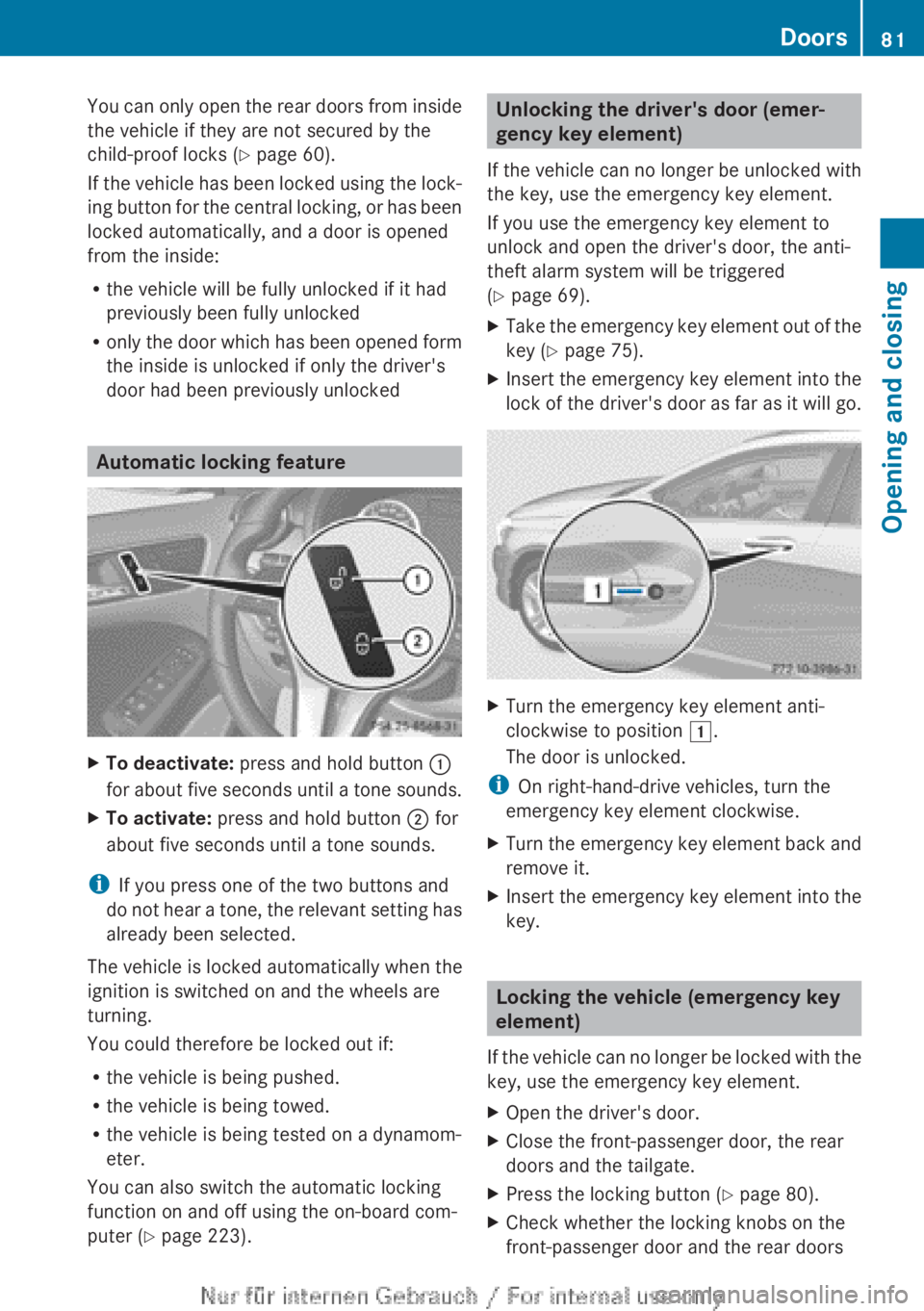
door had been previously unlocked Automatic locking feature
X
To deactivate: press and hold button :
for
about five seconds until a tone sounds.
X To activate: press and hold button ; for
about five seconds until a tone sounds.
i If you press one of the two buttons and
do
not hear a tone, the relevant setting has
already been selected.
The vehicle is locked automatically when the
ignition is switched on and the wheels are
turning.
You could therefore be locked out if:
R the vehicle is being pushed.
R the vehicle is being towed.
R the vehicle is being tested on a dynamom-
eter.
You can also switch the automatic locking
function on and off using the on-board com-
puter ( Y page 223). Unlocking the driver's door (emer-
gency key element)
If
the vehicle can no longer be unlocked with
the key, use the emergency key element.
If you use the emergency key element to
unlock and open the driver's door, the anti-
theft alarm system will be triggered
(Y page 69).
X Take the emergency key element out of the
key ( Y page 75).
X Insert the emergency key element into the
lock
of the driver's door as far as it will go. X
Turn the emergency key element anti-
clockwise to position 1.
The door is unlocked.
i On right-hand-drive vehicles, turn the
emergency key element clockwise.
X Turn the emergency key element back and
remove it.
X Insert the emergency key element into the
key. Locking the vehicle (emergency key
element)
If
the vehicle can no longer be locked with the
key, use the emergency key element.
X Open the driver's door.
X Close the front-passenger door, the rear
doors and the tailgate.
X Press the locking button (Y page 80).
X Check whether the locking knobs on the
front-passenger door and the rear doors Doors
81
Opening and closing Z