belt MERCEDES-BENZ A CLASS 2012 Owners Manual
[x] Cancel search | Manufacturer: MERCEDES-BENZ, Model Year: 2012, Model line: A CLASS, Model: MERCEDES-BENZ A CLASS 2012Pages: 356, PDF Size: 4.96 MB
Page 7 of 356
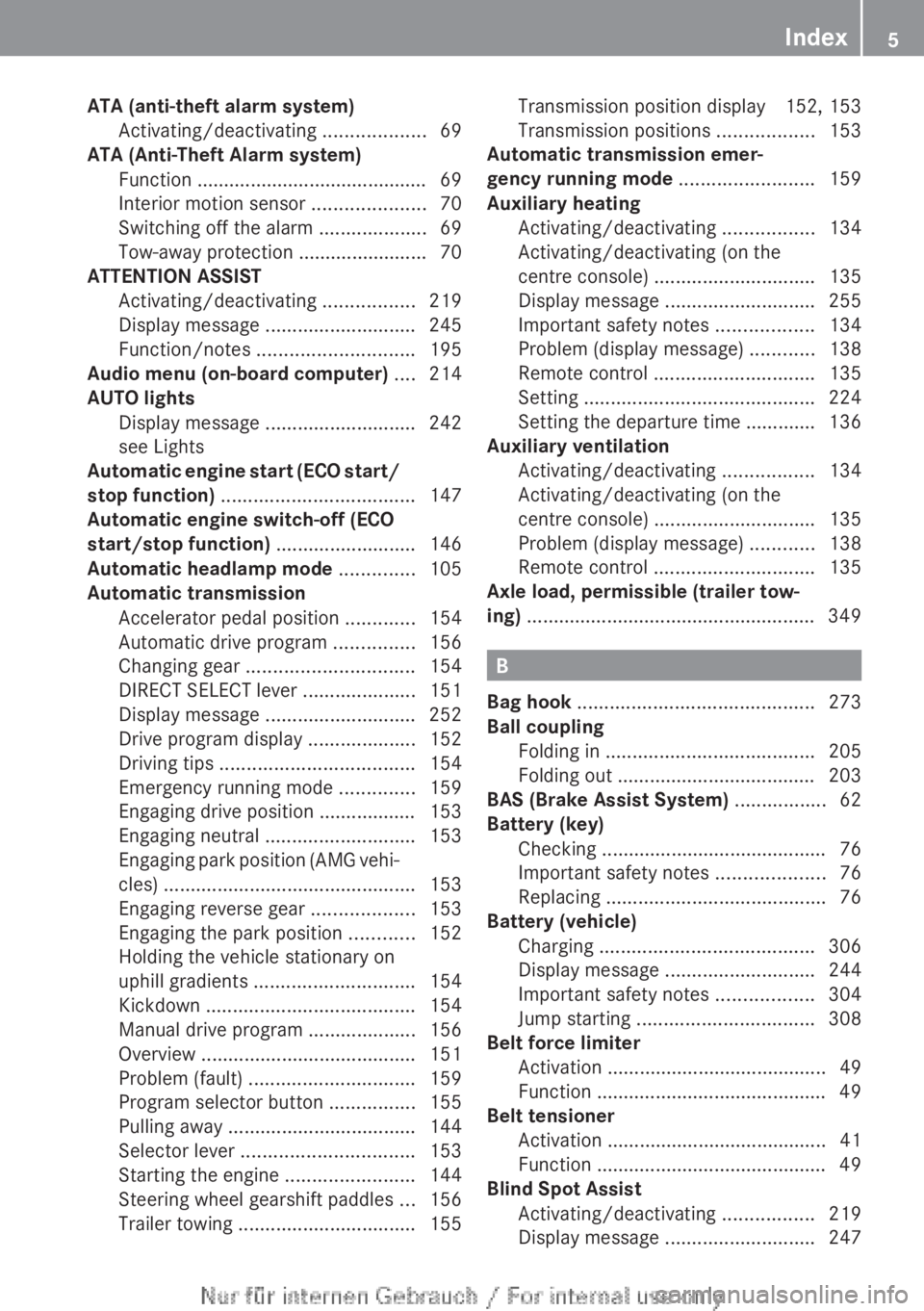
ATA (anti-theft alarm system)
Activating/deactivating ...................69
ATA (Anti-Theft Alarm system)
Function ........................................... 69
Interior motion sensor .....................70
Switching off the alarm .................... 69
Tow-away protection ........................ 70
ATTENTION ASSIST
Activating/deactivating ................. 219
Display message ............................ 245
Function/notes ............................. 195
Audio menu (on-board computer) .... 214
AUTO lights Display message ............................ 242
see Lights
Automatic engine start (ECO start/
stop function) .................................... 147
Automatic engine switch-off (ECO
start/stop function) .......................... 146
Automatic headlamp mode ..............105
Automatic transmission Accelerator pedal position .............154
Automatic drive program ............... 156
Changing gear ............................... 154
DIRECT SELECT lever .....................151
Display message ............................ 252
Drive program display ....................152
Driving tips .................................... 154
Emergency running mode ..............159
Engaging drive position .................. 153
Engaging neutral ............................ 153
Engaging park position (AMG vehi-
cles) ............................................... 153
Engaging reverse gear ................... 153
Engaging the park position ............ 152
Holding the vehicle stationary on
uphill gradients .............................. 154
Kickdown ....................................... 154
Manual drive program ....................156
Overview ........................................ 151
Problem (fault) ............................... 159
Program selector button ................155
Pulling away ................................... 144
Selector lever ................................ 153
Starting the engine ........................ 144
Steering wheel gearshift paddles ...156
Trailer towing ................................. 155Transmission position display 152, 153
Transmission positions ..................
153
Automatic transmission emer-
gency running mode .........................159
Auxiliary heating Activating/deactivating
.................134
Activating/deactivating (on the
centre console) .............................. 135
Display message ............................ 255
Important safety notes .................. 134
Problem (display message) ............138
Remote control .............................. 135
Setting ........................................... 224
Setting the departure time ............. 136
Auxiliary ventilation
Activating/deactivating ................. 134
Activating/deactivating (on the
centre console) .............................. 135
Problem (display message) ............138
Remote control .............................. 135
Axle load, permissible (trailer tow-
ing) ...................................................... 349 B
Bag hook ............................................ 273
Ball coupling Folding in ....................................... 205
Folding out .....................................
203
BAS (Brake Assist System) ................. 62
Battery (key) Checking .......................................... 76
Important safety notes .................... 76
Replacing ......................................... 76
Battery (vehicle)
Charging ........................................ 306
Display message ............................ 244
Important safety notes .................. 304
Jump starting ................................. 308
Belt force limiter
Activation ......................................... 49
Function ........................................... 49
Belt tensioner
Activation ......................................... 41
Function ........................................... 49
Blind Spot Assist
Activating/deactivating ................. 219
Display message ............................ 247 Index
5
Page 8 of 356
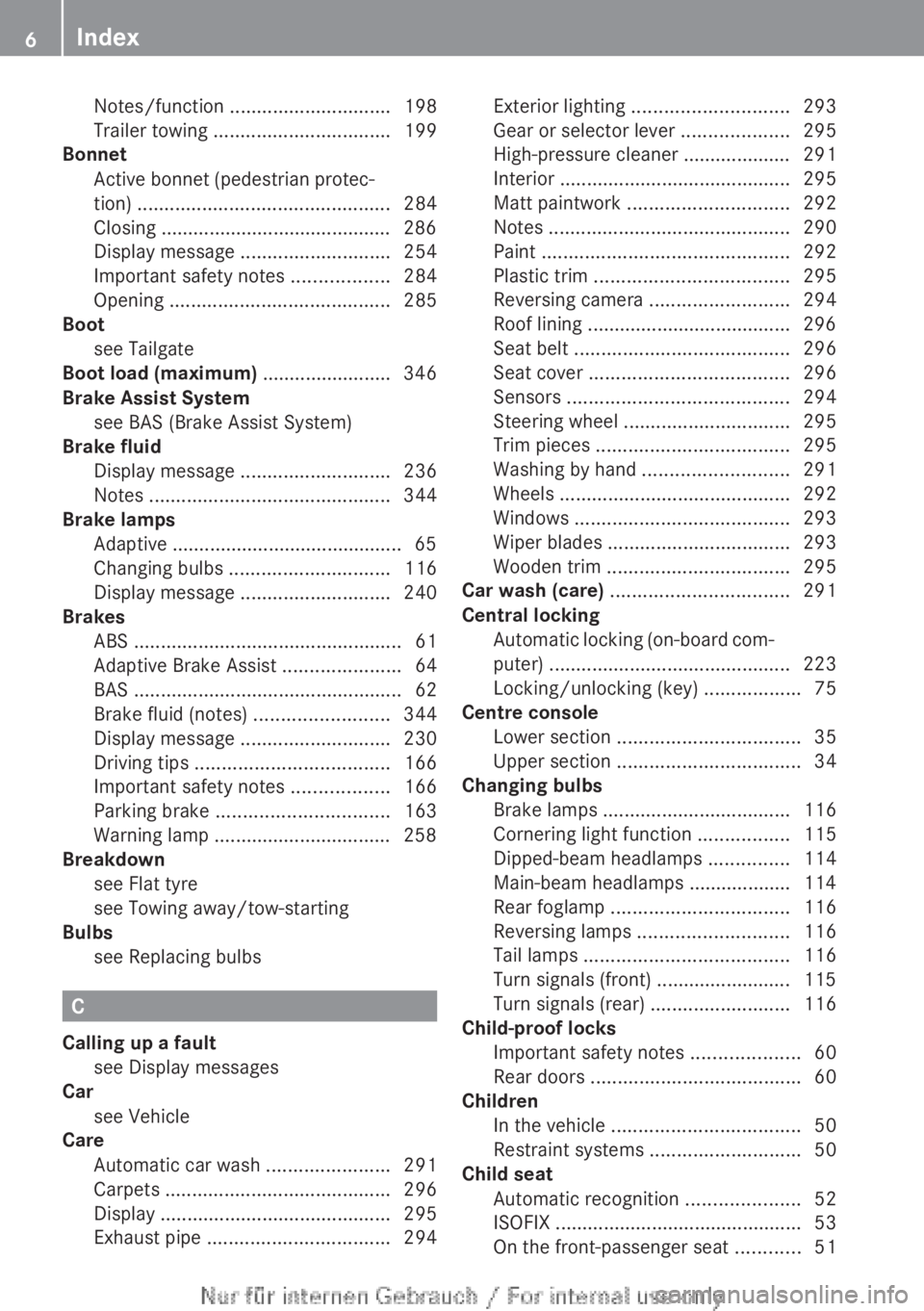
Notes/function
.............................. 198
Trailer towing ................................. 199
Bonnet
Active
bonnet (pedestrian protec-
tion) ............................................... 284
Closing ........................................... 286
Display message ............................ 254
Important safety notes .................. 284
Opening ......................................... 285
Boot
see Tailgate
Boot load (maximum) ........................ 346
Brake Assist System see BAS (Brake Assist System)
Brake fluid
Display message ............................ 236
Notes ............................................. 344
Brake lamps
Adaptive ........................................... 65
Changing bulbs .............................. 116
Display message ............................ 240
Brakes
ABS .................................................. 61
Adaptive Brake Assist ......................64
BAS .................................................. 62
Brake fluid (notes) .........................344
Display message ............................ 230
Driving tips .................................... 166
Important safety notes .................. 166
Parking brake ................................ 163
Warning lamp ................................. 258
Breakdown
see Flat tyre
see Towing away/tow-starting
Bulbs
see Replacing bulbs C
Calling up a fault see Display messages
Car
see Vehicle
Care
Automatic car wash ....................... 291
Carpets .......................................... 296
Display ........................................... 295
Exhaust pipe .................................. 294Exterior lighting
............................. 293
Gear or selector lever ....................295
High-pressure cleaner ....................
291
Interior ........................................... 295
Matt paintwork .............................. 292
Notes ............................................. 290
Paint .............................................. 292
Plastic trim .................................... 295
Reversing camera ..........................294
Roof lining ...................................... 296
Seat belt ........................................ 296
Seat cover ..................................... 296
Sensors ......................................... 294
Steering wheel ............................... 295
Trim pieces .................................... 295
Washing by hand ........................... 291
Wheels ........................................... 292
Windows ........................................ 293
Wiper blades .................................. 293
Wooden trim .................................. 295
Car wash (care) ................................. 291
Central locking Automatic locking (on-board com-
puter) ............................................. 223
Locking/unlocking (key) ..................75
Centre console
Lower section .................................. 35
Upper section .................................. 34
Changing bulbs
Brake lamps ................................... 116
Cornering light function .................115
Dipped-beam headlamps ............... 114
Main-beam headlamps ................... 114
Rear foglamp ................................. 116
Reversing lamps ............................ 116
Tail lamps ...................................... 116
Turn signals (front) ......................... 115
Turn signals (rear) .......................... 116
Child-proof locks
Important safety notes .................... 60
Rear doors ....................................... 60
Children
In the vehicle ................................... 50
Restraint systems ............................ 50
Child seat
Automatic recognition ..................... 52
ISOFIX .............................................. 53
On the front-passenger seat ............516
Index
Page 17 of 356
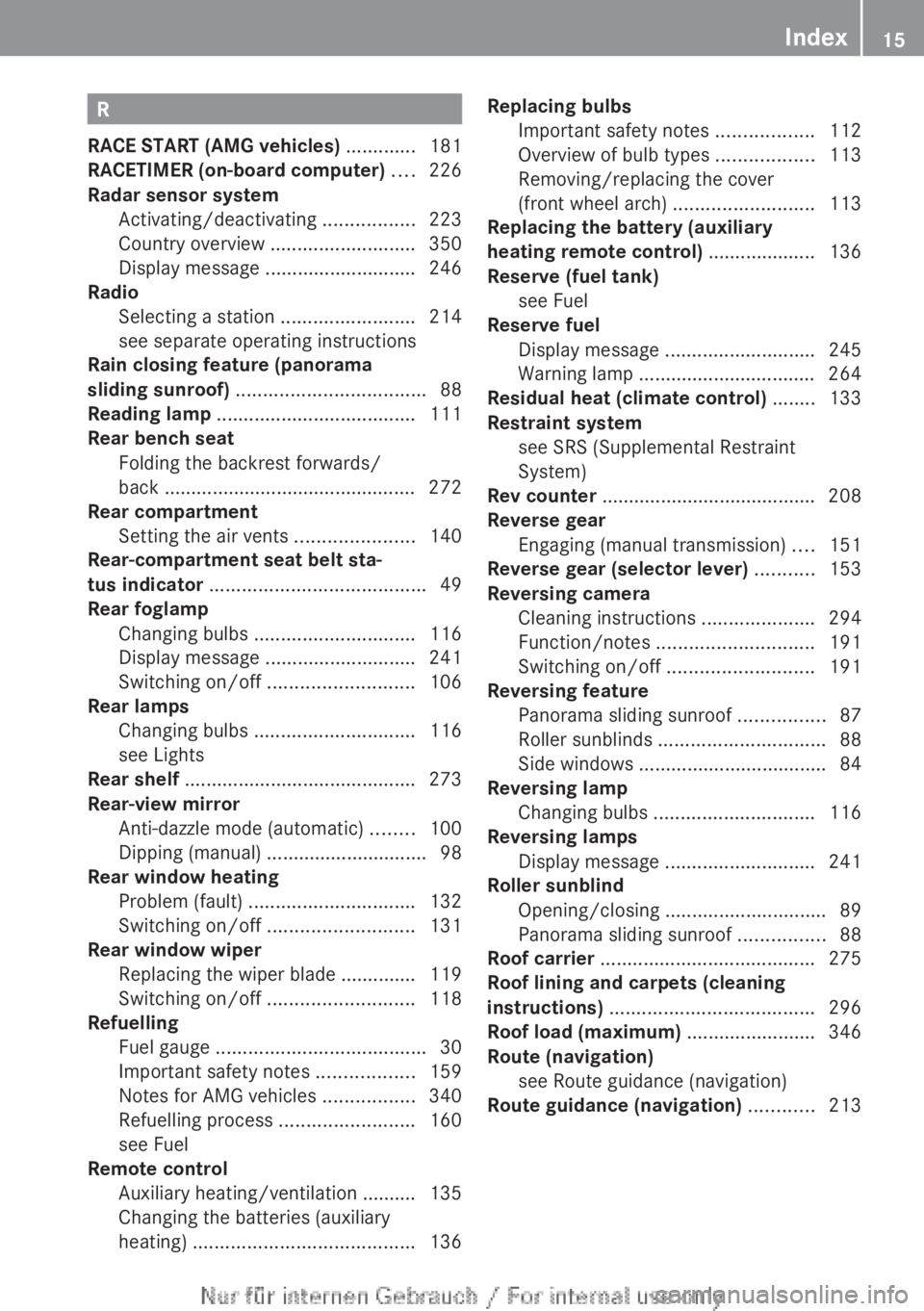
R
RACE START (AMG vehicles) .............181
RACETIMER (on-board computer) .... 226
Radar sensor system Activating/deactivating
.................223
Country overview ........................... 350
Display message ............................ 246
Radio
Selecting a station .........................214
see separate operating instructions
Rain closing feature (panorama
sliding sunroof) ................................... 88
Reading lamp ..................................... 111
Rear bench seat Folding the backrest forwards/
back ............................................... 272
Rear compartment
Setting the air vents ......................140
Rear-compartment seat belt sta-
tus indicator ........................................ 49
Rear foglamp Changing bulbs .............................. 116
Display message ............................ 241
Switching on/off ........................... 106
Rear lamps
Changing bulbs .............................. 116
see Lights
Rear shelf ........................................... 273
Rear-view mirror Anti-dazzle mode (automatic) ........ 100
Dipping (manual) .............................. 98
Rear window heating
Problem (fault) ............................... 132
Switching on/off ........................... 131
Rear window wiper
Replacing the wiper blade .............. 119
Switching on/off ........................... 118
Refuelling
Fuel gauge ....................................... 30
Important safety notes .................. 159
Notes for AMG vehicles ................. 340
Refuelling process .........................160
see Fuel
Remote control
Auxiliary heating/ventilation .......... 135
Changing the batteries (auxiliary
heating) ......................................... 136Replacing bulbs
Important safety notes ..................112
Overview of bulb types ..................113
Removing/replacing the cover
(front wheel arch) .......................... 113
Replacing the battery (auxiliary
heating remote control) .................... 136
Reserve (fuel tank) see Fuel
Reserve fuel
Display message ............................ 245
Warning lamp ................................. 264
Residual heat (climate control) ........133
Restraint system see SRS (Supplemental Restraint
System)
Rev counter ........................................ 208
Reverse gear
Engaging (manual transmission) ....151
Reverse gear (selector lever) ...........153
Reversing camera Cleaning instructions ..................... 294
Function/notes ............................. 191
Switching on/off ........................... 191
Reversing feature
Panorama sliding sunroof ................ 87
Roller sunblinds ............................... 88
Side windows ................................... 84
Reversing lamp
Changing bulbs .............................. 116
Reversing lamps
Display message ............................ 241
Roller sunblind
Opening/closing .............................. 89
Panorama sliding sunroof ................ 88
Roof carrier ........................................ 275
Roof lining and carpets (cleaning
instructions) ...................................... 296
Roof load (maximum) ........................346
Route (navigation) see Route guidance (navigation)
Route guidance (navigation) ............213 Index
15
Page 18 of 356
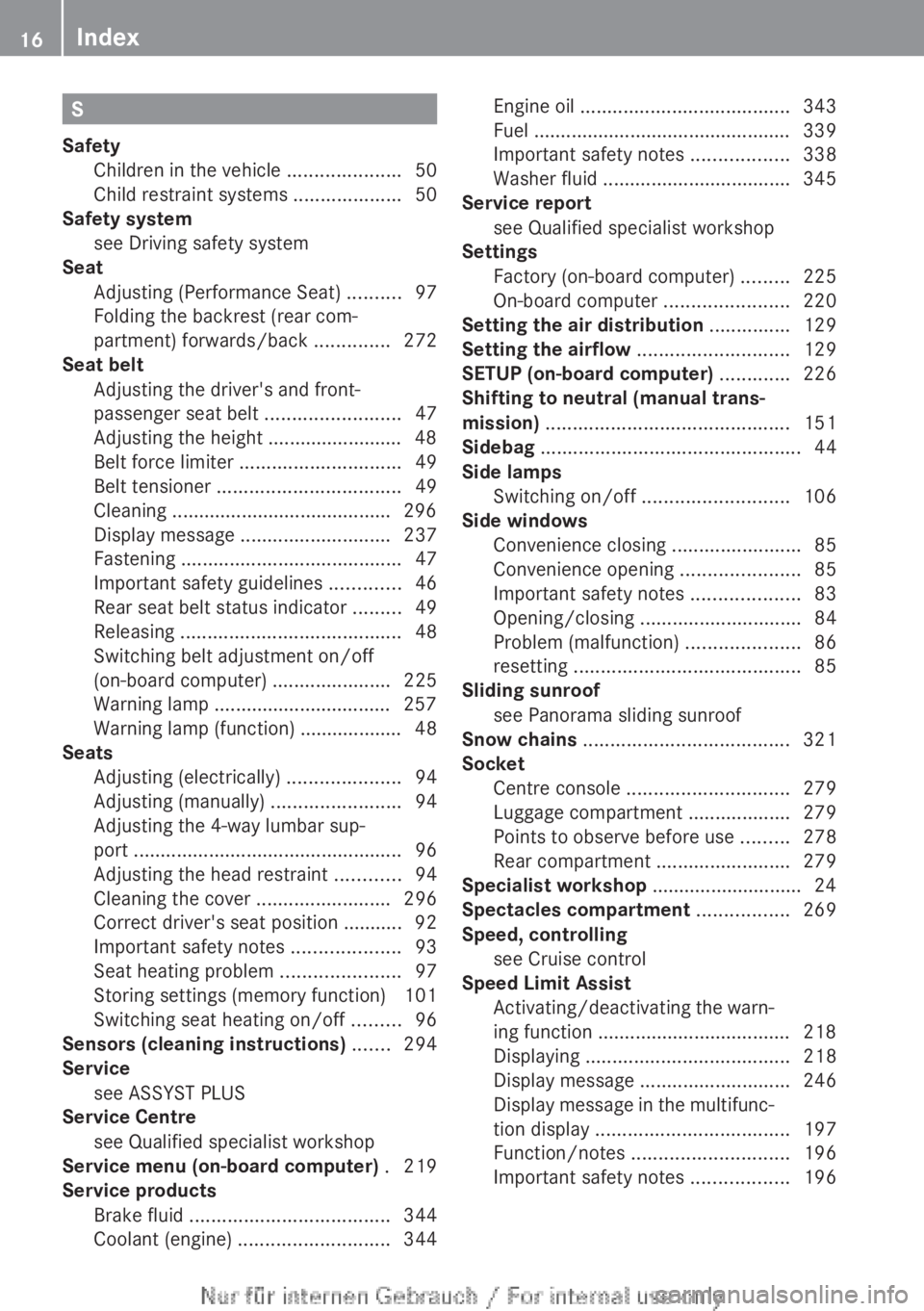
S
Safety Children in the vehicle .....................50
Child restraint systems ....................50
Safety system
see Driving safety system
Seat
Adjusting (Performance Seat) ..........97
Folding the backrest (rear com-
partment) forwards/back ..............272
Seat belt
Adjusting the driver's and front-
passenger seat belt .........................47
Adjusting the height ......................... 48
Belt force limiter .............................. 49
Belt tensioner .................................. 49
Cleaning ......................................... 296
Display message ............................ 237
Fastening ......................................... 47
Important safety guidelines .............46
Rear seat belt status indicator ......... 49
Releasing ......................................... 48
Switching belt adjustment on/off
(on-board computer) ...................... 225
Warning lamp ................................. 257
Warning lamp (function) ................... 48
Seats
Adjusting (electrically) .....................94
Adjusting (manually) ........................94
Adjusting the 4-way lumbar sup-
port .................................................. 96
Adjusting the head restraint ............ 94
Cleaning the cover ......................... 296
Correct driver's seat position ........... 92
Important safety notes .................... 93
Seat heating problem ...................... 97
Storing settings (memory function) 101
Switching seat heating on/off ......... 96
Sensors (cleaning instructions) .......294
Service see ASSYST PLUS
Service Centre
see Qualified specialist workshop
Service menu (on-board computer) . 219
Service products Brake fluid ..................................... 344
Coolant (engine) ............................ 344Engine oil .......................................
343
Fuel ................................................ 339
Important safety notes .................. 338
Washer fluid ................................... 345
Service report
see Qualified specialist workshop
Settings
Factory (on-board computer) ......... 225
On-board computer ....................... 220
Setting the air distribution ...............129
Setting the airflow ............................ 129
SETUP (on-board computer) ............. 226
Shifting to neutral (manual trans-
mission) ............................................. 151
Sidebag ................................................ 44
Side lamps Switching on/off ........................... 106
Side windows
Convenience closing ........................ 85
Convenience opening ...................... 85
Important safety notes .................... 83
Opening/closing .............................. 84
Problem (malfunction) .....................86
resetting .......................................... 85
Sliding sunroof
see Panorama sliding sunroof
Snow chains ...................................... 321
Socket Centre console .............................. 279
Luggage compartment ................... 279
Points to observe before use ......... 278
Rear compartment ......................... 279
Specialist workshop ............................ 24
Spectacles compartment .................269
Speed, controlling see Cruise control
Speed Limit Assist
Activating/deactivating the warn-
ing function .................................... 218
Displaying ...................................... 218
Display message ............................ 246
Display message in the multifunc-
tion display .................................... 197
Function/notes ............................. 196
Important safety notes .................. 19616
Index
Page 21 of 356
Tyre size (data)
.............................. 329
Tyre tread ...................................... 319
see Flat tyre
U
Unladen weight ................................. 346
Unlocking Emergency unlocking .......................81
From inside the vehicle (central
unlocking button) ............................. 80V
Vanity mirror (in sun visor) .............. 277
Variable SPEEDTRONIC see SPEEDTRONIC
Vehicle
Correct use ...................................... 24
Data acquisition ............................... 25
Electronics ..................................... 336
Equipment ....................................... 22
Implied warranty .............................. 24
Individual settings ..........................220
Leaving parked up ......................... 164
Locking (in an emergency) ............... 81
Locking (key) ................................... 75
Lowering ........................................ 329
Pulling away ................................... 144
Raising ........................................... 326
Registration ..................................... 24
Securing from rolling away ............325
Towing away .................................. 310
Tow-starting ................................... 310
Transporting .................................. 313
Unlocking (in an emergency) ........... 81
Unlocking (key) ................................ 75
Vehicle data ................................... 346
Vehicle data ....................................... 346
Vehicle dimensions ...........................346
Vehicle emergency locking ................81
Vehicle identification number see VIN
Vehicle identification plate ..............338
Vehicle maintenance see ASSYST PLUS
Vehicle tool kit .................................. 299
Vehicle weights ................................. 346Video (DVD)
........................................
215
Video DVD (on-board computer) ......215
VIN ...................................................... 338 W
Warning and indicator lamps ABS
................................................ 258
Brakes ........................................... 258
Distance warning signal ................. 266
ESP ®
.............................................. 260
ESP ®
OFF ....................................... 261
Fuel tank ........................................ 264
LIM (cruise control) ........................ 169
LIM (DISTRONIC PLUS) .................. 174
LIM (variable SPEEDTRONIC) ......... 171
Overview .......................................... 32
PASSENGER AIRBAG OFF ................ 52
Reserve fuel ................................... 264
Seat belt ........................................ 257
SRS ................................................ 263
Warning triangle ................................ 298
Washer fluid
Display message ............................ 256
Wheel bolt tightening torque ...........329
Wheel chock ...................................... 325
Wheels Changing/replacing .......................324
Changing a wheel .......................... 324
Checking ........................................ 319
Cleaning ......................................... 292
Cleaning (warning) .........................324
Emergency spare wheel ................. 332
Fitting a new wheel ........................328
Fitting a wheel ............................... 325
Important safety notes .................. 318
Removing a wheel ..........................328
Storing ........................................... 324
Tightening torque ........................... 329
Wheel size/tyre size ......................329
Windowbag
Display message ............................ 239
Operation ......................................... 45
Windows
Cleaning ......................................... 293
see Side windows
Windscreen
Demisting ...................................... 130 Index
19
Page 23 of 356
Protection of the environment
General notes
H
Environmental note
Daimler's declared policy is one of compre-
hensive environmental protection.
Our objectives are to use the natural resour-
ces which form the basis of our existence on
this planet sparingly and in a manner which
takes the requirements of both nature and
humanity into consideration.
You too can help to protect the environment
by operating your vehicle in an environmen-
tally-responsible manner.
Fuel consumption and the rate of engine,
transmission,
brake and tyre wear depend on
the following factors:
R operating conditions of your vehicle
R your personal driving style
You can influence both factors. Therefore,
please bear the following in mind:
Operating conditions:
R avoid short trips, as these increase fuel
consumption.
R observe the correct tyre pressure.
R do not carry any unnecessary weight in the
vehicle.
R remove the roof rack once you no longer
need it.
R a regularly serviced vehicle will contribute
to environmental protection. You should
therefore adhere to the service intervals.
R all maintenance work should be carried out
at a qualified specialist workshop.
Personal driving style:
R do not depress the accelerator pedal when
starting the engine.
R do not warm up the engine when the vehicle
is stationary.
R drive carefully and maintain a safe distance
from the vehicle in front.
R avoid frequent, sudden acceleration and
braking. R
change
gear in good time and use each gear
only up to Ô of its maximum engine speed.
R switch off the engine in stationary traffic.
R monitor the vehicle's fuel consumption. Returning an end-of-life vehicle
EU countries only:
Mercedes-Benz
will take back your old vehicle
to dispose of it in an environmentally-respon-
sible manner in accordance with the Euro-
pean Union (EU) End of Life Vehicles Direc-
tive.
There is a network of return points and dis-
assembly plants available. You can return
your vehicle to these plants free of charge.
This makes a valuable contribution to the
recycling process and the conservation of
resources.
For further information on recycling old vehi-
cles, recovery and the terms of the policy,
visit the Mercedes-Benz homepage. Genuine Mercedes-Benz parts
H
Environmental note
Daimler AG also supplies reconditioned
assemblies and parts which are of the same
quality
as new parts. For these, the same war-
ranty applies as for new parts.
! Airbags and seat belt tensioners, as well
as control units and sensors for these
restraint systems, may be installed in the
following areas of your vehicle:
R doors
R door pillars
R door sills
R seats
R dashboard
R instrument cluster
R centre console Introduction
21 Z
Page 34 of 356
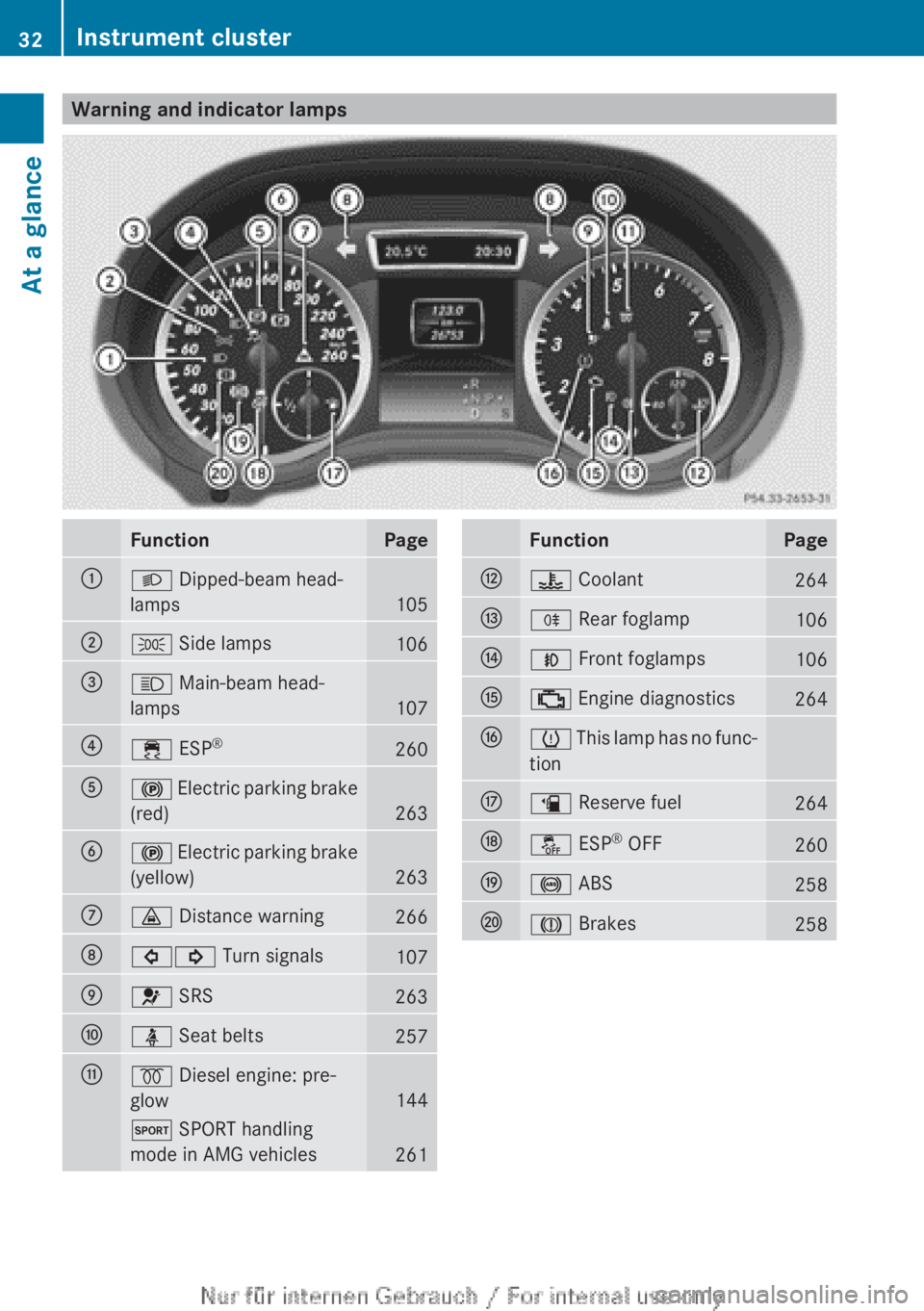
Warning and indicator lamps
Function Page
:
L Dipped-beam head-
lamps
105
;
T Side lamps
106
=
K Main-beam head-
lamps
107
?
÷ ESP
® 260
A
! Electric parking brake
(red)
263
B
!
Electric parking brake
(yellow)
263
C
· Distance warning
266
D
#! Turn signals
107
E
6 SRS
263
F
ü Seat belts
257
G
% Diesel engine: pre-
glow
144
M SPORT handling
mode in AMG vehicles
261 Function Page
H
? Coolant
264
I
R Rear foglamp
106
J
N Front foglamps
106
K
; Engine diagnostics
264
L
h
This lamp has no func-
tion
M
æ Reserve fuel
264
N
å ESP
®
OFF 260
O
! ABS
258
P
J Brakes
25832
Instrument cluster
At a glance
Page 42 of 356
Useful information
i This Owner's Manual describes all mod-
els,
series and optional equipment for your
vehicle that were available at the time of
going to press. National variations are pos-
sible. Note that your vehicle may not be
equipped with all of the functions descri-
bed. This is also the case for systems and
functions relevant to safety.
i Read the information on qualified special-
ist workshops: (Y page 24). Occupant safety
Important safety notes
G
WARNING
If service work is not carried out correctly, the
operating
safety of your vehicle may be affec-
ted. This could cause you to lose control of
your vehicle and cause an accident. More-
over, the safety systems may no longer be
able to protect you or others as they are
designed to do.
Always have service work carried out at a
qualified specialist workshop. G
WARNING
Modifications to or work performed incor-
rectly on the following parts can result in the
restraint
systems not functioning as intended:
R the restraint system, consisting of seat
belts and their anchorage points, belt ten-
sioners, belt force limiters and airbags
R the wiring
R networked electronic systems
Airbags and belt tensioners could fail to
deploy or be triggered in an accident despite
the deceleration force being sufficient to trig-
ger the systems, or could be triggered unin-
tentionally. For this reason, never make any
modifications to the restraint systems.
Therefore, you must not tamper with elec-
tronic components or their software. The seat belts, together with SRS (Supple-
mental Restraint System), are complemen-
tary, co-ordinated restraint systems
(Y page 41). They reduce the risk of injury
in specific, pre-defined types of accident sit-
uations and thereby increase occupant
safety. However, seat belts and airbags gen-
erally do not protect against objects pene-
trating the vehicle from the outside.
To ensure that the restraint systems can
deliver their full potential protection, make
sure that:
R
the seat and head restraint are adjusted
properly
(Y page 92)
R the seat belt has been fastened properly
(Y page 46)
R the airbags can inflate unrestricted if
deployed ( Y page 42)
R the steering wheel is adjusted properly
(Y page 98)
R the restraint systems have not been modi-
fied
An airbag increases the protection of vehicle
occupants wearing a seat belt. However, air-
bags are only an additional restraint system
which complements, but does not replace,
the seat belt. All vehicle occupants must wear
their seat belt correctly at all times, even if
the vehicle is equipped with airbags. The air-
bags are not deployed in all types of acci-
dents. For example, if the protective capacity
of correctly fastened seat belts is not
increased by deploying the airbags, the air-
bags will not deploy.
Airbag deployment only provides increased
protection if the seat belt is worn correctly.
The seat belt helps, firstly, to keep the vehicle
occupant in the best position in relation to the
airbag. Secondly, in a head-on collision, for
example, the seat belt prevents the vehicle
occupant from being propelled towards the
point of impact. 40
Occupant safety
Safety
Page 43 of 356
SRS (Supplemental Restraint System)
Introduction Supplemental Restraint System (SRS) with:
R
The 6 SRS warning lamp
R Airbags
R Airbag control unit (with crash sensors)
R Belt
tensioners for the front seat belts and
the outer seat belts in the rear
R Seat belt force limiters for the front seat
belts and the outer seat belts in the rear
SRS reduces the risk of occupants coming
into contact with parts of the vehicle's interior
in the event of an accident. It can also reduce
the forces to which occupants are subjected
during an accident.
SRS warning lamp G
WARNING
If SRS is malfunctioning, individual systems
may
be triggered unintentionally or might not
be triggered in the event of an accident with
a high rate of vehicle deceleration.
A malfunction has occurred if:
R the 6 SRS warning lamp does not light
up when the ignition is switched on.
R the engine is running and the 6 SRS
warning lamp does not go out after a few
seconds.
R the engine is running and the 6 SRS
warning lamp lights up again.
In this case, have SRS checked immediately
at a qualified specialist workshop.
The 6 SRS warning lamp in the instrument
cluster lights up when the ignition is switched
on. It goes out no later than a few seconds
after the engine is started.
SRS functions are checked regularly when the
ignition is switched on or the engine is run-
ning. Therefore, malfunctions can be detec-
ted in good time. Triggering of belt tensioners and air-
bags During the first stage of a collision, the airbag
control unit evaluates important physical
data
relating to vehicle deceleration or accel-
eration, such as:
R duration
R direction
R magnitude
Based on the evaluation of this data, the air-
bag control unit pre-emptively triggers the
belt tensioners in the first stage.
If there is an even higher rate of vehicle decel-
eration or acceleration in a longitudinal direc-
tion, the front airbags are also deployed.
Your vehicle has adaptive, two-stage front air-
bags. The airbag control unit evaluates vehi-
cle deceleration or acceleration in the event
of a collision. In the first deployment stage,
the front airbag is filled with enough propel-
lant gas to reduce the risk of injuries. The
front airbag is fully deployed if a second
deployment threshold is reached within a few
milliseconds.
The belt tensioner and airbag triggering
thresholds are variable and are adapted to the
detected rate of deceleration or acceleration
of the vehicle. This process is pre-emptive in
nature. The triggering process must take
place in good time at the start of the collision.
The rate of vehicle deceleration or accelera-
tion and the direction of the force are essen-
tially determined by:
R the distribution of forces during the colli-
sion
R the collision angle
R the deformation characteristics of the vehi-
cle
R the characteristics of the object with which
the vehicle has collided
Factors which can only be seen and measured
after a collision has occurred do not play a
decisive role in the deployment of an airbag, Occupant safety
41
Safety Z
Page 44 of 356
nor do they provide an indication of airbag
deployment.
The vehicle may be deformed significantly,
e.g.
the bonnet or the wing, without an airbag
being deployed. This is the case if only parts
which are relatively easily deformed are affec-
ted and the rate of deceleration is not high.
Conversely, airbags may be deployed even
though the vehicle suffers only minor defor-
mation. This is the case if, for example, very
rigid vehicle parts such as longitudinal body
members are hit, and sufficient deceleration
occurs as a result.
i The front belt tensioners can only be trig-
gered if the seat belt tongues on the front
seats are correctly engaged in the seat belt
buckles.
i Not all airbags are deployed in an acci-
dent. The different airbag systems work
independently of each other.
How the airbag system works is deter-
mined by predicting the severity of the acci-
dent, especially vehicle deceleration or
acceleration, and the type of accident:
R head-on collision
R side impact
R overturn Airbags
Important safety notes G
WARNING
Airbags provide additional protection; they
are not, however, a substitute for seat belts.
Observe
the following notes to reduce the risk
of serious or even fatal injury caused by airbag
deployment:
R all vehicle occupants – in particular, preg-
nant women – must wear their seat belt
correctly at all times and lean back against
the backrest, which should be positioned
as close to the vertical as possible. The head restraint must support the back of the
head at about eye level.
R always secure children less than
1.50
m tall or under 12 years of age in suit-
able child restraint systems.
R all vehicle occupants must select a seat
position that is as far away from the airbag
as possible. The driver's seat position must
allow the vehicle to be driven safely. The
driver's chest should be as far away from
the centre of the driver's airbag cover as
possible.
R move the front-passenger seat as far back
as possible. This is especially important if
you have secured a child in a child restraint
system on the front-passenger seat.
R vehicle occupants – in particular, children
– must not lean their head into the area of
the window in which the sidebag/window-
bag is deployed.
R rearward-facing child restraint systems
must not be fitted to the front-passenger
seat unless the front-passenger airbag has
been disabled. On the front-passenger
seat, the front-passenger airbag is disabled
if a child restraint system with a trans-
ponder for automatic child seat recognition
is fitted to the front-passenger seat in a
vehicle equipped with automatic child seat
recognition. The 4 PASSENGER AIRBAG
OFF indicator lamp must be continuously
lit.
If the front-passenger seat of your vehicle
does not have automatic child seat recog-
nition, or your rearward-facing child
restraint system does not have a trans-
ponder for automatic child seat recogni-
tion, children must be secured in a child
restraint system on a suitable seat in the
rear. If you secure a forward-facing child
restraint system to the front-passenger
seat, you must move the front-passenger
seat as far back as possible.
R make sure there are no heavy or sharp-
edged objects in the pockets of clothing.42
Occupant safety
Safety