coolant MERCEDES-BENZ A-CLASS HATCHBACK 2008 User Guide
[x] Cancel search | Manufacturer: MERCEDES-BENZ, Model Year: 2008, Model line: A-CLASS HATCHBACK, Model: MERCEDES-BENZ A-CLASS HATCHBACK 2008Pages: 305, PDF Size: 5.43 MB
Page 217 of 305
Display
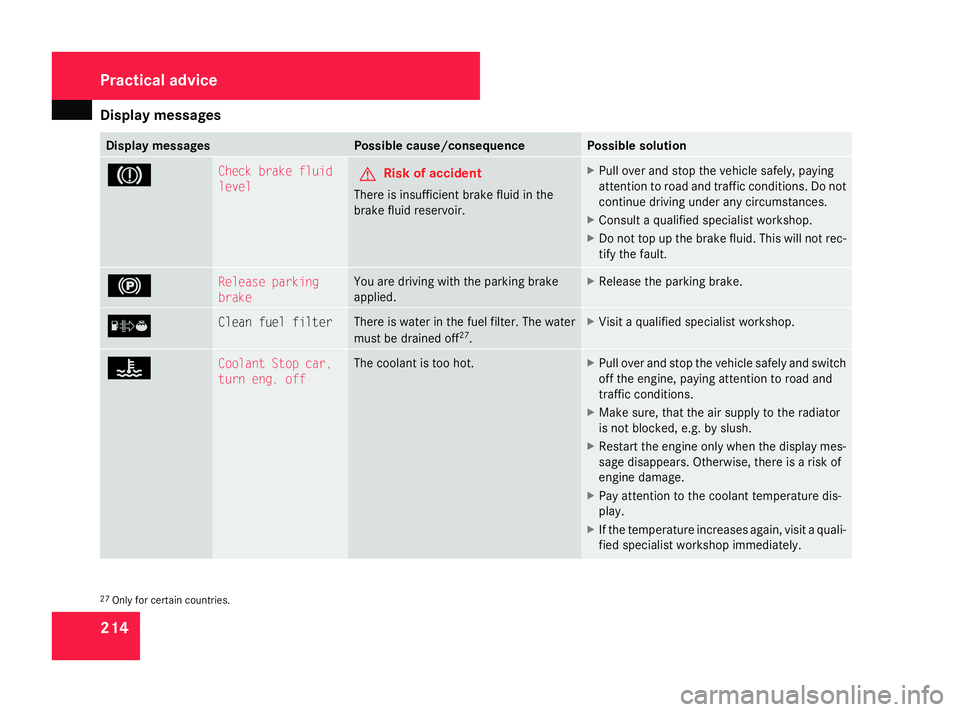
messages 214 Display messages Possible cause/consequence Possible solution
3 Check brake fluid
level
G
Risk of accident
There is insufficient brake fl uid in the
brake fluid reservoir. X
Pull over and stop the vehicle safely, paying
attention to road and traffic conditions. Do not
continue driving under any circumstances.
X Consult a qualified specialist workshop.
X Do not top up the brake fluid. This will not rec-
tify the fault. ! Release parking
brake You are driving with the parking brake
applied. X
Release the parking brake. [ Clean fuel filter There is water in the fuel filter. The water
must be drained off
27
. X
Visit a qualified specialist workshop. D Coolant Stop car,
turn eng. off The coolant is too hot. X
Pull over and stop the vehicle safely and switch
off the engine, paying attention to road and
traffic conditions.
X Make sure, that the air supply to the radiator
is not blocked, e.g. by slush.
X Restart the engine only when the display mes-
sage disappears. Otherwise, there is a risk of
engine damage.
X Pay attention to the coolant temperature dis-
play.
X If the temperature increases again, visit a quali-
fied specialist workshop immediately. 27
Only for certain countries. Practical advice
169_AKB; 2; 4, en-GB
wdomann
,V ersion: 2.10.6
2008-07-16T08:52:06+02:00 - Seite 214 Dateiname: 6515_0315_02_buchblock.pdf; preflight
Page 218 of 305
Display
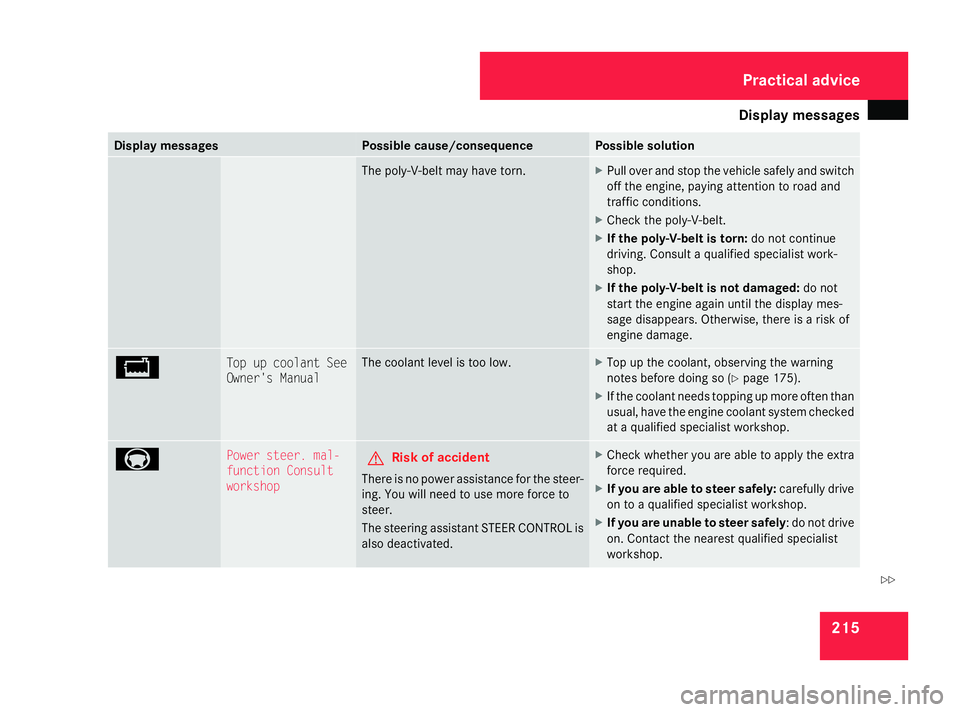
messages 215Display messages Possible cause/consequence Possible solution
The poly-V-belt ma
y have torn. X
Pull over and stop the vehicle safely and switch
off the engine, paying attention to road and
traffic conditions.
X Check the poly-V-belt.
X If the poly-V-belt is torn: do not continue
driving. Consult a qualified specialist work-
shop.
X If the poly-V-belt is not damaged: do not
start the engine again until the display mes-
sage disappears. Otherwise, there is a risk of
engine damage. B Top up coolant See
Owner's Manual The coolant level is too low. X
Top up the coolant, observing the warning
notes before doing so (Y page 175).
X If the coolant needs topping up more often than
usual, have the engine coolant system checked
at a qualified specialist workshop. 3 Power steer. mal-
function Consult
workshop G
Risk of accident
There is no power assistance for the steer-
ing. You will need to use more force to
steer.
The steering assistant STEER CONTROL is
also deactivated. X
Check whether you are able to apply the extra
force required.
X If you are able to steer safely: carefully drive
on to a qualified specialist workshop.
X If you are unable to steer safely : do not drive
on. Contact the nearest qualified specialist
workshop. Practical advice
169_AKB; 2; 4, en-GB
wdomann
,V ersion: 2.10.6
2008-07-16T08:52:06+02:00 - Seite 215 ZDateiname: 6515_0315_02_buchblock.pdf; preflight
Page 237 of 305
Troubleshooting
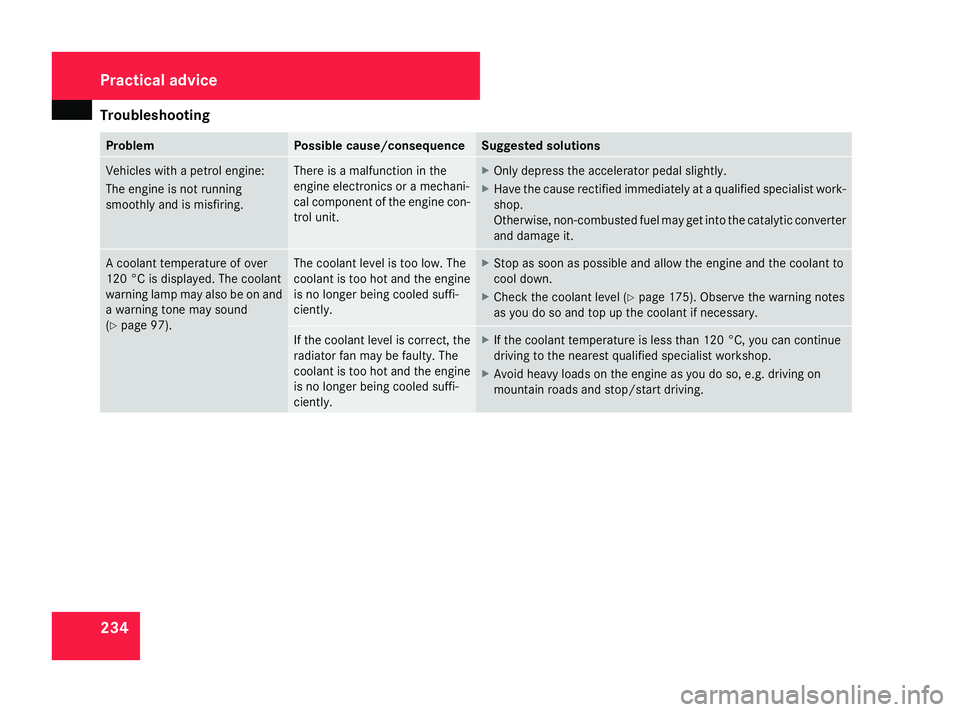
234 Problem Possible cause/consequence Suggested solutions
Vehicles with a petrol engine:
The engine is not running
smoothly and is misfiring. There is a malfunction in the
engine electronics or a mechani-
cal component of the engine con-
trol unit. X
Onl y depress the accelerator pedal slightly.
X Have the cause rectified immediately at a qualified specialist work-
shop.
Otherwise, non-combusted fuel may get into the catalytic converter
and damage it. A coolant temperature of over
120 °C is displayed. The coolant
warning lamp may also be on and
a warning tone may sound
(Y page 97). The coolant level is too low. The
coolant is too hot and the engine
is no longer being cooled suffi-
ciently. X
Stop as soon as possible and allow the engine and the coolant to
cool down.
X Check the coolant level (Y page 175). Observe the warning notes
as you do so and top up the coolant if necessary. If the coolant level is correct, the
radiator fan may be faulty. The
coolant is too hot and the engine
is no longer being cooled suffi-
ciently. X
If the coolant temperature is less than 120 °C, you can continue
driving to the nearest qualified specialist workshop.
X Avoid heavy loads on the engine as you do so, e.g. driving on
mountain roads and stop/start driving. Practical advice
169_AKB; 2; 4, en-GB
wdomann
,V ersion: 2.10.6
2008-07-16T08:52:06+02:00 - Seite 234 Dateiname: 6515_0315_02_buchblock.pdf; preflight
Page 295 of 305

Service products and capacities
292 Service products and capacities
Notes on service products and capaci-
ties
Service products are:
R fuels (e.g. petrol, diesel)
R lubricants (e.g. engine oil, transmission oil)
R coolant
R brake fluid
R windscreen washer fluid
Mercedes-Benz recommends that you only
use those products which have been tested
and specially approved by Mercedes-Benz for
your vehicle and are listed in the Mercedes-
Benz Owner's Manual in the relevant chapter
since:
R parts and service products are matched
R damage caused by the use of non-approved
service products is not covered by the war-
ranty
You can recognise service products approved
by Mercedes-Benz by the following inscrip-
tion on the containers:
R MB-Freigabe (e.g. MB-Freigabe 229.51)
R MB Approval (e.g. MB Approval 229.51) Other designations or recommendations that
relate to a level of quality or a specification in
accordance with an MB Approval have not
necessarily been approved by Mercedes-
Benz.
You can obtain further information from any
Mercedes-Benz Service Centre. G
Risk of injury
When handling, storing and disposing of
any service products, please observe the
relevant regulations, as you could other-
wise endanger yourself and others.
Keep service products away from children.
To protect your health, do not allow service
products to come into contact with your
eyes or open wounds. See a doctor imme-
diately if any service product is swallowed. H
Environmental note
Dispose of service products in an environ-
mentally-responsible manner. Fuels
G
Risk of explosion
Fuel is highly flammable. Fire, naked flames
and smoking are therefore prohibited when
handling fuels.
Before refuelling, always turn off the
engine. G
Risk of injury
Do not allow fuel to come into contact with
skin or clothing.
Allowing fuels to come into direct contact
with your skin or inhaling fuel vapours is
damaging to your health.
Tank capacity Total capacity 54 l
Of which reserve
fuel
Approximately 6 l
!
Do not use petrol to refuel vehicles with a
diesel engine. Do not use diesel to refuel
vehicles with a petrol engine. Never mix
diesel with petrol. Even small amounts of
the wrong fuel result in damage to the
injection system. Damage resulting from Technical data
169_AKB; 2; 4, en-GB
wdomann,
Version: 2.10.6
2008-07-16T08:52:06+02:00 - Seite 292 Dateiname: 6515_0315_02_buchblock.pdf; preflight
Page 300 of 305

Service products and capacities
297
!
Engine oils for vehicles without a diesel
particle filter may also be used temporarily in vehicles with a diesel particle filter if the
engine oil listed is not available. You must
then have an oil change carried out as soon
as possible.
Capacities The following values refer to an oil change including the oil filter.
Engine with oil filter A 150
A 150 BlueFFICIENCY A 170
A 170 BlueFFICIENCY A 200 A 200 TURBO
Replacement amount
5.0 l 5.0 l 5.0 l 5.0 l
Engine with oil filter A 160 CDI
A 160 CDI BlueFFICIENCY A 180 CDI A 200 CDI
Replacement amount
5.8 l 5.4 l 5.4 l
Coolant
The coolant is a mixture of water and anti-
freeze/corrosion inhibitor. It performs the
following tasks:
R anti-corrosion protection
R antifreeze protection
R raising the boiling point
i When the vehicle is first delivered, it is
topped up with a coolant that will ensure
adequate antifreeze and corrosion protec-
tion. !
Only top up with coolant that has been
premixed with the desired antifreeze pro-
tection. You could otherwise damage the
engine.
More information on coolant and refilling
can be found in the Mercedes-Benz Speci-
fications for Service Products, sheet no.
310.1 and is available from any Mercedes-
Benz Service Centre. !
Always use a suitable coolant mixture,
even in countries where high temperatures
prevail.
Otherwise, the cooling system will not be
sufficiently protected from corrosion, and
the boiling point will be too low.
If antifreeze/corrosion inhibitor is present in
the correct concentration, the boiling point of
the coolant will be around 130 °C.
The antifreeze/corrosion inhibitor concentra-
tion in the cooling system should: Technical data
169_AKB; 2; 4, en-GB
wdomann,
Version: 2.10.6
2008-07-16T08:52:06+02:00 - Seite 297 ZDateiname: 6515_0315_02_buchblock.pdf; preflight
Page 301 of 305

Service products and capacities
298
R
be at least 50%. This will protect the cooling
system against freezing down to around –
37 °C.
R not exceed 55% concentration (antifreeze
protection down to –45 °C); otherwise,
heat will not be effectively dissipated.
If the vehicle has lost coolant, top it up with
equal amounts of water and antifreeze/cor-
rosion inhibitor. Mercedes-Benz recom-
mends an antifreeze/corrosion inhibitor
which has been approved for Mercedes-Benz.
! The cooling system contains a filling
which must be renewed after 15 years, or
after 250, 000 km at the latest.
The warranty is only valid if you top up with
an antifreeze/corrosion inhibitor which
has been approved by Mercedes-Benz, and
observe the recommended mixing ratios. Technical data
169_AKB; 2; 4, en-GB
wdomann,
Version: 2.10.6
2008-07-16T08:52:06+02:00 - Seite 298 Dateiname: 6515_0315_02_buchblock.pdf; preflight
Page 302 of 305

Service products and capacities
299
Capacities The following values indicate the total cooling system capacities.
A 150
Manual trans- mission A 150
BlueEFFICIENCY A 150
AUTOTRONIC* A 170
Manual trans- mission A 170
BlueEFFICIENCY A 170
AUTOTRONIC* Coolant
6.3 l 6.3 l 6.5 l 6.3 l 6.3 l 6.6 l
Amount of antifreeze/corrosion inhibitor required for antifreeze protection
Down to –37 °C
(approx. 50%)
3.2 l 3.2 l 3.25 l 3.2 l 3.2 l 3.3 l
Down to –45 °C
(approx. 55%)
3.5 l 3.5 l 3.6 l 3.5 l 3.5 l 3.65 l
A 200 A 200
TURBO A 160 CDI
Manual transmission A 160 CDI
AUTOTRONIC* A 180 CDI A 200 CDI
Coolant
6.6 l 8.5 l 8.4 l 8.0 l 9.7 l
Amount of antifreeze/corrosion inhibitor required for antifreeze protection
Down to –37 °C
(approx. 50%)
3.3 l 4.25 l 4.2 l 4.0 l 4.85 l
Down to –45 °C
(approx. 55%)
3.65 l 4.7 l 4.6 l 4.4 l 5.35 lTechnical data
* optional
169_AKB; 2; 4, en-GB
wdomann,
Version: 2.10.6
2008-07-16T08:52:06+02:00 - Seite 299 ZDateiname: 6515_0315_02_buchblock.pdf; preflight